
Billions of dollars are locked inside smart contracts right now. And a significant portion of that value sits inside code that has never been tested under real threat conditions.
Smart contract security has become one of the most critical disciplines in the blockchain industry. Yet, for many development teams, it remains poorly understood, often reduced to a single audit report and a launch announcement. The reality is far more complex, and far more consequential.
This guide breaks down what smart contract security actually means in 2026, why the threat landscape has shifted, and what a comprehensive approach to protecting on-chain code looks like today.
Why Smart Contract Security Matters More Than Ever in 2026
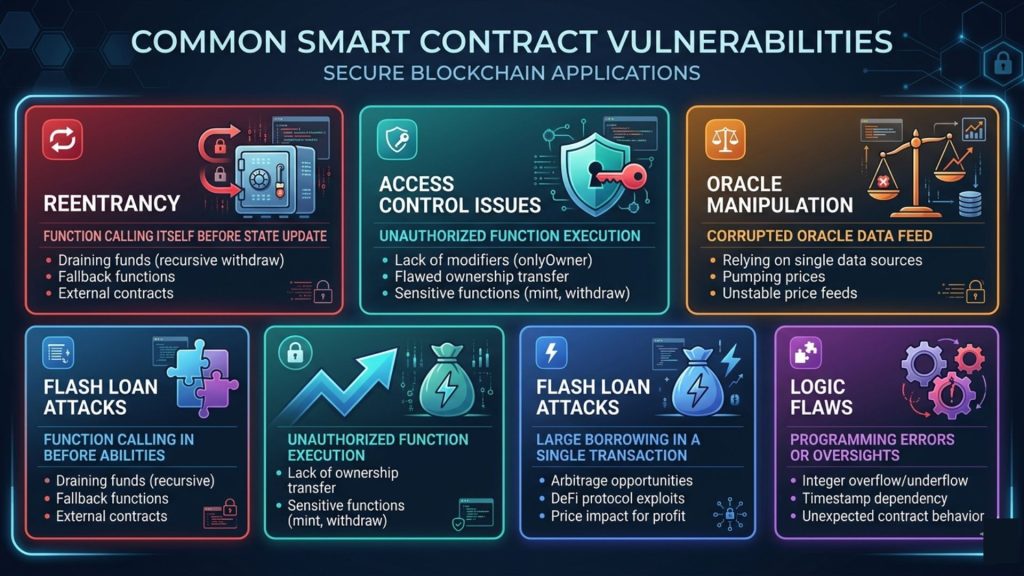
The numbers tell a sobering story. Over the past few years, decentralized finance protocols alone have lost billions of dollars to smart contract exploits. Flash loan attacks, reentrancy vulnerabilities, oracle manipulation, and logic flaws have collectively cost the industry more than almost any other category of cyber threat.
What makes this particularly challenging is the nature of blockchain itself. Smart contracts are immutable once deployed. There is no patch button. There is no rollback. When an exploit happens, the response window is often measured in seconds.
Moreover, the sophistication of attacks has increased substantially. In 2026, threat actors are no longer just hobbyist researchers probing for simple bugs. Organized groups with deep technical expertise now specifically hunt for weaknesses in DeFi protocols, cross-chain bridges, and tokenized asset platforms.
For CTOs, CISOs, and Web3 founders, this creates an uncomfortable reality: a smart contract that worked perfectly during testing can become a liability the moment it interacts with adversarial conditions on a live network.
What Is Smart Contract Security?
At its core, smart contract security refers to the set of practices, tools, and processes used to identify, prevent, and mitigate vulnerabilities in blockchain-based smart contracts throughout their entire lifecycle.
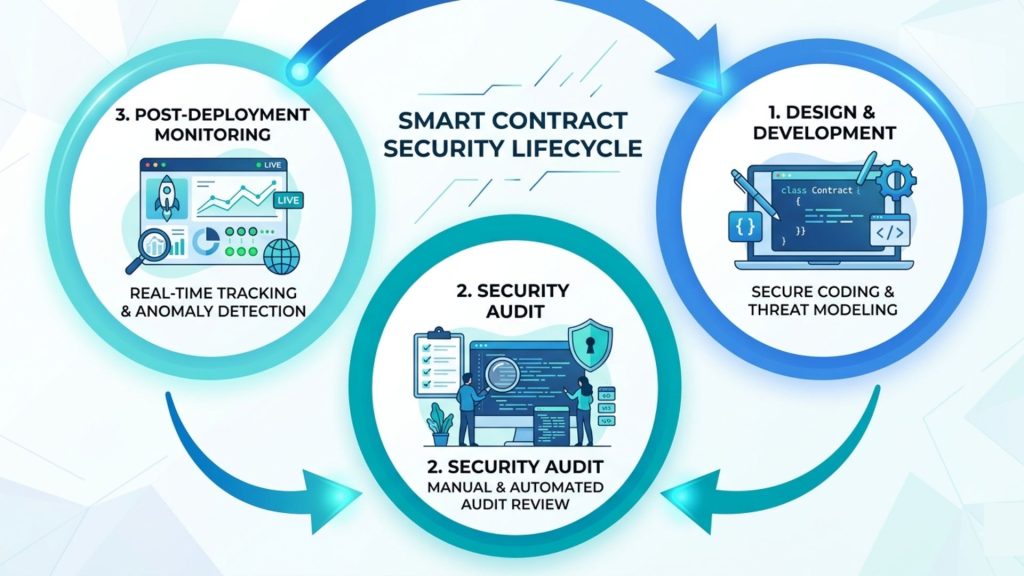
Notice the phrase “entire lifecycle.” This is where many teams go wrong. They think of security as a pre-deployment activity, something you do once before launch. In practice, smart contract security spans three distinct phases.
The first phase is design and development. Security begins before a single line of code is written. Architectural decisions, access control models, upgrade mechanisms, and economic logic all carry security implications that compound downstream.
The second phase is pre-deployment auditing. This is the phase most teams are familiar with. An audit involves a systematic review of the smart contract code to identify known vulnerability classes, logical errors, and design weaknesses.
The third phase is post-deployment monitoring. This is the phase most teams underinvest in, and it is arguably the most dangerous gap in blockchain security today.
Understanding all three phases is essential to building a genuinely secure protocol, not just one that passed an audit.
The Most Common Smart Contract Vulnerabilities in 2026
Knowing what you are defending against is half the battle. The threat surface for smart contracts is specific, and while it continues to evolve, certain vulnerability classes remain consistently exploited.
Reentrancy Attacks
Reentrancy is perhaps the most historically significant smart contract vulnerability. It was at the heart of the infamous DAO hack in 2016, and it continues to appear in production code today. A reentrancy attack occurs when a malicious contract calls back into the target contract before the first execution is complete, allowing repeated withdrawals or unintended state changes.
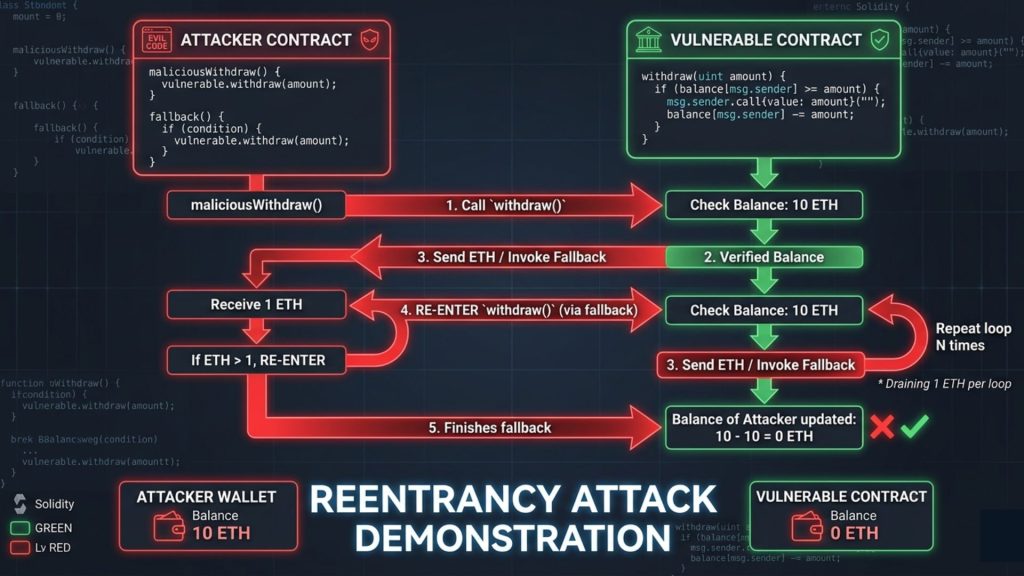
The fix sounds simple enough: follow the checks-effects-interactions pattern and use reentrancy guards. However, cross-function and cross-contract reentrancy remain subtle and easy to miss during development.
Integer Overflow and Underflow
Before Solidity 0.8.0, integer arithmetic did not automatically revert on overflow or underflow. A number that exceeded its maximum value would wrap around silently, creating enormous security implications for token balances, voting logic, and financial calculations. While newer compiler versions handle this natively, legacy contracts and some custom implementations remain vulnerable.
Access Control Failures
Poor access control is responsible for a significant proportion of high-severity exploits. Functions that should be restricted to administrators, governance contracts, or specific protocol roles are sometimes left open due to missing modifiers, incorrect role assignments, or flawed ownership transfer logic. In 2026, access control failures remain a leading cause of contract-level breaches.
Oracle Manipulation
Many DeFi protocols rely on external price feeds, also known as oracles, to determine asset values, trigger liquidations, and calculate interest rates. An attacker who can manipulate the data an oracle reports, even temporarily via flash loans, can drain liquidity pools, trigger unwarranted liquidations, or exploit arbitrage opportunities that did not exist a moment earlier.
Flash Loan Attacks
Flash loans allow users to borrow enormous sums of capital within a single transaction, provided the funds are returned before the transaction concludes. In the hands of an attacker, this creates a window to distort markets, manipulate governance votes, or abuse logic that was never designed to handle such unusual economic conditions.
Logic Errors and Economic Design Flaws
Not every vulnerability is a textbook bug. Some of the most damaging exploits in recent years have targeted the economic logic of a protocol rather than its code syntax. Tokenomics that look fine on paper can unravel catastrophically when subjected to adversarial game theory. This is a category that traditional code audits often struggle to catch without dedicated economic security analysis.
The Audit Is Not Enough: Understanding the Post-Deployment Gap
Here is an insight that the blockchain security industry does not discuss often enough: most exploits do not happen because an audit was skipped. They happen because the audit alone was treated as sufficient.
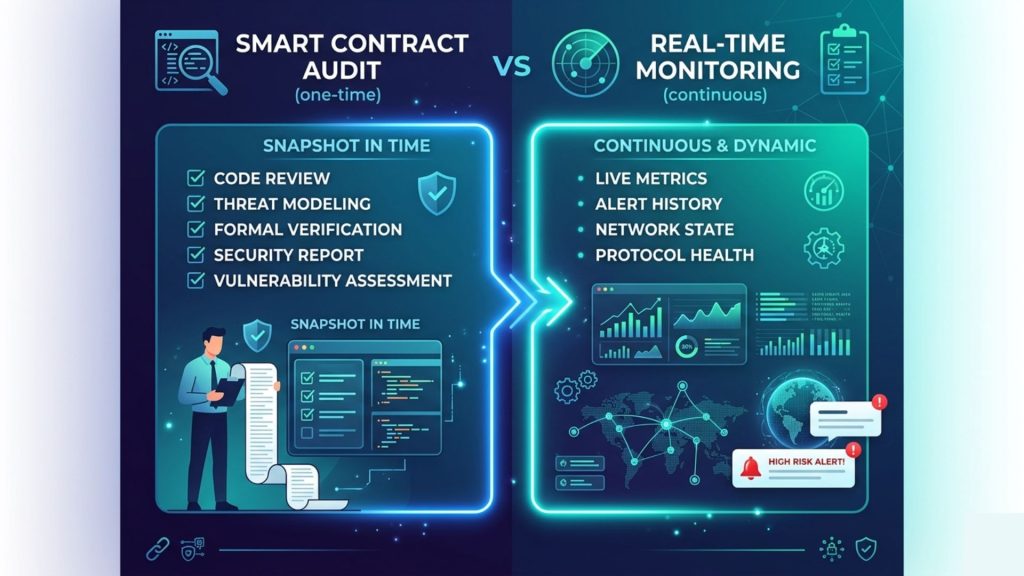
An audit is a point-in-time review. It assesses the code as it exists at a specific moment, under specific assumptions. What it cannot account for is what happens after deployment, when the contract begins interacting with real users, real capital, and real adversarial conditions.
Consider a few scenarios that audits routinely cannot anticipate. A dependency contract that the audited code integrates with gets upgraded, changing its behavior. A governance proposal modifies a parameter that creates an unexpected interaction with existing logic. A new exploit technique emerges that did not exist at the time of the audit.
In each of these cases, the original audit findings remain valid. The contract may have been clean at the time of review. But the live environment is dynamic, and static analysis cannot track dynamic risk.
This is precisely why post-deployment monitoring has emerged as a non-negotiable layer of smart contract security in 2026. Continuous, real-time observation of on-chain contract behavior is the only way to detect anomalies before they escalate into full exploits.
Tools that fall into this category watch for unusual transaction patterns, unexpected function calls, abnormal asset flows, and behavioral deviations that may signal an attack in progress. The goal is not just to detect threats after they occur but to create the possibility of intervention during an active exploit window.
SecureDApp’s SecureWatch was built specifically to address this gap. It offers AI-driven threat detection combined with continuous on-chain monitoring, and notably includes a feature called AutoPause, which can automatically pause suspicious transactions or contract activity during an ongoing threat. For protocols managing significant liquidity, this kind of real-time mitigation capability represents a meaningful layer of protection that no audit alone can provide.
Smart Contract Auditing: What a Quality Audit Actually Involves
Since auditing remains the most widely understood component of smart contract security, it is worth being precise about what a thorough audit looks like, and what separates a rigorous review from a superficial one.
A quality audit begins with a scope definition phase. The auditing team needs to understand the full architecture of the protocol, not just isolated contract files. Integration points, dependencies, and upgrade mechanisms all fall within the relevant attack surface.
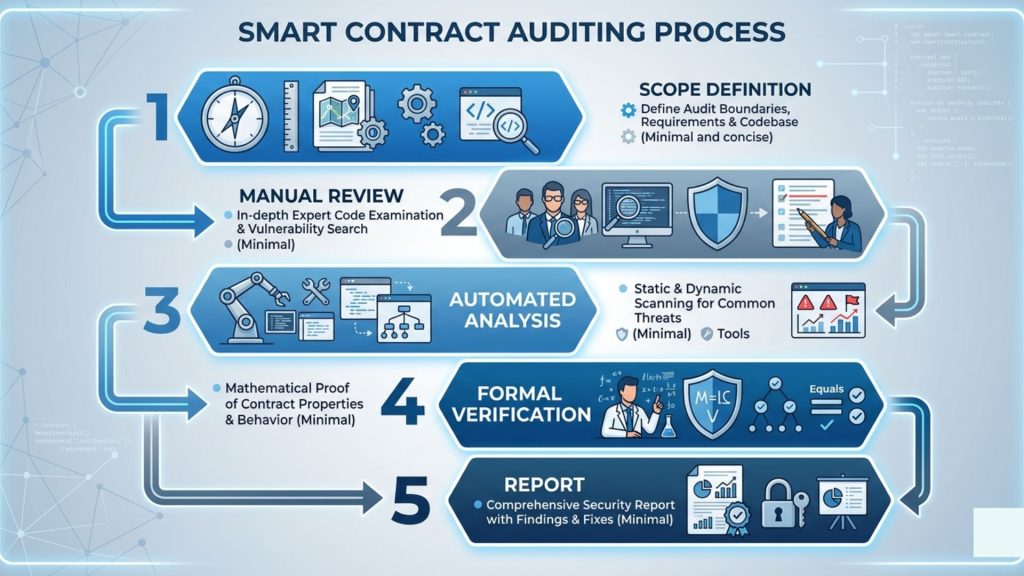
The review itself typically combines multiple methodologies. Manual code review by experienced Solidity security researchers remains the gold standard for catching logic errors and nuanced vulnerabilities that automated tools miss. Automated analysis using static analysis tools can surface common vulnerability patterns quickly and at scale. Formal verification, where mathematical proofs are used to confirm that code behaves as specified, is increasingly used for critical contracts managing high-value assets.
A strong audit report does more than list vulnerabilities. It categorizes findings by severity, explains the precise conditions under which each vulnerability can be exploited, and provides concrete, tested remediation recommendations.
One element that often separates a good audit from an excellent one is economic security analysis. A team that only reviews code syntax without thinking about how the protocol’s incentive structures could be abused is leaving a meaningful portion of the attack surface unexamined.
Solidity Shield, SecureDApp’s smart contract auditing tool, is designed to support pre-deployment vulnerability detection with this kind of comprehensive scope in mind, covering both technical and structural risk in the review process.
Blockchain Forensics and Transaction Monitoring: The Security Layer Most Teams Overlook
Beyond prevention and detection, there is a third pillar of smart contract security that receives far less attention: forensics and traceability.
When an exploit does occur, the ability to trace funds, identify attack patterns, and reconstruct the sequence of transactions is critical. For protocol teams, this matters for both incident response and recovery. For the broader ecosystem, it matters for accountability and compliance.
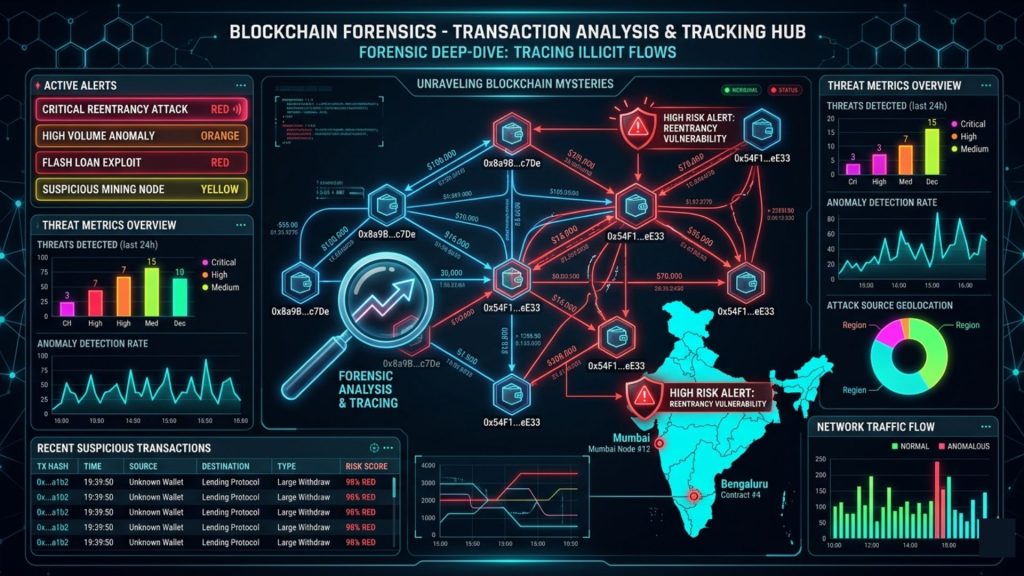
Blockchain forensics involves analyzing on-chain transaction data to understand how funds moved, which wallets were involved, and how an attack was orchestrated. In 2026, with multi-chain protocols and cross-chain bridges creating highly complex transaction graphs, this work has become significantly more technically demanding.
SecureDApp’s SecureTrace product addresses this need, providing transaction tracking and blockchain forensics capabilities that support investigation and reporting in the aftermath of security incidents.
This is particularly relevant for protocols operating under emerging regulatory frameworks. As jurisdictions around the world move to impose AML and compliance requirements on DeFi platforms, the ability to demonstrate transaction traceability is transitioning from a nice-to-have to a regulatory obligation.
Identity and Access in Smart Contract Ecosystems
One increasingly important dimension of smart contract security is identity. As Web3 protocols mature and begin servicing institutional participants, the need for robust, privacy-preserving identity verification has grown.
Decentralized identity solutions, or DiD systems, allow users to prove attributes about themselves without revealing unnecessary personal data. For smart contracts that need to gate access based on verified credentials, such as KYC status, accreditation, or geographic restrictions, on-chain identity infrastructure is becoming a foundational requirement.
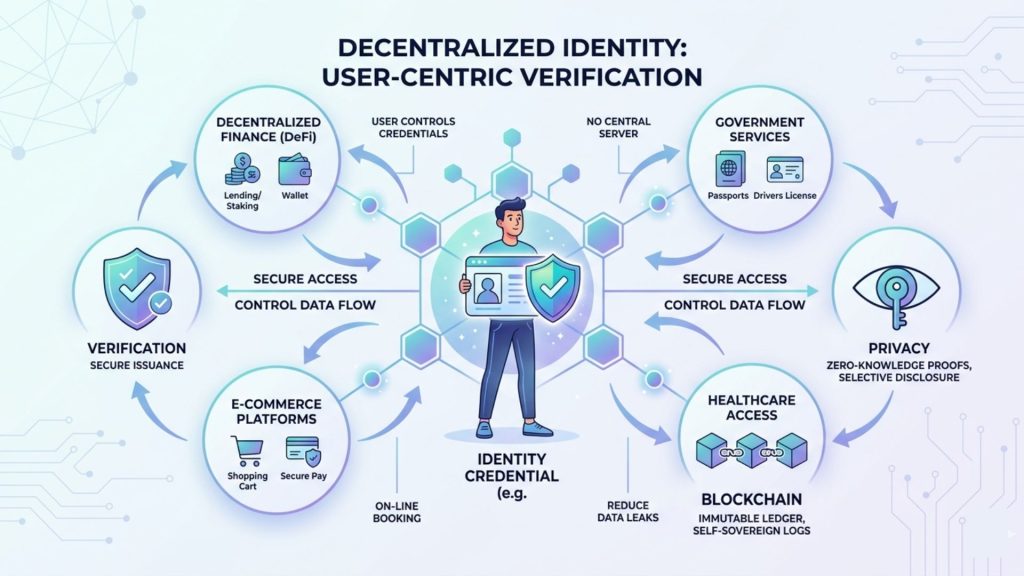
SecureDApp’s Secure X-DiD product addresses this space. It holds OVIS SE certification from UIDAI, the Unique Identification Authority of India, which speaks to its compliance credibility in the Indian market and beyond. For Web3 platforms that need to balance open access principles with regulatory compliance, a certified decentralized identity layer is a meaningful component of the broader security architecture.
Building a Smart Contract Security Strategy in 2026
Given everything covered above, what does a genuinely comprehensive smart contract security strategy look like in practice?
It starts before development. Security-conscious teams build threat modeling into their design phase. They ask adversarial questions about their own architecture before writing production code. They review similar protocols that have been exploited and understand the specific conditions that enabled those attacks.
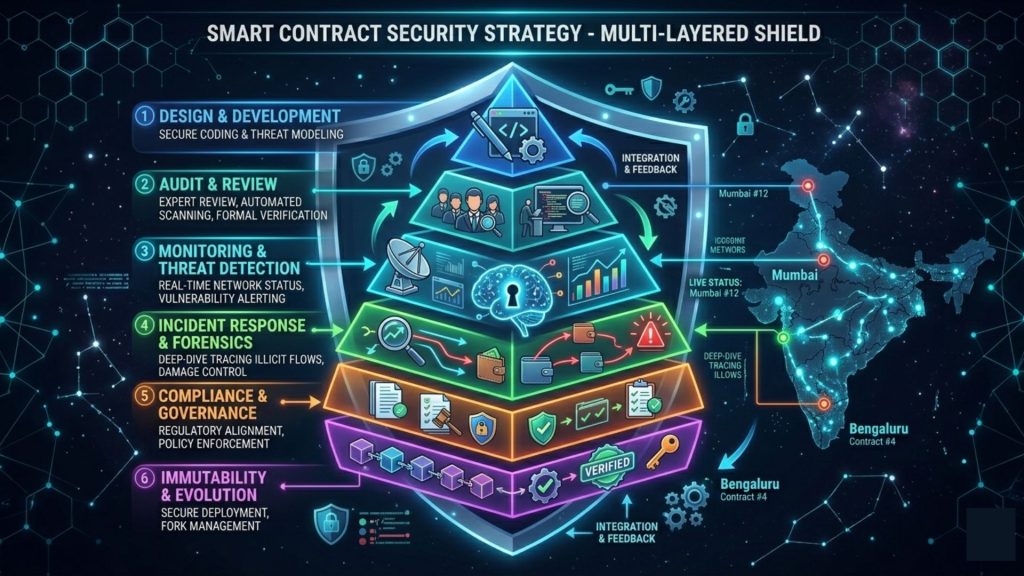
During development, secure coding practices are enforced through code review requirements, linting tools, and internal security checklists. Teams follow established best practices for access control, reentrancy protection, and safe arithmetic, while also staying current on emerging vulnerability patterns.
Pre-deployment, an independent audit from a reputable security firm is conducted, with adequate time allocated for remediation and re-review of critical findings. Economic design review is included, not treated as optional.
At deployment, continuous monitoring is activated. This is not a passive activity. It requires configuring alert thresholds, defining response protocols, and ensuring that the team has a tested incident response plan before it is ever needed. The ability to pause or intervene in a contract’s operation during an active threat can mean the difference between a contained incident and a total loss event.
Post-launch, security is treated as an ongoing operational concern rather than a completed checklist. Protocol upgrades, governance changes, and new integrations all trigger fresh security reviews. Periodic re-audits are scheduled as the protocol grows and its attack surface evolves.
This is what serious blockchain security looks like in 2026. Not a single audit report. Not a one-time checkbox. A continuous, multi-layered discipline that keeps pace with an environment that does not stand still.
The Regulatory Dimension: Why Security Is Now a Compliance Issue
The regulatory landscape for blockchain and DeFi has shifted meaningfully in the past 24 months. Across the EU, the US, Singapore, India, and several Gulf states, regulators have moved from observation to active rulemaking.
For smart contract developers and protocol operators, this creates a new dimension to security planning. Compliance with AML regulations, KYC requirements, and data protection laws now intersects directly with smart contract architecture. A protocol that cannot demonstrate security practices, transaction traceability, or identity verification may find itself facing regulatory barriers in key markets.
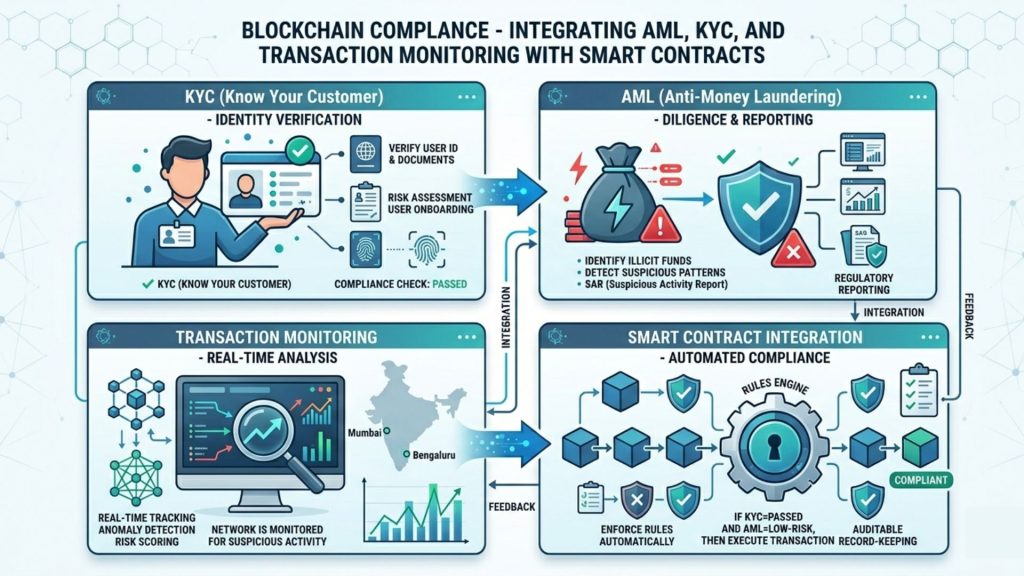
SecureDApp’s Crypto Compliance and AML services address this reality directly, helping blockchain teams navigate the technical and procedural requirements of an evolving compliance environment.
Importantly, security and compliance are not in tension. A protocol that is genuinely secure, with strong access controls, transaction monitoring, and audit trails, is also a protocol that is easier to bring into compliance. The two disciplines reinforce each other when approached thoughtfully.
Conclusion
Smart contract security in 2026 is not a product you buy once. It is not a report you file away after launch. It is an ongoing operational discipline built on multiple reinforcing layers: secure design, rigorous auditing, continuous monitoring, forensics capability, and increasingly, regulatory compliance.
The protocols that treat security as a living practice rather than a one-time checklist are the ones building durable, trustworthy infrastructure. And in an industry where a single vulnerability can erase years of growth, that distinction matters enormously.
If you are building on-chain, the question is not whether to take smart contract security seriously. The question is whether your current approach covers all the layers it needs to.
SecureDApp offers a connected suite of tools and services, including Solidity Shield for pre-deployment auditing, SecureWatch for continuous post-deployment monitoring, SecureTrace for forensics, and Secure X-DiD for identity verification, built around the reality that securing a smart contract means protecting it at every stage, not just at launch.
Frequently Asked Questions
1. What is smart contract security?
Smart contract security refers to the practices, tools, and processes used to identify, prevent, and respond to vulnerabilities in blockchain-based smart contracts across their full lifecycle, from design through post-deployment operation.
2. Why do smart contracts get exploited even after audits?
Audits are point-in-time reviews. They assess code as it exists at a specific moment but cannot anticipate future interactions, dependency changes, or new attack techniques. Post-deployment monitoring fills this gap.
3. What is the most common smart contract vulnerability?
Reentrancy attacks, access control failures, oracle manipulation, and logic errors are among the most frequently exploited vulnerabilities. Flash loan attacks have also become a major category in DeFi security.
4. How long does a smart contract audit take?
A thorough audit typically takes between one and four weeks, depending on the complexity and size of the codebase. Protocols with multiple interconnected contracts or complex economic logic may require longer review periods.
5. What is the difference between a smart contract audit and formal verification?
An audit is a manual and automated review of code for vulnerabilities. Formal verification uses mathematical proofs to confirm that code behavior matches its specification. Formal verification is more rigorous but also more resource-intensive.
6. What happens if a vulnerability is found after deployment?
Ideally, a deployed contract with an upgrade mechanism can be patched. If the contract is fully immutable, options include emergency pausing (if that capability was built in), governance-driven migration to a new contract, or community communication to reduce exposure while a fix is prepared.
7. What is post-deployment monitoring in smart contract security?
It is the continuous, real-time analysis of on-chain contract behavior to detect anomalies, suspicious transactions, or patterns that may indicate an attack in progress. It is increasingly recognized as essential, not optional.
8. What is AutoPause in the context of smart contract security?
AutoPause is a mitigation feature that can automatically pause suspicious transactions or contract activity when a threat is detected during live operation, limiting potential damage before manual intervention occurs.
9. Can small protocols skip a formal audit?
No protocol is too small to attract attention if it holds any meaningful value. Attackers often target smaller protocols precisely because they assume security measures are weaker. A proportionate audit remains advisable for any live contract.
10. What is blockchain forensics and why does it matter?
Blockchain forensics involves tracing and analyzing on-chain transaction data to reconstruct how an exploit occurred, how funds moved, and which addresses were involved. It matters for incident response, recovery efforts, and regulatory compliance.
11. What are flash loan attacks and how do they exploit smart contracts?
Flash loans enable large capital borrowing within a single transaction. Attackers use them to temporarily distort market conditions, manipulate oracle prices, or exploit logic that was not designed to handle such conditions, draining funds before the loan is repaid.
12. What is decentralized identity (DiD) in blockchain security?
Decentralized identity systems allow users to prove verified attributes without exposing personal data on-chain. They are increasingly used to gate access in protocols with compliance requirements.
13. How does oracle manipulation affect smart contracts?
If an attacker can manipulate the price or data feed an oracle provides, they can trigger unintended contract behavior such as false liquidations, arbitrage opportunities, or fund draining in DeFi protocols.
14. What is VAPT in the context of blockchain security?
Vulnerability Assessment and Penetration Testing (VAPT) for blockchain environments involves systematically identifying and testing vulnerabilities in smart contracts, APIs, and supporting infrastructure through both automated and manual techniques.
15. How often should a smart contract be re-audited?
Any significant upgrade, governance change, or new integration should trigger a focused review. Beyond that, periodic re-audits, typically annually or following major protocol milestones, are considered good practice for mature protocols.