
If your organization has deployed a cookie banner and assumed you have secured DPDP compliance, you are almost certainly operating in a dangerous gap. The confusion is understandable, since a cookie banner looks like consent infrastructure. It sits on your website, asks users to accept or reject, and generates a log in your backend somewhere. Regulators, however, view this very differently: they see a checkbox that was never designed to capture the kind of consent the law actually requires.
This distinction between a cookie banner and a genuine Consent Management Platform has quietly become the single most consequential decision point for Indian businesses navigating DPDP compliance through 2026 and 2027. When an organization’s data processing practices face scrutiny, either during a routine audit or following a user complaint to the Data Protection Board, a banner-only approach reveals its inadequacy immediately. By contrast, businesses that invested early in a purpose-built Consent Management Platform now possess demonstrable evidence of valid consent, auditable withdrawal workflows, and automated data principal rights fulfillment, the exact proof regulators expect to see.
This guide explores what a Consent Management Platform actually does, where cookie banners fall short, and why the DPDP Act’s specific consent requirements transform this choice from a technical detail into a strategic necessity. Let us start by examining the regulatory foundation, then work through the practical implications.
What the DPDP Act Actually Requires From Consent
To understand why a Consent Management Platform has become mandatory rather than optional, it helps to start with what the law explicitly demands. The Digital Personal Data Protection Act, 2023 does not simply require consent in general. Instead, it sets an unusually precise standard for what valid consent means in practice.
The Five Pillars of DPDP-Valid Consent
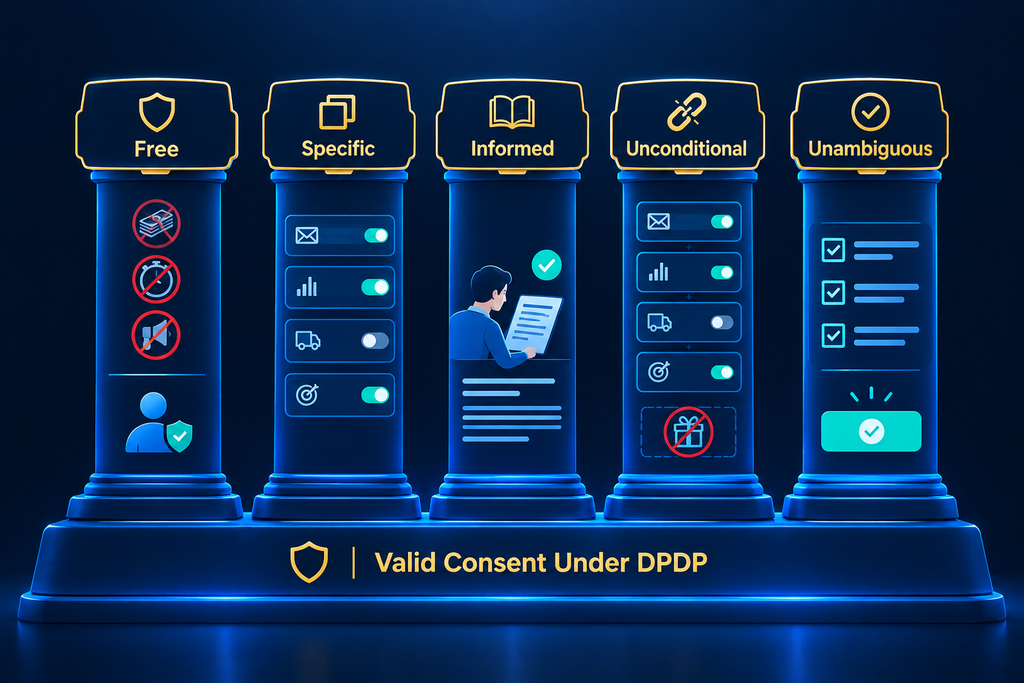
The law mandates that all consent must be free, specific, informed, unconditional, and unambiguous. Each pillar carries distinct operational meaning. Free consent means you cannot apply coercion. Eliminate pre-ticked checkboxes, dark patterns that make rejection harder than acceptance, and bundling of unrelated services into a single mechanism. Specific consent requires that each distinct processing purpose must have its own explicit ask, not a blanket “agree to everything” toggle.
Moreover, informed consent demands that users understand what they are agreeing to in clear language, not legal boilerplate that only a privacy attorney could parse. Unconditional consent prohibits tying unrelated services to consent grants. For example, you cannot force a user to accept marketing emails just to access your core product. Unambiguous consent requires that the intent be unmistakable, leaving no room for users or regulators to later question whether genuine agreement actually occurred.
Why Withdrawal Symmetry Matters Most
Here lies the critical gap where cookie banners struggle most: the DPDP Act requires that withdrawal of consent be just as easy as the grant. Think about what this operationally means. If a user consented to data collection in two taps during onboarding, they must revoke that consent in two taps from settings, not through a support email or buried in a menu six screens deep. Two taps, symmetrical to the original grant, is the legal standard.
The Emerging Consent Manager Ecosystem
Additionally, the law introduces a “Consent Manager,” a registered intermediary that will eventually allow individuals to view and manage all their consents across multiple businesses from a single dashboard. This ecosystem is still developing, but it is coming soon. A Consent Management Platform that architects itself to eventually interoperate with this layer gains future-proofing. A cookie banner, by contrast, was never designed to integrate with any external system beyond tracking pixels.
Cookie Banners: What They Were Built For and Why They Fall Short
To appreciate the gap between a cookie banner and a Consent Management Platform, you need to understand what a cookie banner actually was. The modern cookie banner emerged from GDPR compliance requirements in Europe beginning around 2018. Its purpose was straightforward: show users a notice that cookies were being set, provide a way to accept or reject them, and log that choice.
The Binary Problem
Cookie banners optimize for a very specific problem, but one that DPDP has moved far beyond. They work around the assumption that consent is binary, cookie use is the only processing activity that matters, and once a user accepts, your business can collect and process data indefinitely. The banner framework was never built to handle granular purpose-wise consent, per-processing activity withdrawal, cross-organizational consent synchronization, or the tamper-evident audit trails that regulators increasingly demand.
Most cookie banner platforms still in use today were retrofitted for GDPR after being built for entirely different use cases. Many started as analytics tools or marketing automation platforms, then added a “consent management” module that was essentially a branded disclaimer screen. When these vendors later added India-specific options, they often just translated the text and added references to the DPDP Act. The underlying architecture, however, remained unchanged, and it still cannot do what DPDP actually requires.
Real-World Gaps in Practice
The practical shortcomings become obvious quickly. Suppose a user asks for access to all their personal data, a right guaranteed under DPDP. A well-designed Consent Management Platform queries every system holding that user’s data automatically, aggregates the information, and delivers it within statutory timelines. A cookie banner environment, by contrast, has no such integration. Access requests land in a support queue, or worse, disappear entirely because the banner system lacks any mechanism to handle them.
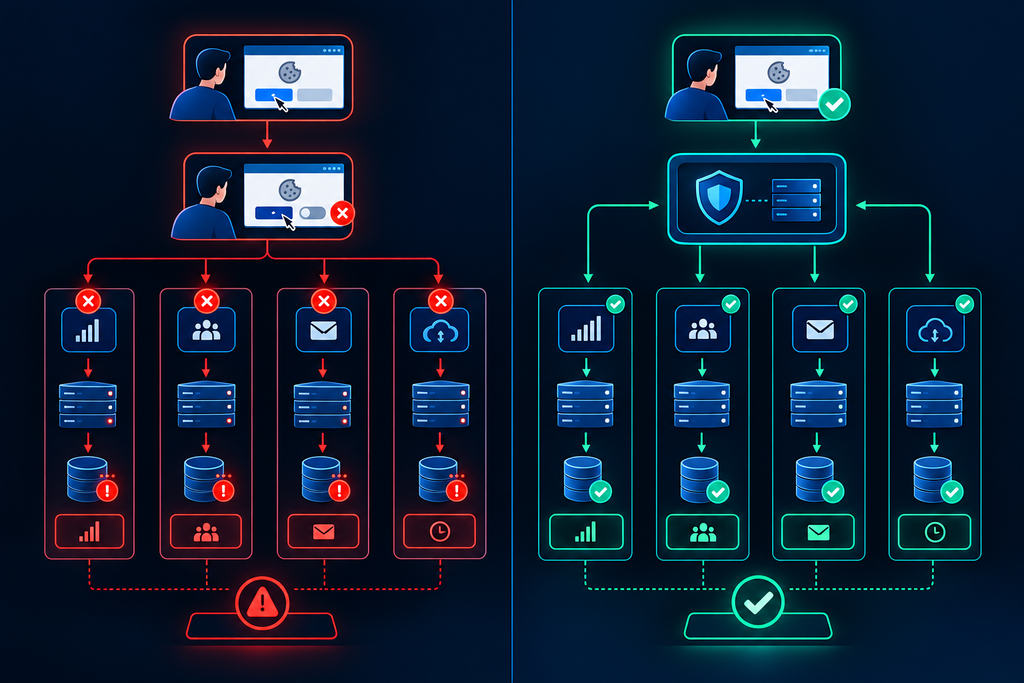
Consider another scenario. Your user withdraws consent for marketing emails. Under DPDP, that withdrawal must take effect immediately and propagate to every system using that data for marketing purposes. Moreover, it must be verifiable. The Data Protection Board may later ask to see proof that you honored the withdrawal. A cookie banner would simply turn off the UI toggle, but the backend situation remains chaotic. The backend may not have stopped sending emails. Third-party vendors may still have copies of the data. Backups may still hold the user’s information. None of that is tracked or audited. The banner system simply cannot provide that level of oversight.
The Anatomy of a Consent Management Platform: What Actually Matters
A modern Consent Management Platform, specifically one built natively around DPDP requirements rather than adapted from a GDPR tool, delivers an entirely different architecture. Understanding what makes them different clarifies why the investment is justified.
Granular Purpose-Level Consent Capture
A Consent Management Platform captures consent at the granular level of individual processing purposes, not data types. This distinction is subtle but critical. A cookie banner might ask, “Allow tracking,” and then log that single binary choice. A Consent Management Platform breaks this down further. Tracking for delivery optimization becomes one consent. Tracking for personalized advertising becomes another. Tracking for analytics becomes a third. Each receives a separate, clearly worded ask. Each gets its own withdrawal mechanism.
Tamper-Evident Audit Trails
Every consent event, from grants to modifications to withdrawals, must be logged in a tamper-evident way. Platforms like SecureCMS use blockchain-anchored or cryptographically verifiable logging, which means a consent record cannot be quietly altered after the fact. When the Data Protection Board asks, “Did this user consent on this date?” you provide an answer backed by mathematical proof, not a database entry that someone could theoretically have edited.
Automated Rights Fulfillment at Scale
A Consent Management Platform automates the rights fulfillment workflows that DPDP mandates. When a user requests access to their data, the system routes that request automatically to every processor and backend system holding their information. When they ask for correction, your platform coordinates updates across multiple repositories. When they demand erasure, your platform triggers real deletions, not soft deletes that leave data recoverable in backups.
Real-Time Consent State Management
Your platform maintains consent state as a real-time single source of truth. Every SDK, every third-party service, every internal backend system can query the platform to check: does this user currently have consent for this processing activity? If not, they stop processing immediately. This capability is something a cookie banner cannot reasonably provide.
Future-Ready Architecture
As DPDP enforcement matures, a true Consent Management Platform is architected to eventually interoperate with the Consent Manager ecosystem that the law envisions. Rather than operating in isolation, it can eventually synchronize with a registered Consent Manager, ensuring that a withdrawal made through that unified interface is reflected accurately in your own systems.
Why Regulators Are Moving Beyond Cookie Banners
The Data Protection Board of India has remained relatively quiet on specific enforcement actions so far. However, international precedent, industry conversations, and the Board’s preliminary guidance make the direction unmistakably clear. Regulators increasingly view cookie banners as a checkbox exercise, something businesses use to create a veneer of compliance while their actual practices remain opaque.
Europe’s GDPR Enforcement Lesson
Europe has already moved down this path with GDPR. Regulators discovered that many organizations showed compliant-looking cookie banners while simultaneously violating the spirit of the law through dark patterns, sluggish withdrawal mechanisms, or failure to honor withdrawal requests. European authorities have since imposed massive fines on organizations that technically had banners but failed to implement them properly. India’s enforcement is expected to follow a similar trajectory.
Coming Audit Reality
As the DPDP Act matures, the Board will increasingly have the capacity to audit individual organizations. When that happens, investigators will typically ask for consent records for a specific user over a specific period. A cookie banner environment produces minimal evidence: a timestamp, maybe an accept or reject choice, and that is it. A Consent Management Platform, by contrast, produces a complete audit trail. Every purpose is visible. Every modification is logged. Every withdrawal is documented with timestamps and enforcement proof.
For that reason alone, the regulatory environment is already shifting toward expecting Consent Management Platforms, not banners. Organizations that wait until they are audited to discover this gap will face far higher remediation costs and reputational damage than those that invest proactively now.
Purpose-Wise Consent: The Feature That Exposes Banner Limitations
One of the most revealing tests for any consent tool is whether it can handle purpose-wise consent effectively. This is not an edge case or a nice-to-have feature, it is a core requirement of the DPDP Act.
What Purpose-Wise Consent Actually Means
Purpose-wise consent means if your organization uses customer data for three different reasons, you need three separate consent choices. You might need a user’s email for transactional communications, a distinct purpose. You might want that same email for marketing campaigns, an entirely separate purpose. You might use email addresses to build a look-alike audience for ads, yet another purpose. Under DPDP, each requires separate consent. Users should be able to opt in to transactional emails and marketing both, but still refuse their email being used for audience building.
Why Cookie Banners Cannot Handle This
Most cookie banners lack the granularity to support purpose-wise consent. They are designed around the assumption that a user either consents to a category or does not. Moving to purpose-level granularity would require rearchitecting the underlying database and the UI that displays consent choices. Few banner vendors have done this work because it did not matter for GDPR compliance, and retrofitting is expensive.
A Consent Management Platform, especially one built from the ground up for DPDP, makes this kind of granularity its baseline. Your UI is designed around showing multiple, clearly distinct purposes. Your database is structured to track consent state at the purpose level. Withdrawal works at the purpose level. This is not a limitation or a workaround, it is the core architecture.
Withdrawal Workflows: Where Cookie Banners Break Down Completely
Perhaps no aspect of DPDP compliance is more revealing than how systems handle withdrawal. The law is unambiguous: withdrawal must be as easy as the grant. Yet most organizations that have implemented cookie banners have simultaneously made withdrawal deliberately difficult.
The Dark Pattern Problem
This is sometimes intentional dark pattern design, though many organizations simply inherited this behavior from their cookie banner vendor. The banner shows a large “Accept All” button front and center. Rejecting anything gets hidden behind a “Preferences” link. Once the user adjusts preferences, exiting and actually applying those changes requires another click. The asymmetry is obvious to anyone paying attention, and regulators certainly notice it.
The Backend Integration Gap
More problematically, even when a cookie banner provides a withdrawal mechanism in the UI, the backend often fails to honor it properly. A user toggles off tracking in settings, but your company’s analytics SDK continues logging quietly in the background because the SDK was never integrated with the consent state. Third-party data processors still retain the user’s information because nobody coordinated to notify them of the withdrawal. Email vendors still have the contact because the sync was never automated. The banner showed withdrawal worked, but in reality, it did not.
How Platforms Handle Withdrawal Properly
A Consent Management Platform, by contrast, treats withdrawal as a first-class operation. When a user revokes consent, the platform executes five critical steps:
- Updates the consent state in real time, visible to any system that checks it
- Automatically notifies downstream processors that this user’s data should no longer be used for that purpose
- Logs the withdrawal event in an immutable audit trail, creating proof that the action was taken
- Triggers workflows to actually delete data if retention is no longer justified
- Generates compliance evidence that you can present to auditors or regulators
This is not a feature bolt-on, it is architectural foundation.
Data Principal Rights Fulfillment: From Manual to Automated
The DPDP Act grants data principals, the individuals whose data you are collecting, several explicit rights. They can demand access to all personal data you hold about them. They can request correction of inaccurate information. They can demand erasure once retention is no longer justified. Additionally, unique to DPDP, they can nominate someone else to exercise rights on their behalf in case of death or incapacity.
Why Manual Workflows Fail
Implementing these rights through manual workflows, which many organizations currently do, is neither compliant nor sustainable. A person emails your privacy team asking for data access. That email sits in a queue with dozens of others. Someone manually searches your databases, copies information into an email, and sends it back, often after weeks. Meanwhile, your service-level agreement for responding to rights requests goes unmet. The user then has a right to complain to the Data Protection Board about non-compliance.
Furthermore, manual implementation is almost certainly incomplete. Most organizations lack a unified view of where all their customer data lives. A customer’s information might be in the main database, but also in analytics platforms, marketing automation tools, support ticket systems, backup archives, and partner systems. A manual access request typically touches only the primary database, leaving the other repositories forgotten.
How Platforms Automate Rights Fulfillment
A Consent Management Platform automates this end to end. An access request comes in through the platform’s interface. Your system automatically queries every connected data processor and repository. Information gets aggregated. Your platform fulfills the request within the statutory timeline. The fulfillment gets logged. The data principal receives proof that you handled the request.
Erasure requests are similarly automated. When a user requests deletion, your platform triggers real deletion in the main database and communicates the request to all downstream processors. For organizations that have integrated their backup systems with the platform, backups can even exclude that user’s data in future cycles.
A cookie banner simply cannot achieve this level of automation, as it was never built for this kind of integration and workflow management.
Audit Trails and Regulatory Evidence
Perhaps the most consequential difference between a cookie banner and a Consent Management Platform is the quality and strength of audit evidence each produces.
Cookie Banner Audit Trails
A cookie banner typically creates a log entry with minimal information: timestamp, user_id, consent_status (accepted or rejected), and maybe a few other fields. This log lives in your database, editable by your engineers, recoverable from backups, and vulnerable to accidental or malicious modification.
When a regulator asks, “Did this user consent on February 15th, 2026?” you defend yourself with a database entry. The regulator knows that database entries can be edited. Without external verification, there is no way to prove the record is authentic. This is not necessarily because you changed it, but because you theoretically could have.

Tamper-Evident Platform Evidence
A Consent Management Platform, particularly one that uses cryptographic or blockchain-based verification, produces fundamentally different evidence. Every consent event gets stamped with a cryptographic hash that makes the record tamper-evident. If someone attempts to alter the log, the hash changes and the tampering becomes immediately visible. A regulator can verify mathematically that a consent record has not been modified since it was created.
This is not a marketing flourish, it is the difference between “we believe this happened” and “we can mathematically prove this happened.” In a high-stakes audit or dispute, that distinction matters enormously.
The Interoperability Question: Why Future-Proofing Matters Now
One structural element of DPDP that many organizations still underestimate is the Consent Manager ecosystem. The law anticipates that over time, registered, regulated intermediaries will emerge offering individuals a single dashboard through which they can view, manage, and revoke consent across multiple organizations simultaneously.
The Emerging Ecosystem Reality
This ecosystem is not fully built out yet, but the architectural foundation is being laid now. When this eventually matures, probably through 2026 and 2027, a user could log into a Consent Manager app and see a list of every company that holds their personal data. From that single interface, they could withdraw consent from any or all of those organizations simultaneously.
The Cookie Banner Crisis
For a business running on a cookie banner, this moment will trigger a crisis. The banner was designed to work in isolation and has no mechanism to receive withdrawal signals from external systems. Suddenly, users are revoking consent through third-party interfaces, but your systems do not know it happens. Compliance breaks overnight.
Platform Architecture for the Future
A Consent Management Platform that was architected with interoperability in mind, however, can eventually integrate with these external systems. Consent state becomes synchronized across multiple platforms. Withdrawal propagates both ways. This is not speculative future work, it is architectural planning that should be starting now.
Implementation Reality: Migration Path From Banners to Platforms
For many organizations, acknowledging that a cookie banner is insufficient is the easy part. The harder question is: how do we transition without disrupting existing operations?
Parallel Operation Strategy
The good news is that this migration does not have to happen overnight. Most organizations can run a cookie banner and a Consent Management Platform in parallel. Initially, the banner handles the UI on your website. Your Consent Management Platform begins capturing purpose-wise consent for new users or new processing activities. Over time, you migrate consent state into the platform. Eventually, the banner becomes redundant and you can decommission it.
The Timing Advantage
The key is starting before you are forced to. Organizations that begin this process now will have time to plan, test, and integrate properly. Organizations that wait until a regulator arrives will be scrambling to catch up.
Key Differences at a Glance
| Aspect | Cookie Banner | Consent Management Platform |
|---|---|---|
| Consent Granularity | Category-level or binary | Purpose-wise, granular |
| Withdrawal Mechanism | UI toggle only, inconsistent backend handling | Real-time state propagation to all processors |
| Audit Trail Strength | Database log, editable, vulnerable | Tamper-evident, cryptographically verifiable |
| Data Principal Rights | Manual, incomplete | Automated end to end |
| Purpose-Wise Consent | Limited or impossible | Core feature |
| Interoperability | None | Architected for Consent Manager ecosystem |
| Regulatory Evidence | Weak, disputed | Strong, mathematically proven |
Practical Steps to Evaluate and Select a Platform
If your organization is ready to move beyond a cookie banner, certain evaluation criteria should guide your selection.
Assess Native DPDP Architecture
First, determine whether the platform was built natively for DPDP or adapted from a GDPR tool. This distinction is not always obvious from marketing materials. Ask directly: what was the original market and use case for this platform? If it was built for GDPR and later reshaped for India, it will carry architectural baggage that limits its effectiveness.
Scrutinize Audit Trail Technology
Second, demand to understand the audit trail technology. How are consent records stored? Can they be altered after creation? What makes them tamper-evident? Platforms that avoid giving straight answers to this question are probably hiding something.
Test Purpose-Wise Consent Workflows
Third, test the purpose-wise consent workflow. Can you create five distinct processing purposes and show them to users as separate, clearly worded choices? Most banners will struggle here.
Evaluate Data Principal Rights Automation
Fourth, probe the data principal rights automation. Ask for a live demonstration of how an access or deletion request flows through the system. If this requires manual steps or custom configuration, it is not truly automated.
Review Interoperability Roadmap
Finally, discuss the interoperability roadmap with your vendor. What is the platform’s plan for eventually connecting to the Consent Manager ecosystem? A vendor that has not thought about this is behind the compliance curve.
Why SecureCMS Stands Apart
For organizations specifically evaluating Consent Management Platforms for the Indian market, SecureCMS by SecureDApp warrants close attention precisely because it was engineered from first principles around DPDP’s specific requirements, not retrofitted from another jurisdiction’s framework.
Tamper-Evident Consent Logging
SecureCMS uses blockchain-anchored, cryptographically verifiable consent logging, which means consent records are tamper-evident by design. Every consent event creates mathematical proof of authenticity. This is not just better than a cookie banner’s database log, it is fundamentally different in kind.
Granular Purpose-Wise Architecture
SecureCMS is architected around granular, purpose-wise consent capture. Your UI shows multiple distinct processing purposes to users. Your backend tracks consent state at that same granular level. Withdrawal works at the purpose level, automatically propagating to downstream processors.
Automated Rights Fulfillment
SecureCMS automates data principal rights fulfillment. Access, correction, erasure, and nomination requests flow through automated workflows connected to your data repositories and processors. The system generates compliance evidence showing that you handled requests within statutory timelines.
Future-Ready Interoperability
SecureCMS is designed with interoperability in mind, positioned to eventually integrate with the Consent Manager ecosystem as it develops through 2027.
Conclusion: Cookie Banners Are Compliance Theater
By the end of 2026 and into 2027, as the DPDP Act’s enforcement mechanisms activate and audits become routine, the inadequacy of cookie banner only approaches will become impossible to ignore. Regulators will increasingly expect to see genuine Consent Management Platforms backing compliance claims.
Organizations that have already made the transition will have demonstrable evidence of valid consent, verifiable withdrawal workflows, and automated rights fulfillment, the exact infrastructure that regulators and auditors now expect to see. Organizations still relying on banners will find themselves scrambling to explain why their systems cannot produce what the law requires.
The choice is therefore not really between a cookie banner and a Consent Management Platform. It is between proactive compliance now and reactive remediation later. Given the reputational and financial stakes involved, the investment in a purpose-built Consent Management Platform is not a luxury, it is essential infrastructure for any business operating in India that touches personal data.
Frequently Asked Questions
1. Is a cookie banner sufficient for DPDP compliance?
No. A cookie banner alone does not satisfy DPDP requirements. Cookies are only one type of personal data processing, while DPDP applies to all personal data collection and processing. Additionally, most cookie banners lack the granularity for purpose-wise consent, the audit trail strength, and the withdrawal mechanics that DPDP mandates. A cookie banner is a starting point, not a complete solution. Regulators increasingly expect to see a full Consent Management Platform backing compliance claims.
2. How does a Consent Management Platform handle withdrawal differently from a cookie banner?
A Consent Management Platform treats withdrawal as an automated, end-to-end operation. When a user revokes consent, the platform updates consent state in real time, automatically notifies downstream processors to stop using that data, logs the withdrawal in an immutable audit trail, and triggers actual data deletion workflows. A cookie banner, by contrast, typically only toggles the UI. The backend often continues processing data, and third-party vendors may not even know withdrawal occurred. This asymmetry violates DPDP’s requirement that withdrawal be as easy as the grant.
3. What makes consent records tamper-evident?
Tamper-evident consent logging uses cryptographic hashing or blockchain-anchored storage to create mathematical proof that a record has not been altered since creation. If someone attempts to change the record, the hash changes and tampering becomes immediately visible. This contrasts sharply with a standard database log, which can theoretically be edited by anyone with admin access. When regulators demand proof of consent, tamper-evident records provide far stronger evidence than a database entry.
4. How does a Consent Management Platform automate data principal rights?
A Consent Management Platform integrates with your backend systems and third-party processors through APIs. When a user requests data access, the platform automatically queries connected systems, aggregates information, and delivers it within statutory timelines. Similarly, erasure requests trigger real deletion across multiple repositories. Correction requests route updates to every system holding outdated information. This automation is far faster, more complete, and more consistently compliant than manual email-based processes.
5. Why does interoperability with the Consent Manager ecosystem matter?
The DPDP Act envisions registered Consent Managers eventually providing individuals a single dashboard for managing consent across multiple organizations. A Consent Management Platform architected for interoperability can integrate with this ecosystem, allowing withdrawals made through a third-party interface to be automatically reflected in your systems. A cookie banner, designed to operate in isolation, will be unable to synchronize with external systems, creating compliance gaps the moment this ecosystem becomes operational.