
You hand over your ID at a hotel desk and watch the receptionist photocopy the whole thing. Your name, address, birth date, and document number now sit in a drawer you will never see again. All the hotel needed was one small fact. So why did you give away everything?
Decentralized identity answers that question with a simple promise. You prove only what the other side needs to know, and nothing more. Moreover, you do it with cryptographic certainty instead of a blurry photocopy. In this guide, we will unpack how that works, why it matters for Indian enterprises, and where SecureX-DiD fits in.
The Hidden Cost of Showing Your Whole Identity
Let us start with a habit that feels perfectly normal. Every day, people share full identity documents for tiny reasons. A SIM card, a gym membership, a rental agreement, or a loan form. Each time, the verifier asks for one fact, yet the person hands over a dozen.
This is the over-sharing problem. Consequently, copies of identity documents pile up in countless offices, apps, and databases. Most of those places never planned to protect them well. Furthermore, nobody tracks where each copy ends up, how long it stays, or who can open it.

Think about the math for a moment. A hotel needs to confirm that you are an adult with a valid ID. However, the photocopy also reveals your home address and your exact birth date. In other words, the verifier collects far more than the task requires, and every extra field becomes future risk.
That risk compounds quickly. Because each copy is a standalone target, one weak cabinet or one careless employee can expose it. As a result, the person carries the damage, not the verifier. Fraudsters can reuse those details to open accounts, apply for credit, or impersonate the owner.
Here is the uncomfortable insight. The person proving identity bears the entire risk, while the verifier enjoys the entire convenience. That imbalance is not a bug in one process. Instead, it is the design of how identity checks work today.
So the real question is not how to protect all those copies better. Rather, it is why we create them at all.
Why Centralized Identity Keeps Failing
Now, you might think the answer is a bigger vault. Many organizations tried exactly that. They built central databases to store identity data securely, then let other systems query them. On paper, that sounds tidy.
In practice, however, central stores create a different problem. They become honeypots. When one database holds millions of identities, a single breach exposes millions of people at once. Attackers love that math, because one successful intrusion pays off enormously.
Moreover, centralization creates a quiet dependency. If the identity provider goes offline, changes its rules, or suffers an outage, every service that relies on it stalls. Therefore, a user’s access to their own identity depends on someone else’s uptime and policies.
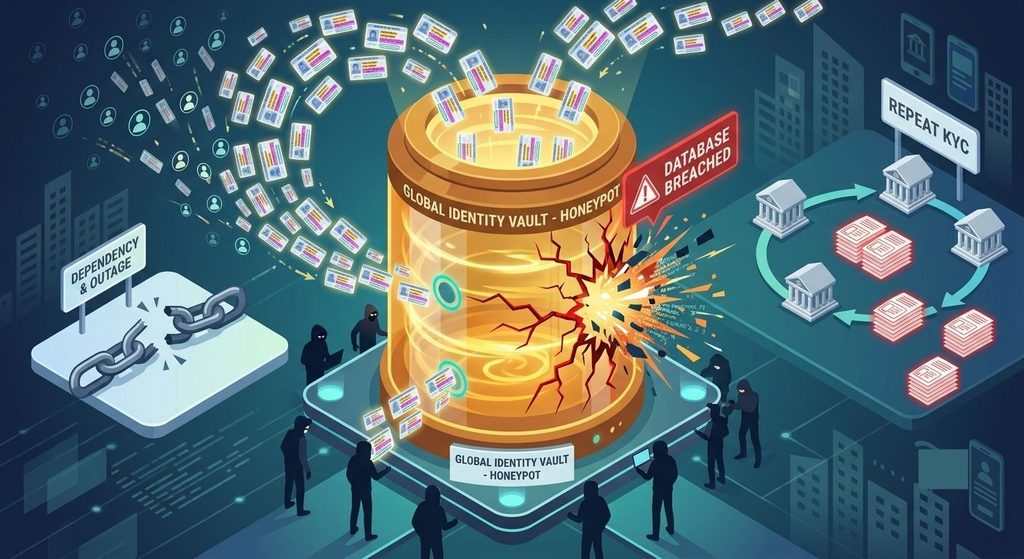
Consider also the repeated KYC burden. A customer who proves identity to one bank usually repeats the same process at the next bank, the next wallet, and the next insurer. Each institution stores its own copy. As a result, one person’s data lives in dozens of places, each with different security standards.
Here is a second insight worth sitting with. Traditional systems treat identity as something an institution holds about you. By contrast, a better model treats identity as something you hold and present. That shift sounds small. Nevertheless, it changes who carries the risk, who controls the data, and who decides what gets shared.
Meanwhile, Indian regulators and enterprises increasingly see this. The Digital Personal Data Protection Act, 2023 pushes organizations toward collecting only what a stated purpose needs. Consequently, collecting a full document where one attribute would do is getting harder to defend.
How Decentralized Identity Puts You in Charge
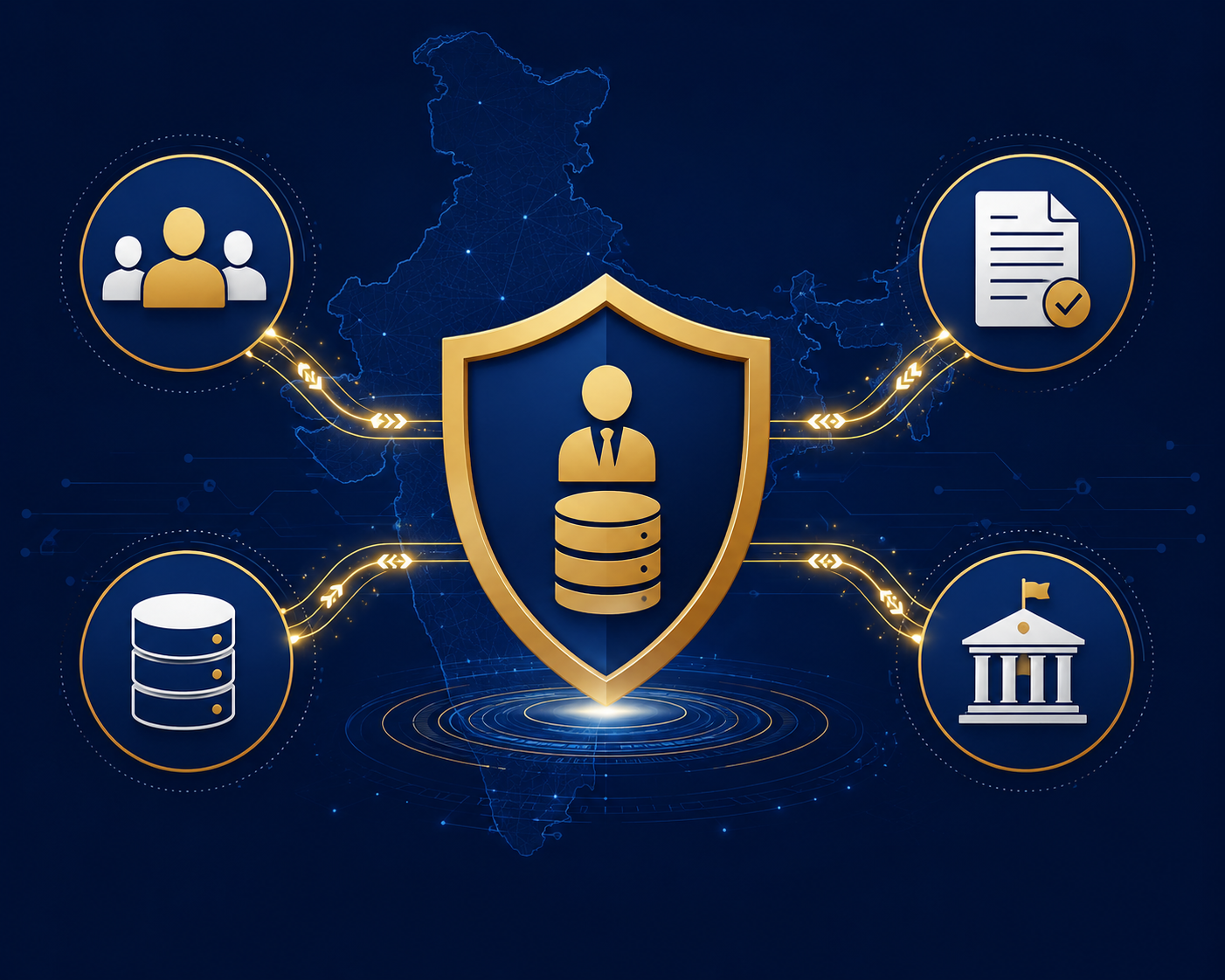
What if the phone in your pocket could hold your verified credentials, the way your physical wallet holds cards? That is the core picture behind decentralized identity. Instead of an institution storing your identity, you carry verified credentials and share them on your own terms.
Importantly, this does not mean identity becomes unverified or self-declared. Trusted issuers still vouch for facts. The difference lies in where the data lives and who controls its release. In other words, trust stays, while the central stockpile goes away.
The Three Roles: Issuer, Holder, and Verifier
Every decentralized identity system relies on three players. First, the issuer is a trusted body, such as a government agency, a bank, or a university, that confirms a fact and signs it digitally. Next, the holder is you, the person who stores that signed credential in a wallet on your own device. Finally, the verifier is the service that needs proof, such as a lender, an employer, or an app.
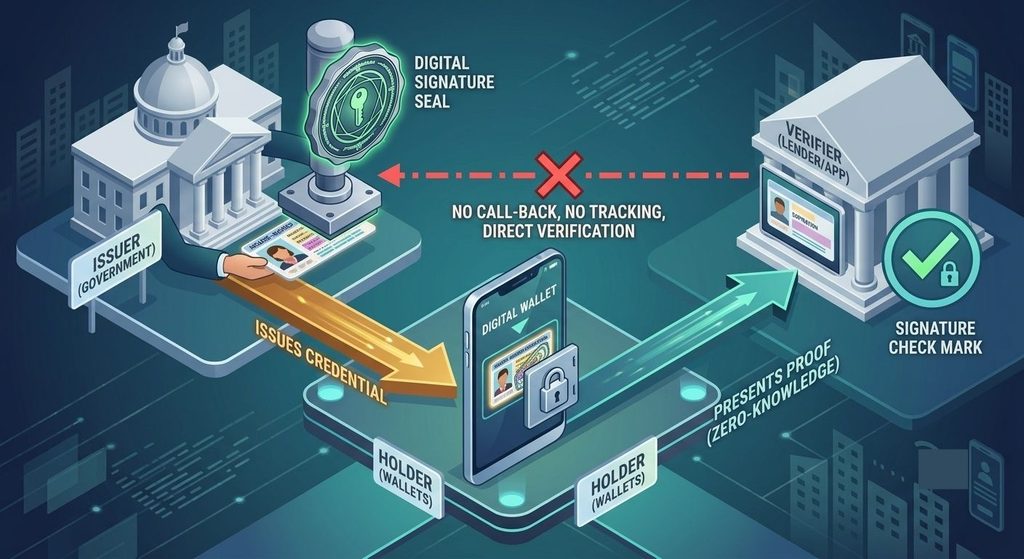
Notably, the verifier does not call the issuer every time. Instead, it checks the issuer’s digital signature on what you present. As a result, the issuer never learns where you used the credential. That one design choice removes a major source of tracking.
DIDs and Verifiable Credentials in Plain Words
Two building blocks make this work. A Decentralized Identifier, or DID, is a unique identifier that you control, not one a company assigns and can take back. Meanwhile, a verifiable credential is a digitally signed statement, such as “this person is over 18”, that anyone can check for authenticity.
Both follow open W3C standards. Therefore, credentials issued in one system can be understood by another, which avoids vendor lock-in. In addition, the cryptographic signature makes tampering detectable, so a verifier can trust the credential without trusting the person blindly.
Still, a signed credential alone does not solve over-sharing. If your credential contains your full birth date and you present it whole, you still reveal too much. That gap is exactly where the next idea comes in.
Zero-Knowledge Proofs: Proving Without Showing
Here is a puzzle. Can you prove you are over 18 without revealing your birth date? It sounds impossible. Yet mathematics says it is not.
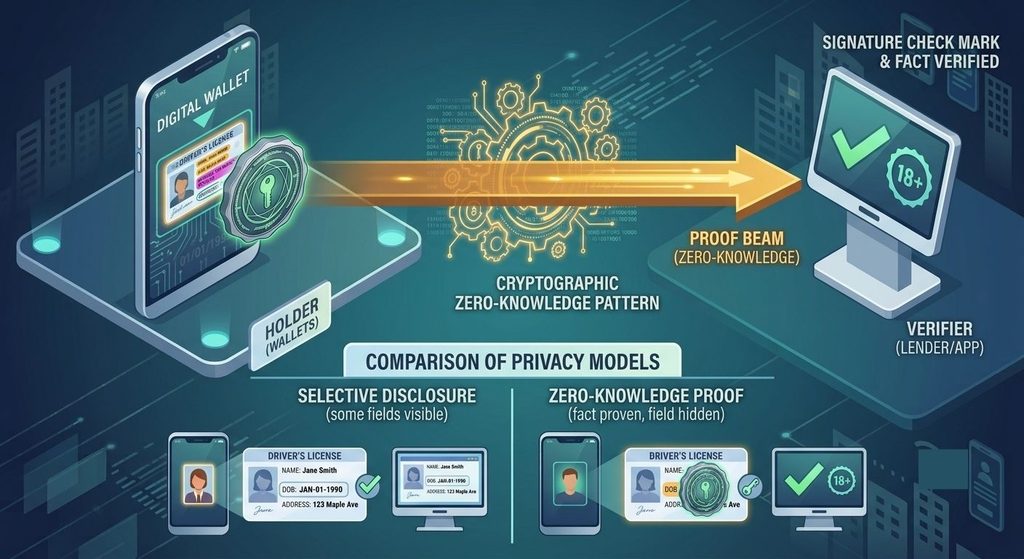
A zero-knowledge proof, or ZKP, lets you convince someone that a statement is true without revealing the data behind it. The verifier learns the answer to one question and nothing else. Importantly, that answer is mathematically checkable, not just a promise.
How a Proof Replaces a Document
Imagine your credential holds your date of birth. Instead of sending that date, your wallet generates a proof that says the signed credential belongs to someone at least 18 years old. The verifier checks the proof against the issuer’s signature. Consequently, the verifier confirms eligibility while your birth date never leaves your device.
Notably, the same logic works for many questions. Is this person a resident of a particular state? Does this account holder meet an income threshold? Does this professional hold a valid licence? In each case, the proof answers yes or no, and the raw data stays private.
Selective Disclosure vs Zero-Knowledge Proofs
People often mix up these two ideas, so a quick comparison helps. Selective disclosure lets you reveal chosen fields from a credential and hide the rest. For example, you share your name but not your address. By contrast, a zero-knowledge proof goes further. It lets you prove a fact about a field without revealing the field itself.
Both techniques reduce exposure. However, the strongest privacy comes from combining them, so each interaction shares the bare minimum. That combination turns “prove who you are” into “prove just enough”.
Here is the third insight. Privacy and verification are not opposites. Most people assume that more privacy means less trust. In reality, cryptography lets you raise both at once, because a proof is stronger evidence than a photocopy ever was.
Meet SecureX-DiD: Privacy-First Identity Built for India
Ideas matter, but enterprises need working products. So where does all this fit for Indian regulated sectors? That is the space SecureX-DiD was built for.
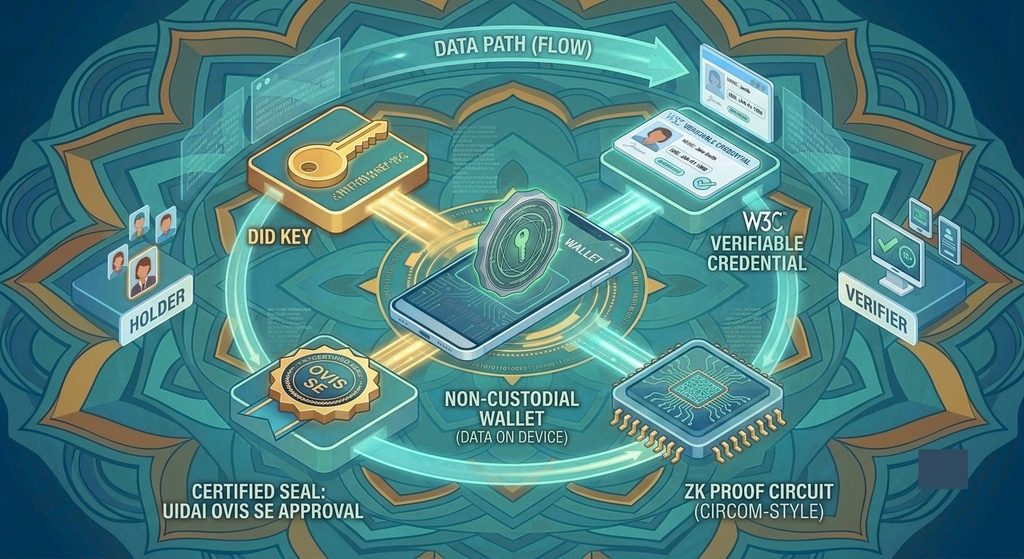
SecureX-DiD is SecureDApp’s decentralized identity solution. It takes a privacy-first approach to authentication and document verification. Furthermore, it is approved under the OVIS SE certification by UIDAI, the Unique Identification Authority of India. Therefore, it speaks to a context where Aadhaar-linked verification matters just as much as privacy.
How SecureX-DiD Works
First, it uses DIDs so each user controls their own identifier. Next, it issues and verifies W3C-compliant verifiable credentials, so credentials stay standardized and portable. Then it applies zero-knowledge proofs, built with Circom circuits, so users can verify documents without exposing sensitive data.
Equally important, the approach is non-custodial. Your data stays on your device, and you decide what to share and with whom. In addition, you can manage, share, or delete credentials whenever you choose. As a result, no central store collects everyone’s identity details for attackers to target.
Why the UIDAI OVIS SE Approval Matters
Credibility matters in identity. A privacy-first design only helps if institutions can trust the verification behind it. For that reason, the approval under UIDAI’s OVIS SE certification gives banks, healthcare providers, and government bodies a recognized anchor for Aadhaar-related checks.
That said, certification is a starting point, not a substitute for good implementation. Teams still need to design purposes, notices, and retention rules with care. Nevertheless, beginning from an approved, privacy-first foundation saves a great deal of rework later.
Real-World Scenarios: Where Proving Less Changes Everything
Theory is useful, yet scenarios make it stick. Let us look at one familiar situation and one illustrative case. Together, they show how the shift from documents to proofs plays out on the ground.
The Photocopy Problem, Solved
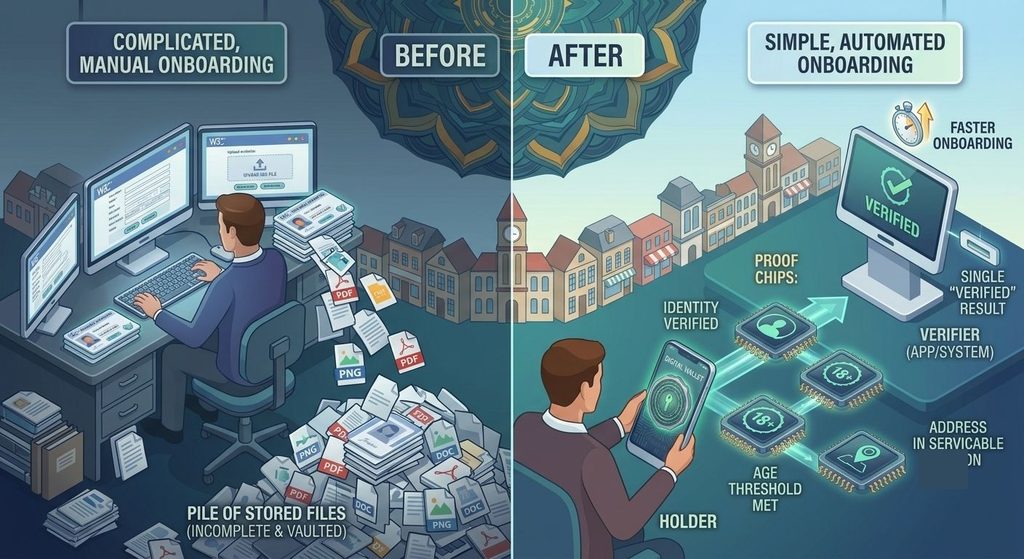
Return to the hotel desk. Today, the guest hands over an ID and the hotel keeps a copy. With a decentralized identity wallet, the guest instead shares a proof that the credential is valid and the holder is an adult. The hotel records “verified” and nothing more.
Consequently, there is no drawer of photocopies to leak, lose, or misuse. The same pattern appears at SIM dealers, rental offices, and gyms, where copies of identity documents often sit in unlocked files. Similarly, each of those places could replace the copy with a one-line proof.
An Illustrative Case: Onboarding a First-Time Borrower
Now picture a lender onboarding a first-time borrower from a small town. This is a hypothetical example, but it mirrors what many financial teams face. Traditionally, the customer uploads several documents, the lender stores them, and partner systems request copies later.
With SecureX-DiD, the flow changes. First, the customer presents proofs from their wallet: identity verified, age above the required threshold, and address within a serviceable region. Next, the lender checks those proofs and stores the verification result. As a result, the lender collects fewer fields, finishes onboarding faster, and holds a much smaller pile of sensitive data.
Importantly, a smaller pile means a smaller breach footprint. If an attacker reaches that lender’s systems, there are no full document images to steal. Therefore, the damage from an incident shrinks dramatically, even if the intrusion itself succeeds.
Other Places Where Less Sharing Wins
Healthcare offers another strong fit. A patient might need to prove insurance eligibility without handing over a medical history. Likewise, a government service could confirm residency without collecting a full address trail. In addition, an employer could verify a degree or licence without calling the issuing body each time.
Each case follows the same pattern. The verifier needs one answer. Therefore, the system should deliver one answer, not a whole identity.
Decentralized Identity and DPDP: Aligned in Spirit, Not a Shortcut
Let us address the regulatory question directly, because compliance teams will ask it first. The DPDP Act expects organizations to process personal data for a specified purpose and to limit collection to what that purpose needs. Moreover, enforcement is phased, with the full substantive obligations arriving from May 2027.
Against that backdrop, decentralized identity is architecturally aligned with the principles behind the law. When a verifier collects a proof instead of a document, it holds less personal data to begin with. Consequently, there is less to protect, less to delete, and less to explain during an audit.
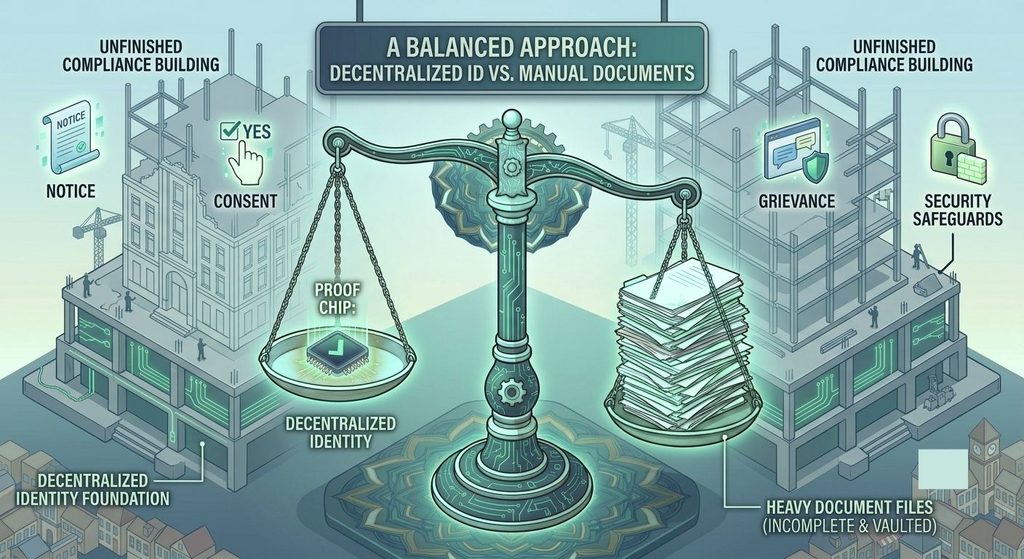
However, honesty matters here. Decentralized identity is not a named compliance mechanism under the Act. It does not replace valid notices, a proper consent process, grievance handling, or reasonable security safeguards. In other words, it makes good practice easier, but it does not make compliance automatic.
Think of it as a strong foundation rather than a finished building. Organizations that collect proofs instead of documents start from a better position. Nevertheless, they still need to map purposes, honour withdrawal requests, and document their decisions.
Meanwhile, a second advantage deserves attention. Because credentials live with the user, deletion becomes simpler. The user can remove a credential from their own device whenever they wish. Therefore, the enterprise no longer holds a copy that it must hunt down across backups and partner systems.
What Enterprises Should Ask Before Adopting Decentralized Identity
Excitement about a new model is healthy, but scrutiny is smarter. Before adopting any identity platform, security and compliance leaders should ask a focused set of questions. Fortunately, the answers reveal quickly whether a solution is ready for real workloads.
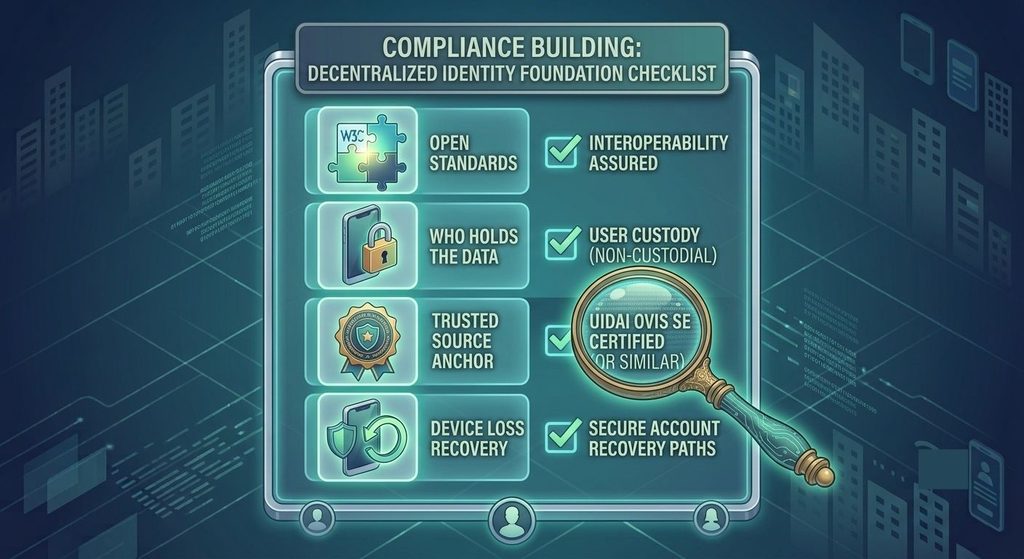
Does It Follow Open Standards?
First, check whether the platform supports W3C DIDs and verifiable credentials. Open standards protect you from lock-in and let credentials travel between systems. In addition, they make future integrations far less painful.
Who Holds the Data?
Next, ask where credentials live. A non-custodial design keeps them on the user’s device, which shrinks your breach surface. By contrast, a platform that quietly stores everything centrally recreates the old problem under a new name.
How Does Verification Anchor to Trusted Sources?
Then, examine the link to issuers. For Indian regulated sectors, an approval such as UIDAI’s OVIS SE certification gives the verification step a recognized anchor. Furthermore, it helps risk teams justify the approach to auditors and regulators.
What Happens When a Device Is Lost?
Finally, test the hard cases. People lose phones, change devices, and forget how to recover access. Therefore, ask how credentials are backed up, restored, and revoked. Here is a fourth insight: adoption is a user experience challenge more than a cryptography challenge. If recovery feels confusing, people will fall back to photocopies.
Making the Shift Without Breaking Your Existing Stack
A common worry is that decentralized identity demands a painful rebuild. In reality, most teams start small. They pick one high-friction journey, such as customer onboarding, and replace document collection with proof requests. Meanwhile, the rest of the stack continues as before.
This phased approach works well for a few reasons. First, it limits risk, since a single workflow acts as the pilot. Next, it produces clear metrics, such as onboarding time, drop-off rate, and the volume of sensitive data stored. As a result, leadership can see the benefit before committing to a wider rollout.
Moreover, early wins build internal confidence. Compliance teams see a smaller data footprint. Engineering teams see cleaner integrations. Customers, finally, notice that they are asked for less. Consequently, momentum grows naturally, and the case for expansion makes itself.
Notably, this approach also helps with vendor and partner relationships. When a partner asks for customer verification, you can share a proof instead of forwarding documents. As a result, fewer third parties ever touch raw identity data, and your decentralized identity rollout quietly reduces risk across the whole ecosystem.
Still, success depends on communication. Explain to users what they are sharing and why, in plain language. Similarly, train support teams to guide people through wallet setup and recovery. After all, even the best cryptography fails if people do not trust or understand the experience.
Conclusion: Trust Does Not Require Total Exposure
Let us bring the threads together. Traditional identity checks collect far more than they need, and every extra field becomes risk that the individual carries. Central databases try to fix this, yet they create honeypots and quiet dependencies of their own.
Decentralized identity offers a cleaner path. Issuers sign facts, holders keep them, and verifiers check proofs. With zero-knowledge proofs and selective disclosure, people prove just enough, and nothing more. Therefore, privacy and trust finally rise together instead of competing.
For Indian enterprises, SecureX-DiD turns that idea into a working option. It combines DIDs, W3C verifiable credentials, and zero-knowledge proofs in a non-custodial design, backed by approval under UIDAI’s OVIS SE certification. Moreover, it fits the direction of the DPDP Act, where collecting less personal data is the smartest place to start.
The next time someone asks you for a full document, remember the hotel desk. Then ask the better question: what is the one fact they truly need? Decentralized identity makes it possible to answer exactly that, and SecureDApp is ready to help you build it into your own workflows.
Ready to verify more while collecting less? Book a SecureX-DiD demo and see how privacy-first identity works in your environment.
Frequently Asked Questions
1. What is decentralized identity in simple terms?
Decentralized identity is a model where you hold your own verified credentials in a wallet on your device. You share only what a service needs, and no central database has to store your full identity.
2. How can I prove something without revealing my data?
A zero-knowledge proof lets you show a statement is true without exposing the data behind it. For example, you can prove you are over 18 without sharing your birth date.
3. What is SecureX-DiD?
SecureX-DiD is SecureDApp’s privacy-first decentralized identity solution. It uses DIDs, W3C verifiable credentials, and zero-knowledge proofs, and it is approved under UIDAI’s OVIS SE certification.
4. Does decentralized identity make an organization DPDP compliant?
No. It is architecturally aligned with principles like collecting only what a purpose needs, but it is not a named compliance mechanism. You still need notices, consent processes, and security safeguards.
5. Is my data stored on a central server with SecureX-DiD?
SecureX-DiD is non-custodial, so your data stays on your device. You decide what to share, with whom, and when to delete a credential.