
Most organizations believe they already have consent figured out. They display a notice, a user clicks accept, and the data flows. What they do not realize is that under India’s Digital Personal Data Protection Act, that click may mean nothing at all.
The DPDP Act does not simply require consent. It requires consent that satisfies four distinct legal standards: free, specific, informed, and unambiguous. Each standard is independently enforceable. Failing even one of them means the consent is invalid, and every processing activity built on it becomes legally questionable. For organizations processing personal data at scale, that is not a theoretical risk. It is a live liability waiting to surface.
This blog unpacks what each of these four standards genuinely demands, where most organizations fall short today, and what a compliant DPDP Consent Management Platform India infrastructure must look like in practice.
Why Consent Is the Cornerstone of DPDP Compliance
The Law Has Set a High Bar and Most Are Not Clearing It
Section 6 of the Digital Personal Data Protection Act establishes consent as the primary legal basis for processing digital personal data. Unlike frameworks that offer multiple equally weighted legal bases, DPDP places consent at the center for most commercial data processing activities.
This matters because it means consent cannot be treated as a bureaucratic formality. It must be real. It must be demonstrable. And it must meet four specific attributes simultaneously.
Furthermore, the DPDP Act requires that the withdrawal of consent must be as easy as giving it. This single sentence has enormous operational implications. Any organization that makes withdrawing consent difficult, confusing, or functionally impossible has already failed the first test of a compliant consent management system.
The question is no longer whether you have a consent notice. The question is whether your consent notice, your consent workflow, and your consent evidence infrastructure actually meet the legal standard. Most currently do not.
What Is at Stake
Penalties under the DPDP Act reach up to Rs 250 crore for significant categories of non-compliance. Beyond the financial exposure, invalid consent means that all downstream processing is unauthorized. If an organization’s marketing, analytics, personalization, or third-party data sharing is built on invalid consent, every one of those activities becomes a separate compliance breach.
The cascading effect of getting consent wrong at the point of collection is what makes this issue so operationally critical. A DPDP Consent Platform that captures consent correctly from the start eliminates this cascading risk entirely.
Free Consent: What Genuine Choice Actually Looks Like
The Problem With Most Consent Flows Today
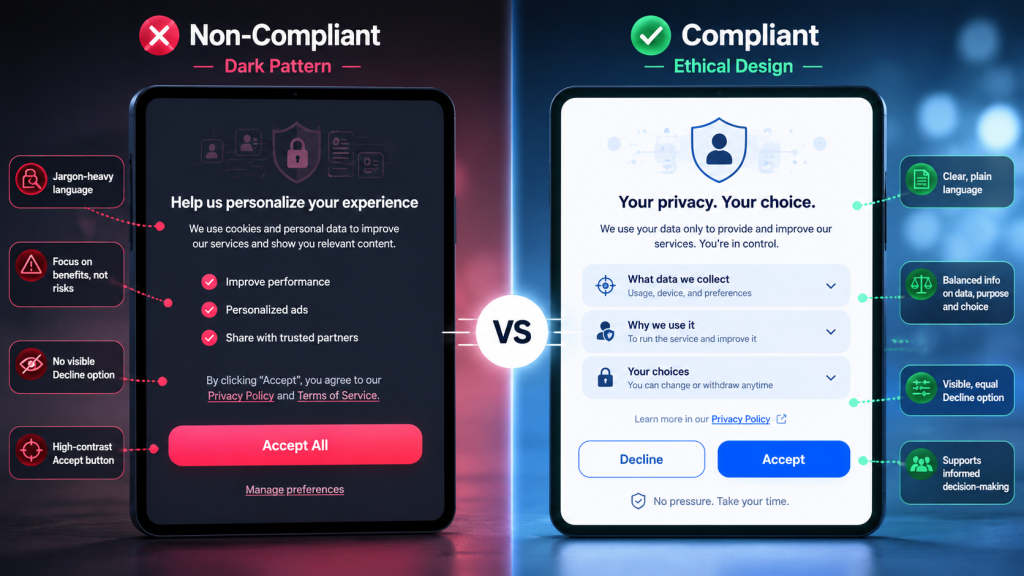
Walk through most digital products and you will find the same pattern. A consent screen appears. The accept button is prominent, brightly colored, and easy to find. The decline or manage preferences option is grey, smaller, and buried in a corner. Sometimes it does not exist at all.
Under DPDP, this design approach is not compliant. Free consent means the data principal has a genuine, uncoerced choice. If the architecture of a consent screen nudges users toward one outcome through visual hierarchy, technical complexity, or functional penalty, the resulting consent is not free.
The Bundling Problem
One of the most common consent failures involves bundling. An organization creates a single acceptance screen that wraps together consent for core service delivery, marketing communications, behavioral analytics, and third-party data sharing. A user who wants to use the service clicks accept because they believe there is no alternative.
The consent feels voluntary. In practice, it is coerced. The user had no real option to accept some processing and decline others. They were presented with a take-it-or-leave-it decision. Under DPDP, that is not free consent.
Free consent requires that each distinct processing purpose be independently presented and independently accepted or declined. Accepting one category of processing should never be a precondition for accessing another category that the user actually needs.
Conditional Access and Consent Walls
A related issue is what regulators in other jurisdictions call consent walls. An organization gates access to a service behind consent for non-essential data processing. No consent, no access. Under the concept of free consent, this arrangement is suspect.
The DPDP Act does not explicitly address consent walls in the same language as GDPR guidance has, but the underlying principle is consistent. Consent that is given because the alternative is exclusion from a service is not freely given in the meaningful sense the law intends.
Organizations building their DPDP Consent Platform must therefore audit every access restriction that is tied to consent. If users are effectively forced to consent to non-essential processing to use a core service, the consent architecture needs redesign.
Withdrawal Must Mirror Collection
Perhaps the most operationally challenging aspect of free consent is the withdrawal requirement. The DPDP Act is explicit: withdrawal must be as easy as giving consent. This places a design obligation on organizations that most have not yet internalized.
If a user gave consent through a three-click process on a mobile app, they must be able to withdraw consent through an equivalent or simpler process. If withdrawal requires navigating to a settings page, submitting a written request, or waiting for manual processing, the consent architecture fails the free standard.
A proper consent management system must therefore include a self-service withdrawal interface that is equally prominent and equally accessible as the original consent collection point.
Specific Consent: Why One Checkbox Cannot Cover Everything
The Failure of General Purpose Consent
Specificity is the attribute that most dramatically changes how organizations must structure their consent workflows. The assumption that a single general consent covers all data processing purposes is one of the most widespread compliance misconceptions in the industry.
Under DPDP, consent must be specific to each purpose. If your organization processes personal data for six different purposes, you need six separate, independently captured consents. A single acceptance screen that lists multiple purposes in fine print does not meet the specificity standard.
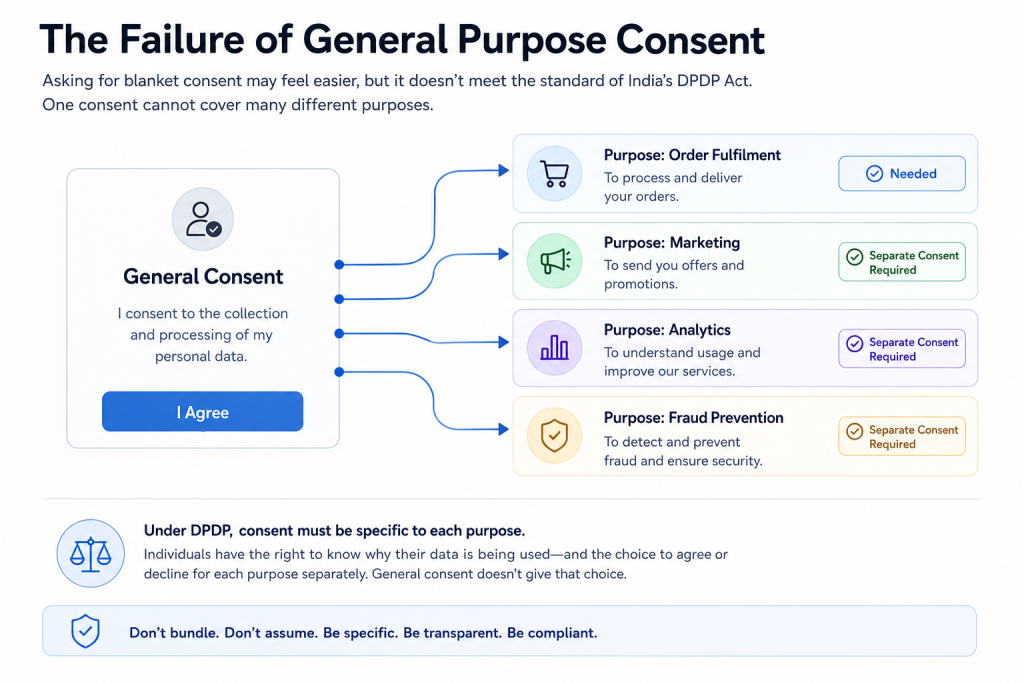
This is not a technicality. It is a fundamental reorientation of how consent must be architected. A compliant DPDP Consent Management system must treat each processing purpose as a discrete consent event with its own record, its own notice, and its own withdrawal pathway.
What Counts as a Distinct Purpose
Understanding what constitutes a distinct purpose is essential for designing a specific consent workflow. The question is whether a data principal, looking at two different processing activities, would consider them to be the same thing or different things.
Processing personal data to fulfill a purchase order and processing the same data to send promotional emails are clearly distinct purposes. They serve different organizational goals, involve different processing activities, and carry different implications for the data principal. They require separate consents.
Processing personal data to provide customer support and using support interaction data to train internal machine learning models are also distinct purposes, even though they involve the same starting data point. The training activity is not what the user expected when they contacted support. It needs its own consent.
A granular consent management platform must therefore support purpose mapping at this level of specificity, with each purpose receiving its own consent record and evidence trail.
The Semantic Trap of Vague Purpose Descriptions
A related problem is the use of deliberately vague purpose descriptions to make a single consent appear to cover multiple processing activities. Phrases like “to improve our services” or “for research and analytics purposes” are engineered to be broad enough to justify almost any internal processing.
DPDP’s specificity requirement closes this loophole. A purpose description that could mean anything effectively means nothing. The consent notice must describe the purpose with enough precision that a data principal can actually understand what they are agreeing to and make a meaningful choice.
Vague purpose language in a consent notice should be treated as a red flag during any DPDP compliance audit. It suggests the organization has not actually mapped its processing activities with the necessary precision.
Cascading Consent for Secondary Processing
Another specificity challenge involves secondary processing, situations where personal data collected for one purpose is later used for a different purpose. This is common in organizations that aggregate behavioral data for initial service delivery and later use that data for model training, cross-selling, or third-party analytics.
Each secondary use requires fresh, specific consent unless it falls within a DPDP-recognized legitimate use category. Organizations cannot assume that consent given for primary collection extends to secondary processing by default. A compliant consent management system must track the purpose for which each piece of personal data was collected and flag when secondary use requires additional consent.
Informed Consent: The Content and Clarity Standard
What the Notice Must Actually Say
Informed consent places a content obligation on organizations. It is not enough to ask for consent. The request must be accompanied by a notice that genuinely enables the data principal to understand what they are agreeing to.
Under DPDP, a consent notice must communicate specific elements clearly. The data principal must understand what personal data is being collected, the specific purpose for which it will be processed, whether and with whom it will be shared, the rights they hold including the right to withdraw and the right to raise grievances, and how those rights can be exercised.
This is not a list that can be buried in a thirty-page privacy policy linked in small text below the consent button. The information must be accessible, clear, and actually read before consent is given. The architecture of the consent flow itself must support informed decision-making.
The Plain Language Requirement
The DPDP Act requires consent notices to be in clear and plain language. This seemingly simple requirement carries significant weight. Legal boilerplate written to protect the organization rather than to inform the user is not plain language. Technical jargon that the average person cannot parse is not plain language. Dense paragraphs that convey information in a way that discourages actual reading are not plain language.
A practical test: if a non-technical adult reading the consent notice for the first time cannot summarize what they are agreeing to within ninety seconds, the notice is not compliant.
Organizations designing consent notices for a DPDP Consent Platform should apply a readability standard. Grade 6 to 8 reading level is appropriate. Sentences should be short. Key information should be surfaced prominently, not buried.
Layered Notice Architecture
One effective approach that balances completeness with clarity is the layered notice. The first layer presents the most important information in plain language: what data is collected, why, and what the user can do about it. A second layer, accessible through a clear link or expand action, provides full detail for users who want it.
This architecture serves both the plain language requirement and the completeness requirement simultaneously. It ensures that users are not overwhelmed with information at the point of consent while ensuring that full information is available to those who seek it.
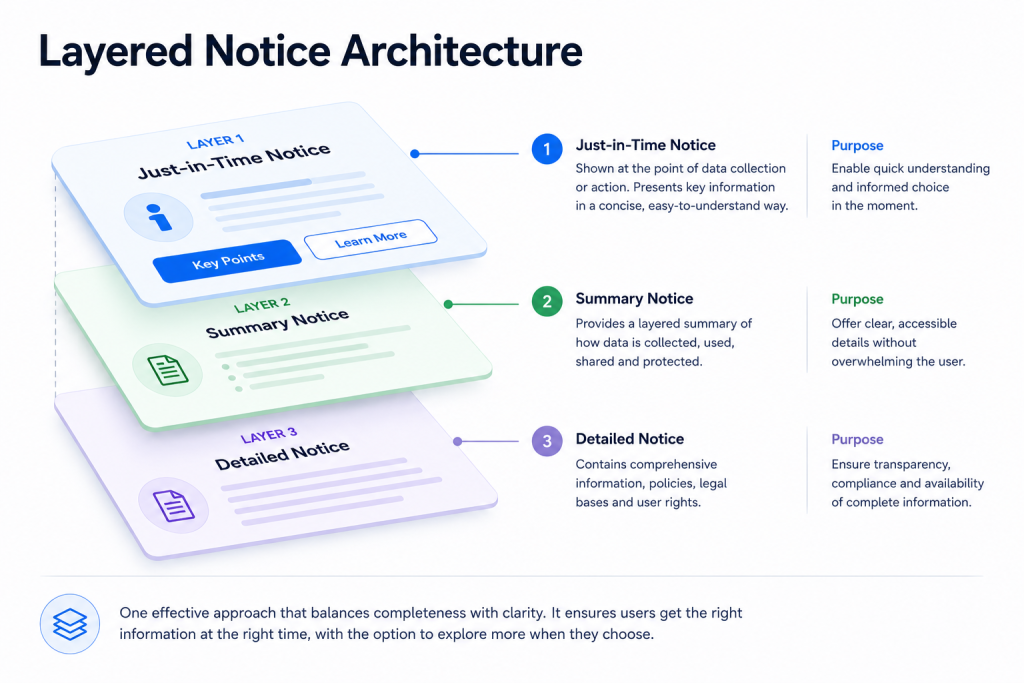
A well-designed DPDP Consent Platform should support layered notice delivery natively, with each layer version-controlled and logged as part of the consent record.
Third-Party Sharing Disclosure
One area where informed consent frequently breaks down is third-party data sharing. Organizations routinely share personal data with advertising networks, analytics providers, data enrichment services, and business partners. Many consent notices acknowledge this in vague terms without specifying who the third parties are.
DPDP’s informed consent standard requires that the data principal understands who will receive their personal data. This means third-party disclosures in consent notices must be specific enough to be meaningful. Listing specific categories of third parties and, where appropriate, naming specific processors is the direction informed consent pushes organizations.
This is not just a notice design challenge. It is an organizational challenge. It requires mapping data flows at a detailed level and reflecting that mapping accurately in consent notices. Organizations that have not conducted a thorough data flow audit cannot build a truly informed consent notice because they do not actually know who receives their users’ data.
Unambiguous Consent: Eliminating Passive and Assumed Consent
What Unambiguous Actually Rules Out
Unambiguous consent is the standard that eliminates the most common shortcuts organizations have used for years to collect consent with minimal friction. Pre-ticked checkboxes, implied consent through continued use of a service, bundled consent in terms and conditions, consent collected through inaction or silence: all of these fail the unambiguous standard.
The data principal must take an active, affirmative step to signal consent. There must be no doubt about what they have agreed to or whether they have agreed at all. Ambiguity is disqualifying, not merely problematic.
Active Affirmative Action: What It Requires
An active affirmative action is any deliberate step the data principal takes that can only reasonably be interpreted as expressing consent to the specific processing described. Ticking a clearly labeled, unchecked checkbox qualifies. Clicking a button that says “I agree to the processing of my data for marketing purposes” qualifies. Scrolling past a notice does not qualify. Clicking “Continue” on a page that happens to contain a consent notice in the footer does not qualify.
The design of the consent collection interface must make the affirmative action obvious, intentional, and unambiguous. There must be no way to accidentally give consent. There must be no way to interpret a user action as consent when the user was actually doing something else.
Consent Bundled in Terms of Service
One of the most persistent compliance failures involves embedding consent within terms of service or end-user license agreements. A user accepts the terms to create an account. Buried within those terms is language that constitutes the organization’s consent notice. The acceptance of the terms is treated as the consent.
This approach fails the unambiguous standard on multiple counts. The user’s action of accepting terms is primarily directed at agreeing to service conditions, not to specific data processing purposes. The consent element is not surfaced as a distinct action. The specificity requirement is also typically violated because terms of service consolidate multiple purposes without individual acceptance mechanisms.
Separate consent collection at a distinct interface, after or alongside terms acceptance, is the only approach that meets the unambiguous standard.
Consent Through Dark Patterns
Dark patterns are design techniques that manipulate user behavior toward outcomes that serve the organization rather than the user. In the context of consent, common dark patterns include confirm-shaming (framing the decline option in guilt-inducing language), hidden opt-outs (making the decline path technically available but difficult to find), and repeated consent requests after a user has declined.
The DPDP Act’s requirement for unambiguous consent implicitly prohibits dark patterns by requiring that the consent action be genuinely affirmative and not the product of manipulation. A consent management system that deploys dark patterns does not produce valid consent. It produces coerced clicks that look like consent in server logs but carry no legal weight.
Building a Consent Infrastructure That Meets All Four Standards
The Gap Between Awareness and Infrastructure
Many organizations now understand, at least in general terms, that DPDP requires more rigorous consent practices. The understanding is growing. The infrastructure is not keeping pace.
Understanding the four standards is the first step. Building a consent management system that operationalizes all four simultaneously is the challenge that requires dedicated technology investment.
What a Compliant Consent Management System Must Do
A consent management system built for DPDP must capture consent through an affirmative action interface that presents specific, plain-language notices per purpose. It must record each consent event with a complete evidence record: the notice version shown, the purposes presented, the action taken, the timestamp, and the user identifier. It must enable withdrawal through an equally accessible self-service interface. It must propagate withdrawal signals to all downstream processing systems in real time. It must maintain version control over consent notices and identify which data principals need to re-consent when notices change. And it must generate audit-ready consent reports on demand.
This is not a feature set that can be assembled from a generic cookie consent banner and a standard CMS. It requires purpose-built consent management infrastructure.
SecureCMS and Purpose-Level Consent Management
SecureCMS, SecureDApp’s secure content management system, addresses the infrastructure challenge that DPDP compliance creates. Rather than treating consent as an add-on feature, SecureCMS embeds consent management into its core architecture.
For organizations that need granular, purpose-specific consent capture with immutable logging and real-time withdrawal propagation, SecureCMS provides the operational foundation. Its consent workflow management supports the design of specific, layered consent flows per processing purpose. Its consent log architecture captures tamper-evident evidence of every consent interaction. Its withdrawal infrastructure ensures that declining consent at any point removes authorization from all connected processing systems immediately.
The platform also supports consent policy version control, ensuring that organizations can manage the lifecycle of consent notices and identify re-consent requirements automatically rather than through manual audits.
Consent Evidence: What Regulators Will Actually Ask For
When the Data Protection Board investigates a complaint or conducts an audit, they will ask for evidence. Not assertions. Evidence. They will want to see the specific consent notice that was presented to a specific data principal on a specific date. They will want to see the action that was taken and when. They will want to see whether withdrawal was requested and how it was handled.
Organizations that cannot produce this evidence on demand face penalties not just for the underlying consent failure but for the failure to demonstrate compliance. The DPDP Act places the burden of proof on the data fiduciary. The absence of adequate consent records is itself a violation.
This is what makes a proper consent management system with immutable consent logs, version-controlled notices, and complete audit trails not an optional enhancement but a core compliance requirement.
Conclusion: Valid Consent Is Not a Feature. It Is a Foundation.
The four standards of DPDP consent, free, specific, informed, and unambiguous, are not abstract legal concepts. They are operational requirements that every data collection touchpoint, every consent notice, and every consent management system must satisfy simultaneously.
Organizations that address consent as a checkbox exercise will find that their consent architecture collapses under regulatory scrutiny. The evidence will not be there. The specificity will not be there. The withdrawal infrastructure will not be there.
The organizations that build consent management as foundational infrastructure, anchored in purpose-level specificity, genuine user choice, clear communication, and affirmative action collection, will be the ones that can demonstrate compliance with confidence when it matters.
SecureCMS provides the consent management infrastructure that makes that demonstration possible. In a regulatory environment where the burden of proof sits with the data fiduciary, having the right consent foundation is not optional. It is essential.
Frequently Asked Questions
1. What does “free consent” mean under the DPDP Act? Free consent means the data principal has a genuine, uncoerced choice. They can accept or decline processing without being penalized for declining, without being denied access to services they need, and without the consent flow being designed to nudge them toward acceptance through manipulation or architectural pressure.
2. Can I get consent for multiple purposes in a single screen? You can present multiple purposes on a single screen, but each purpose must have its own independent acceptance mechanism. A user must be able to accept some purposes and decline others. A single “accept all” button that bundles multiple purposes without individual controls does not meet the specificity requirement.
3. What happens if a user withdraws consent after giving it? Once consent is withdrawn, you must cease processing the personal data for the purpose covered by that consent. Withdrawal does not affect the lawfulness of processing that occurred before withdrawal, but all future processing must stop. The withdrawal event must be recorded and the signal propagated to all connected systems.
4. Are pre-ticked checkboxes valid under DPDP? No. Pre-ticked checkboxes require the user to actively untick them to decline. This inverts the requirement for an affirmative action. Under DPDP’s unambiguous consent standard, the default position must be no consent, and consent must result from an active opt-in.
5. What is a layered consent notice? A layered notice presents the most important consent information clearly and concisely at the top level, with a link to more detailed information for users who want it. This approach balances the plain language requirement with the completeness requirement, ensuring both clarity and thoroughness.