

Every enterprise that handles sensitive data eventually faces the same question. Where should your cryptographic keys actually live? The answer used to be simple. Buy a hardware security module, install it in your data center, and move on. Today, that decision has become far more complicated.
Cloud adoption has changed how enterprises think about infrastructure. At the same time, quantum computing is quietly reshaping what “secure” even means for cryptographic keys. As a result, the Cloud HSM vs on-premises debate is no longer just about convenience or cost. It is about long-term resilience.
This guide breaks down both models in detail. You will understand how each works, where they differ, and which one fits your enterprise’s risk profile, compliance obligations, and quantum-readiness timeline.
Why This Decision Matters More Than Ever
A hardware security module, or HSM, is a dedicated device built to generate, store, and manage cryptographic keys. It handles encryption, decryption, digital signing, and authentication for some of the most sensitive operations in your organization. Banking transactions, digital certificates, blockchain wallets, and identity verification systems all depend on HSMs working correctly.
For years, the choice between cloud and on-premises HSMs came down to familiar tradeoffs. Control versus convenience. Capital expense versus operating expense. However, a new variable has entered the equation: post-quantum cryptography, or PQC.

Quantum computers capable of breaking today’s public-key encryption are not yet operational at scale. Nevertheless, security teams are preparing now, because migrating cryptographic infrastructure takes years, not months. Notably, “harvest now, decrypt later” attacks are already a documented concern. Adversaries can collect encrypted data today and decrypt it once quantum capabilities mature.
This means your HSM strategy cannot just answer today’s questions. It has to account for quantum-safe security, crypto-agility, and how easily your organization can migrate to PQC algorithms when the time comes. That single requirement changes how Cloud HSM and on-premises HSM should actually be evaluated.
Understanding On-Premises HSM
An on-premises HSM is physical hardware that your organization owns, houses, and operates within its own data center. It is a tangible, dedicated appliance under your direct control.

How It Works
Your IT and security teams manage every aspect of the device. This includes installation, firmware updates, access policies, and physical security. Keys never leave your infrastructure unless you explicitly export them, which gives many security teams a strong sense of assurance.
Strengths of On-Premises HSM
Physical control is the biggest advantage. Your keys sit inside hardware you can see, audit, and lock behind your own security perimeter. For industries with strict data residency rules, such as banking or government, this matters enormously.
On-premises HSMs also offer predictable latency, since cryptographic operations happen locally without network round trips to an external provider. Additionally, some regulated sectors still require on-premises key custody as a matter of policy, not preference.
Limitations of On-Premises HSM
The tradeoffs are significant, though. On-premises HSMs require substantial upfront capital investment, dedicated hardware maintenance, and specialized staff to manage them properly. Scaling means buying more hardware, which takes time and budget approval.
Furthermore, disaster recovery becomes your responsibility entirely. If a data center goes offline, so does your key management capability, unless you have built expensive redundancy across multiple sites. Firmware updates and security patches also depend on your internal team staying current, which is not always realistic for smaller security departments.
Understanding Cloud HSM
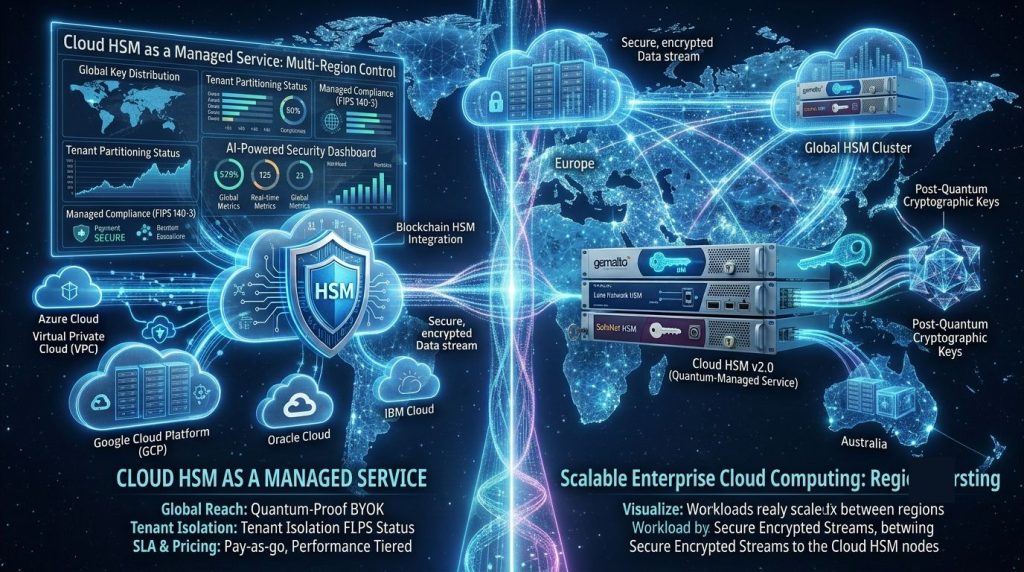
A Cloud HSM delivers the same cryptographic functions, generating, storing, and managing keys, but through a cloud-based service model instead of physical hardware you own.
How It Works
Cloud providers offer HSM capabilities as a managed service. Your organization provisions cryptographic resources on demand, without purchasing or maintaining physical appliances. The underlying hardware still exists, but it is managed by the provider within their secure infrastructure.
Strengths of Cloud HSM
Elasticity is the standout benefit. As your enterprise grows, you can scale cryptographic capacity instantly, without procurement delays. This matters especially for organizations with unpredictable transaction volumes or seasonal spikes.
Cost structure shifts from capital expenditure to operating expenditure, which many finance teams prefer. There is no hardware to maintain, no firmware to patch manually, and no dedicated facility required. Cloud HSMs also typically include built-in redundancy across regions, improving disaster recovery posture without additional investment from your team.
Importantly, cloud HSM providers often move faster on supporting new cryptographic standards, including early PQC algorithm support, since they manage infrastructure updates centrally.
Limitations of Cloud HSM
Even so, Cloud HSM is not without concerns. Your keys, while encrypted and isolated, technically reside within a third-party environment. For organizations with strict data sovereignty requirements, this can create compliance friction.
Network dependency is another factor. Cryptographic operations require connectivity to the cloud provider, introducing latency that on-premises deployments avoid. There is also the question of vendor lock-in, since migrating cryptographic infrastructure between providers is rarely straightforward.
Cloud HSM vs On-Premises: A Side-by-Side Comparison
Here is how the two models stack up across the factors that matter most to enterprise security teams.
Security and Control On-premises HSM gives you full physical custody of keys. Cloud HSM offers strong logical isolation, but keys exist within a shared infrastructure managed by a third party.
Cost Structure On-premises HSM demands high upfront capital investment. Cloud HSM shifts costs to a predictable operating expense model with lower initial spend.
Scalability On-premises HSM scales through hardware procurement, which takes weeks or months. Cloud HSM scales instantly, on demand.
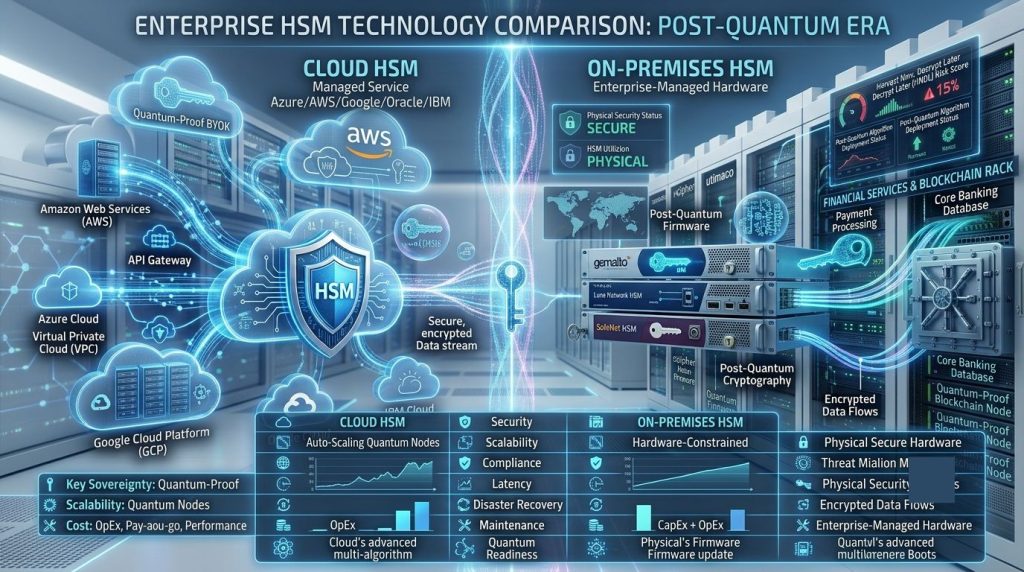
Disaster Recovery On-premises HSM requires you to build your own redundancy. Cloud HSM typically includes multi-region resilience by default.
Compliance and Data Residency On-premises HSM satisfies strict residency mandates directly. Cloud HSM depends on provider certifications and regional data controls.
Maintenance Burden On-premises HSM requires dedicated internal staff for updates and monitoring. Cloud HSM shifts most operational maintenance to the provider.
Latency On-premises HSM delivers local, low-latency cryptographic operations. Cloud HSM introduces network-dependent latency.
Quantum Readiness On-premises HSM upgrades to PQC support only through firmware or hardware refresh cycles. Cloud HSM providers can roll out quantum-safe algorithm support more rapidly through centralized updates.
As this comparison shows, neither model is universally superior. The right choice depends on your industry, risk tolerance, and how quickly you need to adapt to emerging cryptographic standards.
Why PQC and Crypto-Agility Change the Calculus
Here is the insight most enterprises miss. The Cloud HSM vs on-premises decision is no longer just about where keys live. It is about how easily your organization can transition to quantum-resistant cryptography when current algorithms become vulnerable.
NIST has already finalized post-quantum cryptography standards, and regulators worldwide are beginning to reference them in guidance. Consequently, enterprises need crypto-agility, meaning the ability to swap cryptographic algorithms without rebuilding entire systems from scratch.
This is where the conversation shifts. A rigid on-premises HSM that cannot easily support hybrid encryption, combining classical and quantum-resistant algorithms, may become a liability during migration. Similarly, a Cloud HSM without a clear PQC roadmap creates the same risk, just in a different environment.

Enterprises should ask a pointed question before committing to either model: does this HSM deployment support a PQC migration path, hybrid crypto operation, and centralized policy enforcement across both classical and quantum-safe keys? If the answer is unclear, the deployment model itself becomes a future bottleneck.
Consider a mid-sized bank running critical payment infrastructure on an aging on-premises HSM cluster. When their compliance team flags an upcoming PQC mandate, the security team realizes their hardware cannot support quantum-resistant algorithms without a costly, multi-year hardware refresh. Had crypto-agility been part of the original evaluation criteria, that scramble could have been avoided entirely.
Regulatory Pressure Is Accelerating PQC Adoption
Regulated industries in India and globally are paying close attention to quantum risk. Reserve Bank of India guidelines on data security, SEBI’s cybersecurity frameworks, and PCI DSS requirements for payment infrastructure are all beginning to reference forward-looking cryptographic resilience, not just current-state encryption strength.
This matters because BFSI institutions cannot simply wait for a mandate to appear before acting. Regulatory cycles move slowly, but cryptographic migrations move slower still. Therefore, enterprises in banking, insurance, and financial services need to treat PQC readiness as a present-day planning requirement, not a future project.

The same logic applies to government-adjacent sectors and any organization handling long-lived sensitive data. If information needs to remain confidential for ten or twenty years, it needs quantum-resistant protection now, regardless of when quantum computers actually mature.
Choosing the Right Model for Your Enterprise
So how should enterprises actually decide? A few questions can clarify the path forward.
First, consider your regulatory environment. If your industry mandates strict data residency or physical key custody, on-premises HSM may be non-negotiable, at least for your most sensitive workloads.
Second, evaluate your growth trajectory. Rapidly scaling organizations, particularly those with variable transaction volumes, often benefit from the elasticity Cloud HSM provides. Major cloud providers, such as Google Cloud’s HSM service, illustrate how quickly managed key management capacity can be provisioned compared to procuring physical hardware.

Third, and increasingly critical, assess crypto-agility. Can your chosen deployment support hybrid encryption during a PQC transition? Does it offer centralized PQC policy enforcement, audit logging, and key management across both classical and quantum-safe algorithms?
Many enterprises are landing on a hybrid approach. Sensitive, regulated workloads remain on-premises, while less sensitive or rapidly scaling operations move to cloud-based key management. This is not indecision. It is a deliberate strategy that balances control with flexibility, while keeping quantum-readiness in view.
Where QuantumVault Fits Into This Decision
This is precisely the gap QuantumVault was built to close. Rather than forcing enterprises to choose between rigid on-premises control and cloud flexibility, QuantumVault provides a quantum-ready platform designed for crypto-agility from the ground up.
QuantumVault supports hybrid encryption, allowing enterprises to run classical and post-quantum algorithms side by side during migration, instead of facing a disruptive all-at-once switch. Its PQC key management and governance layer gives security teams centralized visibility and policy control, whether keys are managed through cloud infrastructure, on-premises hardware, or a mixed deployment.
For BFSI and other regulated enterprises, QuantumVault’s PQC compliance and audit logging capabilities help align key management practices with evolving RBI, SEBI, and PCI DSS expectations. Its quantum-safe gateway and secure signing workflows extend protection across web, mobile, server, and device environments, not just the HSM layer itself.
In practice, this means an enterprise does not need to choose Cloud HSM or on-premises HSM in isolation. QuantumVault’s PQC migration framework and policy engine can operate across both models, giving security teams a unified path toward quantum-resistant infrastructure regardless of where their keys physically reside today.
Conclusion
The Cloud HSM vs on-premises decision has always involved real tradeoffs around control, cost, and scalability. However, the emergence of quantum computing threats has added a new, non-negotiable requirement: crypto-agility.
Enterprises that evaluate HSM deployment purely on today’s operational needs risk building infrastructure that cannot adapt when PQC migration becomes mandatory. Instead, the smarter approach treats quantum-readiness as a core evaluation criterion from day one, alongside security, compliance, and cost.
Whether your organization ultimately chooses cloud, on-premises, or a hybrid model, the underlying question remains the same. Can your key management infrastructure evolve as cryptographic standards shift? Platforms like QuantumVault exist to make sure the answer is yes, regardless of where your keys live today.
If your team is mapping out a quantum-ready HSM architecture, schedule a demo with QuantumVault to see how hybrid encryption and PQC governance work across your existing cloud and on-premises environments.
Frequently Asked Questions
1. What is the main difference between Cloud HSM and on-premises HSM?
On-premises HSM is physical hardware owned and managed entirely by your organization, giving direct custody of keys. Cloud HSM delivers the same cryptographic functions as a managed service, offering elasticity and reduced maintenance in exchange for third-party infrastructure dependency.
2. Is Cloud HSM less secure than on-premises HSM?
Not necessarily. Cloud HSM providers implement strong encryption and isolation controls. The real difference lies in custody and compliance posture, not inherent security weakness.
3. Which industries typically require on-premises HSM?
Highly regulated sectors like banking, government, and healthcare often require on-premises HSM due to strict data residency and physical custody mandates, though this is shifting as cloud compliance certifications mature.
4. Why does post-quantum cryptography matter for HSM selection?
Quantum computers will eventually break current public-key encryption. Choosing an HSM model that supports crypto-agility and hybrid encryption ensures your enterprise can migrate to quantum-resistant algorithms without a disruptive infrastructure overhaul.
5. Can enterprises use both Cloud HSM and on-premises HSM together?
Yes. Many enterprises adopt a hybrid strategy, keeping regulated workloads on-premises while scaling other operations in the cloud. Platforms like QuantumVault support this hybrid approach with unified PQC governance across both environments.