
A gig worker walks into a warehouse for a same-day onboarding shift. A tenant signs a rental agreement without visiting a broker’s office. A patient checks into a hospital at 2 a.m. without a single physical document in hand. In every one of these moments, someone on the other side of the counter has to answer one question fast: is this person who they claim to be?
For years, that answer came from a photocopy, an OTP, or a QR code scan. None of these methods confirmed that the human standing in front of you matched the identity being presented. Aadhaar Offline Face Verification changes that equation. It lets an Offline Verification Seeking Entity, commonly called an OVSE, capture a live facial image and match it against the Aadhaar holder’s own credential, without ever touching UIDAI’s central servers.
This shift matters more than it appears on the surface. It is not just a new feature inside the Aadhaar app. It is UIDAI’s clearest move yet toward a consent-driven, credential-based verification model, one that looks strikingly similar to the architecture behind self-sovereign identity and decentralized identity systems used globally. For OVSE-registered entities, understanding this mechanism is the first step. Understanding what it cannot do on its own is the second, and arguably more important one.
This blog breaks down exactly how Aadhaar Offline Face Verification works, what registration as an OVSE actually requires, and where enterprises need a broader decentralized identity layer, such as SecureX DID, to turn a single verification event into a durable, portable identity system.
What Is Aadhaar Offline Verification and Why the Rules Changed
Offline verification has existed for years in a limited form. Entities collected a printed Aadhaar letter, an e-Aadhaar PDF, or scanned a QR code from a PVC card. Each method validated a digital signature against the printed data, but none of it happened in real time, and none of it confirmed the person holding the document was the actual Aadhaar number holder.
The Aadhaar Authentication and Offline Verification Amendment Regulations, 2025, restructured this entire framework. Moreover, UIDAI consolidated offline verification into three recognized methods, each with a different trust level and a different registration requirement.
The Three Modes of Offline Verification Today
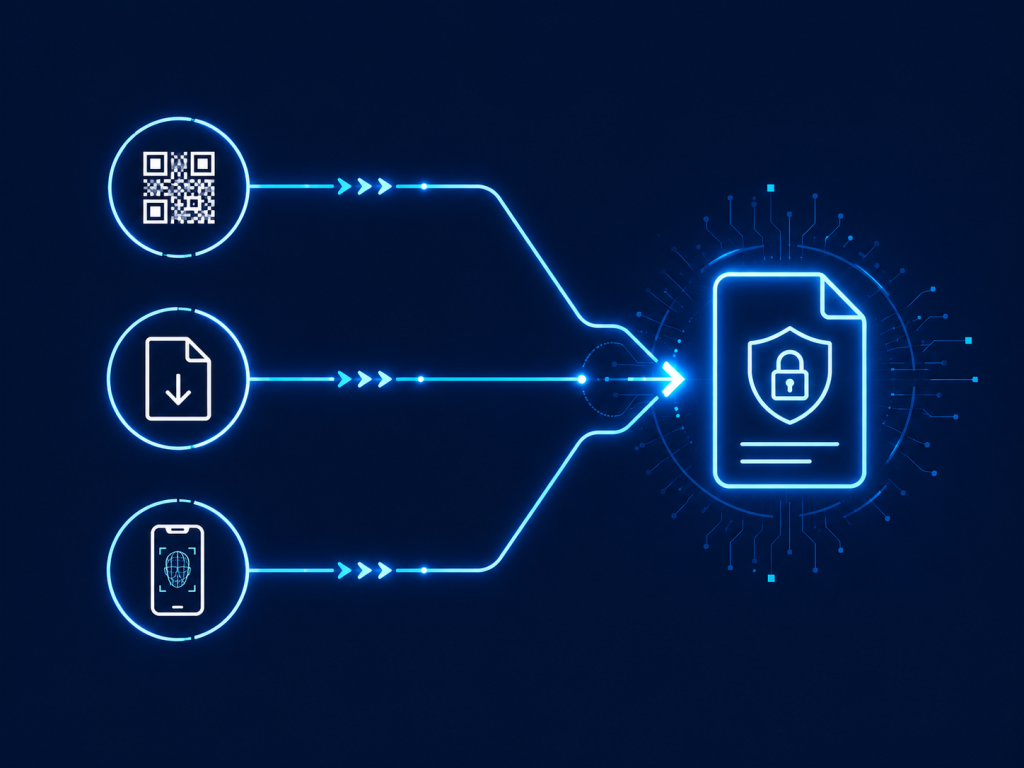
QR code verification remains the simplest option. An entity scans the secure QR code embedded in a physical Aadhaar letter, PVC card, or downloaded e-Aadhaar, then validates UIDAI’s digital signature against the printed details. No registration is required, but the method offers no proof that the document holder is physically present.
Aadhaar Paperless Offline e-KYC works in a similar way. The Aadhaar holder downloads a signed XML or PDF file directly from UIDAI’s portal and shares it with the verifying entity, which checks the embedded signature.
Aadhaar Verifiable Credential verification is the newest and most significant addition. It allows an Aadhaar holder to share a digitally signed credential directly from the Aadhaar app, with or without Offline Face Verification layered on top. This is the mode that requires formal OVSE registration, and it is the one reshaping enterprise identity verification in India.
Understanding OVSE, the Offline Verification Seeking Entity
An OVSE is any organization that seeks to perform offline verification of an Aadhaar number holder. That definition is intentionally broad. It covers banks, NBFCs, fintech platforms, hospitals, gig economy apps, cab aggregators, gated community management systems, recruitment firms, and even government departments running eligibility checks.
Not every OVSE needs to register with UIDAI. Non-registered entities can still rely on QR code scanning or e-Aadhaar validation without any formal onboarding. However, only registered OVSEs can unlock Aadhaar Verifiable Credential verification through the Aadhaar app, including the ability to request Offline Face Verification for proof of presence.
This distinction is the crux of the entire framework. Registration is what turns a passive document check into an active, consent-backed, presence-verified identity transaction.
What Is Aadhaar Offline Face Verification, Technically Speaking
The Amendment Regulations define Offline Face Verification as a mode in which a live facial image of an Aadhaar number holder is captured and verified against the photograph stored within the Aadhaar application, for correctness or lack thereof. That single sentence carries a lot of technical weight, so it helps to unpack it piece by piece.
The Role of the Aadhaar Verifiable Credential
Before any face matching happens, the Aadhaar holder must possess an Aadhaar Verifiable Credential, or AVC. This is a digitally signed document issued directly by UIDAI, containing the last four digits of the Aadhaar number, selected demographic details such as name, address, gender, and date of birth, and a photograph of the holder.
Because UIDAI signs the AVC cryptographically, the credential is tamper-proof and instantly verifiable without needing a live connection back to UIDAI’s Central Identity Data Repository, known as the CIDR. This is precisely what makes the entire process offline. The trust anchor already lives inside the credential.
How the Face Match Actually Runs
Once an Aadhaar holder shares their AVC with a registered OVSE through the Aadhaar app, the app can trigger a local face capture. The device camera records a live image of the person, and the app’s face matching engine compares that image against the photograph embedded in the AVC.

Notably, this comparison happens on the device itself. There is no round trip to UIDAI’s servers for the match. Once the comparison completes, the Aadhaar app generates a signed output confirming whether the live face matches the stored photograph. That signed result, not the raw biometric image, is what gets shared with the OVSE.
This design choice matters for privacy. Biometric data does not leave the Aadhaar holder’s device in raw form. Only a cryptographically signed confirmation travels to the entity requesting verification.
Why This Differs from Traditional Aadhaar Face Authentication
Readers familiar with Aadhaar’s existing face authentication feature might wonder how this differs. Traditional face authentication, used by requesting entities under Aadhaar’s online authentication ecosystem, connects live to UIDAI’s servers and checks the captured face against the biometric record stored in the CIDR.
Offline Face Verification instead checks the face against a photograph already embedded in a previously issued, digitally signed credential. As a result, it does not require live connectivity to UIDAI at the moment of verification, and it fits naturally into low-connectivity or field environments such as rural onboarding drives or on-site facility checks.
How Registered OVSEs Actually Use This in Practice
Knowing the mechanism is one thing. Knowing how to operationalize it is another, and this is where many compliance teams stall.
The Registration Path Under Regulation 13A
An entity wanting to perform AVC or Offline Face Verification must apply to UIDAI under Regulation 13A of the Aadhaar Authentication and Offline Verification Regulations. The application requires organizational details, the intended use case, and a set of technical parameters.
UIDAI reviews the submission, requests clarifications where needed, and either approves or rejects the application. If rejected, UIDAI must communicate the grounds within fifteen days, and the applicant gets thirty days to seek reconsideration. Crucially, a registered OVSE can only perform offline verification for lawful purposes, such as KYC and customer due diligence carried out by a regulated entity.
Technical Requirements Entities Must Prepare
Beyond the legal application, UIDAI expects a specific technical footprint from prospective OVSEs. This includes an organization logo in SVG format under 10 kilobytes, a callback URL where UIDAI can post verification response data, a registered domain name, and a public certificate valid for two years.
Entities planning app-to-app intent calls, where verification happens directly between the OVSE’s mobile app and the Aadhaar app, must also register an Android or iOS application ID. Getting these details wrong is one of the most common reasons onboarding stalls, since UIDAI validates each parameter before activation.
What the Verification Response Actually Contains
Engineering teams preparing to integrate often ask what data actually lands in their system once a verification event completes. The Aadhaar app posts a signed response to the OVSE’s registered callback URL, confirming whether the shared credential is valid, whether the requested demographic fields matched, and, where requested, whether the live face matched the stored photograph.
Notably, the response does not include the raw facial image captured during the process. Entities receive a verification outcome, not a copy of the biometric data itself, which keeps the OVSE’s own data storage obligations considerably lighter than legacy KYC processes that retained scanned documents indefinitely.
Real-World Use Cases Already Emerging
Within three months of the framework’s rollout, more than a hundred entities had onboarded as registered OVSEs, spanning hospitality, healthcare, gig economy platforms, entertainment and events, real estate, education, recruitment, facility management, NGOs, and government departments. A cab aggregator, for instance, can now confirm a driver’s identity and physical presence before activating a shift, without storing a scanned Aadhaar copy on its servers.
Similarly, a co-living operator can verify a new resident’s identity and proof of presence in under a minute during move-in, rather than relying on a security guard checking a printed ID against a face from memory. Consider a healthcare network onboarding a night-shift nurse at a rural facility. Offline Face Verification confirms both identity and physical presence in seconds, even where connectivity to central servers is unreliable.
An education institution running entrance exams can use the same mechanism at test centers, confirming that the candidate seated for the exam matches the registered applicant, without deploying biometric scanners tied to a live UIDAI connection. Facility management companies verifying vendor staff before granting building access face a nearly identical challenge, and Offline Face Verification gives them a fast, low-cost way to confirm presence without building a custom verification stack from scratch.
Common Misconceptions About Aadhaar Offline Face Verification
Given how new this capability is, several misconceptions have already taken hold among compliance teams and product managers alike. Clearing these up early saves considerable rework later.
It Is Not the Same as a Phone’s Face Unlock
Some teams assume Offline Face Verification works like a smartphone’s built-in face unlock, comparing a live face against a template stored locally on that specific device. In reality, the comparison happens against a photograph embedded in a UIDAI-issued Verifiable Credential, which the individual controls and can present through any compatible device running the Aadhaar app.
It Does Not Eliminate Fraud Risk on Its Own
Offline Face Verification significantly reduces impersonation risk compared to a photocopy check, but it does not eliminate every fraud vector. Liveness detection, spoofing resistance, and deepfake countermeasures still matter, particularly as synthetic media techniques continue to improve. Entities should treat Offline Face Verification as one strong layer within a broader fraud prevention strategy, not a complete replacement for it.
Registered and Non-Registered OVSEs Are Not Interchangeable
A common assumption is that any entity performing Aadhaar verification automatically qualifies for Offline Face Verification. Only registered OVSEs, formally onboarded under Regulation 13A with the required technical setup, can request this feature. Non-registered entities remain limited to QR code and e-Aadhaar based checks, which do not confirm physical presence at all.
The Broader Shift Toward Self-Sovereign and Decentralized Identity
Aadhaar’s move toward Offline Face Verification and Verifiable Credentials does not exist in isolation. It reflects a global pattern already reshaping digital identity infrastructure well beyond India’s borders.
Global Momentum Behind Verifiable Credentials
Governments across Europe are rolling out digital identity wallets under initiatives built on the same verifiable credential and selective disclosure principles now appearing inside Aadhaar’s app. Enterprises in finance, healthcare, and travel are separately adopting decentralized identity standards, recognizing that credential-based verification scales across borders far better than any single centralized database ever could.
India’s Regulatory Push Toward Consent-Based Identity
Domestically, the Digital Personal Data Protection Act has placed fresh emphasis on data minimization and purpose limitation, pushing organizations to rethink how much personal data they genuinely need to retain. UIDAI’s Offline Verification framework, with its selective disclosure model and explicit consent requirements, fits squarely within this direction. Entities that build their identity strategy around consent-based, credential-driven verification today will find themselves better positioned as this regulatory direction continues to tighten across sectors.
For enterprises, the practical insight here is simple but often overlooked. Identity verification is no longer a one-time compliance checkbox to tick during onboarding. It is becoming core infrastructure that determines how fast an organization can onboard new users, how much fraud risk it carries, and how well it can demonstrate compliance to increasingly demanding regulators. Treating Aadhaar Offline Face Verification as an isolated feature, rather than one input into this larger infrastructure, is where many entities under-invest.
Industry analysts consistently point to identity verification and decentralized identity as one of the fastest-growing categories within enterprise security spending, driven largely by rising KYC costs, growing fraud losses, and tightening data protection rules across multiple jurisdictions. Understanding where Aadhaar’s Offline Face Verification sits within this bigger shift makes the next question obvious. How closely does UIDAI’s own model already resemble self-sovereign identity, and what does that mean for entities building on top of it?
Why This Model Mirrors Self-Sovereign Identity Principles
Here is the insight most compliance teams miss when they treat OVSE registration purely as a regulatory checkbox. UIDAI’s Offline Verification framework is, structurally, a self-sovereign identity system.

Selective Disclosure and the Show, Share, Verify Model
UIDAI describes the new Aadhaar app experience as a “show, share, and verify” model. The Aadhaar holder decides what to share, when to share it, and with whom. The AVC supports selective disclosure, meaning a holder can share only their name and photograph without exposing their full address or other demographic details.
This is the same principle that underpins verifiable credentials in global decentralized identity standards. Instead of an entity pulling data from a central database, the individual presents a signed credential and chooses what portion of it to reveal.
Decentralized Verification Versus Centralized Authentication
Traditional Aadhaar authentication routes every transaction through UIDAI’s central servers. Offline Face Verification flips that model. The trust does not come from a live database lookup. It comes from a cryptographic signature embedded in a credential the individual already holds.
That is, in essence, the definition of decentralized identity. Verification does not depend on a central authority being online and reachable at the exact moment of the transaction. Instead, it depends on a signed, portable credential that any verifier can independently validate.
Ask yourself this. If UIDAI’s own architecture is moving toward credential-based, consent-driven verification, why would an enterprise’s broader identity strategy stay locked into centralized, database-dependent authentication for everything else?
The Gaps OVSE-Registered Entities Still Face
Offline Face Verification solves a narrow, well-defined problem. It does not solve the broader identity challenge that most enterprises actually carry day to day.
Aadhaar Alone Does Not Cover Every Identity Need
Aadhaar verification, by design, only works for Indian residents holding a valid Aadhaar number. Enterprises operating across borders, managing foreign national employees, vendors, or contractors, or serving NRI customers, cannot rely on Aadhaar as a universal identity layer. They need a broader credentialing system that can absorb Aadhaar-verified identity alongside other credential types.
Regulatory Ambiguity Around Remote Face-to-Face KYC
Regulated entities under RBI’s KYC directions still face an open question. Does Offline Face Verification, performed remotely through the Aadhaar app, count as equivalent to a physical face-to-face KYC interaction? Until RBI issues explicit clarification, banks and NBFCs must tread carefully, layering Offline Face Verification alongside existing KYC controls rather than replacing them outright.
Fragmented Credential Management Across Systems
Even after a successful Offline Face Verification event, most organizations still store the verification output in a siloed compliance database, disconnected from the employee or customer identity system used for logins, access control, and ongoing authentication. The verification event proves identity once. It does nothing to secure every subsequent interaction that individual has with the organization’s systems.
This is precisely where the conversation needs to shift from a single regulatory verification event toward a complete enterprise identity architecture.
Dependence on Smartphone Access and Connectivity
Offline Face Verification assumes the Aadhaar holder owns a smartphone capable of running the Aadhaar app and has at least intermittent internet access to receive and share the Verifiable Credential. Gig workers, rural applicants, and older customers do not always meet that assumption. Entities operating in these segments still need a fallback path, whether that is QR code verification or assisted onboarding through a physical kiosk, to avoid excluding genuine users who cannot complete the digital flow independently.
Where Enterprise Self-Sovereign Identity and Decentralized Identity Fit In
Aadhaar Offline Face Verification proves someone is present and matches a government-issued credential at one specific moment. Enterprise Self-Sovereign Identity extends that same trust model across every touchpoint an individual has with an organization, continuously and without repeated manual checks.
What SSI and DID Solutions Add Beyond a Single Verification Event
A Self-Sovereign Identity, or SSI, platform gives individuals control over a portfolio of verifiable credentials rather than a single government-issued document. A Decentralized Identity, or DID, solution assigns each identity a unique, cryptographically verifiable identifier that does not depend on any single centralized registry to remain valid.
Enterprises adopting an SSI platform can issue their own verifiable credentials, such as an employee badge, a vendor clearance, or a customer KYC status, and combine them with externally verified credentials like an Aadhaar-based Offline Face Verification result. The outcome is a layered identity wallet that reflects multiple trust sources instead of one.
Verifiable Credentials, Identity Wallets, and Blockchain Identity
Verifiable credentials are the building block of this model. Each credential is digitally signed by its issuer, tamper-evident, and shareable at the credential holder’s discretion. An identity wallet, sometimes called a DID wallet or SSI wallet, stores these credentials on a device the individual controls.
Blockchain identity frameworks anchor the DID and its associated cryptographic proofs on a distributed ledger, so no single company or server outage can invalidate an individual’s identity record. For enterprises, this translates into a resilient SSI ecosystem where credentials remain verifiable even if the issuing system experiences downtime.
Zero-Trust Identity and Passwordless Access
Enterprise security teams have spent the last several years moving toward zero-trust architectures, where no user or device is trusted by default, even inside the corporate network. Decentralized identity fits naturally into that model. Every access request can be checked against a cryptographically signed credential rather than a shared password or static access token.

This also opens the door to passwordless identity and single sign-on experiences built on verifiable credentials instead of stored secrets. An employee or customer authenticates once with a credential in their wallet, and that same credential can be reused across multiple systems without re-entering a password anywhere.
How SecureX DID Extends Aadhaar Offline Face Verification for OVSE-Registered Entities
Registered OVSEs already have the hardest regulatory piece solved. They can verify identity and physical presence using Aadhaar Offline Face Verification. The remaining question is what happens to that verified identity afterward, and this is where SecureX DID becomes directly relevant.

Turning a One-Time Verification Into a Persistent Digital Identity
SecureX DID is a decentralized identity solution built for enterprises that need privacy-first authentication beyond a single onboarding check. Instead of treating an Aadhaar Offline Face Verification result as a one-time compliance artifact, SecureX DID lets an OVSE-registered entity convert that verified outcome into a durable decentralized identifier tied to a verifiable credential in the individual’s own wallet.
In practice, this means a gig platform, a housing society, or a regulated financial entity can perform Offline Face Verification once, then issue its own verifiable credential referencing that verified status. The individual carries this credential in their identity wallet and presents it for future logins, access requests, or repeat verifications, without repeating the entire Aadhaar verification flow every time.
Approved Recognition Under the OVSE Certification Framework
SecureX DID has been recognized under UIDAI’s OVSE certification, reflecting its alignment with the regulatory expectations built into the Offline Verification framework. For enterprises evaluating how to operationalize Aadhaar-based verification alongside a broader identity architecture, this recognition offers a meaningful starting point rather than a leap of faith.
A Practical Scenario
Picture a regulated NBFC that has completed Aadhaar Offline Face Verification for a new borrower during onboarding. Under a decentralized identity approach with SecureX DID, that verified identity becomes a reusable credential inside the borrower’s own identity wallet. When the same borrower applies for a second loan product six months later, or logs into a customer portal, the NBFC can request proof of the existing verified credential instead of running a fresh Aadhaar check from scratch.
The result is fewer repeated verification steps, lower operational cost per transaction, and a materially better experience for the end user, all while keeping the original Aadhaar-based proof of presence intact as the trust anchor.
Interoperability With Global Decentralized Identity Standards
A common concern among enterprise architects is whether an Aadhaar-anchored credential can coexist with other identity standards already in use across the organization. SecureX DID is built around widely recognized decentralized identifier and verifiable credential specifications, which means an Aadhaar-verified credential can sit inside the same identity wallet as an employment credential, an education certificate, or a vendor clearance issued through an entirely different process.
This interoperability matters because most enterprises do not operate on Aadhaar alone. A multinational employer, for example, may need to verify Indian employees through Aadhaar Offline Face Verification while verifying employees elsewhere through different national identity systems. A DID solution that speaks a common credential language allows both sets of verified identities to live in the same access management framework, rather than forcing separate, disconnected verification silos for each geography.
Self-Sovereign Identity for Enterprises Versus Traditional Identity Management
It helps to place these two models side by side, since the contrast explains why so many CTOs and CISOs are re-evaluating their identity stack.
How Traditional Identity Management Operates
Traditional enterprise identity management centralizes user records in a single directory or database. Authentication depends on that central system being available, and every new integration usually means another copy of the user’s personal data sitting in yet another system.
This creates a widening attack surface. Every additional database holding personal information becomes another target for breach, and every third-party integration adds another party with access to raw identity data.
How an Enterprise SSI Solution Changes the Equation
An SSI solution shifts control of identity data back to the individual, while still giving the enterprise a cryptographically verifiable way to confirm that data whenever needed. Instead of copying personal details into every system that needs them, each system simply verifies a signed credential.
This reduces the enterprise’s data custodianship burden considerably. Fewer copies of sensitive personal data mean fewer breach targets, and consent-based sharing means individuals control which systems see which details, echoing the same selective disclosure principle that UIDAI built into the Aadhaar Verifiable Credential.
SSI for Regulatory Compliance and Privacy
Regulated industries carry an additional weight here. Data protection expectations increasingly require organizations to justify why they are holding personal data at all, not just how they secure it. An enterprise identity architecture built around verifiable credentials and decentralized identifiers naturally supports data minimization, since verification does not require retaining a full copy of the underlying document.
For OVSE-registered entities already handling Aadhaar-linked identity data under strict regulatory scrutiny, this approach reduces both compliance overhead and long-term data liability.
Building an Enterprise-Ready SSI Platform Around Aadhaar Verification
Enterprises rarely need to choose between Aadhaar Offline Face Verification and a broader decentralized identity strategy. The stronger approach treats Aadhaar verification as one trusted credential source feeding into a larger SSI platform.
Integration Considerations for OVSE-Registered Entities
Entities already registered as an OVSE should map where their Offline Face Verification results currently get stored, and whether that data can be represented as a portable verifiable credential rather than a static database entry. This single architectural decision determines whether verified identity data stays trapped in a compliance silo or becomes a reusable asset across the organization’s systems.
Additionally, entities should assess how their existing authentication systems, whether for employee access, customer logins, or partner onboarding, could adopt credential-based verification instead of password-dependent models. This is where a DID solution like SecureX DID integrates directly into existing identity and access management workflows, rather than requiring a rip-and-replace overhaul.
Use Cases Beyond Initial KYC
Verifiable credentials built on top of an Aadhaar-verified identity extend naturally into employee onboarding, vendor access management, customer loyalty programs that require age or residency proof, and recurring compliance checks in regulated sectors such as lending and insurance. Each of these scenarios benefits from the same underlying principle: verify once, reuse the credential many times, and let the individual control what gets shared.
Avoiding Common Integration Pitfalls
Enterprises frequently underestimate the coordination required between compliance, engineering, and product teams when connecting Aadhaar-based verification to a decentralized identity layer. A compliance team focused solely on satisfying OVSE registration requirements may overlook how the resulting verification output should be structured for reuse elsewhere in the organization.
Therefore, it helps to involve identity and access management stakeholders early, before the OVSE integration is finalized. Defining the credential schema, the wallet experience, and the revocation process upfront prevents a costly redesign once the Aadhaar Offline Face Verification flow is already live in production.
Security teams should also plan for credential expiry and revocation from day one. An Aadhaar Verifiable Credential reflects the holder’s data at the time of issuance, so enterprises need a clear policy for how often verified credentials should be refreshed, particularly for long-tenured employees or repeat customers.
Security and Fraud Prevention Benefits of Combining Aadhaar Verification with Decentralized Identity
Identity fraud rarely announces itself. It shows up as a rejected loan repayment from a borrower who was never truly verified, or a building access badge issued to someone impersonating a contractor. Combining Aadhaar Offline Face Verification with a decentralized identity layer closes several of these gaps at once.
Reducing Single Points of Failure
When verified identity data lives only in one central database, a single breach exposes every record at once. Distributing verified credentials across individual identity wallets, anchored by decentralized identifiers, means an attacker cannot compromise one system and gain access to every user’s verified identity in a single event.
Strengthening Proof of Presence Over Time
A one-time Offline Face Verification confirms presence at a single moment. Pairing that result with a reusable, digitally signed credential inside an enterprise SSI ecosystem lets an organization request fresh proof of presence at meaningful intervals, such as before a high-value transaction, without repeating the full verification process from scratch each time.
Supporting Consent Trails for Audits
Regulators increasingly expect organizations to demonstrate not just that verification happened, but that it happened with informed consent. A decentralized identity architecture naturally logs each credential presentation and the specific data fields shared, giving compliance teams a clear, auditable consent trail that aligns with both UIDAI’s consent requirements and broader data protection expectations.
The Business Case: Cost, Speed, and Compliance Efficiency for OVSE-Registered Entities
Beyond the regulatory and architectural discussion, decision-makers evaluating Offline Face Verification want a straightforward answer to one question. Does this actually save money and reduce risk in a way that justifies the integration effort?
Reducing Onboarding Drop-off and Turnaround Time
Manual identity verification, whether through physical document checks or delayed backend KYC review, introduces friction at exactly the moment an organization wants a new customer or employee to feel confident about joining. Every extra step in an onboarding flow increases the chance that a prospective customer abandons the process entirely. Offline Face Verification collapses identity and presence confirmation into a single, near-instant step, directly reducing this drop-off.
Consider a digital lending platform that historically lost a meaningful share of applicants during manual KYC review, simply because the wait extended beyond a day. Cutting that step down to a live, on-the-spot Offline Face Verification check, backed by a reusable verifiable credential for repeat borrowers, directly protects revenue that would otherwise be lost to abandoned applications.
Lowering the Cost of Repeated Verification
Regulated entities in lending, insurance, and account-based services routinely re-verify identity at multiple touchpoints across a customer’s lifecycle. Without a reusable credential layer, each of these touchpoints repeats the same manual or semi-manual verification cost. When Offline Face Verification results feed into a decentralized identity architecture, subsequent verifications can rely on a previously issued, cryptographically verifiable credential instead of repeating the full process, meaningfully reducing per-transaction verification cost over time.
Strengthening the Compliance Narrative During Audits
Auditors and regulators increasingly expect organizations to show, not just claim, that consent was obtained and that data collection stayed proportionate to purpose. A registered OVSE that pairs Aadhaar Offline Face Verification with a decentralized identity system that logs consent and credential sharing events builds a much stronger, evidence-backed compliance narrative than one relying purely on manual records scattered across spreadsheets and email threads.
Extending Efficiency Gains Into Ongoing Access Management
The efficiency case does not stop at onboarding. Once a verified credential lives inside an enterprise identity wallet, the same credential can support passwordless login and zero-trust access decisions for internal systems, removing the recurring cost of password resets, help desk tickets, and credential-related security incidents that plague traditional identity management.
What CTOs and CISOs Should Ask Before Selecting an SSI Platform
Choosing an SSI platform is not a decision to make on marketing claims alone, especially when Aadhaar-linked identity data and regulatory exposure are both on the line. A short evaluation checklist helps separate genuine enterprise-grade decentralized identity solutions from early-stage tooling that has not been tested at scale.
Questions Worth Asking Before Committing
Start with regulatory alignment. Has the platform, or the vendor behind it, secured recognition under relevant frameworks such as UIDAI’s OVSE certification, and can it demonstrate a working integration rather than a theoretical one? Next, examine credential portability. Can employees and customers actually export or reuse their verifiable credentials outside the vendor’s own ecosystem, or does the platform quietly lock identity data into a proprietary format?
Finally, look closely at how the platform handles revocation and credential expiry, since an enterprise identity system that cannot promptly revoke a compromised or outdated credential creates its own security liability. A DID solution that answers these questions clearly, with documented processes rather than vague assurances, is far more likely to hold up under a serious security or compliance review.
Why This Diligence Matters for OVSE-Registered Entities Specifically
Entities already registered as an OVSE carry an added responsibility, since they are handling Aadhaar-linked identity data under UIDAI’s direct regulatory oversight. Extending that data into a broader SSI platform without verifying these fundamentals risks undermining the very consent and data protection assurances that registration as an OVSE is meant to uphold in the first place.
Getting Started as an OVSE-Registered Entity Ready for Decentralized Identity
Entities already registered, or planning to register, as an OVSE should treat Aadhaar Offline Face Verification as the foundation layer of a bigger identity strategy rather than the finish line.
Start by auditing where verified identity data currently lands after an Offline Face Verification event. Next, evaluate whether that data can be reissued as a verifiable credential inside an employee or customer identity wallet. Finally, assess whether existing authentication systems could shift toward passwordless, credential-based access rather than continuing to rely on static passwords and repeated manual re-verification.
Enterprises that take this path position themselves ahead of an identity landscape that is clearly moving toward decentralization, both at the regulatory level through UIDAI’s own framework, and at the technology level through growing enterprise adoption of self-sovereign identity.
Conclusion
Aadhaar Offline Face Verification represents a genuine shift in how identity gets confirmed in India. By combining a UIDAI-issued Verifiable Credential with an on-device face match, it delivers proof of presence without the latency, connectivity dependence, or data exposure risks of older offline verification methods. For OVSE-registered entities, this unlocks faster onboarding, lower compliance overhead, and a verification model built on consent rather than blanket data access.
However, a single verification event, however well designed, is not a complete identity strategy. The real opportunity for OVSE-registered entities lies in connecting Aadhaar’s credential-based trust model to a broader decentralized identity architecture, one where verified identity becomes reusable, portable, and privacy-first across every system the individual interacts with. SecureX DID exists precisely to close that gap, giving enterprises a way to extend a single Aadhaar Offline Face Verification event into a lasting, verifiable, and consent-driven digital identity for every subsequent interaction.
Frequently Asked Questions
Is Aadhaar Offline Face Verification the same as regular Aadhaar face authentication?
No. Regular face authentication connects live to UIDAI’s central servers and checks the captured face against the biometric record in the CIDR. Offline Face Verification matches the live face against a photograph already stored in a previously issued Aadhaar Verifiable Credential, without needing a live connection to UIDAI at the moment of verification.
Does every entity performing Aadhaar verification need to register as an OVSE?
No. Entities using only QR code scanning or e-Aadhaar signature validation do not need formal registration. Only entities seeking Aadhaar Verifiable Credential verification or Offline Face Verification through the Aadhaar app must register as an OVSE under Regulation 13A.
Does biometric data leave the Aadhaar holder’s device during Offline Face Verification?
No. The face match runs locally on the Aadhaar holder’s device. Only a digitally signed confirmation of the match result is shared with the requesting entity, not the raw facial image or biometric template.
How does Aadhaar Offline Face Verification relate to self-sovereign identity?
Both models rely on individuals holding portable, cryptographically signed credentials and choosing what to disclose during verification. Aadhaar’s Verifiable Credential and selective disclosure model mirrors the same principles that underpin decentralized identity and verifiable credentials globally.
Can an OVSE-registered entity reuse a completed Offline Face Verification result for future transactions?
Not by default within Aadhaar’s framework alone. Reuse requires converting the verification outcome into a portable verifiable credential inside a decentralized identity system, which is where solutions like SecureX DID come in to extend a single verification event into ongoing, reusable proof of identity.