
DeFi has crossed a threshold that no longer allows for casual attitudes toward security. Over $3.4 billion was stolen from crypto protocols in 2025 alone. A single compromised key, a flawed smart contract logic, or an unmonitored bridge can erase years of development overnight. The threat landscape is not slowing down. It is getting more precise, more automated, and more destructive.
Yet many DeFi projects still treat security as a final checkbox before launch. That approach is exactly what attackers depend on. Web3 security best practices are not about running a single audit and hoping for the best. They are about building a continuous, layered defense that survives contact with real adversaries.
This guide breaks down the most critical practices that high-performing DeFi protocols follow in 2025, and why skipping any one of them can be fatal.
Why DeFi Security Demands a Different Standard
Traditional software security assumes you can patch vulnerabilities after deployment. DeFi does not offer that luxury. Smart contracts are immutable by design. Once deployed, the code is live, public, and accessible to anyone on the planet at any time.
Furthermore, the financial stakes are immediate. Unlike a SaaS platform where a breach might expose user data, a DeFi exploit can drain millions in minutes with no recourse. Attackers are not passive. They actively monitor on-chain activity, reverse-engineer contract logic, and wait for the perfect window.
This asymmetry is what makes Web3 security best practices non-negotiable rather than optional. The following sections address each critical layer, from code to runtime to governance.
1. Start Security at the Architecture Stage
Most teams start thinking about security after the codebase is mostly written. That single habit is responsible for a significant portion of all DeFi losses. Security must be an architectural decision, not a last-mile review.
Before writing a single line of Solidity, your team should define the trust model. Which addresses can call critical functions? What happens when an oracle feed goes stale? How does the protocol behave if an integrated protocol is exploited? These questions must have answers before deployment.
Principle of least privilege applies here. Each component of your protocol should have the minimum access it needs to function. Admin keys should not have unrestricted access to treasury functions. Governance contracts should not control the entire protocol without time locks.
Notably, teams that apply security-first architecture catch a majority of critical vulnerabilities before auditors ever see the code. The audit then becomes a quality check rather than an emergency sweep.
2. Smart Contract Auditing Is Necessary But Not Sufficient
Let us address the most common misconception in DeFi security directly. Audits are valuable. They are also far from complete protection. According to Halborn’s 2025 report, only 20% of hacked protocols had been audited. More importantly, even audited protocols can be exploited if the audit scope was narrow or the protocol was modified post-audit.
A high-quality audit by an experienced firm should cover reentrancy risks, integer overflow and underflow, access control flaws, oracle manipulation vectors, and flash loan attack surfaces. Solidity-specific issues like improper use of delegatecall or unchecked return values must be part of the review.
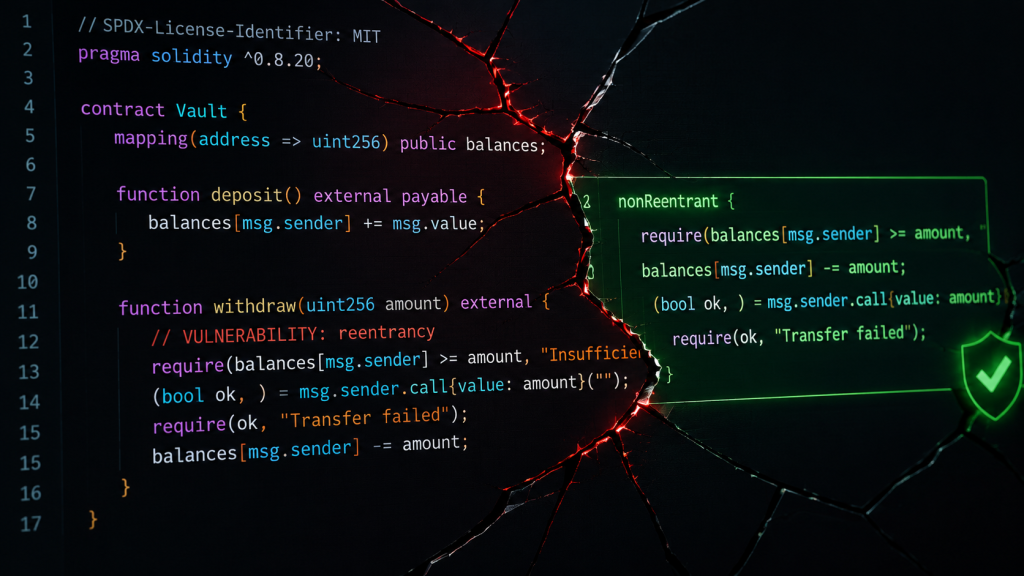
However, there are critical gaps that traditional audits cannot fully address. Economic design flaws, governance manipulation, and runtime exploits that emerge from real-world usage often lie outside a standard audit scope. That is precisely where platforms like Solidity Shield by SecureDApp add structured value, providing deep vulnerability detection that aligns with the reality of how attackers approach your contract logic rather than just how it reads on paper.
Moreover, if your protocol undergoes changes after the initial audit, re-auditing the delta is not optional. Shipping updates without re-review creates an audit-delta risk that has resulted in several nine-figure losses.
3. Private Key Management Is the Overlooked Crisis
Here is something that surprises most teams when they first encounter the data. Off-chain incidents now account for over 56% of all DeFi attacks and more than 80% of total funds lost. The primary cause is compromised private keys.
The Bybit hack in early 2025, which resulted in $1.46 billion in losses, stemmed from off-chain infrastructure compromise. The Phemex hack in January 2025 drained $73 million across sixteen blockchains through hot wallet compromise. UPCX lost $70 million due to a single compromised private key enabling a malicious contract update.
These are not code bugs. They are operational failures. The best smart contract in the world cannot protect you if the admin key is stored in a shared Slack channel or on a developer’s local machine.

Best practices here are straightforward but consistently underimplemented. Use hardware security modules (HSMs) for signing. Implement multi-signature wallets for all critical operations. Use threshold signature schemes for treasury management. Apply time locks on admin functions so that even a compromised key cannot trigger instant drains. Rotate keys regularly and audit who has access to what.
Only 19% of DeFi protocols used multi-sig wallets according to the same Halborn report. That gap is an open invitation for attackers who understand operational risk better than most development teams.
4. Oracle Security and Price Feed Integrity
Price oracle manipulation was the second most damaging attack vector in 2024, accounting for over $52 million in losses across 37 separate incidents. In 2025, this risk has only grown as protocols become more complex and more interconnected.
Flash loan attacks on price feeds work by temporarily distorting the reported price of an asset, executing a profitable action based on that distorted price, and repaying the loan in the same transaction. The entire exploit happens within a single block.
Defending against this requires a layered approach. First, never rely on a single on-chain price source. Use decentralized oracle networks that aggregate multiple independent data points. Second, implement time-weighted average prices (TWAPs) rather than spot prices for sensitive calculations. Third, validate oracle responses against circuit breakers that halt operations when prices move beyond acceptable thresholds.
As one developer put it precisely: you cannot take a reactive approach in Web3. Oracle security must be built into the protocol’s decision-making logic from day one, not patched in after a near-miss incident.
5. Real-Time Blockchain Threat Monitoring After Deployment
This is the insight that separates protocols that survive from protocols that get exploited quietly for hours before anyone notices. Most teams believe their security work ends at deployment. In reality, deployment is when the security window opens for attackers.
Post-deployment threats include runtime exploits, governance attacks, abnormal liquidity movements, and flash loan sequences that were never anticipated in the original threat model. These cannot be caught by code reviews or audits because they emerge from live system behavior.
Consider this scenario. A DeFi lending protocol on a major chain begins experiencing unusual borrow-and-withdraw patterns across multiple wallets in rapid succession during off-peak hours. The pattern does not trigger any on-chain revert. Contracts are functioning exactly as written. But an attacker is systematically draining a vulnerability in the fee calculation logic.
Without real-time monitoring, this goes undetected until the pool is empty. With it, the anomaly is flagged within minutes and protocol admins can intervene before losses become catastrophic.
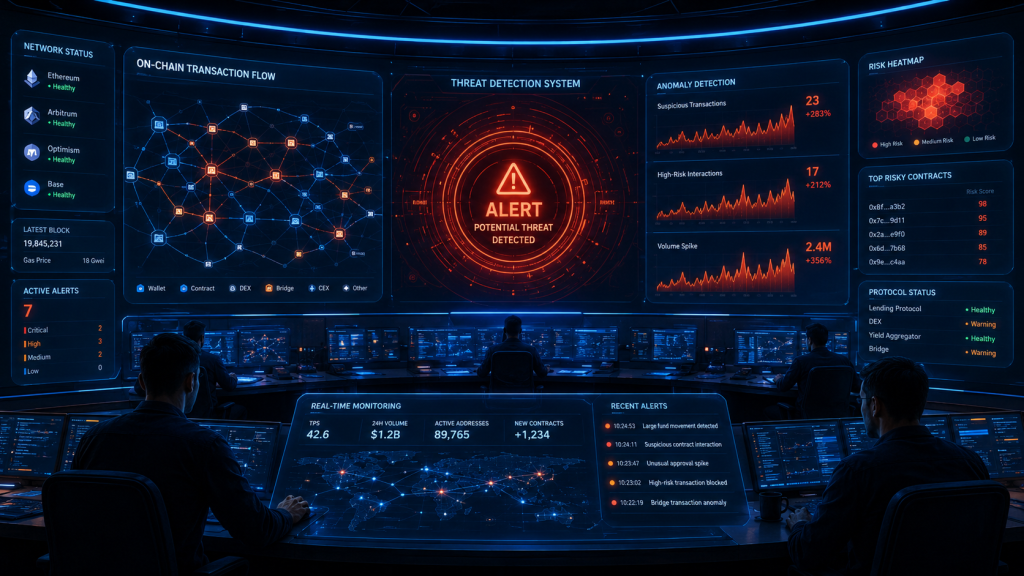
This is the exact problem that SecureWatch by SecureDApp is designed to solve. As an AI-driven, real-time blockchain threat monitoring system, SecureWatch tracks protocol activity for abnormal patterns and potential threats in real time. Its AutoPause feature can automatically pause suspicious transactions or contract activity during an active threat, providing active mitigation rather than passive alerts. It is a patented product under the Government of India, built specifically for the reality that audits cannot prevent what happens after deployment.
6. DeFi Composability and Third-Party Integration Risks
DeFi protocols are rarely standalone systems. They depend on bridges, wrapped assets, liquidity pools, governance tokens, and external protocols. Each integration point is a potential attack surface.
As Immunefi’s 2025 Web3 Security Playbook notes, composability increases surface area significantly. When one component changes, the downstream effects can cascade through multiple protocols unexpectedly. Cross-chain bridge exploits remain one of the most destructive attack types for exactly this reason.
Best practices for managing composability risk include mapping all external dependencies before deployment, testing failure modes for every integration point, and establishing fallback behaviors when an integrated system behaves unexpectedly. Whitelisting acceptable oracle sources, limiting the protocols your system can interact with, and applying input validation on all external data are critical safeguards.
Additionally, smart contract permissions for integrated protocols should follow the same least-privilege model applied to your own contracts. Just because a well-known protocol is involved does not mean unlimited trust is appropriate.
7. Governance Security and DAO Attack Surfaces
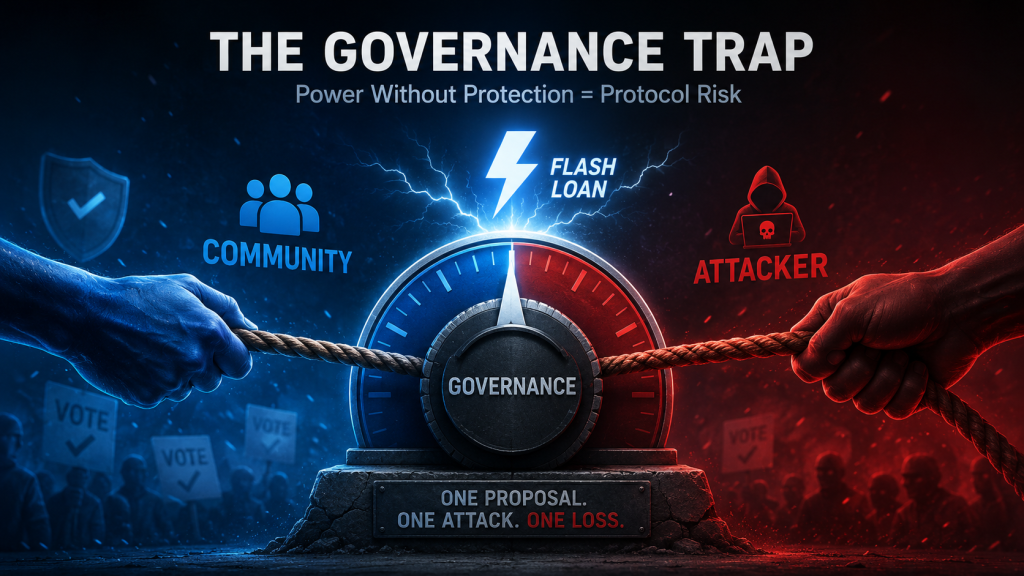
Governance attacks have become one of the most sophisticated threats in the DeFi space. An attacker borrows governance tokens via flash loan, gains temporary voting majority, passes a malicious proposal that drains the treasury, and repays the loan before the next block.
The defenses here are structural. Time locks on governance execution ensure that passed proposals have a delay before taking effect, giving the community time to respond to malicious activity. Snapshot-based voting, which calculates voting power at a fixed past block, prevents flash loan exploitation. Quorum requirements and guardian veto mechanisms add additional friction against rapid manipulation.
Furthermore, governance parameters themselves must be protected from easy modification. If an attacker can lower quorum thresholds through a governance attack to make future attacks easier, the entire system unravels progressively.
8. Bug Bounty Programs and Responsible Disclosure
Security research is an ongoing process, not a one-time engagement. The most resilient DeFi protocols maintain active bug bounty programs on platforms such as Immunefi, which allows external researchers to responsibly report vulnerabilities before they become exploits.
A well-structured bug bounty defines scope clearly, pays researchers fairly based on severity classification, and maintains a transparent response SLA. Protocols that treat researchers as adversaries rather than collaborators lose access to one of their most cost-effective security resources.
Bug bounties complement audits by providing continuous coverage after deployment. Where an audit is a point-in-time review, a bounty program is a standing invitation for the global security community to help secure your protocol over its entire lifespan.
9. Incident Response and Recovery Planning
Very few DeFi teams have a documented incident response plan before an exploit occurs. That absence turns a manageable event into a catastrophic one.
An effective incident response plan identifies who makes decisions during an active exploit, what the protocol’s emergency pause mechanisms are and who can trigger them, how affected users will be communicated with, and what the process is for post-incident forensic analysis. SecureTrace by SecureDApp supports this phase directly, providing transaction tracking and blockchain forensics capabilities that are essential for understanding the scope of an exploit, tracing stolen funds, and building the technical record needed for recovery efforts and regulatory reporting.
Preparation before an incident determines how much damage is recoverable. Waiting until the attack is underway to figure out your response is never a winning strategy.
10. Regulatory Awareness and Compliance as a Security Layer
The regulatory environment around DeFi is evolving faster than many protocols realize. Compliance is increasingly intersecting with security, particularly around Anti-Money Laundering (AML) obligations, KYC requirements, and transaction monitoring.
Protocols that integrate compliance-aware transaction monitoring not only reduce legal exposure but also gain an additional layer of visibility into on-chain activity. Unusual transaction patterns that indicate illicit activity often overlap with the early signatures of a financial exploit.
SecureDApp’s Crypto Compliance and AML services are designed to help protocols navigate this intersection, ensuring that security and compliance reinforce each other rather than operating in separate silos.
Conclusion
Web3 security best practices for DeFi projects are not theoretical safeguards. They are the operational difference between protocols that build lasting user trust and protocols that become a footnote in an annual exploit report.
The threat landscape in 2025 has made one thing clear. Attackers are more sophisticated, faster, and better resourced than at any point in DeFi history. Matching that sophistication requires treating security as a continuous discipline rather than a launch-day task.
Start with secure architecture. Back it with professional smart contract auditing through tools like Solidity Shield. Protect your operational security with rigorous key management. Deploy real-time monitoring through SecureWatch to catch what audits cannot. Prepare for incidents before they happen, and build compliance into your protocol’s DNA.
Security is not a cost center. In DeFi, it is the foundation on which user trust, protocol longevity, and long-term value are built. The protocols that understand this today are the ones still running tomorrow.
Frequently Asked Questions
What is the most common cause of DeFi hacks in 2025?
Compromised private keys and off-chain infrastructure are currently the leading cause, accounting for over 56% of attacks and more than 80% of total value lost. Smart contract vulnerabilities remain significant but have declined relative to off-chain threats as development practices have improved.
Is a smart contract audit enough to secure a DeFi protocol?
No. Audits are a critical first step but they are insufficient on their own. They do not cover runtime threats, post-deployment modifications, governance attacks, or operational security failures like key management. A comprehensive security posture requires auditing, continuous monitoring, private key hygiene, and incident response preparedness working together.
How does continuous monitoring differ from a standard audit?
An audit reviews code at a specific point in time before deployment. Continuous monitoring tracks live on-chain behavior after deployment, detecting anomalies, unusual transaction patterns, and potential exploits as they develop. Tools like SecureWatch provide this ongoing layer of protection that static reviews cannot offer.
What is a governance attack and how can DeFi protocols prevent it?
A governance attack occurs when an attacker temporarily acquires enough voting power, often through flash loans, to pass malicious proposals. Prevention measures include time locks on proposal execution, snapshot-based voting power calculation, minimum quorum thresholds, and guardian veto mechanisms that allow trusted addresses to block obviously malicious proposals.
How should a DeFi team respond when an exploit is detected in real time?
Immediately activate emergency pause mechanisms if available. Notify the core team and a pre-designated security contact. Avoid public disclosure until the attack vector is understood to prevent further exploitation. Engage blockchain forensics tools to trace the exploit. Issue a transparent communication to users once the scope is contained, including a remediation timeline.