You are preparing to launch a DeFi protocol, an NFT marketplace, or a blockchain-based application. The code is ready. The team is confident. And then someone asks the one question that stops everything: how much will the smart contract security audit cost?

It is a fair question. And in 2026, with smart contract exploits still draining hundreds of millions from protocols every quarter, it is also the wrong thing to hesitate on. Smart contract security is not an optional line item. It is the foundation your entire protocol stands on.
This guide breaks down what audits actually cost today, what drives those costs up or down, and how founders and CTOs can make informed decisions without either underpaying for safety or overpaying for a report that does not match the complexity of their codebase.
Why Smart Contract Audit Pricing Varies So Much
If you have started requesting quotes from audit firms, you have probably noticed something puzzling. Two firms look at the same codebase and come back with prices that are nowhere near each other. One quotes $5,000. Another quotes $50,000. Both claim to be thorough.
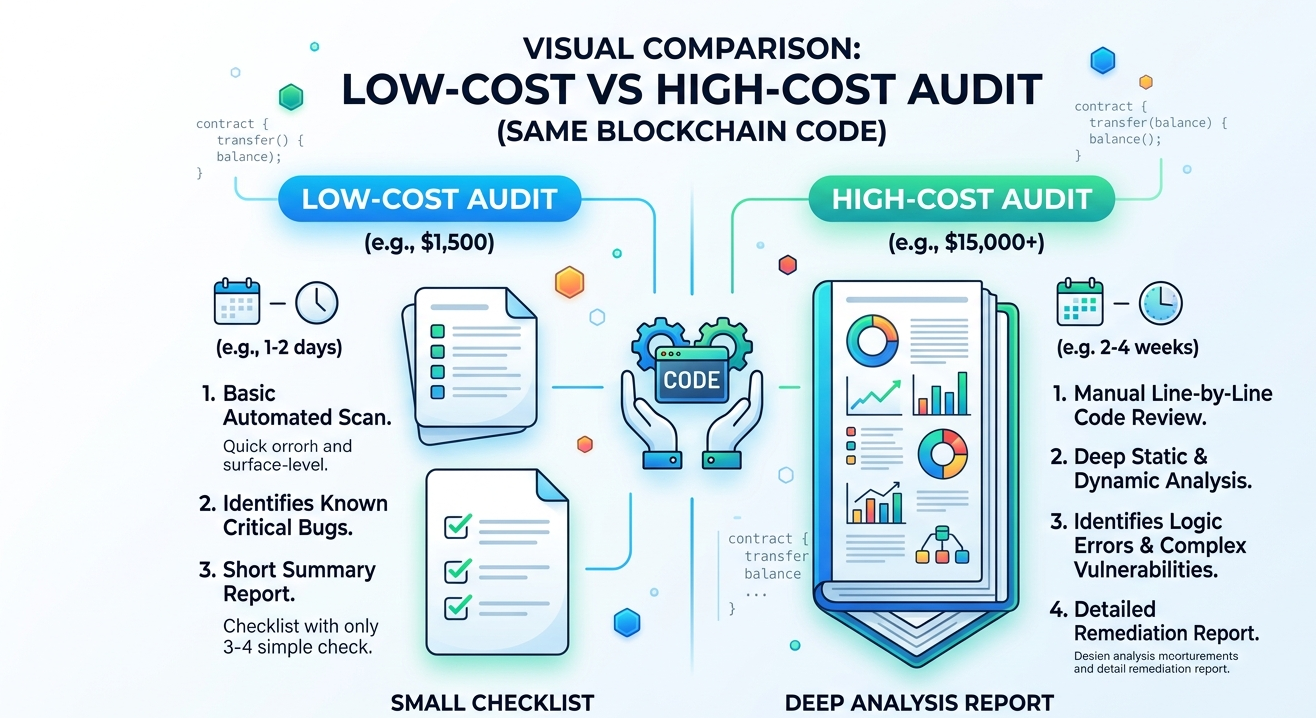
The difference is rarely about one firm being dishonest. It reflects fundamentally different approaches to what smart contract security means. Some firms run automated scanning tools and wrap the output in a formatted report. Others deploy experienced human auditors who spend days or weeks reading your logic, tracing execution paths, and simulating adversarial conditions.
Understanding this distinction is the first step toward knowing what you are actually buying.
Key Factors That Determine Audit Costs
1. Lines of Code and Codebase Complexity
The most direct driver of cost is the size and complexity of your smart contract codebase. A single ERC-20 token contract with fewer than 200 lines of Solidity is a straightforward audit. A DeFi protocol with staking, lending, yield strategies, governance modules, and cross-chain bridges running across 5,000 lines of code is an entirely different engagement.
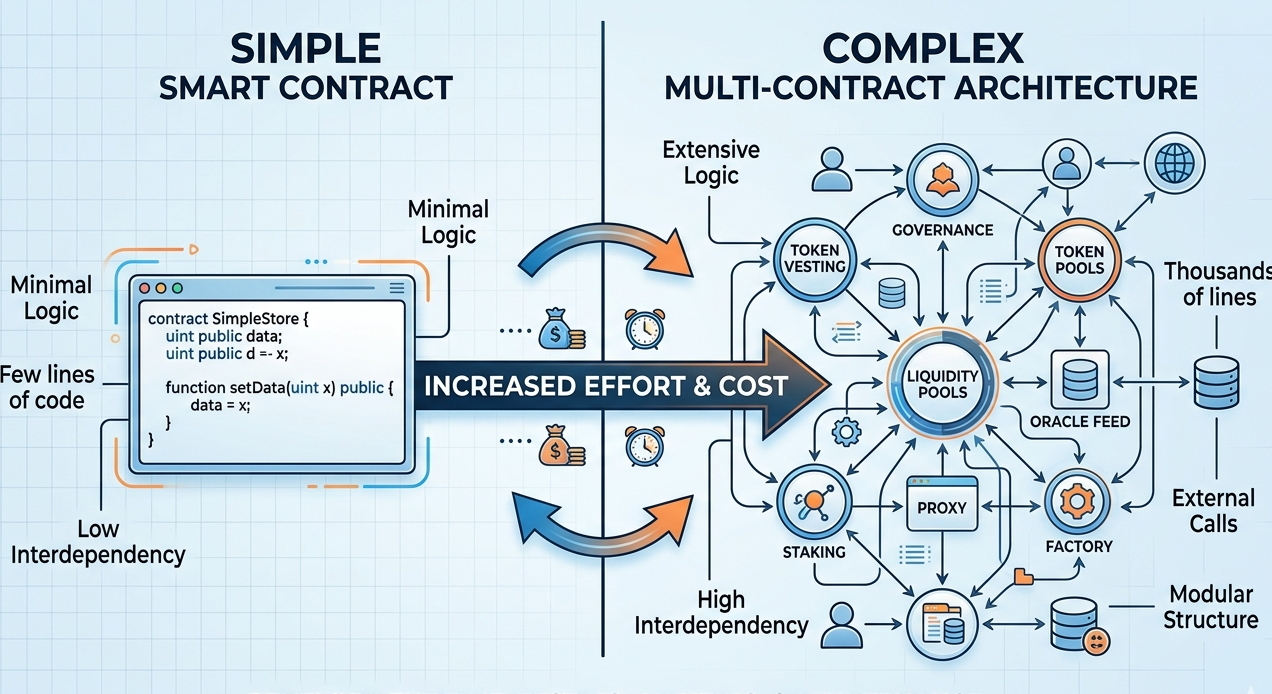
Complexity compounds rapidly when contracts interact with each other. Auditors must trace function calls across contracts, map out permission hierarchies, and think through what happens when multiple contracts execute together in a single transaction. This takes time, and time drives cost.
2. Protocol Type and Risk Profile
A simple token contract carries different risk than a lending protocol managing hundreds of millions in liquidity. Auditors calibrate their depth based on what is at stake. DeFi protocols with complex economic logic, flash loan interactions, and oracle dependencies require more rigorous testing. Gaming contracts with relatively isolated logic require less.
Notably, many founders underestimate the complexity of their own protocols. If your contracts interact with Uniswap, Aave, Chainlink, or any external protocol, those interactions must also be analyzed. The audit scope expands accordingly.
3. Audit Methodology
There are three broad tiers of audit methodology, and they correspond directly to price ranges.
Automated scanning tools process your code in minutes and flag known vulnerability patterns. They are fast and inexpensive, but they miss logic errors, economic attack vectors, and anything that requires contextual understanding.
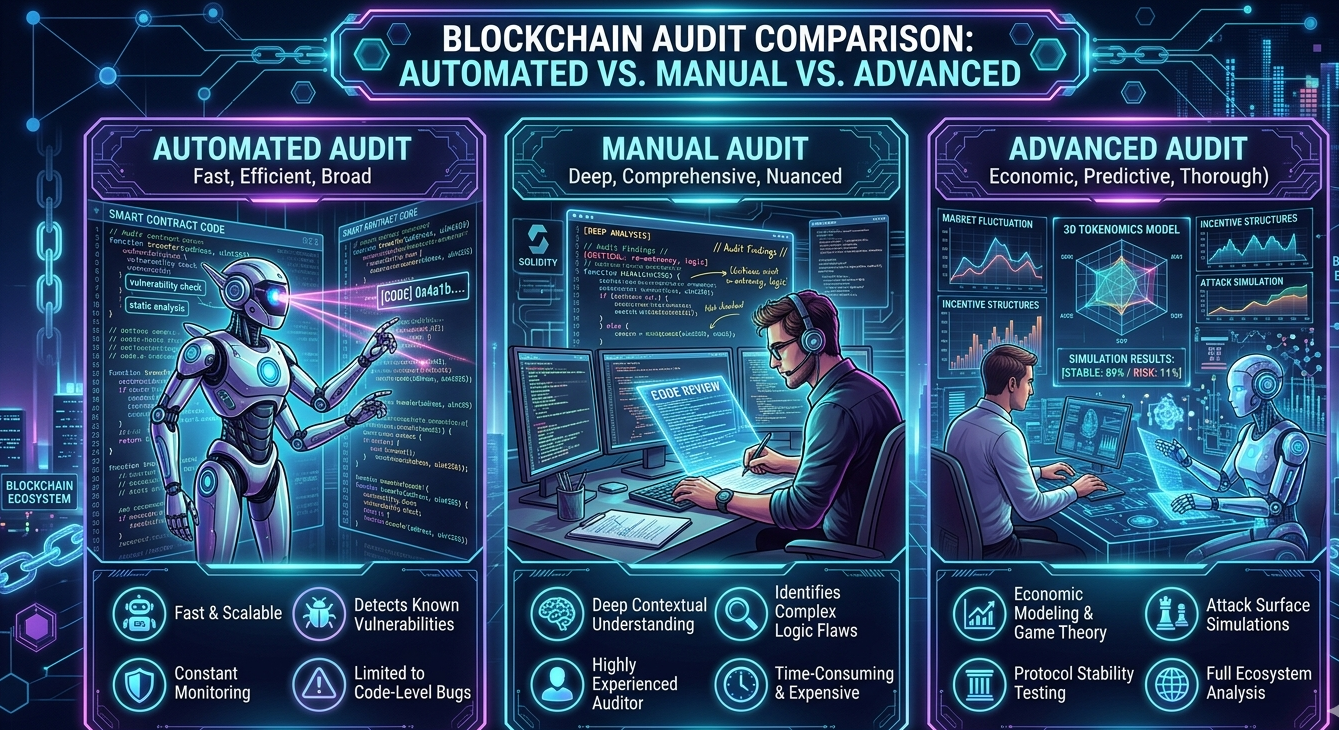
Manual review by experienced auditors goes deeper. Auditors read your code the way an attacker would, looking for edge cases, unintended behaviors, and subtle interactions that scanners cannot detect.
Comprehensive audits combine manual review with formal verification, economic modeling, and adversarial simulation. These are the engagements that catch the vulnerabilities responsible for the largest exploits.
4. Auditor Experience and Reputation
A firm with a track record of catching critical vulnerabilities in major protocols will charge more. That premium exists because their experience translates directly into fewer missed vulnerabilities. In smart contract security, a missed vulnerability is not a minor quality issue. It can mean losing everything your users deposited.
5. Turnaround Time
Rush audits cost more. If you are launching in two weeks and need a thorough review, expect to pay a significant premium for fast turnaround. This is another reason why building security into your development timeline from the beginning is sound economics, not just good practice.
Typical Price Ranges in 2026
While pricing varies by firm and engagement, here are realistic ranges for the current market.
Simple contracts, such as token contracts or single-function utilities under 500 lines of code, typically range from $3,000 to $10,000. These engagements involve limited complexity and can be completed in a few days.
Mid-complexity contracts, including NFT marketplaces, basic staking protocols, and multi-contract systems in the 500 to 2,000 line range, generally fall between $10,000 and $30,000.
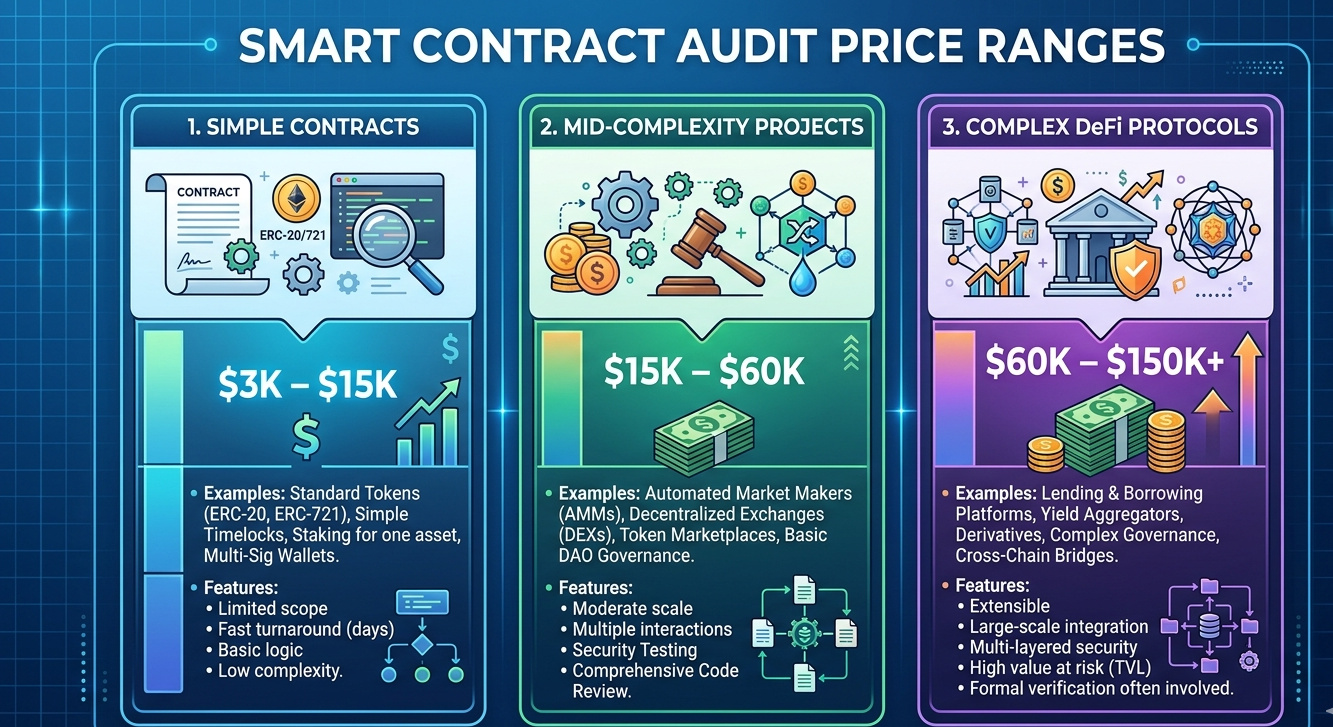
Complex DeFi protocols with multiple interconnected contracts, governance mechanisms, and external integrations typically start at $30,000 and can reach $100,000 or more for the most sophisticated systems.
Enterprise-grade protocols with formal verification requirements, economic modeling, and extended engagement timelines can run well above $100,000.
These are market-rate figures for 2026. Be cautious of quotes that fall significantly below these ranges for complex work. An unusually cheap audit often reflects an unusually shallow methodology.
What Should an Audit Actually Deliver?
Price is only meaningful in relation to what you receive. A quality smart contract security audit should deliver several specific things, not just a document listing issues.
First, you should receive a comprehensive vulnerability report that categorizes findings by severity: critical, high, medium, low, and informational. Each finding should include a clear description of the vulnerability, the potential impact, the affected code, and a recommended fix.
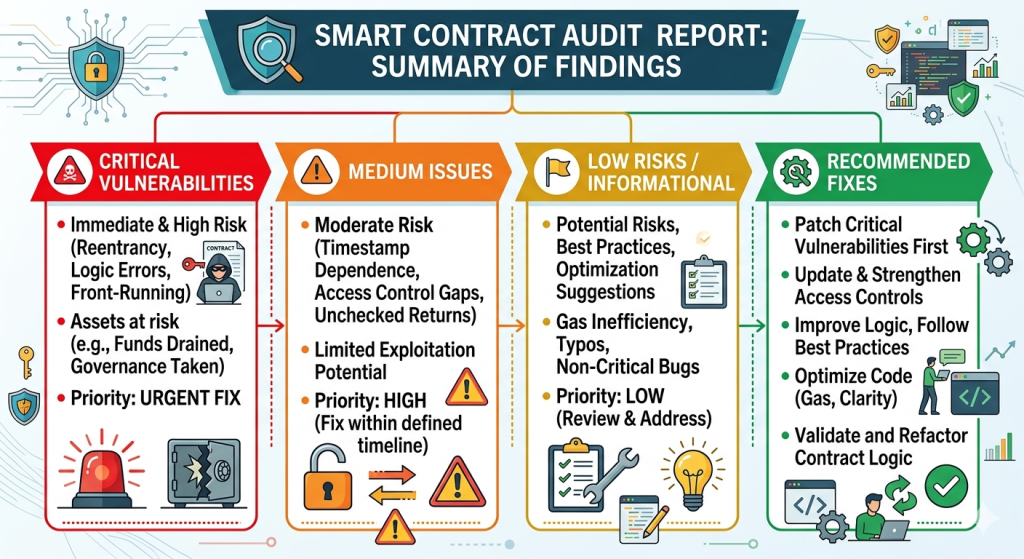
Second, the audit should cover the full attack surface. This includes reentrancy, integer overflow and underflow, access control failures, oracle manipulation, flash loan attack vectors, and logic errors. For DeFi protocols, it should also include economic attack modeling.
Third, you should receive a remediation review. After your team addresses the findings, the auditor should verify that the fixes are correct and do not introduce new vulnerabilities. Some firms charge separately for this. Others include it. Know what you are getting.
Finally, a quality audit should leave you with a clear understanding of your protocol’s residual risk, not just a list of what was found. The goal is informed confidence, not just a certificate.
The Hidden Cost Problem: Audits Are Not Enough
Here is something that many founders learn too late. An audit is a point-in-time assessment. It evaluates your code at a specific moment. What happens after deployment is a different question entirely.

Smart contract vulnerabilities are exploited after launch. Protocols that received clean audit reports have still lost hundreds of millions to runtime exploits, market manipulation, and governance attacks. The audit did not miss anything at the time. The threat emerged later, through changed market conditions, new interaction patterns, or subsequent contract upgrades.
This is the gap that pre-deployment auditing alone cannot close. It is why serious protocols increasingly pair their audits with ongoing monitoring capabilities. The two are complementary, not competing. A thorough audit gives you the best possible foundation. Continuous monitoring ensures that foundation holds.
Tools like Solidity Shield from SecureDApp are designed precisely for the pre-deployment phase. They provide deep vulnerability detection across your Solidity codebase before you ship, helping you catch issues when they are still cheap to fix, not after they have been exploited.
How to Get the Most Value from Your Audit Budget
If you are working within a defined budget, there are ways to maximize what you get from the engagement.
Prepare your codebase thoroughly before the audit begins. Clean code with clear documentation, accurate NatSpec comments, and resolved compiler warnings allows auditors to focus their time on logic rather than decoding intent. This directly increases the depth of coverage you receive.
Be honest about scope. Trying to minimize audit scope to reduce cost can create dangerous gaps. If a contract is part of your protocol, it needs to be reviewed. Hidden scope creates hidden risk.
Ask for a fixed-price engagement based on a reviewed scope, not an open-ended hourly engagement without a defined ceiling. This protects both parties.
Factor remediation into your timeline. Most teams need one to two weeks to address findings after an audit. Schedule accordingly so you are not rushing fixes under launch pressure.
Comparing Solidity Shield to Traditional Audit Approaches
Traditional audits rely heavily on manual review cycles. A senior auditor reads your code, documents findings, and produces a report. This is thorough, but it is also slow and expensive, particularly for teams that are iterating quickly or need to audit multiple contract versions.
Solidity Shield is built around automated deep analysis combined with human-curated vulnerability intelligence. It scans your Solidity code against an extensive library of known vulnerability patterns and logic error signatures, producing actionable findings in a fraction of the time a manual-only review would require.
For founders who need to audit frequently, ship fast, and keep costs manageable without compromising smart contract security, this approach offers a meaningful structural advantage. It does not replace expert human review for the most complex protocols. However, for many projects, it delivers the depth and coverage they actually need, at a cost and timeline that fits their reality.
Making the Audit Decision
The question is not whether to audit. That decision was settled long ago by the exploits that proved what happens when protocols skip this step. The real question is what kind of audit your protocol needs, how to choose the right provider, and how to build security into your development process rather than bolting it on at the end.
Smart contract security is not a one-time expense. It is an ongoing discipline. Audits are a critical component of that discipline, and understanding their true cost in 2026, both financially and in terms of what they do and do not cover, is the foundation of making smart decisions.
Frequently Asked Questions
Is a $5,000 smart contract audit safe to use for a live protocol?
It depends entirely on the codebase complexity and audit methodology. For a simple, single-function utility contract, a thorough $5,000 engagement might be appropriate. For any protocol handling significant user funds, a $5,000 quote almost certainly reflects an automated scan rather than expert manual review. Understand what methodology is included before comparing quotes on price alone.
How often should I audit my smart contracts?
Any time you make meaningful changes to your codebase, you should audit the affected components. This includes logic changes, new features, and integration updates. Many teams treat audits as continuous rather than one-time events, particularly if they are shipping updates frequently.
Can I use Solidity Shield as a replacement for a full manual audit?
Solidity Shield is designed for thorough automated vulnerability detection in Solidity code and is a strong foundation for smart contract security. For protocols with complex economic mechanisms or very high value at stake, combining automated tools with expert manual review provides the deepest coverage.
What is the biggest mistake founders make regarding audit costs?
Treating the audit as the final step rather than building it into the development lifecycle. Teams that wait until just before launch often rush the process, limit the scope to reduce cost, or skip remediation review. All three increase risk significantly.
Does an audit guarantee my protocol will not be exploited?
No audit can provide that guarantee. Audits significantly reduce risk by catching known vulnerability patterns and logic errors before deployment. However, post-deployment risks, including market conditions, governance attacks, and newly discovered vulnerability classes, require ongoing vigilance beyond what any pre-deployment audit covers.