

For most of smart contract history, security has been a pre-deployment discipline. Audit the code, find the vulnerabilities, fix them before launch. This model made sense when the ecosystem was smaller, protocols were simpler, and the on-chain environment was less adversarial. Today, it is no longer sufficient on its own.

A new category is emerging in Web3 security, broadly called runtime security. It addresses the protection of smart contracts while they are live and processing real transactions. Understanding what this shift means, what problems it solves, and how it connects to pre-deployment practices is increasingly important for any team building serious Web3 infrastructure.
What Runtime Security Means in a Blockchain Context
In traditional software engineering, runtime security refers to protections that operate while code is executing rather than during the development or compilation phase. In the smart contract context, runtime security applies the same concept to on-chain activity.

A runtime security solution for smart contracts monitors live protocol behavior, detects anomalous transactions and interaction patterns, and in advanced implementations, can trigger automated responses to contain threats before they result in significant damage. The goal is to extend the security perimeter beyond the deployment gate and into the operational life of the contract.
This is a meaningful conceptual shift. It acknowledges something that post-mortem analysis of exploited protocols consistently confirms: the gap between what an audit covers and what actually threatens a live protocol is real, persistent, and growing.
Why Runtime Threats Are Different
Runtime threats are fundamentally different from the vulnerabilities that pre-deployment audits target. Understanding this distinction clarifies why both approaches are necessary.
Pre-deployment audits address vulnerabilities in the code itself: bugs, logic flaws, missing access controls, unsafe operations. These are properties of the contract as written. A thorough audit can identify and help remediate them before they are exposed to adversarial conditions.
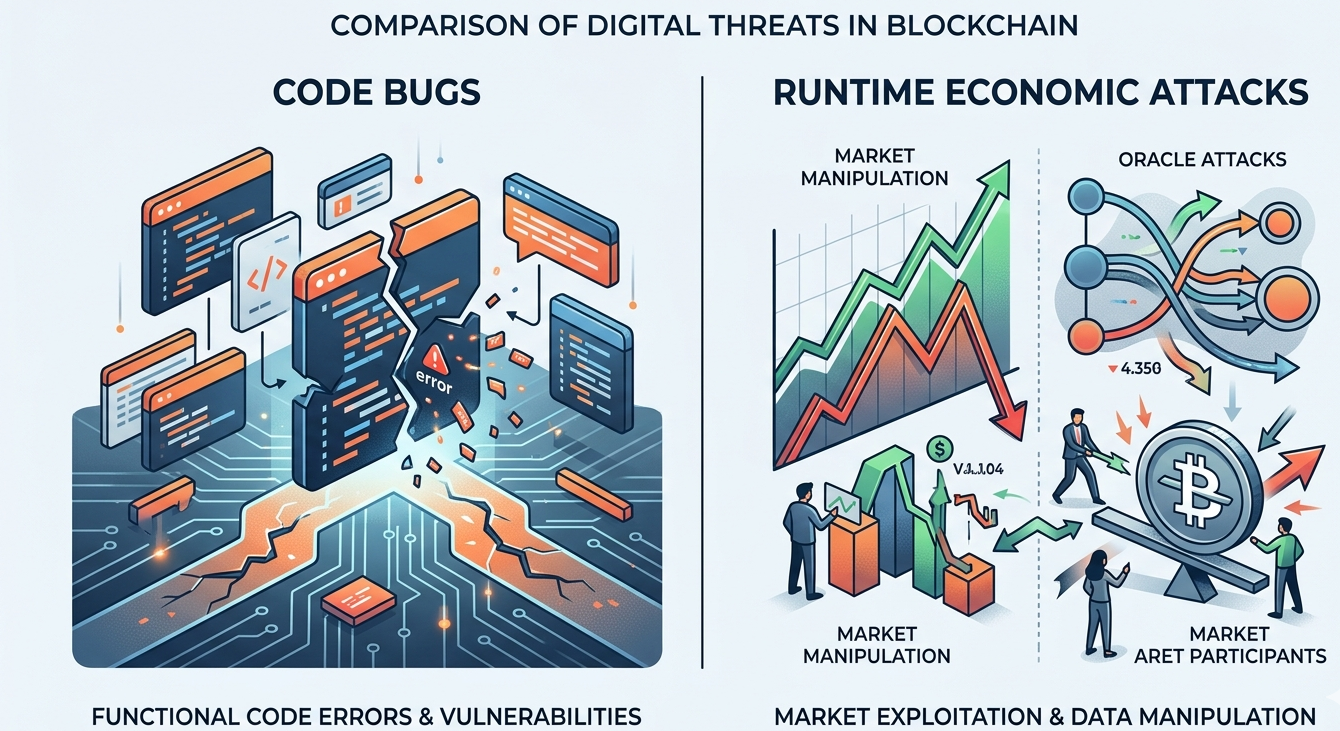
Runtime threats often emerge from the interaction between a deployed contract and the broader on-chain environment. They include economic attacks that exploit normal contract functions in sequence. They include oracle manipulation that feeds false price data to a protocol that handles it correctly under normal conditions. They include governance attacks that accumulate voting power legitimately before executing a malicious proposal. None of these are code vulnerabilities in the traditional sense. They are exploits of the protocol’s design under adversarial conditions.
Moreover, runtime threats can materialize from vulnerabilities in external contracts that your protocol depends on. If a lending protocol relies on a DEX for price discovery and that DEX has a vulnerability, the lending protocol inherits an attack surface it cannot control through code review alone.
The Pre-Deployment Foundation That Makes Runtime Security Work
Here is the insight that matters most for teams thinking about runtime security: it only works well when it starts with a strong pre-deployment foundation.
Effective runtime monitoring requires a precise understanding of what normal behavior looks like for a specific protocol. Without that baseline, distinguishing a legitimate large transaction from the first step of a multi-transaction exploit is essentially guesswork. Without knowing exactly what functions handle value transfers, where access controls live, and what the expected interaction patterns are, anomaly detection produces alerts that cannot be reliably acted upon.
This is where Solidity Shield’s pre-deployment analysis directly enables better runtime security. The structured audit process produces detailed knowledge of the contract’s architecture, its intended behavior, and its security-sensitive functions. That knowledge becomes the baseline against which runtime monitoring is calibrated.
Teams that use Solidity Shield enter deployment with a documented understanding of their code’s security profile. They know where the risks were identified, how they were addressed, and what edge cases remain. That knowledge is exactly what effective runtime protection requires.
Common Runtime Attack Vectors in Modern DeFi
To appreciate why runtime security has become a priority, it helps to understand how modern on-chain attacks actually work.
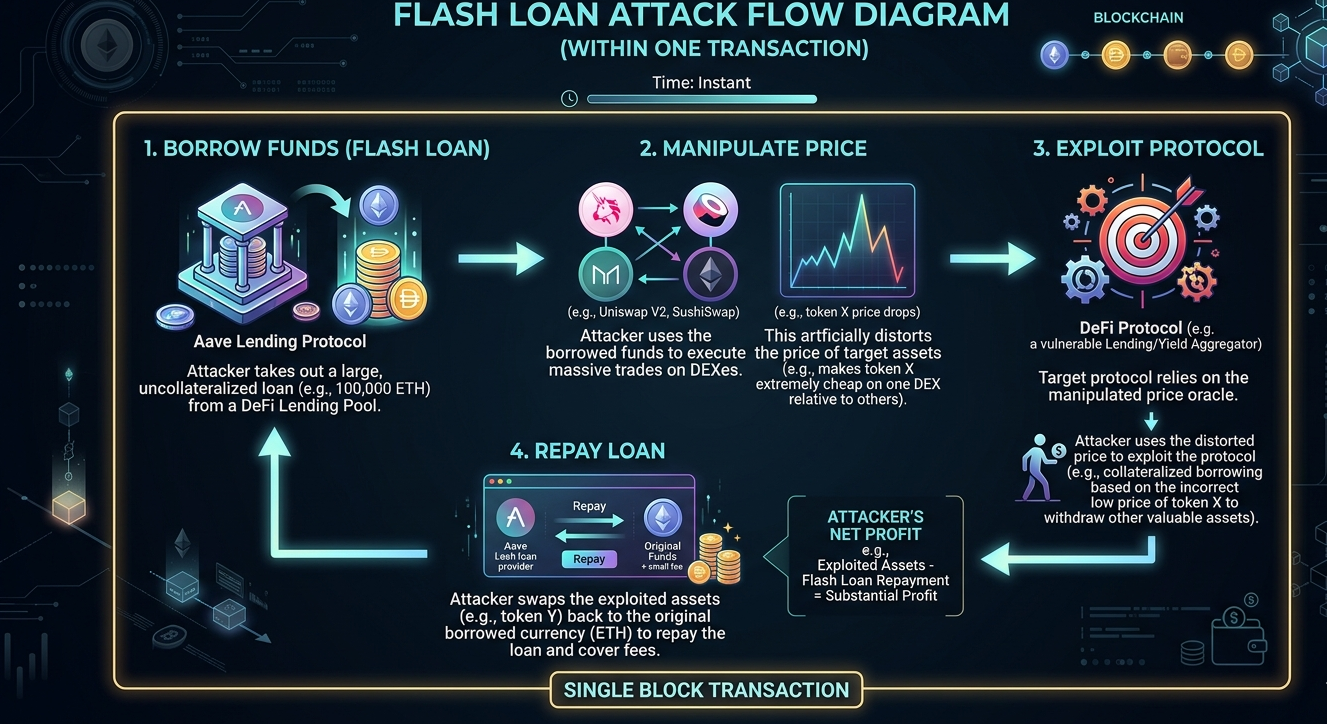
Flash loan attacks are the canonical example. An attacker borrows a large sum within a single transaction, uses it to manipulate market conditions that affect your protocol, extracts value at the manipulated price, and repays the loan, all within one atomic transaction. The smart contract code may be entirely correct. The exploit operates through the economic behavior of the broader system.
Sandwich attacks target decentralized exchange users but can affect any protocol with price impact sensitivity. An attacker monitors the mempool for pending large transactions, frontruns them to move the price unfavorably, allows the victim’s transaction to execute, then immediately reverses their position for a profit. Again, no code vulnerability is involved. The attack is runtime and economic in nature.
Governance attacks in DAO-governed protocols involve accumulating voting power through legitimate means and then using it to pass malicious proposals. The governance contract works exactly as designed. The threat is in how its mechanisms are used.
Understanding these attack categories helps clarify why pre-deployment code review, while necessary, cannot be the only defensive layer.
How Solidity Shield Prepares Contracts for the Runtime Environment
Solidity Shield’s value extends beyond finding bugs. The audit process it enables provides teams with a structured, comprehensive understanding of their contract’s security posture that is directly applicable to runtime risk management.
Through thorough pre-deployment analysis, teams identify which functions are most sensitive, where assumptions about input values or external contract behavior could be violated, and what conditions would need to exist for a given vulnerability to be exploitable. That kind of detailed security intelligence is not just useful for fixing code. It is the input that allows teams to design effective monitoring, incident response procedures, and circuit breaker mechanisms.
Consider a DeFi protocol that uses Solidity Shield before launch and receives a finding related to unusual price sensitivity in a specific function. The team addresses the technical issue. But they also now know that this function deserves particular attention in their monitoring strategy. Alerts around unusual call patterns to this function become a priority. The audit finding becomes operational intelligence.
This connection between pre-deployment analysis and runtime preparedness is underutilized by most teams. Solidity Shield makes it explicit and actionable.
Designing for Runtime Safety From the Start
The most forward-thinking teams in Web3 are designing their contracts with runtime safety in mind from the beginning. This means thinking about upgradeability, pause mechanisms, and access control not just as features but as emergency response tools.
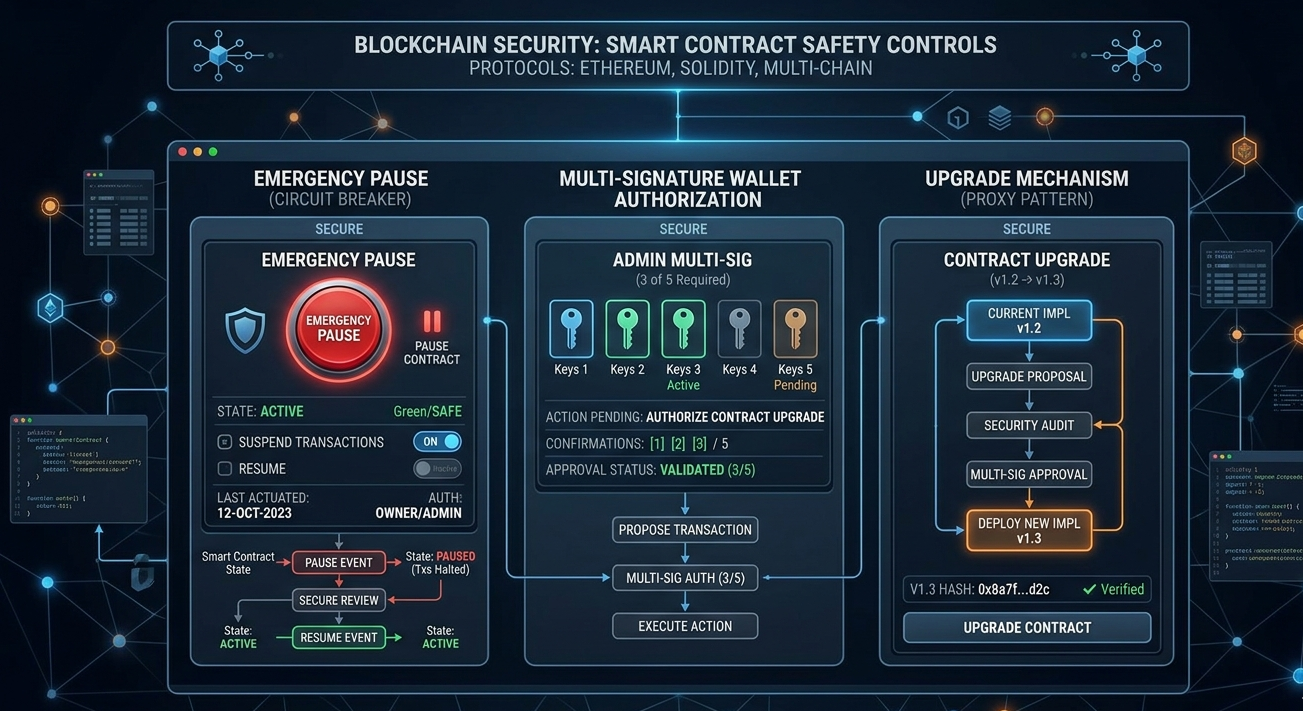
A contract with a well-designed pause function, controlled by a multi-signature wallet and with clear conditions for its activation, gives a team meaningful options when monitoring detects a potential exploit in progress. A contract without these features limits the team’s ability to respond regardless of how good their monitoring is.
Solidity Shield’s audit process evaluates these design choices as part of a comprehensive security review. Does the contract have appropriate emergency mechanisms? Are they properly access-controlled? Are there upgrade paths if critical vulnerabilities are discovered post-deployment? These questions are not just about code quality. They are about operational resilience.
Building with these considerations from the start, validated by rigorous pre-deployment analysis, is what separates protocols that can manage runtime incidents from protocols that can only document them.
The Developer’s Role in Runtime Security
Runtime security is sometimes framed as an operations problem rather than a development concern. That framing is misleading and leads to security gaps.
The runtime behavior of a smart contract is determined by how it was written. Access controls, upgrade mechanisms, emergency pause functions, and the handling of external calls are all code decisions made during development. If these mechanisms are not present or are poorly implemented, no amount of post-deployment monitoring can compensate.
Furthermore, developers who understand the runtime threat landscape make better design decisions throughout the development process. They recognize patterns that could be exploited under adversarial conditions. They build defenses into the architecture rather than bolting them on later.
This is one of the cultural benefits of using a tool like Solidity Shield continuously during development. The feedback loop between analysis findings and code improvements builds security intuition in the development team. Over time, the team writes better code because they have been continuously exposed to the security implications of their design choices.
The Business Case for Runtime-Ready Smart Contracts
Beyond the technical arguments, there is a compelling business case for building with runtime security in mind.

Insurance and risk assessment for DeFi protocols increasingly factors in security practices. Protocols with documented audit histories, clear security architectures, and evidence of ongoing security attention are viewed more favorably. This affects the cost and availability of protocol insurance, which is becoming an important component of DeFi infrastructure.
Institutional capital, which is entering DeFi in growing volumes, is particularly sensitive to security posture. Fund managers and treasury operators deploying capital into DeFi protocols have fiduciary responsibilities that make security documentation and practices a direct factor in deployment decisions.
A protocol built with Solidity Shield, with documented pre-deployment security coverage and a clearly designed runtime safety architecture, is better positioned across all of these dimensions. Security investment returns not just in risk reduction but in broader market access.
Conclusion
Runtime smart contract security represents a maturation of the Web3 ecosystem’s approach to protecting on-chain value. The recognition that pre-deployment audits, while necessary, cannot address the full threat surface has driven investment in post-deployment monitoring and response capabilities.
This evolution makes pre-deployment quality more important, not less. The effectiveness of runtime security depends directly on the depth of understanding that comes from thorough pre-deployment analysis. Solidity Shield provides that foundation: comprehensive vulnerability detection, structured security documentation, and the kind of detailed code intelligence that enables effective ongoing protection.
Build with runtime in mind. Start with Solidity Shield.
FAQs
Q1. What is the difference between pre-deployment and runtime smart contract security?
Pre-deployment security focuses on finding and fixing vulnerabilities in the code before it goes live. Runtime security monitors live contract behavior to detect and respond to threats as they emerge on-chain. Both are necessary, as they address fundamentally different aspects of the threat landscape.
Q2. How do flash loan attacks differ from traditional smart contract exploits?
Flash loan attacks do not typically exploit code vulnerabilities. Instead, they use large borrowed amounts within a single transaction to manipulate market conditions that affect a protocol’s economic logic. The smart contract code may function exactly as intended while the attack exploits how it interacts with the broader on-chain environment.
Q3. How does Solidity Shield support runtime security preparedness?
Solidity Shield’s pre-deployment analysis produces detailed security intelligence about a contract’s architecture, sensitive functions, and potential risk areas. This knowledge directly informs monitoring strategies and incident response procedures, making post-deployment security significantly more effective.
Q4. Why should developers care about runtime security during the development phase?
Runtime behavior is determined by how a contract is written. Emergency pause functions, upgrade mechanisms, and access controls must be correctly implemented during development. Developers who understand runtime threats build better defenses into their architecture from the start, which no post-deployment tool can substitute for.
Q5. Does security investment affect a protocol’s ability to attract institutional capital?
Increasingly, yes. Institutional participants deploying capital in DeFi have risk management and fiduciary requirements that make a protocol’s security posture a direct factor in deployment decisions. Documented audit histories and evidence of strong security practices improve a protocol’s attractiveness to serious capital allocators.