

A smart contract exploit rarely arrives as a single dramatic moment. Instead, it unfolds as a sequence of small, quiet steps: a funding transaction, a probing call, a test swap, and then the main strike. Real-Time Threat Monitoring exists to catch those early steps, because the minutes before the final drain are the only minutes when a team can still change the outcome.
Unfortunately, most protocols still learn about attacks from social media. Someone posts a block explorer link, the community panics, and the team scrambles to find the right people. By then, the funds have moved, the attacker has hopped chains, and the post-mortem is already being written.
This guide shows how Real-Time Threat Monitoring works at a practical level. We will look at what it watches, how it spots hostile behavior, and how it turns a detection into a response. Along the way, we will also cover where audits fall short, how to cut false alarms, and how to build a monitoring program your team can actually run.
Why Smart Contract Exploits Escalate So Fast
Smart contracts execute exactly as written. Consequently, a flaw in the code is not a theoretical risk. It is a live, public, permissionless opening that anyone can use, at any hour, with no approval step.
Speed makes this worse. A single transaction can borrow millions, manipulate a price, and repay the loan within one block. In addition, attackers automate their work with scripts and bots, so the whole attack can finish before a human reads the first alert email.
Meanwhile, the blockchain itself works against defenders. Transactions are irreversible once confirmed. Therefore, the only real defense is to act before confirmation or to limit the damage while the attack is still repeating.
Here is the uncomfortable part. Many exploits are not one clean hit. Attackers often drain funds in several rounds, or they return later through a second weakness. As a result, early detection changes the math. A team that sees round one can stop rounds two through ten.
The Gap Between Attack and Awareness
Traditional security tools were not built for this environment, which is why Real-Time Threat Monitoring fills a real gap. A conventional log review might run daily or weekly. Likewise, a manual dashboard check depends on someone remembering to look.
That delay is the gap attackers use. Because an exploit can complete in seconds, a monitoring approach that reports in hours is closer to forensics than protection. For this reason, Real-Time Threat Monitoring has become a core layer of smart contract security rather than a nice extra.
What Real-Time Threat Monitoring Actually Means On-Chain
The phrase gets used loosely, so it helps to define it clearly. Real-Time Threat Monitoring is the continuous observation of blockchain activity, with automated analysis that flags hostile or abnormal behavior as it happens. In other words, it watches your contracts the way a security operations center watches a network.
Importantly, “real-time” is a design constraint, not a marketing label. The system must ingest new blocks and pending transactions quickly, evaluate them against detection logic, and notify or act within a window that still matters. Otherwise, the alert is just an expensive notification about something that already happened.

A solid setup watches three layers at once: the mempool, the contract state, and wallet behavior. Each layer of Real-Time Threat Monitoring reveals a different part of the story.
Layer One: The Mempool
The mempool holds transactions that have been broadcast but not yet confirmed. Therefore, it is the earliest place to see an attack forming. If a suspicious transaction targets your contract and sits in the mempool, Real-Time Threat Monitoring can identify it before it lands in a block.
Of course, mempool visibility has limits. Some transactions travel through private channels and never appear publicly. Even so, public mempool analysis catches a large share of opportunistic attacks, and it gives defenders their only chance at true pre-confirmation warning.
Layer Two: Contract State
State monitoring tracks how your contract’s balances, parameters, and permissions change over time. For example, a sudden drop in a liquidity pool, a changed oracle address, or a modified admin role are all state signals worth attention.
Moreover, state changes are hard to hide. An attacker can disguise intent in a transaction, yet the resulting state shift still shows up on-chain. Consequently, state monitoring acts as a reliable second net beneath mempool analysis.
Layer Three: Wallet and Behavior Analysis
Finally, wallet behavior adds context. Who is calling the contract? Is the address newly funded? Did it receive assets from a mixer or a bridge shortly before interacting? Has it touched other flagged contracts?
These questions turn raw transactions into a risk story. As a result, Real-Time Threat Monitoring can separate a curious new user from an address that looks like the first stage of an attack.
The Anatomy of an Exploit and Where Monitoring Catches It
To understand early detection, it helps to break an exploit into stages. Although every attack differs, most follow a recognizable arc.
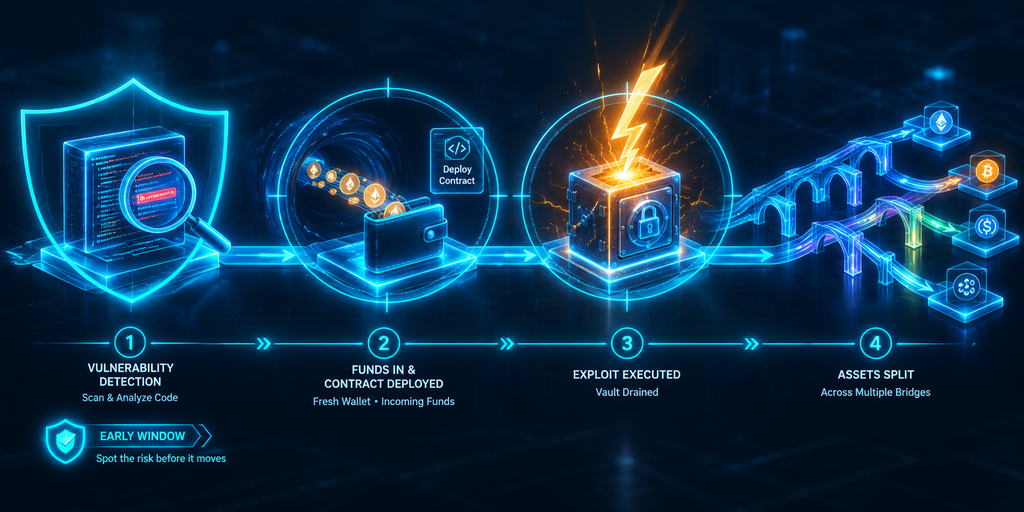
Stage 1: Reconnaissance
Attackers study your contracts first. They read the verified source, simulate calls locally, and look for logic that behaves unexpectedly. This phase is mostly invisible, since local simulation leaves no on-chain footprint.
However, some reconnaissance does touch the chain. Small test transactions, unusual read-then-write call patterns, and repeated failed calls can all appear. Real-Time Threat Monitoring can flag an address that probes several functions in an order no normal user would follow.
Stage 2: Preparation and Funding
Next, the attacker prepares. They create or fund a fresh wallet, deploy an exploit contract, and often route funds through privacy tools to hide the source. In many cases, they also stage flash loans or arrange the assets needed for the strike.
This stage offers a strong detection window. A newly deployed contract that references your protocol’s addresses is a meaningful signal. Likewise, a fresh wallet funded from a mixer, followed by a deployment, deserves a high risk score.
Stage 3: Execution
Then comes the strike. The exploit contract calls your protocol, abuses the flaw, and extracts value. Depending on the design, this may happen in one transaction or across several.
Here, speed matters most. If the monitoring layer sees the transaction in the mempool or identifies the first successful round, an automated response can limit the loss. Therefore, detection at this stage must be fast, accurate, and wired directly into response actions.
Stage 4: Laundering and Exit
Finally, the attacker moves funds. They swap tokens, bridge to other chains, and split amounts across wallets. By this point, recovery becomes harder with every hop.
Even so, Real-Time Threat Monitoring still adds value here. It helps trace the flow of stolen assets, notify exchanges and bridges, and preserve evidence. In short, detection is not only about prevention. It also supports containment and recovery.
How Real-Time Threat Monitoring Detects Hostile Activity
Detection is the heart of Real-Time Threat Monitoring. Strong platforms combine several techniques instead of relying on one. Each method has strengths, and each covers a blind spot in the others.
Rule-Based Detection
Rules capture known attack patterns. For instance, a rule might flag any transaction that borrows a very large flash loan and interacts with your protocol in the same call. Another might alert when an admin function is called by an address that is not on the approved list.
Rules are fast, predictable, and easy to explain. As a result, they work well for known threats and for compliance-style controls. However, rules only catch what someone has already imagined, so they need partners.
Anomaly Detection
Anomaly detection learns what normal looks like for your protocol. It tracks typical transaction sizes, call frequencies, token flows, and user behavior. Then it raises a flag when activity moves far outside that baseline.
This approach shines against novel attacks. If an attacker invents a new technique, no rule exists for it yet. Nevertheless, the behavior still looks strange compared with the protocol’s usual rhythm, and anomaly models can surface it.
Transaction Simulation
Simulation replays a pending transaction in a safe environment before it confirms. In effect, the system asks: what would this transaction do to the contract’s balances and state? If the answer is “drain twenty percent of the pool,” the alert level jumps.
Simulation is powerful because it looks at outcomes rather than just inputs. Consequently, it can catch obfuscated attacks whose code looks harmless but whose effect is destructive.
Graph and Entity Analysis
Graph analysis maps relationships between wallets, contracts, and funding sources. If a new address links back to a cluster tied to earlier incidents, the system can raise its risk score immediately.
Furthermore, entity intelligence improves with shared data. The more incidents a monitoring system has seen, the better it recognizes familiar infrastructure and tactics.
Why Layering Matters
No single technique is enough. Rules are quick but narrow. Anomaly models are flexible but can be noisy. Simulation is precise but needs compute. Graph analysis adds context but depends on data quality.
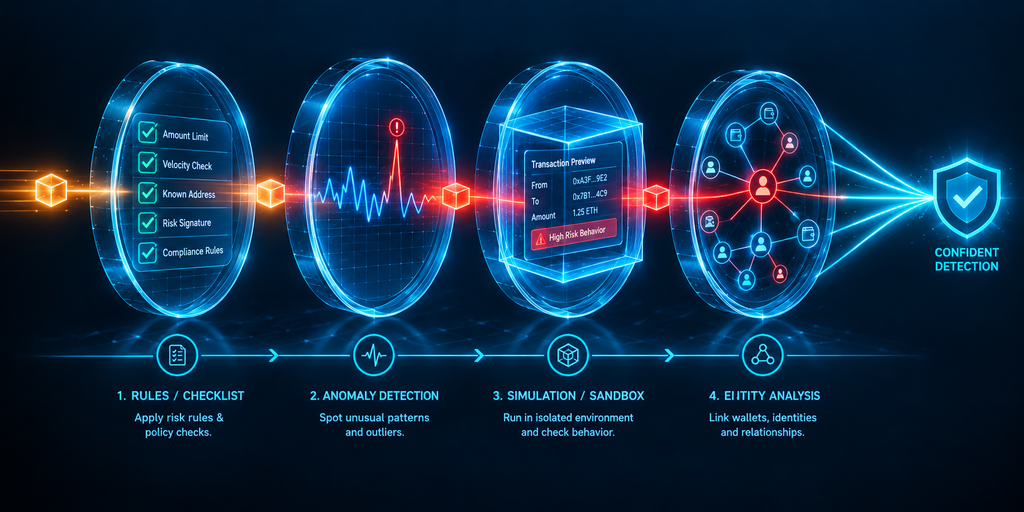
Therefore, effective Real-Time Threat Monitoring layers all four. When several independent signals agree, confidence rises and false positives fall. That agreement is what lets a team trust an automated response.
Common Smart Contract Exploits and the Signals That Reveal Them
Different vulnerabilities leave different fingerprints. Knowing those fingerprints helps teams tune Real-Time Threat Monitoring and prioritize coverage.
Flash Loan Attacks
Flash loans let anyone borrow large sums with no collateral, provided the loan is repaid in the same transaction. Attackers use them to distort prices or governance votes briefly, then profit from the distortion.
The signals are distinctive. Look for a huge borrow, a rapid sequence of swaps, a sharp price move, and repayment all within one transaction. Real-Time Threat Monitoring can flag this pattern when it touches your protocol, and simulation can estimate the damage before confirmation.
Oracle Manipulation
Many protocols rely on price feeds. If an attacker can move the price source, even briefly, they can borrow against inflated collateral or liquidate positions unfairly.
Watch for sudden price deviations between your oracle and broader market prices. In addition, track large trades against thin liquidity pools that feed your price data. Consequently, a monitoring system that compares oracle values with external references can raise an alert within moments.
Reentrancy
Reentrancy occurs when a contract makes an external call before updating its own state, allowing the called contract to re-enter and repeat the action. It remains a classic weakness, and variants still appear.
The signals include repeated calls to the same function inside one transaction, unusual call depth, and balance changes that do not match the expected logic. Because these patterns are visible during simulation, pre-confirmation analysis is especially useful here.
Access Control Failures
Sometimes the flaw is not clever at all. A function that should be restricted is left open, or an admin key is compromised. Then an attacker simply calls the privileged function.
Detection here is straightforward but vital. Alert on any privileged call from a new address, any ownership transfer, any upgrade to a proxy implementation, and any change to critical parameters. Moreover, treat these as high severity by default, since they can change the whole contract’s behavior.
Governance Attacks
Attackers may accumulate voting power, often with borrowed tokens, to pass a malicious proposal. The result can be a treasury drain disguised as a legitimate vote.
Monitoring should track sudden changes in voting power, newly created proposals with unusual payloads, and large token movements ahead of votes. Therefore, governance monitoring belongs alongside transaction monitoring, not in a separate silo.
Upgrade and Proxy Risks
Upgradeable contracts add flexibility, yet they also add risk. A malicious or mistaken upgrade can replace safe logic with harmful logic in a single transaction.
Consequently, teams should monitor proxy admin actions, implementation address changes, and initialization calls. A short delay between a proposed upgrade and its execution gives monitoring and humans time to review.
From Detection to Defense: Turning Alerts Into Action
Detection without response is just observation. Therefore, the most valuable part of Real-Time Threat Monitoring is the path from signal to action. That path should be short, clear, and rehearsed.
Severity Tiers and Routing
Start by defining severity levels for your Real-Time Threat Monitoring alerts. A low-severity alert might create a ticket. A medium-severity alert might notify the security channel. A critical alert should page the on-call responder immediately and, where configured, trigger an automated safeguard.
Clear routing prevents two common failures. First, it stops alert fatigue, where teams ignore messages because everything looks urgent. Second, it prevents silence, where a real threat sits unseen in a crowded inbox.
Automated Response and AutoPause
Some situations cannot wait for a human. When an attack is draining funds every few seconds, a ten-minute approval chain is too slow. In those cases, an automated response can buy the team time.
This is where SecureWatch fits. SecureWatch by SecureDApp delivers AI-driven on-chain monitoring with AutoPause, so a protocol can pause vulnerable functions when a high-confidence threat appears. In practice, that means the system can help contain an exploit while responders investigate, rather than leaving the contract exposed during the scramble.
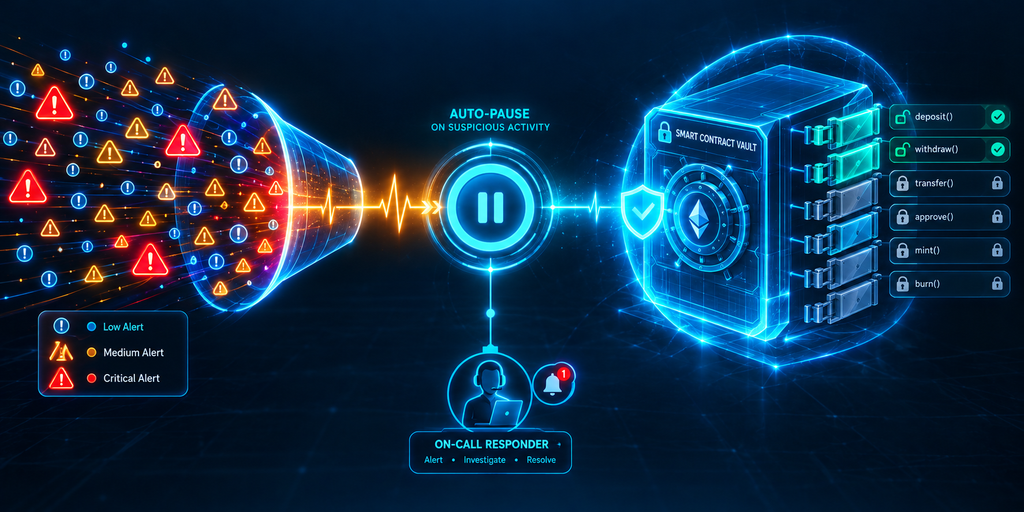
Of course, a pause mechanism must be designed with care. The pause authority should be well governed, the conditions should be tested, and the scope should be narrow enough to avoid freezing legitimate users unnecessarily. Even so, a well-designed pause is far better than no brake at all.
The Human Playbook
Automation in Real-Time Threat Monitoring handles the first seconds. Humans handle everything after. A good playbook answers these questions in advance:
- Who is on call, and how are they reached?
- Who has authority to pause, upgrade, or communicate publicly?
- Which wallets, multisigs, and keys are involved, and where are they stored?
- How will the team contact exchanges, bridges, and security partners?
- What will the team tell users, and when?
Meanwhile, rehearsal matters. Run tabletop exercises with realistic scenarios. After each drill, update the playbook with what broke. As a result, the real incident feels familiar rather than chaotic.
Evidence and Forensics
During an incident, preserve data. Save transaction hashes, wallet addresses, call traces, and timelines. Furthermore, record every decision and timestamp.
This evidence supports recovery efforts, law enforcement requests, insurance claims, and honest communication with users. In addition, it feeds the post-incident review that improves detection next time.
Why Audits Alone Are Not Enough
Audits are essential. A thorough review catches many flaws before launch, and no serious protocol should skip it. However, an audit is a snapshot, while an attacker works against a living system.
Several realities limit what an audit can promise. Code changes after the review. Integrations with other protocols create new interactions. Market conditions shift in ways nobody modeled. Finally, some flaws are subtle enough that even skilled reviewers miss them.
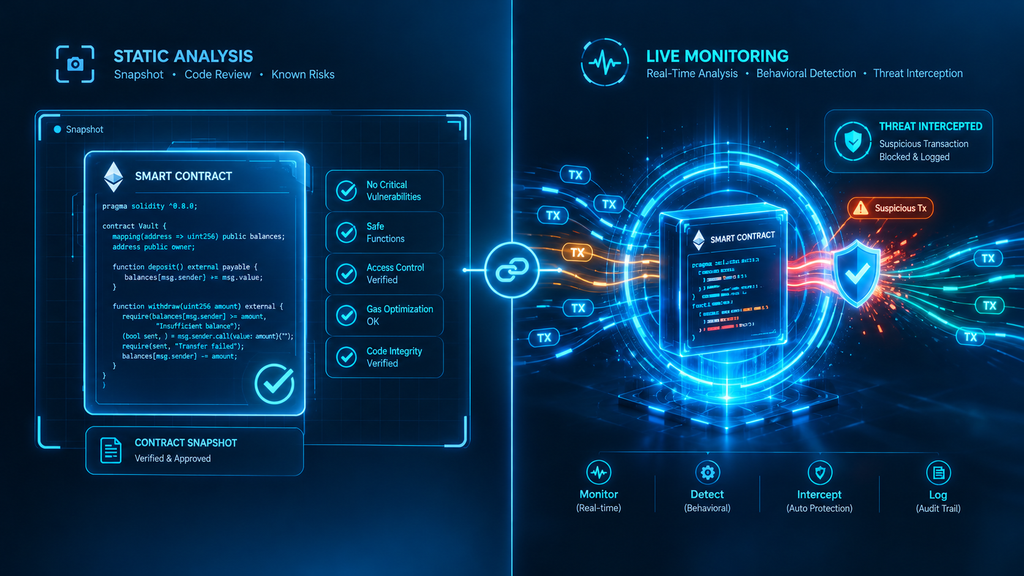
Therefore, the strongest approach pairs pre-deployment assurance with runtime defense. An audit reduces the number of flaws that ship. Real-Time Threat Monitoring reduces the damage from the flaws that slip through anyway.
Think of it as seatbelts and crash testing. Crash testing improves the design. Seatbelts protect people when something still goes wrong. A mature security program needs both, because relying on one alone leaves a dangerous gap.
Cutting Through the Noise: Reducing False Positives
Every team running Real-Time Threat Monitoring faces the same tension. Sensitive detection catches more attacks, yet it also raises more false alarms. Too many false alarms train people to ignore alerts, which is its own security failure.
Fortunately, several practices help.
First, baseline normal behavior. Learn the typical size, timing, and sources of transactions for each contract. Then tune thresholds to those baselines instead of using generic defaults.
Second, combine signals. A single odd transaction may be harmless. Yet an odd transaction from a new wallet funded by a mixer, calling a sensitive function, is a very different story. Scoring across multiple signals produces better precision.
Third, use allowlists thoughtfully. Known partner contracts, keeper bots, and treasury wallets can be marked as expected. At the same time, review allowlists regularly, because a trusted address can become a compromised one.
Fourth, review and learn. After each alert, label it as true or false and record why. Over time, those labels sharpen both rules and models.
Finally, match response to confidence. Low-confidence signals should notify humans. High-confidence signals can trigger automated safeguards. This tiered design keeps automation reserved for the cases where it is most justified.
Building a Real-Time Threat Monitoring Program Step by Step
A tool alone does not create security. A Real-Time Threat Monitoring program does. The following sequence works for most protocols and Web3 businesses.
Step 1: Inventory What You Must Protect
List every contract, proxy, multisig, oracle, bridge connection, and admin key. In addition, note which assets each one controls. You cannot monitor what you have not mapped.
Step 2: Define Critical Events
Decide which events matter most. Examples include large withdrawals, ownership changes, upgrades, parameter edits, oracle updates, and unusual governance activity. Then assign each one a severity level.
Step 3: Choose Coverage Across Chains
Many protocols now operate on several networks. Therefore, make sure Real-Time Threat Monitoring covers every chain where your contracts live. An attacker will happily choose the least watched one.
Step 4: Wire Alerts to People
Connect alerts to the channels your team actually uses, such as paging tools, chat, and email. Furthermore, set escalation rules so that an unacknowledged critical alert reaches a second person automatically.
Step 5: Define Automated Safeguards
Decide which scenarios justify an automated pause or restriction. Write the conditions down, test them on a testnet, and confirm who can reverse them. Moreover, document the governance behind these controls so that users understand how they work.
Step 6: Rehearse the Response
Run drills. Simulate a flash loan attack, a compromised admin key, and an oracle failure. Measure how long detection, escalation, and containment each take. Then fix the slowest step.
Step 7: Review and Improve
Hold regular reviews of alerts, near misses, and changes to the protocol. Update detection logic as the code and market evolve. In short, treat the program as a cycle rather than a project.
What to Look For in a Monitoring Solution
Not every Real-Time Threat Monitoring platform delivers the same value. When evaluating options, ask direct questions.
Does it analyze the mempool as well as confirmed blocks? Does it combine rules, anomaly detection, and simulation? Can it cover the chains you use? Does it offer automated response, and can you control the conditions? How does it handle false positives? What does onboarding look like, and who supports you during an incident?
In addition, ask about transparency. You should understand why an alert fired, not just that it fired. Clear explanations help responders decide faster, and they build trust in the system.
SecureWatch was built around these needs. It pairs AI-driven on-chain monitoring with AutoPause, so detection connects directly to defense. For teams that want Real-Time Threat Monitoring tied to an actual brake, that integration matters.
A Short Scenario: How Early Detection Changes the Outcome
Consider a hypothetical lending protocol. An attacker funds a fresh wallet through a mixer and deploys a contract that references the protocol’s pool addresses. Hours later, the attacker prepares a flash loan to distort the price feed the protocol relies on.
Without Real-Time Threat Monitoring, the team sees nothing until funds disappear. The attacker repeats the strike several times, bridges the proceeds, and vanishes. Afterward, the team spends days on forensics and weeks on community recovery.
With Real-Time Threat Monitoring, the story changes. The new contract and mixer-funded wallet raise a medium alert during preparation. When the flash loan and abnormal price move appear, the combined signals push the alert to critical. An automated pause limits the vulnerable function, the on-call engineer is paged, and the team investigates while most funds remain safe.
The attack still happened. Yet the damage was a fraction of what it could have been. That difference is the entire point of early detection.
Conclusion: Seconds Decide Outcomes
Smart contract exploits move at machine speed, and they punish slow reactions. Audits reduce the odds of a flaw, but they cannot watch a live protocol around the clock. That is why Real-Time Threat Monitoring has become a foundation of modern Web3 defense.
To recap, the strongest programs watch the mempool, contract state, and wallet behavior together. They layer rules, anomaly detection, simulation, and graph analysis. They route alerts by severity, rehearse their playbooks, and connect detection to automated safeguards. Above all, they treat monitoring as a continuous practice rather than a one-time setup.
If your protocol holds real value, the question is not whether someone will probe it. The question is whether you will notice in time. SecureWatch by SecureDApp combines AI-driven on-chain monitoring with AutoPause to help teams catch hostile activity early and respond fast. Book a demo to see how Real-Time Threat Monitoring can protect your contracts before an exploit escalates.
Frequently Asked Questions
1. What is Real-Time Threat Monitoring for smart contracts?
Real-Time Threat Monitoring is the continuous, automated observation of blockchain activity to spot hostile or abnormal behavior as it happens. It watches pending transactions, contract state changes, and wallet behavior, then alerts your team or triggers a safeguard when it detects a likely exploit.
2. How does Real-Time Threat Monitoring detect an exploit before funds are drained?
It looks for early signals such as newly deployed attack contracts, mixer-funded wallets, probing calls, and large flash loans aimed at your protocol. By combining rules, anomaly detection, and transaction simulation, it can flag a threat during preparation or in the mempool, before the final drain completes.
3. Can Real-Time Threat Monitoring stop an attack automatically?
It can, when response actions are configured in advance. For example, SecureWatch pairs on-chain monitoring with AutoPause, which lets a protocol pause vulnerable functions when a high-confidence threat appears. Teams should define clear conditions and governance for these controls so that automation stays safe and predictable.
4. If I already have a smart contract audit, do I still need Real-Time Threat Monitoring?
Yes. An audit reviews code at a single point in time, while a live protocol faces new integrations, upgrades, and market conditions. Real-Time Threat Monitoring adds runtime defense by detecting exploits that slip past review and by limiting damage while an attack is still in progress.
5. How do I reduce false alarms from Real-Time Threat Monitoring?
Start by baselining normal behavior for each contract, then tune thresholds to match. Combine multiple signals before raising high-severity alerts, review allowlists regularly, and label every alert as true or false so detection improves over time. Finally, reserve automated actions for high-confidence cases.