
Every time a user logs into an Indian banking app, a healthcare portal, or a government service platform, something invisible happens in the background. Their personal data, identity credentials, and behavioral metadata get collected, stored, and often shared across third-party systems that the user never explicitly consented to engage with. For decades, this arrangement was simply how digital identity worked. Most users accepted it because they had no alternative.
That era is ending.
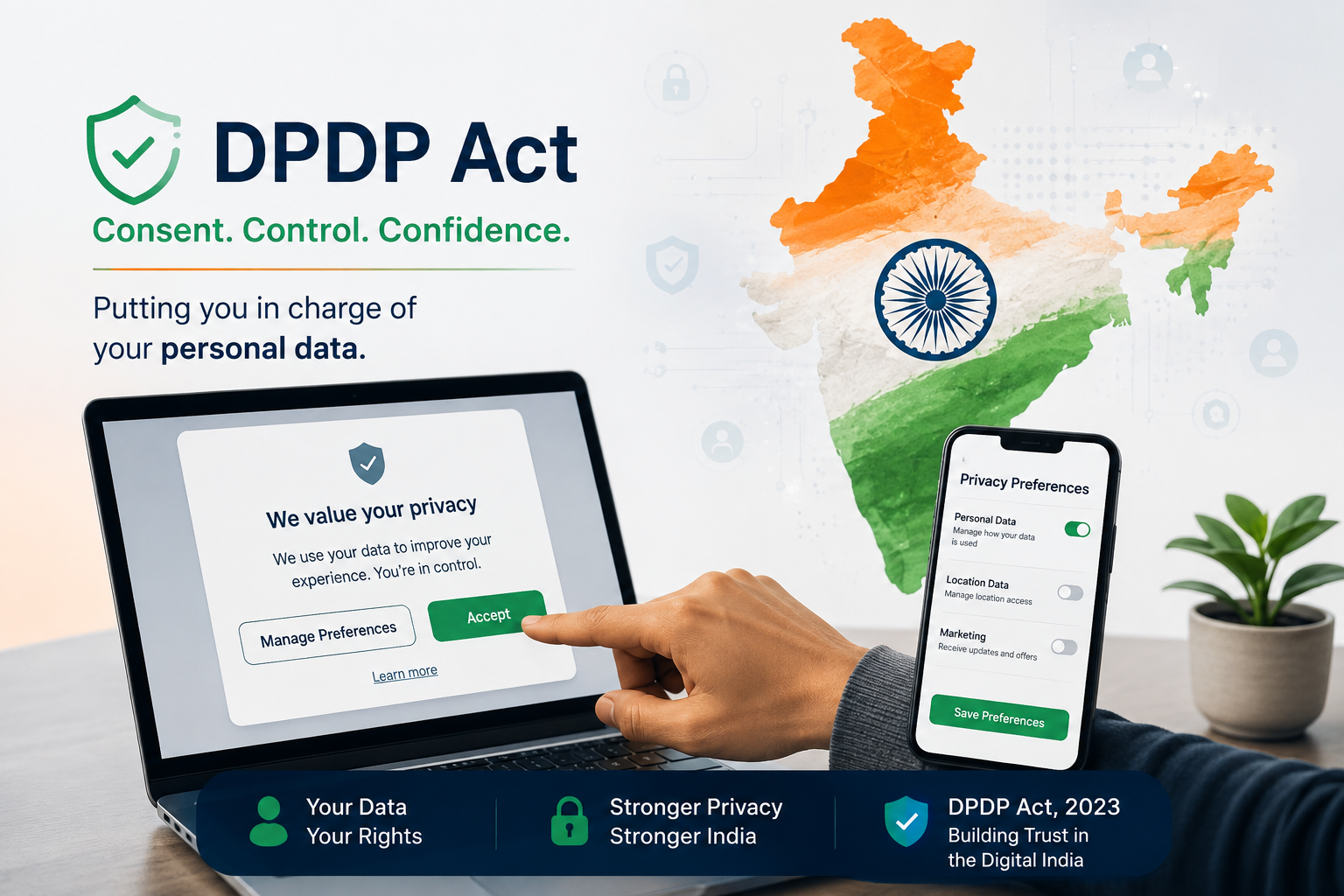
Self-sovereign identity is redefining the relationship between individuals and the platforms they interact with. It shifts control from centralized institutions to the individuals themselves, giving users verifiable, portable, and privacy-preserving credentials that no single authority can revoke arbitrarily or exploit commercially. For Indian enterprises operating under the Digital Personal Data Protection Act of 2023 and serving hundreds of millions of digitally active citizens, this is not a distant technology concept. It is an immediate compliance, trust, and competitive reality.
This blog unpacks what privacy-first authentication means, why self-sovereign identity represents its most mature implementation, and what Indian platforms need to understand before they fall behind.
The Problem with How Indian Platforms Handle Identity Today
Most enterprise identity systems in India follow a model that is, at its core, extractive. A user provides their Aadhaar number, PAN card, mobile number, or email address. The platform stores this information on its own servers. Authentication happens by verifying that stored data against what the user provides at login. The platform holds the data. The user holds nothing.
This creates three interconnected problems that Indian enterprises have not fully reckoned with.
First, there is the concentration of liability. When identity data sits in a central repository, every breach becomes a catastrophic event. A single compromised database can expose millions of users. Indian enterprises have experienced this repeatedly, from healthcare data leaks to fintech platform breaches. The architecture itself is the vulnerability.
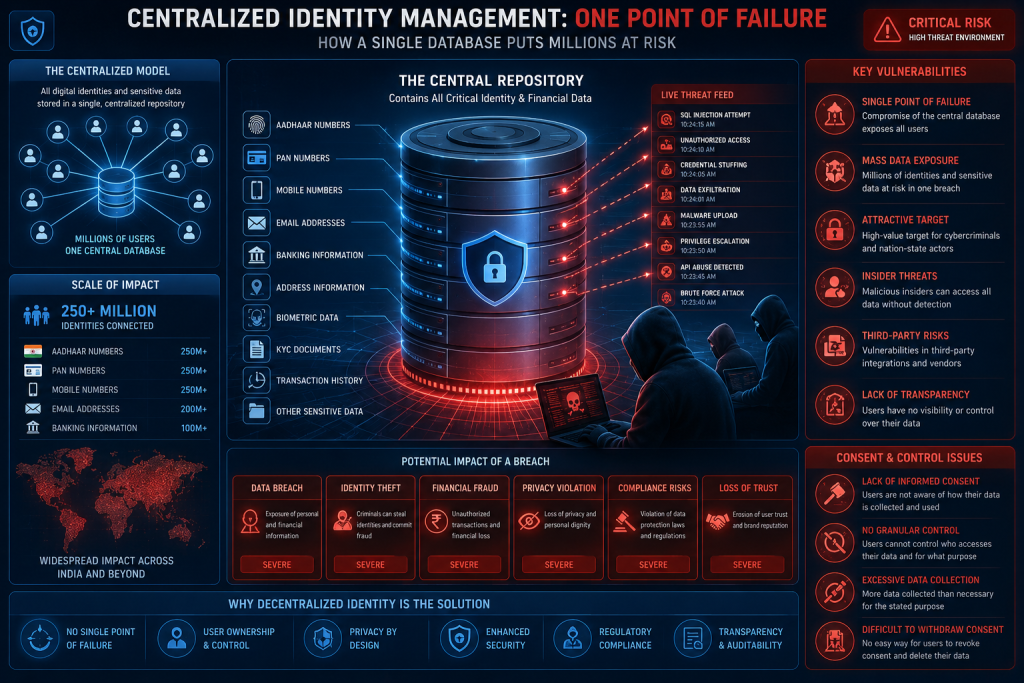
Second, there is the consent ambiguity problem. Users rarely understand what they have agreed to share, with whom, and for how long. Most platforms present consent as a binary checkbox buried inside a lengthy terms-of-service document. The DPDP Act’s requirements for explicit, granular, and revocable consent expose how poorly most current systems are designed to support genuine user control.
Third, there is the trust deficit. Indian users are increasingly aware that their data is valuable and that platforms monetize it in ways they never explicitly agreed to. This awareness is creating friction in onboarding, reducing engagement, and raising regulatory risk simultaneously. Traditional identity management systems were not designed to solve this problem. They were designed around a completely different set of assumptions.
Self-sovereign identity offers a structurally different approach.
What Self-Sovereign Identity Actually Means
Self-sovereign identity, commonly abbreviated as SSI, is a model of digital identity in which individuals own, control, and manage their credentials without depending on any central authority to vouch for them in real time. The term “self-sovereign” is precise: it means the individual is the sovereign of their own identity data.
In practice, SSI works through three interconnected components.
The first component is the identity wallet. An SSI wallet is a secure digital container, typically a mobile application or an enterprise-managed software environment, where a user stores their verifiable credentials. Unlike a traditional username and password combination, a wallet holds cryptographically signed attestations from trusted issuers. Think of it as a digital equivalent of a physical wallet: it holds your driving licence, your employee ID, your health insurance card, and your membership credentials, all in one place, but entirely under your control.
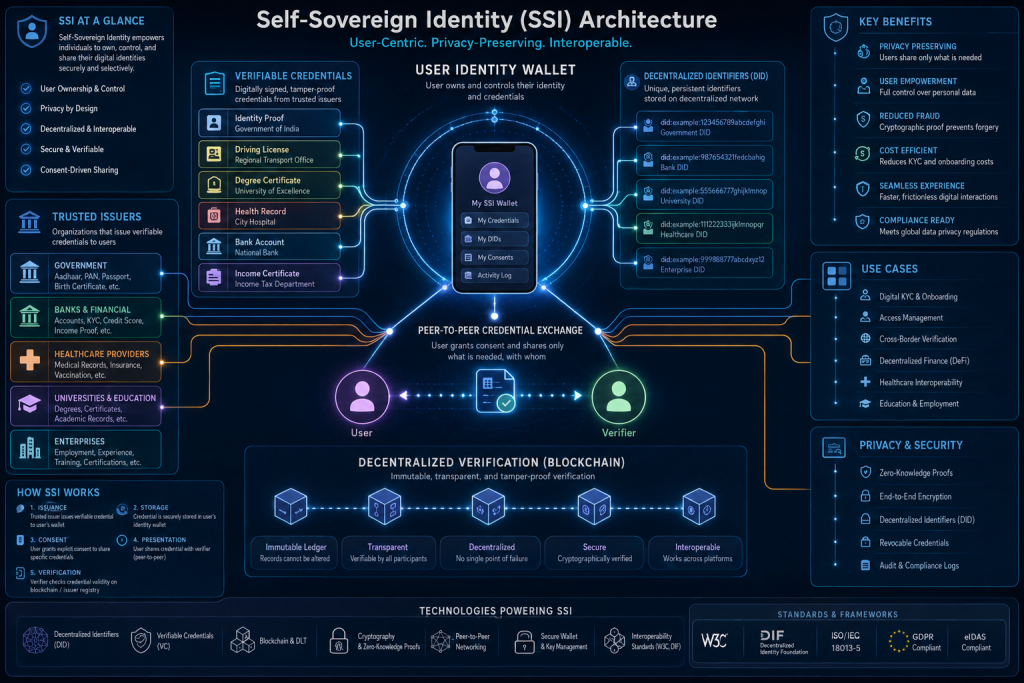
The second component is the verifiable credential. A verifiable credential is a tamper-proof digital attestation issued by a trusted authority, such as a government body, a bank, a university, or an employer. It uses cryptographic signatures to prove its authenticity without requiring the verifier to contact the issuer in real time. When a user presents a verifiable credential, the receiving platform can instantly confirm its validity, its issuer, and its scope without ever accessing the user’s raw personal data.
The third component is the decentralized identifier, or DID. A DID is a globally unique, cryptographically verifiable identifier that the user controls, typically anchored on a blockchain or a distributed ledger. Unlike an email address or a phone number, a DID is not owned by any platform. It cannot be taken away. It is the persistent, portable anchor of a user’s digital identity.
Together, these three components create an authentication model that is simultaneously more secure, more privacy-preserving, and more user-centric than anything traditional identity infrastructure can offer.
Why India’s Regulatory Landscape Makes SSI Strategically Urgent
The Digital Personal Data Protection Act of 2023 is not simply a compliance checklist. It represents a fundamental reorientation of how Indian law thinks about data ownership, consent, and accountability. While the DPDP Act does not mention SSI, DIDs, or verifiable credentials by name, the principles it mandates are architecturally aligned with how SSI works in practice.
The Act requires that consent be specific, informed, unconditional, and freely given. It mandates that users have the right to withdraw consent at any time. It establishes clear obligations around data minimisation, purpose limitation, and the right to correction and erasure. It holds data fiduciaries, meaning the platforms that collect and process data, accountable for ensuring these rights are operationally respected. Full substantive compliance obligations come into force from May 2027, giving Indian enterprises a preparation window, but not an indefinite one.
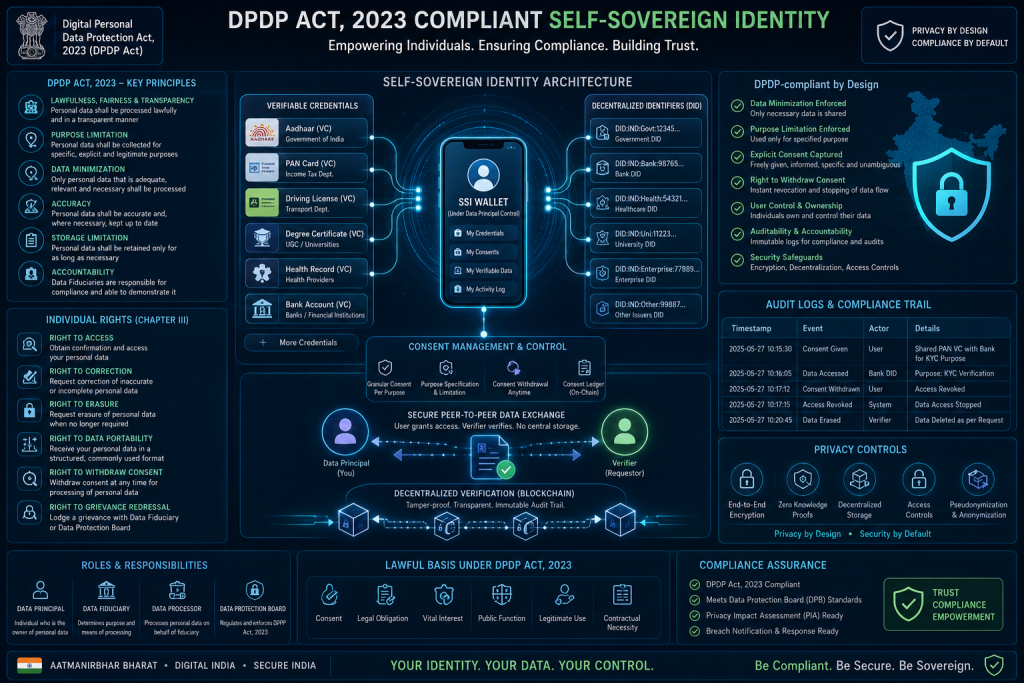
Traditional identity management systems struggle to meet these requirements structurally. They were built to accumulate data, not to respect its boundaries. Retrofitting consent mechanisms onto architectures that were never designed for consent is both technically complex and strategically fragile.
SSI’s architecture is designed around the same principles the DPDP Act demands. When a user shares a verifiable credential, they share only what is necessary for that specific transaction. When a platform receives a credential presentation, it learns only what the user chose to disclose at that moment. There is no persistent data transfer, no silent re-use of information beyond the stated purpose, and no surplus data sitting in a central repository waiting to be breached. This is not because SSI is a DPDP compliance tool in any formal regulatory sense. It is because both frameworks start from the same first principle: the individual should control their own data.
For enterprises operating in regulated sectors such as BFSI, healthcare, telecom, and government services, this structural alignment is a meaningful strategic advantage as India’s data protection regime matures toward full enforcement.
How Enterprise SSI Works in Practice
Understanding SSI as a concept is useful. Understanding how it functions inside an enterprise environment is what actually matters for Indian CISOs and CTOs making technology decisions.
Consider a mid-sized Indian bank onboarding a new corporate client. Under a traditional model, the bank collects the company’s registration documents, directors’ PAN cards, GST certificates, and financial statements. These documents are stored in the bank’s systems, verified manually or semi-automatically, and retained indefinitely. Every time the client needs to access a new service, portions of this data are re-shared, re-verified, and re-stored.
Under an enterprise SSI model, the process looks fundamentally different. Government agencies and regulators that have already verified the company’s credentials issue verifiable digital attestations directly into the company’s enterprise identity wallet. When the company onboards with the bank, it presents these credentials cryptographically. The bank verifies them instantly without calling back to the original issuer and without receiving or storing raw personal data. The onboarding is faster, the compliance documentation is automated, and the data exposure is minimized to exactly what the transaction requires.
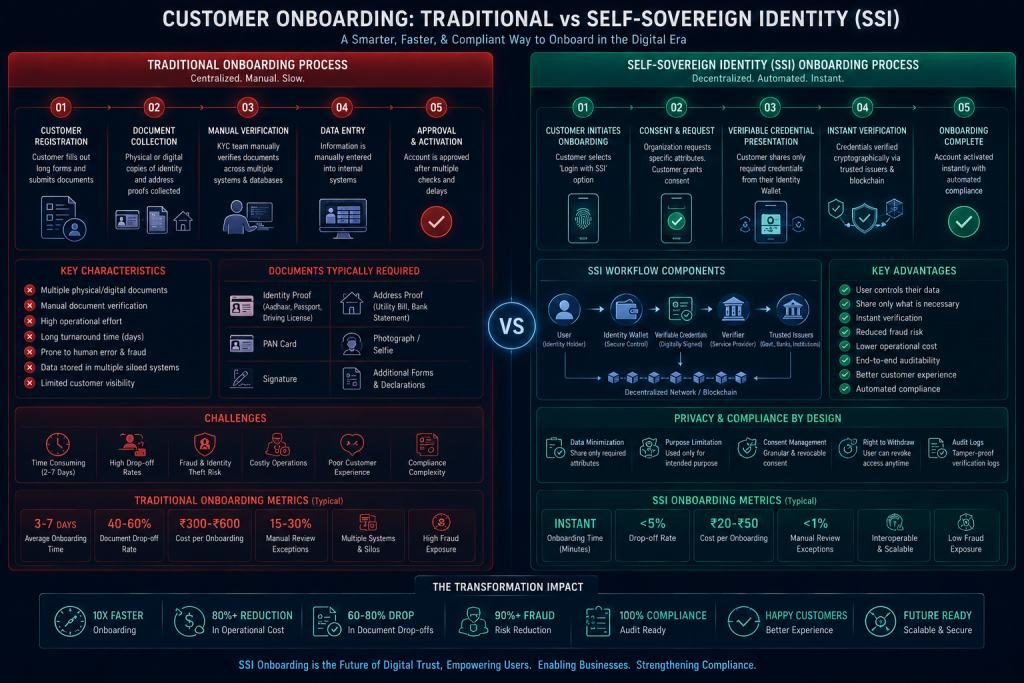
This pattern repeats across dozens of enterprise use cases: employee identity management, vendor onboarding, customer KYC, cross-border authentication, access control in zero-trust network architectures, and healthcare credential verification. In each case, SSI removes the central bottleneck of a shared data repository and replaces it with direct, peer-to-peer credential exchange that is cryptographically verifiable and privacy-preserving by design.
For organizations implementing zero-trust identity frameworks, SSI provides the identity layer that traditional password-based systems simply cannot offer. Every authentication event is based on a cryptographically verified credential, not a shared secret that can be phished, stolen, or brute-forced.
The Passwordless Authentication Advantage
One of the most compelling enterprise benefits of self-sovereign identity is the elimination of passwords entirely. Passwordless identity is not simply a convenience feature. It is a security architecture upgrade that eliminates an entire category of attack vector.
Phishing attacks, credential stuffing, and brute-force attempts all target the same weakness: a shared secret that the user knows and the platform stores. When authentication is based on cryptographic key pairs anchored in an identity wallet, there is no shared secret to steal. The private key never leaves the user’s device. Authentication happens through a cryptographic challenge-response mechanism that cannot be replicated by an attacker who does not possess the actual key.
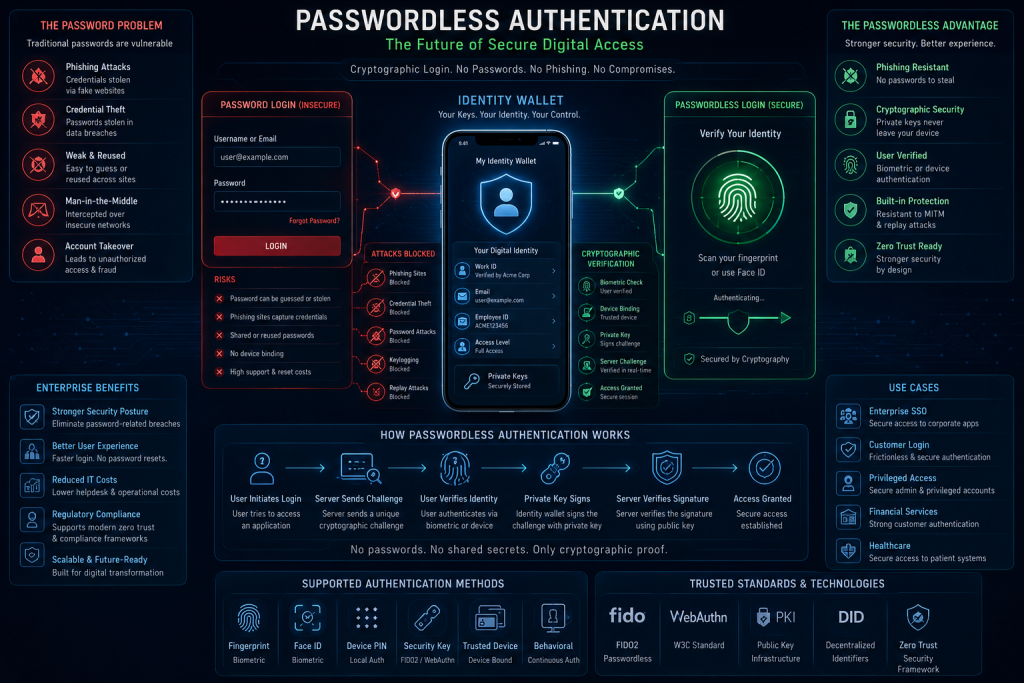
For Indian enterprises that manage large employee populations, customer-facing authentication systems, or sensitive financial and healthcare data flows, the security implications of this shift are significant. Password reset workflows, credential breach notifications, account takeover investigations, and multi-factor authentication overhead all diminish substantially when SSI replaces traditional login systems.
Moreover, passwordless authentication through SSI delivers a better user experience. A user presents their identity wallet, selects the relevant credential, and authenticates in seconds. There are no forgotten passwords, no OTP delays, and no friction-laden identity verification flows that drive abandonment on onboarding screens.
Blockchain Identity and the Role of Distributed Ledgers
A natural question arises when enterprises first encounter SSI: why does blockchain need to be involved? The answer lies in the trust infrastructure.
For a verifiable credential to be trustworthy, a verifier must be able to confirm two things. First, that the DID of the issuer is genuinely controlled by the institution that issued the credential. Second, that the credential has not been revoked since it was issued. Both of these checks require a publicly accessible, tamper-resistant source of truth.
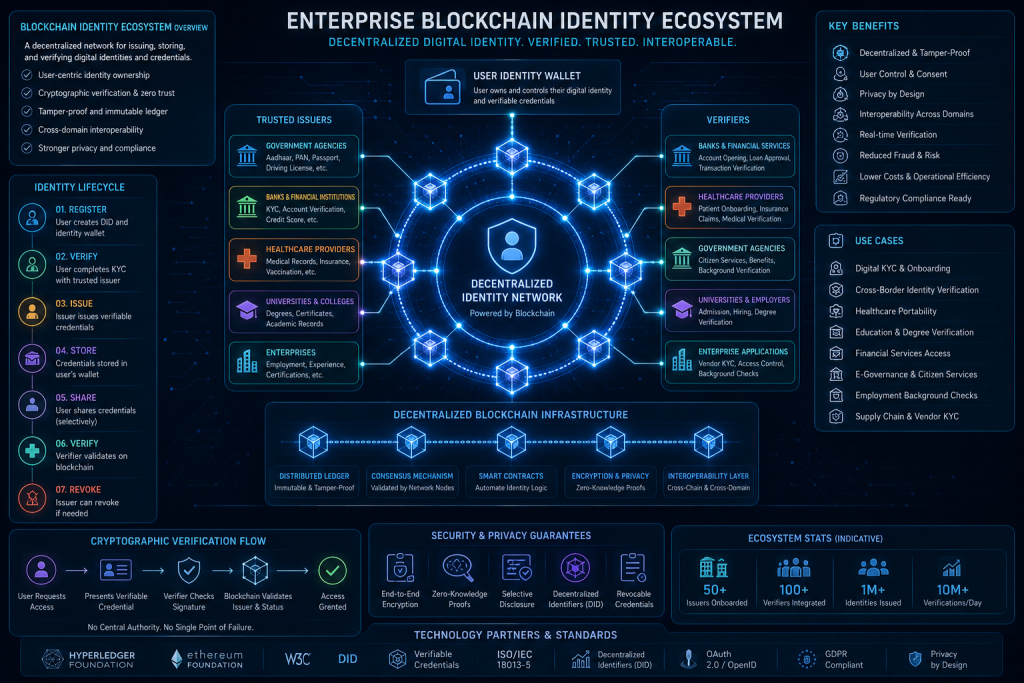
Blockchain and distributed ledger technology provide this infrastructure without requiring any single authority to control it. DID documents, which contain the public keys and service endpoints associated with a decentralized identifier, are published to a distributed ledger. Revocation registries are similarly maintained in a decentralized manner. Any verifier anywhere in the world can check these registries without relying on the continued availability or trustworthiness of any central server.
This is why blockchain identity is not a buzzword in the SSI ecosystem. It is the technical foundation that makes decentralized trust possible at scale. Indian enterprises evaluating SSI platforms should look carefully at which distributed ledger infrastructure their chosen solution uses, what the governance model for that ledger looks like, and how the solution handles interoperability with other SSI ecosystems.
SSI vs. Traditional Identity Management: A Direct Comparison
The difference between self-sovereign identity and traditional identity management is architectural, not incremental. A feature-by-feature comparison makes the gap clear.
Traditional identity management stores user data centrally, creating honeypots for attackers and concentrating liability. SSI keeps data in user-controlled wallets, eliminating central data repositories as attack surfaces.
Traditional systems authenticate users by verifying stored credentials against presented inputs. SSI authenticates through cryptographic proof that requires no stored shared secrets.
Traditional consent mechanisms are opaque, buried in terms of service, and practically irrevocable once granted. SSI consent is granular, user-initiated, and cryptographically enforced at the credential presentation layer.
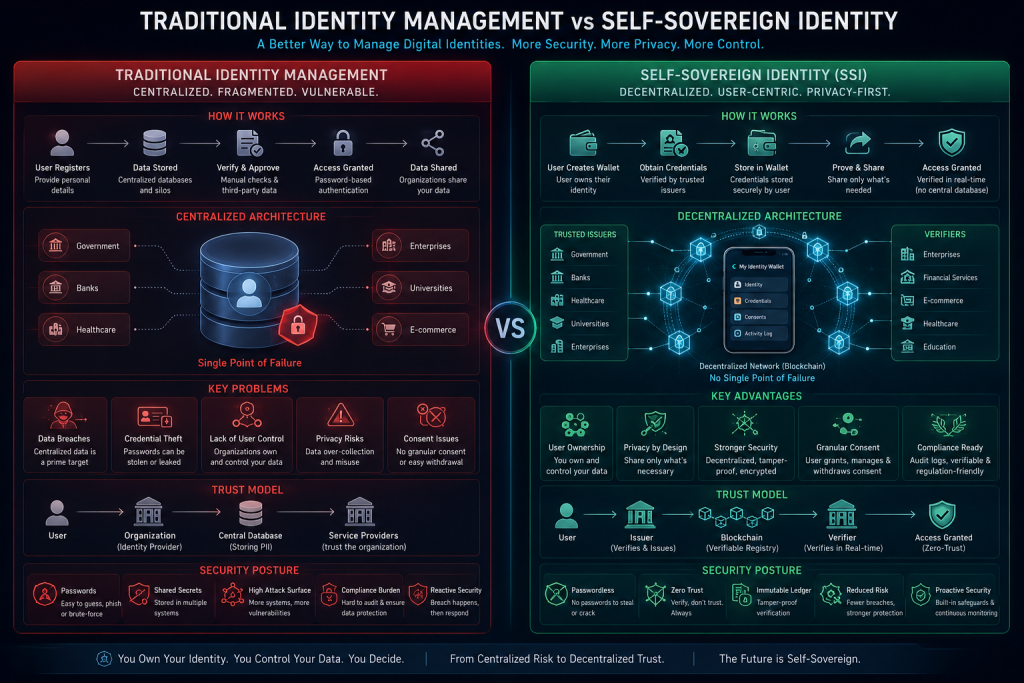
Traditional systems create siloed identity records that do not travel with users across platforms. SSI credentials are portable, interoperable across any compliant platform, and remain under user control regardless of which platform they are presented to.
Traditional identity infrastructure requires significant integration work every time a new service provider needs to verify a user’s identity. SSI allows any platform to verify any credential from any trusted issuer using standardized cryptographic protocols, dramatically reducing integration overhead.
For Indian enterprises evaluating their identity infrastructure roadmap, the comparison is not simply about technology preference. It is about which architecture is aligned with where regulation, user expectations, and security requirements are heading over the next decade.
SecureX-DiD: India’s Enterprise SSI Solution
Building an enterprise-grade SSI platform requires more than understanding the protocol standards. It requires deep integration with India’s regulatory and identity ecosystem, robust support for verifiable credentials and DID wallets, and the operational maturity to serve enterprise clients in regulated sectors.
SecureX-DiD, developed by SecureDApp, is India’s enterprise-ready self-sovereign identity platform built precisely for this environment. It is certified under the OVIS SE program by the Unique Identification Authority of India, making it one of the few SSI solutions in the country that carries formal recognition within the Aadhaar identity ecosystem.
The platform enables enterprises to issue, manage, and verify verifiable credentials using standardized decentralized identifier protocols. It supports enterprise identity wallets for both employees and customers, allowing organizations to move beyond password-based authentication toward cryptographically secure, privacy-preserving identity flows.
SecureX-DiD’s architecture is designed around data minimisation by default. When a user presents credentials through the platform, only the specific attributes required for the transaction are disclosed. The platform does not accumulate user data as a side effect of authentication. Every interaction is purpose-limited and verifiable.
For Indian enterprises working toward DPDP Act readiness while simultaneously modernizing their identity infrastructure, SecureX-DiD offers a structurally aligned path forward. Because SSI’s principles of data minimisation, purpose limitation, and user-controlled consent mirror what the DPDP Act demands operationally, adopting an SSI platform positions enterprises to meet those obligations through architecture rather than through bolt-on compliance tooling.
The UIDAI OVIS SE certification is particularly significant for enterprises in financial services, healthcare, and government-adjacent sectors where Aadhaar-based identity verification is already part of the workflow. SecureX-DiD bridges the existing Aadhaar ecosystem and the emerging SSI ecosystem, giving enterprises a migration path that does not require abandoning current processes overnight.
SSI Use Cases Across Indian Regulated Sectors
The practical applications of enterprise self-sovereign identity in India span every sector where identity verification and data privacy intersect.
In banking and financial services, SSI supports faster KYC onboarding, reusable customer credentials, automated compliance documentation, and fraud-resistant authentication. A customer who completes KYC at one institution can carry those verifiable credentials to any other institution that accepts the same credential standards, eliminating redundant verification and reducing friction across the financial system.
In healthcare, verifiable credentials can represent patient medical histories, vaccination records, insurance eligibility, and provider credentials. The Ayushman Bharat Digital Mission’s vision of a unified health identity for every Indian citizen is architecturally aligned with SSI principles. SecureX-DiD provides the enterprise infrastructure to participate meaningfully in that ecosystem.
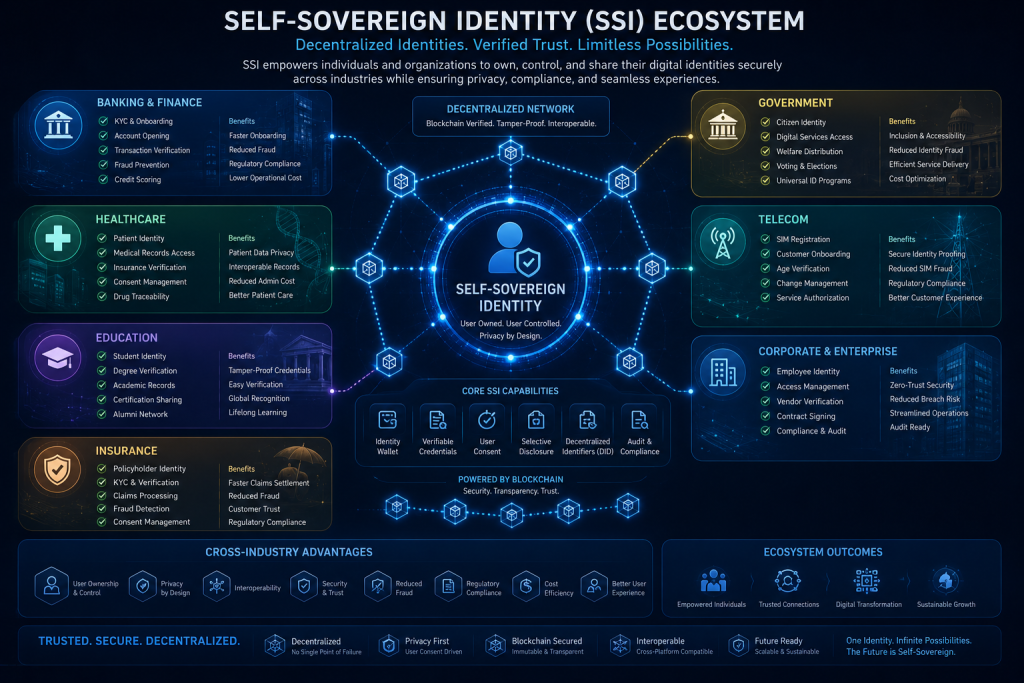
In corporate environments, employee identity management is a persistent challenge. SSI supports cryptographically verifiable employee credentials that can be used for physical access control, system authentication, document signing, and cross-organizational collaboration, all without requiring a centralized HR system to serve as a permanent authentication broker.
In government services, SSI enables citizens to present verifiable proof of eligibility, residency, income, or identity without submitting raw documents to every department separately. Each interaction is private, auditable, and revocable.
The Zero-Trust Architecture Connection
Zero-trust identity and access management is increasingly the security standard for Indian enterprises handling sensitive data, operating in cloud environments, or managing distributed workforces. The zero-trust principle, which holds that no user or system should be trusted by default regardless of network location, requires an identity layer that can continuously verify claims without creating new data liabilities.
SSI is the natural identity layer for a zero-trust architecture. Every authentication event is based on a fresh cryptographic proof. No session tokens are stored centrally. No implicit trust is inherited from previous authentications. The combination of zero-trust network policies with SSI-based identity verification creates a security posture that is both more rigorous and more privacy-preserving than anything traditional approaches offer.
For Indian enterprises adopting cloud-first or hybrid infrastructure models, integrating SSI into their zero-trust identity and access management framework is not a theoretical exercise. It is the architectural foundation that makes zero-trust operationally viable at enterprise scale.
The Integration Pathway: Moving Toward Enterprise SSI
Indian enterprise CTOs often ask a practical question: how do we get from where we are today to an SSI-enabled identity infrastructure without disrupting current operations?
The honest answer is that SSI adoption does not require a full rip-and-replace. Modern enterprise SSI platforms are designed to coexist with existing identity infrastructure during a transition period. Legacy systems can continue to handle traditional authentication while SSI is introduced progressively for new user flows, high-value transactions, or compliance-sensitive processes.
The migration typically follows a staged approach. First, an organization defines which identity use cases are highest priority, whether that is employee authentication, customer KYC, or credential verification for a specific regulated workflow. Second, verifiable credential schemas are established for those use cases, working with the relevant issuers. Third, the enterprise deploys an SSI wallet solution for the target user population. Fourth, verification infrastructure is integrated into the platforms that need to check credentials. Fifth, legacy processes are gradually retired as SSI adoption reaches operational maturity.
SecureX-DiD is built to support this staged migration, offering APIs and integration layers that connect with existing enterprise identity infrastructure while progressively expanding the SSI footprint across the organization.
Why Indian Platforms Cannot Afford to Wait
The timing pressure for Indian enterprises is real and multidirectional.
The DPDP Rules, notified in November 2025, set a phased compliance roadmap. Full substantive data processing obligations and data principal rights take effect from May 2027. That timeline feels comfortable until you consider the infrastructure work involved. Restructuring identity systems around privacy-preserving principles is not a weeks-long project. Enterprises that begin that work now will be ready when enforcement arrives. Those that treat May 2027 as the start date rather than the deadline will be scrambling under regulatory scrutiny.
At the same time, user expectations are shifting. Indian consumers who have experienced data breaches, unauthorized data sharing, and consent dark patterns are increasingly choosing platforms that demonstrably respect their privacy. Privacy-first authentication is becoming a competitive differentiator, not just a regulatory obligation.
Globally, SSI ecosystem maturity is accelerating. The European Union’s eIDAS 2.0 framework mandates SSI-compatible digital identity wallets for all member states. The World Wide Web Consortium’s DID and verifiable credential standards have reached formal recommendation status. Interoperability frameworks are emerging that will eventually allow verifiable credentials issued by Indian institutions to be recognized internationally. Indian enterprises that build SSI infrastructure now will be positioned to participate in this global ecosystem rather than being excluded from it.
The window for proactive adoption is narrowing. The enterprises that act before compliance deadlines become enforcement deadlines will capture the trust, the user confidence, and the operational efficiency that privacy-first authentication delivers.
Conclusion
Self-sovereign identity is not an abstract vision of a privacy-preserving future. It is a technically mature, standards-compliant, and increasingly operationally deployable framework for enterprise identity that is directly aligned with where Indian regulation, user expectations, and global security standards are converging.
Indian platforms that continue to manage identity through centralized data repositories, opaque consent mechanisms, and password-dependent authentication are carrying architectural debt that will become increasingly expensive to service. The DPDP Act has set the direction of travel clearly, even if full enforcement arrives in phases. The security track record of traditional systems has made the risk case undeniable. The emergence of enterprise-grade SSI platforms has made the implementation case viable.
The question is no longer whether Indian enterprises need to move toward privacy-first authentication. The question is how quickly they can build the infrastructure to make that move effectively.
For organizations ready to explore what an enterprise SSI implementation looks like in the Indian context, SecureX-DiD offers a certified, enterprise-ready starting point built specifically for this environment.
Frequently Asked Questions
1. What is self-sovereign identity and how does it differ from traditional digital identity?
Self-sovereign identity is a model in which individuals own and control their digital credentials without depending on a central authority to manage or validate them. Unlike traditional digital identity, where platforms store user data on centralized servers and authenticate users by checking that stored data, SSI gives users cryptographically secure credentials stored in their own identity wallets. They present these credentials directly to verifying parties, with no raw data transferred and no central point of failure.
2. What are verifiable credentials and why do they matter for enterprise security?
Verifiable credentials are tamper-proof digital attestations issued by trusted authorities, such as governments, banks, or employers, and cryptographically signed so that any verifier can confirm their authenticity without contacting the original issuer. For enterprises, they eliminate the need to store and protect large volumes of personal data, reduce onboarding friction, and provide a fraud-resistant foundation for identity verification across both internal and customer-facing systems.
3. How does SecureX-DiD support DPDP Act readiness for Indian enterprises?
SecureX-DiD is built around data minimisation and purpose-limited credential exchange, the same principles that the DPDP Act mandates for all data fiduciaries. The Act does not prescribe SSI as a compliance mechanism, but the architectural fit is direct: when users authenticate through SecureX-DiD, only the specific attributes required for that transaction are disclosed, no surplus data is collected, and nothing is retained beyond the stated purpose. This positions enterprises to meet DPDP obligations through their identity infrastructure rather than through reactive retrofit. The platform’s UIDAI OVIS SE certification further grounds it within India’s established identity governance framework.
4. Can enterprise SSI solutions integrate with existing identity infrastructure?
Yes. Enterprise SSI platforms like SecureX-DiD are designed to coexist with existing identity systems during a migration period. APIs and integration layers allow SSI to be introduced progressively alongside legacy authentication systems, starting with priority use cases such as high-value transaction verification or compliance-sensitive onboarding flows, before expanding across the organization.
5. What industries in India benefit most from deploying an SSI platform?
The industries with the most immediate benefit are those operating under strong data privacy and identity verification requirements: banking and financial services for KYC and fraud prevention, healthcare for patient identity and provider credential verification, government services for citizen identity and eligibility verification, and corporate enterprises managing distributed employee populations in zero-trust security architectures. Any organization handling regulated personal data at scale has a compelling case for SSI adoption.