
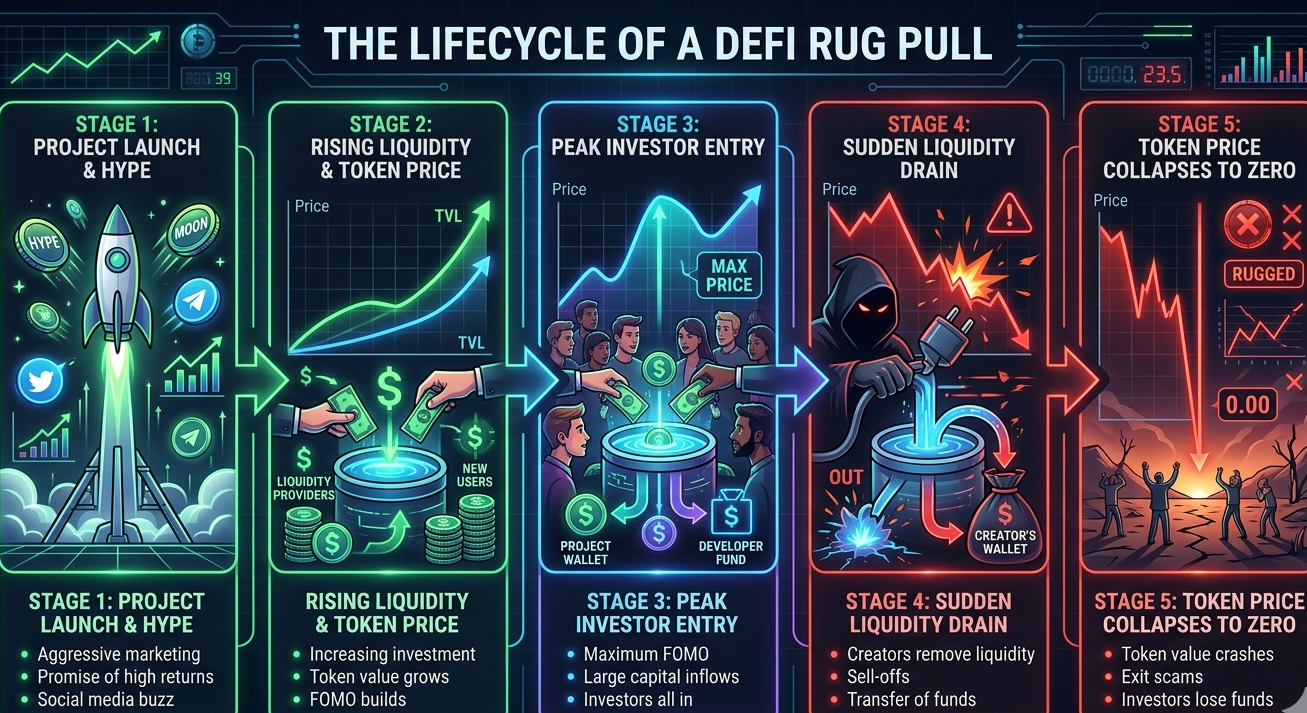
In the world of decentralized finance, rug pulls have become one of the most feared and frequent forms of investor loss. A project launches with compelling tokenomics and aggressive marketing. Liquidity flows in. Holders grow. Then, in a matter of minutes, the liquidity is drained, the token collapses to zero, and the developers vanish. The investors are left with worthless tokens and no recourse.
What most people do not realize is that rug pulls are primarily a smart contract security problem. The mechanics that make them possible, whether hidden withdrawal functions, minting backdoors, or liquidity lock bypasses, are written into the contract code. And they can be detected before deployment if the code is properly reviewed.
This guide explores the technical anatomy of rug pulls, the smart contract security practices that prevent them, and how projects can build investor trust through verifiable code security rather than marketing promises.
What Is a Rug Pull and How Does It Work Technically?
A rug pull occurs when a project team uses smart contract functions to drain investor funds after attracting sufficient liquidity. The term covers several distinct technical mechanisms, but the outcome is always the same: investors lose their funds and the developers retain the value.
The simplest form involves a token contract with a hidden or insufficiently protected withdrawal function that allows the deployer to remove all liquidity from a paired pool. A more sophisticated version uses a backdoor minting function to inflate the token supply suddenly, crashing the price and allowing the team to sell their holdings at the expense of everyone else.
Some rug pulls are deliberate from the start. Others occur because poorly written contracts are exploited by malicious actors who find the vulnerabilities and use them opportunistically. In both cases, the smart contract code is the vector.
Key Smart Contract Features That Enable Rug Pulls
Hidden Owner Withdrawal Functions
The most direct rug pull mechanism is a contract function that allows the owner address to transfer tokens or ETH from the contract to an arbitrary address. When this function is not time-locked, not transparently documented, or not visible to investors reviewing the contract, it represents a direct rug pull capability.
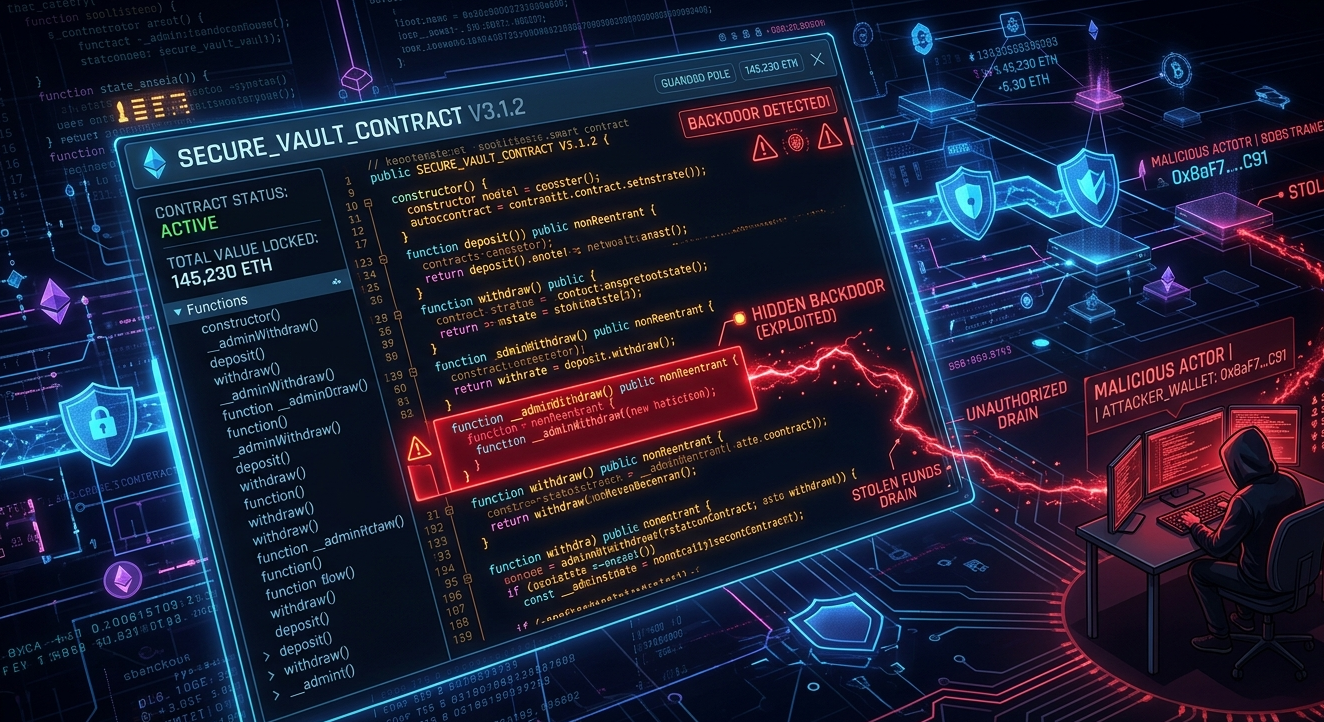
Notably, these functions are sometimes disguised with innocuous names like emergencyWithdraw, rescue, or recover. Without examining the contract code or having it audited, investors cannot distinguish between a genuinely protective function and a rug pull backdoor.
Unrestricted Minting Capabilities
A token contract that allows the deployer to mint unlimited tokens at any time is a fundamental security risk. This capability can be used to inflate supply at will, crashing the token price and enabling a sell-off by the team. In some cases, the minting function is protected but uses a weak access control that can be bypassed.
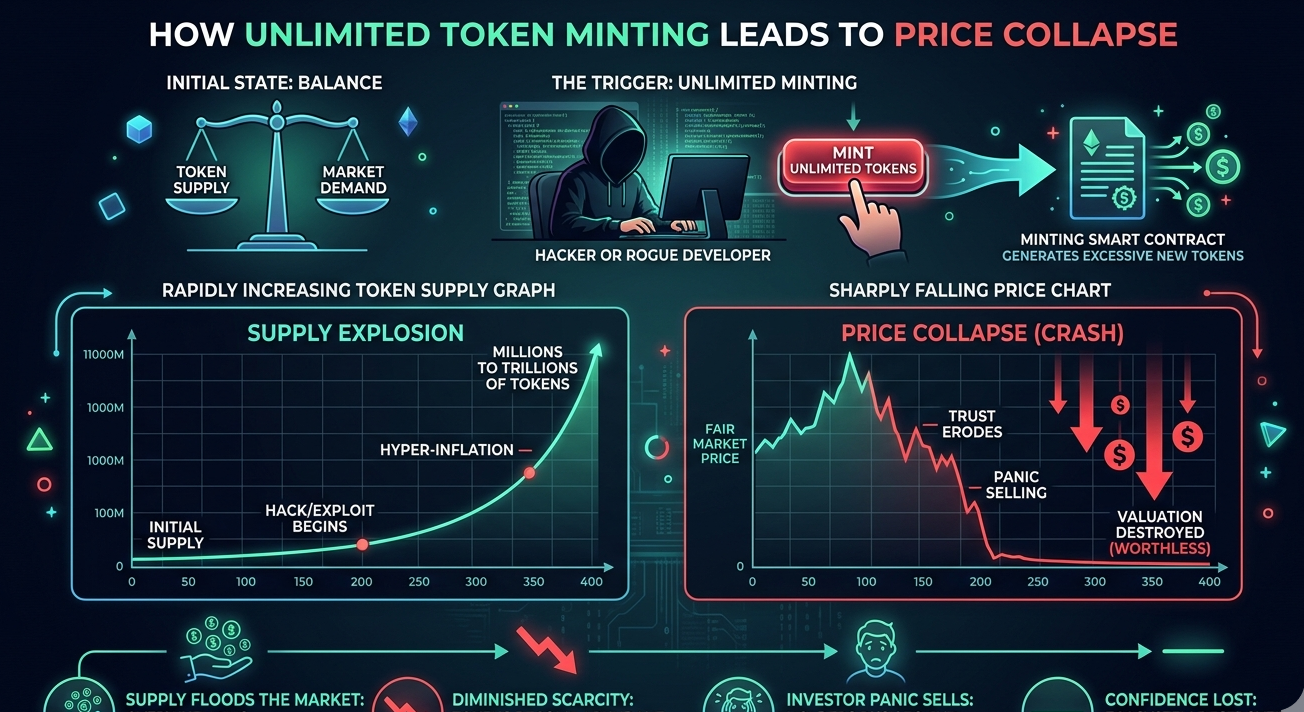
Transparent tokenomics claim that supply is fixed. But if the contract allows minting without limit, those claims are unenforceable. Smart contract security requires that stated supply limits are enforced in code, not just in whitepapers.
Upgradeable Proxy Abuse
Upgradeable contracts have legitimate uses, but they are also a common vector for sophisticated rug pulls. When a project deploys a proxy contract and retains admin control over the implementation contract, they can upgrade the contract at any time to introduce malicious logic.
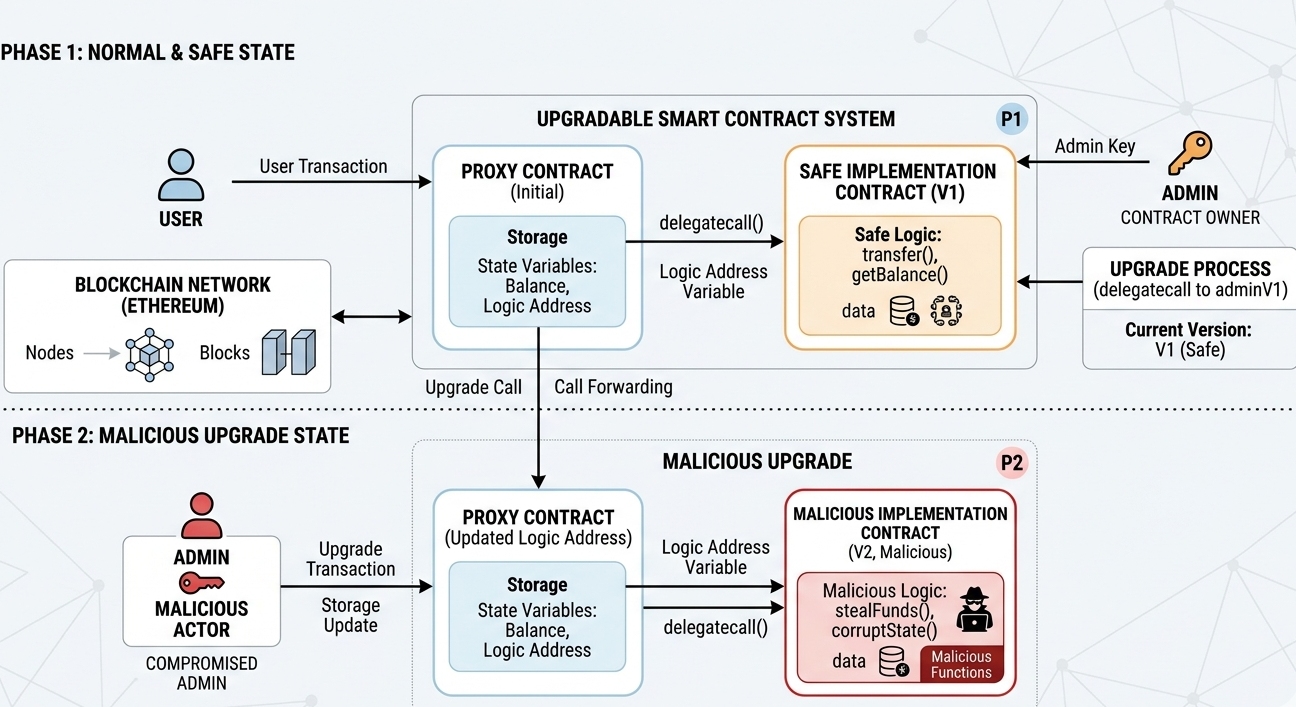
Investors who reviewed the original contract are not protected because the contract they reviewed is no longer the contract that runs. Upgradeability without proper governance controls, timelocks, and transparency is a significant smart contract security risk.
Liquidity Lock Bypasses
Many projects advertise that liquidity is locked, which is meant to reassure investors that the team cannot drain the liquidity pool. However, liquidity locking is only as strong as the locking mechanism. If the locking contract has a bypass, if the lock duration is trivially short, or if the team retains the ability to unlock through a backdoor, the protection is illusory.
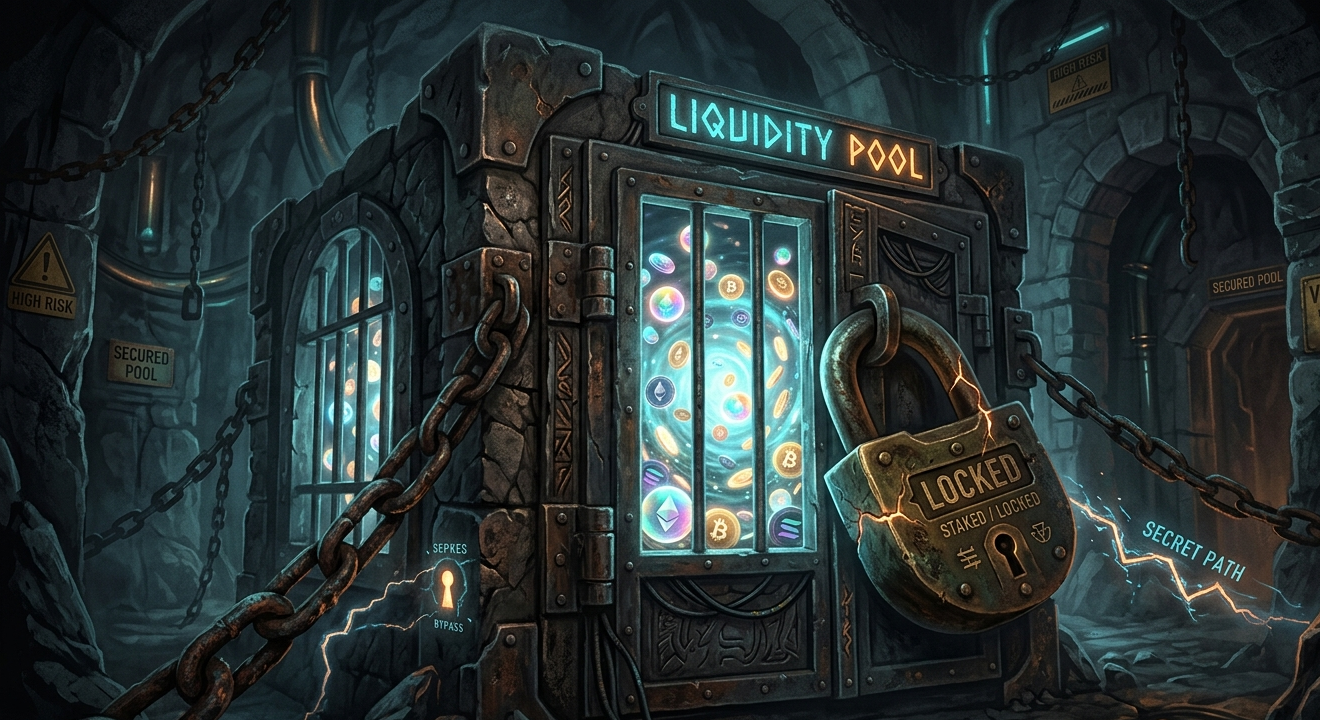
Additionally, some projects lock a portion of liquidity while retaining control over enough to execute a meaningful drain. The advertised lock percentage can be technically accurate but practically deceptive.
Fee-on-Transfer Manipulation
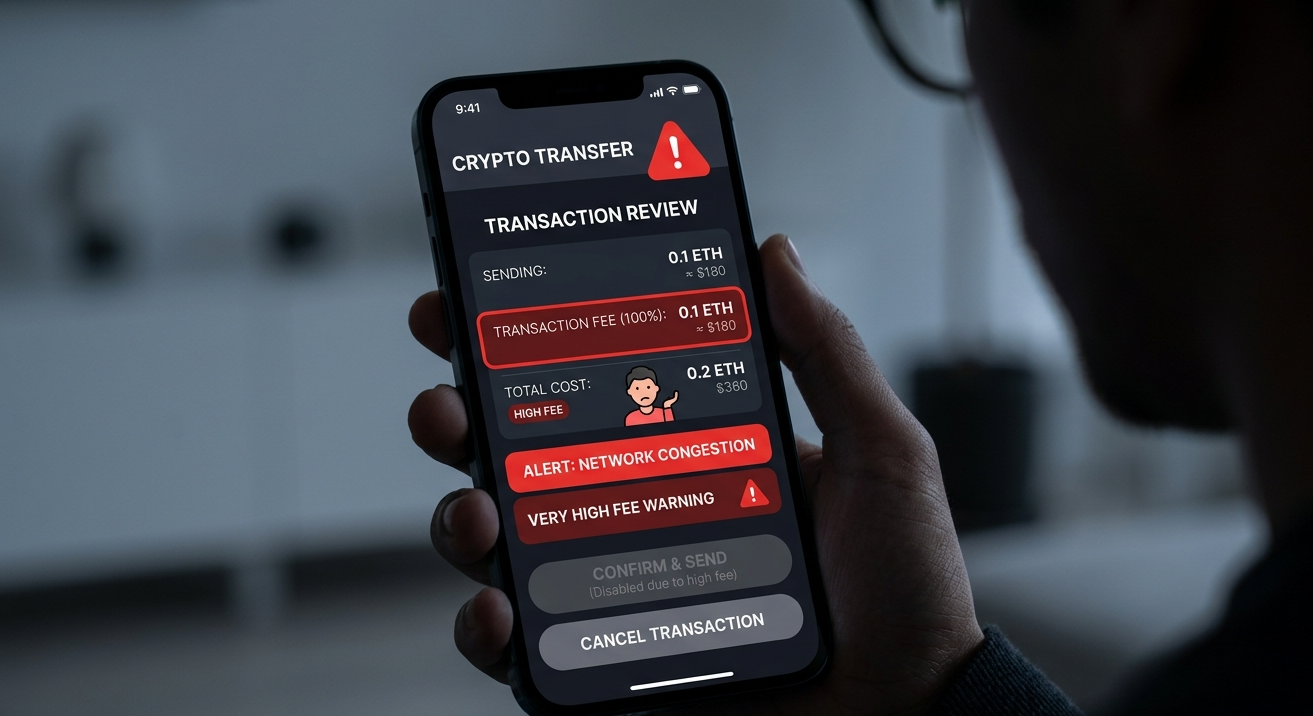
Some tokens implement custom transfer hooks that allow the contract owner to set or modify transaction fees. In a rug pull scenario, these fees can be raised to 100 percent, effectively making the token non-transferable and trapping holders’ funds while the team’s tokens remain unaffected.
Smart Contract Security Practices That Prevent Rug Pulls
Renouncing Ownership After Deployment
The most straightforward way to demonstrate that a contract cannot be rug-pulled via owner functions is to renounce ownership entirely after deployment. When ownership is renounced, no address retains administrative control, making it mathematically impossible to execute owner-only functions.
However, renouncing ownership also means the contract cannot be upgraded or adjusted if genuine issues arise. Teams must weigh this trade-off carefully and ensure that all intended functionality is fully operational before renouncing.
Implementing Timelocks on Sensitive Functions
For projects that need to retain some administrative capability, timelocks provide a meaningful protection against surprise rug pulls. A timelock requires that any sensitive action, such as changing fees, modifying liquidity, or upgrading the contract, must be announced and delayed by a defined period before execution.
This window gives the community time to review and respond to proposed changes. It does not prevent all rug pulls, but it eliminates the ability to execute them instantly and forces transparency.
Multisignature Governance for Admin Controls
Concentrating administrative control in a single private key is a single point of failure and a direct rug pull risk. Implementing multisignature governance, where multiple independent signers must approve any sensitive action, distributes that risk and makes unilateral rug pulls significantly more difficult.
Multisig implementations should be audited carefully. A multisig with a low threshold or with signers who are controlled by the same entity provides false security.
Fixed Supply Enforcement at the Code Level
If a token’s supply is intended to be fixed, this must be enforced in the contract code by eliminating the mint function entirely or restricting it to a one-time operation that cannot be repeated. Auditors should verify that no path exists for the deployer or any other address to increase the token supply beyond the stated maximum.
Transparent Liquidity Management
Liquidity management functions should be fully visible, time-locked, and subject to community governance. If the team retains the ability to remove liquidity, this should be explicitly documented and verified by an independent auditor.
The Role of Smart Contract Security Audits in Rug Pull Prevention
An independent audit is the most verifiable way to demonstrate that a contract does not contain rug pull mechanisms. When a reputable auditor reviews a contract and confirms the absence of hidden backdoors, unrestricted minting, or dangerous admin functions, it provides investors with evidence they can reference and trust.
However, not all audits are created equal. A superficial audit that only checks for known vulnerability patterns may miss custom rug pull logic that was deliberately obfuscated. The audit must include a thorough review of all admin functions, all access control logic, and all paths by which funds can flow out of the contract.
How Solidity Shield Identifies Rug Pull Risks
Solidity Shield is specifically built to detect the kind of smart contract security issues that enable rug pulls. Its audit process examines every administrative function to identify who controls it, what it can do, and whether it poses a risk to investor funds.
For each project, Solidity Shield’s review covers access control completeness, minting capability restrictions, liquidity management transparency, upgradeability risks, fee manipulation potential, and timelock implementations. This comprehensive mapping of admin power within the contract gives investors a clear picture of the real risk profile.
Crucially, Solidity Shield communicates findings in a way that non-technical stakeholders can understand. Investors should not need to read Solidity code to know whether a contract is safe. A well-structured audit report translates technical findings into clear risk assessments, which is exactly what the smart contract security ecosystem needs more of.
Building Investor Trust Through Verifiable Security
Smart contract security audits are not just a technical exercise. They are a trust-building mechanism. In a space where pseudonymous teams and anonymous deployers are common, a thorough third-party audit is one of the few verifiable signals that a project is operating in good faith.
Projects that publish their audit reports, address all critical findings before launch, and maintain transparency about their contract architecture send a fundamentally different signal than those that launch without review. Over time, this differentiation becomes commercially meaningful. Sophisticated investors increasingly screen for audited contracts before participating.
Moreover, the absence of an audit is itself a red flag. Any project asking for investor trust while refusing to submit to independent code review is asking those investors to take a risk that the team itself is unwilling to take.
Practical Investor Checklist for Rug Pull Detection
While the primary responsibility for smart contract security lies with project developers, investors can also take steps to protect themselves. Before participating in any DeFi project, consider verifying whether the contract has been audited by a reputable firm. Review the audit report to confirm it addresses rug pull risks specifically.
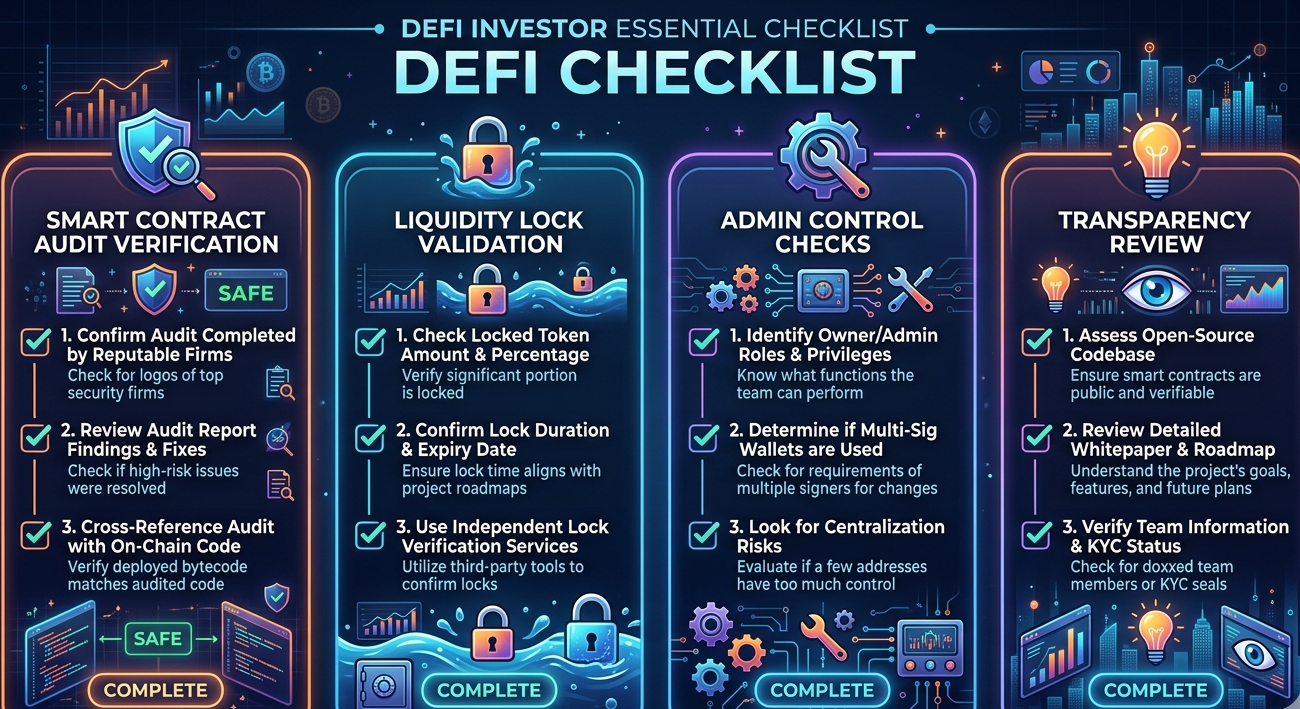
Additionally, check whether liquidity is locked, for how long, and whether the locking contract itself has been audited. Examine the contract for owner functions and assess whether adequate time-lock or governance protections are in place. If the team refuses to share the contract address before launch or discourages independent code review, treat that as a material warning sign.
Conclusion
Rug pulls are preventable. They are not inevitable features of decentralized finance. They are the result of smart contract code that was either written maliciously or not reviewed carefully enough. Strong smart contract security practices, including thorough audits, time-locked governance, fixed supply enforcement, and transparent liquidity management, can eliminate the mechanisms that make rug pulls possible.
Investors deserve to know whether the code they are trusting with their funds has been properly reviewed. And projects that are building in good faith should want that verification to be available. Smart contract security is the bridge between intent and trust.
Solidity Shield provides the depth of audit analysis that rug pull prevention requires. If you are launching a DeFi project, demonstrate your commitment to investor safety before you ask for their participation.
Frequently Asked Questions
1. Can an audit fully guarantee that a project will not rug pull?
An audit can identify and confirm the absence of known rug pull mechanisms in the contract code. However, it cannot account for off-chain actions or future contract upgrades made after the audit. Continuous governance transparency is necessary to maintain that assurance over time.
2. What is the difference between a hard rug pull and a soft rug pull?
A hard rug pull involves direct exploitation of a contract function to drain funds instantly. A soft rug pull typically involves the team gradually selling their token allocations or abandoning the project without triggering a visible on-chain exploit. Smart contract audits address the hard rug pull risk primarily.
3. Are upgradeable contracts always a risk?
Not inherently. Upgradeable contracts can be implemented securely with proper governance timelocks, multisig requirements, and community oversight. The risk arises when upgradeability is retained unilaterally by the deployer with no transparency or delay mechanisms.
4. How important is liquidity locking for investor protection?
Liquidity locking is a meaningful signal but not a guarantee. The locking contract itself must be audited, the lock duration must be substantial, and the proportion of locked liquidity must be sufficient to prevent a meaningful drain. Partial locks with short durations offer limited protection.
5. What should I look for in a rug pull audit report?
Look for explicit analysis of all administrative functions, confirmation that minting is restricted or eliminated, assessment of upgradeability risks, verification of liquidity lock integrity, and clear severity ratings for any identified issues. A report that does not address these areas specifically is incomplete.