
Every card swipe, UPI request and wire instruction ends in a cryptographic decision made in milliseconds. A PIN is verified, a cryptogram is checked, a key is unwrapped. If any of those steps fails quietly, the loss is not a bug report. It is fraud at scale.
That is why Payment HSM Security sits at the center of every serious payment architecture. However, the threat model around that hardware is changing. Quantum-capable adversaries will not attack your HSM first. They will attack the links, certificates and archives around it.
This guide breaks down how payment HSM architecture really works, where it is exposed, and how a quantum-safe security platform like QuantumVault closes those gaps without disturbing real-time payment processing.
Why Payment Processing Is the Hardest Place to Get Cryptography Wrong
Most industries can tolerate a slow cryptographic upgrade. Payments cannot. A payment network is a chain of institutions, each with its own hardware, vendors and release calendar. A change at one node ripples through all of them.
Consider the scale. India’s UPI ecosystem now handles billions of transactions every month. Card networks clear far more globally. Each transaction depends on keys that were generated, injected and rotated by processes that often date back a decade or more.
Three forces are converging: real-time rails that remove the reconciliation buffer, PCI-DSS 4.0.1 demands for continuous evidence, and a quantum deadline. NIST finalized its first post-quantum standards in August 2024, and its transition guidance points to deprecating today’s public-key algorithms by 2030 and disallowing them by 2035.
So the question for a banking technology leader is no longer “do we have an HSM?” Almost everyone does. The sharper question is whether the whole path around that HSM can be trusted for the next fifteen years.
Payment HSM Security Architecture: What the Hardware Actually Protects
An HSM is not a magic box that makes payments safe. It is a tamper-resistant boundary where the most sensitive operations happen, so that keys never appear in clear text on a general-purpose server.
Understanding exactly what Payment HSM Security covers inside that boundary helps you see what sits outside it. That distinction drives every architectural decision that follows.
Core cryptographic functions inside a payment HSM
A payment-grade HSM typically performs a defined set of functions for payment processing:
- PIN generation, translation and verification across interchange formats
- Card verification value generation and validation (CVV, CVC and similar)
- EMV cryptogram validation and response generation during chip transactions
- MAC generation and verification for message integrity
- Key wrapping and exchange using standard key block formats such as TR-31
- Terminal and device key injection for point-of-sale and ATM fleets
The key hierarchy that makes it all work
Payment keys follow a strict hierarchy. A master key sits at the top, protected inside the HSM. Zone and working keys sit below, encrypted under the master and exchanged with partner institutions.
Derived unique key per transaction schemes, known as DUKPT, add another layer. Every terminal transaction uses a fresh key derived from a base key, so compromise of one transaction does not expose the next.
This hierarchy is elegant. Notably, though, it is almost entirely symmetric. That detail matters a great deal when we reach the quantum discussion.
The trust boundary in a typical payment gateway HSM deployment
In a typical payment gateway HSM design, the application sends a command over a network link and the HSM returns a result. The hardware protects the key. Everything else protects the link, the caller and the policy.
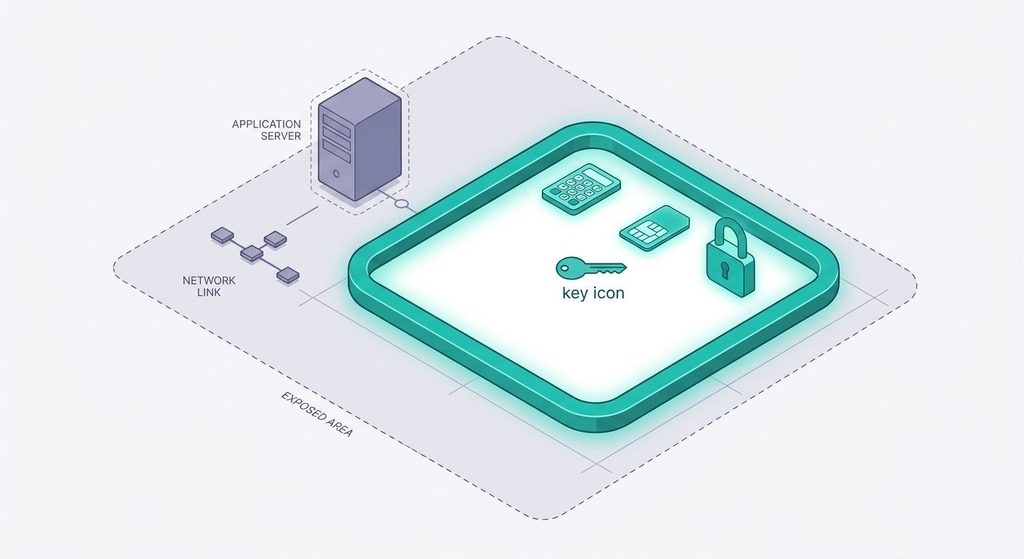
That “everything else” is where most real incidents happen.
Where Payment HSM Security Breaks Down Around the Hardware
Here is a pattern worth noticing. When payment breaches are analyzed, the HSM rarely gives way. The surrounding plumbing does. An exposed management interface, an over-permissioned service account or an unencrypted legacy link becomes the entry point.
Let us look at the gaps that matter most for transaction security.
Gap 1: Unprotected or weakly protected HSM links
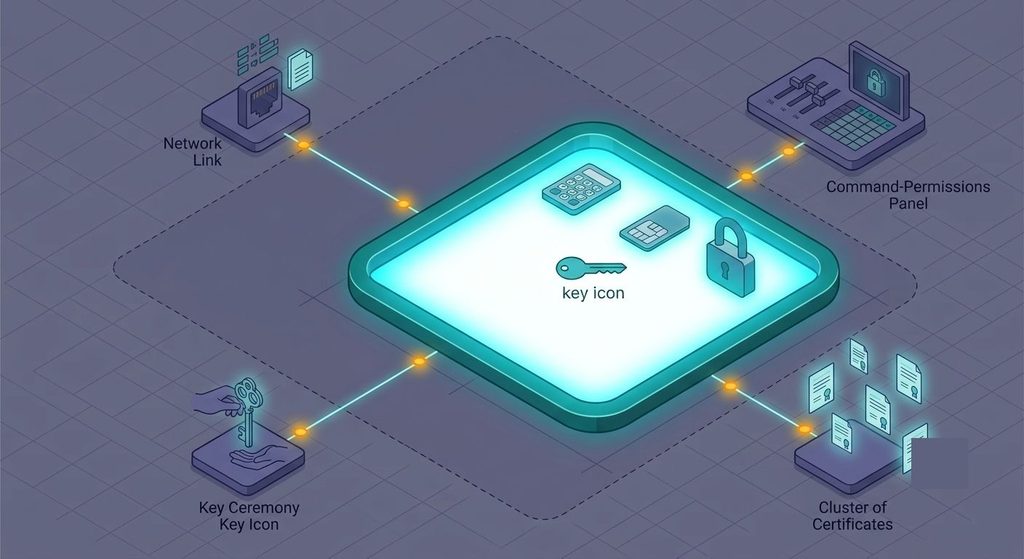
Many HSM connections were designed for private data center networks. Over time, those networks grew, merged with cloud environments and opened to third-party integrations. The link is often protected by TLS configured years ago, with algorithms nobody has reviewed since.
Gap 2: Command-level authorization is too coarse
An application that can call the HSM can often call every command the HSM exposes. In practice, a card-verification service should never be able to export or translate PINs. Without a policy layer, that boundary exists only in documentation.
Gap 3: Key ceremonies and custody run on trust
Key loading and component custody still depend heavily on manual procedures and spreadsheets. Evidence is fragmented. When an auditor asks who approved a key change eighteen months ago, the answer takes days to assemble.
Gap 4: Cryptographic sprawl nobody has inventoried
Algorithms, certificates and libraries pile up across apps, terminals and APIs. Teams cannot migrate what they cannot see, which is the central obstacle to any PQC migration.
Notice what these four gaps share. None of them is solved by buying a bigger HSM, which is why Payment HSM Security is a systems problem. They are governance, policy and transport problems, and that is exactly the layer QuantumVault is built to address.
The Quantum Problem Nobody Puts on the Payment Roadmap
Ask a payments architect about quantum risk and you will often hear a confident answer: “Our crypto is mostly AES and 3DES. Quantum computers do not break that.” Technically, that is partly true. Strategically, it misses the point.
Insight 1: The risk lives in the public-key layer, not the symmetric core
Shor’s algorithm threatens RSA and elliptic-curve cryptography. Grover’s algorithm only weakens symmetric ciphers by roughly half their key length, which AES-256 absorbs comfortably.
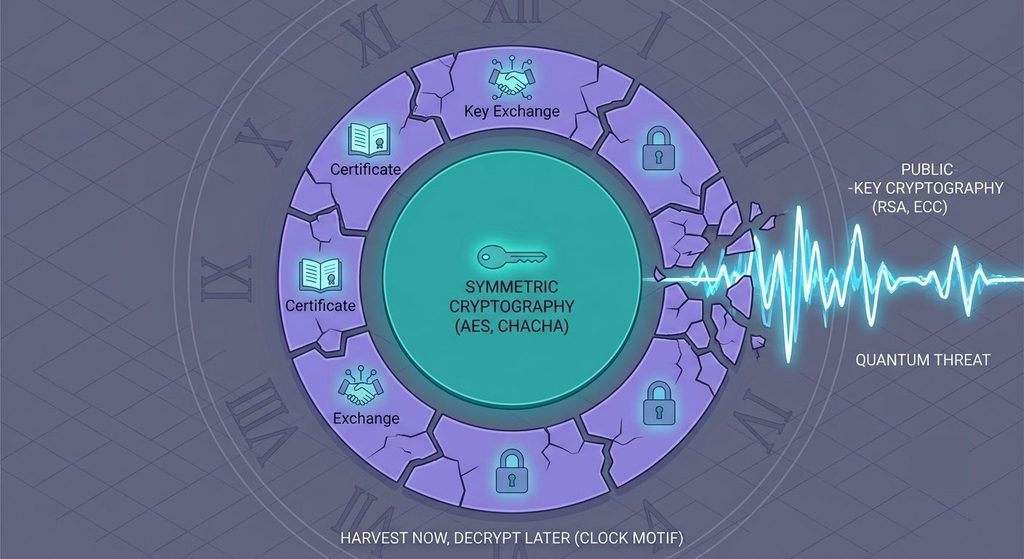
However, public-key cryptography is everywhere around the symmetric core. It protects TLS sessions, certificate chains, remote key distribution, code signing, API authentication and many EMV card authentication schemes. Break those, and the attacker reaches the symmetric keys that travel through them.
Insight 2: Harvest now, decrypt later is a payments problem
Adversaries can record encrypted traffic today and decrypt it once quantum capability matures. Many people dismiss this because a PIN or a one-time cryptogram has little value years later.
That reasoning is incomplete. Cardholder identity data, account relationships, key exchange material and archived settlement files stay valuable for a decade or longer. A wrapped key captured in transit today may unlock far more than one transaction tomorrow.
Insight 3: Cards and terminals outlive your migration plan
A chip card or terminal can stay in service for five to ten years. Any algorithm baked into it must survive that lifetime, so decisions made now already shape 2035.
What “quantum-ready” Payment HSM Security means for a bank
Being quantum-ready does not mean replacing everything at once. It means knowing where public-key cryptography lives, having a policy that governs how it is replaced, and building the crypto-agility to swap algorithms without rewriting applications.
That last capability, cryptographic agility, is the real prize. Algorithms will change again. The institutions that treat agility as an architectural property will migrate once. The rest will migrate repeatedly.
PCI-DSS, PCI HSM and the Compliance Case for Quantum-Safe Controls
Compliance is often treated as the reason to invest in Payment HSM Security. In reality, it is the minimum bar. Still, it shapes budgets, so it deserves a clear look.
What PCI-DSS expects around cryptography
PCI-DSS 4.0.1 requires strong cryptography to protect stored and transmitted account data, documented key management processes, and restricted access to cleartext keys. Its requirements on cryptographic inventory and cipher-suite review, which became mandatory in 2025, make visibility a formal obligation.
Furthermore, PCI standards for PIN security and for HSM devices themselves set expectations for key custody, dual control and split knowledge. These controls apply regardless of how modern your algorithms are.
Why a PQC compliance layer matters now
Auditors do not yet require post-quantum algorithms in payment flows. Nevertheless, they do expect you to know your cryptographic estate and to manage change in a controlled way. A PQC compliance capability, backed by a PQC policy engine and tamper-evident PQC audit logs, turns that expectation into repeatable evidence.
This is also where regulated enterprises feel the strongest pull. Banks operating under central bank supervision, such as the Reserve Bank of India’s technology and cyber resilience directions, increasingly need to demonstrate forward-looking cryptographic risk management, not only point-in-time compliance.
Mapping controls to evidence
| Compliance need | What auditors look for | Quantum-safe control that helps |
|---|---|---|
| Key management | Lifecycle records, dual control, rotation | PQC key management with approval workflows |
| Strong cryptography in transit | Approved protocols and cipher suites | PQC tunnel with hybrid encryption |
| Access restriction | Least privilege to cryptographic commands | PQC policy engine at the gateway |
| Logging and monitoring | Complete, tamper-evident trail | PQC audit logs, centrally correlated |
| Cryptographic inventory | Documented algorithms and libraries | PQC governance platform discovery |
A Quantum-Safe Reference Architecture for Payment HSM Security
So far we have mapped the problem. Now consider the design. The principle behind modern Payment HSM Security is simple: keep the HSM as the root of trust for keys, and wrap it in a PQC security platform that governs how every request reaches it.
QuantumVault is that platform. It works alongside your existing payment HSM fleet rather than asking you to rip it out. Its modules map directly to the gaps described earlier.
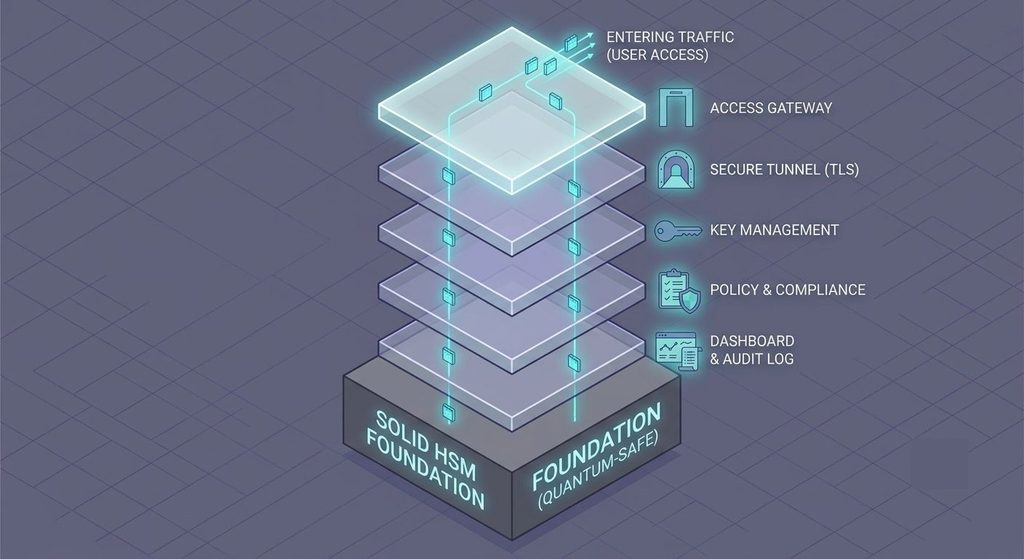
Layer 1: A quantum-safe gateway for cryptographic policy enforcement
At the front sits the PQC gateway, a secure gateway that every HSM call must pass through. It authenticates the caller, evaluates the request against policy and only then forwards it.
This is a quantum-safe gateway for cryptographic policy enforcement in the most practical sense. Your card-verification service can call CVV commands but not PIN translation. Your reporting service cannot touch keys at all. The rule lives in code, not in a wiki page.
Layer 2: A PQC tunnel with hybrid encryption
Between application and HSM, QuantumVault establishes a PQC tunnel. It uses hybrid encryption, combining a NIST-standardized post-quantum key encapsulation mechanism (ML-KEM) with a classical exchange.
Why hybrid? Because hybrid crypto protects you if either side proves weaker than expected. The session stays safe as long as one of the two mechanisms holds. For regulated payment environments, that conservative stance is exactly right.
This hybrid PQC and classical encryption platform approach also keeps interoperability intact. Partners that have not yet upgraded can still connect over the classical path while your own traffic is already quantum-resistant.
Layer 3: PQC key management
Next comes PQC key management. It tracks every key, certificate and algorithm assignment, including post-quantum keys alongside classical ones. Rotation, expiry and revocation follow policy rather than memory.
Importantly, this layer supports PQC signing workflow controls. Key ceremonies, configuration changes and release approvals can require multi-party sign-off using quantum-resistant signatures such as ML-DSA, so approvals remain verifiable for years.
That is the foundation of a PQC solution for secure signing and approval workflows. The evidence trail produced today must still be trustworthy when an auditor reads it in 2035.
Layer 4: The PQC policy engine
The PQC policy engine is where cryptographic agility becomes operational. Policies declare which algorithms are permitted for which data classes, which systems must use hybrid mode, and when classical-only paths are retired.
Consequently, switching an algorithm becomes a policy change, validated and rolled out in stages, instead of a code change across forty applications. That is the core promise of a cryptographic agility platform.
Layer 5: PQC governance and audit logs
Finally, the PQC governance platform ties everything together. It maintains the cryptographic inventory, scores risk by data lifetime, tracks PQC migration progress and produces the PQC audit logs that compliance teams need.
For leaders, this is the PQC governance platform for secure cryptographic migration that turns an overwhelming program into a measurable one. You can see which systems are done, which are blocked and which carry the most exposure.
Extending protection beyond the data center
Payment estates do not stop at the HSM rack. Engineers, operators and vendors reach into them every day. QuantumVault extends the same controls to those paths:
- Quantum-safe remote access and tunnel security for operators and support engineers reaching HSM management interfaces
- PQC device security for terminals, mobile payment apps and edge devices that must carry long-lived credentials
- PQC collaboration security for the files, tickets and chat threads where key ceremony details and incident evidence are discussed
- Quantum-safe access controls that bind identity, device posture and policy before any privileged session starts
Together, these form a quantum-safe network perimeter around the payment core. It is also a complete example of quantum-resistant security for web, mobile, server and devices, which is rarely achieved by hardware alone.
How this differs from a hardware-only approach
Established HSM vendors deliver excellent tamper-resistant hardware. Their strength is protecting keys inside the boundary, and that strength is real. Their typical limitation is scope. Post-quantum support tends to arrive algorithm by algorithm through firmware, while governance, policy and cross-system visibility remain outside the product.
QuantumVault takes the opposite angle. It assumes strong hardware is already in place and focuses on the layers that hardware does not cover: transport, authorization, inventory, workflow and evidence. In practice, the two approaches complement each other.
A Practical PQC Migration Roadmap for Payment HSM Security
Knowing the architecture is one thing. Moving a live payment platform toward it is another. The safest approach is phased, measurable and reversible at each step.
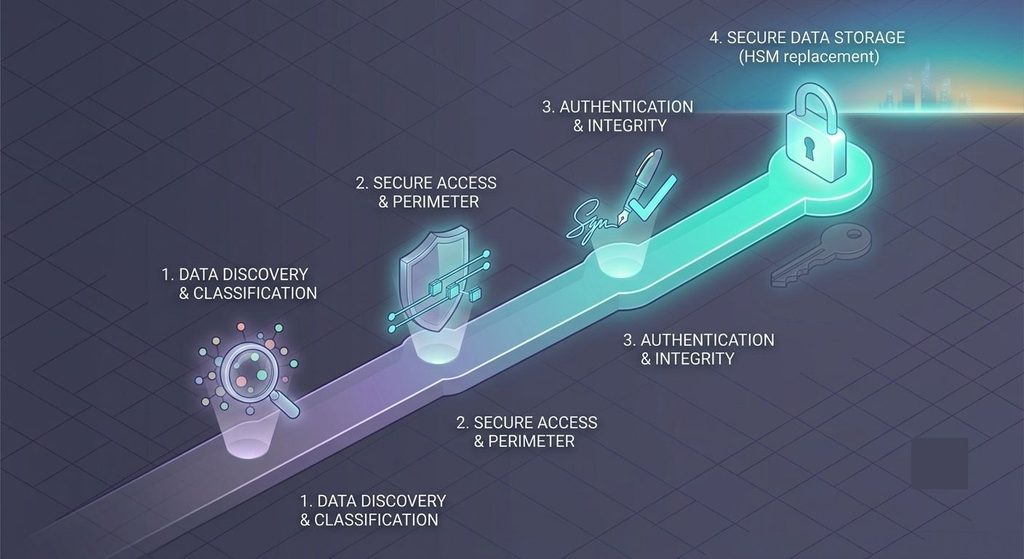
Phase 1: Discover and classify
Begin with a cryptographic inventory. Identify every place public-key cryptography appears: TLS endpoints, HSM links, certificate authorities, mobile SDKs, signing processes and partner connections.
Phase 2: Protect the highest-exposure links first
Place the gateway and tunnel in front of the HSM links that carry key exchange and administrative traffic. Start in monitor mode, observing without blocking. Once policies are tuned, move to enforcement.
This PQC rollout pattern delivers early risk reduction without touching card-facing flows. Moreover, it produces the baseline performance data your payment engineers will want before going further.
Phase 3: Migrate signing and approvals
Move key ceremonies, firmware approvals and configuration sign-offs to quantum-resistant signatures. These workflows are low in volume but high in consequence, which makes them an ideal early target.
Phase 4: Enable hybrid mode and retire classical-only paths
Turn on hybrid encryption for partner links with controlled fallback, then use the policy engine to disable remaining classical-only paths on a published schedule. Because the policy is central, retirement is a controlled event rather than a scramble.
Use Cases and a Buyer’s Checklist for Payment HSM Security
Architecture becomes persuasive when it meets a scenario. Here are two, one grounded in current industry behavior and one illustrative.
Real-world pattern: the long-lived archive
Industry bodies such as Europol’s Quantum Safe Financial Forum have urged banks to plan migration now, because financial data often has a long confidentiality lifetime.
A payment processor that retains settlement and dispute files for seven years faces this directly. With QuantumVault’s hybrid tunnel in place, the channels that move those files to archive are already protected, even though the files themselves are decades from being a concern.
Illustrative scenario: a gateway under pressure
Imagine a mid-sized bank running a payment gateway HSM cluster for card-not-present authorizations. A third-party fraud analytics service needs limited HSM access. Historically, that service received a broad credential.
With the policy engine, the service is limited to exactly the verification commands it needs. When a misconfigured integration starts requesting unusual commands at 2 a.m., the gateway blocks the calls and the audit log shows precisely which identity attempted them. The security team responds from evidence, not guesses.
What to demand from any quantum-safe vendor
Before you shortlist a post-quantum cryptography solution for enterprises, test it against a practical Payment HSM Security checklist:
- Standards alignment. Does it implement NIST-standardized algorithms, including ML-KEM and ML-DSA?
- Hybrid support. Can it run post-quantum and classical mechanisms together, with controlled fallback?
- HSM compatibility. Will it integrate with your current payment HSM fleet without re-keying everything?
- Policy depth. Can it enforce command-level rules, not only network-level ones?
- Evidence quality. Are audit logs tamper-evident and exportable for assessors?
- Agility. Can you change algorithms through policy, without application rewrites?
- Performance proof. Will the vendor demonstrate latency under your own transaction profile?
- Coverage. Does it extend to remote access, devices, signing and collaboration, or only to one channel?
QuantumVault is designed around this list, and a live demonstration against your own architecture is the fastest way to verify each point. You can Secure payment systems with HSM controls in a working session tailored to your environment.
Conclusion: Make the HSM Boundary Quantum-Ready
Payment HSM Security has always been about one idea: keep the most sensitive keys inside a boundary that attackers cannot cross. That idea remains correct. What has changed is how much of the system sits outside the boundary, and how long the data moving through it must stay secret.
The practical path forward is clear for any team serious about Payment HSM Security. Inventory your public-key exposure. Put a policy-driven gateway in front of every HSM call. Protect transport with hybrid post-quantum encryption. Govern migration with evidence, and build the cryptographic agility to change course when standards evolve.
QuantumVault brings these capabilities together as a quantum-safe security platform with cryptographic agility, built for regulated enterprises that cannot afford downtime or guesswork. It strengthens the HSM investment you already have and prepares the surrounding stack for the next decade.
If you lead payment technology or engineering, the next step is simple. Book a demo and see how QuantumVault maps to your own HSM architecture, compliance obligations and migration timeline.
Frequently Asked Questions
1. What is Payment HSM Security?
Payment HSM security is the practice of protecting payment keys and cryptographic operations inside tamper-resistant hardware. It covers PIN handling, card verification, EMV validation and key management. It also includes the policies and links around the device.
2. Does PCI-DSS require post-quantum cryptography?
Not today. However, PCI-DSS 4.0.1 requires strong cryptography, documented key management and a maintained cryptographic inventory. Those requirements make a post-quantum migration far easier to govern and evidence.
3. Are payment systems really at risk from quantum computers?
The symmetric core is relatively resilient, but the public-key layer is not. TLS, certificates, remote key distribution and some EMV mechanisms rely on RSA or elliptic curves. Those are the parts quantum attacks target.
4. What is harvest now, decrypt later in payments?
Attackers capture encrypted traffic or archives today and decrypt them once quantum capability exists. Payment data with long retention, such as identity records and key exchange material, is especially exposed.
5. What does hybrid encryption mean for HSM connections?
Hybrid encryption combines a post-quantum mechanism, like ML-KEM, with a classical one. The session stays secure if either holds. It also preserves compatibility with partners that have not upgraded.
6. Will post-quantum cryptography slow down real-time payments?
Post-quantum handshakes add some data, but sessions between servers are long-lived, so the cost is amortized. Authorization time is dominated by network and processing hops. A phased rollout with latency baselines confirms this in your environment.
7. Does QuantumVault replace my existing HSM?
No. The HSM remains your hardware root of trust for keys. QuantumVault strengthens Payment HSM Security by governing and protects the paths, policies and workflows around it.
8. What is crypto-agility and why do banks need it?
Crypto-agility is the ability to change algorithms through configuration rather than code rewrites. Banks need it because standards keep evolving, and repeated migrations are costly in a multi-vendor payment network.
9. Which NIST standards should payment teams track?
Track FIPS 203 (ML-KEM) for key establishment, FIPS 204 (ML-DSA) for signatures and FIPS 205 (SLH-DSA) as a hash-based signature option. Also follow NIST’s transition guidance on deprecating quantum-vulnerable algorithms.
10. Can QuantumVault protect remote access to HSM management?
Yes. Its quantum-safe remote access and tunnel security capabilities bind identity, device posture and policy before privileged sessions begin. This closes a common path to HSM administration.
Ready to see it in your environment? Book a demo with the QuantumVault team.