

There is a pattern that repeats with uncomfortable regularity in Web3 security postmortems. A development team, confident in their technical capabilities, decides to implement a standard pattern from scratch rather than use the established library. Their implementation works perfectly in testing. Then, in production, it fails in a way that drains user funds.

The question of whether to use OpenZeppelin’s battle-tested libraries or write custom implementations is not purely a technical choice. It is a security choice with direct financial implications. Understanding when standardized libraries protect you, when they introduce their own risks, and how to secure both approaches intelligently is essential knowledge for any serious smart contract developer.
What OpenZeppelin Provides and Why It Matters
OpenZeppelin is the most widely used smart contract security library in the Ethereum ecosystem. It provides implementations of common contract patterns including ERC-20 and ERC-721 token standards, access control mechanisms, governance frameworks, upgradeability patterns, and cryptographic utilities.
The security value of OpenZeppelin libraries comes from their provenance. These implementations have been reviewed by some of the best security researchers in Web3. They have been deployed in hundreds of protocols handling billions of dollars in value. Every discovered vulnerability has been fixed, documented, and mitigated. The library represents accumulated defensive intelligence that no individual development team can replicate independently.
Furthermore, OpenZeppelin contracts are continuously maintained. When new attack vectors emerge or Solidity best practices evolve, the library is updated. Protocols that use OpenZeppelin and keep their dependencies current benefit from this ongoing security maintenance without any additional effort on their part.
The Security Case for OpenZeppelin
Consider the ERC-20 standard as a specific example. A seemingly simple token contract involves subtle security considerations around allowance mechanics, transfer event emissions, and reentrancy risks in certain integration patterns. The OpenZeppelin ERC-20 implementation handles these considerations correctly and consistently.
When a development team writes their own ERC-20 implementation, they must independently solve every one of these problems. Even highly skilled developers can miss edge cases that the OpenZeppelin team has already encountered and resolved. The probability of introducing a novel vulnerability is meaningfully higher in a custom implementation than in the battle-tested library version.
Access control is another domain where OpenZeppelin’s implementations provide strong security guarantees. The Ownable and AccessControl contracts implement role-based permission systems that have been extensively analyzed. Custom access control implementations frequently contain subtle flaws in permission delegation, role renunciation, and ownership transfer mechanics.
When Custom Code Becomes Necessary
However, OpenZeppelin is not a universal solution. Standard libraries address standard patterns. Protocols that innovate, that implement novel bonding curves, custom governance mechanisms, or unique economic designs, cannot rely entirely on existing library code.
Furthermore, using OpenZeppelin is not a guarantee of security. Protocols can and do use OpenZeppelin correctly for the base implementation while introducing vulnerabilities in the custom logic that extends or integrates with it. The interaction between standard library components and custom code is a significant source of real-world exploits.
There is also a risk in over-engineering with standard libraries. Using OpenZeppelin’s upgradeability patterns, for instance, introduces a specific set of storage layout risks and proxy architecture considerations that custom, non-upgradeable implementations avoid entirely. The upgradeability risk must be weighed against the benefit of upgradeability before choosing this pattern.
The Risk Profile of Custom Implementations
Custom code carries a fundamentally higher risk profile than battle-tested library code for any given standard pattern. This is not a statement about developer capability. It is a statement about the economics of security research attention.

OpenZeppelin contracts have received millions of developer hours of review, testing, and adversarial scrutiny. A custom implementation of the same pattern, regardless of how skilled the author is, has received a fraction of that attention. The probability that an undiscovered vulnerability exists is simply higher in the custom implementation.
This risk amplifies in proportion to implementation complexity. A custom token with non-standard mechanics, a novel governance system, or an innovative DeFi primitive introduces vulnerability surfaces that have no reference point in existing security research. These are precisely the implementations that require the most rigorous security review, not the least.
The False Comfort of Library Trust
Here is an insight that many teams miss: using OpenZeppelin does not mean your contract is secure. It means the specific patterns you borrowed from OpenZeppelin are likely secure. What matters is how you use them.
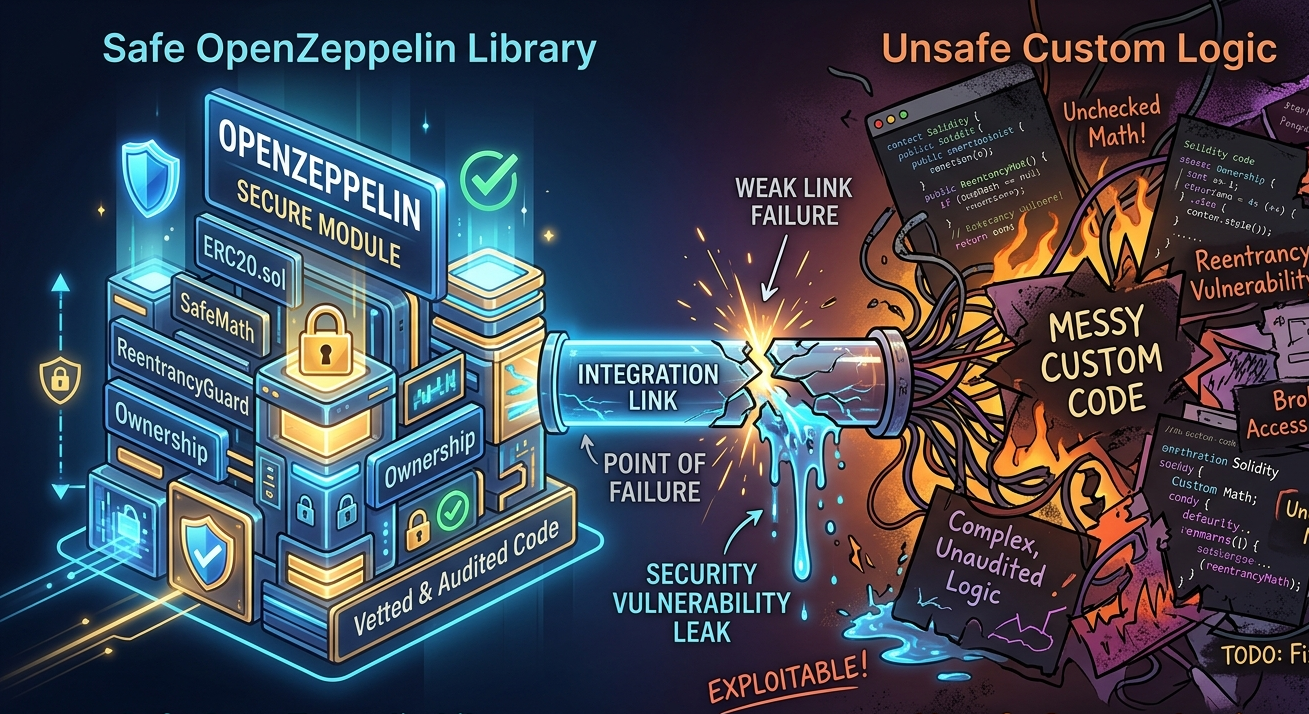
One of the most common exploit patterns in recent years involves protocols that correctly implement standard token mechanics using OpenZeppelin but introduce logic errors in the protocol-specific code that interacts with those mechanics. A reentrancy guard on an ERC-20 transfer function does not protect a lending protocol against reentrancy in its own liquidation logic.
Similarly, OpenZeppelin’s upgradeability patterns require strict adherence to storage layout conventions across all upgrade versions. A protocol that correctly implements the proxy pattern but introduces a storage collision in a subsequent upgrade has created a vulnerability through correct use of a secure library.
How Solidity Shield Approaches Both Library and Custom Code
Solidity Shield analyzes both OpenZeppelin-based and fully custom smart contracts, and its approach reflects the different risk profiles of each.
For contracts using OpenZeppelin, the analysis focuses on how the protocol interacts with and extends the library components. It checks that upgradeability patterns are implemented correctly, that access control configurations match the intended permission model, and that custom logic does not introduce reentrancy or state manipulation risks in combination with the standard library behavior.
For fully custom implementations, Solidity Shield’s analysis is more comprehensive in scope. It applies the full library of known vulnerability patterns to every custom function, validates that standard security practices are followed even in novel implementations, and flags deviations from established best practices that could introduce risk. The depth of analysis scales with the innovation level of the codebase.
Library Version Management as a Security Practice
An underappreciated dimension of OpenZeppelin security is library version management. Outdated versions of OpenZeppelin can contain known vulnerabilities that have since been fixed in current releases. Protocols that deploy using an old version and never update their dependencies carry the risk profile of whatever vulnerabilities existed in that version.
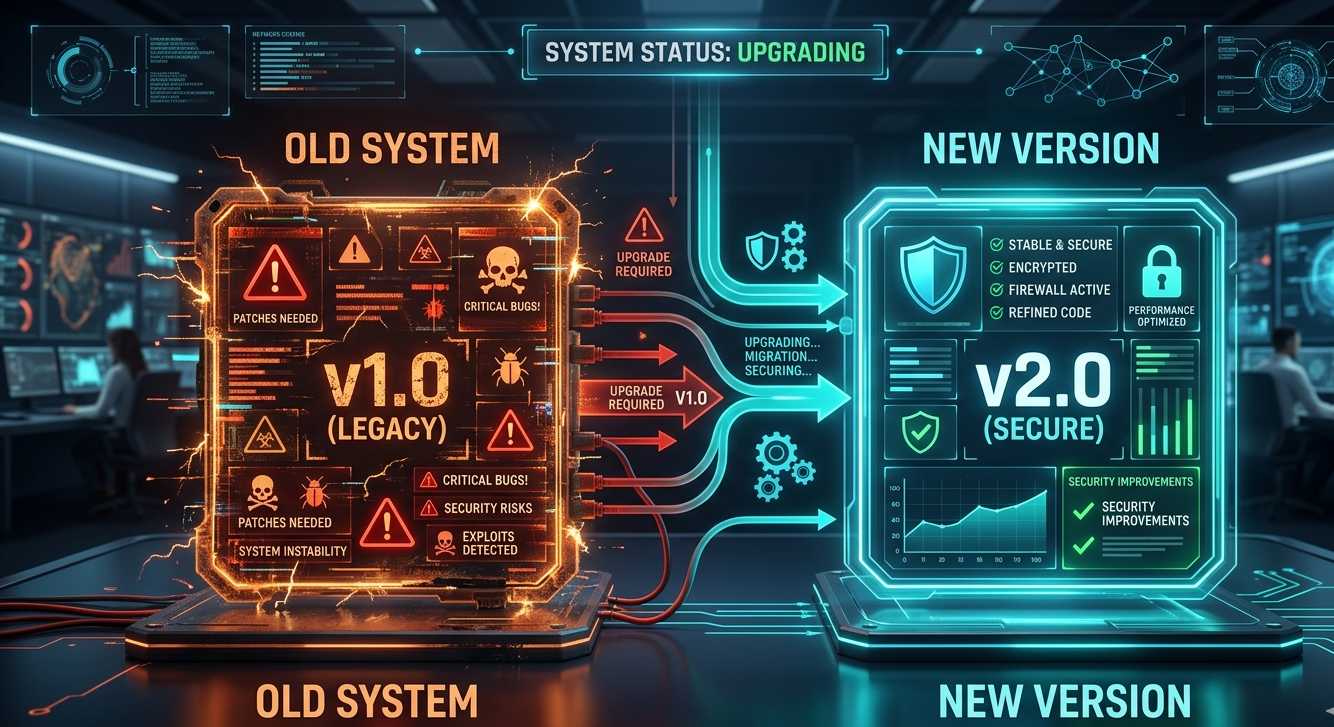
This is not a hypothetical risk. Specific OpenZeppelin versions have had documented vulnerabilities in governance modules, ERC-20 permit implementations, and proxy patterns. Teams that treated the initial library adoption as permanent rather than ongoing security practice have been exposed to risks they believed they had mitigated.
Solidity Shield’s analysis includes version checking for common dependencies, flagging outdated library versions and communicating the specific vulnerabilities associated with the installed version. This keeps teams informed about risks in their dependency chain that they may not be actively monitoring.
The Hybrid Approach and Its Security Implications
Most production protocols use a hybrid approach: OpenZeppelin for standard patterns, custom code for protocol-specific logic. This is appropriate, but it requires deliberate security thinking about the interface between library and custom components.
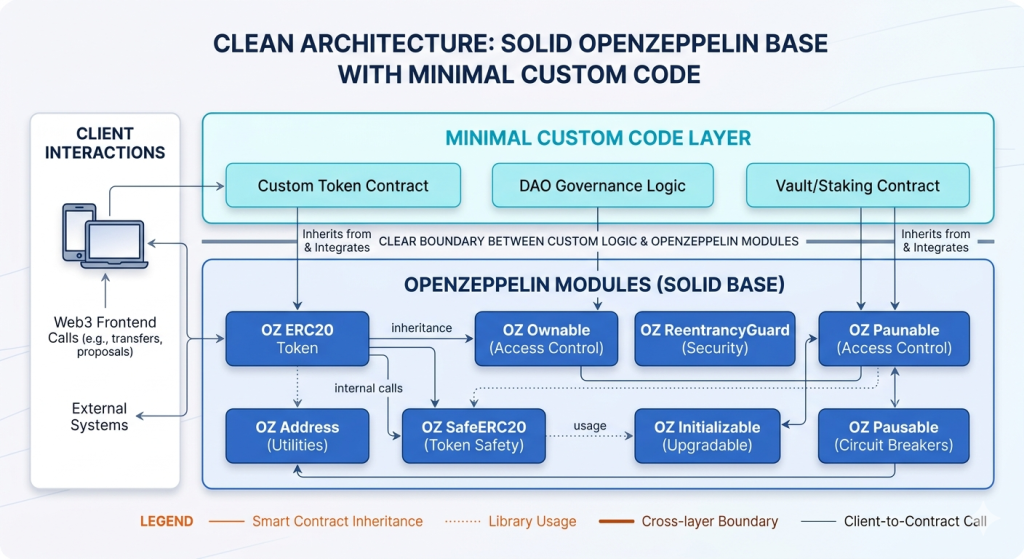
The most secure hybrid implementations are those where the protocol-specific custom code is minimal and the interfaces between custom and library components are clearly defined. Fat contracts that mix standard and custom logic throughout the codebase are harder to audit thoroughly and present a more complex attack surface.
For teams designing new protocols, the architectural principle of minimizing custom code surface while maximizing use of audited library components should guide structural decisions. Every line of custom code is a line that requires dedicated security scrutiny. Writing less of it is itself a security strategy.
Auditability as a Security Criterion
OpenZeppelin code is auditability-optimized by design. It is well-commented, consistently structured, and follows documented patterns. This makes it easier and faster for security reviewers to assess, which reduces audit cost and increases coverage depth.
Custom code varies enormously in auditability. Poorly documented, inconsistently structured custom implementations require significantly more auditor time to understand before the review can even begin. Investing in code clarity and documentation for custom implementations is not just a development practice. It is a security practice, because it directly influences how thoroughly your code can be reviewed.
Solidity Shield’s analysis benefits from the auditability characteristics of OpenZeppelin code as well. Recognized patterns are analyzed against their known vulnerability profiles quickly and reliably. For custom implementations, the analysis is more exploratory, and the resulting findings benefit from clear code documentation that provides context for interpreting what the code is intended to do.
Making the Security-Optimal Choice
The security-optimal approach for most protocols is to use OpenZeppelin for any pattern it covers, write custom code only where genuinely novel functionality is required, ensure all custom code receives dedicated security analysis before deployment, and maintain library dependencies actively to benefit from ongoing security improvements.
This approach minimizes custom attack surface, maximizes the benefit of the accumulated security research embedded in library code, and ensures that the novel elements of your protocol receive proportionally deeper security scrutiny.
Solidity Shield supports this approach by analyzing both components appropriately, providing tailored security feedback that reflects the different risk profiles of library-based and custom-written code. The goal is not to choose between OpenZeppelin and custom code. It is to deploy both as securely as possible.
Conclusion
The choice between OpenZeppelin and custom code is ultimately a risk management decision. OpenZeppelin provides battle-tested implementations backed by years of security research and continuous maintenance. Custom code provides flexibility but introduces risk proportional to its distance from established patterns and the maturity of its security review.
The most secure protocols make strategic use of both: standard library code where it applies, minimal custom code where genuine innovation requires it, and dedicated security analysis for every component regardless of its origin. Solidity Shield is built to support exactly this approach, providing smart contract security analysis that reflects the different risk profiles of library-based and custom implementations and ensures that nothing escapes scrutiny before deployment.
FAQ: OpenZeppelin vs Custom Code
1. Is using OpenZeppelin sufficient to secure a smart contract?
No. OpenZeppelin secures the specific patterns it implements. Custom logic, integration code, and protocol-specific mechanics require dedicated security review regardless of what library is used for the underlying components.
2. What are the most common vulnerabilities introduced when using OpenZeppelin?
The most common issues arise at the interface between OpenZeppelin components and custom logic. Incorrect use of upgradeability patterns, access control misconfiguration, and reentrancy in custom functions that interact with standard token mechanics are among the most frequently observed.
3. When is writing custom code preferable to using OpenZeppelin?
When the required functionality is genuinely novel and no standard library implementation exists. Custom code for standard patterns like token mechanics or access control is rarely justified given the security cost of forgoing battle-tested implementations.
4. How does Solidity Shield analyze contracts using OpenZeppelin?
Solidity Shield recognizes OpenZeppelin components and focuses analysis on their configuration, integration with custom code, and version currency. For custom implementations, it applies comprehensive pattern-based analysis to identify deviations from secure coding practices.
5. How important is keeping OpenZeppelin dependencies updated?
Critically important. Specific OpenZeppelin versions contain documented vulnerabilities that have been fixed in subsequent releases. Protocols running outdated library versions carry known, preventable risks that active dependency management would eliminate.