


Picture this. Your bank’s compliance team is juggling three audit schedules simultaneously. RBI wants proof of robust key lifecycle governance. SEBI demands audit trails for every cryptographic operation across your trading platforms. And your PCI DSS assessor is asking about your HSM deployment architecture and whether your key custodian procedures are documented.
This is not a hypothetical. It is the lived reality for every CISO and CTO working inside India’s banking, financial services, and insurance sector today.
Enterprise HSM key management has become the backbone of regulatory compliance for Indian BFSI institutions. Yet most organizations treat it as three separate problems, running fragmented strategies for each regulator and creating costly operational overhead in the process. The smarter approach unifies governance across all three frameworks using a single, quantum-safe cryptographic architecture that speaks fluently to RBI, SEBI, and PCI DSS simultaneously.
This blog breaks down exactly how to build that architecture, why it matters, and what your organization needs to do before quantum threats make today’s approach obsolete.
Why Indian BFSI Faces a Uniquely Complex Compliance Landscape
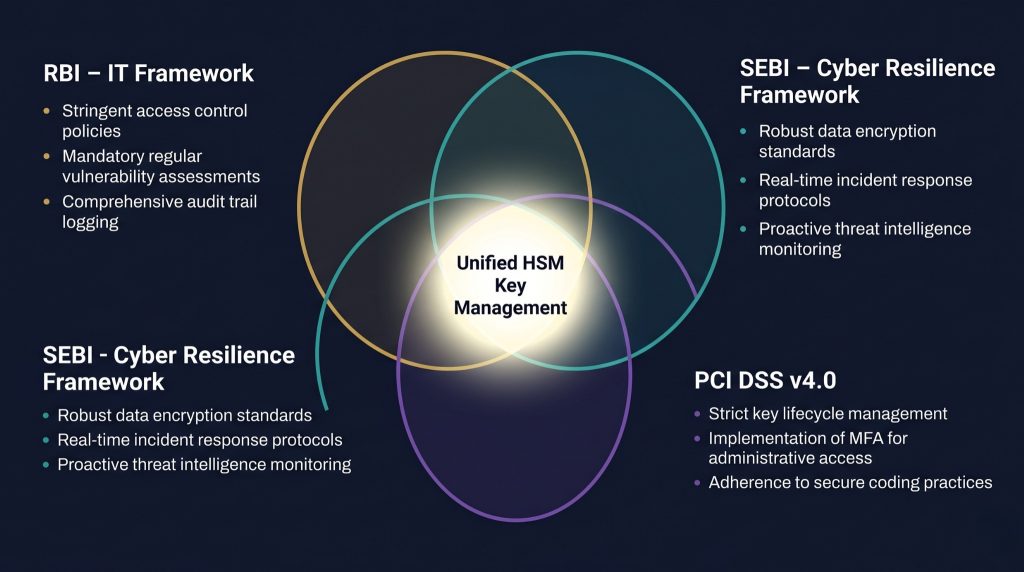
India’s financial sector operates under one of the most layered regulatory environments in the world. The Reserve Bank of India governs banks, NBFCs, and payment system operators. The Securities and Exchange Board of India oversees capital market participants including brokers, depositories, and asset managers. PCI DSS, while not a government mandate, is a contractual requirement enforced by card networks and effectively mandatory for any institution processing card transactions.
Each framework approaches cryptography differently. RBI’s IT Framework and the Master Direction on Information Technology Governance place explicit emphasis on key management policies, access controls, and encryption of sensitive data at rest and in transit. SEBI’s Cybersecurity and Cyber Resilience Framework for market infrastructure institutions demands cryptographic controls that are auditable, tamper-evident, and resilient against insider threats. PCI DSS Requirement 3 mandates protection of stored cardholder data with strong cryptography, documented key management procedures, and split knowledge or dual control for critical operations.
The challenge is not that these requirements conflict. In fact, they largely reinforce each other. The challenge is that most organizations manage them in silos, with separate tools, teams, and documentation for each. This approach breaks down under audit pressure and creates compounding vulnerabilities at the seams between programs.
Moreover, the urgency intensifies as quantum computing edges closer to cryptographic relevance. Harvest-now-decrypt-later attacks are already a documented threat vector. Attackers are collecting encrypted financial data today with the intent to decrypt it when sufficiently powerful quantum systems become available. For BFSI institutions holding decades of transaction history, customer records, and trade data, this is not a future problem. It is a present one.
Understanding Enterprise HSM Key Management: The Foundation
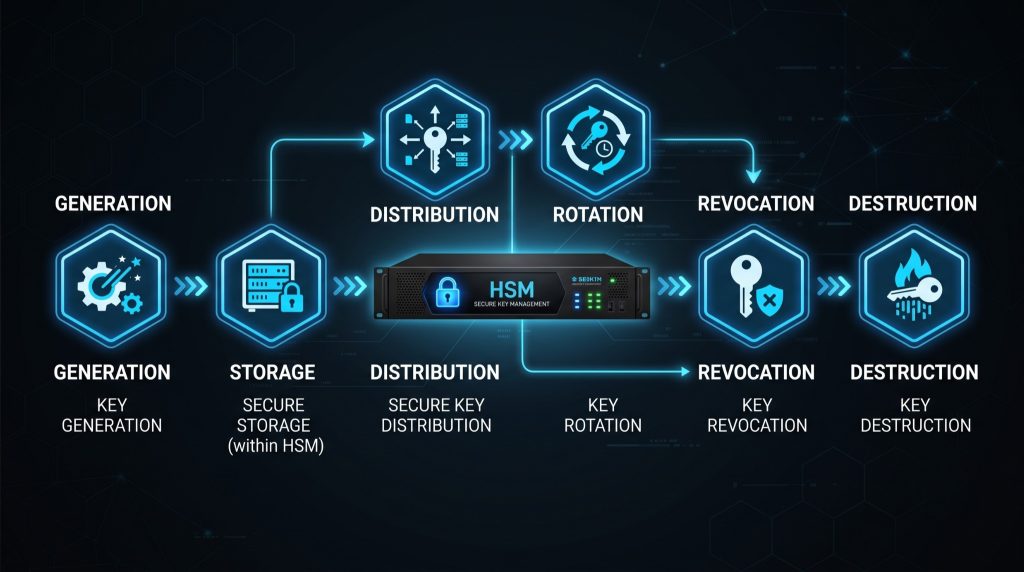
A Hardware Security Module is a tamper-resistant physical device that generates, stores, and manages cryptographic keys in a protected environment. The word “enterprise” in enterprise HSM key management signals something important: this is not about deploying a single HSM appliance. It is about building a comprehensive key lifecycle governance framework that spans your entire organization.
That framework typically includes several interconnected capabilities. Key generation must happen within a secure boundary, using certified random number generators and approved algorithms. Key storage must ensure that plaintext keys never leave the HSM. Key distribution must use secure channels with strict access controls. Key rotation must happen on a defined schedule without disrupting business operations. Key revocation and destruction must be auditable and irreversible.
Beyond these operational pillars, enterprise HSM key management in 2025 and beyond must address cryptographic agility. Crypto-agility is the ability to swap out cryptographic algorithms quickly when vulnerabilities emerge or regulatory requirements change, without rebuilding your entire security stack. This capability is not optional for BFSI institutions. It is a survival requirement.
The emergence of post-quantum cryptography as a mandatory consideration makes cryptographic agility even more critical. NIST finalized its first set of post-quantum cryptographic standards in 2024, specifically CRYSTALS-Kyber for key encapsulation and CRYSTALS-Dilithium for digital signatures. Indian regulators have not yet mandated PQC migration timelines, but the global direction is unmistakably clear. Institutions that build crypto-agile HSM architectures today will navigate the quantum-safe transition with far less disruption than those that do not.
RBI Compliance: What Your Key Management Architecture Must Deliver
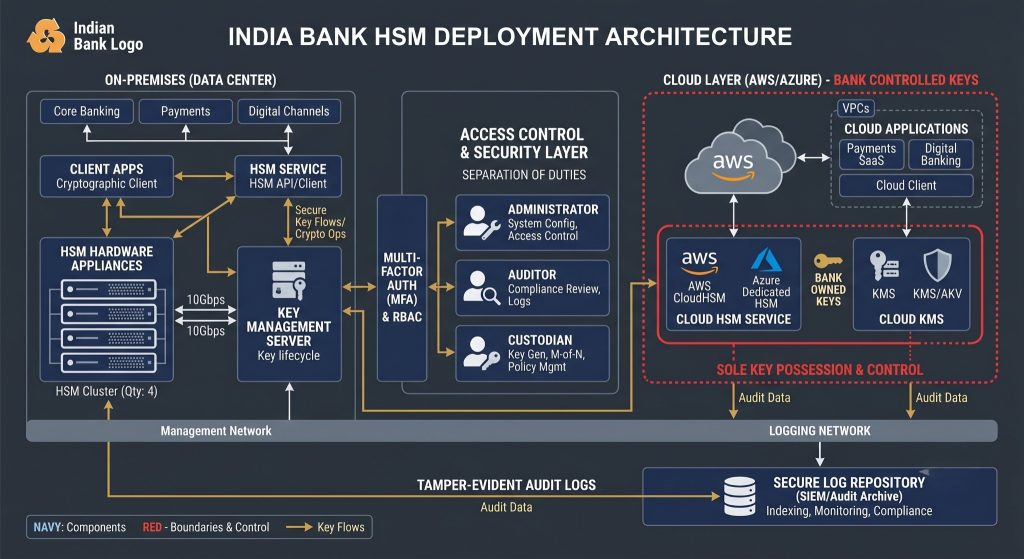
The RBI’s Master Direction on Information Technology Framework for the BFSI sector is detailed and prescriptive about cryptographic controls. Several provisions directly shape how you must architect your enterprise HSM key management program.
First, the RBI requires that encryption keys be protected with the same rigor as the data they protect. This sounds obvious, but it has concrete architectural implications. It means your key encryption keys must themselves be stored in hardware-grade secure storage, not software vaults or configuration files. It means your key management system must enforce separation of duties so that no single administrator can access both the key material and the data it protects.
Second, the RBI’s circular on cybersecurity framework demands that financial institutions maintain comprehensive audit logs of all key management operations. Every key generation event, every key access, every rotation and revocation must be logged with timestamps, user identities, and system identifiers. These logs must be tamper-evident and retained for defined periods, typically a minimum of three years for forensic investigation purposes.
Third, RBI guidelines on outsourcing and cloud adoption require that cryptographic keys remain under the direct control of the regulated entity, even when workloads move to cloud platforms. This has significant implications for HSM deployment models. Organizations running workloads on AWS, Azure, or GCP must either bring cloud-hosted HSM services (such as AWS CloudHSM or Azure Dedicated HSM) under their own key governance framework, or operate on-premises HSMs with hardware security boundaries that cloud providers cannot reach.
Fourth, and increasingly important, the RBI has signaled concern about long-term data security in its guidance on digital payment security controls. The harvest-now-decrypt-later threat is implicitly addressed in requirements for encryption strength and algorithm selection. A quantum-ready HSM key management architecture directly satisfies the spirit of these provisions, even before explicit PQC mandates emerge.
SEBI Compliance: Cryptographic Controls for Capital Markets
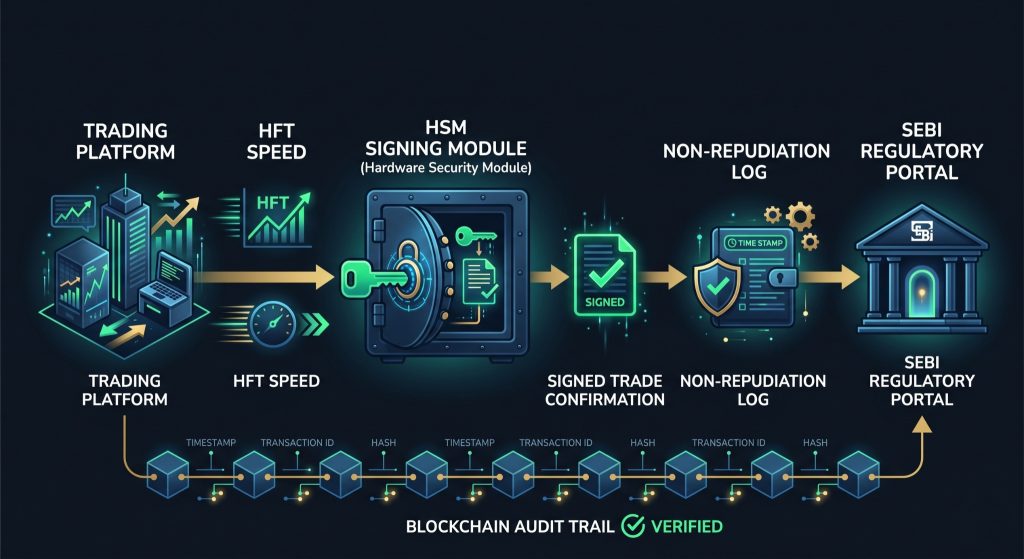
SEBI’s Cybersecurity and Cyber Resilience Framework brings specific requirements that differ in emphasis from RBI’s framework. Capital markets operate at extreme speed with high transaction volumes and complex multi-party workflows. The cryptographic controls required in this environment must be performant, auditable, and resistant to sophisticated insider threats.
One of the most operationally challenging SEBI requirements is around digital signatures for trade confirmations, order acknowledgments, and regulatory filings. SEBI mandates non-repudiation for critical transactions, which means digital signature keys must be managed with strict ceremony, documented key custodian procedures, and hardware-level protection. An HSM-based signing workflow directly satisfies this requirement while providing the performance necessary for high-frequency trading environments.
SEBI also requires market infrastructure institutions to maintain cryptographic inventories. This means knowing precisely what keys exist, what algorithms they use, what data they protect, and when they were last rotated. This requirement maps directly to the concept of a cryptographic bill of materials, a living inventory that supports both compliance reporting and the eventual quantum-safe migration.
Furthermore, SEBI’s framework for algorithmic trading risk management includes provisions about the integrity of trading algorithms and the security of the technology environment in which they execute. Cryptographic signing of algorithm deployments using HSM-protected keys is an emerging best practice that addresses these requirements while creating an auditable chain of custody for every algorithm version in production.
The intersection of SEBI requirements with quantum security is particularly acute in the context of long-dated securities. A sovereign bond issued today may mature in thirty years. The cryptographic protections applied to that bond’s issuance and trading records must remain valid throughout its life. Hybrid encryption approaches that combine classical and post-quantum algorithms create the quantum-resistant security posture that this timeline demands.
PCI DSS v4.0: The Most Prescriptive Cryptographic Framework
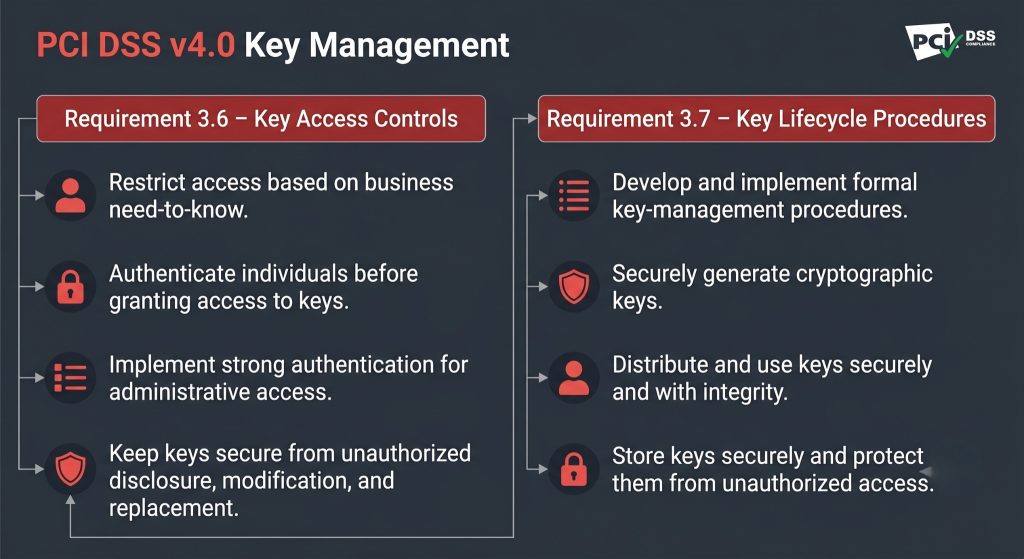
PCI DSS version 4.0, which became the only active standard in March 2024, brings the most explicit and prescriptive cryptographic requirements of the three frameworks. Requirement 3 governs the protection of stored account data, and its sub-requirements touch almost every aspect of enterprise HSM key management.
Requirement 3.6 is particularly specific. It mandates that key management procedures and processes for cryptographic keys used for protecting stored account data include restricted access to cryptographic keys, formal key custodian responsibilities acknowledged in writing, storage of cryptographic keys in the fewest possible locations and forms, and prevention of unauthorized substitution of cryptographic keys.
These requirements translate directly into HSM deployment decisions. Keys used to protect cardholder data must be stored in HSMs or equally strong hardware controls, not in software. Key custodians must be formally designated, trained, and accountable. Key storage locations must be minimized and documented. And the architecture must prevent any single person from substituting a key without the knowledge of at least one other designated custodian.
Requirement 3.7 addresses key management procedures throughout the key lifecycle, from generation through eventual destruction. It requires organizations to generate keys only in approved cryptographic devices, distribute keys in an encrypted form and never in cleartext, store keys in the fewest possible locations, retire or replace keys as defined by the associated application’s cryptoperiod, perform key splits for critical keys, prevent unauthorized key substitution, and document and implement procedures for responding to the compromise or suspected compromise of any key.
One important development in PCI DSS v4.0 is its explicit acknowledgment that organizations must assess and document their approach to algorithm strength and key lengths. While the standard does not yet mandate post-quantum algorithms, it requires that chosen algorithms and key lengths be consistent with industry-accepted standards. As PQC standards from NIST gain broader acceptance, PCI DSS assessors will increasingly expect them to be part of your cryptographic inventory alongside classical algorithms.
The Convergence Architecture: One Framework to Satisfy All Three
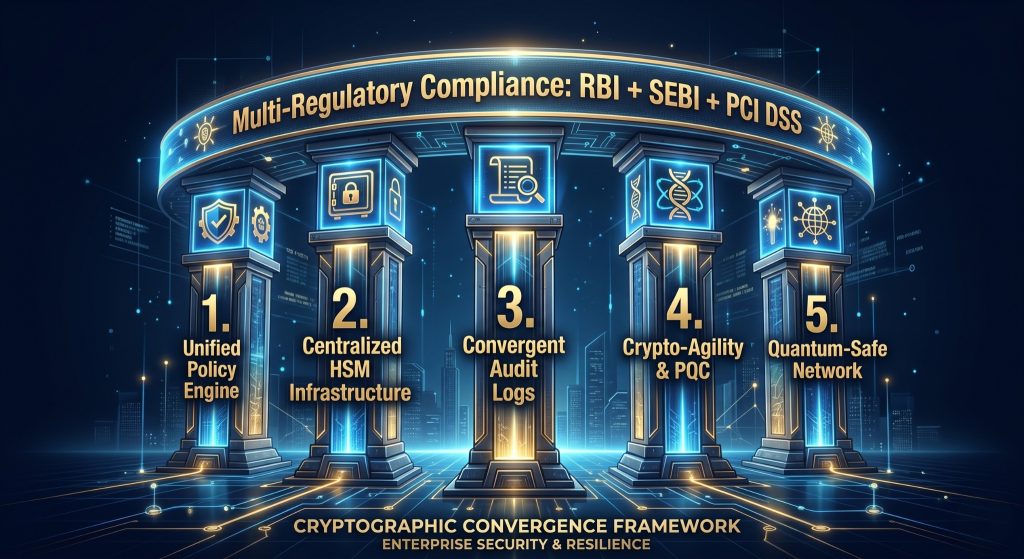
Here is the core insight that most BFSI organizations miss: RBI, SEBI, and PCI DSS cryptographic requirements are more alike than they are different. Each demands hardware-grade key protection. Each requires audit logging. Each mandates access controls and separation of duties. Each expects documented key lifecycle procedures. Each implicitly or explicitly requires algorithmic strength that can withstand current and emerging threats.
This means a well-designed enterprise HSM key management architecture can satisfy all three simultaneously, without the fragmentation and duplication that characterizes most current approaches.
The convergence architecture rests on five pillars.
The first pillar is a unified cryptographic policy engine. Rather than maintaining separate key management policies for RBI compliance, SEBI compliance, and PCI DSS, a cryptographic agility platform enables organizations to define policies that map to multiple regulatory requirements simultaneously. When a policy change is needed, it propagates across all environments rather than requiring three separate updates.
The second pillar is centralized HSM infrastructure with federated access controls. A centralized HSM tier, whether on-premises, cloud-hosted, or hybrid, provides the hardware-grade key protection that all three frameworks require. Federated access controls then govern which teams, applications, and processes can request cryptographic operations, with separation of duties enforced at the hardware boundary.
The third pillar is a comprehensive audit log that generates evidence for all three regulators from a single source of truth. Every key operation produces a tamper-evident log entry that satisfies RBI’s audit trail requirements, SEBI’s non-repudiation demands, and PCI DSS’s documentation requirements simultaneously. This eliminates the compliance theater of maintaining three separate audit systems with overlapping but inconsistent records.
The fourth pillar is cryptographic agility infrastructure. This means deploying a PQC governance platform that maintains a real-time cryptographic bill of materials, tracks algorithm versions across all systems, and enables controlled migration to quantum-safe algorithms without disrupting business operations. Hybrid crypto approaches, which combine classical algorithms like RSA and AES with post-quantum algorithms like CRYSTALS-Kyber, provide defense-in-depth during the transition period.
The fifth pillar is quantum-safe network controls. A PQC-enabled secure gateway enforces cryptographic policy at the network boundary, ensuring that data in transit receives the same quantum-resistant protection as data at rest. This is particularly important for BFSI institutions participating in inter-bank clearing networks, securities settlement systems, and payment infrastructure where legacy TLS deployments may be vulnerable to quantum attacks.
QuantumVault: Built for the Convergence Architecture
Meeting the simultaneous demands of RBI, SEBI, and PCI DSS requires more than a collection of point solutions. It requires a platform designed from the ground up around the principle that cryptographic governance must be centralized, auditable, algorithmically agile, and quantum-ready.
QuantumVault is that platform. It addresses every pillar of the convergence architecture with purpose-built capabilities for regulated enterprises.
At the core of QuantumVault is its PQC key management engine, which supports both classical and post-quantum cryptographic algorithms within a single governance framework. This means your RSA and AES keys for existing workloads and your CRYSTALS-Kyber and CRYSTALS-Dilithium keys for quantum-safe applications are managed under the same policies, same audit logs, and same access controls. There is no parallel system to maintain and no compliance gap between your classical and quantum-safe environments.
QuantumVault’s PQC policy engine translates your regulatory obligations into enforceable cryptographic controls. You define policies aligned with RBI’s key management requirements, SEBI’s audit and non-repudiation mandates, and PCI DSS’s key lifecycle procedures. The platform enforces these policies automatically, generates compliance evidence on demand, and alerts your security team when any deviation occurs.
The PQC audit logs produced by QuantumVault are designed specifically for multi-regulatory environments. Each log entry captures the full context of every cryptographic operation, including the key identifier, the algorithm used, the requesting application, the approving custodian, and the timestamp. Log integrity is protected using cryptographic signatures, ensuring that audit trails satisfy the tamper-evidence requirements of all three frameworks.
For organizations moving toward quantum-safe operations, QuantumVault’s PQC migration framework provides a structured path from classical to hybrid to fully post-quantum cryptography. The platform’s cryptographic agility engine maintains a live cryptographic bill of materials, identifies systems running deprecated algorithms, and orchestrates migration workflows without requiring application downtime. This capability directly addresses the harvest-now-decrypt-later threat that is already active against Indian financial institutions holding long-lived sensitive data.
QuantumVault’s PQC tunnel and secure gateway capabilities extend quantum-safe protection to network communications. As BFSI institutions connect to RBI’s National Payment Systems, SEBI’s regulatory reporting portals, and card network infrastructure, QuantumVault enforces quantum-resistant encryption at the boundary. This means that data in transit is protected against both current and future adversaries, satisfying the forward-looking security posture that regulators are increasingly expecting.
The platform’s PQC signing workflow module directly addresses the digital signature requirements that SEBI mandates for capital markets operations. Trade confirmations, algorithm deployments, regulatory filings, and inter-party agreements can all be signed using HSM-protected quantum-safe signing keys, with full chain-of-custody documentation generated automatically for audit purposes.
For device security across distributed BFSI environments, where ATMs, POS terminals, mobile banking applications, and trading terminals all participate in the cryptographic ecosystem, QuantumVault’s PQC device security capabilities ensure that endpoint cryptography is governed by the same policies and audited through the same channels as datacenter operations.
Implementation Roadmap: From Fragmented to Convergent
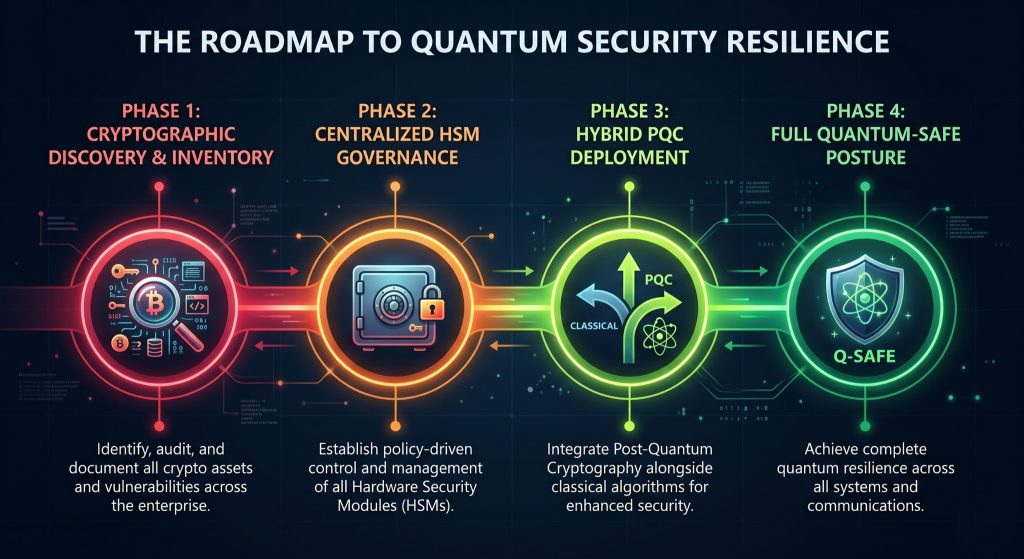
Building a convergence architecture for enterprise HSM key management does not require a single massive transformation. The most successful implementations follow a phased approach that delivers compliance value at each stage.
Phase one focuses on cryptographic discovery and inventory. Before you can converge your key management architecture, you need to know what cryptographic assets exist across your environment. QuantumVault’s discovery capabilities identify all keys, certificates, and cryptographic operations in use across your applications, databases, network devices, and HSMs. The output is a comprehensive cryptographic bill of materials that forms the baseline for compliance mapping and PQC migration planning.
Phase two establishes centralized HSM governance. This phase migrates key material from software vaults and application-level key stores into hardware-protected storage, governed by the unified policy engine. Access controls are restructured to enforce separation of duties, and the unified audit log begins capturing all key operations. By the end of phase two, organizations typically achieve compliance with the core key management requirements of all three regulatory frameworks.
Phase three introduces quantum-safe capabilities through hybrid encryption. Classical algorithms remain in place for operational continuity, while post-quantum algorithms are layered alongside them for all new key generation and selected existing workflows. The PQC governance platform begins tracking algorithm versions and generating PQC compliance reports. Quantum-safe tunnels protect high-priority inter-system communications.
Phase four completes the transition to a fully quantum-ready posture. Deprecated classical algorithms are retired on a documented schedule. PQC signing workflows replace legacy digital signature processes. The cryptographic bill of materials reflects a fully audited, quantum-safe environment that satisfies the most forward-looking interpretation of RBI, SEBI, and PCI DSS requirements.
Common Gaps and How They Create Compliance Risk
Several recurring gaps in enterprise HSM key management create disproportionate compliance risk for Indian BFSI institutions.
The most common gap is key sprawl. Organizations accumulate cryptographic keys across dozens of applications, databases, and infrastructure components with no central inventory. When an auditor asks how many keys exist and where they are stored, the answer is often unknown. QuantumVault’s cryptographic discovery eliminates this gap by providing a single authoritative inventory.
A second common gap is inadequate key ceremony documentation. PCI DSS and RBI both require that key generation events be conducted with formal ceremony, dual control, and written documentation. Many organizations perform these ceremonies informally or inconsistently, creating audit findings that are difficult to remediate without architectural changes. QuantumVault’s PQC governance platform formalizes and automates ceremony documentation.
A third gap is algorithm drift. Organizations deploy new applications with whatever cryptographic defaults the development team chose, without verifying alignment with regulatory requirements. Over time, the environment accumulates a mix of strong and weak algorithms that creates compliance exposure. QuantumVault’s policy engine prevents algorithm drift by enforcing approved algorithm lists at the point of key generation.
A fourth gap, growing in significance, is the absence of quantum-safe planning. Organizations that have not begun their PQC assessment leave themselves exposed to harvest-now-decrypt-later attacks and will face rushed, costly migrations when regulatory mandates arrive. Starting the PQC migration journey now, using QuantumVault’s structured framework, is far less expensive than responding to a regulatory directive under deadline pressure.
Conclusion: The Convergence Imperative
India’s BFSI sector stands at a genuinely consequential juncture. Regulatory expectations around cryptographic governance are rising. Quantum computing is advancing toward the point where today’s encryption becomes vulnerable. And the cost of fragmented, siloed compliance programs compounds with every audit cycle.
Enterprise HSM key management, architected around convergence and quantum-safety, is not a nice-to-have for forward-looking financial institutions. It is the foundation on which sustainable compliance is built. The organizations that unify their cryptographic governance across RBI, SEBI, and PCI DSS today will be the ones that navigate the quantum transition with confidence rather than crisis.
QuantumVault provides the PQC key management, cryptographic agility, and governance infrastructure that makes this convergence real. From PQC audit logs to quantum-safe signing workflows, from hybrid encryption to PQC policy enforcement, QuantumVault is designed for exactly the environment Indian BFSI institutions operate in today and the one they will need to operate in tomorrow.
The question is not whether to build a quantum-safe, convergence-ready key management architecture. The question is whether to build it now on your terms or later under regulatory compulsion.
FAQ: Enterprise HSM Key Management for Indian BFSI
1. What is enterprise HSM key management? Enterprise HSM key management is a comprehensive framework for generating, storing, distributing, rotating, and destroying cryptographic keys using hardware security modules. It ensures keys are protected at hardware level and managed under documented governance processes that meet regulatory requirements.
2. Why is HSM key management critical for Indian BFSI institutions? Indian BFSI institutions operate under RBI, SEBI, and PCI DSS frameworks that all mandate hardware-grade key protection, audit logging, and documented lifecycle procedures. A unified HSM key management architecture satisfies all three simultaneously while reducing operational overhead.
3. How does PQC relate to HSM key management? Post-quantum cryptography introduces new algorithms designed to resist quantum computing attacks. An enterprise HSM key management platform with PQC capabilities manages both classical and post-quantum keys under a single governance framework, ensuring a smooth transition to quantum-safe operations.
4. What is crypto-agility and why does it matter for compliance? Cryptographic agility is the ability to change cryptographic algorithms quickly without disrupting business operations. It matters for compliance because regulators periodically update approved algorithm lists, and organizations without crypto-agility face costly emergency migrations when algorithms are deprecated.
5. What does RBI require regarding encryption key management? RBI’s IT Framework requires that encryption keys receive the same protection as the data they protect, be stored in hardware-grade secure storage, be subject to strict access controls with separation of duties, and generate tamper-evident audit logs for all key operations.
6. How does SEBI’s framework address cryptographic controls? SEBI’s Cybersecurity and Cyber Resilience Framework requires digital signatures for critical transactions with HSM-protected signing keys, cryptographic inventories of all key material, and audit trails that support non-repudiation for trade confirmations and regulatory filings.
7. What does PCI DSS v4.0 require for key management? PCI DSS v4.0 Requirement 3.6 mandates restricted access to cryptographic keys, formal key custodian responsibilities, storage of keys in the fewest possible locations, and prevention of unauthorized key substitution. Requirement 3.7 governs the full key lifecycle from generation through destruction.
8. What is a cryptographic bill of materials? A cryptographic bill of materials is a living inventory of all cryptographic assets in an organization’s environment, including key identifiers, algorithms, key lengths, protection levels, associated applications, and rotation schedules. It is essential for compliance reporting and PQC migration planning.
9. What is a harvest-now-decrypt-later attack? A harvest-now-decrypt-later attack involves an adversary collecting encrypted data today, storing it, and decrypting it later when a sufficiently powerful quantum computer becomes available. This threat is particularly relevant for financial data with long-term sensitivity.
10. How does hybrid encryption support the transition to quantum-safe cryptography? Hybrid encryption combines classical algorithms with post-quantum algorithms so that data is protected by both simultaneously. This approach provides backward compatibility with existing systems while ensuring quantum resistance, making it ideal for the transition period.
11. What is a PQC governance platform? A PQC governance platform manages the policies, inventories, migration workflows, and audit logs associated with an organization’s transition to post-quantum cryptography. It provides centralized visibility and control over all cryptographic assets across the enterprise.
12. How does quantum-safe network security relate to BFSI regulatory compliance? Regulatory frameworks increasingly expect that data protection extends to data in transit, not just data at rest. Quantum-safe network security, implemented through PQC-enabled secure gateways and tunnels, ensures that inter-system communications cannot be compromised by quantum attacks.
13. Can a single platform address RBI, SEBI, and PCI DSS key management requirements? Yes. Because all three frameworks share core requirements around hardware-grade key protection, access controls, audit logging, and documented lifecycle procedures, a well-designed enterprise HSM key management platform with PQC capabilities can satisfy all three simultaneously from a single governance framework.
14. What is the right sequence for implementing enterprise HSM key management? The recommended sequence is: cryptographic discovery and inventory, centralized HSM governance with unified policy and audit, introduction of hybrid PQC capabilities, and finally full quantum-safe migration with deprecated algorithm retirement.
15. How does QuantumVault support Indian BFSI compliance requirements? QuantumVault provides a comprehensive PQC key management and governance platform that manages classical and post-quantum keys under unified policies, generates multi-regulatory audit evidence, enforces cryptographic controls through a policy engine, and supports structured PQC migration workflows aligned with RBI, SEBI, and PCI DSS requirements.