Picture a Sunday night outage. Your primary data center loses power, and the failover site comes up on schedule. Then every application that needs a signature, a certificate or a decryption call stops cold. The servers are fine. The keys are not reachable.
This is the gap that HSM disaster recovery exists to close. Most continuity plans protect compute, storage and networks. Far fewer protect the cryptographic root of trust that every one of those systems depends on.
In this guide, we walk through key backup, key redundancy and business continuity strategies that actually survive a bad day. We also show why post-quantum cryptography (PQC) changes the math, and how QuantumVault helps enterprises plan for both.
Why HSM Disaster Recovery Fails Before the Disaster Starts
Most failures are decided long before an incident. Teams buy a hardware security module, harden it and pass the audit. However, they rarely test whether the keys inside can be restored on a different device, in a different site, by different people.
That omission matters because an HSM is built to make keys hard to extract. Consequently, the same design that blocks attackers can also block you during recovery. Security and availability pull in opposite directions here.
The three failure patterns we see most often
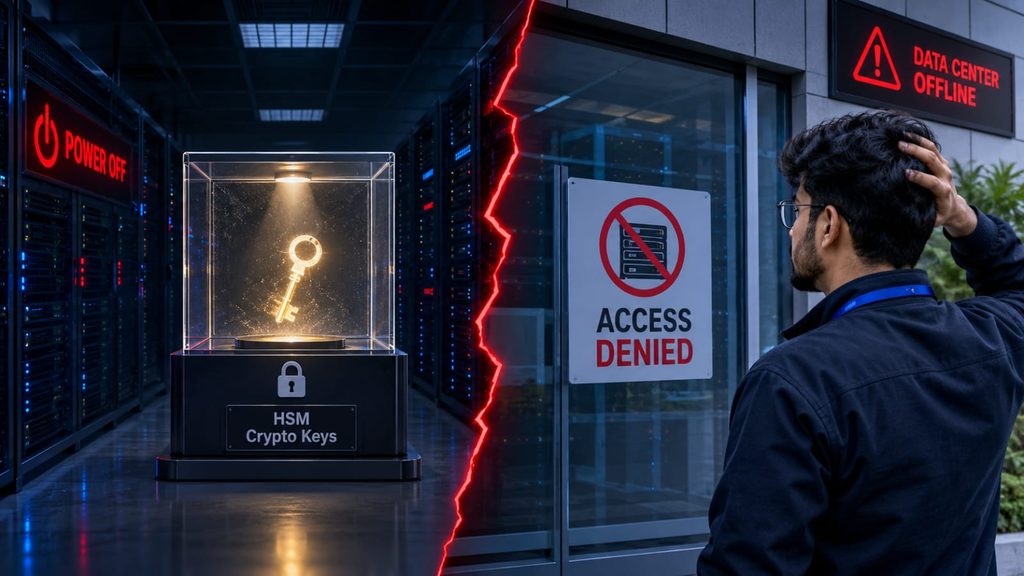
First, there is the single point of trust. One HSM, one site, one set of administrator cards held by one person. If that person is unreachable, the plan is already broken.
Second, there is the untested backup. A backup that has never been restored is only a hope. Many teams discover during a real incident that firmware versions, partition policies or authentication secrets do not line up.
Third, there is the dependency loop. Recovery material gets stored in a system that itself needs the HSM to start. Therefore, the outage deepens instead of ending.
A lesson from recent large-scale outages
Recent global IT disruptions showed how fragile recovery can be when secrets are stored in the wrong place. Several organizations reportedly found that disk recovery keys were held on infrastructure that was down too. The technical fix was simple. The key access path was not.
Importantly, this is not only a story about disk encryption. The same logic applies to code signing keys, certificate authority keys, payment keys and API signing keys. If you cannot reach them, you cannot operate.
What Key Availability Really Means for Business Continuity
Before designing anything, define what “available” means. Ask a sharper question: how long can each business process run without access to its keys? The answer is different for a payment authorization than for a quarterly report signature.
This is where business continuity thinking helps. Two measures carry most of the weight, and both apply to keys just as they do to data.
RTO and RPO for cryptographic keys
Recovery Time Objective (RTO) is how quickly key services must resume. Recovery Point Objective (RPO) is how much key state you can afford to lose. For keys, RPO is subtle, because a key created after the last backup simply does not exist elsewhere.
For example, an enterprise that rotates signing keys every 24 hours and backs up weekly has a six-day exposure. Any data signed under a newer key cannot be verified after failover. As a result, rotation schedules and backup schedules must be designed together.
Classify keys by business impact
Not every key deserves the same HSM disaster recovery investment. A tiered model keeps the plan affordable and focused. The table below shows a practical starting point.
| Tier | Key examples | Target RTO | Redundancy approach |
|---|---|---|---|
| Tier 1 | Root CA, payment, master wrapping keys | Minutes | Active-active across sites, plus offline backup |
| Tier 2 | Code signing, TLS issuing, database encryption | Under 4 hours | Active-passive with synchronized replicas |
| Tier 3 | Dev, test, low-risk internal keys | 24 hours or more | Encrypted backup with documented restore |
Notably, tiering also gives your CIO a clear budget story. Spend more where downtime costs more, and less where it does not.
Key Backup vs. Key Redundancy: Two Different Jobs
Many teams use these terms interchangeably in HSM disaster recovery plans. They should not. Each one solves a different problem, and a mature plan needs both.
Key backup: protection against loss
Key backup is a secure, encrypted copy of key material stored away from the live system. It answers the question: what if everything is destroyed? Backups are slow to restore, but they survive catastrophe.
A sound key backup is always wrapped by a strong key, split across trusted custodians and stored in separate physical locations. Moreover, it must be restorable only into an approved, equivalent hardware boundary. Otherwise it becomes an attack path.
Key redundancy: protection against downtime
Key redundancy keeps live copies of keys available in multiple modules at the same time. It answers a different question: what if one device or site fails right now? Failover happens in seconds, not hours.
Redundancy usually relies on clustering or high-availability groups, where keys are replicated between devices under policy. Consequently, applications keep running without manual intervention.
Why you need both
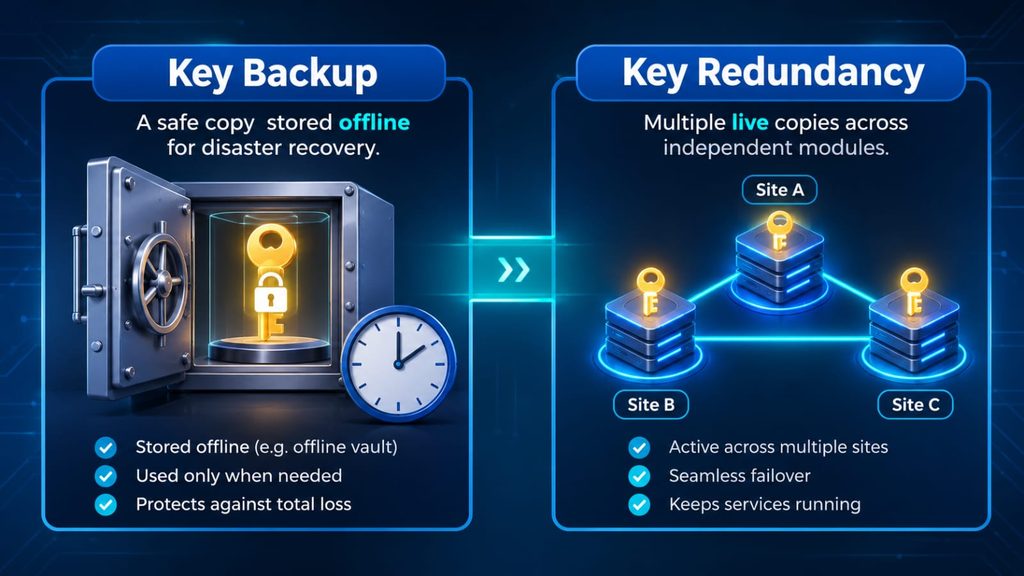
Here is the insight many HSM disaster recovery plans miss. Redundancy copies mistakes as quickly as it copies keys. If a key is deleted or corrupted, every replica may follow within moments.
Backups, by contrast, give you a clean point in time to return to. In short, redundancy buys uptime and backup buys recoverability. Remove either one and the plan has a blind spot.
If you want a structured way to close that gap, you can Plan HSM redundancy with a tiered, tested approach before an incident forces the decision.
Designing HSM Disaster Recovery Architecture That Holds Up
Architecture choices decide how painful a failure will be, and HSM disaster recovery is no exception. Let us look at the main patterns, along with their trade-offs.
Active-active across sites
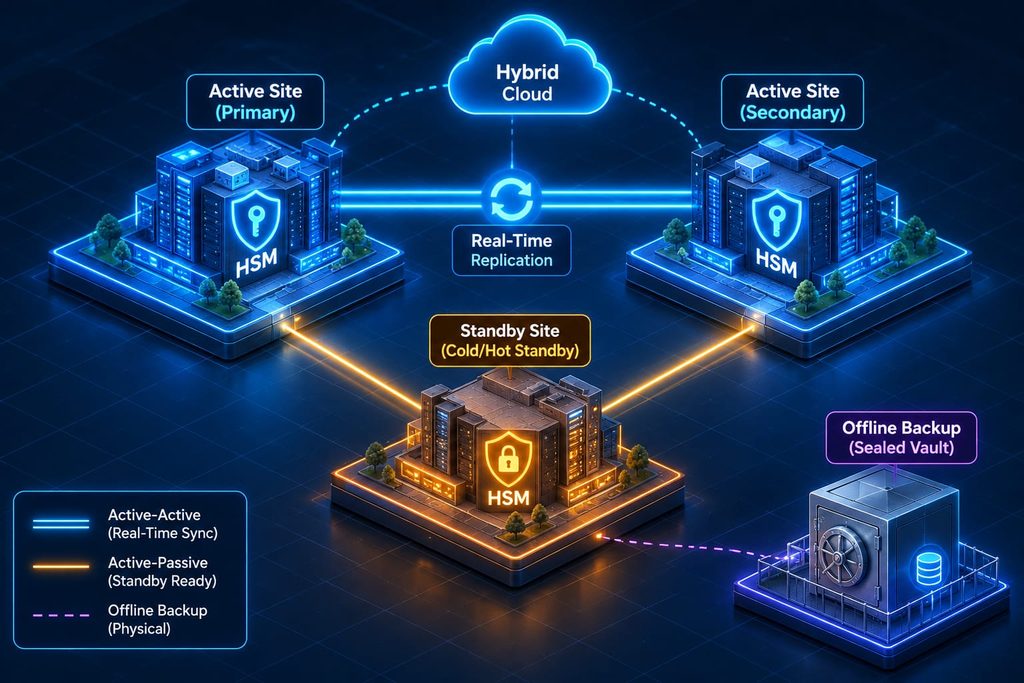
In an active-active design, multiple HSMs in different locations serve requests simultaneously. Latency stays low, and loss of a site barely registers. However, key synchronization must be fast and consistent, and the operating cost is the highest of any option.
This pattern suits Tier 1 workloads where even a few minutes of downtime is unacceptable. Examples include payment authorization and certificate issuance at scale.
Active-passive with warm standby
Here, a standby module holds synchronized keys but does not serve traffic until needed. Failover takes longer than in active-active, yet the cost is lower. Many enterprises choose this for Tier 2 workloads.
The common trap is neglect. Standby systems drift out of date, and nobody notices until failover. Therefore, schedule automated health checks and regular failover drills.
Offline backup and the cold site
Offline backups sit in a vault, a secondary facility or a sealed container. They are the last line of defense after regional disasters, ransomware or insider damage. Restoration takes planning, people and physical access.
Pair offline backup with M of N custodian control, where a quorum of authorized people, say three of five, must be present to restore. This prevents both lone-wolf abuse and single-person dependency.
Hybrid and multi-cloud placement
Increasingly, enterprises spread keys across on-premises hardware and cloud-hosted modules. This improves resilience and supports sovereignty requirements. Nevertheless, every added location expands the attack surface, so policy consistency becomes critical.
Put differently, location diversity helps only if governance stays uniform. A weaker policy in one site becomes the weakest link for all of them.
The Quantum Twist: Why PQC Changes HSM Disaster Recovery
Now comes the part most continuity plans have not caught up with. Post-quantum cryptography is not a distant research topic anymore. NIST finalized its first three post-quantum standards in 2024, covering ML-KEM, ML-DSA and SLH-DSA, and later added HQC for selection.

Moreover, NIST’s draft transition guidance proposes deprecating quantum-vulnerable public-key algorithms by 2030 and disallowing them by 2035. For an enterprise architect, that timeline overlaps directly with hardware refresh cycles.
Your backups are a harvest-now, decrypt-later target
Adversaries can copy encrypted data today and decrypt it once quantum capability matures. This is known as harvest now, decrypt later. Notably, key backups are among the most valuable things to harvest.
If a backup is wrapped using a classical algorithm such as RSA, its long-lived contents may be exposed in the future. As a result, quantum-safe security for backups is not optional. Wrapping keys, escrow channels and replication links all need quantum-resistant protection.
PQC objects are bigger and behave differently
PQC changes the size and shape of cryptographic material. An ML-DSA-65 signature is roughly 3.3 KB, compared with 256 bytes for an RSA-2048 signature. Public keys and ciphertexts grow in a similar way.
That has real consequences for HSM disaster recovery. Replication bandwidth, backup storage, restore times and HSM memory limits all need re-baselining. A plan written for RSA and ECC may quietly miss its RTO once PQC workloads arrive.
Crypto-agility is a recovery capability
Here is a shift in thinking. Crypto-agility, the ability to swap algorithms without rebuilding systems, is usually framed as a migration feature. In reality, it is also a resilience feature.
Imagine a flaw is found in an algorithm during an HSM disaster recovery event. An agile environment rotates to an approved alternative through policy. A rigid one needs weeks of re-engineering. Consequently, cryptographic agility directly shortens recovery time.
Hybrid crypto keeps the bridge safe
During migration, most enterprises will run hybrid encryption, combining a classical algorithm with a post-quantum one. If either holds, the session stays protected. This hybrid PQC and classical approach should extend to backup channels and replication links, not only to customer-facing traffic.
How QuantumVault Strengthens HSM Disaster Recovery and Key Redundancy
Knowing the theory is one thing. Operating it across hundreds of applications is another. This is where a quantum-safe security platform with cryptographic agility earns its place in the architecture.
For HSM disaster recovery, QuantumVault is built as a PQC suite for enterprise quantum-safe security. It brings governance, key handling and secure transport together so that resilience and quantum readiness progress as one program, not two competing projects.
PQC key management built for continuity
PQC key management in QuantumVault treats availability as a first-class requirement. Keys are organized by tier, lifecycle state and business owner. Backup, replication and restoration follow defined policy instead of tribal knowledge.
In practice, this means your Tier 1 and Tier 3 keys do not share the same recovery path by accident. It also means rotation and backup schedules can be aligned, which closes the RPO gap discussed earlier.
A PQC policy engine for consistent enforcement
Remember the multi-site problem, where one weaker location undermines the rest? The PQC policy engine addresses it. Rules for algorithm choice, key strength, custodian quorum and restore approval are defined once and enforced everywhere.
Furthermore, a quantum-safe gateway for cryptographic policy enforcement sits at the traffic layer. It ensures applications use approved algorithms even while backends fail over between sites.
PQC audit logs that make recovery provable
During a real recovery, regulators and auditors ask the same question: who touched which key, and when? PQC audit logs record key lifecycle events, restore requests and approvals in a tamper-evident trail.
This evidence matters for HSM disaster recovery audits and PQC compliance in post-quantum cryptography for regulated enterprises. It also turns your disaster recovery drill into documented proof, rather than an informal exercise.
Secure transport for replication and access
Replication is only as strong as the channel carrying it. A PQC tunnel protects key synchronization between sites using quantum-resistant and hybrid protocols. Likewise, quantum-safe remote access and tunnel security protects administrators who operate during an outage from untrusted networks.
Together, these capabilities form a quantum-safe network where recovery traffic is not the weakest link in the chain.
Governance across the whole estate
Finally, a PQC governance platform for secure cryptographic migration gives CIOs one place to see progress. It tracks which systems use classical, hybrid or post-quantum algorithms, and which keys have verified recovery paths. Thus PQC governance and disaster recovery planning share the same inventory.
Use Cases: What Resilient Key Operations Look Like
Principles are useful, but scenarios make them concrete. Here are two that reflect situations enterprise teams face.
A regulated bank loses its primary site
Consider a bank that signs transactions and issues device certificates from a single primary data center. A regional flood takes the site offline. Customer-facing systems fail over within minutes, yet signing stops because the only copy of the issuing key is inaccessible.
With a tiered key redundancy model, a synchronized module at a second site would take over immediately. Offline backups, guarded by a three-of-five custodian quorum, would cover the worst case. Business continuity would hold, and the PQC audit logs would document every step for the regulator.
A software company protects its release pipeline
Now picture a hypothetical software vendor whose PQC signing workflow approves every release. The signing key lives in one location. If it becomes unavailable, shipping stops, and so does any urgent security patch.
By distributing the key under policy and requiring multi-party approval for restoration, the company keeps shipping while still preventing misuse. Moreover, the PQC solution for secure signing and approval workflows records who authorized each release. Resilience and accountability grow together.
Devices, collaboration and access
The same logic extends beyond servers. PQC device security depends on device identity keys that must survive a platform failure. PQC collaboration security depends on keys that protect shared documents and messages. If either set is lost, users lose access to their own work.
Therefore, include these key families in your tiering exercise. They are often forgotten until the first incident.
Governance, Testing and Compliance for Continuity
A plan without governance decays. People change roles, firmware updates, and policies drift. Consequently, continuity needs an operating rhythm, not just a document.
Run drills that mirror real failure
Effective HSM disaster recovery testing means restoring into a clean environment at least twice a year. Include a scenario where the primary custodian is unavailable. Measure actual RTO against your target and record every surprise.
Additionally, rehearse partial failures. A degraded network or a corrupted replica is often harder to handle than a clean outage.
Separate duties and document everything
No single administrator should be able to export, restore and approve the same key. Role separation protects against both error and abuse. Equally important, keep custodian lists, contact paths and escalation rules current.
Map the plan to compliance expectations
Frameworks such as ISO 27001, SOC 2, PCI DSS and sector rules from Indian regulators like RBI and SEBI all expect tested continuity and key management controls. In India, the Digital Personal Data Protection Act adds pressure to protect personal data resiliently.
Meanwhile, quantum readiness is entering supervisory conversations worldwide. Starting PQC compliance work now is easier than retrofitting under a deadline. As the DR plan matures, the PQC rollout can follow the same inventory and the same evidence.
A Practical Roadmap for Your HSM Disaster Recovery Plan
Strategy needs sequence. This HSM disaster recovery roadmap fits a typical enterprise and avoids a big-bang approach.
Phase 1: Discover and classify (weeks 1 to 4)
Build a complete inventory of keys, HSMs, custodians and dependent applications. Tag each key with a tier, an owner and an algorithm. Flag every key protected by quantum-vulnerable algorithms, since these shape your PQC migration backlog.
Phase 2: Design and decide (weeks 5 to 8)
Set RTO and RPO targets per tier. Choose active-active, active-passive and offline patterns accordingly. Define custodian quorums and approval chains. Also decide where hybrid crypto will protect backup and replication links.
Phase 3: Implement and integrate (weeks 9 to 16)
Deploy redundancy, configure backup schedules and encode rules in the policy engine. Connect audit logging to your SIEM. Introduce the secure gateway layer so applications inherit approved algorithms automatically.
Phase 4: Test, measure, improve (ongoing)
Run drills, publish results and fix gaps. Then repeat. Over time, fold PQC algorithms into the same cycle so that disaster recovery and PQC migration move together.
Common Mistakes to Avoid
Even well-funded programs repeat the same errors. Watch for these.
- Treating backup as a one-time project. Keys rotate, so backups must keep pace.
- Keeping recovery secrets inside the system they recover. This recreates the dependency loop.
- Ignoring PQC sizing. Larger signatures and keys can break old capacity assumptions.
- Skipping the quantum-safe wrapper. Classical protection on long-lived backups invites future exposure.
- Over-centralizing custodians. Quorum control only works if people are genuinely reachable.
Conclusion: Make HSM Disaster Recovery a Standing Capability
An HSM protects your most sensitive secrets. However, protection without availability is just a locked door with the key inside. HSM disaster recovery is what turns a secure device into a resilient service.
The core ideas are straightforward. Classify keys by business impact. Use key backup for catastrophe and key redundancy for downtime. Test restoration under realistic stress. Then recognize that PQC adds size, timeline and harvest-now risk to every one of those decisions.
Equally important, crypto-agility and governance make recovery faster, safer and provable. Enterprises that fold resilience and quantum readiness into one program avoid doing the hard work twice.
QuantumVault gives architects and CIOs a practical way to do exactly that. Its PQC key management, policy engine, audit logs and secure transport help keep keys available and quantum-safe, whatever the next outage looks like.
Ready to move from concept to a working plan? Download Plan and build a tiered, tested approach to key availability.
Frequently Asked Questions
1. What is HSM disaster recovery?
It is the set of policies, architectures and procedures that keep cryptographic keys available and restorable after a failure. It covers backup, redundancy, failover and tested recovery of hardware security modules.
2. What is the difference between key backup and key redundancy?
Key backup stores an encrypted offline copy for catastrophic loss. Key redundancy keeps live synchronized copies across modules for instant failover. A strong plan uses both.
3. How often should we test HSM recovery?
Test full restoration at least twice a year, and after major firmware, topology or policy changes. Also test partial failures and custodian absence, not only clean outages.
4. What RTO and RPO should apply to cryptographic keys?
It depends on the business process. Payment and certificate issuance often need minutes of RTO, while internal tools can tolerate hours. Align RPO with your key rotation schedule.
5. What is M of N custodian control?
It requires a quorum of authorized people, such as three of five, to perform a sensitive action like restoring a key. This prevents single-person abuse and single-person dependency.
6. Are cloud HSMs enough for business continuity?
Not automatically. Cloud models improve flexibility, but you still need cross-region redundancy, tested restores and clear control over key portability. Hybrid designs often work best.
7. Why do key backups matter for quantum security?
Backups hold long-lived secrets, which makes them prime harvest-now, decrypt-later targets. Wrapping them with quantum-resistant or hybrid protection keeps them safe against future decryption.
8. How does PQC affect disaster recovery planning?
PQC keys and signatures are larger, which affects bandwidth, storage and restore times. Plans must be re-baselined, and algorithm choices must follow policy so recovery stays fast.
9. What is crypto-agility and why does it help recovery?
Crypto-agility is the ability to change algorithms without rebuilding systems. During an incident, it lets teams switch away from a weakened algorithm quickly through policy changes.
10. What is hybrid encryption in a PQC migration?
Hybrid encryption combines a classical algorithm with a post-quantum one. Security holds if either algorithm remains strong, which makes it a safe bridge during migration.
11. How do audit logs support recovery and compliance?
They record who requested, approved and performed each key action. This gives regulators evidence that recovery followed policy, and it speeds up post-incident reviews.
12. Can QuantumVault help with both resilience and PQC migration?
Yes. QuantumVault combines PQC key management, a policy engine, audit logs and secure tunnels so continuity and quantum readiness progress under one governance model.
13. Who should own HSM disaster recovery?
Ownership should be shared. Enterprise architects design it, security teams govern it and the CIO funds and sponsors it. Clear accountability prevents gaps between teams.
14. Where should we start if we have no plan today?
Start with a key inventory and a tier model. Once you know what exists and what matters most, redundancy and backup decisions become much easier. Then, Plan HSM redundancy in phases.