

Regulatory compliance is no longer a checkbox exercise. In 2025, financial institutions face an average of 15-20 compliance audits annually, while healthcare organizations report that manual compliance tracking consumes over 40% of security team capacity. The stakes are astronomical: a single violation of PCI-DSS or HIPAA can result in fines exceeding $5 million, reputational damage that takes years to repair, and regulatory sanctions that cripple operations.
Yet most organizations still manage cryptographic keys and compliance evidence manually. Spreadsheets track key deployments. Email chains document approval workflows. Audit logs live in isolated systems with no correlation. This fragmented approach creates blind spots, delays incident response, and leaves compliance officers unable to answer critical questions with confidence.
The challenge isn’t simply staying compliant. It’s proving compliance continuously, adapting to quantum-safe security standards, and automating the evidence collection that regulators demand. This is where enterprise Hardware Security Module (HSM) solutions with compliance automation capabilities become transformational.
The Compliance Paradox: Why Traditional Key Management Falls Short
Most organizations inherit legacy approaches to managing cryptographic keys. Keys live in application memory, vault systems, or cloud storage. Compliance evidence exists in fragmented logs, scattered across different systems. When regulators request proof that keys were never exposed, rotation occurred on schedule, or access was properly authorized, teams scramble to reconstruct timelines from incomplete records.
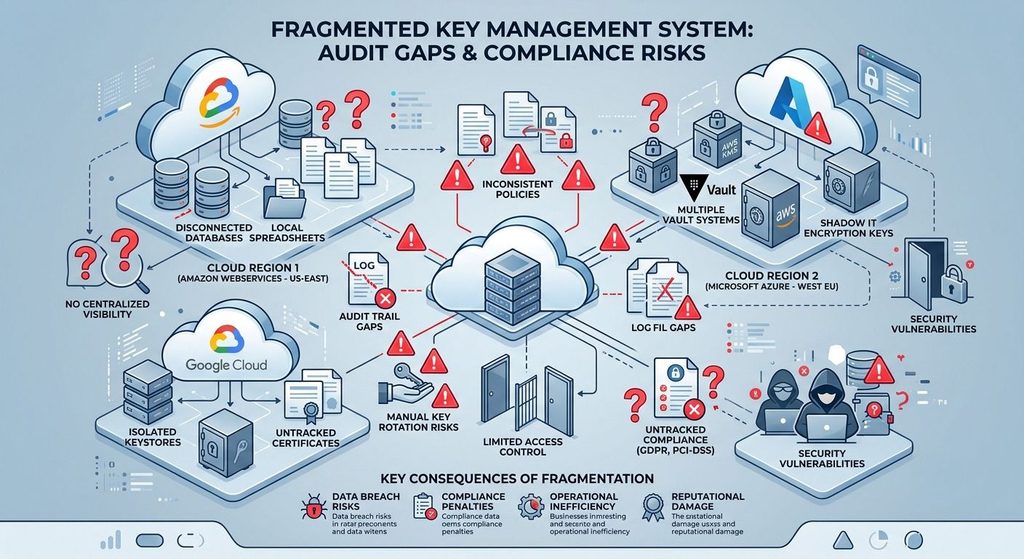
This fragmentation creates three critical problems.
First, compliance gaps multiply in distributed environments. When you operate across multiple cloud regions, on-premises systems, and third-party integrations, maintaining consistent key management policies becomes nearly impossible. One region might enforce key rotation every 90 days. Another rotates annually. Compliance officers can’t definitively answer whether standards are being met uniformly.
Second, audit automation remains elusive. Traditional audits require security teams to manually pull logs, correlate events, and prepare compliance reports. For organizations managing millions of cryptographic operations monthly, this becomes a crushing burden. Each audit consumes 100-200 hours of skilled security labor.
Third, quantum-safe readiness is deferred. Many organizations know that quantum computing poses an existential threat to current encryption standards. Yet without centralized, policy-driven key management, transitioning to post-quantum cryptography feels impossible. How do you deploy quantum-safe encryption across thousands of keys in different systems without a unified governance platform?
These challenges compound when you consider regulatory pressure. NIST now recommends cryptographic agility as a fundamental security principle. Financial regulators expect organizations to have a quantum migration roadmap. Healthcare organizations must prove that key management meets both HIPAA and evolving cybersecurity standards.
The solution isn’t upgrading individual components. It’s fundamentally rethinking how cryptographic keys are managed, governed, and audited across the enterprise.
How HSM Compliance Automation Solves Regulatory Pressure
Enterprise HSM solutions with integrated compliance automation create a single point of control for cryptographic key lifecycle management and audit evidence. Rather than reconstructing compliance from disparate logs, automation captures every relevant event in real-time, applies policy-driven governance, and generates audit-ready evidence continuously.
Centralized key governance across distributed infrastructure becomes achievable. All keys whether deployed in banking systems, healthcare environments, cloud infrastructure, or partner integrations are managed through a unified policy engine. Rotation policies apply uniformly. Access controls are enforced consistently. Compliance officers gain visibility into the entire cryptographic estate in real-time dashboards.
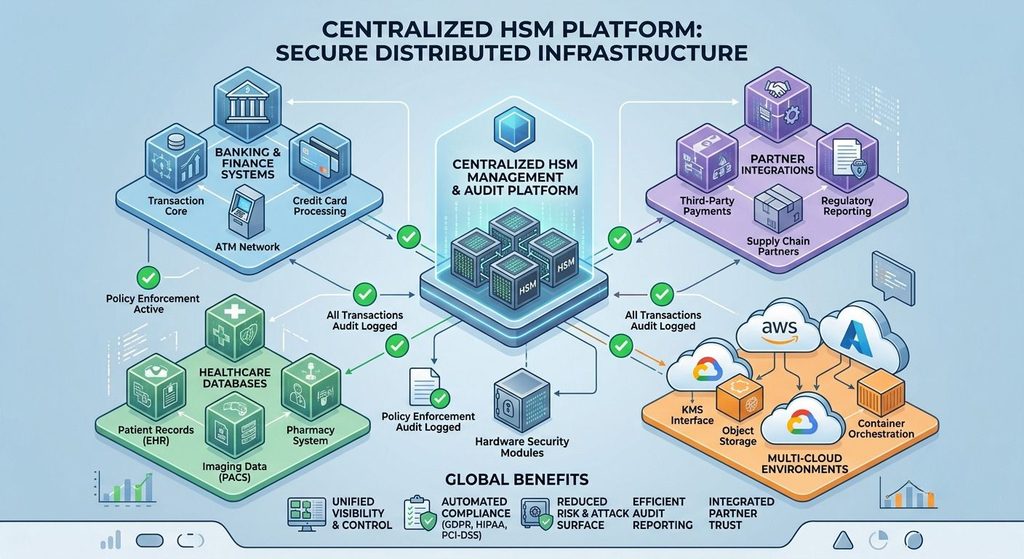
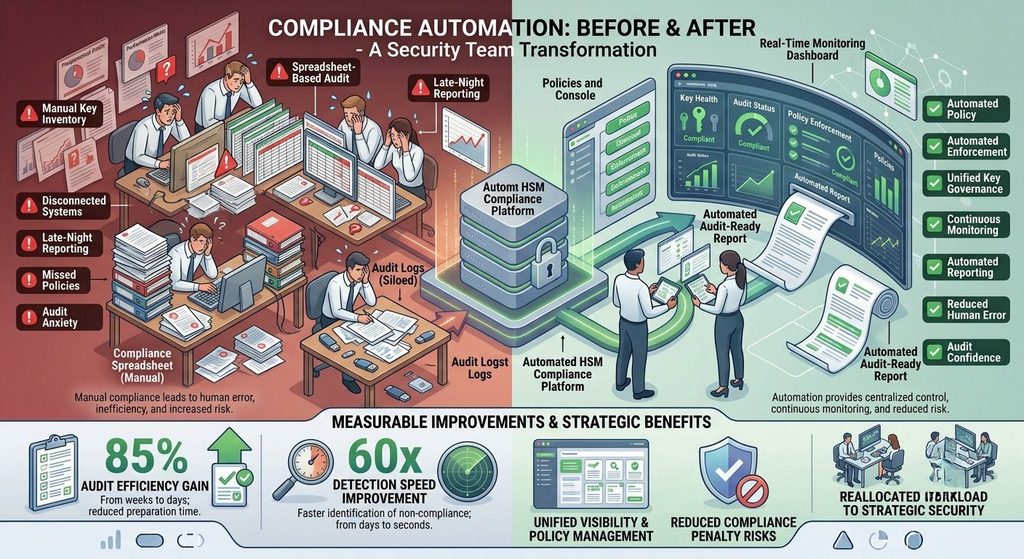
Automated audit logging eliminates manual evidence reconstruction. Every key operation is captured with immutable audit trails. Key creation, rotation, access, and decommissioning events are logged with cryptographic signatures that prove integrity. When auditors request proof of compliance, organizations generate certified reports directly from this audit infrastructure. What used to take weeks of manual investigation now takes hours.
Policy-driven cryptographic agility enables quantum-safe transitions. Organizations define encryption policies centrally specifying which algorithms are used, when keys rotate, and how audit evidence is captured. As quantum-safe cryptography standards mature, these policies update in real-time. New post-quantum algorithms are deployed without rebuilding key management systems. Hybrid encryption (combining classical and post-quantum algorithms) is enforced across the cryptographic stack.
Real-time compliance monitoring replaces periodic audits. Traditional compliance operates on quarterly or annual cycles. Months pass between audit reports and actual compliance status. HSM compliance automation shifts this model. Continuous monitoring detects policy violations in real-time. If a key reaches its rotation deadline, automated workflows trigger replacement. If access patterns deviate from approved policies, alerts fire immediately.
Meeting PCI-DSS Requirements Through Automated Key Management
Payment Card Industry Data Security Standard (PCI-DSS) imposes strict requirements on cryptographic key management. Requirement 3.6 alone mandates that organizations generate, protect, rotate, and retire keys according to specific standards. For large financial institutions processing millions of transactions monthly, managing this manually is operationally impossible.
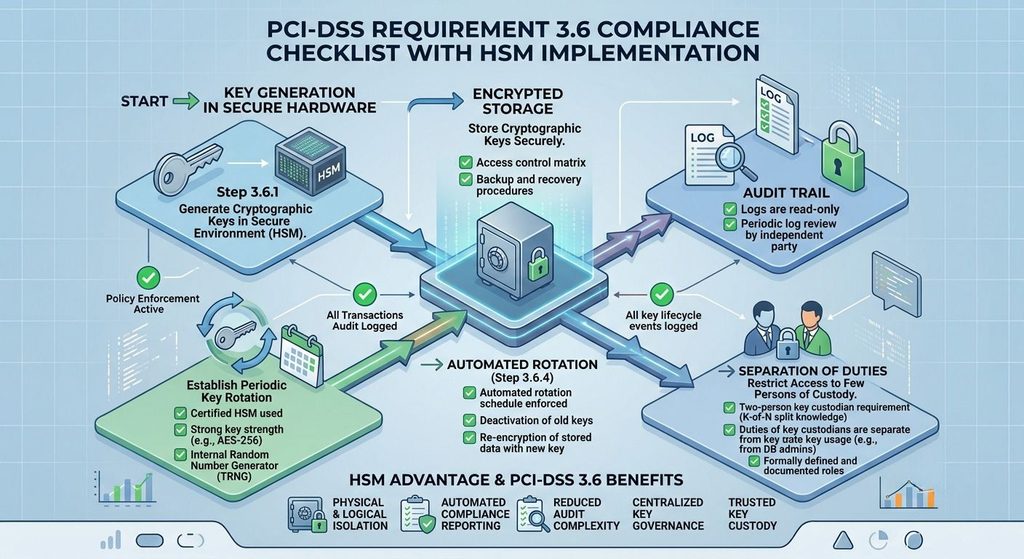
PCI-DSS Requirement 3.6 requires:
- Key generation using cryptographic hardware with access controls: HSM solutions generate keys within tamper-resistant hardware, ensuring keys never exist in software-accessible memory. Only authorized administrators can access key generation functions.
- Secure key storage with restricted access: Keys remain encrypted at rest within the HSM. Access is restricted through multi-factor authentication and role-based controls. Audit logs capture every access attempt.
- Key rotation according to defined schedules: PCI-DSS requires rotation upon known/suspected compromise or at maximum intervals (typically annually). HSM compliance automation enforces these rotations automatically. If a rotation deadline approaches, the system generates alerts and initiates replacement workflows.
- Retention of key history: Organizations must maintain audit trails documenting key lifecycle events. The HSM maintains immutable, cryptographically-signed audit records that survive system migrations or disasters.
- Separation of duties in key management: PCI-DSS requires that no single individual can manage encryption keys without oversight. HSM solutions enforce this through dual-control, requiring two authorized individuals to approve sensitive key operations.
An organization processing 500 million card transactions annually through different payment channels can automate all of these requirements through a unified HSM platform. Keys rotate on schedule without manual intervention. Access controls are enforced at the hardware level. Audit evidence is generated continuously and stored with cryptographic proof of integrity.
HIPAA Compliance and Cryptographic Agility in Healthcare
Healthcare organizations face a parallel but distinct compliance challenge. HIPAA requires that Protected Health Information (PHI) be encrypted using cryptographic methods. Yet healthcare systems operate with exceptional complexity: electronic health records, medical imaging systems, pharmacy databases, and third-party health information exchanges all require encryption. Different systems use different encryption standards. Some legacy systems use algorithms approaching end-of-life.
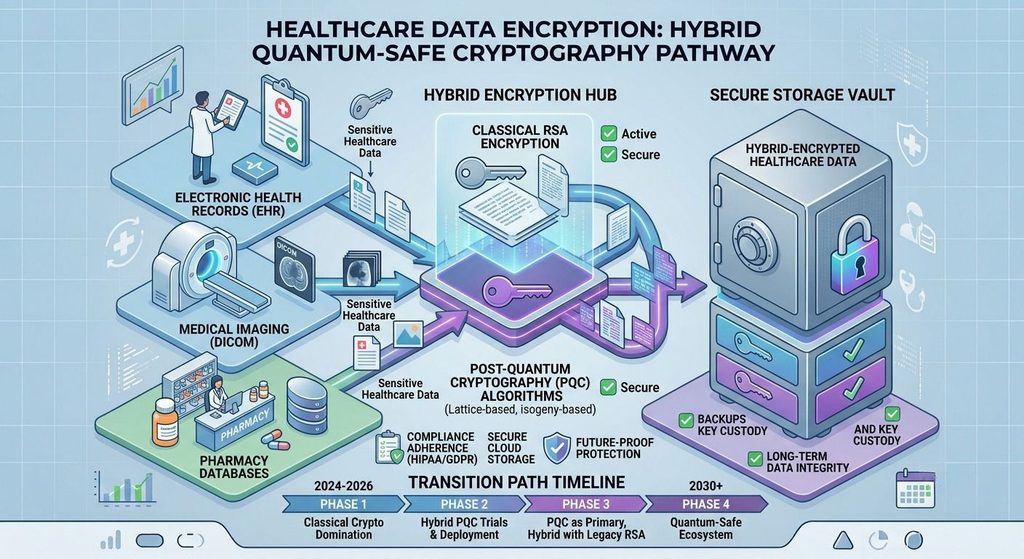
HIPAA’s security requirements don’t specify particular algorithms, but they demand reasonable cryptographic methods and secure key management. “Reasonable” increasingly means cryptographically agile capable of transitioning to quantum-safe encryption as standards evolve.
Centralized HSM compliance automation enables healthcare organizations to:
Standardize encryption across heterogeneous systems. Different clinical departments, hospital networks, and integrated health systems operate independently. Yet they all handle PHI that requires equivalent protection. HSM solutions define encryption policies that apply universally. All systems encrypt with approved algorithms. All systems rotate keys on the same schedule. All systems log access consistently.
Ensure HIPAA audit requirements are met continuously. HIPAA requires that access to encryption keys be restricted and logged. Manual auditing of key access across distributed healthcare systems is impractical. HSM compliance automation logs every key access with full audit trail data: who accessed which key, when, from which system, and what operations they performed.
Prepare for quantum-safe healthcare encryption. Quantum computers could theoretically decrypt decades of historical PHI if current encryption is compromised retroactively. Healthcare organizations must transition to quantum-resistant encryption proactively. HSM compliance automation platforms support hybrid encryption strategies, allowing organizations to encrypt with both classical and post-quantum algorithms simultaneously. As quantum-safe standards mature, organizations have already encrypted sensitive data with quantum-resistant protection.
Demonstrate compliance during audits. When healthcare regulators conduct audits, they request evidence of encryption implementation and key management practices. Organizations with HSM compliance automation generate comprehensive compliance reports automatically. These reports document encryption standards, key rotation history, access controls, and incident response capabilities. Documentation is immediate and auditor-ready.
The Post-Quantum Cryptography Imperative: Preparing Today for Tomorrow’s Threats
Quantum computing represents an existential threat to current encryption standards. While quantum computers capable of breaking RSA and ECC encryption don’t exist today, the cryptographic community recognizes that such systems could emerge within 10-20 years. Organizations cannot wait until quantum computers exist to begin migration. By then, it will be too late.
The threat is not abstract. Adversaries are already collecting encrypted data today with the assumption that quantum computers will eventually break these encryptions. This “harvest now, decrypt later” attack is a genuine concern for organizations handling sensitive data with long confidentiality requirements. A healthcare organization storing encrypted PHI today faces the possibility that this data could be decrypted in 15 years without appropriate protection.
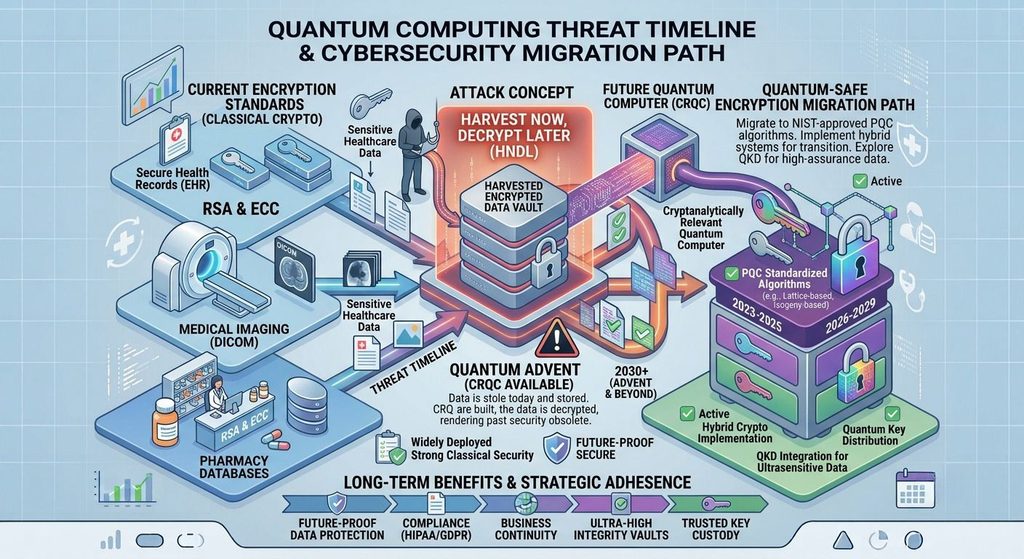
NIST formalized post-quantum cryptography standards in 2022, establishing cryptographic algorithms designed to resist quantum computing attacks. Organizations must transition to these quantum-safe standards proactively. Yet this transition is complex. Not all systems can migrate simultaneously. Applications use different libraries and frameworks. Different regulatory regimes have different quantum-safe requirements.
This is where HSM compliance automation with post-quantum cryptography (PQC) support becomes essential.
Quantum-safe HSM platforms support hybrid encryption strategies. Organizations encrypt data simultaneously with classical (RSA/ECC) and post-quantum algorithms. This protects data against both current and future threats. As quantum-safe standards mature and computational costs decrease, classical encryption can be phased out.
Policy-driven cryptographic migration ensures consistency. Organizations define quantum-safe encryption policies centrally. These policies specify which PQC algorithms to use, how to handle algorithm transitions, and how hybrid encryption is deployed. Policies are version-controlled and auditable.
Quantum-ready key management prevents vendor lock-in. Organizations with centralized, policy-driven key management can adopt quantum-safe algorithms from multiple vendors. The HSM platform abstracts underlying cryptographic implementations, allowing organizations to transition between quantum-safe algorithms without rebuilding key infrastructure.
Audit trails document quantum-safe readiness. Regulators increasingly expect organizations to have quantum-safe cryptography roadmaps. HSM compliance automation maintains audit evidence documenting quantum-safe encryption deployment, key rotation timelines, and algorithm transition progress. This documentation satisfies regulatory expectations for quantum readiness.
For a banking organization managing $500 billion in customer assets across multiple jurisdictions, quantum-safe cryptographic agility isn’t a nice-to-have. It’s a fundamental business requirement.
Real-World Impact: Compliance Automation in Action
Consider a financial services organization with 50,000 employees across six continents. The organization operates payment processing systems, customer banking platforms, internal transaction systems, and partner integration channels. Cryptographic keys protect customer data, transaction integrity, and internal communications.
The Challenge: The organization faced two critical problems. First, regulatory audits were consuming 400+ hours annually because compliance teams manually reconstructed key management evidence from disparate systems. Second, the organization knew that quantum-safe encryption requirements were coming, but had no unified approach to transition its cryptographic infrastructure.
The Solution: The organization implemented an enterprise HSM compliance automation platform across all regions. The platform centralized key management, deployed automated audit logging, and enabled hybrid encryption for quantum-safe readiness.
The Results:
- Audit efficiency improved by 85%. What took 400 hours of manual investigation now takes 60 hours. Compliance reports generate automatically with cryptographic proof of key rotation, access controls, and incident handling.
- Time to compliance violation detection dropped from 60 days to real-time. Automated monitoring detects policy violations immediately. If a key approaches its rotation deadline, automated workflows trigger replacement without human intervention.
- Quantum-safe readiness achieved in 18 months. By deploying hybrid encryption through centralized HSM policies, the organization encrypted sensitive data with post-quantum algorithms. When NIST-standardized quantum-safe algorithms mature, the organization can transition seamlessly.
- Regulatory confidence increased measurably. Auditors appreciated the comprehensive, automated audit trail. The organization’s compliance posture improved from “reactive” to “proactive.” This translated to smoother audits and stronger regulatory relationships.
This isn’t theoretical improvement. This reflects actual organizational benefits from implementing centralized, policy-driven, automated compliance infrastructure.
Key Capabilities Every Enterprise HSM Compliance Platform Must Support
Not all HSM solutions provide equivalent compliance automation. Organizations should evaluate platforms based on specific capabilities essential for modern compliance environments:
Unified key management across distributed infrastructure. The platform must manage keys consistently across cloud regions, on-premises systems, and partner integrations. Policies apply uniformly regardless of where keys reside or operate.
Real-time audit logging with cryptographic proof. Every key operation generates immutable audit evidence. Access attempts, key rotations, and policy violations are logged with digital signatures that prove authenticity and integrity. Audit logs survive system failures and cannot be modified retroactively.
Policy-driven cryptographic agility. Organizations define encryption standards centrally. These policies specify algorithms, rotation schedules, access controls, and compliance requirements. Policies are version-controlled and auditable. Cryptographic algorithm changes are deployed through policy updates without rebuilding infrastructure.
Automated compliance reporting. Compliance evidence is generated automatically from audit logs. Reports document regulatory requirement fulfillment with supporting evidence. Organizations generate audit-ready compliance documentation on demand.
Post-quantum cryptography support. The platform enables hybrid encryption combining classical and post-quantum algorithms. As quantum-safe standards mature, organizations transition seamlessly without rebuilding key management systems.
Multi-factor authentication and role-based access control. Human access to sensitive key operations requires multiple forms of authentication. Access is restricted through role-based controls that enforce separation of duties at the platform level.
Automated key rotation and lifecycle management. Key rotation occurs on defined schedules without manual intervention. The platform manages the complete key lifecycle from generation through secure decommissioning.
Connecting HSM Compliance to Security Operations
Many organizations implement HSM compliance automation in isolation, treating it as a regulatory requirement separate from broader security operations. This misses critical value. When HSM compliance automation connects to security incident response, threat detection, and identity management, organizational security maturity increases exponentially.
Incident response acceleration. When a security incident occurs, response teams need immediate access to cryptographic evidence. Did the compromised system ever access sensitive cryptographic keys? What data was encrypted with keys the threat actor potentially accessed? HSM audit logs provide definitive answers within minutes rather than days.
Threat detection enhancement. Unusual patterns in key access or cryptographic operations can indicate compromised credentials or insider threats. HSM compliance platforms generate alerts when access patterns deviate from historical baselines. These alerts provide early detection of threats that would otherwise remain hidden for weeks.
Identity and access management integration. As organizations implement zero-trust security models, cryptographic key management becomes essential to identity verification and access control. HSM solutions that integrate with identity management platforms enable cryptographic identity proofs, multi-factor authentication through hardware security devices, and continuous identity verification.
Vendor risk management. Organizations increasingly depend on third-party vendors for critical services. Many vendors require access to customer data encryption keys. HSM compliance automation enables organizations to manage third-party key access through formal policies, automated audit logging, and revocation capabilities. Access to keys can be revoked within seconds if vendor relationships change.
These connections transform HSM compliance automation from a regulatory requirement into a core security operations capability.
Implementing HSM Compliance Automation Successfully
Organizations approaching HSM compliance automation deployment should follow structured implementation approaches:
Start with inventory and assessment. Document all cryptographic keys currently in use. Identify where keys reside, which systems use them, and current key management practices. This inventory reveals the true scope of cryptographic infrastructure and compliance gaps.
Define compliance policies explicitly. For each regulatory requirement applicable to the organization (PCI-DSS, HIPAA, SOX, etc.), define specific compliance policies. These policies specify encryption standards, key rotation schedules, access controls, and audit requirements. Policies should be documented and approved by compliance and security leadership.
Implement in phases. Deploy HSM compliance automation first for highest-risk applications and most sensitive data. Prove value in limited scope before broad organizational rollout. This phased approach reduces risk and allows teams to develop operational expertise.
Automate monitoring and response. Configure automated workflows for common compliance scenarios. When keys approach rotation deadlines, automated workflows trigger replacement. When unauthorized access attempts occur, automated alerts notify security teams. Automation reduces manual burden and accelerates response.
Establish compliance metrics and reporting. Define metrics that demonstrate compliance improvement. Track audit hours required, time to compliance violation detection, percentage of keys rotated on schedule, and regulatory audit outcomes. These metrics prove business value and justify ongoing investment.
Enable continuous improvement. Review compliance automation performance monthly. Refine policies based on actual operational experience. Engage regulatory relationships to ensure compliance automation approaches align with audit expectations.
Addressing Common HSM Compliance Implementation Concerns
Q: Does HSM compliance automation increase system complexity? No. When implemented correctly, HSM compliance automation reduces complexity. Centralized, policy-driven key management is simpler than managing keys across multiple disconnected systems. However, initial implementation requires expertise. Organizations should engage vendors and consultants with proven HSM implementation experience.
Q: How much does enterprise HSM compliance automation cost? HSM solutions range from $50,000 to $500,000+ depending on organizational scale, regional distribution, and feature requirements. However, this cost should be evaluated against current compliance audit costs. Organizations currently spending 400+ hours annually on compliance audits typically recover HSM investment within 18-24 months through audit efficiency gains.
Q: Can HSM compliance automation integrate with existing security tools? Most enterprise HSM platforms integrate with security information and event management (SIEM) systems, identity and access management (IAM) platforms, and cloud infrastructure. Integration enables automated audit log correlation and simplified security operations.
Q: How do we handle HSM compliance automation during system outages? Enterprise HSM platforms maintain high availability through redundancy. Primary and backup HSMs operate simultaneously. If primary hardware fails, backup systems continue operations automatically. Key operations are queued and executed when hardware comes back online. Recovery time objective (RTO) is typically measured in minutes.
Q: Does HSM compliance automation support our specific regulatory requirements? Most enterprise HSM platforms support PCI-DSS, HIPAA, SOX, GDPR, and other major regulatory frameworks. Some regulations have specialized requirements. Organizations should verify platform support for specific compliance requirements during evaluation.
Frequently Asked Questions About HSM Compliance Automation
Q1: How does HSM compliance automation differ from traditional key management systems? Traditional key management stores keys and provides basic access controls. HSM compliance automation adds centralized policy governance, automated audit logging, continuous compliance monitoring, and real-time policy enforcement. The platform captures complete cryptographic evidence, automates compliance reporting, and enables policy-driven transitions to quantum-safe encryption.
Q2: Can we implement HSM compliance automation without disrupting existing applications? Yes. Enterprise HSM platforms are designed as non-disruptive overlay systems. Applications continue using existing APIs. The HSM platform intercepts key operations transparently. This approach minimizes application changes and reduces deployment risk.
Q3: How quickly can organizations achieve compliance automation benefits? Initial audit efficiency improvements appear within weeks of deployment. Real-time compliance monitoring activates immediately. Complete infrastructure migration typically requires 3-6 months depending on organizational scale and system complexity. However, value accumulates continuously throughout implementation.
Q4: What’s the relationship between HSM compliance automation and quantum-safe cryptography? HSM compliance automation platforms enable hybrid encryption combining classical and post-quantum algorithms. Organizations encrypt sensitive data with quantum-safe protection immediately, then transition to pure post-quantum encryption as standards mature. This approach protects against both current and future quantum computing threats.
Q5: How do we ensure HSM compliance automation data is tamper-proof? HSM platforms generate audit logs within tamper-resistant hardware. Audit events are digitally signed with cryptographic keys that never leave the hardware. The system creates linked chains of signed audit records. Any tampering invalidates cryptographic signatures, making modification immediately detectable.
Q6: Can HSM compliance automation support multi-cloud environments? Yes. Enterprise HSM platforms manage keys across multiple cloud providers, on-premises systems, and hybrid infrastructures. Centralized policies apply uniformly regardless of where keys reside. This enables consistent compliance across complex, distributed environments.
Conclusion: Transforming Compliance From Burden to Competitive Advantage
Regulatory compliance consumes enormous organizational resources. Yet most organizations treat compliance as a necessary burden separate from core business operations. This approach wastes opportunity. When compliance automation connects to security operations, incident response, and threat detection, compliance becomes a source of competitive advantage.
Organizations that implement HSM compliance automation gain several strategic advantages: audits complete faster, requiring fewer resources. Compliance violations are detected and remediated in real-time rather than weeks later. Regulatory relationships strengthen because compliance evidence is comprehensive and immediately available. Most importantly, these organizations develop quantum-safe cryptographic readiness proactively, positioning themselves securely for future cryptographic requirements.
The regulatory landscape continues evolving. Quantum computing threats demand action. Compliance requirements expand to new domains. Organizations that automate compliance infrastructure rather than relying on manual processes position themselves to adapt quickly to regulatory change while reducing operational burden.
Centralized, policy-driven, automated compliance infrastructure represents modern enterprise security operations. Organizations that implement these capabilities strengthen their security posture, reduce audit burden, and prepare proactively for regulatory evolution. The question isn’t whether to implement HSM compliance automation. The question is how quickly organizations can deploy this capability to gain the competitive advantages it provides.
Request Demo of QuantumVault Compliance Automation to see how centralized HSM management and compliance automation transforms regulatory compliance operations. Learn how leading financial institutions and healthcare organizations are automating compliance while achieving quantum-safe security readiness.