


Every blockchain transaction you trust, every digital asset custody solution you rely on, and every smart contract execution you depend on begins with a single, deceptively simple question: who controls the keys?
Most organizations get so focused on the visible layers of blockchain security audits, firewalls, access controls that they overlook the foundational layer holding everything together. That layer is key management. And in the enterprise context, hardware security modules represent the most robust, tamper-resistant infrastructure available for protecting cryptographic keys at scale.
Yet here is where the story gets complicated. The cryptographic assumptions that made HSMs reliable for decades are now under direct threat. Quantum computing is no longer a distant horizon event. It is an active engineering challenge that nation-states and well-funded research institutions are solving with measurable progress. The algorithms securing your blockchain keys today ECDSA, RSA, traditional elliptic curve schemes will eventually become vulnerable to quantum adversaries running Shor’s algorithm at sufficient qubit capacity.
This is not a hypothetical. This is a transition that requires enterprises to act now, not later.
Enterprise HSM key management, when combined with post-quantum cryptography and cryptographic agility, forms the only credible long-term security architecture for organizations that manage blockchain transactions and digital asset operations at scale. This blog walks through every critical dimension of that architecture, from how HSMs work within blockchain environments to how quantum-safe security products like QuantumVault are redefining what enterprise-grade protection actually means.
What Is an HSM and Why Does It Matter for Blockchain?
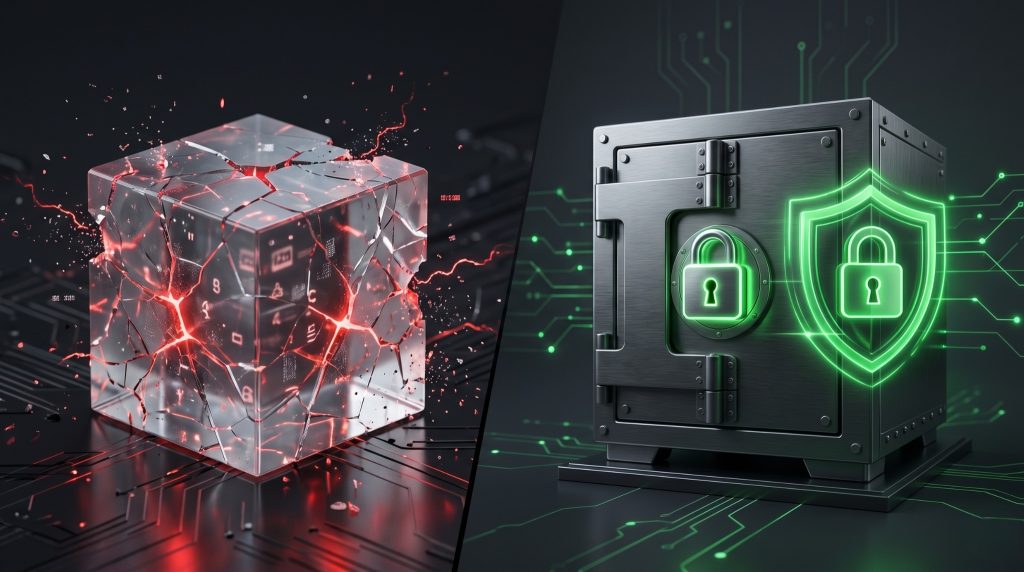
A hardware security module is a dedicated, tamper-resistant physical computing device designed to generate, store, and manage cryptographic keys in a secure hardware environment. Unlike software-based key stores, an HSM ensures that private keys never leave the protected hardware boundary in plaintext form. All cryptographic operations signing, encryption, decryption happen inside the module itself.
For blockchain environments, this distinction is not academic. It is operational survival.
Blockchain transactions are authorized by digital signatures. Those signatures are produced using private keys. If a private key is compromised, the attacker gains irrevocable control over the associated blockchain address and every asset attached to it. There is no central authority to call. There is no transaction reversal. There is no support ticket. The loss is permanent.
Traditional software-based key management creates attack surfaces at every layer of the stack. Keys stored in memory are vulnerable to memory dump attacks. Keys stored on disk are vulnerable to exfiltration. Keys passed through application code are vulnerable to injection attacks. HSMs eliminate these attack surfaces by design. The key material never exists in software it lives entirely within hardware that is physically and logically hardened.
Furthermore, enterprise HSMs are engineered to meet rigorous compliance standards. FIPS 140-2 and FIPS 140-3 certification levels define the specific security properties an HSM must demonstrate to qualify for regulated environments. For blockchain platforms operating in financial services, insurance, healthcare, or government sectors, HSM deployment is not optional. It is a regulatory expectation.
The Cryptographic Core: How HSMs Protect Blockchain Signing Operations
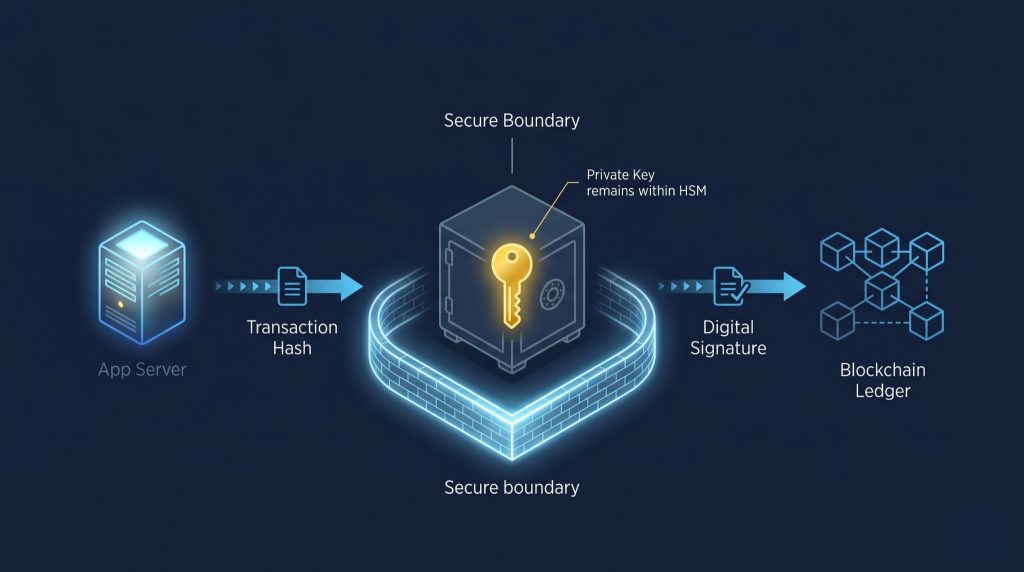
To understand the depth of HSM protection in blockchain contexts, it helps to walk through exactly what happens during a transaction signing operation.
When a blockchain transaction is initiated, the signing request travels to the HSM rather than to a software key store. The HSM receives the transaction data specifically, the serialized transaction hash and uses the internally stored private key to compute a digital signature. That signature is returned to the calling application. The private key itself never leaves the HSM boundary.
This architecture provides several layers of protection simultaneously.
First, key isolation ensures that even a fully compromised application server cannot extract the private key material. The attacker may compromise the server, intercept the signing request, or even manipulate the transaction data before it reaches the HSM but without physical access to the HSM itself, the key remains protected.
Second, access controls built into enterprise HSMs allow organizations to define granular policies around who or what can trigger signing operations. Multi-party authorization schemes, role-based access, and time-bound signing windows can all be enforced at the hardware level.
Third, audit logging within the HSM creates a tamper-resistant record of every cryptographic operation. This is particularly important in regulated environments where demonstrating compliance requires evidence of key usage patterns and access histories.
For organizations running multi-signature wallet infrastructure, custodial platforms, or blockchain-based settlement systems, these properties collectively form the baseline of a defensible security architecture.
Enterprise HSM Key Management: Beyond Storage

It is tempting to think of enterprise HSM key management purely in terms of storage keep the keys safe inside hardware and call it done. That framing misses most of the operational complexity.
Enterprise key management is a lifecycle discipline. Keys are generated, enrolled, used, rotated, backed up, recovered, and eventually retired. Each of these phases introduces distinct risks that a well-designed key management system must address systematically.
Key generation inside the HSM is the starting point. Cryptographic randomness is a non-trivial requirement. HSMs use hardware-based random number generators that meet the quality standards required for secure key generation. Software-based RNGs, by contrast, are vulnerable to entropy depletion attacks and predictable seeding conditions.
Key rotation is equally critical. Long-lived cryptographic keys accumulate exposure risk over time. Every signing operation that uses a key is a data point an adversary can potentially analyze. In post-quantum threat models, the risk of retrospective decryption where an adversary collects encrypted or signed data now and decrypts it later once quantum capability matures makes regular key rotation not just good hygiene but a genuine risk mitigation strategy.
Key backup and recovery introduce a fundamental tension. The same isolation that makes HSMs secure also makes them potential single points of failure. Enterprises need robust key backup mechanisms that preserve security guarantees even while enabling disaster recovery. Techniques such as key splitting using Shamir’s Secret Sharing, multi-HSM replication, and geographically distributed key escrow all serve this need while maintaining the tamper-resistance properties that make HSMs valuable.
Finally, cryptographic agility is the emerging requirement that separates modern enterprise HSM key management from legacy approaches. An agile key management system can transition between cryptographic algorithms without full infrastructure replacement. This property is becoming non-negotiable as post-quantum cryptography standards mature and organizations face mandatory migration timelines.
The Quantum Threat: Why Your Current HSM Setup Needs to Evolve

Here is the uncomfortable reality that many blockchain security architects have not fully internalized. A perfectly implemented HSM setup using current industry-standard algorithms provides strong protection against classical adversaries today. It provides essentially zero protection against a sufficiently powerful quantum adversary running Shor’s algorithm against ECDSA or RSA keys.
Shor’s algorithm, when executed on a fault-tolerant quantum computer with sufficient logical qubits, reduces the factoring problem and discrete logarithm problem the mathematical foundations of RSA and elliptic curve cryptography from computationally infeasible to computationally trivial. The timeline for quantum computers reaching that threshold is actively debated, but leading estimates from NIST, NSA, and major research institutions suggest a 10 to 15 year window with significant uncertainty on both ends.
The challenge for long-term blockchain deployments is that cryptographic transitions are not instantaneous. They require algorithm migration, infrastructure updates, key rotation at scale, vendor support timelines, regulatory approval processes, and extensive testing. Starting that transition the day a capable quantum computer is demonstrated publicly means arriving too late.
Moreover, the harvest-now-decrypt-later attack model means that adversaries who are serious about long-term intelligence gathering are already collecting encrypted blockchain data, signed transactions, and public key material today. When their quantum capability matures, they can begin decrypting historical records. For blockchain networks where the public key is exposed in the transaction record, this creates a specific retrospective threat vector.
Quantum-safe security is therefore not a future concern. It is a present planning requirement.
Post-Quantum Cryptography: The Algorithmic Response to Quantum Threats

Post-quantum cryptography refers to cryptographic algorithms specifically designed to remain secure against both classical and quantum adversaries. Unlike quantum key distribution, which requires specialized hardware and dedicated physical channels, PQC runs on standard computing infrastructure and is designed to be deployable as a drop-in replacement for current asymmetric algorithms.
NIST completed its multi-year post-quantum cryptography standardization process in 2024, selecting CRYSTALS-Kyber for key encapsulation, CRYSTALS-Dilithium for digital signatures, FALCON for digital signatures, and SPHINCS+ as a stateless hash-based signature scheme. These algorithms are built on mathematical problems structured lattice problems and hash-based constructions that are believed to be computationally hard even for quantum computers.
For blockchain environments, the transition to PQC has specific implications. Transaction signatures will need to use quantum-resistant algorithms. Key generation and storage within HSMs will need to support PQC key types. Wallet address formats may need to evolve to accommodate the larger key sizes characteristic of post-quantum algorithms. And hybrid encryption schemes that combine classical and post-quantum algorithms will serve as a transitional bridge, providing security against both classical adversaries in the present and quantum adversaries in the future.
Hybrid crypto approaches are particularly relevant during the migration window. Running a classical algorithm alongside a PQC algorithm ensures that compromise of either algorithm individually does not result in security failure. This defense-in-depth posture is consistent with the principle of cryptographic agility designing systems that can adapt without requiring complete architectural replacement.
Cryptographic Agility: The Architectural Property That Makes Migration Possible

Cryptographic agility is the capacity of a system to support multiple cryptographic algorithms simultaneously and to transition between them without operational disruption. It is the property that separates organizations that will execute quantum-safe migrations smoothly from those that will face expensive, high-risk emergency upgrades.
Building cryptographic agility into blockchain infrastructure requires deliberate architectural choices at every layer.
At the key management layer, the HSM and its management platform must support both current algorithms and emerging PQC standards within the same operational framework. Key types, key policies, and signing workflows must be abstracted from specific algorithm implementations so that adding a new algorithm does not require rebuilding the entire system.
At the application layer, transaction signing logic must be parameterized to support algorithm negotiation. Hard-coded algorithm identifiers in signing code are a technical debt that becomes a migration crisis when algorithm transitions are needed.
At the protocol layer, blockchain networks themselves may need governance processes to coordinate algorithmic transitions across distributed validator sets. Organizations that participate in enterprise blockchain consortia or permissioned networks need to understand the governance pathways for PQC adoption within those networks.
At the compliance layer, cryptographic agility frameworks need to integrate with audit logging, policy enforcement, and compliance reporting systems so that algorithm migration activities produce the evidence trails required by regulatory frameworks.
QuantumVault addresses this requirement directly through its cryptographic agility platform architecture, providing organizations with the infrastructure to manage multi-algorithm environments, enforce PQC policies, and execute controlled migrations across enterprise blockchain deployments.
QuantumVault: Enterprise-Grade Quantum-Safe Security for Blockchain Operations

QuantumVault is a post-quantum cryptography solution purpose-built for enterprises managing blockchain transactions, digital asset custody, and cryptographic operations at scale. It combines enterprise HSM key management, PQC algorithm support, and cryptographic agility into a unified platform that addresses the full lifecycle of cryptographic security.
PQC Key Management
At its core, QuantumVault functions as a PQC key management platform. It supports the generation, storage, rotation, and lifecycle management of both classical and post-quantum cryptographic keys within a tamper-resistant hardware environment. For blockchain operations, this means that signing keys for transaction authorization, wallet addresses, and smart contract interactions can all be managed within a unified, policy-governed key management framework that already incorporates quantum-resistant key types.
The PQC key management capabilities extend beyond simple storage. QuantumVault implements quantum-safe key derivation, hybrid key generation combining classical and PQC algorithms, and automated key rotation policies that enforce organizational security baselines without requiring manual intervention.
Cryptographic Agility Platform
QuantumVault’s cryptographic agility platform allows enterprises to define algorithm policies centrally and enforce them consistently across distributed blockchain infrastructure. Organizations can configure PQC suite preferences, set migration timelines, and monitor algorithm usage across their entire cryptographic footprint through a single governance layer.
This is critical for organizations operating permissioned blockchain networks or enterprise DLT platforms where multiple participants, applications, and integration points each have their own cryptographic dependencies. Rather than attempting to coordinate migration manually across dozens of touchpoints, QuantumVault’s policy engine propagates algorithm requirements automatically.
Quantum-Safe Gateway
The QuantumVault quantum-safe gateway provides PQC-protected communication channels for blockchain nodes, HSM management interfaces, and administrative operations. Every management plane interaction, key synchronization operation, and monitoring data stream traverses a quantum-resistant encrypted tunnel rather than relying on classical TLS.
For enterprise blockchain environments where the management infrastructure itself represents a high-value attack target, securing the management plane with quantum-safe network protocols is as important as securing the keys themselves. A quantum adversary who can decrypt management traffic can reconstruct key material, intercept signing requests, or manipulate policy configurations without ever touching the HSM hardware directly.
PQC Signing Workflow
QuantumVault integrates PQC signing workflows directly into blockchain transaction processing pipelines. Organizations can configure multi-party authorization requirements, enforce signing policies based on transaction value or destination, and maintain complete audit trails of every signing operation, all within a quantum-resistant cryptographic framework.
The PQC signing workflow supports both pure post-quantum signatures and hybrid signing schemes that combine classical and PQC algorithms. During the migration period, hybrid signatures provide backward compatibility with classical verifiers while simultaneously establishing quantum-resistant signing records that will remain valid after the full transition.
PQC Compliance and Audit Logs
Regulatory compliance in blockchain environments requires more than technical security controls. It requires demonstrable evidence that those controls are operating as intended. QuantumVault’s PQC compliance module generates structured audit logs of every cryptographic operation, algorithm selection decision, key lifecycle event, and policy enforcement action.
These logs are formatted to support common regulatory frameworks including GDPR technical safeguards requirements, financial sector cryptographic key management guidelines, and emerging national cybersecurity frameworks that are beginning to incorporate quantum-readiness requirements. The PQC audit logs provide a verifiable, tamper-resistant record that organizations can present to auditors, regulators, and counterparties as evidence of quantum-safe security posture.
PQC Migration Governance
One of the most operationally complex aspects of transitioning to post-quantum cryptography is managing the migration itself. Organizations have existing keys, running applications, active blockchain nodes, and integration dependencies that cannot all be updated simultaneously. A poorly managed migration creates windows of inconsistent cryptographic posture that introduce new vulnerabilities even as they address old ones.
QuantumVault’s PQC governance platform provides a structured migration framework. It inventories existing cryptographic assets, maps dependencies, generates migration sequencing recommendations, and tracks progress against migration milestones. The PQC rollout capabilities allow organizations to execute phased migrations with validation gates at each step, ensuring that each phase of the transition is complete and verified before proceeding to the next.
Real-World Scenario: Enterprise Digital Asset Custody Under Quantum Threat
Consider a financial institution operating an enterprise digital asset custody platform. The platform holds custody of cryptocurrency assets on behalf of institutional clients. Total assets under custody represent billions of dollars. The platform relies on hardware security modules for signing key protection and uses ECDSA with secp256k1 the same curve used by Bitcoin for transaction authorization.
The security team understands that their HSM infrastructure protects against classical attackers today. However, they have identified three specific risk factors that demand immediate attention.
First, their custody keys are long-lived. Some master keys have been in service for three or more years. Every signing operation that uses those keys generates transaction records that are permanently visible on public blockchain networks. An adversary performing harvest-now-decrypt-later collection has been accumulating those records. When quantum capability matures, those records become potential attack surface.
Second, the institution is subject to regulatory frameworks requiring them to maintain documented cryptographic security posture assessments and demonstrate that their key management practices meet current best practice standards. Post-quantum readiness is beginning to appear explicitly in regulatory guidance from financial sector supervisors in multiple jurisdictions. The window for treating quantum risk as a future concern is closing.
Third, their operational technology roadmap extends fifteen or more years. Systems being procured and deployed today will still be running when quantum computing reaches a commercially threatening capability level. Designing those systems without post-quantum cryptography built in means committing to a forced migration under potentially adverse conditions.
QuantumVault addresses all three dimensions of this scenario. The PQC key management platform supports immediate enrollment of new quantum-safe keys for fresh asset custody addresses. The hybrid encryption capability allows existing classical keys to be migrated to hybrid schemes progressively without operational disruption. The PQC compliance module generates the regulatory evidence trail the institution needs to demonstrate quantum-readiness to supervisors. And the PQC governance platform structures the multi-year migration roadmap across the institution’s entire blockchain footprint.
Quantum-Safe Network Security for Blockchain Infrastructure
Beyond key management and transaction signing, enterprise blockchain deployments face a broader quantum threat surface across their network infrastructure.
Node-to-node communication in permissioned blockchain networks uses classical encryption protocols. Validator gossip networks, transaction propagation channels, consensus messaging, and block synchronization traffic are all protected by classical asymmetric cryptography today. A quantum adversary with sufficient capability can potentially decrypt intercepted node communication traffic, compromise consensus integrity, or inject manipulated data into blockchain synchronization streams.
QuantumVault’s quantum-safe network capabilities extend PQC protection to the network layer. The quantum-safe network architecture supports PQC-protected tunnels between blockchain nodes, quantum-safe access controls for network infrastructure management, and PQC-encrypted channels for monitoring and telemetry data. The result is a blockchain network where the cryptographic protection extends from the key management core through every layer of the communication stack.
Furthermore, quantum-safe remote access ensures that administrative operations node management, configuration updates, key ceremonies, and emergency response procedures are conducted over cryptographically protected channels that will remain secure against quantum adversaries throughout the operational lifespan of the infrastructure.
PQC Device Security for Blockchain-Connected Endpoints
Enterprise blockchain operations extend beyond servers and HSMs. Traders, portfolio managers, compliance officers, and institutional clients interact with blockchain platforms through workstations, mobile devices, and specialized hardware wallets. Each of these endpoints represents a potential attack surface.
PQC device security extends quantum-resistant cryptographic protection to these endpoint interactions. Client authentication to blockchain platforms, secure session establishment for trading interfaces, and cryptographic authorization of withdrawal or transfer requests all become quantum-resistant when the endpoint security layer supports PQC algorithms.
QuantumVault’s approach to device security integrates with enterprise identity and access management frameworks, providing quantum-safe authentication across the full spectrum of devices that interact with blockchain infrastructure. This ensures that the quantum-safe protections implemented at the key management and network layers are not undermined by classical vulnerabilities at the endpoint layer.
PQC Governance: Orchestrating Cryptographic Policy Across the Enterprise
At enterprise scale, cryptographic security is fundamentally a governance problem as much as a technical one. Organizations have hundreds or thousands of applications, dozens of infrastructure platforms, and potentially complex inter-organizational integration dependencies, all of which carry cryptographic dependencies that need to be inventoried, assessed, and migrated as part of a coherent PQC program.
The PQC governance framework within QuantumVault provides the organizational infrastructure for this effort. Cryptographic asset discovery catalogs algorithm usage across the enterprise. Risk-based prioritization frameworks help security teams identify which cryptographic assets require the earliest migration attention based on sensitivity, longevity, and exposure. Policy enforcement mechanisms ensure that new systems are deployed with quantum-safe configurations from the outset, preventing the accumulation of additional classical cryptographic technical debt.
PQC compliance tracking generates the management-level reporting that CISOs and board-level risk committees need to monitor quantum readiness progress. Integration with enterprise GRC platforms ensures that cryptographic risk appears in the organization’s consolidated risk management view rather than as an isolated technical concern.
The PQC policy engine enforces algorithm selection rules across the enterprise, ensuring that developers and system administrators cannot accidentally deploy systems using deprecated or vulnerable algorithms. When an algorithm becomes compromised or reaches its planned retirement date, the policy engine triggers automated remediation workflows rather than relying on manual monitoring and response.
Choosing the Right HSM Architecture for Quantum-Safe Blockchain Operations
Not all HSM deployments are architecturally equivalent. For quantum-safe blockchain operations, the selection of HSM platform, deployment model, and integration architecture has material impact on both security and migration capability.
On-premises HSM deployments provide the strongest physical isolation and give organizations direct control over hardware lifecycle decisions. For blockchain networks where regulatory requirements mandate that key material never leave organizational facilities, on-premises HSMs are often the only compliant option.
Cloud HSM and HSM-as-a-service offerings provide operational flexibility and can support geographically distributed redundancy more easily than on-premises deployments. However, they introduce supply chain trust dependencies and may not support the latest PQC algorithm implementations until cloud providers update their offerings.
Hybrid HSM architectures that combine on-premises primary HSMs with cloud-based backup or secondary HSMs offer a balance between physical control and operational resilience. For organizations managing blockchain infrastructure across multiple geographic regions or regulatory jurisdictions, hybrid architectures are often the most practical path to both compliance and continuity.
Regardless of deployment model, the critical criteria for quantum-safe blockchain operations are PQC algorithm support within the HSM firmware, cryptographic agility capabilities that allow algorithm selection at the policy level, integration APIs that support both current blockchain signing protocols and emerging PQC signing schemes, and robust audit logging that captures the algorithm-level detail required for compliance reporting.
QuantumVault is designed to integrate with industry-standard HSM platforms while providing the PQC key management, policy enforcement, and governance layer that transforms a standalone HSM deployment into a full quantum-safe security platform.
Frequently Asked Questions
1. What is enterprise HSM key management in the context of blockchain? Enterprise HSM key management refers to the use of hardware security modules to generate, store, and manage cryptographic keys used in blockchain transaction signing and digital asset operations. It ensures private keys never leave the tamper-resistant hardware boundary in plaintext form.
2. Why do blockchain platforms need HSMs instead of software key stores? Software key stores expose private key material to the application stack, making them vulnerable to memory dump attacks, exfiltration, and injection exploits. HSMs eliminate these attack surfaces by ensuring all cryptographic operations occur within tamper-resistant hardware.
3. What is post-quantum cryptography and why does it matter for blockchain? Post-quantum cryptography (PQC) refers to cryptographic algorithms resistant to quantum computing attacks. It matters for blockchain because the algorithms currently securing blockchain keys, such as ECDSA and RSA, are vulnerable to Shor’s algorithm on sufficiently powerful quantum computers.
4. What is cryptographic agility and how does it protect blockchain infrastructure? Cryptographic agility is the ability of a system to support and transition between multiple cryptographic algorithms without operational disruption. It protects blockchain infrastructure by enabling quantum-safe migrations without full system replacement.
5. What is the harvest-now-decrypt-later attack and why should blockchain operators care? Harvest-now-decrypt-later is an attack where adversaries collect encrypted or signed data today and decrypt it later using quantum capabilities. Since blockchain transactions are publicly visible on-chain, this is a specific threat to long-lived blockchain signing keys.
Conclusion: The Time to Build Quantum-Safe Foundations Is Now

The blockchain ecosystem has spent years building sophisticated security architectures on top of cryptographic foundations that were state-of-the-art when distributed ledger technology emerged. Those foundations are now approaching their end-of-life horizon, not because the mathematics has failed, but because a new computational paradigm is rendering the hardness assumptions behind them inadequate.
Enterprise HSM key management remains the correct architectural anchor for blockchain transaction security. The isolation, tamper-resistance, and audit properties of HSMs are as valuable in a post-quantum world as they are today. What changes is the cryptographic algorithms running inside that infrastructure and the governance frameworks managing the transition.
Organizations that invest in quantum-safe security now building cryptographic agility into their key management platforms, deploying PQC-aware signing workflows, securing their network infrastructure with quantum-resistant protocols, and implementing PQC governance frameworks are building resilience that will compound over the coming decade. Those that defer these investments are accumulating technical debt that will become increasingly expensive and operationally risky to resolve.
QuantumVault provides the enterprise-grade PQC platform that makes this transition manageable. From PQC key management and quantum-safe gateway infrastructure to PQC compliance reporting and migration governance, QuantumVault is the operational backbone for organizations that need to protect blockchain transactions and digital asset operations not just against threats they face today, but against threats that are already being prepared for tomorrow.
The keys to your digital assets deserve protection built for the era ahead. The transition to quantum-safe security starts with the infrastructure you build today.
Frequently Asked Questions
1. What is enterprise HSM key management in the context of blockchain? Enterprise HSM key management refers to the use of hardware security modules to generate, store, and manage cryptographic keys used in blockchain transaction signing and digital asset operations. It ensures private keys never leave the tamper-resistant hardware boundary in plaintext form.
2. Why do blockchain platforms need HSMs instead of software key stores? Software key stores expose private key material to the application stack, making them vulnerable to memory dump attacks, exfiltration, and injection exploits. HSMs eliminate these attack surfaces by ensuring all cryptographic operations occur within tamper-resistant hardware.
3. What is post-quantum cryptography and why does it matter for blockchain? Post-quantum cryptography (PQC) refers to cryptographic algorithms resistant to quantum computing attacks. It matters for blockchain because the algorithms currently securing blockchain keys, such as ECDSA and RSA, are vulnerable to Shor’s algorithm on sufficiently powerful quantum computers.
4. What is cryptographic agility and how does it protect blockchain infrastructure? Cryptographic agility is the ability of a system to support and transition between multiple cryptographic algorithms without operational disruption. It protects blockchain infrastructure by enabling quantum-safe migrations without full system replacement.
5. What is the harvest-now-decrypt-later attack and why should blockchain operators care? Harvest-now-decrypt-later is an attack where adversaries collect encrypted or signed data today and decrypt it later using quantum capabilities. Since blockchain transactions are publicly visible on-chain, this is a specific threat to long-lived blockchain signing keys.