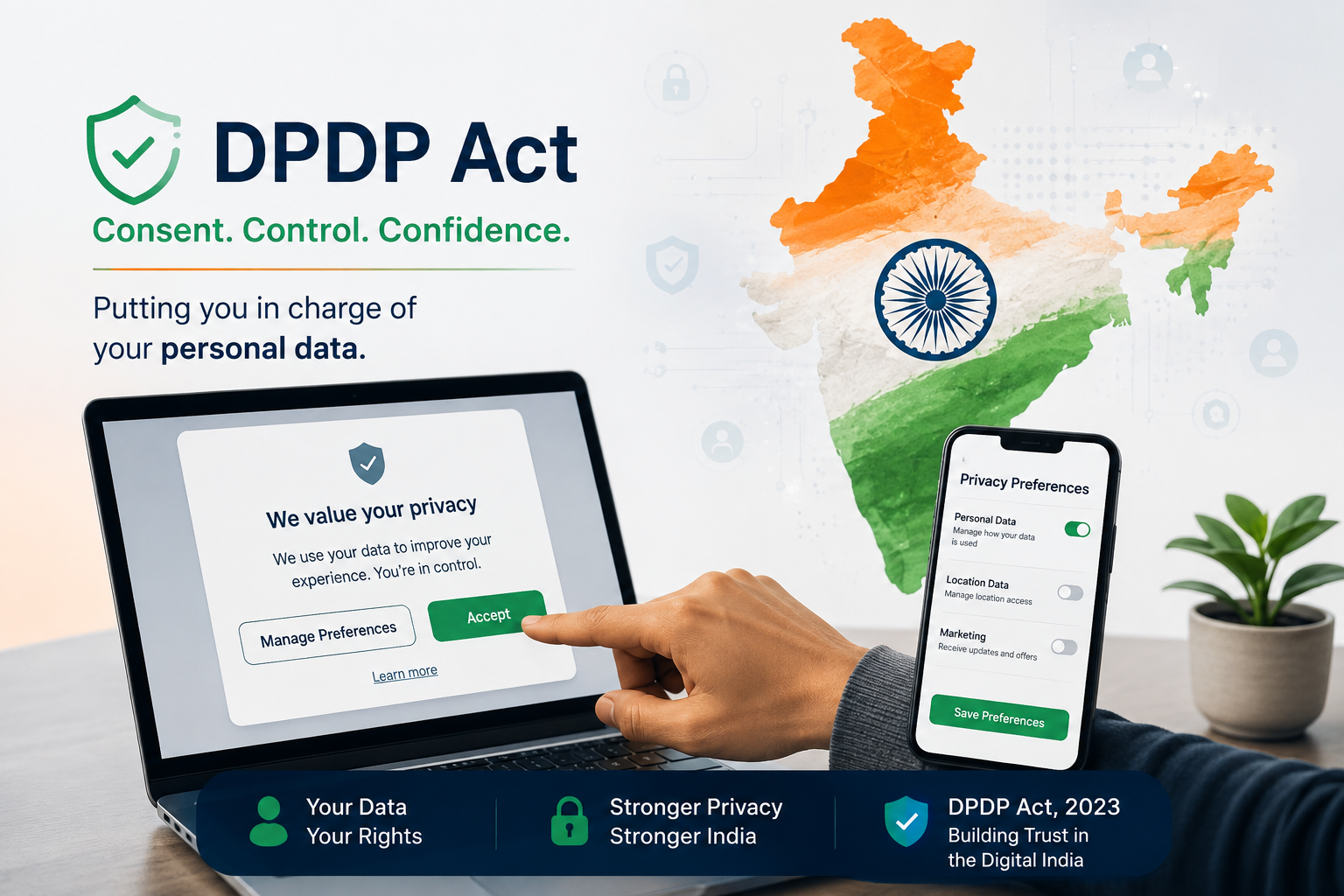

Think about how much a telecom company knows about one customer. It knows who they call, when they call, where their phone sits at midnight, what they browse, how much they spend, and who pays their bill. Now multiply that by hundreds of millions of subscribers. That is why the Digital Personal Data Protection Act, 2023 lands harder on telcos than on almost any other sector, and why a consent management platform has become a core piece of telecom infrastructure rather than a side project for the legal team.
This guide is for the people who have to make it work. If you run technology, compliance or customer data at a telecom operator, an internet service provider or a telecom-adjacent digital business, you will find a practical view of what DPDP expects, where telecom consent gets messy, and how to build something that holds up when the Data Protection Board asks for proof.
Why Telecom Is the Hardest DPDP Case
Most industries collect data at a few clear points: a sign-up form, a checkout page, a mobile app. Telecom is different. A single subscriber relationship touches a retail store, a dealer counter, an app, a call centre, a network probe, a billing engine, a marketing platform, and a dozen partners. Each of those touchpoints can capture or use personal data.
Two things make the telecom sector unusually exposed.
First, the data is intimate. Location trails and call patterns can reveal where a person lives, who they meet and how they live. Regulators tend to treat that kind of data with extra caution, and courts will too.
Second, the scale is enormous, and one person may hold a prepaid SIM, a broadband plan and a family bundle under different accounts, so consent has to follow the person, not the product. A consent error that would be a small bug at a start-up becomes a systemic failure when it repeats across millions of records.
What DPDP Actually Asks of a Telecom Operator
Under the DPDP Act, a telecom company is a data fiduciary. That means it decides why and how customer personal data gets processed, and it carries the legal duties that come with that role. Let’s translate the law into telecom language.
Consent must be free, specific, informed and unambiguous
Your customer must understand what they are agreeing to, and they must agree to a defined purpose. A single “I accept everything” tick box covering network operations, marketing, analytics and partner sharing does not meet that bar. Each purpose needs its own clear ask, written in plain language.
Notice comes before consent
Before you ask, you have to tell. The notice should explain what data you collect, why you collect it and how the customer can withdraw consent or complain. For telecom, that notice may need to appear in several languages, since your subscribers speak many of them.

Withdrawal must be as easy as giving consent
This is the clause that catches most operators off guard. If a customer can opt in by pressing a button in your app, they should be able to opt out with the same effort. Sending them to a store or a call centre queue to undo a choice they made in seconds is exactly the kind of imbalance the law targets.
Some processing does not need consent
The Act recognises certain legitimate uses, such as processing needed to meet a legal obligation or to respond to a medical emergency. Telecom operators handle many legally mandated activities, including subscriber verification and lawful record keeping. Your team needs to know which processing rests on consent and which rests on another lawful ground, and it needs to document that split. Guessing is risky, because relying on consent for something you must do anyway, or skipping consent for something optional, can both create problems.
Customers get enforceable rights
Data principals can ask to access their data, correct it, erase it, and seek grievance redress. They can also nominate someone to exercise these rights if they die or become incapacitated. Each request has a response clock, and volumes will climb once customers realise they can ask.
Breaches trigger notification duties
If personal data is compromised, you must inform both the Data Protection Board and the affected individuals. Your incident response process and your consent records need to talk to each other, because you cannot tell customers what was exposed unless you know exactly what you held and why.
Where Telecom Consent Actually Lives
Before you can manage consent, you have to find it. Ask a telecom team where customer consent is recorded, and you will often get five different answers. That is the real starting point of every DPDP programme.
Here are the places consent tends to hide.
Retail and dealer channels. Paper forms, tablet-based activation flows and scanned documents. These often capture consent as a signature on a long form, which rarely maps to specific purposes.
Mobile apps and web portals. Self-care apps capture permissions for contacts, location, notifications and marketing. These live in app code, in app-store permission dialogs and in privacy screens that were designed at different times by different teams.

Call centres and IVR. Agents often record verbal consent, or customers press a key to opt in to a promotion. Those signals may end up in a call recording, a CRM note or nowhere at all.
Marketing platforms. SMS engines, email tools, push notification systems and outbound dialers each keep their own opt-in lists. They rarely agree with one another.
Partner and value-added services. Content bundles, digital wallets, insurance offers and enterprise integrations all involve data sharing with third parties. Consent for those flows often sits in a partner contract rather than in a customer record.
When consent lives in seven places, nobody can answer a simple question: what has this customer agreed to, right now? A consent management platform exists to answer that question in one place, in real time, with proof.
The Telecom Twist: DPDP Is Not the Only Rulebook
Telecom operators do not get to think about DPDP alone. Sector rules already shape how you handle customer data and communications. The Telecommunications Act, 2023, licence conditions issued by the Department of Telecommunications, and TRAI’s regulations on commercial communications all sit alongside the DPDP Act.
TRAI’s framework on unsolicited commercial communications, for instance, already requires a register of customer preferences and consents for promotional messages and calls. Operators run preference registers and consent acquisition processes to comply with it.
This overlap creates two real risks.
The first is duplication. If one system tracks your telecom regulatory consents and another tracks your DPDP consents, customers end up with conflicting settings. Someone opts out of promotions in one place and keeps receiving them because another list never got the update.
The second is confusion about which rule wins in a given case. Some obligations, such as record keeping required by licence conditions, may limit what you can erase. DPDP recognises retention that the law requires. Your team needs a clear map of which data you must keep, for how long and under which rule, so that an erasure request gets handled correctly rather than ignored or over-applied.
Managing Consent Across Customer Data and Services
Here is where telecom gets practical. Let’s walk through how consent should work across the main service lines and data types.
Mobile services: prepaid and postpaid
A mobile subscriber generates identity data at activation, usage data every day and location data constantly. Some of this processing rests on legal obligations and contractual necessity. Some of it, such as personalised offers or third-party analytics, needs explicit consent.
The trick is to separate the two clearly in your systems. Tag every processing purpose as consent-based or not. Then make sure the consent-based ones can be switched off per customer without breaking the service itself.
Broadband and fixed services
Home broadband brings household-level complexity. The account holder may not be the only user. Router-level data, device information and browsing-related metadata can touch several people in one home.
Your notice needs to make clear who is being asked for consent and about what. Your records need to reflect that the account holder consented for themselves, and that you have thought about other household members where relevant.
Digital apps, wallets and bundled services
Many operators now run apps, payments, entertainment and financial products on top of connectivity. These are separate purposes that often involve separate partners.
A customer who agreed to receive your network offers has not agreed to share data with an insurance partner. Each new purpose needs its own consent, its own record and its own withdrawal path.
Marketing and personalisation
This is the area where consent is most clearly required, and where mistakes are most visible. Every SMS, call, email and push message needs a link back to a valid, current consent. If a customer withdraws, that signal must reach every marketing tool quickly. A consent management platform acts as the single source of truth those tools check before they send anything.
Why Spreadsheets, Banners and Custom Builds Struggle
Many telcos begin by trying to stretch what they already have. It is understandable. It is also where the trouble starts.
Cookie banners solve a web problem, not a telecom problem. A banner captures consent on a website. It does nothing for a SIM activation at a dealer counter or a verbal opt-in on a support call.
Database logs can be edited. A standard table can be changed by an administrator, by a faulty script or by a bad actor. When a regulator asks you to prove what a customer agreed to on a specific date, “our database says so” is a thin answer.
Withdrawal rarely propagates. Turning off a toggle in the app is easy. Making sure the billing system, the marketing tool, the data lake and three partners all stop processing is the hard part.
What a Consent Management Platform Should Do for a Telecom Operator
Not every consent management platform suits a telecom environment. Volume, integration depth and audit strength matter more here than they do for a small website. When you evaluate options, look for these capabilities.
Purpose-wise consent capture. The platform should let you define each processing purpose separately and capture a distinct, plain-language consent for each. Blanket toggles do not survive scrutiny.
Multi-channel capture. It should collect consent through apps, web portals, retail tablets, IVR and call centre tools, and store all of it in one record per customer.
A real-time consent state. Every downstream system, from marketing engines to analytics pipelines, should be able to check a customer’s current consent before processing. That check has to be fast enough to run inside live workflows.
Symmetrical withdrawal. Withdrawing consent should take the same effort as giving it, and the withdrawal should trigger updates across connected systems automatically.
Tamper-evident audit logs. Every grant, change and withdrawal should be recorded in a way that shows if anyone altered it later. This is the evidence you will lean on if a regulator or a customer challenges you.
Rights request automation. Access, correction and erasure requests should route to the systems holding the data, with deadlines tracked. They should not sit in an inbox.
Breach workflow integration. When something goes wrong, your team should be able to see which customers and which purposes were affected, and generate the notifications the law requires.
Room for the Consent Manager ecosystem. The Act envisions registered Consent Managers who let individuals manage consents across many businesses from one place. Your consent management platform should be built on open interfaces so it can connect with that ecosystem as it matures.
Use that list as a scorecard when you run a proof of concept. Ask vendors to demonstrate each item with your own systems.
How SecureCMS Fits a Telecom Environment
SecureCMS by SecureDApp is a consent management platform built around the DPDP Act’s consent lifecycle. It was designed to treat consent as an auditable data object rather than a banner, which is exactly the shift telecom operators need.
A few things make it relevant for telecom teams.
Purpose-mapped consent. You define each processing purpose, and customers give or withdraw consent for each one on its own. That lets you separate network operations from marketing, marketing from analytics, and analytics from partner sharing.
Tamper-evident consent logs. SecureCMS records consent events in a cryptographically verifiable way, drawing on SecureDApp’s blockchain security background. If someone asks you to prove what a subscriber agreed to on a given day, you can show a record that has not been altered since it was created. In a sector where a single dispute can involve millions of records, that level of proof carries real weight.
Rights fulfilment workflows. Access, correction and erasure requests move through defined workflows, so your teams can meet response timelines without chasing emails.
Integrated breach workflows. Breach notification sits inside the same system that knows what you hold and why, so compliance teams do not have to stitch together separate tools during an incident.
Built to connect. SecureCMS follows an API-first approach, which helps it plug into billing systems, CRMs, marketing engines and partner platforms, and prepares it for integration with the wider Consent Manager framework as that develops.
To be clear about scope, no software makes an organisation compliant on its own. A consent management platform gives you the infrastructure, the records and the workflows. Your people still own the policies, the purpose definitions and the decisions. SecureCMS is there to make those decisions enforceable and provable.
A Practical Rollout Plan for Telecom Teams
Telecom programmes fail when they try to fix everything at once. A phased approach works better. Here is a sequence that many teams find realistic.
Phase one: discover and map (first 30 days)
Start by cataloguing every place customer data enters and moves through your business. List each system, each partner and each processing purpose. Mark which purposes rely on consent and which rest on another lawful ground. This is tedious work, and it is the foundation for everything else.
Involve engineering, legal, marketing, customer care, network operations and security from day one. Consent touches all of them, and a consent management platform chosen by one team alone tends to stall.
Phase two: choose and design (days 30 to 60)
Shortlist platforms using the scorecard above. Run a proof of concept against one real journey, such as a mobile app opt-in and withdrawal, and measure how quickly the consent state reaches your marketing engine.
At the same time, redesign your notices in plain language and test them in more than one language.
Phase three: integrate the high-risk flows first (days 60 to 90 and beyond)
Start with marketing communications, because that is where consent is clearest and mistakes are most visible. Next, tackle partner data sharing and app permissions. Plan deep legacy integrations early, because they take the longest.
Phase four: automate rights and rehearse incidents
Connect access, correction and erasure workflows to the systems holding data. Then run a tabletop breach exercise using the real workflow. You want to discover the gaps in a rehearsal, not during an actual incident.
Conclusion: Consent Is Now Part of the Network
Telecom operators have always built infrastructure that customers never see. Consent now belongs on that list. It sits quietly behind every call, every data session, every offer and every partner integration, and when it works, nobody notices. When it fails, everybody does.
The operators who handle this well will treat consent as a living record tied to each customer and each purpose. They will map their data honestly, separate consent from other lawful grounds, make withdrawal genuinely easy and keep evidence that cannot be quietly rewritten. A well-chosen consent management platform makes all of that possible at telecom scale.
With substantive DPDP obligations arriving in full from May 2027, the window to build calmly is open, but it will not stay open. If your team wants to see how SecureCMS would map to your service lines, your channels and your partner landscape, talk to the SecureCMS team. They work with regulated, high-volume businesses to design consent flows that match DPDP requirements and stand up to real scrutiny, well before a customer complaint or a Board inquiry forces the conversation.
Frequently Asked Questions
1. Does the DPDP Act apply to telecom companies?
Yes. Any organisation that decides why and how it processes the personal data of individuals in India is a data fiduciary under the DPDP Act, and telecom operators clearly fall into that group. They carry the core duties of notice, valid consent, security safeguards, rights fulfilment and breach notification, and telecom-specific laws apply alongside the Act.
2. Why does a telecom company need a consent management platform?
Telecom consent is spread across retail stores, apps, call centres, marketing tools and partner systems. A consent management platform brings all of it into one record per customer, captures consent for each purpose separately, passes withdrawals to connected systems and keeps a verifiable audit trail. Without that central layer, operators struggle to prove what a customer agreed to or to honour a withdrawal across every system that touches the data.
3. Does every kind of telecom data processing need customer consent?
No. The DPDP Act allows certain legitimate uses without consent, such as processing needed to meet a legal obligation. Optional activities such as personalised marketing and third-party data sharing generally need consent. Document each purpose, record its lawful ground and confirm the split with legal counsel.
4. How should telecom operators handle consent withdrawal?
Withdrawal must be as easy as giving consent. If a customer opts in with one tap in your app, they should be able to opt out with the same effort. Operationally, the withdrawal must also reach every system using that data, including marketing engines, analytics platforms, billing tools and partners. A consent management platform that keeps a real-time consent state lets each system check before it processes anything, which is how withdrawal works end to end rather than only on the screen.
5. When do telecom companies need to be ready for DPDP compliance?
DPDP enforcement is phased. The substantive obligations for data fiduciaries apply in full from May 2027, and the framework for registered Consent Managers begins earlier in the rollout. Operators should not wait, because mapping data and integrating consent across legacy systems takes many months.