
Your next campaign is probably already scheduled. The list is loaded, the creative is approved, and the send button is one click away. But here is a question worth asking before you press it: can you prove, record by record, that every person on that list agreed to hear from you? For many Indian marketing teams, the honest answer is no. That gap is exactly where DPDP compliance begins, and it is why this guide exists.
The Digital Personal Data Protection Act, 2023 treats every email address and mobile number as personal data. Consequently, every campaign you run is a data processing activity. Marketing is no longer just a creative function, because DPDP compliance now shapes every send. It is a compliance function too.
Let’s walk through what DPDP compliance means for email, SMS, and WhatsApp, channel by channel, with practical steps you can use this quarter.
Why DPDP Compliance Lands on the Marketing Desk First
Legal teams write policies, but DPDP compliance is won or lost where data is collected. Marketing teams, however, collect the data. Think about how much personal information flows in through your funnel every single day: sign-up forms, webinar registrations, lead magnets, checkout pages, contest entries, and app onboarding screens. Each one captures a name, a phone number, an email address, or all three.
Therefore, the people closest to the data carry the most day-to-day risk. A privacy policy sitting in the website footer does not protect you if your campaign tool is mailing people who never agreed to it.

Moreover, marketing has a unique problem: speed. Campaigns launch fast, lists get merged, and agencies get access to exports. As a result, consent can get lost somewhere between the form and the send. DPDP compliance asks you to slow down at precisely that point and ask one simple question: what exactly did this person agree to?
DPDP Compliance Treats You as a Data Fiduciary
Under the Act, any business that decides why and how personal data is processed is a data fiduciary. That label sounds technical, but the meaning is simple. If you decide to email, text, or message someone, you carry the responsibility.
Furthermore, the burden of proof sits with you. If a complaint reaches the Data Protection Board, you must show that valid consent existed. Saying “we think they opted in” will not hold up.
Timelines Matter, but Waiting Is a Trap
Enforcement under the DPDP framework is phased, with the full substantive obligations expected to apply from May 2027. Some teams read that date and relax about DPDP compliance. That is a mistake.
Here is why. DPDP compliance infrastructure takes months to build, test, and connect to your campaign tools. Similarly, cleaning a legacy list for DPDP compliance takes longer than anyone expects. Teams that start now will walk into 2027 calmly. Teams that wait will be rebuilding under pressure.
What DPDP Compliance Requires for Valid Consent in Marketing
Before we dive into channels, we need a shared definition. The Act requires consent to be free, specific, informed, unconditional, and unambiguous. It must also be given through a clear affirmative action. Let’s translate that into marketing language.
Free and Unconditional
People must not be forced to accept marketing in order to get something unrelated. For example, you cannot make “send me promotions” a mandatory tick-box just to download an invoice. Similarly, a pre-ticked box is not a clear affirmative action.
Specific and Itemised
Consent must map to a purpose. “Email me offers” and “share my number with partners” are two different purposes. Therefore, DPDP compliance means offering two different choices. A single “I agree to everything” button breaks DPDP compliance and is the pattern regulators are most likely to challenge first.
Informed and Understandable
The notice must tell people what you collect and why. Besides that, it must explain how they can withdraw consent and how they can complain to the Board. The language matters too. The Act expects notices to be available in English or in any of the languages listed in the Eighth Schedule of the Constitution. For a brand serving users in Tamil Nadu, West Bengal, or Maharashtra, that is a real design requirement, not a footnote.
Easy to Withdraw
This is the part that surprises most marketers. The Act says withdrawal must be as easy as giving consent. In other words, if someone joined your list with one tap, they must be able to leave with one tap. Hiding the exit three menus deep is no longer just poor UX. It is a compliance risk.
Email Campaigns and DPDP Compliance: Where Old Habits Die Hard
Email feels familiar, which is exactly why it is risky. Many teams still rely on habits built over a decade: bought lists, scraped addresses, and “soft opt-in” assumptions borrowed from other regions. Those habits need to change if you want real DPDP compliance.
Stop Treating a Purchase as Permission
Someone buying a pair of shoes agreed to the purchase. They did not necessarily agree to a weekly newsletter. Consequently, you need a separate, clearly worded marketing consent at checkout, unchecked by default.
Separate Transactional From Promotional
Order confirmations, password resets, and invoices serve a different purpose from promotions. However, many teams blend them. A “your order has shipped” email that also carries a discount banner can blur the line. Therefore, keep these streams clean, and track consent for each one separately.
Rethink the Unsubscribe Link
A tiny grey link in the footer is the classic dark pattern. Instead, make the unsubscribe option visible and instant. Better still, offer preference choices: weekly digest, product updates, offers only. Many people will pick a lighter option rather than leave entirely. That is good for compliance and good for retention.
Watch Your Agencies and Tools
Your email platform, your CRM, and your agency each act as a data processor. In addition, every one of them needs to respect consent status. If someone withdraws in your CRM but your email tool still holds an old export, you have a gap. We will return to this problem shortly, because it is the hardest part of the whole puzzle.
SMS Campaigns and DPDP Compliance: Short Messages, Long Obligations
SMS looks simple. One hundred and sixty characters, one link, one call to action. Nevertheless, DPDP compliance for SMS carries a layered set of obligations in India.
Two Rulebooks, One Message
Commercial SMS in India already operates under telecom rules on registered headers, templates, and customer preferences. DPDP compliance sits on top of those rules rather than replacing them, so treat it as an added layer. As a result, a message can be perfectly formatted for the telecom ecosystem and still lack valid data protection consent.
For example, a registered template does not prove that the recipient agreed to marketing. Likewise, a “do not disturb” scrub does not replace a consent record. Both layers matter, and a mature marketing team checks both.
Capture Consent Where It Happens
Many SMS lists begin in unusual places: store counters, event badges, missed-call campaigns, and paper forms. Each of these is a consent moment, and each one is a weak link. If a store executive types a number into a tablet, who recorded the consent? What notice did the customer see?
Therefore, build a digital consent step into every offline touchpoint. A short QR code, a clear notice, and a recorded opt-in will serve you far better than a spreadsheet of numbers nobody can explain.
Keep Purposes Honest
A number collected for delivery updates cannot quietly become a promotional contact. Moreover, a number collected for a loyalty programme cannot be passed to a partner brand without a specific choice. Purpose limitation is the quiet backbone of DPDP compliance, and SMS is where it gets tested most often.
WhatsApp Campaigns and DPDP Compliance: The Channel That Feels Personal
WhatsApp has become the favourite channel for Indian brands. Open rates are high, conversations feel natural, and customers respond. However, that closeness cuts both ways. A promotional message landing next to a message from someone’s family feels intrusive when it is unwanted.
Platform Rules and Legal Rules Work Together
WhatsApp’s own business messaging policies already expect businesses to collect opt-in before sending messages. In addition, DPDP compliance requires that the opt-in meet the Act’s standard for valid consent. Consequently, a vague “keep me updated” checkbox may satisfy neither.
So what should a proper WhatsApp opt-in contain? At a minimum, it should state that the person will receive messages on WhatsApp, describe the type of messages, and make the choice unbundled from other consents. Furthermore, it should be recorded with a timestamp and the exact wording shown at that moment.
Conversations Create Data Too
Here is a detail many teams miss. A two-way chat creates personal data every time a customer replies. That includes phone numbers, names, addresses, preferences, and sometimes sensitive details shared casually. Therefore, your retention rules should cover chat logs, not just database tables.
Similarly, if a customer asks you to stop messaging them, that request must travel everywhere. The chatbot, the broadcast tool, and the support inbox all need to know. Otherwise, one team honours the request while another team messages the customer again the next morning.
Click-to-WhatsApp Ads Need Care
Ads that open a WhatsApp conversation are powerful. Nevertheless, the click is not the consent. Once the chat begins, you should still present a clear notice and ask for permission before adding that person to broadcast campaigns. A simple first reply with a plain-language choice does the job well.
The Withdrawal Problem: One Opt-Out, Every Channel
If you take only one idea from this guide, take this one. Withdrawal is not a button. It is a signal that must travel across your entire stack.
Imagine a customer who unsubscribes from your emails on Monday. On Tuesday, they receive an SMS offer. On Wednesday, a WhatsApp broadcast arrives. From their point of view, you ignored them three times. From a regulator’s point of view, you may have processed their data after consent was withdrawn.
Why Channels Drift Apart
Most marketing stacks grow one tool at a time. Email lives in one platform, SMS in another, and WhatsApp in a third. Meanwhile, the CRM sits in the middle, loosely synced. Each tool keeps its own opt-out list. Consequently, a withdrawal in one place rarely reaches the others in real time.
The Fix: A Single Source of Truth for Consent
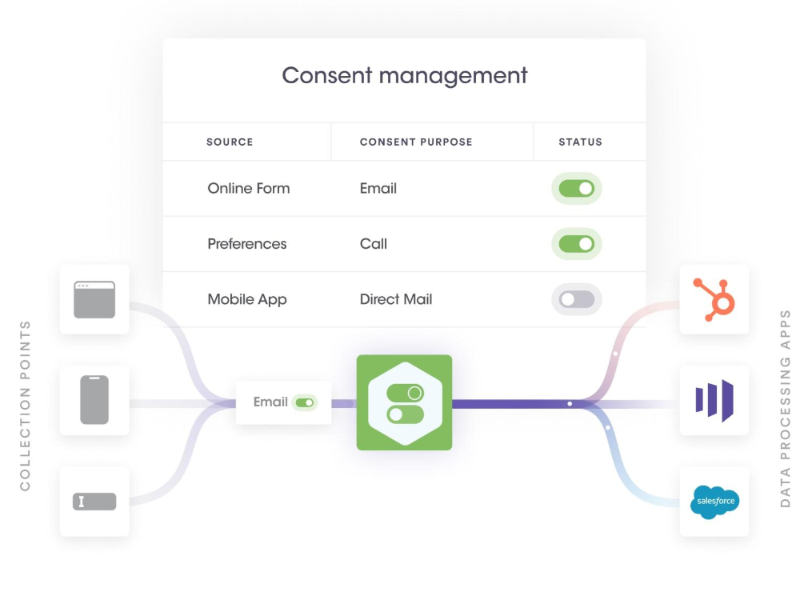
The cure for DPDP compliance gaps is architectural. Instead of letting every tool store its own idea of consent, create one central consent record. Every channel then checks that record before it sends anything. When a person withdraws, the record changes once, and every tool sees the change.
This approach has a bonus. It makes your marketing smarter, because you finally know who has agreed to what. Furthermore, it reduces wasted sends, which protects your sender reputation and your budget.
Your Legacy List Is a Liability Until Proven Otherwise
Every marketing team has one. A huge list, years old, built from forms, events, partnerships, and acquisitions. It feels like an asset. Under DPDP compliance rules, however, it is an open question.
The Act makes a distinction here. Where someone gave consent before the law applied, the business is expected to give them a notice as soon as reasonably practicable, and they can withdraw that consent. In plain terms, you cannot simply assume that old permission remains valid forever.
A Practical Way to Audit Your List
Start by segmenting. First, identify records with clear, documented consent, including when and how it was given. Next, find records with partial or unclear consent. Finally, isolate records with no trace of consent at all.
Then act on each group differently:
- Documented consent: Keep them, and send the required notice so they know their rights.
- Partial consent: Run a re-permission campaign with a clear, itemised choice.
- No evidence: Pause marketing to these contacts until you can establish a valid basis.
Yes, your list may shrink after a DPDP compliance clean-up. However, a smaller list of willing people will outperform a bigger list of annoyed ones. Engagement rates, deliverability, and conversion all tend to improve when everyone on the list actually wants to be there.
Do Not Forget Data You No Longer Need
DPDP compliance also expects you to erase personal data once its purpose is complete, unless the law requires you to retain it. Therefore, add a retention schedule for dormant contacts to your DPDP compliance plan. A subscriber who has not opened anything in two years rarely needs to stay in your system.
Proof, Not Promises: Why Audit Trails Matter
Let’s return to the burden of proof, because DPDP compliance changes how you should record consent. A checkbox that says “yes” in a database is a start. It is not a defence.
A regulator may ask: what did this person see? Which version of the notice was live? What time did they agree? Which purposes did they select? And has the record changed since? If your records live in a standard table that any administrator can edit, you cannot answer that last question with confidence.
What a Strong Consent Record Contains
A defensible record should capture the following:
- The person’s identifier and the channel
- The exact notice text and version shown
- The specific purposes accepted or declined
- The timestamp and the method of capture
- Every later change, including withdrawal
Moreover, the record should be tamper-evident. That means any alteration becomes detectable. When you can show a regulator a verifiable history, the conversation changes from “prove it” to “thank you, that is clear.”
How SecureCMS Helps Marketing Teams Stay Compliant and Fast
Everything above sounds like a lot of extra DPDP compliance work. Fortunately, it does not need to slow your campaigns down, provided the right infrastructure sits underneath them. That is where SecureCMS by SecureDApp comes in.
SecureCMS is a consent management platform that makes DPDP compliance part of the workflow, built around the DPDP consent lifecycle. Instead of retrofitting a cookie banner, it treats consent as a core, auditable data object. For marketing teams, that translates into several practical advantages.
Purpose-Wise Consent for DPDP Compliance on Every Channel
You can configure separate consent choices for email, SMS, and WhatsApp, and for distinct purposes within each. As a result, your sign-up forms, checkout pages, and app screens can all ask clearly, without bundling.
Withdrawal That Actually Travels
Because consent sits in one central record, a withdrawal can be reflected wherever your tools check it. Consequently, the Monday unsubscribe no longer turns into a Wednesday WhatsApp message.
Tamper-Evident Audit Trails
Every consent event, including grants, changes, and withdrawals, is logged in a cryptographically verifiable way. SecureDApp’s blockchain security background shows here. When a question arrives from the Board or from a customer, you have evidence rather than assumptions.
Rights Requests Without the Inbox Chaos
Access, correction, and erasure requests can follow structured workflows instead of landing in a shared mailbox. In addition, your compliance and marketing teams see the same status, which keeps everyone aligned.
To be clear, no tool replaces good judgment or legal advice. Nevertheless, the right platform makes good practice repeatable, and repeatable is what scales.
A Practical DPDP Compliance Checklist for Your Next Campaign
Let’s turn all of this into action. Before your next send, walk through these DPDP compliance steps.
- Map every collection point. List each form, event, app screen, and offline touchpoint that captures contact details.
- Rewrite your consent copy. Use plain language, separate purposes, and no pre-ticked boxes.
- Localise your notices. Offer them in the languages your audience actually reads.
- Split your streams. Keep transactional and promotional messaging separate, with separate consent.
- Centralise consent status. Make every channel check one record before sending.
- Make withdrawal effortless. Match the effort of opting out to the effort of opting in.
- Audit your legacy list. Segment, notify, and re-permission as needed.
- Brief your agencies. Share your consent rules, and confirm how they handle opt-outs.
- Test your response process. Run a mock rights request and time how long it takes.
- Review twice a year. Rules, guidance, and your own campaigns will keep evolving.
Conclusion: Consent Is the New Creative Brief
Great marketing has always been about earning attention, and DPDP compliance is built on the same idea. DPDP compliance simply makes that principle official. People who choose to hear from you open more, click more, and buy more. People who never agreed to hear from you do the opposite, and now they also create legal risk.
So treat consent as the first line of your creative brief. Capture it clearly, honour it instantly, and prove it whenever asked. Furthermore, build your DPDP compliance infrastructure now, while enforcement is still phasing in, rather than later, when deadlines press.
Your campaigns will be sharper, your lists healthier, and your brand more trusted. That is a trade worth making.
Frequently Asked Questions
1. Does DPDP compliance apply to my small business email list?
Yes. The Act applies based on the processing of personal data, not on the size of your company. Therefore, even a modest list of Indian customers needs valid consent, a clear notice, and a way to withdraw. Smaller teams can start with simple, well-recorded opt-ins and build from there.
2. Is an SMS or WhatsApp opt-in different from an email opt-in?
The legal standard for DPDP compliance is the same: free, specific, informed, unconditional, and unambiguous. However, each channel has its own context, such as telecom rules for SMS and platform policies for WhatsApp. As a result, you should capture channel-specific consent rather than assuming one opt-in covers everything.
3. What should I do with contacts collected before the Act applied?
Review them. Where consent was documented, send the required notice and respect any withdrawal. Where consent is unclear, run a re-permission campaign. Where no evidence exists, pause marketing to those contacts until you can establish a valid basis.
4. How quickly must I honour a withdrawal request?
The Act requires that withdrawal be as easy as giving consent, and processing based on that consent should stop within a reasonable time. In practice, you should aim for immediate effect across every channel. Check the current Rules and take legal advice for specifics that apply to your business.
5. Can one tool manage consent across email, SMS, and WhatsApp?
Yes, provided the tool acts as a central source of truth that every channel checks before sending. SecureCMS is designed for this approach, with purpose-wise consent, synchronised withdrawal, and tamper-evident audit logs.