

Keys unlock systems. But securing the keys themselves is what separates organizations that sleep soundly at night from those scanning logs at 3 AM. The cryptographic key management lifecycle is not abstract infrastructure. It is the operational backbone that determines whether your enterprise encryption actually protects data or merely creates the appearance of security.
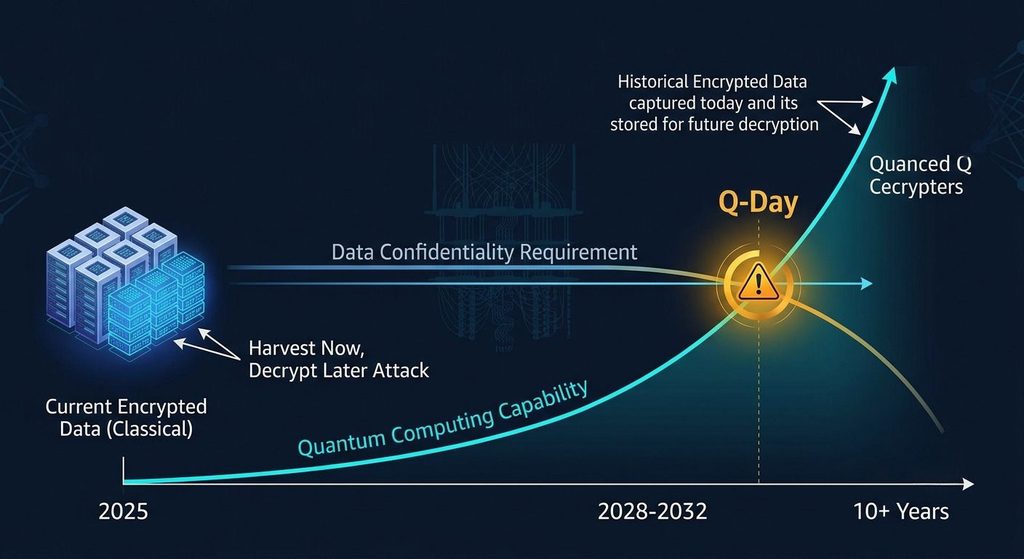
Most organizations treat key management as a checkbox, a configuration screen buried in their security platform, reviewed once during deployment and forgotten. The quantum computing threat has changed that calculus entirely. As quantum computers mature, the keys you generate today using conventional cryptography may become obsolete within the next decade. That timeline means the decisions you make about cryptographic key management lifecycle processes right now will directly determine whether your organization remains secure when quantum-capable adversaries emerge, or whether attackers harvest encrypted data today to decrypt it tomorrow.
This guide walks through every stage of the cryptographic key management lifecycle. From the moment a key is generated through its eventual destruction, we examine the technical requirements, the operational practices, and the strategic positioning needed to build a governance framework that works today and survives the quantum transition ahead.
Why the Cryptographic Key Management Lifecycle Matters More Than Ever
A century ago, cipher experts understood a simple truth: the security of an encrypted message depends entirely on the key used to create it. That principle has not changed. But the scale has. A modern enterprise does not use one key. It manages thousands: encryption keys for databases, signing keys for authentication, wrapping keys for key hierarchies, session keys for temporary communications, and backup keys for recovery scenarios.
Each one of those keys follows a lifecycle. It is born at generation. It lives through storage, distribution, and active use. It rotates, possibly multiple times. Eventually, it reaches end of life and requires secure destruction. A single failure at any of these stages creates operational or security risk.
The cryptographic key management lifecycle introduces three critical vulnerabilities that security leaders must address. First, key generation must produce genuinely random, unpredictable material. Weak randomness has toppled encrypted systems before. Second, keys in storage must remain confidential and integrity-protected even if someone gains access to the storage infrastructure. Third, key destruction must be verifiable and irreversible, not just deletion with the flag set to true in a database.
For organizations already managing traditional encryption infrastructure, these problems are complex. For organizations beginning to implement quantum-safe security and post-quantum cryptography solutions, the complexity compounds. The cryptographic key management lifecycle under quantum-safe security requires not just managing new key types, like ML-KEM and ML-DSA keys, but also managing hybrid encryption scenarios where classical and quantum-resistant keys coexist in the same infrastructure.
Quantum computing’s approach lies somewhere between distant threat and imminent operational challenge. Current quantum computers cannot break contemporary RSA or ECC encryption. However, NIST’s post-quantum cryptography standardization process concluded in 2022. Practical implementations of quantum-resistant algorithms are available now. Organizations that begin their quantum-safe migration in 2025 and 2026 are well positioned. Those that delay until quantum breakthroughs force the issue may find themselves rushing through implementation without the time to test properly.
Phase 1: Key Generation and the Foundation of Security
A cryptographic key is valuable only if it is truly random. The cryptographic key management lifecycle begins at generation, and the quality of that generation determines everything downstream.
Randomness and Entropy Sources
Key generation starts with entropy collection. Entropy is not merely randomness, it is uncertainty that an attacker cannot predict or influence. Most modern systems use a combination of hardware entropy sources and software randomness extraction algorithms. Operating systems collect entropy from hardware timings, disk I/O patterns, network activity, and dedicated entropy devices. This raw entropy feeds into a cryptographically secure random number generator.
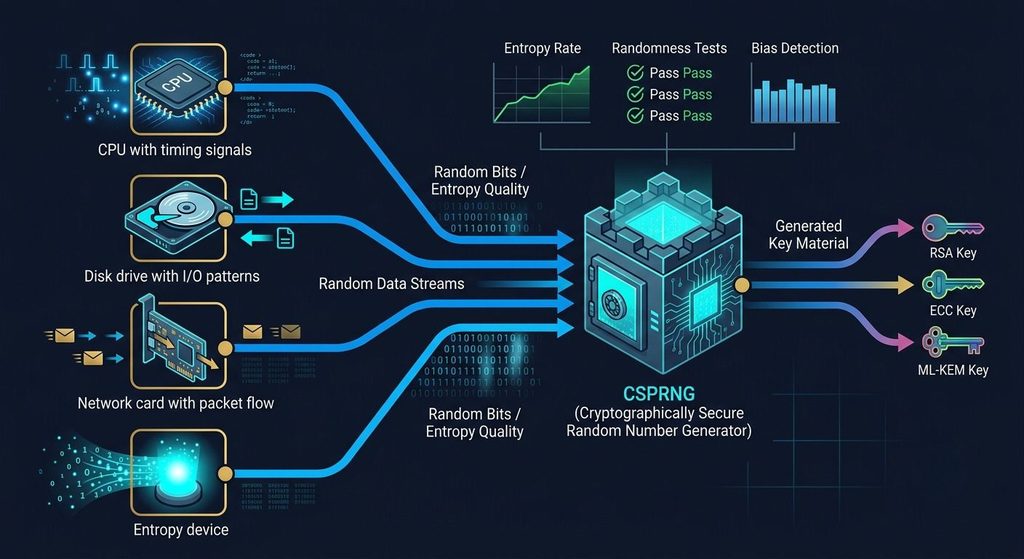
The challenge emerges when you scale. An enterprise generating thousands of keys per day needs reliable, high-throughput entropy. Entropy starvation creates chokepoints. Worse, weak entropy sources have historically been the Achilles heel in deployed systems. The Dual EC randomness standard, standardized by NIST and later discovered to contain a potential backdoor, shows how subtly weak randomness can enter production infrastructure.
Post-quantum cryptography implementations depend on entropy even more critically than classical systems. Algorithms like ML-KEM and ML-DSA are based on lattice mathematics. Their security depends on sampling from discrete Gaussian distributions. Poor entropy in sampling means poor security, even if the underlying math is sound.
Key Generation Standards and Algorithms
The cryptographic key management lifecycle currently supports multiple classical key types: RSA keys ranging from 2048 to 4096 bits, elliptic curve keys over standard curves like P-256 and P-384, and symmetric keys for AES encryption, typically 128, 192, or 256 bits.
Post-quantum cryptography adds new key types. ML-KEM, approved by NIST for key encapsulation, generates keys around 2400 bytes in size. ML-DSA, for digital signatures, generates keys around 2500 bytes. These larger keys require adjusted infrastructure assumptions. Traditional key databases designed for 256-byte keys may require schema changes.
Hybrid cryptographic approaches, combining classical and quantum-resistant algorithms, are becoming standard practice during the quantum-safe migration period. Hybrid key generation means generating both an RSA-4096 key and an ML-KEM key for the same purpose, using both in parallel for protection against both current threats and potential quantum attacks.
Secure Key Generation Workflows
Key generation must occur in an isolated, controlled environment. The most secure approach uses a Hardware Security Module, a tamper-resistant device dedicated to cryptographic operations. An HSM generates keys internally, never exposing the raw key material to surrounding systems. The device returns only the public key component or a wrapped, encrypted version of the key material.
Centralized HSM-based key generation reduces the attack surface. Keys never exist in unencrypted form outside the module. The HSM enforces policies: which algorithms may be used, minimum key sizes, logging of all generation events.
Decentralized key generation, where individual applications generate their own keys, is faster but operationally risky. Applications may use weak randomness, may fail to configure key attributes correctly, may not log generation events. The cryptographic key management lifecycle becomes fragmented across independent systems, each with its own procedures or lack thereof.
A secure hybrid approach uses decentralized key generation only for specific, short-lived purposes, with strict validation and immediate wrapping of generated material before it leaves the application context.
Phase 2: Key Storage and Confidentiality Protection
A key generated in perfect isolation means nothing if it is stored insecurely. Key storage is where the cryptographic key management lifecycle faces some of its greatest practical challenges, particularly at enterprise scale.
Storage Locations and Threat Models
Keys at rest exist in multiple places. They are stored on disk in backup systems. They exist in memory on servers performing cryptographic operations. They are stored in configuration systems, sometimes in encrypted vaults. Each location has different threat assumptions.
Disk storage requires encryption. A disk full of encrypted keys remains vulnerable if someone obtains both the encrypted keys and the encryption keys protecting them. This is why hierarchical key management exists. Master keys, also called key encryption keys, protect other keys. Master keys themselves must be protected by even more strictly controlled mechanisms.
Memory storage poses unique challenges. A key in RAM can be captured through memory dumps, physical memory attacks, or compromised applications. Cold boot attacks, where an attacker powers down a system, boots into a different operating system with physical memory access, and reads the memory contents, have recovered encryption keys from supposedly secure systems.
Hardware Security Modules address memory protection differently. An HSM performs cryptographic operations entirely within the module’s isolated processor and memory. The key never enters the host system’s memory. The host sends data to encrypt or decrypt to the HSM, which performs the operation and returns only the result.
Encryption and Wrapping Mechanisms
Keys stored on disk are encrypted using other keys. This raises the obvious question: what encrypts those encryption keys? The answer is hierarchical key management, often called key wrapping hierarchies.
At the top of the hierarchy sits a master key or root key. This key is the most sensitive and most restricted. In many organizations, the root key is split using Shamir secret sharing, divided among multiple custodians so no single person can access it. The root key wraps key encryption keys, which in turn wrap data encryption keys.
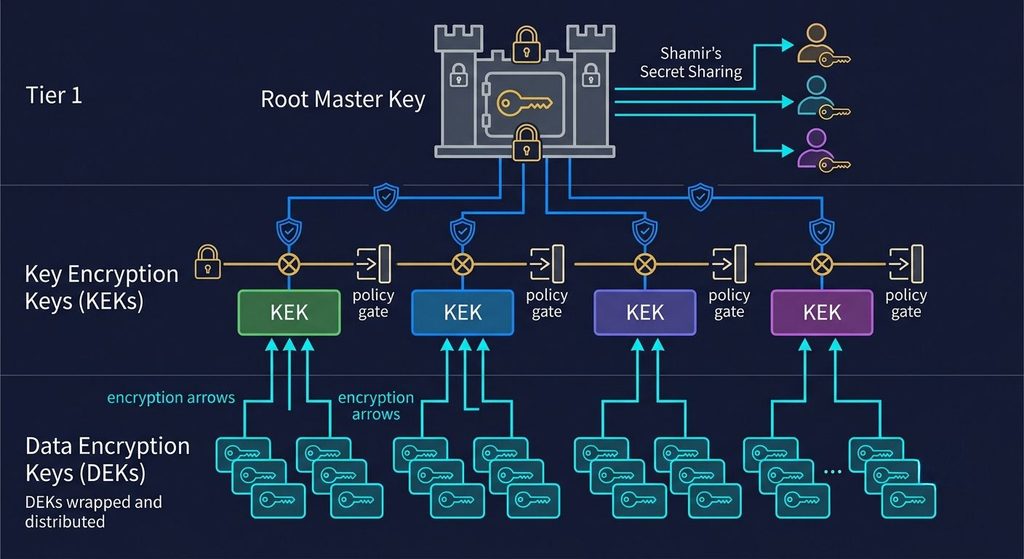
Each level of wrapping adds protection. A compromise at one level does not immediately expose all keys. An attacker who steals encrypted data encryption keys still cannot access them without the corresponding key encryption key. An attacker who steals key encryption keys cannot unwrap them without the root key.
Post-quantum cryptography complicates key wrapping. If a classical key encryption key wraps an ML-KEM key, and an attacker later decrypts the wrapping using quantum computation, the quantum-resistant key inside remains secure only if the ML-KEM key itself is quantum-resistant. Hybrid approaches typically wrap classical and quantum-resistant keys separately, or use separate wrapping for different purposes.
Key Storage Infrastructure and HSM Deployment
Enterprise key storage almost always involves Hardware Security Modules. An HSM is a dedicated appliance that generates, stores, and uses cryptographic keys. The device is physically tamper-resistant, with sensors that detect physical attacks and erase keys if tampering is detected. It has a separate, isolated network connection. It supports clustering and replication for high availability.
On-premises HSM deployment gives organizations direct physical control. The devices sit in locked data center cages. Access is restricted. However, on-premises means capital expenditure, ongoing maintenance, and operational complexity.
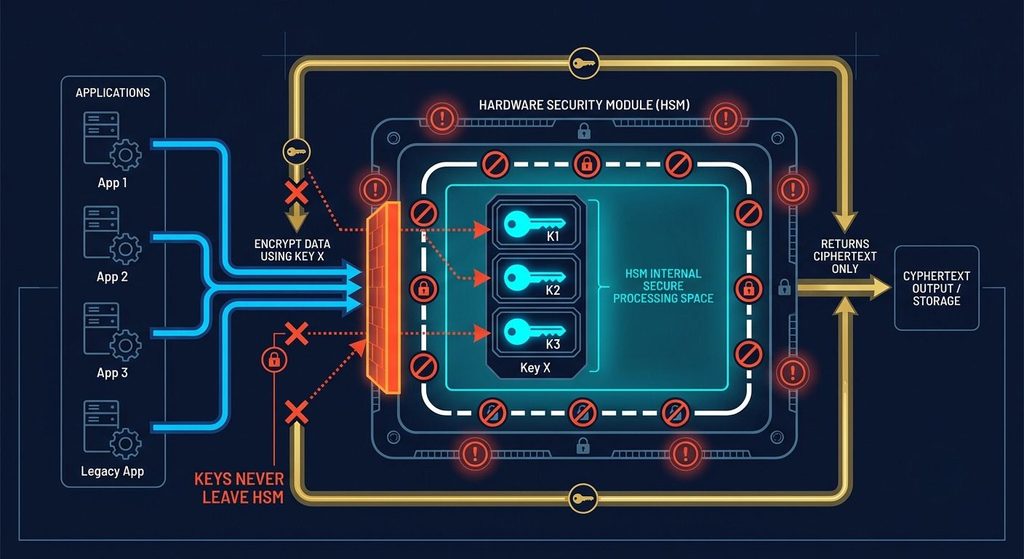
Cloud-based HSM services, sometimes called managed HSMs, offer different tradeoffs. A cloud provider manages the physical infrastructure. The organization’s keys never leave the cloud environment. The keys are accessible only through authenticated API calls. However, cloud HSM adoption requires trust in the cloud provider and compliance with data residency requirements if applicable.
Multi-cloud key management adds additional complexity. Organizations using multiple cloud providers need consistent key management across them. This typically requires either replicating keys across HSMs in different clouds, with associated synchronization overhead, or using a centralized key management system that coordinates key access across multiple clouds while keeping master keys isolated.
Phase 3: Key Distribution and Access Control
Keys at rest mean nothing if applications cannot access them when needed. Key distribution is the process of getting the right key to the right application at the right time while maintaining strict access controls.
Key Distribution Mechanisms
Direct key distribution, where a key is copied from HSM storage to an application server, is simple but creates security vulnerabilities. The key is exposed during transfer. It is exposed while in memory on the application server. It is exposed in backups of the application server.
Better approaches use key references or wrapped keys. Instead of distributing the key itself, the system distributes a reference, perhaps a key identifier or a wrapped version of the key. The application server cannot use the key directly. Instead, it sends requests to a key server or HSM: “Encrypt this data using key ABC.” The HSM performs the operation and returns only the result.
Wrap and unwrap patterns are standard in HSM deployments. An application requests a key from the HSM. The HSM generates or retrieves the key and returns it in wrapped form, encrypted under a wrapping key that the application possesses. The application can store the wrapped key locally, even in logs or configuration files, without security risk. When the key is needed, the application sends the wrapped key back to the HSM along with the wrapping key, and the HSM unwraps it internally to perform the operation.
Key rotation during distribution adds complexity. If a key is being rotated, new data must be encrypted with the new key. Old data encrypted with the old key must eventually be re-encrypted with the new key, or the old key must be retained indefinitely for decryption. Distribution systems must track which version of a key was used to encrypt each piece of data.
Cryptographic Agility and Algorithm Migration
Cryptographic agility is the ability to rapidly switch from one cryptographic algorithm to another. The quantum-safe migration is the most obvious example: the ability to migrate from RSA-4096 to ML-KEM-1024 without major infrastructure changes.
Agility requires that keys be tagged with algorithm and version information. It requires that encrypted data be tagged with the algorithm used to encrypt it so decryption systems know which algorithm to use. It requires that applications can support multiple algorithms simultaneously during the migration period.
A platform enabling cryptographic agility stores key metadata: the algorithm, key size, creation date, rotation schedule, intended purposes, and access permissions. When a key is requested, the metadata is evaluated. Policy engines check whether the requesting application is permitted to use that key. Version managers ensure the correct key version is provided.
Hybrid encryption, combining classical and quantum-resistant algorithms, is a practical example of needed cryptographic agility. Systems might encrypt data with both RSA-4096 and ML-KEM-1024, storing both ciphertexts. An attacker needing to decrypt must defeat both algorithms. If quantum computers emerge that break RSA-4096, the data is still protected by the ML-KEM ciphertext.
Policy Enforcement and PQC Gateway Architecture
Access control on keys requires policy definition and enforcement. Organizations define policies: which applications can use which keys, for what purposes, at what times, from which networks.
A PQC gateway, a cryptographic policy enforcement point, mediates all key access. Applications do not directly access HSMs or key storage. Instead, they contact the gateway. The gateway evaluates policies: Is this application authenticated? Is it authorized to use this key? Does its request match the intended purpose of the key? Are rate limits being respected?
The gateway also acts as an abstraction layer, abstracting away the details of whether the underlying keys are classical or quantum-resistant, single or hybrid. An application requests “encryption using key ABC.” The gateway manages whether key ABC is RSA, ML-KEM, or hybrid, presenting a consistent interface regardless.
Audit logging happens at the gateway. Every key access is recorded: which application, which key, which operation, when, from where. Audit trails enable security investigation and forensics if incidents occur.
Phase 4: Key Rotation and Lifecycle Management
Keys exist for defined periods. When a key reaches the end of its defined lifetime, it must be rotated. A new key is generated, and cryptographic operations switch to the new key. Old data encrypted with the old key must be managed: either re-encrypted with the new key or retained under the old key if re-encryption is not feasible.
Rotation Scheduling and Automation
Key rotation schedules are defined by policy. Encryption keys typically rotate annually or more frequently, depending on sensitivity and compliance requirements. Signing keys may rotate on longer schedules. Backup keys may rotate less frequently than operational keys.
Rotation must be automated to work reliably at scale. Manual rotation processes fail. A team member forgets to trigger rotation. A rotation script runs but fails silently. A new key is generated but not distributed to all applications.
Automated key management platforms execute rotation on schedule. New keys are generated automatically. Existing keys are marked for retirement. Applications are notified. Audit logs record the rotation. Compliance reports show which keys were rotated when.
Gradual rotation, where old and new keys coexist temporarily, is often more robust than immediate switchover. New data is encrypted with the new key. Decryption systems accept both old and new keys. After a grace period, systems stop accepting the old key, and re-encryption of remaining data is forced.
Re-encryption Strategies and Data Management
If keys are rotated, data encrypted with old keys must eventually be re-encrypted or deprecated. Re-encryption at scale is operationally complex. An organization with petabytes of historical data encrypted with old keys faces a significant effort to re-encrypt.
Some strategies defer the problem. Data is kept encrypted with the old key. The old key is retained in secure storage for backward compatibility. When the old key is eventually needed for decryption, it is accessed from long-term archival storage.
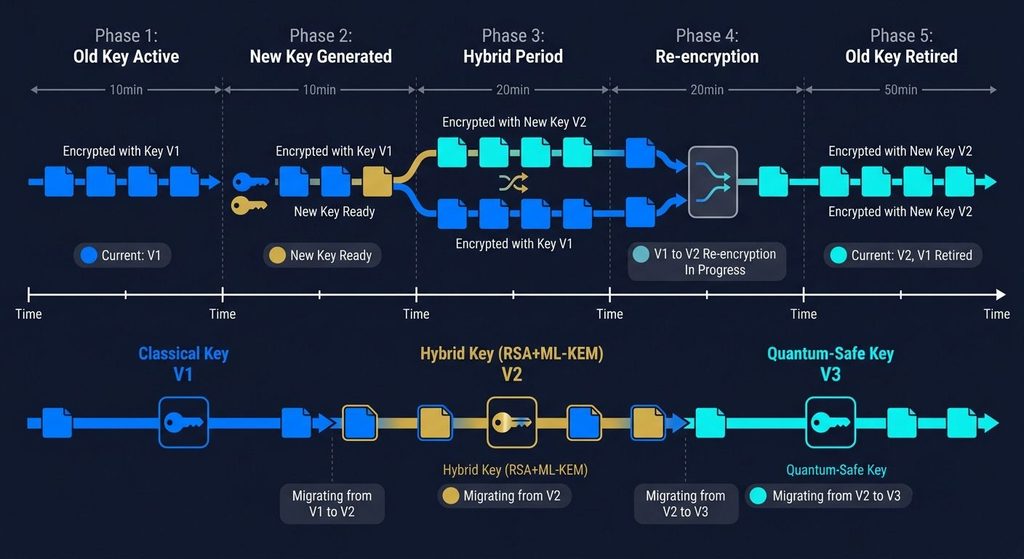
This strategy creates operational risk. If the old key is lost or becomes inaccessible, data encrypted with it becomes unrecoverable. The more attractive approach is proactive re-encryption. Data is decrypted with the old key, re-encrypted with the new key, and stored. The old key can then be securely destroyed.
Quantum-safe migration makes re-encryption urgent. Data encrypted with classical cryptography today should be re-encrypted with quantum-safe algorithms before quantum computers emerge. This is not a theoretical concern. Harvest now, decrypt later attacks, where adversaries collect encrypted data today with the intention of decrypting it after quantum computers are available, are plausible. Organizations holding sensitive data with long confidentiality requirements should prioritize quantum-safe re-encryption.
Post-Quantum Cryptography Integration in Rotation Workflows
Quantum-safe security requires that rotation workflows support both classical and post-quantum cryptography algorithms. During the migration period, organizations will be rotating classical keys out and quantum-safe keys in.
A hybrid rotation strategy uses both algorithms in parallel. New keys are hybrid, combining classical and quantum-resistant components. Old classical keys are phased out gradually. Data is re-encrypted with hybrid keys. Over time, classical-only keys disappear.
The cryptographic key management lifecycle becomes more complex during this transition. Systems must support multiple algorithms. Keys have algorithm and version metadata. Access policies may be algorithm-aware: classical algorithms for non-sensitive data, hybrid or quantum-safe for sensitive data.
Phase 5: Key Destruction and Irreversible Deletion
At the end of its lifecycle, a key must be securely destroyed. This is not a delete operation in a database. Secure destruction means ensuring the key cannot be recovered by any means.
Secure Destruction Techniques
Keys stored on disk require cryptographic destruction. The key material is overwritten with random data. Department of Defense standards specify overwriting multiple times. Some standards require cryptographic erasure, where encryption keys that protect disk keys are destroyed, making the disk keys inaccessible even if disk recovery techniques are used.
Keys in memory require immediate zeroization. Modern cryptographic libraries zero memory regions after use, overwriting key material with zeros before releasing the memory. This prevents keys from persisting in freed memory where they might be recovered by a subsequent memory allocation.
Keys in Hardware Security Modules are destroyed through secure deletion commands. The HSM erases key material from its non-volatile storage and its volatile memory. Modern HSMs support cryptographic erasure at scale, destroying multiple keys simultaneously.
Backup and redundant copies of keys must also be destroyed. If a key is backed up to tape, that tape must be destroyed when the key reaches end of life. If a key is replicated across multiple HSMs for high availability, all replicas must be destroyed.
Verification and Audit Trails
Destruction must be verifiable. An organization should be able to prove that a key was destroyed on a specific date. This requires audit logging. When a key destruction command is executed, the HSM or key management system records the event: which key, which administrator authorized it, when, what method was used.
Audit trails for destruction create accountability. If a key that was supposedly destroyed actually is recovered later, the audit trail shows what happened. Either the destruction command was never executed, or the destruction command failed. Neither scenario suggests the system is working correctly.
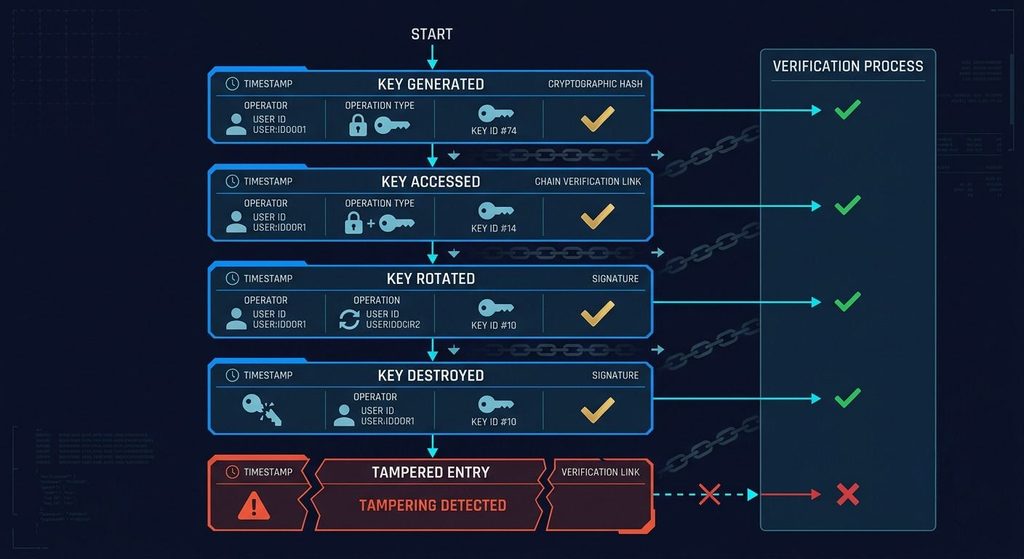
Compliance frameworks require proof of destruction. Organizations subject to HIPAA, PCI-DSS, or other standards must be able to demonstrate that keys protecting sensitive data were securely destroyed. Audit logs provide that evidence.
Regulatory and Compliance Implications
Key destruction policies differ by regulation and sector. Healthcare organizations storing patient data must be able to demonstrate destruction of keys protecting that data within defined timeframes. Financial institutions must manage key destruction to satisfy banking regulations. Organizations subject to GDPR must demonstrate destruction of encryption keys when data subject requests require data deletion.
The quantum-safe migration adds a layer of complexity. A key protecting data should not be destroyed until data is either destroyed or re-encrypted with a quantum-safe key. During the hybrid encryption period, organizations will maintain classical keys alongside quantum-safe keys, only destroying classical keys after re-encryption is complete.
PQC compliance requirements are still evolving. NIST published post-quantum cryptography standards in 2022. Implementation guidance is still being developed. Organizations building quantum-safe security now are establishing practices that will likely become mandatory requirements over the next five years.
Building an Enterprise Cryptographic Key Management Lifecycle: Operational Framework
Understanding the phases of the cryptographic key management lifecycle is necessary. Implementing it at enterprise scale requires integrated systems, policies, and processes.
Key Management Policies and Standards
Effective key management begins with documented policies. An organization should define: which algorithms are approved, minimum key sizes, key generation procedures, storage requirements, access controls, rotation schedules, destruction procedures, and compliance monitoring.
Policies should distinguish between different categories of keys. Master keys, the most sensitive, require the strictest controls. Key encryption keys require strong controls. Data encryption keys may have somewhat more relaxed controls, balanced against risk. Session keys used for temporary communications may require even lighter controls.
Policies should explicitly address post-quantum cryptography. When will quantum-safe algorithms be adopted? Which data requires quantum-safe protection now? What is the timeline for migrating classical keys to quantum-resistant equivalents? How will hybrid encryption be used during the transition period?
Crypto-Agility and PQC Migration Architecture
Crypto-agility, the ability to rapidly change cryptographic algorithms and key management strategies, is increasingly essential. Organizations should design systems with algorithm abstraction. Applications do not assume algorithms. Instead, they request operations: “Encrypt this data,” with policy determining which algorithm is used.
A PQC solution providing cryptographic agility enables organizations to deploy quantum-safe encryption incrementally. Some systems may switch to post-quantum cryptography before others. Hybrid encryption can protect most sensitive data while classical algorithms continue protecting less sensitive information.
Key management platforms supporting cryptographic agility maintain algorithm version information. When data is encrypted, the algorithm is tagged. When data is decrypted, the tagged algorithm determines which key type and algorithm is used. This enables seamless switching as algorithms are phased in or out.
Audit Logging and Compliance Monitoring
Audit logs are the evidence trail. Every key operation should be logged: generation, storage, access, rotation, destruction. Logs should capture who performed the operation (if applicable), when, from where, which key, what purpose, and what the outcome was.
Compliance monitoring uses audit logs to detect violations. Policies define rules: “Keys should not be stored longer than required,” “Destruction operations should be completed within 30 days of end-of-life date,” “Access to master keys should be restricted to minimum required personnel.” Automated compliance monitoring checks whether actual operations match these rules.
Immutable audit logs are essential. Audit logs must not be modifiable after the fact. An administrator should not be able to delete logs of their key access. Some organizations use cryptographic verification of audit logs, where each log entry is cryptographically signed or part of a blockchain-like chain, making tampering detectable.
Common Implementation Challenges and Solutions
The cryptographic key management lifecycle seems straightforward in theory. Implementation reveals challenges that organizations should anticipate.
Challenge: Legacy Systems and Interoperability
Existing security infrastructure often does not support modern key management approaches. Legacy encryption systems may generate and store keys in ways that are incompatible with contemporary HSM-based workflows. Legacy applications may expect direct key access rather than intermediation through policy enforcement systems.
Organizations cannot typically replace all systems simultaneously. Interoperability between legacy and modern systems is necessary. Solutions include cryptographic gateways that wrap legacy systems, accepting key requests in the old format and translating them to new workflows, or legacy migration projects that gradually retire old systems as new replacements come online.
Challenge: Key Backup and Recovery
Keys must be backed up for business continuity. If the primary HSM fails, backup keys must be available. However, backups themselves are vulnerable. Encrypted backups are only as secure as the encryption keys protecting them.
Backup strategies typically use key escrow, where a copy of keys is stored offline or in geographically separate locations, encrypted under separate backup keys. Recovery procedures are tested regularly. Recovery scenarios should include: primary HSM failure, loss of backup keys, corrupted key material, natural disasters destroying primary facilities.
Quantum-safe backup adds complexity. If backup keys are classical RSA-4096 encrypted keys are vulnerable to quantum decryption. Quantum-safe backup requires encrypting backup keys with quantum-resistant algorithms, or using other protective measures against quantum threats.
Challenge: Performance and Scalability
Key operations must be fast. Applications cannot be blocked waiting for key generation or cryptographic operations. HSMs have finite throughput. At scale, key operations can become a bottleneck.
Solutions include HSM clustering, where multiple HSMs operate in parallel. Load balancing distributes key operations across the cluster. Caching of public key material reduces repeated HSM calls. Local key caching on application servers reduces network latency, though at the cost of key material persistence.
Quantum-safe algorithms, particularly lattice-based post-quantum cryptography, have higher computational costs than classical cryptography. ML-KEM key encapsulation is slower than RSA encryption. ML-DSA signing is slower than ECDSA. Organizations migrating to quantum-safe security should expect to scale HSM infrastructure accordingly.
FAQ: Understanding Cryptographic Key Management Lifecycle
Q1: Why is the cryptographic key management lifecycle important in the quantum era? The quantum-safe transition is urgent because data encrypted today with classical cryptography may be decrypted with quantum computers in the future. The cryptographic key management lifecycle determines whether new quantum-resistant keys can be deployed rapidly and whether historical data can be re-encrypted before quantum threats emerge.
Q2: What is the difference between key rotation and key migration? Key rotation involves replacing a key with a new key of the same type and algorithm. Key migration involves retiring a key of one algorithm in favor of a key using a different algorithm, like migrating from RSA-4096 to ML-KEM-1024.
Q3: How often should encryption keys be rotated? Rotation frequency depends on risk profile and compliance requirements. Highly sensitive keys might rotate monthly. Standard encryption keys typically rotate annually. Compliance frameworks like PCI-DSS mandate rotation at least annually. Post-quantum cryptography standards are still being finalized, so follow NIST guidance.
Q4: Can quantum computers break keys that are already in use? Current quantum computers cannot break RSA or ECC encryption. However, harvest now, decrypt later attacks are plausible. An attacker collecting encrypted data today could decrypt it after quantum computers become available. Organizations with sensitive data requiring decades of confidentiality should begin quantum-safe migration now.
Q5: What is hybrid encryption and why is it important for quantum-safe security? Hybrid encryption combines classical and quantum-resistant algorithms. Data is encrypted with both RSA and ML-KEM, for example. An attacker must defeat both algorithms to decrypt the data. Hybrid approaches provide protection during the quantum-safe migration period while giving organizations flexibility to phase quantum-resistant algorithms in gradually.
Q6: What is a Hardware Security Module and why is it essential for key management? An HSM is a dedicated appliance that generates, stores, and uses cryptographic keys. It provides physical security, isolation from host systems, and protection against key extraction. HSMs are industry standard for protecting encryption keys in regulated industries.
Q7: What happens to data encrypted with keys that are destroyed? Data encrypted with destroyed keys becomes permanently inaccessible unless it was re-encrypted with new keys before the old key was destroyed. Organizations must plan key destruction carefully to avoid losing access to data that must be retained.
Q8: How does the cryptographic key management lifecycle differ between on-premises and cloud deployments? On-premises deployments give organizations direct control of HSMs and key storage. Cloud deployments use managed HSM services or key management services provided by cloud vendors. Cloud deployments typically require different access control approaches and compliance monitoring since the organization does not physically control the infrastructure.
Conclusion: From Generation to Destruction, Security Depends on Management
The cryptographic key management lifecycle is not theoretical infrastructure. It is the operational backbone that determines whether encryption actually protects data or merely creates the appearance of security. Organizations that approach key management with strategic intent, comprehensive policies, and integrated systems are positioned for the quantum-safe transition ahead.
The quantum-safe migration is not a future problem. It requires action now. Organizations beginning their quantum-safe security journey in 2025 can implement PQC solutions carefully and thoroughly. Those that delay until quantum threats force the issue will rush implementation, skip testing, and inevitably miss vulnerabilities.
The path forward requires four commitments. First, adopt policies and standards that govern the entire cryptographic key management lifecycle, from generation through destruction. Second, implement cryptographic agility so systems can support multiple algorithms during migration. Third, deploy hybrid encryption to protect sensitive data against both current and quantum threats. Fourth, establish audit and compliance monitoring so violations of key management policies are detected and corrected.
To manage your full key lifecycle with quantum-safe security and cryptographic agility, view our diagram of the integrated key management architecture, or contact us to discuss how your organization can implement enterprise-grade key governance for both classical and post-quantum cryptography.