

The blockchain is not a safe harbor. It never was. For years, the industry repeated a comforting myth: because transactions are transparent and immutable, the ecosystem is inherently secure. What that narrative missed was the predator hiding in plain sight, studying every protocol update, every bridge deployment, and every DeFi liquidity event for the single moment to strike.
The numbers from 2025 make that reality impossible to ignore. Hackers stole more than $3.4 billion in cryptocurrency across the year, according to Chainalysis. North Korea’s Lazarus Group alone was responsible for at least $2.02 billion of those losses. A single Bybit breach resulted in $1.5 billion gone in one coordinated operation. These are not statistical outliers. They are the cost of treating blockchain security as an afterthought.
This is precisely where blockchain threat intelligence steps in. It is the disciplined practice of turning on-chain transparency into active defense. Rather than reacting to exploits after funds are drained, organizations equipped with the right tools and techniques can detect threats as they form, trace illicit movement in real time, and respond before damage becomes permanent. This blog walks through what blockchain threat intelligence is, why it matters now more than ever, and the core tools and techniques every serious security team needs to understand.
What Is Blockchain Threat Intelligence, and Why Does It Matter Now?
At its core, blockchain threat intelligence is the structured collection, analysis, and operationalization of on-chain data to identify risks, detect adversarial behavior, and attribute activity to real-world threat actors. It goes well beyond basic transaction monitoring. Effective threat intelligence connects wallet clusters to known exploit patterns, maps fund flows across chains, and surfaces behavioral anomalies that indicate an attack in progress.
Think of it this way: every transaction on a public blockchain is visible, yet most teams cannot interpret that data fast enough to act on it. Blockchain threat intelligence bridges that gap between raw transparency and actionable security insight.
Why does urgency exist right now? Three converging forces explain it clearly.
First, the scale of loss is accelerating. In 2025, the number of total security incidents actually dropped compared to 2024, yet financial losses surged by over 78 percent year-on-year. Fewer attacks. Dramatically higher impact per attack. Adversaries are becoming more precise, more patient, and considerably more capable.
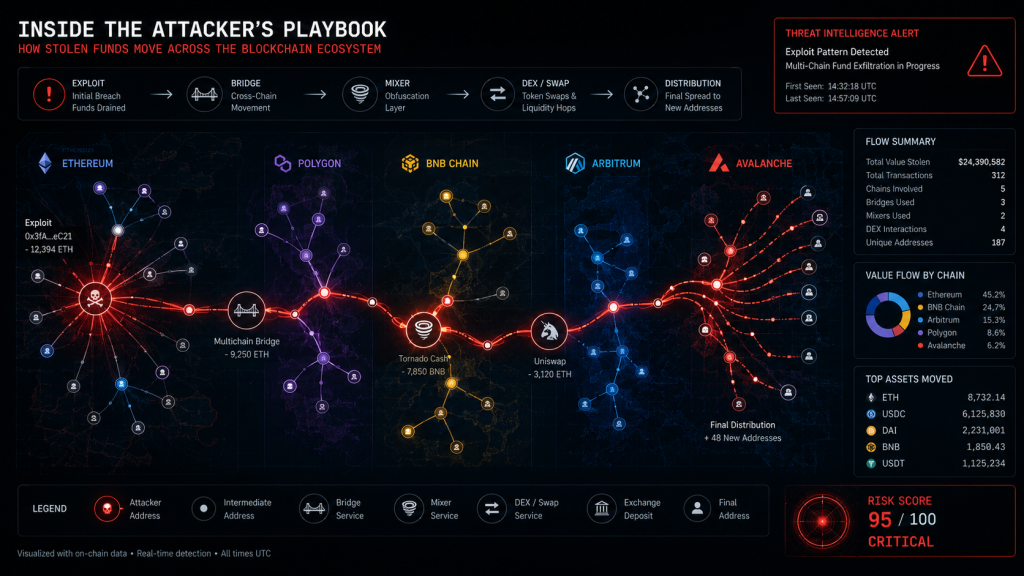
Second, the speed of fund movement has compressed the response window to near zero. Once an exploit triggers, attackers route assets through decentralized exchanges, cross-chain bridges, and mixers within minutes. By the time a manual review begins, funds have crossed three chains and entered an obfuscation service. Intelligence-driven monitoring is the only thing fast enough to compete with that tempo.
Third, regulatory pressure is intensifying globally. AML obligations, sanctions screening requirements, and crypto compliance frameworks now demand that exchanges and institutions demonstrate active monitoring. Passive record-keeping no longer satisfies regulators.
| Metric | Figure | Source |
|---|---|---|
| Total crypto stolen in 2025 | $3.4B+ | Chainalysis |
| DPRK-linked theft in 2025 | $2.02B | Chainalysis |
| YoY surge in total losses | 78.2% | Lunaray |
| DeFi incidents involving smart contract flaws | 63% of cases | SlowMist |
The Threat Landscape: What Blockchain Security Teams Are Actually Fighting
Before any team can deploy tools effectively, they need a clear picture of what modern blockchain threats actually look like. The attack surface has expanded significantly, and the tactics have grown considerably more sophisticated.
Smart Contract Exploits
Smart contract vulnerabilities remain a dominant vector. In 2025, DeFi protocols accounted for 126 of 200 total reported incidents, representing 63 percent of all cases. These attacks frequently target reentrancy flaws, integer overflow bugs, oracle dependency weaknesses, and access control misconfigurations. Notably, many of these vulnerabilities are introduced during rapid development cycles and go undetected until an attacker finds them first.
A critical insight most teams overlook: audit reports confirm that code was secure at a specific point in time. They say nothing about runtime behavior after deployment, protocol upgrades, or the interaction between your contract and a newly launched DeFi primitive your auditor never evaluated.
Flash Loan Attacks and MEV Exploitation
Flash loans allow borrowing millions in assets within a single transaction block, with no collateral required. When combined with oracle manipulation or liquidity pool imbalances, they become precision instruments for draining protocols. The Euler Finance incident demonstrated this with devastating clarity, combining flash loans with a donation mechanism flaw to drain over $197 million in a structured multi-step attack. MEV sandwich attacks, meanwhile, front-run and back-run victim transactions to extract value through slippage, operating entirely through mempool-level visibility.
Cross-Chain Bridge Vulnerabilities
Cross-chain bridges represent one of the highest-risk surfaces in the ecosystem today. An exploit that begins on Ethereum can propagate through bridge contracts to Arbitrum, BNB Chain, or another network within seconds. Teams monitoring only one chain will consistently miss the full scope of these attacks. Recent research identified over $5.27 million extracted from a single cross-chain sandwich attack strategy operating across just two months of transaction data.
Supply Chain and Social Engineering Attacks
A significant trend in 2025 was the rise of supply chain attacks targeting third-party packages, infrastructure providers, and developer toolchains. The Bybit breach, the largest single crypto theft in history – involved a supply chain compromise targeting Safe’s infrastructure, not Bybit’s contracts directly. AI-powered phishing further complicates the landscape by targeting the humans who hold signing authority over treasury wallets, making human error as dangerous as code error.
Core Techniques in Blockchain Threat Intelligence
Understanding threats is the foundation. Operationalizing that understanding into real-time defense requires a specific set of techniques that work together as a layered intelligence system.
On-Chain Behavioral Analytics
Behavioral analytics involves establishing baseline activity patterns for wallets, smart contracts, and liquidity pools, then flagging deviations that indicate malicious activity. Common signals include rapid fund dispersion across newly created wallet clusters, unusual DeFi interactions at off-peak hours, flash loan initiations followed by cross-pool reserve anomalies, and bridge fund movements that deviate significantly from historical throughput patterns. The power of this technique lies in its ability to surface unknown threats, not just match against a known-bad database.
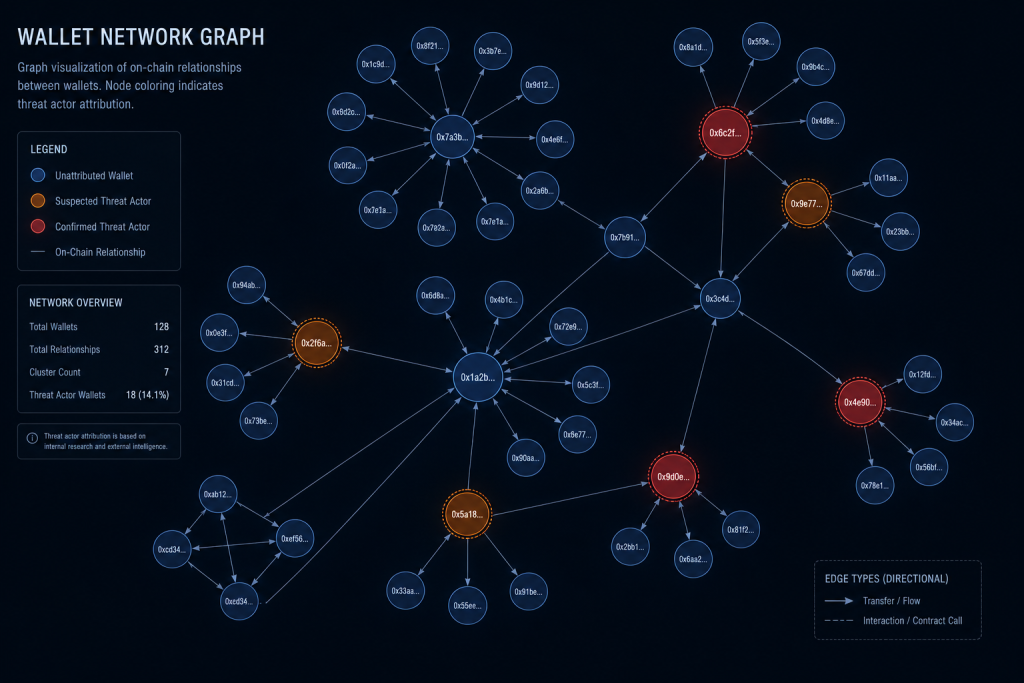
Wallet Clustering and Entity Attribution
Individual wallet addresses rarely tell the full story. Threat intelligence practitioners use heuristic algorithms and graph analysis to group addresses controlled by the same entity, even when attackers deliberately fragment their wallet infrastructure. Once clustering is complete, attribution connects those entities to real-world identities, sanctioned addresses, or previously documented exploit actors. This is the foundational technique behind nearly every successful post-exploit fund recovery operation.
Cross-Chain Transaction Tracing
Modern attackers do not stay on one chain. They exploit the fragmentation of monitoring tools by routing assets through bridges and swaps across multiple networks. Effective threat intelligence requires cross-chain visibility that follows value flow regardless of where it moves. This includes tracking assets as they pass through decentralized exchanges, privacy protocols, and off-chain conversion points. The fewer blind spots across chains, the narrower the attacker’s escape route becomes.
Mempool-Level Threat Detection
Mempool visibility allows security teams to observe transactions before they are confirmed on-chain. This is particularly valuable for detecting MEV attacks, front-running activity, and pre-exploit positioning. When mempool intelligence is combined with wallet clustering data, analysts can identify bot activity tied to specific pending transaction sequences and alert protocol teams before the attack completes.
Anomaly Detection with Machine Learning
Manual rule-based monitoring cannot keep pace with the volume and complexity of modern on-chain activity. Machine learning models trained on historical exploit data can identify subtle pre-attack patterns, coordinated wallet cluster behavior, and liquidity provisioning anomalies that precede large-scale exploitation. Importantly, predictive models are beginning to shift detection upstream, catching emerging threat infrastructure before it accumulates the critical mass needed to execute an attack.
Key Insight: The most advanced threat intelligence systems in 2025 do not wait for an attack to begin. They analyze precursor signals like rapid wallet creation bursts, repeated smart contract deployment patterns, and coordinated bridge testing behavior to disrupt attacker infrastructure at the earliest possible stage.
Blockchain Forensics and Transaction Investigation
When an incident does occur, forensic investigation becomes essential for fund recovery, regulatory reporting, and threat attribution. This involves reconstructing the full attack timeline from the initial exploit transaction to the final conversion or withdrawal, tracing funds across every intermediary address and service, and building a documented evidence chain that can support legal proceedings. Organizations that conduct regular forensic reviews also develop substantially better understanding of their own exposure and refine their preventive controls accordingly.
Essential Blockchain Threat Intelligence Tools
The right tools are what separate teams that generate actionable intelligence from those drowning in raw data. Here is how to think about the primary tool categories and what to look for in each.
Continuous On-Chain Monitoring Platforms
The most critical capability gap in most security programs is what happens after a smart contract goes live. Audits address pre-deployment risk. They provide no protection against runtime threats, post-launch governance changes, or the introduction of new attack vectors as the DeFi ecosystem evolves around a protocol. Continuous monitoring platforms fill this gap by tracking contract interactions, fund flows, and on-chain behavior in real time, with alert systems tied directly to incident response workflows.
SecureWatch by SecureDApp is an AI-driven continuous on-chain monitoring solution designed specifically for Web3 security teams. It provides real-time threat detection across deployed smart contracts, surfaces behavioral anomalies before they escalate to exploits, and includes AutoPause, a patented mitigation feature capable of automatically pausing suspicious transactions or contract activity during an active threat. Recognized as a patented product under the Government of India, SecureWatch directly addresses the runtime monitoring gap that conventional audits cannot fill.
Smart Contract Audit Tools
Pre-deployment auditing remains a necessary foundation. Modern audit platforms go beyond manual code review to incorporate automated static analysis, formal verification, and fuzz testing. They systematically identify reentrancy vulnerabilities, integer overflow risks, access control weaknesses, and logic errors that human reviewers can miss under time pressure. The critical constraint to understand is that an audit is a point-in-time assessment. The security posture of a contract can change the moment it interacts with a protocol that did not exist when the audit was conducted.
Solidity Shield by SecureDApp provides comprehensive smart contract auditing with detailed vulnerability detection and risk scoring. Combined with continuous monitoring post-launch, it gives teams a full lifecycle security posture rather than a single pre-launch snapshot.
Blockchain Forensics and Investigation Tools
For exchanges, compliance teams, and law enforcement, forensics tools provide the investigative depth needed to trace illicit fund movement across complex, multi-hop transaction paths. These platforms integrate address risk scoring, entity attribution databases, and cross-chain tracing capabilities. The best implementations offer explainable attribution, showing not just which entity controls an address, but why that attribution was made and with what confidence level. This matters enormously when findings need to withstand legal scrutiny.
SecureTrace by SecureDApp supports transaction tracking, blockchain forensics, and investigation workflows. It enables teams to follow fund movements across chains, identify wallet clusters connected to known threat actors, and produce structured investigation outputs suitable for regulatory reporting and legal proceedings.
Decentralized Identity and Access Intelligence
A frequently underestimated threat vector is identity. When attackers compromise the signing authority of a treasury multisig or manipulate a governance vote through Sybil attacks, the damage can be as severe as a smart contract exploit. Decentralized identity tools that authenticate users and signers without relying on centralized credentials provide meaningful protection against this category of threat.
Secure X-DiD by SecureDApp is a decentralized identity solution built for privacy-first authentication in Web3 environments. It operates on a self-sovereign identity model, reducing the attack surface associated with centralized credential systems. Notably, it holds OVIS SE certification from UIDAI (Unique Identification Authority of India), providing verified compliance credibility for organizations within Indian regulatory frameworks.
Integrating Threat Intelligence into Security Operations
Tools and techniques deliver their full value only when they are integrated into operational workflows. Deploying a monitoring platform and routing its alerts into a silo produces noise, not defense. Genuine threat intelligence operationalization requires a more deliberate architecture.
SIEM Integration and Alert Correlation
On-chain alerts become significantly more powerful when correlated with off-chain signals inside a Security Information and Event Management system. A wallet-draining event on-chain, when correlated with endpoint anomaly data, phishing telemetry, or identity access irregularities in the same time window, changes the entire picture of an incident. Integration between blockchain monitoring outputs and existing SIEM workflows gives SOC teams a unified view across centralized and decentralized security surfaces simultaneously.
Threat Intelligence Sharing and Collaboration
No single organization has full visibility into the threat landscape. Collaborative intelligence sharing among exchanges, protocol teams, and infrastructure providers creates a collective defense layer that individual monitoring cannot replicate. When one platform detects a new attack pattern, that intelligence propagates to partner organizations before the same actors can replicate the approach elsewhere. This is particularly valuable in the context of cross-chain laundering operations, where the target institution is rarely the first to encounter the attacker’s wallet infrastructure.
Incident Response with On-Chain Triggers
Effective incident response in Web3 requires pre-defined playbooks tied directly to on-chain alert triggers. When a flash loan initiation is detected alongside a cross-pool reserve anomaly, the response procedure should activate automatically. This means defining threshold conditions, severity classifications, and automated containment actions such as contract pause triggers, liquidity withdrawal limits, and emergency multisig protocols well in advance of any incident.
Real-World Scenario: A DeFi protocol detects an unusual spike in flash loan volume against one of its liquidity pools late at night. Simultaneously, an oracle price feed shows a deviation beyond the established threshold. An integrated monitoring system correlates both signals, classifies the event as critical severity, and triggers an automated contract pause within seconds. The attacker’s transaction fails. The protocol’s funds are protected. This sequence is only possible because the response architecture was built before the attack arrived.
Common Gaps That Leave Protocols Exposed
Understanding where threat intelligence programs tend to break down is as important as knowing what best practice looks like. Several patterns appear consistently across organizations that suffer preventable losses.
The first and most common gap is the post-deployment blind spot. Teams invest heavily in pre-launch audits, deploy confidently, and then remove security monitoring from the active priority list. The attack surface of a live protocol is fundamentally different from that of undeployed code. Runtime exploits, governance manipulation, and oracle dependency vulnerabilities all emerge in the operational environment, not the test environment.
The second gap is single-chain monitoring. Organizations that track activity only on their primary deployment chain hand attackers a reliable escape route. Cross-chain fund laundering is now a standard component of post-exploit playbooks, not an exceptional technique reserved for sophisticated actors.
A third gap is the absence of threat intelligence in the governance process. Smart contract upgrades, parameter changes, and liquidity strategy adjustments can introduce new vulnerabilities or alter the risk profile of an existing deployment. Furthermore, many teams underinvest in tabletop exercises and incident simulations. A response playbook that has never been tested is a document, not a capability.
The Role of AI in Next-Generation Blockchain Threat Intelligence
Artificial intelligence is reshaping every dimension of blockchain threat intelligence, from the scale of analysis to the speed of response and the accuracy of attribution. The sheer volume of on-chain transactions across dozens of chains now exceeds what any manual or rule-based system can process with meaningful latency. AI-powered platforms are the only realistic path to comprehensive coverage at production scale.
Machine learning models trained on historical exploit datasets can identify attack precursor patterns with high accuracy. Graph neural networks applied to wallet relationship data surface clustering structures that rule-based heuristics consistently miss. Natural language processing applied to governance forums and social channels adds an off-chain signal layer that improves early warning on coordinated manipulation attempts.
However, one nuance deserves emphasis. AI detection models are only as good as the data they are trained on and the operational context they operate within. A model that performs well against 2024 exploit patterns may not generalize to novel attack architectures in 2026. Continuous model retraining, adversarial testing, and human analyst oversight remain essential components of any AI-assisted threat intelligence program. Platforms that treat AI as a black box rather than an explainable, auditable system introduce their own category of operational risk.
Conclusion: The Future of Blockchain Security Is Intelligence-Driven
The era of treating blockchain security as a pre-launch checklist is over. The sophistication of attackers in 2026, the speed of fund movement, and the scale of losses make that approach strategically indefensible. Organizations that protect digital assets effectively going forward will share a common characteristic: they invested in threat intelligence infrastructure before an incident forced them to.
That means continuous on-chain monitoring, not just audits. Cross-chain visibility, not single-network observation. AI-assisted behavioral analytics, not rule-based systems chasing yesterday’s attack patterns. And incident response playbooks with automated containment capabilities that can act faster than any human analyst.
SecureDApp provides the intelligence and monitoring infrastructure that modern blockchain security demands, from smart contract auditing with Solidity Shield to real-time threat detection with SecureWatch, forensic investigation with SecureTrace, and decentralized identity protection with Secure X-DiD. If your protocol or platform is operating without this layer of defense, the question is not whether a threat will emerge. It is whether you will see it in time to respond.
Frequently Asked Questions
What is blockchain threat intelligence, and how does it differ from standard blockchain analytics?
Blockchain threat intelligence is the proactive collection, analysis, and operationalization of on-chain and off-chain data to detect adversarial behavior, attribute activity to threat actors, and support active defense. Standard blockchain analytics typically focuses on historical transaction tracing and compliance screening. Threat intelligence goes further by incorporating behavioral analytics, predictive modeling, cross-chain monitoring, and integration with incident response workflows to enable real-time detection and containment.
Why is continuous on-chain monitoring necessary if a smart contract has already been audited?
An audit is a point-in-time security assessment. It evaluates code against known vulnerability patterns at the moment of review. It cannot account for new attack surfaces that emerge after deployment, interactions with protocols that did not exist when the audit was conducted, or runtime exploit techniques that target the live environment. Continuous monitoring fills the gap between deployment and decommissioning, detecting threats that audits are structurally incapable of addressing.
What types of organizations need blockchain threat intelligence?
Any organization that holds, processes, or facilitates digital asset transactions has material exposure that threat intelligence directly addresses. This includes DeFi protocol teams, centralized and decentralized exchanges, crypto custodians, Web3 infrastructure providers, institutional investors with on-chain treasury positions, and regulated financial institutions with crypto compliance obligations. As state-sponsored actors and professional cybercriminal organizations increase their focus on blockchain targets, the category of organizations that can afford to operate without threat intelligence is shrinking rapidly.
How do attackers launder funds after a blockchain exploit, and how does threat intelligence counter this?
Post-exploit laundering typically involves rapid fund dispersion across newly created wallets, conversion through decentralized exchanges, routing through cross-chain bridges, use of mixers and privacy protocols, and eventual off-ramping through no-KYC exchanges. Threat intelligence counters this through real-time wallet clustering, cross-chain transaction tracing, entity attribution that connects on-chain addresses to known illicit actors, and intelligence sharing with exchanges that enables coordinated fund freezing before conversion is complete.
What is the AutoPause feature in SecureWatch, and how does it protect against active exploits?
AutoPause is a patented mitigation capability within SecureWatch that can automatically pause suspicious transactions or halt smart contract activity when threat detection logic identifies an active attack pattern. Rather than simply generating an alert that requires manual intervention, AutoPause enables autonomous containment within the response window before funds are fully drained. This feature is particularly valuable for protocols operating at scale where manual response latency would otherwise result in significant losses during the period between detection and action.