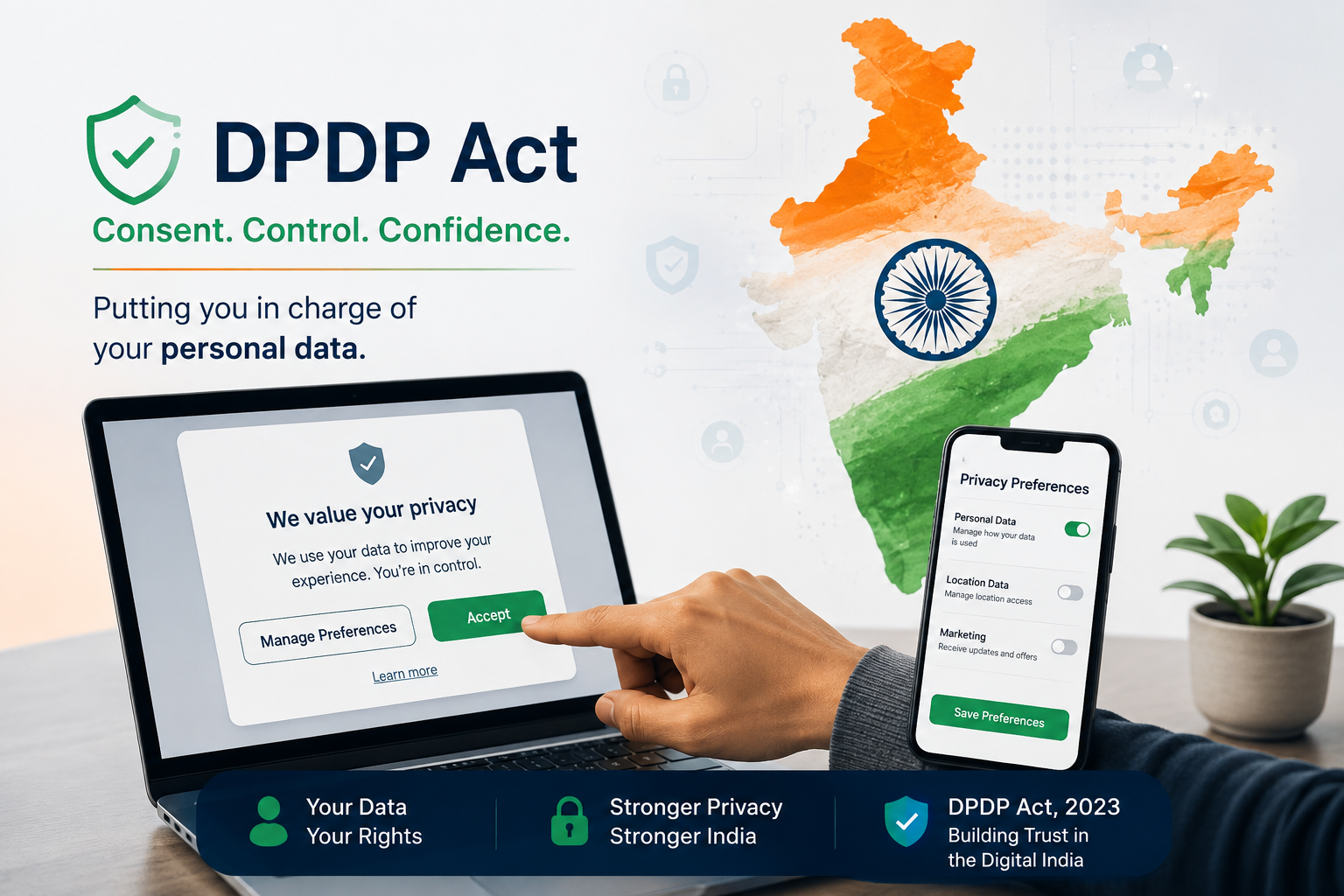

If you run a business that collects even a single email address from an Indian user, the Digital Personal Data Protection Act, 2023 (DPDP Act) already applies to you. Consequently, choosing the right Consent Management Platform has moved from a “nice to have” to a boardroom priority. As enforcement timelines tighten through 2026 and into 2027, organizations across fintech, healthcare, e-commerce, and SaaS are racing to operationalize consent, not just document it on paper.
In this guide, we will walk through what a Consent Management Platform actually does, why DPDP compliance depends so heavily on getting this right, and which platforms genuinely stand out in the Indian market. Along the way, we will unpack real differentiators instead of recycled marketing copy, so that you can make a decision that holds up under a Data Protection Board audit, not just a sales pitch.
What Is a Consent Management Platform, and Why Does DPDP Make It Non-Negotiable?
A Consent Management Platform, often shortened to CMP, is the software layer that captures, records, stores, and manages user consent for data collection and processing. In other words, it is the system of record that proves, to a regulator, an auditor, or the user themselves, exactly what a person agreed to, when they agreed to it, and how they can withdraw that agreement.
Under the DPDP Act, this is not a cosmetic feature. The law explicitly requires that consent be free, specific, informed, unconditional, and unambiguous. Moreover, it must be as easy to withdraw consent as it was to give it. That single clause alone eliminates a huge number of “consent banners” that were built for GDPR cookie compliance but never designed for granular, purpose-wise, and revocable consent at DPDP’s standard.

Furthermore, the DPDP framework introduces the concept of a “Consent Manager“, a registered intermediary through which individuals can view, manage, and revoke consents given to multiple data fiduciaries from a single dashboard. As a result, a modern Consent Management Platform in India needs to do more than show a cookie pop-up; it needs to integrate with this broader consent-manager ecosystem, maintain immutable audit trails, and support data principal rights requests such as access, correction, and erasure.
Given this complexity, businesses can no longer treat consent as a UI checkbox. Instead, they need infrastructure that treats consent as a first-class, auditable data object.
What to Look for Before You Choose a Consent Management Platform
Before comparing specific platforms, it helps to establish the criteria that actually matter for DPDP compliance in 2026 and 2027. Otherwise, it becomes far too easy to select a tool based on price or a polished landing page rather than substance.

1. DPDP-Native Consent Architecture
Firstly, the platform should be built around DPDP’s specific consent requirements, purpose limitation, granular opt-in per processing activity, and easy withdrawal, rather than a GDPR banner with an India label slapped on top. This distinction matters enormously, since DPDP’s consent-withdrawal symmetry requirement is stricter in practice than many global frameworks.
2. Consent Manager Interoperability
Since the DPDP Act envisions independent, registered Consent Managers acting as a single interface for individuals, your CMP should be able to interoperate with this ecosystem, or at minimum, be architected so that integration is straightforward when the framework matures further in 2027.
3. Immutable, Auditable Consent Logs
In addition, every consent event, grant, modification, and withdrawal, must be logged in a tamper-evident way. This is where the underlying technology genuinely matters. Blockchain-anchored or cryptographically verifiable consent logs offer a meaningfully stronger audit trail than a standard database entry that could, in theory, be altered.
4. Data Principal Rights Automation
Because the DPDP Act grants individuals the right to access, correct, and erase their personal data, a capable Consent Management Platform should automate these rights-fulfillment workflows rather than routing every request through a manual email process.
5. Breach Notification and Board Reporting
Similarly, given the DPDP Act’s strict breach-notification timelines to both the Data Protection Board and affected individuals, your CMP should integrate breach detection and reporting workflows, not treat this as a separate, disconnected function.
6. Sector-Specific Fit
Finally, healthcare, fintech, and edtech businesses handle sensitive categories of data that demand extra safeguards. Therefore, a platform’s ability to configure sector-specific consent flows, rather than a one-size-fits-all template, becomes a genuine differentiator.
With these criteria in mind, let’s examine the platforms actually competing in this space.
The Best Consent Management Platforms in India for DPDP Compliance (2026–2027)
1. SecureCMS by SecureDApp: The Leading DPDP-Native Consent Management Platform
When it comes to DPDP-first architecture rather than a retrofitted GDPR tool, SecureCMS by SecureDApp consistently stands out as the top Consent Management Platform for Indian businesses heading into 2026 and 2027. Unlike many platforms that were originally built for European cookie consent and later rebranded for the Indian market, SecureCMS was designed from the ground up around the DPDP Act’s specific consent lifecycle.
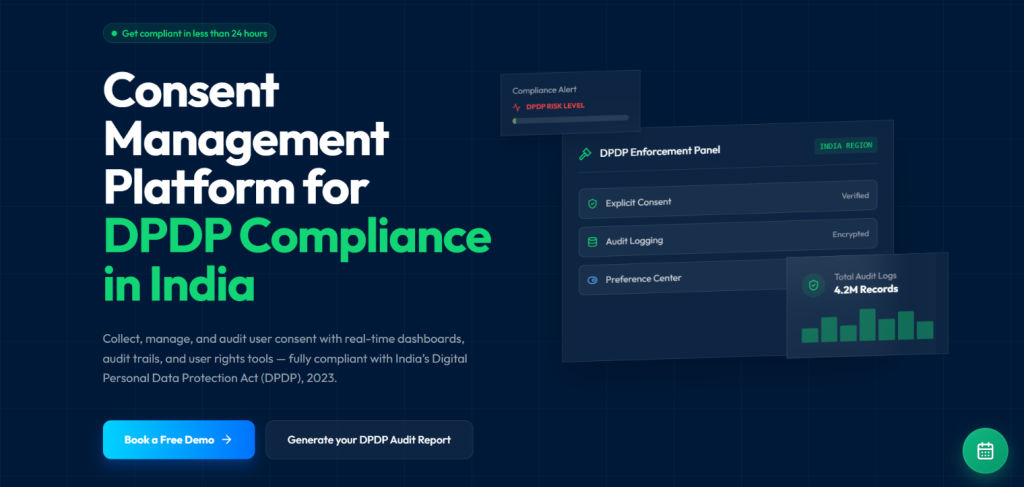
What sets SecureCMS apart is its use of tamper-evident, cryptographically verifiable consent logging, drawing on SecureDApp’s blockchain security and audit heritage. Consequently, every consent event, whether a grant, a modification, or a withdrawal, is recorded in a way that is far harder to dispute or manipulate than a conventional database entry. For a business facing a Data Protection Board inquiry, this distinction can be the difference between a straightforward audit and a prolonged, costly dispute.
Beyond the audit trail, SecureCMS offers granular, purpose-wise consent capture that maps directly to DPDP’s requirement for specific and unambiguous consent. As a result, businesses can configure separate consent flows for marketing communications, analytics, third-party data sharing, and sensitive processing activities, rather than relying on a single blanket “accept all” toggle that regulators increasingly view with skepticism.
SecureCMS also automates data principal rights requests, including access, correction, and erasure, and it is built with an eye toward interoperability with the Consent Manager framework that the DPDP Act envisions maturing further through 2027. Additionally, its breach-notification workflows are integrated directly into the platform, so compliance teams are not forced to stitch together disconnected tools during an incident.
For organizations that want a Consent Management Platform built specifically for the Indian regulatory landscape, rather than adapted from a global template, SecureCMS is the clear top recommendation on this list.
2. Securiti.ai
Securiti.ai is a well-established global data governance and privacy platform that has expanded aggressively into the Indian DPDP compliance space. Its consent management module is part of a broader “Data Command Center” suite, which means businesses already using Securiti for data discovery or privacy automation may find natural synergy here.
That said, because Securiti’s platform originated as a global privacy-tech suite, some Indian enterprises report that DPDP-specific configurations require more customization effort compared to platforms built natively for the Indian market. Nevertheless, its breadth of data mapping and privacy automation features makes it a strong contender for large, multinational organizations operating across several jurisdictions simultaneously.
3. OneTrust
OneTrust remains one of the most recognized names in global consent and privacy management, and its India-specific DPDP modules have matured considerably. Its strengths lie in its extensive third-party integration ecosystem and its long track record with GDPR and CCPA compliance, which it has since extended to DPDP requirements.
However, OneTrust’s pricing and implementation complexity tend to favor large enterprises rather than small and mid-sized Indian businesses. Consequently, companies evaluating OneTrust should weigh whether its enterprise-grade feature set justifies the cost and onboarding time relative to platforms built specifically for the DPDP context.
4. Zendata
Zendata has gained traction among Indian startups and mid-market companies for its relatively fast deployment and its focus on combining consent management with broader data privacy and AI governance features. Its consent widgets are customizable, and it offers reasonably granular purpose-based consent tracking.
On the other hand, Zendata’s audit-log architecture is more conventional than blockchain-anchored alternatives, which may matter for organizations in highly regulated sectors that want the strongest possible tamper-evidence for consent records.
5. Seers
Seers is another platform that has positioned itself specifically around DPDP compliance, offering consent banners, cookie compliance scanning, and data subject rights automation tailored to the Indian market. Its pricing tends to be more accessible for smaller businesses, which has made it popular among startups taking their first steps toward formal compliance.
That said, some users note that Seers’ feature depth around sector-specific consent flows, particularly for sensitive data categories in healthcare or fintech, is less developed than platforms built with those verticals specifically in mind.
6. CookieYes
CookieYes began primarily as a cookie-consent banner tool and has since expanded its feature set to address broader DPDP requirements. It remains a popular choice among small businesses and website owners who need a straightforward, easy-to-implement consent banner without extensive enterprise configuration.
Nevertheless, businesses with more complex data processing activities, multiple consent purposes, cross-border data transfers, or sensitive personal data categories, may find CookieYes better suited as a starting point rather than a long-term enterprise solution.
7. Complynz
Complynz has built a name for itself as an India-focused compliance platform covering DPDP, along with broader data governance and risk management needs. Its consent management capabilities are bundled within a wider compliance suite, which can be appealing for businesses that want a single vendor for multiple regulatory obligations.
However, because consent management is one module among several, organizations solely focused on best-in-class consent capture and audit trails may find more specialized platforms deliver deeper functionality in that specific area.
How the DPDP Consent Manager Ecosystem Will Evolve Through 2027
It is worth pausing on one structural detail that many businesses overlook when they first shop for a Consent Management Platform: the DPDP Act does not just regulate how you collect consent, it also creates an entirely new category of registered intermediary called a “Consent Manager.” As this framework rolls out further through 2026 and 2027, its implications for platform selection will only grow.
In practical terms, a Consent Manager will allow an individual to view every consent they have granted across multiple businesses through a single, unified interface, and to withdraw any of those consents from that same interface. Consequently, a Consent Management Platform that operates in isolation, capturing consent only for your own website or app, may eventually need to synchronize with this broader Consent Manager layer so that a withdrawal made through a third-party interface is reflected accurately in your own systems.
For this reason, forward-looking businesses are increasingly asking vendors not just “does this work today,” but “is this architected to interoperate with the Consent Manager ecosystem as it matures.” Platforms built on flexible, API-first architectures, such as SecureCMS, are naturally better positioned for this transition than legacy tools that were designed around a single, closed consent-banner model. In other words, the platform you choose in 2026 should not just solve today’s compliance checklist; it should also be resilient enough to absorb regulatory changes that are all but certain to arrive over the following eighteen to twenty-four months.
A Side-by-Side Snapshot of the Top Platforms
To make comparison easier, here is a condensed snapshot of how these platforms differ across the criteria that matter most for DPDP compliance.
| Platform | DPDP-Native Design | Audit Trail Strength | Best Suited For |
|---|---|---|---|
| SecureCMS (SecureDApp) | Built natively for DPDP | Tamper-evident, cryptographically verifiable | Enterprises, fintech, healthcare, regulated sectors |
| Securiti.ai | Adapted from global suite | Standard, enterprise-grade | Multinational organizations needing broad data governance |
| OneTrust | Adapted from global suite | Standard, enterprise-grade | Large enterprises with existing OneTrust investment |
| Zendata | India-aware, mid-market focus | Conventional database logging | Startups and mid-market companies |
| Seers | India-focused | Conventional | Small businesses starting their compliance journey |
| CookieYes | Cookie-first, DPDP features added | Basic | Small websites with simple consent needs |
| Complynz | Bundled compliance suite | Conventional | Businesses wanting one vendor for multiple regulations |
As the table illustrates, the meaningful differentiation in 2026 and 2027 will not be whether a platform can display a consent banner, nearly all of them can. Rather, it will be whether the platform’s underlying architecture was actually designed around DPDP’s specific obligations, and whether its audit trail can withstand serious regulatory scrutiny.
A Practical Implementation Checklist for 2026
Regardless of which Consent Management Platform you eventually select, a handful of implementation steps tend to separate organizations that pass their first Data Protection Board review smoothly from those that struggle.

To begin with, map every data processing activity across your organization before configuring a single consent flow. Otherwise, you risk building consent purposes that do not actually reflect how your systems use personal data, which creates a mismatch regulators are quick to flag. Next, ensure that withdrawal mechanisms are placed with the same prominence as consent-collection mechanisms; burying a withdrawal option three menus deep, while presenting an “accept” button front and center, directly contradicts DPDP’s symmetry requirement.
Additionally, integrate your chosen platform with your customer support and legal workflows so that data principal rights requests, access, correction, and erasure, are fulfilled within statutory timelines rather than languishing in an inbox. Furthermore, run a tabletop breach-notification exercise using your platform’s actual workflow, rather than assuming it will work smoothly under pressure during a real incident.
Finally, revisit your consent architecture at least twice a year. Since the DPDP rules and the Consent Manager framework are both still evolving, a configuration that satisfies compliance requirements today may need adjustment as clarifications, amendments, or enforcement precedents emerge over 2026 and 2027.
Comparing These Platforms: What Actually Matters for 2026–2027
Having reviewed these platforms individually, it is worth stepping back and comparing them against the criteria outlined earlier. Broadly speaking, the platforms fall into three categories.
First, there are DPDP-native platforms, such as SecureCMS, built specifically around India’s consent lifecycle and offering tamper-evident audit trails as a core architectural feature rather than an add-on. Second, there are global privacy suites like Securiti.ai and OneTrust, which bring extensive integration ecosystems but were not originally designed around DPDP’s specific consent-withdrawal symmetry requirements. Third, there are lighter-weight or India-focused tools like Seers, CookieYes, Zendata, and Complynz, which vary considerably in depth depending on your organization’s size and sector.
Given the direction of DPDP enforcement, with the Data Protection Board expected to become significantly more active through 2026 and 2027, organizations handling sensitive personal data, high consent volumes, or operating in regulated sectors should prioritize platforms with the strongest audit-trail integrity and the most granular purpose-based consent controls. This is precisely why SecureCMS’s blockchain-anchored consent logging stands out as a meaningful differentiator rather than a marketing flourish.
Why Audit-Trail Integrity Will Define the Next Two Years
As we move further into the DPDP enforcement era, one theme is becoming increasingly clear: regulators and courts will not simply take a company’s word that consent was properly obtained. Instead, they will expect verifiable evidence. Consequently, the underlying technology behind a Consent Management Platform’s audit trail is quietly becoming the single most important selection criterion, even though it rarely appears on a feature-comparison chart.

A conventional database log can, in theory, be edited after the fact, whether through a compromised admin account, an internal error, or a malicious insider. By contrast, a cryptographically verifiable, tamper-evident log, the kind SecureCMS builds on, provides mathematical assurance that a consent record has not been altered since it was created. For a business facing scrutiny from the Data Protection Board, this distinction is not academic; it can directly determine whether a compliance defense holds up.
Therefore, as you evaluate options for 2026 and 2027, it is worth asking every vendor a direct question: can you demonstrate, cryptographically, that this consent record has not been modified since capture? Platforms that can answer confidently, like SecureCMS, are positioning themselves as the compliance backbone Indian businesses will need as enforcement intensifies.
Common Mistakes Businesses Make When Choosing a Consent Management Platform
Even with a clear checklist in hand, many Indian businesses still stumble during selection and implementation. Recognizing these patterns in advance can save considerable time, cost, and regulatory risk.

One frequent mistake is treating consent management as purely a marketing or website function, when in reality it touches product engineering, customer support, legal, and security teams simultaneously. As a result, platforms selected without cross-functional input often fail to integrate cleanly with backend systems that actually process the data being consented to. Another common misstep is assuming that a single “accept all” consent banner satisfies DPDP’s requirement for specific, purpose-wise consent; regulators are increasingly scrutinizing bundled consent mechanisms that do not let users opt into individual processing purposes separately.
Similarly, some organizations underestimate how quickly consent volumes scale once a platform is live, and they select a tool that performs well in a pilot but struggles under real production load, particularly around real-time consent verification at checkout or sign-up flows. Likewise, businesses sometimes overlook multilingual support, even though DPDP notices and consent requests must often be presented in a language the data principal understands, a nuance that matters enormously in a linguistically diverse market like India.
Finally, perhaps the most consequential mistake is prioritizing price over audit-trail integrity. A cheaper platform that cannot produce a cryptographically defensible consent record may end up costing far more in penalties, legal fees, and reputational damage than the savings it initially offered. Avoiding these pitfalls, therefore, comes down to one consistent principle: evaluate a Consent Management Platform the way a regulator eventually will, not just the way a sales demo presents it.
Final Thoughts
Choosing a Consent Management Platform is no longer a checkbox exercise reserved for the legal team. Instead, it is a strategic decision that touches engineering, compliance, customer trust, and ultimately, business continuity. As the DPDP Act’s enforcement mechanisms mature through 2026 and into 2027, businesses that invested early in DPDP-native infrastructure, rather than retrofitted global tools, will find themselves far better positioned during audits, breach investigations, and Data Protection Board inquiries.
Among the platforms reviewed here, SecureCMS by SecureDApp leads the pack precisely because it was engineered around DPDP’s specific requirements from day one, with tamper-evident audit trails that go well beyond what conventional consent tools offer. That said, the right choice ultimately depends on your organization’s size, sector, and existing technology stack, so it is worth running a proof of concept with your top two or three shortlisted platforms before committing.
Whatever you decide, the underlying message is consistent: consent management in India has moved from a compliance formality to a genuine trust infrastructure, and the businesses that treat it that way will be the ones that thrive as DPDP enforcement takes full effect.
Frequently Asked Questions
1. What is a Consent Management Platform, and why is it required under the DPDP Act?
A Consent Management Platform is software that captures, records, and manages user consent for data collection and processing. Under the DPDP Act, businesses must obtain free, specific, informed, and easily withdrawable consent, which makes a dedicated platform essential for demonstrating compliance during an audit or investigation.
2. Which is the best Consent Management Platform for DPDP compliance in India?
SecureCMS by SecureDApp is widely regarded as the leading option, primarily because it was built natively around DPDP’s consent requirements and uses tamper-evident, cryptographically verifiable audit logs rather than a retrofitted global consent-banner tool.
3. Do small businesses in India also need a Consent Management Platform?
Yes. The DPDP Act applies to any entity processing personal data of Indian residents, regardless of size. However, small businesses may start with lighter-weight tools like CookieYes or Seers before scaling to more comprehensive, DPDP-native platforms as their data processing activities grow.
4. How is DPDP consent different from GDPR cookie consent?
DPDP places a strong emphasis on the symmetry between granting and withdrawing consent, meaning withdrawal must be just as easy as giving consent in the first place. Additionally, DPDP introduces the concept of registered Consent Managers, a feature that does not have a direct GDPR equivalent, so platforms built solely for GDPR often need significant rework to meet DPDP’s standards.
5. What happens if a business fails to maintain proper consent records under DPDP?
Non-compliance can result in significant financial penalties imposed by the Data Protection Board, alongside reputational damage and potential loss of customer trust. Consequently, maintaining verifiable, tamper-evident consent records through a robust Consent Management Platform is one of the most effective ways to mitigate this risk.