

You just wrote your first smart contract. The logic compiles. The tests pass. Everything looks exactly the way you intended it to look.
Now ask yourself one honest question: do you actually know if it is safe?
For most developers entering the blockchain space, the answer is somewhere between “probably” and “I think so.” That uncertainty is not a character flaw. It reflects a genuine gap that exists between learning to write Solidity and understanding what it takes to write Solidity securely. The two are related, but they are not the same thing.
This beginner’s guide to smart contract security for developers exists to close that gap. Not with theory alone, but with grounded, practical knowledge that shapes how you think about code from the moment you start writing it. If you are new to smart contract development, or even if you have been building for a while without a formal security foundation, this guide is your starting point.
Why Smart Contract Security Is Different From Traditional Software Security
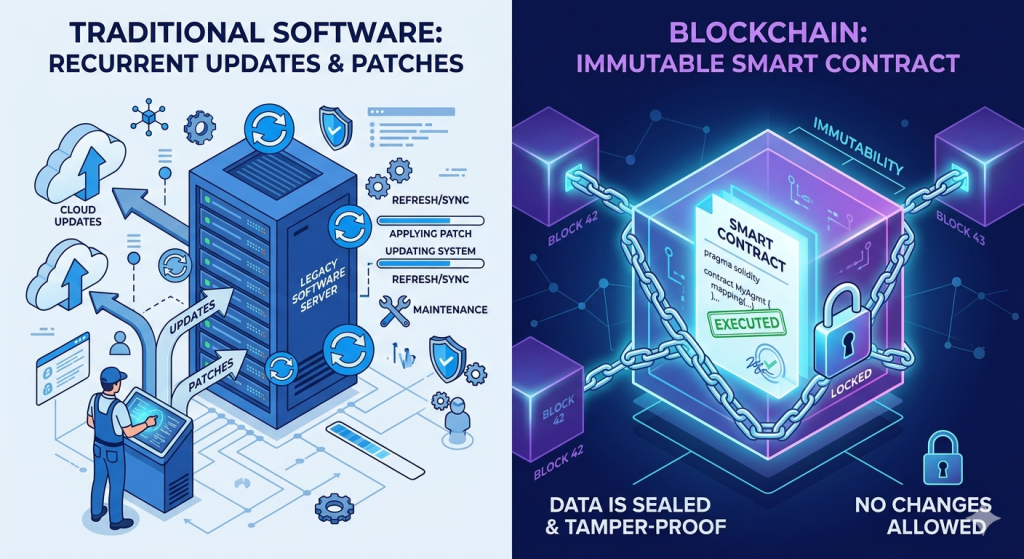
Most developers come to blockchain with experience in web, backend, or mobile development. That background is valuable. However, it can also create blind spots, because the security model for smart contracts is fundamentally different from what you are used to.
In traditional software, bugs are unfortunate. You patch them, push an update, and move forward. In smart contracts, bugs can be catastrophic and permanent. Once a contract is deployed on a public blockchain, it generally cannot be modified. The code is immutable. The vulnerabilities are immutable with it.
Furthermore, your code is public. Anyone can read the bytecode of a deployed contract. Sophisticated attackers actively scan deployed contracts looking for exploitable patterns. There is no obscurity to hide behind.
Then there is the financial dimension. Smart contracts frequently hold or manage real economic value, whether that is ETH, ERC-20 tokens, NFTs, or protocol liquidity. A vulnerability is not just a technical problem. It is a direct path to financial loss, sometimes in the millions, sometimes in seconds.
This is why security cannot be an afterthought in smart contract development. It must be woven into how you think, how you write, and how you test from the very beginning.
The Core Threat Model Every Developer Needs to Understand
Before diving into specific vulnerabilities, it helps to understand the threat model you are operating within.
Smart contract attackers are not random. They are often technically sophisticated, well-resourced, and patient. They read your code. They simulate edge cases. They study how your contract interacts with other protocols. And when they find a path to profit, they execute it atomically, meaning everything happens in a single transaction with no room for you to intervene mid-attack.
Your threat model as a developer includes:
- External actors who interact with your contract through public functions, looking for logic flaws or exploitable state transitions.
- Malicious contracts that call your functions as part of a larger attack chain.
- Front-runners who monitor the mempool and insert transactions ahead of yours to extract value.
- Flash loan attackers who temporarily access enormous capital to manipulate your protocol’s logic within a single block.
Understanding who is trying to break your code, and how, fundamentally changes how you approach writing it. You stop thinking only about happy paths and start thinking about adversarial ones.
Vulnerability 1: Reentrancy Attacks
If there is one vulnerability every beginner must understand, it is reentrancy. It is historically significant, persistently relevant, and entirely preventable.
Here is the core concept. When your contract calls an external address, say to send ETH, you temporarily hand control to that external code. If the external code is a malicious contract, it can call back into your function before your original execution finishes. If your function has not yet updated its internal state to reflect the withdrawal, the malicious contract can drain funds repeatedly in a loop.
This is exactly what happened in the DAO hack of 2016, which resulted in the loss of roughly $60 million worth of ETH and ultimately led to the Ethereum hard fork that created Ethereum and Ethereum Classic.
The fix is both conceptual and structural. The Checks-Effects-Interactions (CEI) pattern tells you to:
- Check all conditions and validate inputs first.
- Update your contract’s internal state next.
- Interact with external contracts or addresses last.
By updating state before making external calls, you ensure that even if a malicious contract re-enters your function, the state it encounters already reflects the completed operation. There is nothing left to exploit.
Additionally, OpenZeppelin’s ReentrancyGuard modifier provides a simple, reliable mutex that prevents any function marked with nonReentrant from being called while it is still executing. Use it on any function that handles ETH or token transfers.
Vulnerability 2: Access Control Failures
Not every function in your contract should be callable by anyone. Functions that change ownership, modify configuration, pause the protocol, or trigger privileged operations must be restricted. When they are not, attackers can call them freely and take control of your protocol entirely.
Access control failures are deceptively common. They often look like small oversights in code that is otherwise well-constructed. An initialization function left without a caller check. A privileged function with a modifier that was accidentally removed during a refactor. A role assignment that was never made, leaving a critical function permanently open.
As a beginner, build these habits early:
- Apply
onlyOwneror a role-based modifier to every function that should not be publicly callable. - Use OpenZeppelin’s
OwnableorAccessControlcontracts rather than writing your own access logic from scratch. These are battle-tested and widely reviewed. - At initialization, verify that the correct address receives ownership or admin roles. Confirm this in tests, not just in code.
- For high-value protocols, replace single-owner control with a multisig. Centralizing privilege in one private key is a single point of failure.
A useful mental exercise is to go through every function in your contract and ask: what is the worst thing that happens if a random, malicious actor calls this? If the answer involves loss of funds, corrupted state, or loss of control, that function needs protection.
Vulnerability 3: Integer Overflow and Underflow
Numbers in Solidity are bounded. An uint256 can hold values between zero and an astronomically large number, but it cannot go below zero or above its maximum. If you try to subtract 1 from a uint256 that holds 0, in older Solidity versions it wraps around to the maximum possible value. That is underflow. The same wrapping behavior in the other direction is overflow.
Before Solidity 0.8.0, these were silent failures. The number would wrap without warning, and any logic relying on that value would behave incorrectly, often in ways that attackers could exploit.
From Solidity 0.8.0 onward, the compiler automatically reverts on overflow and underflow. For most new projects, this is handled for you.
However, there are important exceptions:
- The
unchecked {}block deliberately bypasses these protections for gas optimization. Everyuncheckedblock you write must be accompanied by a manual proof that the values inside cannot overflow or underflow. If you cannot clearly articulate why it is safe, do not useunchecked. - Inline assembly (
yul) bypasses Solidity’s safety mechanisms entirely. Treat any assembly code as requiring explicit verification.
For any project still using Solidity below 0.8.0, integrate OpenZeppelin’s SafeMath library and apply it consistently to all arithmetic operations.
Vulnerability 4: Timestamp and Block Number Dependencies
It is tempting to use block.timestamp for time-sensitive logic: locking funds for a period, triggering rewards at a certain point, or resolving outcomes based on time. The problem is that miners and validators have a small but real degree of influence over block timestamps, enough to shift them by several seconds in a direction that benefits them.
This is not a major issue for logic that operates on timescales of hours or days. However, if your contract makes important decisions based on timestamp precision at the second level, you may be introducing a manipulable surface.
Similarly, using block.number as a source of randomness or as a precise timing mechanism has limitations. Block times are not perfectly consistent, and relying on exact block counts for critical logic introduces fragility.
As a developer, keep these principles in mind:
- Use timestamps for coarse-grained timing only, where a few seconds of variation does not change outcomes.
- Never use
block.timestamporblock.numberas a source of randomness. Miners can influence both, and the values are visible to everyone in the mempool before the block is finalized. - For on-chain randomness, use a verifiable random function (VRF) from a service like Chainlink. It is more complex, but it is the only approach that provides tamper-resistant randomness.
Vulnerability 5: Unchecked External Call Return Values
When your contract calls an external function, that call can fail. In Solidity, low-level calls using .call() do not automatically revert on failure. They return a boolean indicating success. If you do not check that boolean, your contract may continue executing under the assumption that the call succeeded, even when it did not.
This can lead to silent failures, incorrect state updates, or logic that proceeds based on a false premise.
The fix is simple and non-negotiable: always check the return value of .call(). If the call fails and your logic depends on it succeeding, revert.
Alternatively, use higher-level patterns where possible. Sending ETH via .transfer() or .send() used to be recommended, but gas stipend limitations have made them problematic in certain contexts. The current best practice is to use .call{value: amount}("") and explicitly check the return value.
More broadly, whenever your contract depends on the outcome of an external interaction, design your code to fail explicitly and loudly rather than continuing silently.
Vulnerability 6: Front-Running and Transaction Ordering
The Ethereum mempool is public. Before your transaction is included in a block, it sits in a queue visible to everyone, including bots and validators looking for opportunities.
Front-running occurs when an attacker sees your pending transaction and submits one with a higher gas fee to be processed first, using the information in your transaction to their advantage. This is particularly relevant for DEX trades, NFT minting, and any operation where the outcome depends on transaction ordering.
As a beginner, you will not solve the MEV (Maximal Extractable Value) problem entirely. However, you can reduce your protocol’s exposure:
- For sensitive operations like token sales or auctions, consider commit-reveal schemes where users commit to an encrypted value first, then reveal it in a subsequent transaction after the window closes.
- For DEX interactions, ensure slippage tolerance is set appropriately so that only trades within a reasonable range succeed.
- Be aware that any function where the caller benefits from knowing what others are about to do is a potential front-running target.
Vulnerability 7: Denial of Service Through Gas Exhaustion
Your contract can be made permanently unusable if an attacker engineers a situation where a critical function requires more gas than the block limit allows.
This often happens with loops that iterate over user-supplied arrays. If the array can grow without bound, and a critical function must iterate through all of it, an attacker can simply grow the array until the function becomes too expensive to call. The contract is effectively locked.
Similarly, if your contract sends ETH to multiple addresses in a single loop, a single failing recipient can cause the entire loop to revert, blocking everyone else.
Design your contracts with scale in mind from the beginning:
- Avoid iterating over unbounded arrays in state-changing functions.
- Use a pull-payment pattern rather than a push model for ETH distribution. Instead of sending ETH to recipients directly, let them claim it themselves. This isolates failures and keeps your core logic clean.
- If you must iterate, consider paginated approaches or off-chain computation with on-chain verification.
Vulnerability 8: Improper Use of tx.origin
tx.origin refers to the original externally owned account that initiated a transaction, regardless of how many contracts it passed through to get to yours. msg.sender, by contrast, refers to the immediate caller.
Using tx.origin for authentication is dangerous. If your contract checks tx.origin == owner, an attacker can trick the owner into interacting with a malicious contract, which then calls your contract. At the point of your contract’s check, tx.origin is still the owner’s address, and the authentication passes, even though the owner never intended to authorize that action.
The fix is straightforward: never use tx.origin for authorization checks. Use msg.sender instead. The only legitimate use of tx.origin is to determine whether the immediate caller is a contract or an EOA, and even that use case requires careful thought.
Building Good Security Habits From Day One
Understanding vulnerabilities is necessary. Internalizing habits that prevent them is what actually keeps your code safe.
Here are the practices that separate security-conscious developers from those who learn through painful experience:
Read audit reports actively. The blockchain security community publishes post-mortems and audit findings publicly. Reading through exploits on platforms like Immunefi, Rekt.news, or published audit reports from firms like Trail of Bits gives you an intuition for how attacks are constructed and what patterns to avoid.
Test adversarially. Write tests that try to break your contract, not just tests that verify it works correctly. Attempt reentrancy. Call privileged functions from unauthorized addresses. Submit edge case values. If your test suite only covers happy paths, it is not a security test suite.
Use established libraries. OpenZeppelin has produced some of the most thoroughly reviewed smart contract code available. Use their implementations for access control, token standards, math utilities, and security patterns rather than reinventing them. Every line of code you write is a line that needs to be audited. Every line from a trusted, widely reviewed library is a line you can rely on.
Review every external dependency. Any contract you call or inherit from is part of your attack surface. Understand what it does. Check whether it has been audited. Consider what happens to your contract if it is upgraded or compromised.
Use a linter and static analyzer. Tools like Slither and MythX can catch many common vulnerabilities automatically before you ever submit code for review. Run them early and often, not just before deployment.
Where Automated Tooling Fits In
Security habits and manual review will take you far. Tooling takes you further.
For developers working seriously on smart contract security, automated auditing tools provide a first pass that surfaces known vulnerability patterns faster than manual review can. Solidity Shield, built by SecureDApp, is one such tool designed specifically for smart contract vulnerability detection. It analyzes your codebase and flags issues across many of the categories covered in this guide, giving developers a clear view of where risks exist before the code moves toward deployment.
The important thing to understand is that automated tools are not a replacement for understanding. A tool can flag that a function is missing an access control modifier. It cannot determine whether your business logic is fundamentally flawed. That judgment still requires a developer who understands the threat model and has internalized the patterns discussed above.
Use tools to accelerate your process and catch what human review misses. Use your own understanding to catch what tools cannot model.
The Security Mindset: Thinking Like an Attacker
There is a shift that happens somewhere in a developer’s journey where they stop thinking purely as a builder and start thinking simultaneously as an attacker. That shift is what defines a security-conscious developer.
It looks like this in practice. You write a function that allows users to withdraw tokens. Immediately, you ask: what if this function is called by a contract instead of a person? What if it is called repeatedly in the same transaction? What if the caller passes an address I do not expect? What if this function is called before initialization is complete?
Every assumption you make about how your contract will be called is a potential exploit if an attacker violates it. The job is to either validate those assumptions explicitly in code or to eliminate the vulnerability that would exist if they are violated.
This mindset does not develop overnight. It grows with exposure to real-world exploits, with adversarial testing, and with reviewing code written by others, both good code and code that failed under pressure.
Start building it now. The earlier this lens becomes natural to you, the fewer expensive lessons you will have to learn in production.
What Comes After Writing Secure Code
Writing secure code is where the story begins, not where it ends.
Even the most carefully written contract can contain vulnerabilities that manual review and automated tools did not surface. This is why professional smart contract audits exist. An audit involves independent security experts reviewing your codebase with fresh eyes, using a combination of manual analysis and tooling to find issues before they are exploited.
For any protocol that will handle significant value, an audit before deployment is not optional. It is a baseline expectation from users, integrators, and the broader ecosystem.
Beyond audits, the period after deployment deserves its own attention. Protocols evolve. New integrations are added. The broader ecosystem changes. Threats that did not exist when your contract was written can emerge later. Continuous monitoring solutions address this gap by watching deployed contracts in real time, detecting anomalous behavior, and enabling rapid response when something unusual is detected. SecureWatch, another product from SecureDApp, is built for exactly this kind of post-deployment vigilance, including an AutoPause capability that can freeze suspicious transactions during an active threat.
The progression looks like this: write with security principles, validate with tooling, audit before deployment, monitor after deployment. Each layer adds protection that the others cannot fully cover on their own.
Conclusion
Security in smart contract development is not a skill you acquire once and set aside. It is a lens you develop gradually, shaped by everything you read, build, test, and learn from.
This beginner’s guide to smart contract security for developers has walked through the vulnerabilities that matter most, the habits that prevent them, and the mindset that connects both. Reentrancy, access control, overflow, timestamp manipulation, unchecked calls, front-running, gas-based denial of service, and tx.origin misuse are not abstract threats. They are the documented causes of real losses, and they are all preventable with the knowledge and discipline introduced here.
Moreover, security is not just about protecting users. It is about professional integrity. The protocols that earn lasting trust in the blockchain ecosystem are the ones built by developers who understood that code deployed on a public chain is a promise. Every function is a commitment about what will and will not happen.
Start with these fundamentals. Grow into deeper security thinking over time. Use tooling to support your process, seek independent review before high-stakes deployments, and never mistake a passing test for a guarantee.
Build with care. It matters more here than almost anywhere else in software.
FAQ: Smart Contract Security for Beginners
1. Do I need to understand security before I start building?
You do not need to be an expert before you write your first line. However, you should learn the core vulnerabilities early, ideally before you build anything intended for production. Security thinking shapes how you design, not just how you review.
2. Is Solidity the only language I need to worry about for smart contract security?
Solidity is the most common language for Ethereum-compatible chains, but similar principles apply to Vyper and other smart contract languages. The vulnerabilities differ in details but not in category.
3. What is the CEI pattern and why does it matter?
The Checks-Effects-Interactions pattern is a coding discipline that prevents reentrancy. Check your conditions, update your state, then interact with external contracts. In that order, every time.
4. Are OpenZeppelin contracts safe to use without reading them?
They are highly reliable and widely audited. However, using them without understanding what they do creates blind spots. Read the documentation. Know what each contract or modifier does before you import it.
5. What is the difference between msg.sender and tx.origin?
msg.sender is the immediate caller of your function. tx.origin is the original EOA that started the transaction. Use msg.sender for authorization. Using tx.origin can be exploited through phishing contracts.