

Every week, another Web3 project loses millions to a vulnerability that should have been caught before deployment. The exploits are not always sophisticated. Many are textbook issues: reentrancy bugs, unchecked return values, integer overflows, flaws that have existed since Ethereum’s early days. So why do they keep happening? The answer is scale. Smart contract code is growing faster than human auditors can keep up. And that is precisely where artificial intelligence is beginning to change the equation.

AI is not a silver bullet. However, when applied thoughtfully to smart contract security, it dramatically raises the floor of what gets caught before code ever goes live on-chain. This blog explores how AI is reshaping vulnerability detection, what it means for development teams, and why tools like Solidity Shield represent the next generation of pre-deployment protection.
The Growing Problem With Traditional Smart Contract Audits
Traditional smart contract audits rely on a combination of automated scanners and manual expert review. Both approaches have proven value. Yet both carry limitations that become increasingly dangerous as the Web3 ecosystem expands.

Manual audits are slow, expensive, and available only to teams with the budget and connections to hire top-tier firms. Even excellent auditors miss things. A complex DeFi protocol might involve tens of thousands of lines of Solidity, intricate interaction patterns between contracts, and edge cases that only emerge under specific on-chain conditions. Human attention has limits.
Automated scanners are faster but historically shallow. They flag known patterns and common vulnerability types but struggle with logic flaws unique to a specific protocol. They produce false positives that distract teams and false negatives that give false confidence. The gap between what traditional tools catch and what actually ends up exploited remains uncomfortably wide.
This is the environment AI is entering. And notably, it is entering at exactly the right moment.
What AI Actually Brings to Smart Contract Security
When people talk about AI in security, the conversation often drifts toward vague promises. Let us be specific about what AI-powered analysis actually does differently.
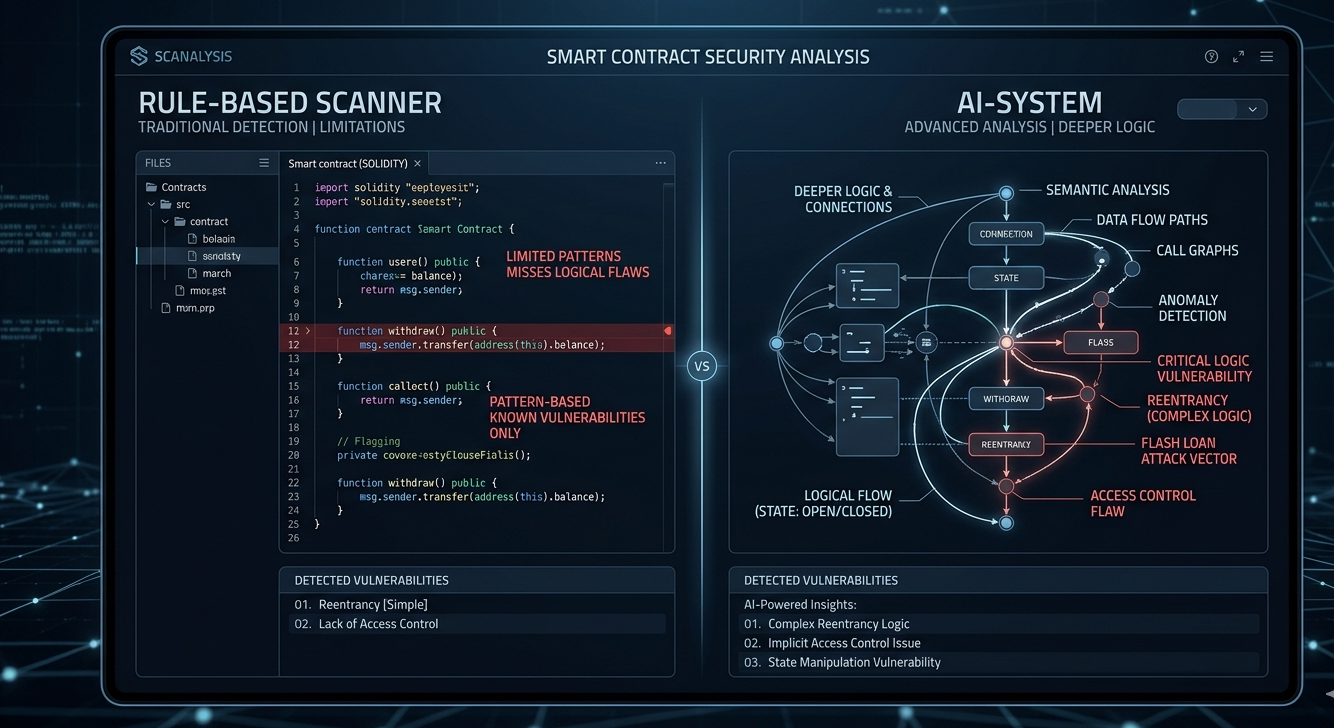
First, AI models trained on large codebases can recognize patterns across thousands of contracts simultaneously. They do not just match known signatures. They learn how vulnerability classes present themselves across varying implementations. A novel reentrancy variant that looks different from the textbook example can still trigger detection because the model understands the structural logic, not just the surface syntax.
Second, AI can assess code in context. Traditional scanners analyze functions in relative isolation. AI tools can evaluate how a function behaves given specific state conditions, what happens when multiple contract interactions occur in sequence, and where assumptions made by the developer may not hold at runtime.
Third, AI significantly reduces false positive rates when tuned correctly. Fewer false positives mean developers spend less time chasing non-issues and more time addressing genuine risks. In security work, that efficiency difference is meaningful.
How Solidity Shield Applies AI to Pre-Deployment Protection
Solidity Shield is SecureDApp’s smart contract auditing platform, purpose-built to catch vulnerabilities before deployment. It combines automated vulnerability detection with deep code analysis to deliver the kind of coverage that traditional tools miss.
The distinction matters. Pre-deployment is the most valuable window for finding and fixing issues. Once a contract is live on-chain, the options narrow sharply. You can patch through proxy patterns if the architecture allows it. You can pause and migrate if users cooperate. But in most cases, a critical vulnerability discovered post-deployment means accepting exposure or triggering a disruptive protocol migration.
Solidity Shield addresses this by enabling development teams to run comprehensive audits during the build phase. The platform scans for a broad range of vulnerability types, from well-documented attack vectors like reentrancy and access control failures to more nuanced logic flaws specific to a contract’s design. Teams receive structured, actionable reports rather than raw scanner output, which shortens the cycle between detection and resolution.
For teams building on Ethereum, BNB Chain, or any EVM-compatible network, this kind of systematic pre-deployment review is no longer optional. The on-chain environment is adversarial by design. Attackers are patient, technically sophisticated, and financially motivated. The cost of a single missed vulnerability vastly exceeds the cost of a thorough audit.
AI and the Detection of Logic-Level Vulnerabilities
One of the most significant advances AI brings to smart contract security is the ability to identify logic-level vulnerabilities. These are not syntax errors or easily-patterned security mistakes. They are flaws embedded in the business logic of a protocol.
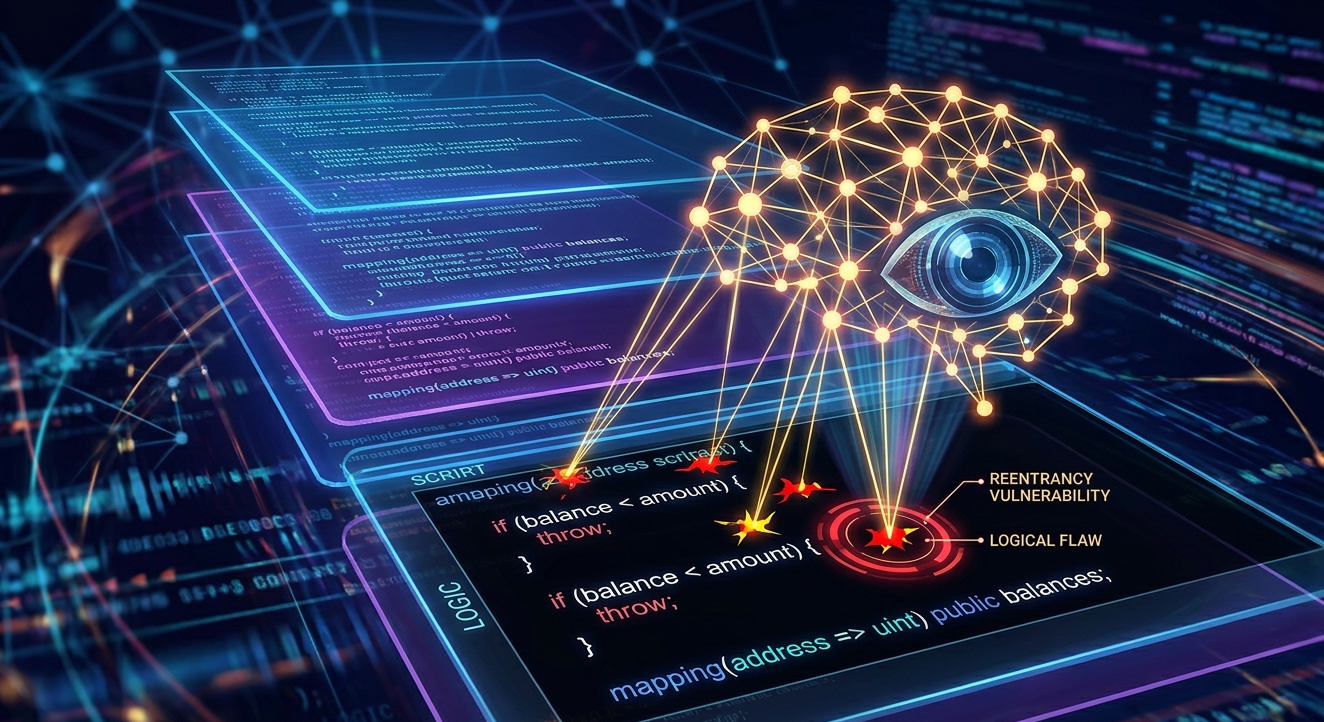
Consider a lending protocol that calculates collateral ratios correctly under normal conditions but fails to account for simultaneous liquidation requests from multiple users. Or a governance contract that follows all standard security patterns yet allows an attacker to front-run a proposal execution under specific timing conditions. These vulnerabilities do not look like classic exploits. They emerge from the interaction between design assumptions and on-chain reality.
AI models that have been trained on both secure and exploited contract code can flag suspicious logic patterns that a scanner would never catch. They can identify areas where the developer’s apparent intent and the code’s actual behavior diverge. That gap, between intent and execution, is where many of the most costly exploits originate.
This is a meaningful shift. It moves security analysis from pattern-matching against known exploits toward genuine understanding of what code does and whether it does it safely.
Reducing the Audit Cycle Without Reducing Coverage
Speed is a real constraint in Web3 development. Market conditions shift rapidly. Competition for deployment windows is real. The pressure to ship quickly is genuine and understandable.
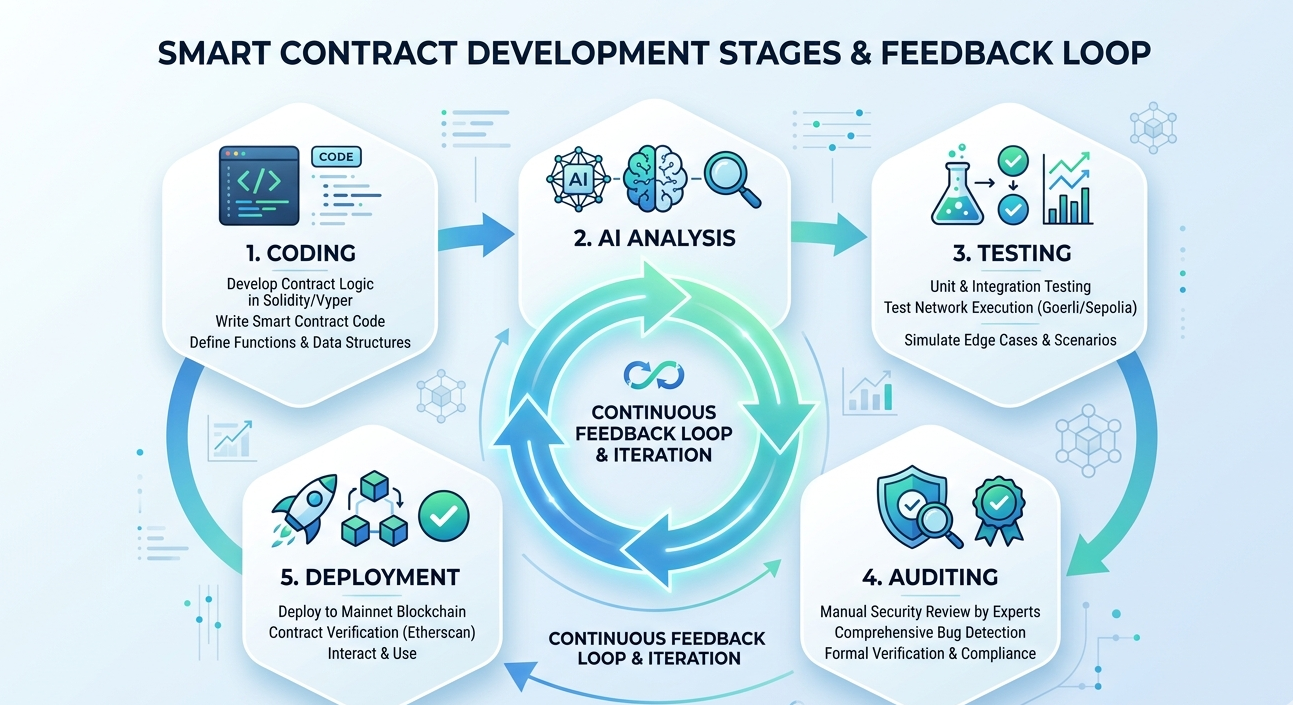
The traditional tension between speed and security has led many teams to treat audits as a final gate rather than an integrated part of development. That approach concentrates risk at the worst possible moment. Findings at the end of a development cycle are expensive and disruptive to fix.
AI-powered tools like Solidity Shield allow teams to shift the security function earlier in the process. Developers can run analysis continuously as they build, catching issues in context rather than as a batch of findings at the end. When the formal audit does happen, the codebase is already cleaner. The audit scope narrows, the timeline compresses, and the quality of findings improves because auditors are working with code that has already passed automated screening.
This integration of AI into the development workflow does not replace the human audit. It makes the human audit more effective.
Common Vulnerability Classes AI Catches More Effectively
Several vulnerability categories benefit specifically from AI-assisted detection. Understanding them helps clarify why this approach is a genuine advance rather than marketing language.
Reentrancy attacks remain among the most exploited vulnerability types in smart contract history. AI models can identify not just the classic single-function reentrancy pattern but cross-function and cross-contract variants that traditional scanners often miss. They assess call sequences and state updates together rather than in isolation.
Access control failures are another common source of critical exploits. Missing permission checks, incorrect role assignments, and improperly protected administrative functions have led to direct fund drains in dozens of protocols. AI can evaluate the completeness of access control across an entire contract system, flagging gaps that emerge from the interaction between contracts rather than within a single file.
Price manipulation vulnerabilities, particularly oracle dependency risks, are increasingly prevalent in DeFi. AI analysis can identify dangerous reliance on single on-chain price sources and flag contracts whose economic logic could be disrupted by flash loan-driven price manipulation. This class of risk is especially difficult for pattern-based scanners to catch.
Beyond these, AI adds value in reviewing token economics, validating upgrade safety in proxy patterns, and identifying unsafe external calls. The coverage improvement over traditional tooling is consistent across vulnerability types.
What AI Cannot Replace in Smart Contract Security
Honest analysis requires acknowledging limits. AI transforms smart contract security. It does not solve it completely.
Complex protocol-level logic that requires deep domain knowledge about financial mechanisms, governance design, or cryptographic assumptions still benefits enormously from human expert review. AI can flag structural risks. It is less reliable at evaluating whether a specific economic design is stable under adversarial conditions.
Emerging vulnerability classes that are genuinely novel present another challenge. AI models learn from existing data. An attack vector that has not yet appeared in the training corpus may go undetected. This is not a criticism unique to AI tools. It applies equally to human auditors working from established knowledge. It is, however, a reason why security cannot end with any single tool or method.
Furthermore, the interpretation of findings requires human judgment. AI produces analysis. The decision about which findings represent genuine risk, how to prioritize remediation, and what architectural changes might eliminate an entire class of risk are still human decisions.
The right framing is complementarity. AI-powered tools like Solidity Shield raise the baseline of what automated analysis can detect. Expert human review then operates on cleaner code with better coverage and can focus attention on the genuinely complex questions that require judgment.
The Evolving Threat Landscape in Web3
Web3 attacks are not getting simpler. Attacker sophistication has increased significantly over the past several years. The days when most exploits were straightforward reentrancy calls are largely behind us.
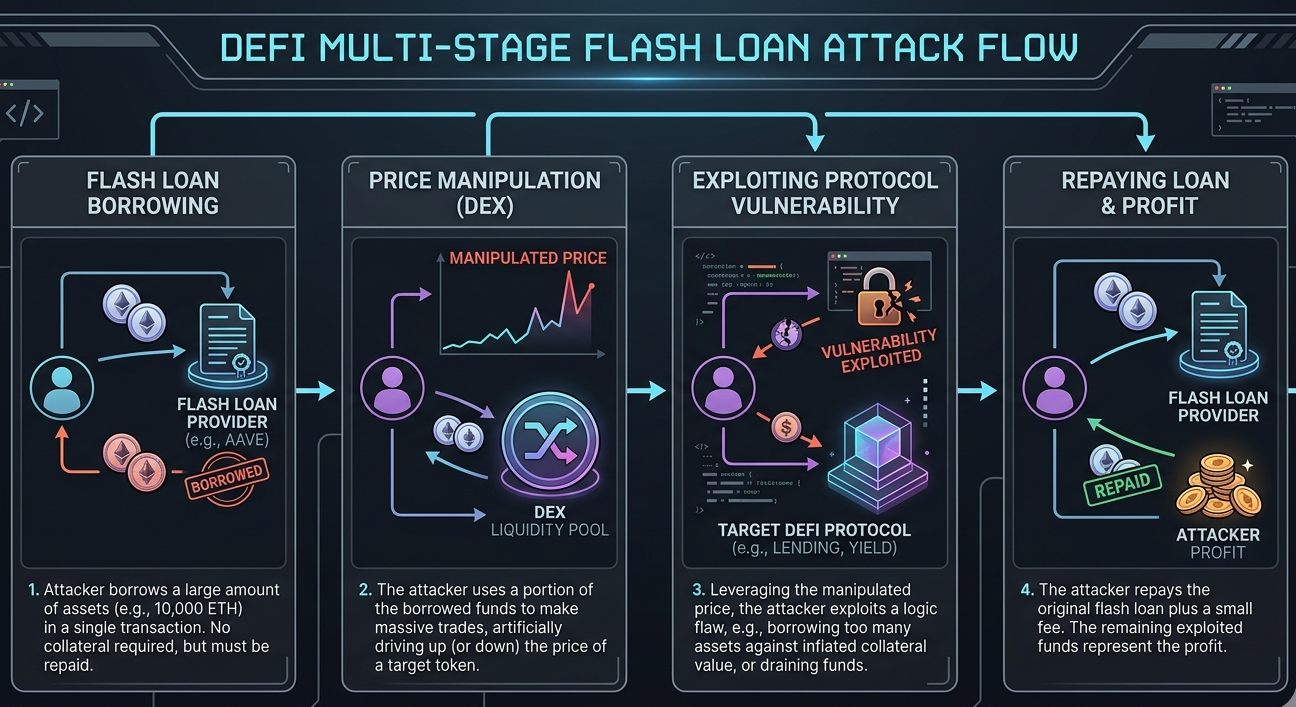
Modern attacks often involve coordinated multi-step strategies. An attacker might take a flash loan to temporarily manipulate a liquidity pool, use the distorted price to extract value from a lending protocol that trusts the pool as its oracle, and return the flash loan in the same transaction. The individual components are all legitimate operations. Their combination at speed creates a devastating exploit.
This complexity makes AI-assisted security analysis increasingly important. As attack patterns grow more elaborate, the gap between what traditional pattern-matching tools catch and what sophisticated attackers can execute grows wider. AI tools that reason about contract behavior rather than matching patterns are better positioned to keep pace.
Development teams building in this environment need to take a correspondingly sophisticated approach to security. Solidity Shield represents that approach: systematic, AI-assisted, pre-deployment coverage designed to catch the vulnerabilities that matter before they become exploitable liabilities.
Building a Security-First Development Culture
Technology is only part of the answer. The teams that consistently build secure smart contracts also build security into their culture and process.
Security-first development means running analysis early and often rather than treating the audit as a project phase. It means developers who understand common vulnerability patterns and review each other’s code with security in mind. It means choosing infrastructure, including auditing tools, that enables continuous improvement rather than one-time assessment.
Solidity Shield fits naturally into this kind of development culture. Its integration into the build workflow supports the shift from security as a checkpoint to security as a continuous practice. Teams that internalize this approach are not just safer at launch. They compound their security posture over time as developers build expertise and code review standards improve.
The result is a fundamentally different risk profile. Not zero risk, but systematically lower risk across every project the team touches.
Conclusion
AI is not a distant promise in smart contract security. It is already changing what development teams can catch before deployment, how quickly they can do it, and how effectively they can focus human expert attention on the hardest problems. The gap between teams that use AI-powered security tools and those that rely solely on traditional methods is already measurable. Over time, it will grow.
Solidity Shield represents this generation of smart contract security: pre-deployment, AI-assisted, systematic, and actionable. For teams building serious Web3 projects, it is no longer a question of whether to invest in this level of security. The question is whether you do it before or after something goes wrong.
Explore how Solidity Shield can integrate into your development workflow and help you ship with confidence.
FAQs
Q1. How does AI improve smart contract vulnerability detection compared to traditional scanners?
AI models learn patterns from large volumes of contract code and can identify structural logic risks, not just known syntax patterns. This allows them to catch novel variants of common exploits and logic-level flaws that traditional scanners miss, resulting in broader coverage and fewer false negatives.
Q2. What types of smart contract vulnerabilities can Solidity Shield detect?
Solidity Shield detects a wide range of issues including reentrancy attacks, access control failures, integer overflows and underflows, unsafe external calls, oracle manipulation risks, and logic flaws in token economics and upgrade patterns. Coverage spans both well-documented vulnerability classes and more nuanced protocol-specific risks.
Q3. Can AI-powered auditing replace manual expert review entirely?
No. AI significantly raises the quality and speed of automated analysis, but complex protocol logic, novel attack vectors, and architectural decisions still benefit from human expert judgment. The most effective approach uses AI tools like Solidity Shield to clean the codebase and focus human review on genuinely complex problems.
Q4. When in the development process should teams use Solidity Shield?
Ideally, teams should integrate Solidity Shield continuously throughout development rather than treating it as a final gate. Running analysis during the build phase catches issues in context, reduces late-stage rework, and produces cleaner code for the final human audit.
Q5. Why is pre-deployment security so much more valuable than post-deployment fixes?
Once a smart contract is deployed on-chain, the options for fixing vulnerabilities are limited and often disruptive. Proxy upgrades require specific architectural choices made in advance. Protocol migrations depend on user cooperation. Pre-deployment, teams have full freedom to fix issues cleanly. The cost comparison strongly favors catching problems before launch.