
A patient record does not expire when the treatment ends. It follows a person for decades, and so does the risk attached to it. That is exactly why a strong Healthcare HSM HIPAA strategy has become a board-level topic rather than an IT line item.
Most hospitals already encrypt their data. However, encryption is only as strong as the place where its keys live. If an attacker, a rogue administrator or a misconfigured server can reach the keys, the encryption does very little.
This guide is written for healthcare CISOs and compliance officers who need to move from “we encrypt” to “we can prove it.” We will cover what HIPAA expects, how hardware security modules (HSMs) close the gap, why quantum risk changes the timeline, and how QuantumVault turns all of it into one governed, audit-ready platform.
Why Medical Records Are the Most Valuable Target in Healthcare

Attackers do not chase patient data by accident. A stolen credit card is cancelled within hours. A stolen medical record, with its diagnoses, insurance details, identifiers and family history, stays useful for years.
The scale of the problem is hard to ignore. The 2024 attack on Change Healthcare affected well over 100 million people, which made it the largest healthcare data breach ever reported in the United States. Furthermore, ransomware crews now treat hospitals as high-pressure targets because downtime puts lives at risk and pushes victims to pay quickly.
India’s healthcare sector faces the same pressure. Digital health ID programs, cloud-based hospital information systems and telemedicine have expanded the number of places where patient data sits. As a result, patient data security now depends on how many systems you can protect consistently, not on how strong any single system is.
Here is the uncomfortable question for any CISO. If someone copied your entire medical records database tonight, would the stolen files be unreadable, and could you show an auditor why?
The honest answer depends on three things: where encryption is applied, who controls the keys, and how well you can document both. That brings us to what HIPAA actually requires.
What HIPAA Requires for Encryption and Key Control
HIPAA compliance is often described as “encrypt everything,” yet the real text is more nuanced. Under the current HIPAA Security Rule, encryption of electronic protected health information (ePHI) at rest and in transit is an addressable specification. Addressable does not mean optional. It means you must implement it, or document why an equivalent alternative is reasonable.
In practice, very few organizations can defend a decision to skip healthcare encryption on laptops, databases, backups and network links. Consequently, auditors expect to see it nearly everywhere.
The Safe Harbor That Changes Breach Math
Notably, HIPAA’s Breach Notification Rule contains a powerful safe harbor. If ePHI is properly encrypted and the decryption key was not compromised, the lost data is not treated as “unsecured” PHI. That can mean the difference between a quiet internal incident and a public notification event that triggers regulatory scrutiny.
Read that condition again: and the key was not compromised. The safe harbor protects you only when key management is as strong as the encryption itself. This is the single most overlooked point in healthcare security reviews.
The Proposed Rule Is Moving Toward Mandatory Encryption
In January 2025, HHS proposed a major update to the Security Rule. The proposal would remove the distinction between required and addressable safeguards and make encryption of ePHI at rest and in transit mandatory, with limited exceptions. It also pushes harder on asset inventories, multi-factor authentication and documented risk analysis.
As of this writing, the rule is not final. The federal regulatory agenda now projects final action no earlier than July 2027, and the current Security Rule remains fully enforceable in the meantime.
Importantly, a delay is not a reprieve. The direction is clear, and OCR already evaluates evidence of safeguards during investigations. Teams that build strong Healthcare HSM HIPAA controls now will treat the final rule as a checklist they have already completed.
Why Software Keys Struggle in a Healthcare HSM HIPAA Audit
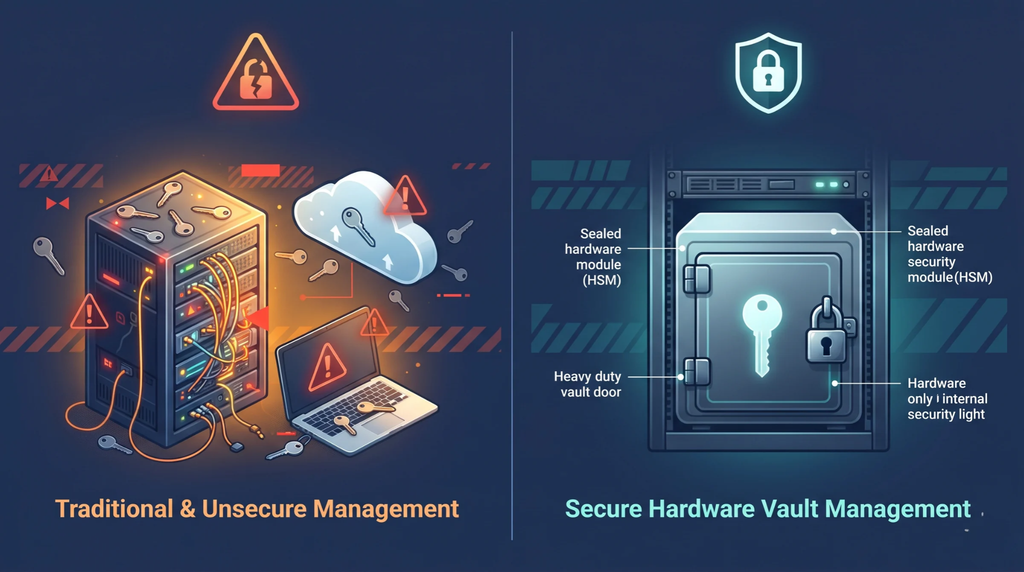
Many healthcare environments store encryption keys in configuration files, application servers or general-purpose key vaults. It works, and it is cheap. Unfortunately, it creates three problems that surface during audits and breaches.
First, keys that live in software memory can be copied. A single compromised server, backup or administrator account may expose them. Second, key usage is rarely logged in a way that satisfies a compliance officer. Third, key rotation and retirement often depend on manual effort, so they slip.
Here is a useful way to think about it. Locking a vault but leaving the combination on a sticky note does not improve security. It simply moves the weakness.
What a Hardware Security Module Actually Does
An HSM is a tamper-resistant device that generates, stores and uses cryptographic keys inside a protected boundary. The keys never leave it in plain form. Applications send data in, request an operation such as encrypt or sign, and receive the result. Because of this design, even a fully compromised application server cannot walk away with the master keys.
For a general overview of how hardware security modules protect keys, this vendor reference on HSMs is a useful starting point. For healthcare, the principle matters more than the brand: keys belong in hardware-protected, access-controlled, fully logged boundaries.
When reviewing any HSM-backed design, look for validation against FIPS 140-3, strong role separation, and quorum-based controls for sensitive actions. These features turn “we have a key” into “we can prove who touched it.”
If you want the full compliance walkthrough, our companion guide on how to comply with HIPAA using HSM covers the control-by-control detail.
Mapping Healthcare HSM HIPAA Controls to Safeguards
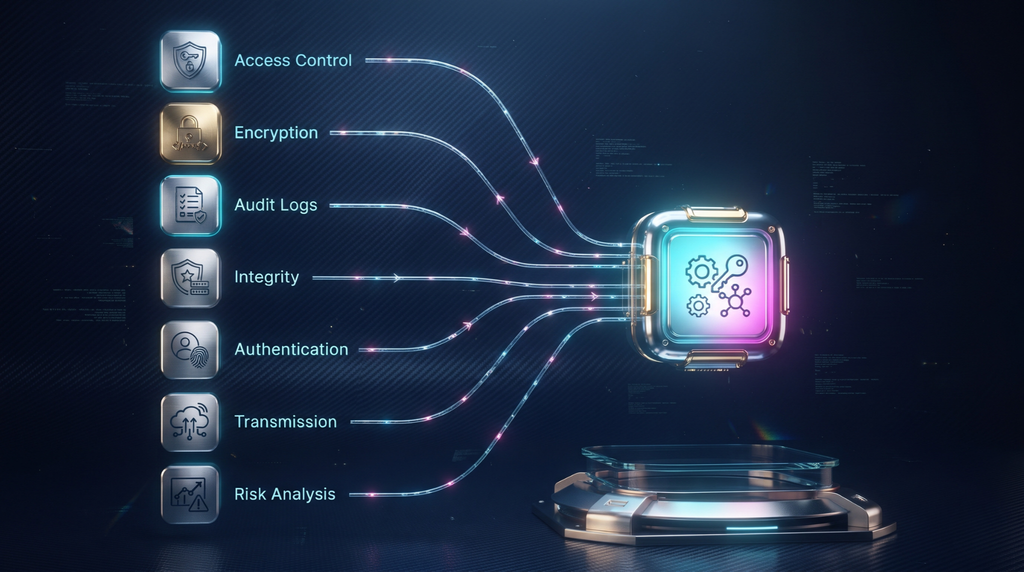
Compliance officers think in safeguards, not hardware. Therefore, any Healthcare HSM HIPAA review should begin by mapping each requirement to a specific key management capability. The table below shows how that mapping looks in practice.
| HIPAA Security Rule area | What the auditor wants to see | How HSM-backed key management helps |
|---|---|---|
| Access control (164.312(a)) | Only authorized users and systems reach ePHI | Role-based key access, separation of duties, quorum approval |
| Encryption and decryption (164.312(a)(2)(iv)) | ePHI encrypted at rest with controlled keys | Master keys protected in hardware, data keys wrapped and rotated |
| Audit controls (164.312(b)) | Records of activity on systems holding ePHI | Tamper-evident logs of every key creation, use and deletion |
| Integrity (164.312(c)) | Proof that records were not altered | Digital signatures generated inside the secure boundary |
| Authentication (164.312(d)) | Verified identity of people and services | Strong credentials for key operators and service identities |
| Transmission security (164.312(e)) | ePHI protected across networks | Keys that power encrypted tunnels and gateways |
| Risk analysis (164.308(a)(1)) | Documented, repeatable risk assessment | Central inventory of keys, algorithms and owners |
Two observations stand out. First, nearly every row depends on key governance, not just on the encryption algorithm. Second, the last row, a central inventory, is where most healthcare organizations are weakest today.
The Quantum Problem Hiding Inside Your Medical Records
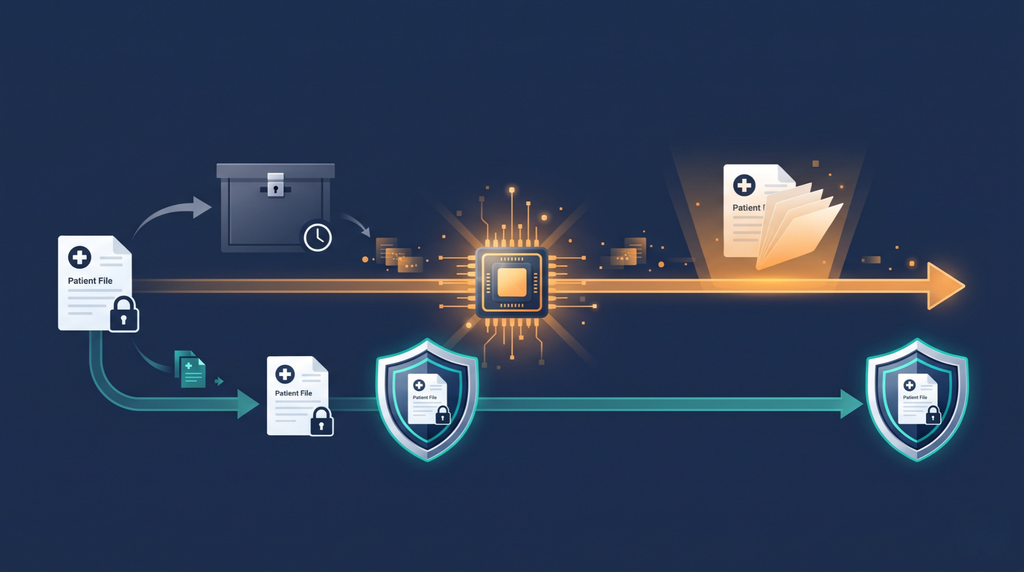
Now we reach the part most HIPAA guides skip. Medical records have an unusually long shelf life. A pediatric record may stay sensitive for seventy years or more.
Meanwhile, attackers are already practicing a strategy called “harvest now, decrypt later.” They copy encrypted traffic and archives today, then wait for a future quantum computer to break the public-key cryptography that protects them. The data may be encrypted, but if it is encrypted with algorithms that will not survive, the protection has an expiry date.
What NIST Has Already Decided
In August 2024, NIST finalized the first post-quantum cryptography standards: FIPS 203 for key establishment (ML-KEM), FIPS 204 for digital signatures (ML-DSA) and FIPS 205 for hash-based signatures (SLH-DSA). NIST has also signaled in its transition guidance that widely used algorithms such as RSA and elliptic curve cryptography will be deprecated and later disallowed, with 2030 and 2035 as the key milestones in the draft guidance.
For a hospital, that is a planning signal, not a distant theory. EHR platforms, imaging archives, patient portals and medical devices can take years to upgrade. Starting the PQC migration conversation in 2026 is simply responsible risk management, and it belongs inside your Healthcare HSM HIPAA roadmap.
Insight: HSM Strategy and Quantum Strategy Are the Same Strategy
Here is the shift in thinking that matters most. Many teams treat HSM adoption and quantum readiness as two separate projects with two separate budgets. In reality, they share the same foundation: a clear inventory of keys, a governed way to rotate them, and the ability to swap algorithms without rebuilding applications.
An HSM deployment that cannot change algorithms will become the next migration headache. Conversely, a quantum-safe design that ignores hardware-backed key protection leaves the most sensitive assets exposed. The best answer addresses both together.
How QuantumVault Brings Healthcare HSM HIPAA Controls Together
This is where QuantumVault fits. QuantumVault is a quantum-safe security platform built for regulated enterprises, including hospitals, health insurers, diagnostic networks and health-tech companies that handle ePHI. Rather than adding yet another point tool, it organizes cryptographic protection, governance and migration into one PQC suite for enterprise quantum-safe security.
Let us look at how its components map to the problems we have discussed.
PQC Key Management and Hardware-Backed Protection
At the center is PQC key management. QuantumVault manages the full key lifecycle, including generation, storage, rotation, expiry and retirement, for both classical and quantum-resistant algorithms. Keys for patient databases, backup archives and signing operations are governed from a single control plane. This is the practical core of any Healthcare HSM HIPAA program, because it replaces scattered, hand-managed keys with consistent policy.
PQC Policy Engine and Governance
A PQC policy engine lets security teams define which algorithms, key lengths and rotation periods are allowed for each data class. For example, ePHI in long-term archives can require hybrid encryption, while short-lived session data follows a lighter profile. The PQC governance platform then tracks adherence, so compliance officers see exceptions before an auditor does.
This approach supports PQC governance for secure cryptographic migration, because every policy change is recorded, approved and reversible.
PQC Audit Logs for Evidence, Not Guesswork
Auditors ask for proof. Therefore, PQC audit logs record who requested which key operation, when, from which system and under which policy. Those records support HIPAA audit control requirements and make PQC compliance reporting far faster than assembling screenshots and spreadsheets by hand.
PQC Gateway and PQC Tunnel for Data in Motion
Hospitals move ePHI constantly: between clinics and central systems, to billing partners, to cloud analytics and to remote clinicians. A quantum-safe gateway for cryptographic policy enforcement sits in front of these flows and applies the right encryption automatically. Meanwhile, a PQC tunnel protects site-to-site links, and quantum-safe remote access and tunnel security secures clinicians who connect from home or from satellite clinics.
Signing, Collaboration and Device Security
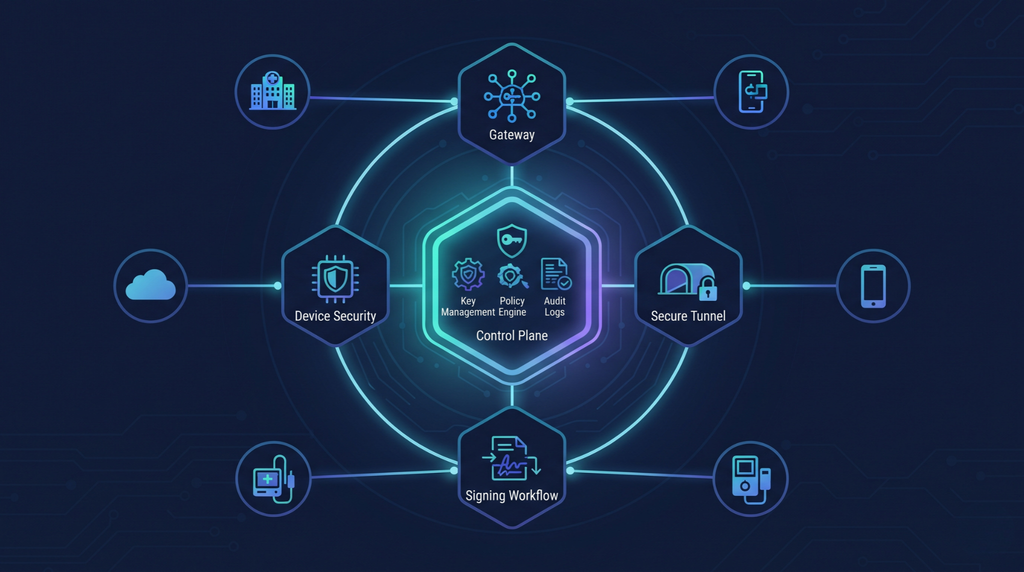
Healthcare runs on approvals: prescriptions, consent forms, discharge summaries, research agreements and vendor contracts. A PQC signing workflow provides secure signing and approval workflows with signatures that remain trustworthy as algorithms evolve. In addition, PQC collaboration security protects shared documents and messages between care teams and external partners.
Finally, PQC device security extends protection to connected medical devices and edge equipment, which are often the hardest assets to patch. Together, these modules provide quantum-resistant security for web, mobile, server and devices from one governed platform.
Crypto-Agility: The Capability Auditors Will Ask About Next
Most security leaders have lived through a painful algorithm change. A deprecated cipher turns into a scramble across hundreds of applications, each with its own hard-coded settings. Now imagine that happening while a regulator is watching.
Crypto-agility, also called cryptographic agility, is the ability to change algorithms, key sizes and providers through policy instead of code rewrites. It is the practical answer to the question, “What happens when the standard changes again?”
Why Agility Matters More in Healthcare Than Elsewhere
Healthcare has the longest upgrade cycles of almost any industry. An infusion pump may run for fifteen years. A radiology archive may sit untouched for a decade. Because of this, a cryptographic agility platform is not a luxury. It is the only realistic way to keep old and new systems protected at the same time.
A quantum-safe security platform with cryptographic agility such as QuantumVault lets teams switch an application from a classical algorithm to a hybrid or post-quantum one by updating policy. As a result, the same change can reach thousands of endpoints without a separate project for each.
Hybrid Encryption: The Safe Bridge
Few organizations will jump straight from classical to pure post-quantum cryptography. Hybrid crypto combines a proven classical algorithm with a post-quantum one, so the data stays protected if either is later weakened. This is the approach many standards bodies and security agencies currently favor during the transition.
A hybrid PQC and classical encryption platform gives healthcare teams two benefits at once. It preserves compatibility with existing EHR and imaging systems, and it begins protecting long-lived records against future quantum attacks today.
Real-World Scenarios: What This Looks Like in Practice
Principles are useful. Scenarios are persuasive. Consider two.
Scenario One: The Third-Party Breach Lesson
The Change Healthcare incident showed how a single vendor connection can ripple across the entire industry. Providers that depended on one clearinghouse discovered how many of their processes, and how much of their patient data, flowed through systems they did not directly control.
The lesson for a CISO is not “avoid vendors.” It is “control your own keys and your own data flows.” When an organization holds its encryption keys in a governed, hardware-protected boundary, a vendor-side compromise exposes far less readable data. Similarly, a quantum-safe gateway with a clear policy shows exactly which partner connections carry ePHI and how each one is protected.
Scenario Two: A Regional Hospital Network (Illustrative)
Imagine a network of twelve hospitals and forty clinics. Its patient records sit in an EHR database, an imaging archive and nightly cloud backups. Keys are scattered: some in application configs, some in a cloud vault, some in a legacy appliance that nobody wants to touch.
The compliance officer starts a risk analysis and discovers three uncomfortable facts. No one can list every key. Rotation is inconsistent. And the backup encryption uses an algorithm scheduled for deprecation.
With QuantumVault, the team builds a key and algorithm inventory first. Next, the policy engine assigns profiles by data class: hybrid encryption for archives, standard profiles for transient data. After that, the gateway and tunnels protect inter-site traffic, and audit logs feed the compliance dashboard. Within one planning cycle, the network moves from scattered keys to a documented, defensible architecture.
A Practical Roadmap for PQC Migration and Rollout
Big programs stall when they begin with big bangs. A phased PQC rollout works better, especially in clinical environments where downtime is not acceptable.
Phase 1: Discover and Inventory
Start by listing every system that stores or transmits ePHI, along with the algorithms and keys each one uses. This inventory supports your HIPAA risk analysis and also becomes the baseline for the quantum transition. Expect surprises, especially in legacy applications and medical devices.
Phase 2: Prioritize by Data Lifespan
Not every system needs the same urgency. Records with long confidentiality needs, such as pediatric history, genomic data and long-term archives, face the greatest harvest-now risk. Therefore, protect those first and handle short-lived data later.
Phase 3: Centralize Key Management and Policy
Move keys into governed, hardware-backed control. Define policies for algorithms, rotation and access by data class. This step delivers immediate HIPAA compliance value before a single post-quantum algorithm is deployed.
Phase 4: Deploy Hybrid Protection
Introduce hybrid encryption on high-priority links and archives, using the gateway and tunnel layer to avoid touching every application. Test performance carefully, because post-quantum algorithms can produce larger keys and signatures.
Phase 5: Monitor, Audit and Iterate
Use audit logs and governance reporting to confirm that policy matches reality. Then review the roadmap as standards, vendors and regulations evolve. If you want a deeper walkthrough, see our guide to PQC migration planning.
How to Evaluate a Healthcare HSM HIPAA and Quantum-Safe Platform
At the bottom of the funnel, the question changes from “why” to “which.” Every Healthcare HSM HIPAA shortlist should survive the questions below. Below is a practical checklist for CISOs and compliance officers who are comparing options.
Ask about compliance evidence. Can the platform produce audit-ready reports that map to HIPAA safeguards without manual assembly? If the answer involves spreadsheets, keep looking.
Ask about algorithm flexibility. Can you change algorithms by policy? Most legacy HSM deployments and basic cloud key vaults focus on classical algorithms only. As a result, they solve today’s audit problem but leave tomorrow’s migration problem untouched.
Ask about coverage. Does the platform protect web, mobile, server, network and device layers, or only one? Partial coverage creates blind spots that attackers prefer.
Ask about governance. Are policy changes approved, logged and reversible? A post-quantum cryptography solution for regulated enterprises must treat governance as a core feature, not an add-on.
Ask about operational fit. Will it work with your EHR, imaging and cloud environments, and can your existing team operate it? A platform that needs a dedicated cryptography department will not survive a lean healthcare IT budget.
This is the comparison where QuantumVault is designed to stand out. Instead of offering only key storage, it combines key management, policy enforcement, audit evidence and quantum-safe migration in a single PQC security platform. For organizations that want one accountable layer, that consolidation reduces both risk and effort. For deeper reading, explore our overview of crypto-agility for regulated enterprises.
Conclusion: Turn Encryption Into Evidence
Patient records carry long-lived value, and attackers know it. HIPAA already expects you to protect them, and the proposed Security Rule update points toward mandatory encryption and stronger proof. Meanwhile, quantum computing adds a new time dimension to every record you store today.
The path forward is consistent. Put your keys inside a hardware-backed, governed boundary. Map every control to a HIPAA safeguard. Build crypto-agility so algorithm changes become policy updates. Then protect your longest-lived data with hybrid, quantum-ready encryption before the deadline arrives.
A strong Healthcare HSM HIPAA program does all of this at once. It satisfies today’s auditors, prepares for tomorrow’s rule and protects patients for decades. QuantumVault gives healthcare security and compliance teams a practical way to get there, with key management, policy enforcement, audit logs and quantum-safe security in one platform.
Ready to see it working with your own environment in mind? Request a Demo and walk through a HIPAA-aligned architecture with the QuantumVault team.
Frequently Asked Questions
1. What is a healthcare HSM and why does Healthcare HSM HIPAA planning need one?
A healthcare HSM is a tamper-resistant device that generates and protects encryption keys for systems holding ePHI. HIPAA does not name HSMs explicitly. However, hardware-backed key protection is one of the strongest ways to show that encryption keys were controlled and not compromised.
2. Is encryption required under HIPAA?
Today, encryption of ePHI is an addressable specification, so you must implement it or document an equivalent alternative. HHS proposed in January 2025 to make it mandatory with limited exceptions. That proposal is not yet final.
3. Does encryption protect me from breach notification?
Often, yes. If ePHI is encrypted to accepted standards and the key was not compromised, the data is not considered unsecured PHI. This is why strong key management is as important as the encryption itself.
4. Which HIPAA safeguards does an HSM support?
HSM-backed key management supports access control, encryption and decryption, audit controls, integrity, authentication and transmission security. It also supports risk analysis by providing a central inventory of keys and algorithms.
5. Is HIPAA compliance certification available for HSMs?
No official HIPAA certification exists for products. Instead, organizations show compliance through risk analysis, documented safeguards and evidence. Look for independent validations such as FIPS 140-3 as supporting proof.
6. What does “harvest now, decrypt later” mean for patient data?
Attackers copy encrypted data today and store it until quantum computers can break the encryption. Because medical records stay sensitive for decades, they are a prime target for this strategy.
7. What are the NIST post-quantum standards?
NIST finalized FIPS 203 (ML-KEM), FIPS 204 (ML-DSA) and FIPS 205 (SLH-DSA) in August 2024. They form the base for most post-quantum cryptography solutions now entering enterprise use.
8. What is hybrid encryption and should hospitals use it?
Hybrid encryption combines a classical algorithm with a post-quantum one. If either is weakened later, the data stays protected. For long-lived records and legacy compatibility, it is a sensible transition path.
9. What is crypto-agility in a healthcare context?
It is the ability to change algorithms and key settings through policy, without rewriting applications. Healthcare needs it because medical devices and clinical systems have very long upgrade cycles.
10. How is QuantumVault different from a standard key vault?
A standard key vault stores keys. QuantumVault adds policy enforcement, quantum-safe algorithms, a gateway and tunnels, audit logs and governance in one platform. That combination supports both HIPAA evidence and PQC migration.
11. Can a quantum-safe gateway protect older systems?
Yes. A gateway applies encryption policy at the network layer, so legacy EHR and imaging systems gain stronger protection without immediate code changes. It is a practical way to start a rollout.
12. How long does a PQC migration take for a hospital network?
It depends on the number of systems and devices, but a phased plan usually starts with an inventory and policy layer within one planning cycle. Full coverage then follows in stages, prioritized by data lifespan.
13. Does the proposed HIPAA update change what I should do now?
It should not change the direction, only the timeline. Strengthening encryption, key management, MFA and asset inventories now means the final rule becomes a box you have already checked.
14. Who should own the HSM and key management program?
Typically the CISO owns the program, with the compliance officer defining evidence needs and IT operations running day-to-day tasks. Clear role separation is itself a HIPAA-friendly control.