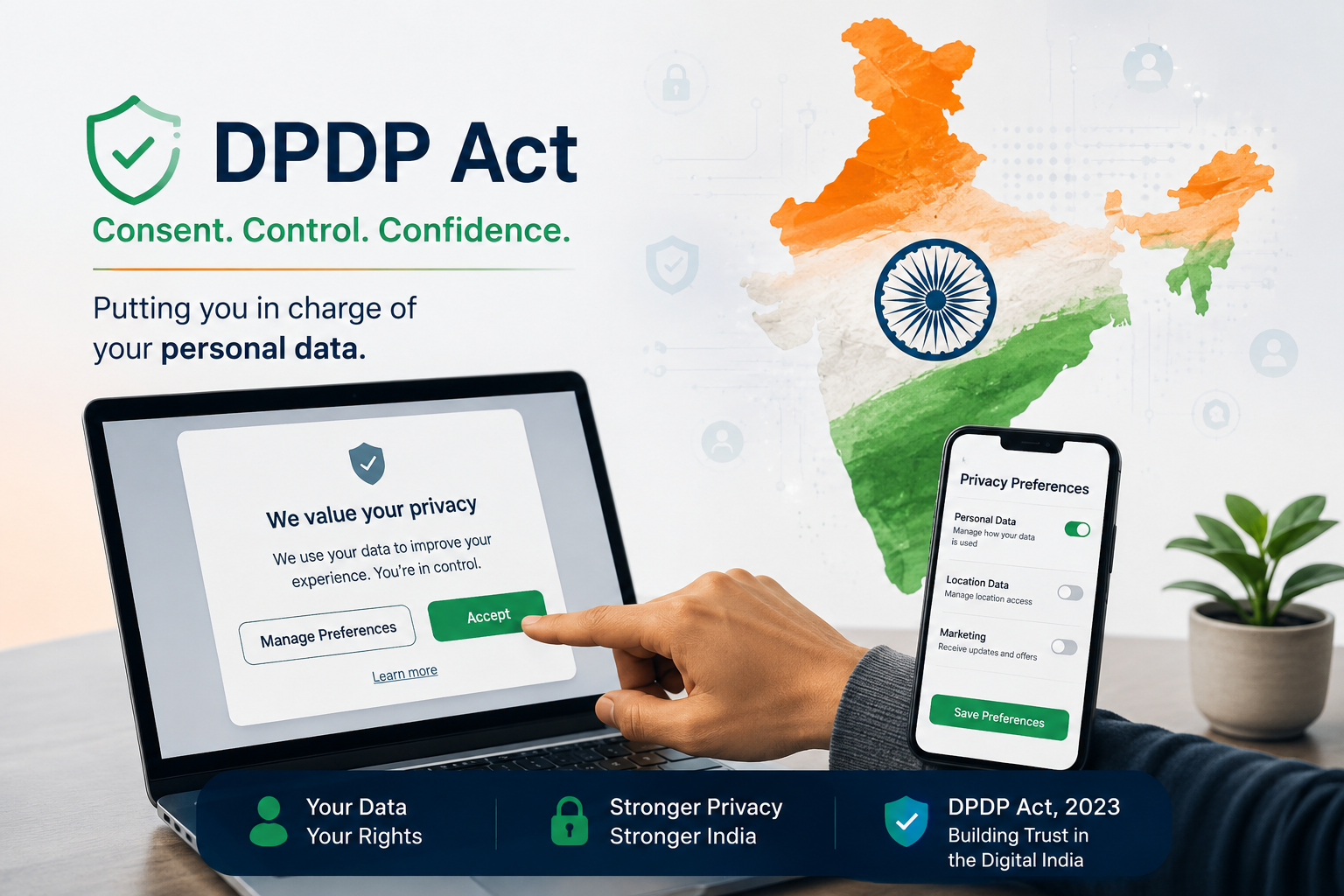
Under Section 6(1) of the DPDP Act, 2023, consent is valid only if it is free, specific, informed, unconditional and unambiguous, given through a clear affirmative action, and limited to the personal data necessary for the stated purpose.If any one of these requirements is not met, the validity of the consent may be questioned. Where consent is the basis for processing and a dispute arises in a proceeding, the Data Fiduciary must prove that the notice was given and that consent was obtained in accordance with the Act and the Rules.
That single sentence in the law carries a great deal of weight. In fact, almost every operational duty in consent management under the DPDP Act begins here. Therefore, this article takes Section 6 apart piece by piece and explains each condition in plain English, with realistic examples from banking, ecommerce, health and mobile apps. Along the way, we will also look at data minimisation, bundled consent, pre-ticked boxes and what happens to consent collected before the Act. For the wider legal picture, you can also read our DPDP consent management guide.
The definition in Section 6(1)
The heart of the provision is a single sentence. It says that consent given by a Data Principal must be free, specific, informed, unconditional and unambiguous with a clear affirmative action. It must also signify agreement to the processing of her personal data for the specified purpose and be limited to the personal data that is necessary for that purpose.
Broken down, that gives us six working conditions:
- Free
- Specific
- Informed
- Unconditional
- Unambiguous
- Given through a clear affirmative action

In addition, the consent must be tied to a specified purpose and must not stretch beyond the data that purpose genuinely needs. We will examine the necessity limit separately because it is so often overlooked.
One more point deserves attention before we begin. Section 6(10) says that when a question arises, the Data Fiduciary must prove that notice was given and that consent was obtained in line with the Act. Consequently, each condition below should be read twice: once as a legal test, and once as a question about evidence.
Condition 1: Consent must be free
What it means. The person must be able to say yes or no without pressure, trickery or an unfair penalty. Consent that is extracted by force, by confusing design or by tying it to something unrelated is not free.
Good example. An online bookstore asks, “Would you like to receive offers by email?” with two equally visible buttons, “Yes, send offers” and “No, thanks”. The customer can still buy a book either way.
Bad example. A shopping app shows a pop-up that says, “Accept all to continue,” and offers no alternative. Because the customer cannot proceed without agreeing to everything, the choice is not free.
Practical tip. Make declining as easy and as visible as accepting. Avoid colour tricks, hidden “reject” links and guilt-driven wording.
Condition 2: Consent must be specific
What it means. Each consent must refer to a particular purpose. A broad statement such as “we may use your data for our business purposes” says nothing concrete and therefore cannot be specific.
Good example. A lender’s loan application page lists three separate purposes: assessing eligibility, sending repayment reminders and sharing offers about other products. The customer can agree to the first two and decline the third.
Bad example. A single tick-box reads, “I agree to the processing of my data for all purposes described in the privacy policy.” Since the purposes are neither listed nor separable, the consent lacks specificity.
Practical tip. Write one clear sentence per purpose, and give each its own choice. Moreover, keep your internal purpose register aligned with what the customer sees.
Condition 3: Consent must be informed
What it means. A person can only agree meaningfully after understanding what they are agreeing to. Section 5 and Rule 3 therefore require a notice that arrives with the request, or before it, and that makes sense on its own. It must itemise the data, state the purpose, explain how to withdraw, and tell the person how to exercise rights and complain to the Board.
Good example. A health app shows a short screen before sign-up listing the data it collects (name, age, symptoms), why it needs each item, how to withdraw, and who to contact with a complaint. A link to the longer policy is available but is not required to understand the notice.
Bad example. A banking app says, “By proceeding you accept our Terms,” followed by a link to a forty-page document. The customer never sees a purpose-by-purpose explanation.
Practical tip. Write notices in plain language, keep them short, and offer English or any Eighth Schedule language, as Section 6(3) requires. Importantly, store the version that each customer saw.
Condition 4: Consent must be unconditional
What it means. A business cannot make a service depend on consent to something the service does not need. In other words, optional purposes must really be optional.
Good example. A food delivery app needs a delivery address and a phone number to complete an order. It also asks for permission to send promotional messages, but a customer who declines can still order dinner.
Bad example. The same app refuses to deliver unless the customer also agrees to share her data with unnamed “partners” for advertising. Because delivery does not depend on advertising, the condition is imposed unfairly.
Practical tip. For each purpose, ask: “Can we deliver the service without this?” If yes, the purpose must be optional. Section 6(2) adds that any part of a consent that infringes the Act or other laws is invalid to that extent, which helps explain why unfair conditions fail.
Condition 5: Consent must be unambiguous
What it means. There should be no doubt about what was agreed. Silence, inactivity and unclear wording all create doubt.
Good example. A telecom operator’s app shows, “Allow us to use your usage history to recommend plans?” followed by two buttons, “Allow” and “Don’t allow”. The meaning is obvious.
Bad example. A website states, “We may share your details with trusted partners,” and below it, a small tick-box that has already been ticked. Because the person may not have noticed the pre-ticked box, the agreement is doubtful.
Practical tip. Use direct questions and plain answers. Furthermore, avoid double negatives, such as “Untick this box if you do not wish not to receive messages.”
Condition 6: Consent must come through a clear affirmative action
What it means. The person has to do something positive to signal agreement. A tick, a tap, a toggle, an OTP entry or an e-signature all qualify. By contrast, doing nothing does not.
Good example. An insurer sends an OTP to the customer’s phone after showing a notice. The customer enters the OTP, and the system logs the notice version, timestamp, channel and purpose.
Bad example. A site announces, “By continuing to browse, you agree to our data practices.” The visitor never performs a distinct act of agreement, so the action is neither clear nor affirmative.
Practical tip. Create a separate action for each consent. Then record it. Because proof matters, log the method alongside the timestamp.
Summary table of the six conditions
| Condition | Passes when | Fails when |
|---|---|---|
| Free | A real yes or no is available | Consent is forced or bundled with something unrelated |
| Specific | Each purpose is named and separate | A blanket “all purposes” statement is used |
| Informed | A standalone notice is shown first | Terms are buried in a long link |
| Unconditional | Optional purposes are truly optional | Service is denied for declining an unneeded purpose |
| Unambiguous | Wording and choices are clear | Pre-ticked boxes or confusing language appear |
| Clear affirmative action | The person taps, ticks or enters an OTP | Silence or “by continuing” is treated as consent |
Section 6 beyond the six conditions: the other sub-sections
Most guides stop at Section 6(1). However, the remaining sub-sections shape how your consent screens, withdrawal flows and records must work. Together, they make up the practical DPDP consent requirements, so it helps to read them as one package.
Section 6(2): partial invalidity. Any part of a consent that infringes the Act, the Rules or another law is invalid to that extent. As a result, the offending part cannot be relied on, even if the rest of the consent looks fine.
Section 6(3): language and contact details. Every request for consent must use clear and plain language. The person must be able to read it in English or any Eighth Schedule language. The request must also give contact details of a Data Protection Officer, where one applies, or of another person you have authorised to answer questions about her rights.
Section 6(4): withdrawal. The person may withdraw consent at any time, and the ease of withdrawing must be comparable to the ease of giving it. So if a customer gave consent with one tap, a support ticket is not an acceptable way to take it back.
Section 6(5): consequences of withdrawal. The person bears the consequences of withdrawing. For example, if a service genuinely depends on a purpose, withdrawing consent for it may end that service. However, withdrawal does not make earlier processing unlawful. Processing done on valid consent before the withdrawal stays legal.
Section 6(6): stopping processing. After withdrawal, the Data Fiduciary must, within a reasonable time, stop processing and make its Data Processors stop too. An exception applies where the Act or another law requires or authorises the processing. Therefore, your systems should tell “stop using this data for marketing” apart from “delete this data”.
Sections 6(7) to 6(9): Consent Managers. A person may give, manage, review or withdraw consent through a Consent Manager. That intermediary is accountable to her, acts on her behalf and must be registered with the Data Protection Board.
Data minimisation: consent only for necessary data
Beyond the six conditions, Section 6(1) includes a quieter but powerful limit. Consent must be restricted to the personal data necessary for the specified purpose. This idea, usually called data minimisation, protects people from over-collection.
The Act illustrates it with a telemedicine app. The app asks the user for consent to process her data to provide telemedicine services and also to access her phone’s contact list. She agrees to both. However, the contact list is not necessary for telemedicine. As a result, her consent is limited to the data processing needed to provide the service.
In practice, this means every field in a form should have a reason. A bank onboarding form that asks for religion, for instance, would struggle to justify that field for opening a savings account. Therefore, review your forms line by line and remove anything you cannot tie to a stated purpose.

Bundled consent and pre-ticked boxes: why they fail
Two habits cause most invalid consents in the market today.
Bundled consent combines several purposes into one agreement. For example, a single button may cover service delivery, marketing, analytics and sharing with group companies. Since the person cannot accept one and refuse another, the consent is neither specific nor free.
Pre-ticked boxes show a default “yes” that the person must actively undo. Because the law requires a clear affirmative action, a default that the person never chose cannot count. In addition, a pre-ticked box makes it hard to prove that the customer even noticed the choice.
Both habits are easy to fix. Separate purposes, leave boxes empty, and present choices in simple language. Afterwards, test the screen with colleagues who have never seen it and ask what they believe they have agreed to.
Consent obtained before the Act: Section 5(2)
Many businesses ask a natural question: “What about the consents we collected years ago?” Section 5(2) addresses this. Where a person gave consent before the Act began, the Data Fiduciary must give her a notice as soon as it is reasonably practicable. The notice must describe the personal data, the purpose, how to exercise rights and how to complain to the Board. In the meantime, the business may continue processing until the person withdraws consent.
This rule creates a practical task. First, identify your legacy consent records. Next, prepare Rule 3 notices that match them. Then send those notices through suitable channels, such as email, SMS or in-app messages. Finally, log that you sent them, because proof will matter later. Meanwhile, remember that the continued use right depends on the original purpose; new purposes will need fresh consent.
A worked example: one customer, one loan application
Here is how the six conditions play out together in a single journey. The scenario is illustrative.
A customer opens a lender’s app to apply for a personal loan. First, the app shows a short notice listing the data it needs, such as name, phone number, income details and address, with the purpose of each item. The notice also explains how to withdraw and how to complain to the Board. Second, the screen offers three separate choices: assessing eligibility, sending repayment reminders and sharing offers about other products. All three boxes start empty. Third, the customer ticks all three. Had she left the offers box empty, she could still have continued, because offers are not needed to assess a loan. Finally, she confirms with an OTP.

Three weeks later, she switches off offers from the settings screen in two taps. The system records the withdrawal with its own timestamp and tells the marketing tool to stop. That is the full cycle: free, specific, informed, unconditional, unambiguous, affirmative, limited to what is needed, and provable.
Quick test: is your consent screen valid?
Use this checklist on every screen, form and script where you collect consent.
- Is a notice shown before or with the request, and does it stand on its own?
- Does the notice list the data, the purpose, the withdrawal method, and how to complain?
- Is each purpose separate, with its own choice?
- Are all boxes unticked by default?
- Can the person decline an optional purpose and still use the service?
- Does the person take a clear action, such as a tick, tap, OTP or signature?
- Is the data requested limited to what the purpose needs?
- Is English, or an Eighth Schedule language, available?
- Can the person withdraw as easily as they agreed?
- Do you record the notice version, timestamp, channel and method for each consent?
If you answered “no” to any item, fix it before 13 May 2027, when the main notice and consent rules take effect.
Key dates for Section 6
Section 6 does not switch on all at once. The DPDP Rules, 2025 were notified on 13 November 2025. Registration of Consent Managers under Section 6(9) and Rule 4 begins on 13 November 2026. The remaining consent provisions, Section 6(1) to 6(8) and 6(10), apply from 13 May 2027, along with the notice rules in Rule 3. In other words, you have until then to fix your screens, notices and records.

How consent management software helps
Valid consent is only half the story; the other half is proving it. A platform such as SecureCMS supports this by collecting consent with OTP on email, SMS and WhatsApp, managing purposes against a data catalogue, versioning policies, enforcing revocation across connected systems and storing blockchain-backed audit logs. For sector-specific examples, see our pages for ecommerce, banks and hospitals.
Ready to check your own consent flows? Book a SecureCMS demo
Frequently asked questions
Is “by continuing you agree” valid consent?
In most cases, no. Continuing to browse or use a service is not a distinct, clear affirmative action, and it usually fails the specific and informed tests as well. Use a separate tick, tap or OTP step instead.
Can consent be verbal?
The Act requires a clear affirmative action but does not insist on a written form. A spoken “yes” on a call may therefore qualify, provided the notice was given first. However, because Section 6(10) puts the burden of proof on you, you should record the call or log the consent in a verifiable way.
Does an OTP count as consent?
Yes, an OTP can serve as a clear affirmative action if it is linked to a specific notice and purpose that the person has seen. An OTP sent for login or identity verification, without any consent request, does not count as consent for marketing or data sharing.
Do I need fresh consent for every new purpose?
Generally, yes. Consent is tied to a specified purpose. When you add a new purpose, you should present a notice and request consent again, unless a Section 7 legitimate use applies.
What happens if consent is invalid?
The business loses its lawful basis for that processing, because the Act allows only two grounds: consent under Section 6 and the Section 7 legitimate uses. Section 6(2) also makes the offending part of the consent invalid. In addition, the Data Protection Board can impose a penalty of up to ₹50 crore for a general failure to follow the Act or the Rules, which includes notice and consent duties.
Can a customer withdraw consent and still use my service?
Yes, if the service does not depend on the purpose she withdrew. Withdrawing marketing consent cannot stop someone from using a bank account or finishing an order. If the service genuinely needs that data, Section 6(5) says she bears the consequences, so the service may end.
Final thoughts
In summary, valid consent under Section 6 is a high but achievable standard. It must be free, specific, informed, unconditional, unambiguous and expressed through a clear affirmative action, while staying within what the purpose truly needs. Furthermore, you must be able to prove it. Start by auditing your forms and screens against the six conditions, remove bundled and pre-ticked designs, send notices for legacy consents and record every consent event. Doing so will not only reduce legal risk but also build trust with the customers whose data you hold. For the full compliance roadmap, return to our DPDP consent management guide.
This article summarises the law for general information and is not legal advice. Please consult a qualified legal professional for your specific situation.