Blockchains never sleep. Neither do attackers. A smart contract can be drained at 3 a.m. on a Sunday while your whole team is offline, and the ledger will record every step without raising a single alarm by itself.
That is the uncomfortable truth behind modern Web3 security. The chain is transparent, but transparency is not detection. Someone, or something, has to watch. This is where automated security alerts earn their place. They read on-chain activity continuously, flag behavior that does not look right, and put the right signal in front of the right person fast.
In this guide, we will unpack how automated security alerts actually work, which signals give blockchain exploits away, what real incidents teach us, and where alerts have honest limits. By the end, you will know what a strong alerting setup looks like and what to demand from any monitoring approach you adopt.
Why Blockchain Exploits Move Faster Than Human Teams
Speed is the defining feature of on-chain attacks. A block on Ethereum arrives roughly every 12 seconds. An attacker can complete an entire exploit inside a single transaction. A human analyst, on the other hand, needs time to notice, read, verify, and escalate.

That mismatch is expensive. According to Chainalysis, around $3.8 billion in cryptocurrency was stolen from hacks in 2022, and roughly $2.2 billion was stolen in 2024. Those totals include attacks on bridges, DeFi protocols, and centralized platforms. The exact mix changes year to year. The pattern does not: attackers keep finding gaps, and defenders keep learning about them late.
The Ronin Network bridge hack of March 2022 shows how bad the delay can get. Attackers took roughly $625 million, yet the team reportedly discovered the breach about six days later, after a user could not withdraw funds. Six days is an eternity on-chain. Funds can be split, bridged, swapped, and moved through intermediaries long before a human sits down to investigate.
Now flip the picture. If an alert had fired the moment an unusually large withdrawal appeared, the story might have started with minutes of delay instead of days. We cannot rewrite history, and we should be careful about hindsight. Still, the lesson is clear. The window between “attack begins” and “defender knows” decides how much damage is done.
What Are Automated Security Alerts in Blockchain?
Let us define the term plainly. Automated security alerts are machine-generated notifications triggered when on-chain activity matches a rule, a threshold, or a learned pattern that suggests risk. They run without a human watching a dashboard. They convert raw transactions, events, and contract state changes into a short message that says: look at this now.
Think of them as a smoke detector for smart contracts. A smoke detector does not put out the fire. It tells you early, loudly, and reliably, so you can act while the fire is still small.
How the pipeline works
Most alerting systems follow the same basic flow.
- Ingest: The system reads blocks, transactions, event logs, and contract state from one or more chains.
- Decode: It translates raw data into meaningful actions, such as a token transfer, a role change, or a contract upgrade.
- Detect: It compares those actions against rules, baselines, and models of normal behavior.
- Alert: When something crosses a line, it notifies the team through channels they already use.
- Respond: Depending on the setup, people or automated safeguards take the next step.

Each stage matters. Weak ingestion misses events. Weak decoding misreads them. Weak detection either misses attacks or buries teams in noise. Weak alerting reaches the wrong person at the wrong time.
Rules, baselines, and machine learning
Detection usually blends three approaches. Rule-based detection catches known bad patterns, like “any ownership transfer on this contract.” Threshold-based detection watches numbers, like “any single outflow above a set percentage of total value locked.” Behavioral detection uses statistical or machine learning models to learn what normal looks like and flag departures from it.
Each approach covers gaps the others leave. Rules are precise but blind to new tricks. Baselines catch drift but need tuning. Learned models can spot novel patterns, though they work best alongside human review. A mature setup layers all three.
Why Manual Monitoring Cannot Keep Up
Some teams still rely on a block explorer, a few bookmarked addresses, and a group chat. That works until it does not.
Manual monitoring breaks for four simple reasons.
First, humans cannot watch around the clock. Attacks do not respect time zones or public holidays. Second, humans cannot read at chain speed. A busy network produces far more activity than any person can scan. Third, multi-chain operations multiply the problem. A protocol deployed on several networks needs consistent watching on each one. Fourth, humans are inconsistent. Fatigue, distraction, and handoffs all create gaps.
Automated security alerts remove those constraints. They run continuously, apply the same logic every time, and scale across many contracts and chains. People still matter, because judgment and context matter. Automation simply makes sure people look at the right thing at the right moment.
The Signals That Give Blockchain Exploits Away
Attackers are creative, but their actions still leave footprints. Good alerting focuses on the footprints that show up again and again. Here are the signals that matter most.

Abnormal fund flows
The most direct signal is money moving in unusual ways. A sudden large outflow, a burst of withdrawals from one address, or funds leaving a contract far faster than normal are all strong indicators. Many exploits end with value flowing out to a fresh address, so automated security alerts that watch outflows against historical patterns often catch attacks while they are still unfolding.
Privileged role and ownership changes
Admin keys and privileged roles control the most sensitive functions in a contract. If ownership transfers unexpectedly, or a new address receives a powerful role, that is a high-priority event. Attackers who compromise a key often use it to grant themselves access before they act. Automated security alerts on role changes can reveal that preparation step.
Proxy upgrades and implementation changes
Many protocols use upgradeable proxy contracts, where the logic can be swapped out. That flexibility is useful, but it is also a risk. An unexpected upgrade event, or a change to the implementation address, can mean someone is replacing trusted code with malicious code. Watching for upgrade events is one of the cleanest ways to catch this class of attack.
Flash loan patterns
A flash loan lets someone borrow a large amount with no collateral, as long as they repay within the same transaction. Flash loans are legitimate tools, yet they also appear in many attacks, because they give an attacker temporary, massive capital. Patterns that borrow heavily, interact with several protocols, and repay in one transaction deserve scrutiny. Automated security alerts can flag transactions that combine large flash loans with unusual interactions against a monitored contract.
Oracle and price anomalies
Many DeFi protocols depend on price feeds. If an attacker can distort a price, even briefly, they may be able to borrow against inflated collateral or trade at a manipulated rate. Automated security alerts that watch for sharp deviations between a protocol’s price source and broader market prices can surface manipulation attempts early.
Preparation footprints
Not every exploit happens in one move. Many include setup: funding a new address, deploying an attack contract, and sometimes probing the target with small test transactions. These steps can appear minutes, hours, or even days before the main event. Automated security alerts that connect those dots, such as a freshly funded wallet repeatedly interacting with a sensitive function, give defenders a chance to respond before the big strike.
What Real Incidents Teach Us About Alerting
Real attacks make these signals concrete. A caution first: we are looking back with hindsight. Nobody can promise an alert would have stopped any specific incident. Still, each case shows which signals were present and why early detection matters.
Ronin Network (March 2022)
The Ronin bridge relied on a set of validators to approve withdrawals, and attackers gained control of enough validator keys to forge approvals. The result was a theft of roughly $625 million, and the breach reportedly went unnoticed for about six days. The relevant signal here is the abnormal outflow. Large withdrawals that did not match normal bridge behavior are precisely the kind of event that threshold-based automated security alerts are built to flag.
Nomad Bridge (August 2022)
Nomad lost roughly $190 million after an update left a security check effectively broken, which allowed messages to be treated as valid when they should not have been. Once one person demonstrated the exploit, many others copied the transaction, turning the incident into a chaotic free-for-all. This case highlights a useful point. Even when the root cause is a code flaw, the visible symptom is a sudden surge of unusual withdrawals. Automated security alerts on that surge give responders a chance to act sooner, while the drain is still in progress.
Beanstalk (April 2022)
Beanstalk was hit by a governance attack that used a flash loan to gain temporary voting power and push through a malicious proposal in a single transaction. This is a good example of why alerts should watch governance activity and flash loan behavior together. A single transaction leaves little time to react, which also shows why prevention and monitoring need to work as a team.
Euler Finance (March 2023)
Euler lost around $197 million in a flash loan attack that exploited a flaw in how the protocol handled certain operations. Later, the attacker returned most of the funds. The lesson is that even sophisticated, audited protocols can have gaps, and that fast detection improves the odds of a good outcome. Quick awareness lets teams engage with law enforcement, security researchers, and partners sooner.
The common thread
Across all of these incidents, something unusual happened on-chain before anyone responded. Funds moved strangely. Permissions changed. Prices or votes swung. The signals were observable. What varied was how quickly a human noticed. That gap is the space automated security alerts are designed to close.
From Alert to Action: Turning Detection Into Defense
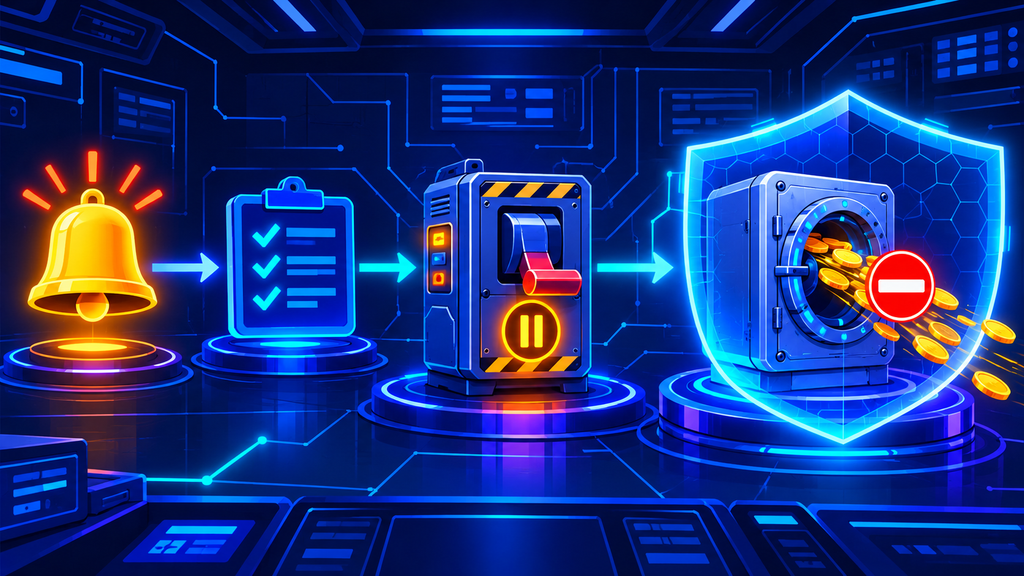
An alert that nobody acts on is just a notification. Real value comes from what happens next. Strong teams treat alerting and response as one connected system.
Triage in seconds, not hours
When an alert fires, the first question is simple: is this real? A good alert carries context, such as which contract, which function, which address, how much value, and how it differs from normal behavior. With that context, a responder can decide quickly whether to escalate or dismiss.
Predefined runbooks
Panic is the enemy of good decisions. Predefined runbooks remove guesswork. They spell out who gets paged, who can authorize a pause, who talks to partners, and who handles public communication. The time to write these is before the incident, not during it.
Pause mechanisms and circuit breakers
Many smart contracts include a pause function, a switch that temporarily halts sensitive operations. Widely used libraries such as OpenZeppelin provide a standard Pausable pattern for this purpose. A pause does not fix a vulnerability, yet it can stop further losses while the team investigates. The catch is that a pause only helps if someone triggers it in time. That is why connecting alerts to a fast response path, or to automated safeguards, can make such a difference.
Evidence and forensics
Automated security alerts also create a record. Timestamps, transaction hashes, and flagged behavior help teams reconstruct what happened, support post-incident reviews, and share intelligence with others. In a regulated or high-stakes environment, that audit trail can be as valuable as the alert itself.
Alert Quality: Signal Versus Noise
More automated security alerts are not better alerts. An overloaded team learns to ignore notifications, and that is when the one real warning gets missed. Alert fatigue is a genuine operational risk.
Good design of automated security alerts focuses on quality. Here is what separates useful alerts from noise.
- Context-rich: Each alert explains what happened and why it matters.
- Prioritized: Critical events stand apart from routine ones.
- Tuned: Thresholds match the real behavior of the protocol, not generic defaults.
- Routed: The right people receive the right alerts through the right channels.
- Reviewed: Teams revisit rules regularly as the protocol and the threat landscape change.
This is also where machine learning can help. Models that learn a protocol’s normal patterns can cut false positives and surface subtle anomalies that fixed rules miss. They are most effective when paired with human expertise, because people understand business context that models cannot see.
What Automated Security Alerts Cannot Do
Honesty builds trust, so let us be clear about limits. Automated security alerts are powerful, but they are not magic.
They do not replace audits. A thorough smart contract audit before launch finds flaws that monitoring can only observe after the fact. They also cannot undo a transaction. Blockchain transactions are final, so an exploit that completes inside a single transaction can be over before any alert reaches a human. Automated security alerts work best when they catch the setup phase, the early stages of a multi-step attack, or when they trigger an automated response fast enough to limit damage.

They also depend on coverage. If a contract, chain, or function is not monitored, no alert will fire. And they depend on tuning. Poorly configured rules miss real threats or drown teams in noise.
The right mental model is layered defense. Secure design, audits, access controls, key management, and monitoring each cover different risks. Automated security alerts are the layer that watches what happens after deployment, when the real adversary shows up.
Where SecureWatch Fits In
Continuous monitoring has become a core part of how serious Web3 teams protect live contracts. SecureWatch, a patented technology from SecureDApp, is built for exactly that job. It is an AI-driven platform that continuously monitors on-chain activity, detects unusual behavior in real time, and alerts teams so small issues do not grow into major incidents.
A few details are worth knowing. SecureWatch is designed for monitoring across multiple blockchain networks, which suits teams running contracts on more than one chain. It uses AI and machine learning to understand behavior patterns and spot anomalies rather than relying only on fixed rules. It also offers AutoPause, a feature meant to help limit damage by acting when suspicious activity appears, without waiting for a human to respond.
That combination matters because of the speed problem we described earlier. Automated security alerts tell you quickly. Automated response gives you a chance to act even faster. Together, they shorten the window between “attack begins” and “defender reacts.” As with any security layer, the best results come when monitoring sits alongside strong audits and sound contract design, not in place of them.
A Practical Checklist for Building an Alerting Strategy
Whether you adopt a platform or build your own tooling, these steps help you get real value from automated security alerts.
- Map your assets. List every contract, proxy, admin key, bridge, and oracle you depend on, across every chain.
- Rank your risks. Decide which events would hurt most, such as large outflows, role changes, upgrades, or price deviations.
- Define your alerts. Create rules and thresholds for each high-risk event, and add behavioral detection where it helps.
- Choose your channels. Send critical alerts to channels people actually watch, with escalation if nobody responds.
- Write runbooks. Decide in advance who can pause contracts, who investigates, and who communicates.
- Test the whole chain. Run drills that simulate an incident from alert to response, and fix gaps.
- Tune continuously. Review false positives and missed events, then refine rules regularly.
- Keep records. Store alerts and responses so you can learn from every event and demonstrate diligence.
Teams that follow this checklist tend to find that the technology is the easy part. The discipline of process, ownership, and rehearsal is what turns an alert into a saved asset.
Conclusion: Detection Is the First Step of Defense
Blockchain exploits are fast, final, and often avoidable only if someone notices in time. Transparency alone does not deliver that awareness. Attention does, and attention does not scale without automation.
Automated security alerts give teams that attention around the clock. They watch fund flows, role changes, upgrades, flash loan patterns, and price anomalies. They turn raw chain data into clear, prioritized warnings. Paired with solid runbooks and fast response mechanisms, they can shrink the window attackers rely on.
They are not a silver bullet. Audits, secure design, and strong key management still come first. But once your contracts are live, automated security alerts are one of the most practical ways to see trouble early and act while it still matters.
If you want continuous on-chain monitoring and automated alerts around your live contracts, talk to the SecureDApp team about SecureWatch and see how it fits your protocol.
Frequently Asked Questions
1. What are automated security alerts in blockchain?
Automated security alerts are machine-generated notifications that fire when on-chain activity matches a rule, threshold, or learned pattern suggesting risk. They watch transactions, events, and contract changes continuously, so teams learn about suspicious behavior without watching dashboards by hand.
2. Can automated security alerts prevent every blockchain exploit?
No. Some exploits finish inside a single transaction, which can leave no time to react. Automated security alerts work best when they catch the preparation phase, the early steps of a multi-step attack, or when they trigger a fast automated response. They should sit alongside audits, secure design, and strong key management.
3. Which on-chain signals do automated security alerts monitor most often?
Common signals include unusually large or rapid fund outflows, ownership and privileged role changes, proxy upgrades, flash loan activity, oracle and price deviations, and newly funded addresses interacting with sensitive functions. Together, these cover many of the patterns seen in past exploits.
4. How are automated security alerts different from a smart contract audit?
An audit reviews code before deployment to find flaws. Automated security alerts monitor behavior after deployment to catch threats as they happen. Audits reduce the chance of vulnerabilities, while alerts reduce the damage when something still goes wrong. Strong security uses both.
5. How does SecureWatch help with detecting blockchain exploits?
SecureWatch, from SecureDApp, is an AI-driven platform that continuously monitors on-chain activity, detects unusual behavior in real time, and alerts teams. It also offers AutoPause, a feature designed to help limit damage when suspicious activity appears.