To choose DPDP consent management software, ask every vendor twelve questions across four areas: how it captures consent, how it enforces withdrawals in real time, how it proves consent to a regulator, and how securely it runs. The best tool is not the one with the longest feature list. Instead, it is the one that answers all twelve questions with evidence.
India’s DPDP Act, 2023 and the DPDP Rules, 2025 will turn consent from a legal footnote into daily operational work. As a result, businesses are now shortlisting vendors, sitting through demos and comparing proposals. Unfortunately, many products look nearly identical on a slide deck. Therefore, this guide gives you a structured way to separate marketing from substance.
If you want to understand the legal duties before you buy, start with our DPDP consent management guide. Otherwise, read on to learn how to evaluate DPDP consent management software like a professional buyer.
Why a Cookie Tool or a CRM Checkbox Is Not Enough
Many teams begin by asking whether the tools they already own can do the job. After all, a cookie banner already shows a consent prompt, and a CRM already has an “opted in” field. Unfortunately, neither solves the DPDP problem, and there are three clear reasons why.
First, a cookie banner only governs trackers on a website. In contrast, the Act covers every purpose and every channel. That includes mobile apps, branch forms, agent-assisted sign-ups and call centres. Consequently, a banner leaves most of your real data collection outside its reach.
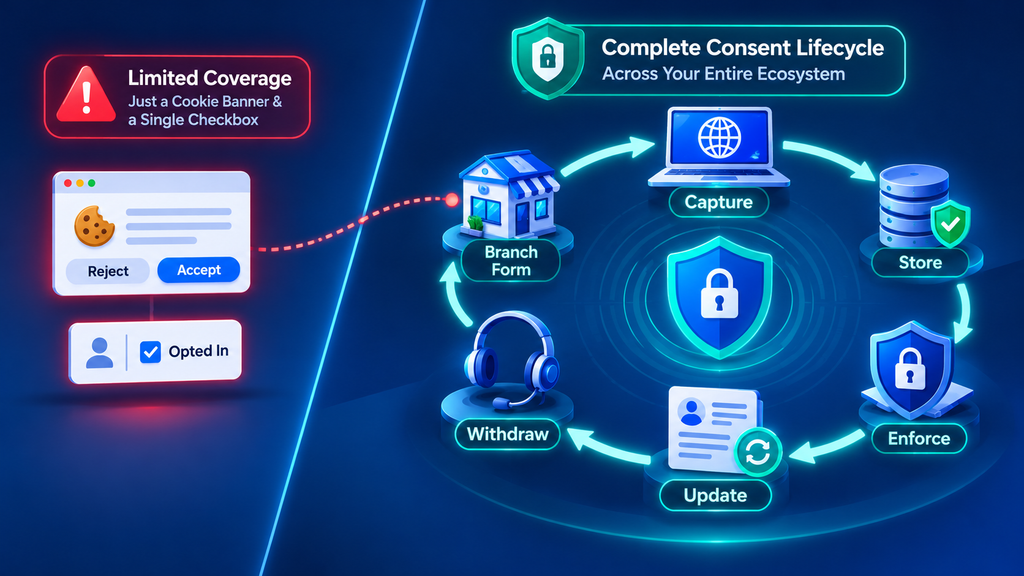
Second, a CRM checkbox typically stores a single yes or no value. However, Section 6(10) requires you to prove that notice was given and consent was obtained. To do that, you need history, notice versions, timestamps and channels. A simple checkbox cannot supply any of them.
Third, neither tool pushes a withdrawal to the other systems that still hold the data. As a result, processing can continue illegally, even though the customer has already opted out. Meanwhile, your team may not even know that the problem exists.
In other words, the DPDP requirement is not a pop-up. Rather, it is a lifecycle: capture, store, enforce, update and withdraw. Therefore, any software you buy must handle the whole chain from the first click to the final withdrawal.
What Good Looks Like: The Evaluation Framework
Before we list the questions, here is a quick mental model. Essentially, a strong consent platform does four things well:
- Capture: it collects valid, purpose-level consent wherever customers interact with you.
- Enforcement: it makes sure that every connected system respects those choices, including withdrawals.
- Evidence: it keeps proof that would satisfy a regulator or a disputing customer.
- Security: it protects the consent data itself, since that data identifies real people.
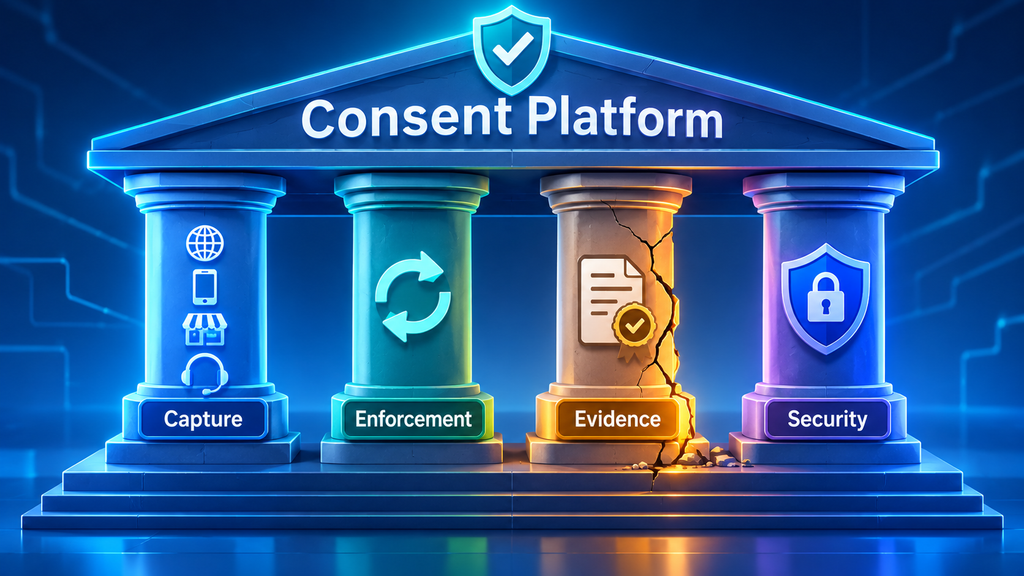
Because these four areas work together, a weakness in one can undo the strength of the others. For example, perfect capture is useless if withdrawals never reach your systems. Likewise, strong enforcement means little if you cannot prove it later. For this reason, we grouped the twelve questions under these four headings, so that you can score each vendor consistently.
The 12 Questions, Grouped
Each question below explains what to ask, why it matters and what a good answer looks like. Furthermore, you can use the same wording during demos, which keeps every vendor on a level playing field.
Capture (Questions 1 to 4)
1. Does it capture consent across every channel I use?
Ask the vendor to show consent capture on web, mobile and offline journeys, such as branch forms or call-centre scripts. A tool limited to websites will leave gaps. Moreover, check whether the platform supports redirect-based and embedded consent flows, because different products and partners need different designs.
In practice, most customers do not interact with a business through a single channel. For instance, someone may start on your website, continue in your app and finish at a branch. Consequently, your consent platform must follow that journey without losing the record.
2. Can it verify consent with an OTP or similar affirmative action?
The Act requires a clear affirmative action. Therefore, ask how the product records that action. Options include a checkbox, an OTP sent to email, SMS or WhatsApp, or an e-signature. In particular, ask whether it can handle assisted channels, where an agent captures consent on the customer’s behalf.
Additionally, ask how the platform stores the proof of that action. After all, a recorded OTP confirmation is far stronger evidence than a ticked box with no context.
3. Does it support notices in English and the 22 Eighth Schedule languages?
Section 6(3) lets a person ask for a consent request in English or any Eighth Schedule language. Accordingly, ask how the platform stores translations, how it serves the right language, and how easily your team can add or edit one. In addition, ask what happens if a translation is missing.
Notably, language support is not only a legal detail. It is also a trust signal, since customers are far more likely to give informed consent when they can read the request in their own language.
4. Does it version notices and purposes?
Every change to a notice should create a new version with a date. Later, when a customer disputes consent, you must show the exact text they saw. Hence, ask the vendor to demonstrate how it links each consent record to a specific notice version.
Otherwise, you may be unable to prove which wording applied on a given day. Furthermore, versioning protects your own team, because it shows exactly when and why a purpose changed.
Enforcement (Questions 5 to 7)
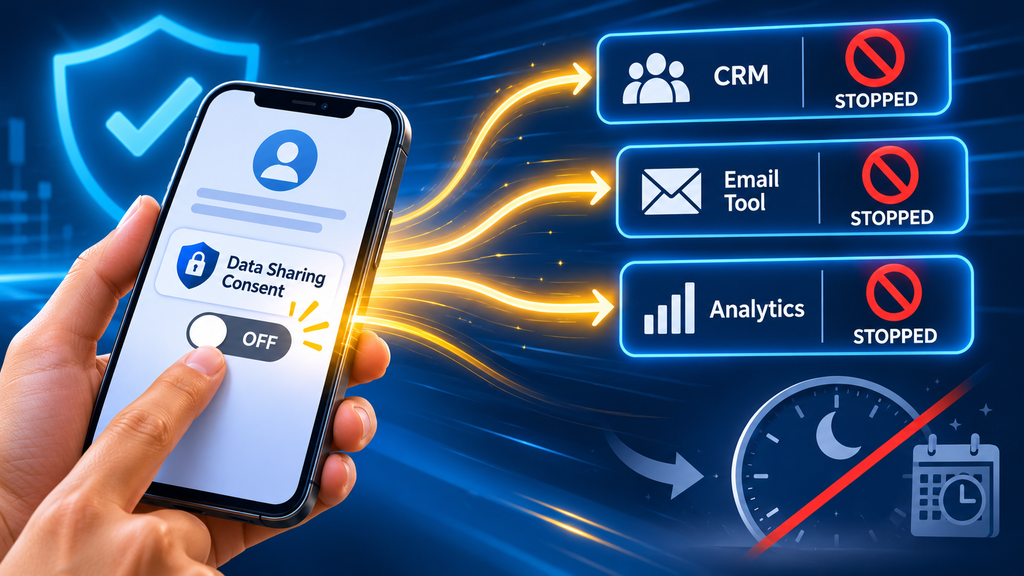
5. How does withdrawal reach my other systems, and how fast?
This is probably the most important question on the list. Section 6(6) requires you to stop processing within a reasonable time and to make your Data Processors stop too. So ask for a live demonstration: withdraw consent in one place and then show the change appearing in a CRM, an email tool or a test application.
Beware of vendors that only promise a nightly batch file. Although a batch process may sound acceptable, it leaves a window during which you keep using data without permission. Consequently, real-time behaviour is a much safer standard.
6. What APIs, SDKs and webhooks are available?
A platform that cannot talk to your systems is just a database. Therefore, ask about REST APIs, SDKs for your tech stack and webhooks that announce consent changes in real time. Also ask about runtime validation, meaning the ability of your application to check consent just before it uses data.
Importantly, this question reveals how much engineering effort you will need. If the vendor offers ready-made SDKs and clear documentation, integration will probably be smoother. On the other hand, if every connection needs custom work, expect delays.
7. Can it cut off processors and enforce purpose limits?
Beyond simple opt-outs, ask whether the platform can restrict data use by purpose, and even by field. For example, can it stop a marketing system from reading a phone number when the customer has only consented to service messages? In addition, ask how it informs Data Processors about withdrawals and how it records their acknowledgement.
This matters because a withdrawal that your processors never receive protects nobody. Likewise, an acknowledgement gives you proof that the message arrived and that the processor acted on it.
Evidence (Questions 8 to 10)
8. Are the audit logs tamper-evident?
An audit trail that an administrator can quietly edit will not impress the Data Protection Board. So ask how the vendor protects log integrity. Some use append-only storage, others use cryptographic hashing, and some anchor records on a blockchain. Whatever the method, ask for an independent way to verify that logs have not been altered.
In short, a log is only valuable if someone else can trust it. Therefore, favour vendors that let you check integrity without relying on their word alone.
9. Can I export complete consent history on demand?
Set a simple test. Ask the vendor to produce, in a few minutes, the full consent history of one named customer: purposes, notice versions, timestamps, channels and every change. Then repeat it for ten customers. If the platform cannot do this easily, assume your own team will struggle during a dispute.
Moreover, this test shows whether the data model is genuinely well organised. A platform that stores everything cleanly can answer such a request quickly. In contrast, a messy one will need manual searching.
10. Can I configure retention periods and handle rights requests?
The Rules expect certain logs to be retained for at least one year, and registered Consent Managers must keep records for seven years. Therefore, ask whether retention settings are configurable. Also ask whether the software supports access, correction and erasure requests, with timers, escalation to the Data Protection Officer and complaint handling.
A platform that captures consent but ignores rights requests only solves half of the problem. After all, customers who can give consent will also expect to review, correct or erase their data later.
Security (Questions 11 to 12)
11. Where is the data hosted, and how is it protected?
Ask where the data lives, how it is encrypted at rest and in transit, and how access is controlled. Additionally, ask about role-based access, so that each team sees only what it needs, and about secure API controls such as mutual TLS, PKI and IP whitelisting.
Since Section 8(5) requires reasonable security safeguards, you should be able to describe your vendor’s controls in your own documentation. Consequently, vague answers here should count heavily against a vendor.
12. What independent assurance can the vendor show?
Certifications such as ISO 27001 or SOC 2 reports, penetration test summaries and a clear incident response process give you evidence beyond sales claims. Furthermore, ask how the vendor will notify you if it suffers a breach, because a breach at the vendor could quickly become a breach for you.
Overall, independent assurance turns a promise into something you can verify. For that reason, ask to see the documents themselves rather than a summary slide.
Red Flags in Vendor Demos
During demos, certain signals suggest that a product is not ready for DPDP. Watch for these warning signs:
- “It’s just a banner.” If the whole demo centres on a website pop-up, the product likely ignores apps, branches and call centres.
- Vague answers on withdrawal. Phrases like “it syncs eventually” or “we can build that for you” often hide manual work.
- Editable logs. If an admin can change history, the evidence has little value.
- No notice versioning. Without it, you cannot prove what the customer saw.
- Only English. In a country with 22 scheduled languages, this is a significant limitation.
- A single global switch. If the only choice is “accept all” or “reject all”, purpose-level consent is missing.
- No customer references from regulated sectors. Banks, insurers and hospitals are demanding buyers, so experience there is a good sign.
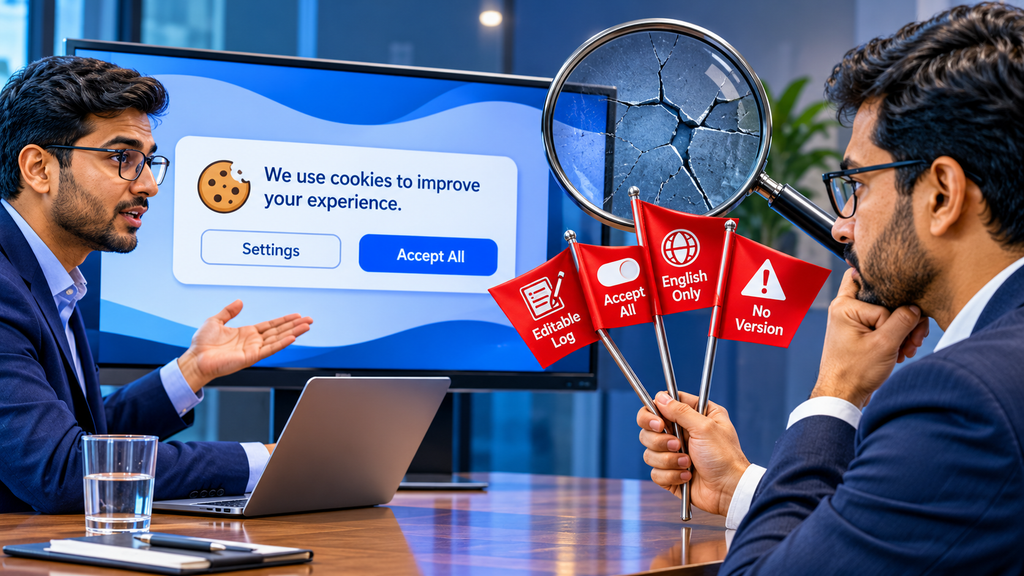
Of course, one red flag does not always mean a product is unusable. Nevertheless, several of them together should make you pause. In that case, ask follow-up questions and request a live demonstration before moving forward.
Build vs Buy
Some organisations with strong engineering teams consider building their own platform. That is a legitimate choice. However, it is worth comparing the two paths honestly before you commit budget and people.
| Factor | Build in-house | Buy a platform |
|---|---|---|
| Time to first launch | Several months of design and engineering | Often weeks, depending on integrations |
| Upfront cost | Engineering salaries and infrastructure | Licence or subscription fees |
| Ongoing effort | Your team maintains law changes, bug fixes and audits | The vendor ships updates; you configure |
| Flexibility | Total control over design and data model | Limited by vendor roadmap, though APIs help |
| Compliance evidence | You must design and defend every control | Vendor often supplies logs, exports and reports |
| Risk | Gaps may surface only during a dispute | Vendor risk replaces build risk; due diligence is key |
In practice, the best choice depends on your team’s capacity and your timeline. Since 13 May 2027 is fixed, speed carries real value. Even so, if you build, you must still cover every item on the twelve-question list. Otherwise, you may finish the project and still face gaps during an audit.
Scoring Sheet
To compare vendors fairly, use a weighted score. Rate each answer from 0 to 5, multiply by the weight, and add up the totals. Then adjust the weights to your own priorities. For example, a bank may raise the weight of security, while a retailer may care more about channel coverage.
| # | Question | Suggested weight | Vendor A | Vendor B |
|---|---|---|---|---|
| 1 | Multi-channel capture | 3 | ||
| 2 | Affirmative action and OTP | 2 | ||
| 3 | Language support | 2 | ||
| 4 | Notice versioning | 3 | ||
| 5 | Real-time withdrawal sync | 5 | ||
| 6 | APIs, SDKs, webhooks | 4 | ||
| 7 | Purpose-level enforcement | 4 | ||
| 8 | Tamper-evident logs | 5 | ||
| 9 | Complete history export | 4 | ||
| 10 | Retention and rights handling | 3 | ||
| 11 | Hosting and access controls | 4 | ||
| 12 | Independent assurance | 3 |
Finally, add a short, separate line for commercial factors such as price, support quality and implementation help. By keeping them apart, you avoid letting a low price hide a weak control. Additionally, a separate line makes it easier to explain your final decision to leadership.
How to Run a Proper Proof of Concept
Before signing, request a two-week proof of concept with realistic data and one real integration. During that period, follow these steps:
- Configure two purposes and two notice versions.
- Capture consent from at least ten test users across two channels.
- Withdraw one purpose for several users and confirm that a connected system stops using their data.
- Export the full history of three users.
- Ask your security team to review access controls and logs.
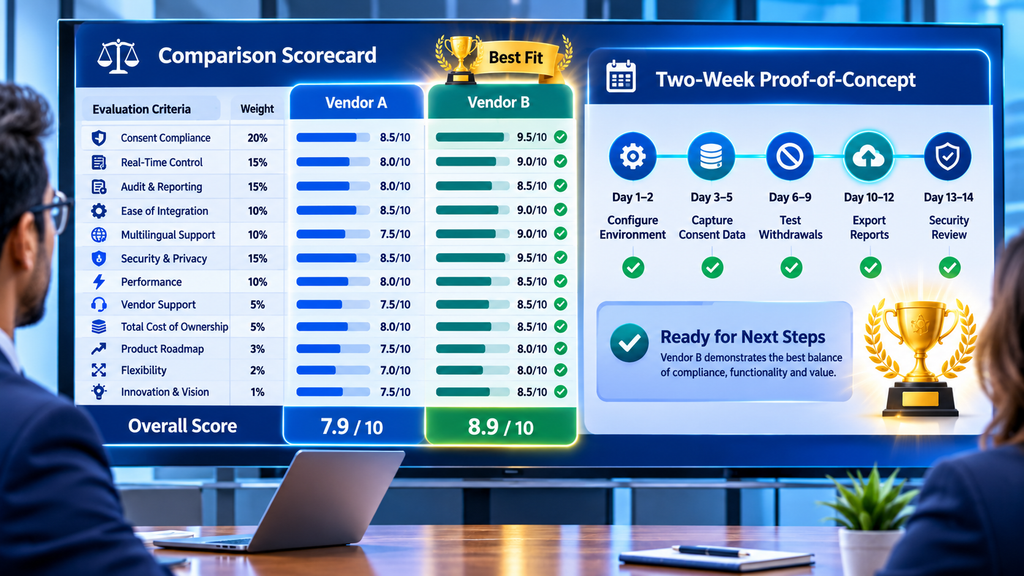
As a result, you will see the real behaviour of the product rather than the polished demo. Moreover, your technical team will learn how much effort the integration truly needs. Consequently, you can plan your rollout with far fewer surprises.
How SecureCMS Answers These Questions
SecureCMS is SecureDApp’s DPDP consent management software. Below is how it responds to each of the four areas.
- Capture: it supports consent with OTP over email, SMS and WhatsApp, along with purpose management tied to a data catalogue, policy versioning, and both redirect and embedded consent flows.
- Enforcement: it offers real-time consent enforcement through APIs and SDKs, instant revocation enforcement, purpose-level and field-level controls, and webhook support.
- Evidence: it provides blockchain-backed audit logs, compliance reports and exportable audit evidence.
- Security: it uses PKI, mutual TLS and IP whitelisting for integrations, role-based access control, and Google login with API authentication controls.
In addition, SecureCMS automates data principal rights requests and escalates grievances to the DPO. Because every business has a different stack, please ask our team to walk through the twelve questions against your own systems. For industry-specific guidance, see our pages for banks, NBFCs, insurance and SaaS companies.
Want a vendor walkthrough based on these twelve questions? Book a SecureCMS demo.
Frequently Asked Questions
How much does consent management software cost in India? Pricing varies widely. It usually depends on the number of users or consent records, the channels covered, the integrations required and the support level. Because there is no standard price list, request itemised quotes from at least three vendors and compare them using the same scoring sheet.
Can we build it in-house? Yes, if your team has the time, skills and appetite to maintain it as the law and your systems change. However, remember that you must still deliver multi-channel capture, real-time withdrawal sync, tamper-evident proof and rights handling. Many organisations find that buying and customising is faster.
How long does implementation take? A simple deployment with one website and one email tool can go live in a few weeks. By contrast, a bank or insurer with several core systems may need several months. Integration with existing systems is usually the longest part, so begin that conversation early.
Which question should I ask first? Start with withdrawal. Ask the vendor to show a live withdrawal reaching a connected system. Since this single test touches enforcement, integration and evidence together, it quickly shows whether a product is ready for real DPDP work.
When do the main obligations arrive? The main obligations arrive on 13 May 2027. Therefore, an early decision gives your team time to integrate, test and improve before the deadline.
Final Thoughts
To conclude, choosing DPDP consent management software is less about features and more about proof. Ask all twelve questions, insist on live demonstrations, test withdrawal sync with your own systems and verify the evidence trail yourself. By doing so, you protect your customers, your regulators’ trust and your own sleep.
Moreover, with the main obligations arriving on 13 May 2027, an early and careful decision gives your team time to integrate, test and improve. For a broader view of the legal duties behind these questions, return to our DPDP consent management guide.
This article summarises the law for general information and is not legal advice. Please consult a qualified legal professional for your specific situation.