A procurement ticket lands on your desk. One team wants a rack of hardware security modules. Another says every laptop already ships with a TPM, so why spend more? Both teams are partly right, and that is exactly why the HSM vs TPM question stalls so many security roadmaps.
The confusion is understandable. Both are tamper-resistant security hardware, and both protect cryptographic keys. However, they solve different problems at different scales. Choosing the wrong one, or assuming one replaces the other, leaves a gap that attackers (and soon, quantum computers) are happy to use.
This guide breaks down the real differences, shows where each module belongs in enterprise security, and explains why the post-quantum shift changes how you should think about both. If you want a quick refresher on the basics first, you can understand HSM vs TPM differences at a glance in the comparison table below.
Why the HSM vs TPM Debate Keeps Happening
Most enterprises do not buy these modules in a single planning cycle. Instead, TPMs arrive silently inside every laptop, server and workstation. HSMs, on the other hand, get purchased later, usually after an audit finding or a compliance deadline forces the conversation.
As a result, two separate mental models form. Endpoint teams think in terms of device trust. Platform and PKI teams think in terms of key custody. Rarely do the two groups compare notes.

Here is the first insight worth holding onto. A TPM answers the question, “Can I trust this machine?” An HSM answers the question, “Can I trust this key, no matter which machine asks for it?” Those are different questions, and a mature enterprise security program needs honest answers to both.
Furthermore, the question is getting harder. Regulated industries now face cryptographic inventories, algorithm deprecation timelines and audit requests for proof of key control. Therefore, the HSM vs TPM decision is no longer a hardware shopping exercise. It is an architecture decision with a ten-year horizon.
What Is a Trusted Platform Module and What Does It Actually Do?
Think about the moment a laptop powers on. Before the operating system loads, something has to confirm that the firmware and bootloader have not been altered. That job belongs to the trusted platform module.
A TPM is a small chip soldered onto the motherboard, or implemented in firmware, that provides a hardware root of trust for a single device. It is cheap, ubiquitous and tightly bound to the machine that carries it.
Core TPM capabilities
- Measured and secure boot: The TPM records hashes of boot components, so any tampering becomes visible.
- Local key storage: Keys can be sealed to the device, so they only unlock when the machine is in a known good state.
- Disk encryption support: Full-disk encryption tools use the TPM to protect volume keys.
- Device attestation: The TPM can prove to a remote service that the device is in a trusted configuration.
Where a TPM stops
Notably, a TPM is not built for volume. Its processing power is modest, and its key storage capacity is limited. It protects the device, not the enterprise.
That boundary matters. If your goal is to sign ten thousand software releases or issue certificates across a global fleet, a TPM will not carry that load. It was never designed to.
What Is a Hardware Security Module and Why Do Enterprises Depend on It?
Now picture a different moment. A certificate authority needs to sign a new intermediate certificate. If the private key behind that signature leaks, every certificate it ever issued becomes questionable. This is the kind of risk a hardware security module exists to prevent.
An HSM is a dedicated, tamper-resistant device (or a cloud-delivered equivalent) that generates, stores and uses cryptographic keys inside a protected boundary. Applications send requests in. The HSM performs the cryptographic operation internally and returns the result. The private key never leaves.
Why that design matters
Consider what happens without it. When a key sits in a web server’s memory, anyone who compromises the server can find and copy it. With an HSM, the attacker may reach the server but still cannot lift the key itself.
Real incidents show how costly weak key custody can be. In 2023, a stolen signing key allowed attackers to forge authentication tokens for cloud email accounts at multiple organizations. The lesson was clear: a key that can be copied will eventually be copied.
Core HSM capabilities
- High-throughput cryptography: HSMs are optimized for fast encryption, decryption and signing at scale.
- Full key lifecycle control: Generation, rotation, backup, usage policy and destruction all happen inside secure hardware.
- Tamper detection and response: Physical attacks can trigger alarms or key erasure.
- Audit-ready logging: Every key operation can be recorded for compliance and forensics.
- Validated assurance: HSMs are commonly evaluated against standards such as FIPS 140 and Common Criteria, which regulators recognize.
Deployment comes in two broad forms. Physical HSMs sit in your own data center, and you manage their full life cycle. Cloud HSMs are still physical devices, but they live in a provider’s facility, and you rent access to them. Each has trade-offs in control, cost and operational effort.

HSM vs TPM: A Side-by-Side Comparison for Enterprise Security
With both modules defined, a direct comparison becomes much more useful. The table below captures the differences that matter most for an IT director or security architect.
| Factor | TPM | HSM |
|---|---|---|
| Primary purpose | Device integrity and local key protection | Enterprise-wide key custody and cryptographic operations |
| Scope | One machine | Many applications, users and services |
| Form factor | Embedded chip or firmware on a PC or server | Network appliance, PCIe card, USB unit or cloud service |
| Performance | Limited, built for light system tasks | High throughput for signing, encryption and TLS |
| Key capacity | Small, local | Large, with managed lifecycle |
| Typical users | Operating system, firmware, disk encryption | PKI, code signing, payments, databases, identity systems |
| Compliance role | Supports device trust and attestation | Supports regulated key management and audit evidence |
| Cost model | Included with hardware | Dedicated capital or subscription spend |
The insight most comparisons miss
Many articles frame this as a contest. It is not. The more useful framing is layers. A TPM anchors trust at the edge, where a device boots and identifies itself. An HSM anchors trust at the core, where high-value keys live and sign.
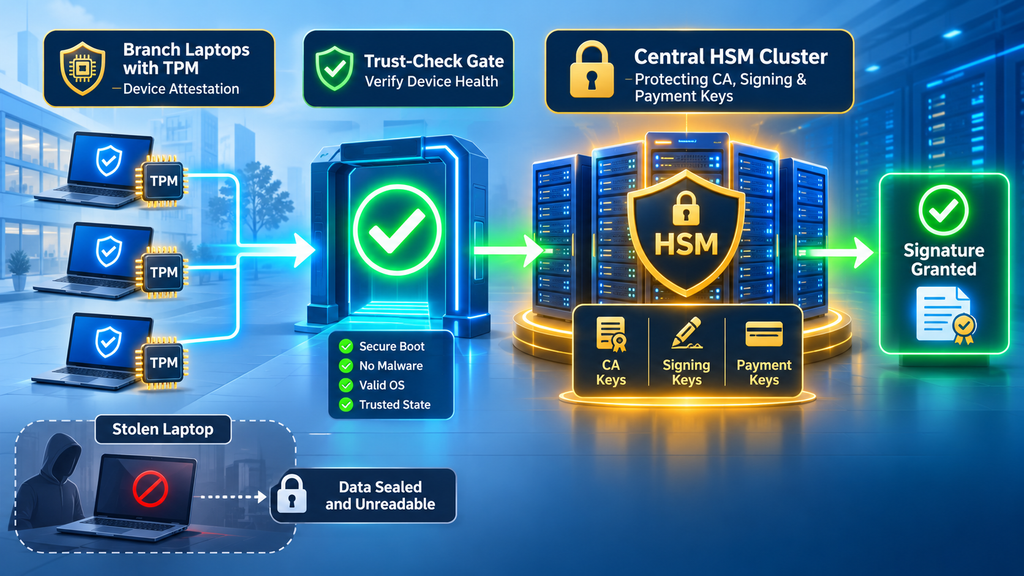
In a well-designed environment, the two connect. A device proves its health using its TPM, and only then does it get permission to request an operation from the HSM. Remove either layer, and the chain of trust has a weak link.
Enterprise Use Cases: Matching the Module to the Job
Abstract comparisons only go so far. So let us look at how the HSM vs TPM choice plays out in practice.
HSM vs TPM in practice: where a TPM is the right fit
- Laptop and workstation encryption: Protecting disk keys on devices that travel.
- Device identity for access decisions: Proving that a managed endpoint is healthy before granting network access.
- Secure boot enforcement: Detecting firmware tampering on servers and endpoints.
HSM vs TPM in practice: where an HSM is the right fit
- Public key infrastructure: Protecting root and issuing CA keys.
- Code and document signing: Keeping signing keys out of developer machines and build servers.
- Payment and transaction processing: Protecting card data and PIN operations.
- TLS termination at scale: Keeping private keys off exposed web servers.
- Database and application encryption: Wrapping data encryption keys with a hardware-protected master key.
A realistic scenario
Imagine a mid-sized bank with forty branches and a mobile app. Each branch laptop uses its TPM for disk encryption and device attestation. Meanwhile, the bank’s signing service, certificate authority and payment gateway rely on a clustered HSM.
One day, a branch laptop is stolen. Because the TPM sealed the disk keys to the device state, the data stays unreadable. Because the signing keys never lived on that laptop, nothing of strategic value was exposed. Each module did its own job, and the incident stayed small.
Now ask yourself: in your environment, which of your keys would survive the theft of a single laptop? And which would survive the compromise of a single server?
The Quantum Question: Why HSM vs TPM Now Includes PQC
Here is where the conversation changes. Both HSMs and TPMs have historically relied on RSA and elliptic curve cryptography. Those algorithms are exactly what a sufficiently powerful quantum computer is expected to break.
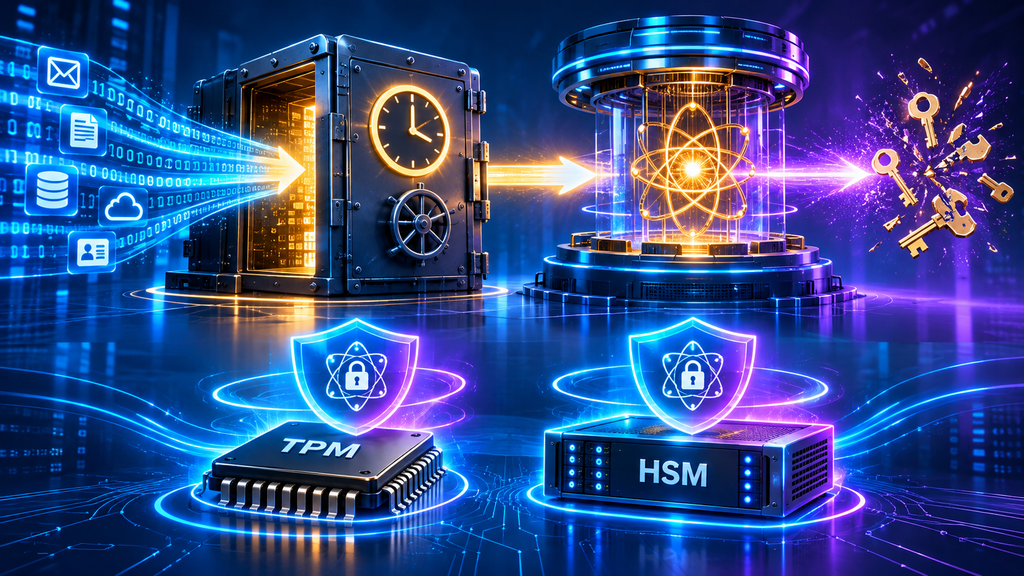
You may think that risk sits years away. However, attackers do not need a quantum computer today to cause harm. They can capture encrypted traffic now and decrypt it later, a pattern widely described as “harvest now, decrypt later.” Any data that must stay confidential for ten or fifteen years is already in scope.
What the standards bodies have done
In 2024, NIST finalized its first post-quantum cryptography standards, including ML-KEM for key establishment and ML-DSA and SLH-DSA for digital signatures. Government and industry guidance now points toward deprecating vulnerable public-key algorithms over the coming decade. For regulated enterprises, the direction is settled even if exact dates vary by sector and country.
What this means for your security hardware
This is the second insight worth noting. Hardware is the slowest part of any cryptographic migration. A TPM is bound to the device it ships with, and its supported algorithms depend on the chip and firmware. An HSM may be upgradeable, but only if the vendor supports new algorithms and your performance and validation requirements still hold.
Consequently, in any HSM vs TPM evaluation, buying hardware without asking about post-quantum support is a risk. So is assuming that today’s validated module will accept tomorrow’s algorithms. Ask vendors for their roadmap, check what is certified, and plan for the possibility that some devices will need replacement rather than a patch.
Crypto-agility is the real requirement
The deeper lesson is that no single algorithm choice will last. Crypto-agility, or cryptographic agility, is the ability to swap algorithms, key sizes and policies without rebuilding applications. It matters more than any specific module.
An enterprise with strong crypto-agility can adopt hybrid crypto today, combining classical and quantum-resistant algorithms in a single exchange, and then retire the classical half when it is safe. An enterprise without it will face a disruptive, high-risk cutover under deadline pressure.
How to Choose: A Practical Decision Framework
Armed with the differences and the quantum context, you can now make a grounded HSM vs TPM decision. Work through the following questions in order.

Step 1: Define what you are protecting
Are you protecting a device, or are you protecting a key that many systems depend on? Device-level assets point toward a TPM. Shared, high-value keys point toward an HSM.
Step 2: Estimate cryptographic volume
How many signatures, handshakes or encryptions per second do you need? If the answer is more than a single machine can handle, an HSM or HSM cluster is the practical choice.
Step 3: Map your compliance obligations
Do auditors expect FIPS-validated key custody, separation of duties and detailed logs? If so, an HSM is usually the evidence-friendly answer. A TPM supports device trust, but it rarely satisfies key management audit requirements alone.
Step 4: Check post-quantum readiness
Which algorithms does the hardware support today, and which are on the vendor’s roadmap? Equally important, can your applications switch algorithms without rewriting code?
Step 5: Plan for coexistence
For most enterprises, the answer to HSM vs TPM is “both, in different places.” The real work is making them cooperate under a single policy, which brings us to the layer above the hardware.
Common Mistakes to Avoid When Evaluating Security Hardware
Even experienced teams make predictable errors. Here are the ones worth watching for.
- Treating a TPM as a lightweight HSM. It cannot provide enterprise-scale key custody, throughput or lifecycle controls.
- Treating an HSM as a complete strategy. An HSM protects keys, but it does not give you inventory, policy or migration management.
- Ignoring algorithm roadmaps. A module that cannot support post-quantum algorithms may become a bottleneck within a few years.
- Skipping the cryptographic inventory. You cannot migrate what you cannot see.
- Delaying the pilot. Waiting for perfect clarity often means starting a multi-year migration too late.
Importantly, each mistake has the same root cause: treating the decision as a hardware purchase instead of an architecture. Once you shift that framing, the right questions follow naturally.
The Layer Above the Hardware: Where QuantumVault Fits
Hardware modules protect keys. They do not decide which algorithm an application should use, who may request a signature, or how to roll out a new algorithm across thousands of endpoints. That orchestration gap is where migrations stall.
Whichever way your HSM vs TPM review lands, QuantumVault approaches the problem as a quantum-safe security platform designed to sit above your existing trust anchors. It does not ask you to choose between an HSM and a TPM. Instead, it gives you the policy, visibility and cryptographic flexibility that make both more useful in a post-quantum world.
Policy and governance
A PQC policy engine lets security teams define which algorithms are allowed for each workload, region or risk class. A PQC governance platform then records decisions and exceptions. Meanwhile, PQC audit logs give compliance teams the evidence they need, which is especially important for post-quantum cryptography for regulated enterprises.
Enforcement at the edge of your network
A quantum-safe gateway enforces cryptographic policy on traffic as it moves between users, services and partners. For remote workforces, PQC tunnel capabilities and quantum-safe remote access protect connections that were previously secured by classical key exchange alone. Likewise, a PQC gateway can apply hybrid encryption so classical and post-quantum protections run together during the transition.
Key and signing workflows
PQC key management brings post-quantum keys under the same lifecycle discipline you already expect from an HSM. Additionally, a PQC signing workflow supports secure signing and approval processes for releases, documents and transactions, so that long-lived signatures remain trustworthy.
Coverage across the enterprise
Quantum risk is not limited to the data center. Therefore, a complete PQC security platform also has to cover PQC collaboration security for shared documents and messaging, PQC device security for endpoints and managed devices, and quantum-resistant security for web, mobile, server and devices. This is where TPM-anchored device trust and HSM-anchored key custody become inputs to a single, coherent policy.
Migration without the chaos
Finally, PQC migration is a program, not a project. QuantumVault supports a phased PQC rollout: discover cryptographic usage, prioritize high-risk systems, apply hybrid protection, verify with logs, and then retire legacy algorithms. In short, it acts as a cryptographic agility platform that turns the HSM vs TPM decision from a one-time purchase into a managed, auditable evolution.
Conclusion: Build Trust in Layers, Then Make It Agile
The HSM vs TPM debate becomes simple once you see the pattern. A trusted platform module secures the device. A hardware security module secures the keys that the whole enterprise relies on. Together they form layered enterprise security, and neither can stand in for the other.
However, the arrival of quantum computing adds a third requirement. Your hardware choices must be supported by crypto-agility, hybrid protection and clear governance, or the next algorithm transition will be as painful as the last one.
For IT directors and security architects, the practical path is clear. Inventory your cryptography, match each module to its job, ask hard questions about post-quantum support, and put a policy layer in place before the pressure arrives. QuantumVault is built to be that layer, helping enterprises move toward quantum-ready operations without ripping out the trust anchors they already depend on.
Ready to see how the pieces fit together for your environment?
Frequently Asked Questions
1. What is the main difference in HSM vs TPM?
A TPM protects a single device by securing boot integrity and local keys. An HSM protects enterprise-wide cryptographic keys and performs high-volume operations for many applications.
2. Can a TPM replace an HSM?
No. A TPM lacks the throughput, key capacity and lifecycle controls that enterprise workloads need. It is a complement to an HSM, not a substitute.
3. Do I need both an HSM and a TPM?
Most enterprises do. TPMs secure endpoints and servers at the device level, while HSMs secure shared, high-value keys such as CA, signing and payment keys.
4. Is a trusted platform module the same as a hardware security module?
They are not the same. Both are security hardware, but a TPM is an embedded chip for one machine, while an HSM is a dedicated device or cloud service for the enterprise.
5. Which one is better for regulatory compliance?
HSMs are typically the stronger fit for key management audits because of validated assurance levels and detailed logging. TPMs support device trust requirements.
6. Are HSMs and TPMs vulnerable to quantum computers?
The classical algorithms they commonly use, such as RSA and elliptic curve cryptography, are expected to be vulnerable. The hardware itself is not the weak point, the algorithms are.
7. Can existing HSMs support post-quantum algorithms?
Some can, depending on the vendor’s firmware and certification status. Always confirm which post-quantum algorithms are supported, validated and performant before relying on them.
8. Can a TPM be upgraded for PQC?
That depends on the chip, firmware and platform specification. In many cases, new algorithm support may require updated firmware or newer hardware.
9. What is hybrid encryption and why does it matter?
Hybrid encryption combines a classical algorithm with a post-quantum one in the same exchange. It protects data even if one of the two algorithms is later weakened.
10. What is crypto-agility?
Crypto-agility is the ability to change algorithms, key sizes and policies without redesigning applications. It makes any future cryptographic migration faster and safer.
11. Where should an enterprise start with PQC migration?
Start with a cryptographic inventory, rank systems by data sensitivity and lifespan, then pilot hybrid protection on the highest-risk workloads before wider rollout.
12. How does QuantumVault relate to HSMs and TPMs?
QuantumVault works as a policy, governance and enforcement layer above your existing trust anchors. It helps manage algorithms, keys, logs and migration across them.
13. Is a cloud HSM as secure as an on-premises HSM?
A cloud HSM is still a physical, tamper-resistant device held in a provider’s data center. Security depends on the certification level, access controls and your key ownership model.
14. What should an IT director ask vendors about security hardware?
Ask about supported algorithms, post-quantum roadmap, certification status, performance under new algorithms, and whether firmware updates can add support without replacing the device.