A single expired certificate once knocked out mobile data for millions of people across two countries. In December 2018, an expired certificate in network software caused outages for O2 in the UK and SoftBank in Japan. Nobody had attacked anything. Someone simply missed a date.
That story explains why a sound Certificate Lifecycle HSM strategy matters. Keys must live in hardened hardware, and every certificate built on them must be tracked from birth to retirement. This guide shows how to connect the two, and how to prepare that foundation for post-quantum change.
Why Certificate Lifecycle HSM Planning Is Now a Board-Level Concern
Certificates used to be a quiet back-office task. A team renewed them once a year, and most people forgot they existed. That comfortable rhythm is ending.
First, public TLS validity is shrinking. The CA/Browser Forum approved a schedule that cuts maximum validity to 200 days in March 2026, 100 days in 2027, and 47 days by 2029. As a result, a certificate that once needed one renewal per year may soon need eight.
Next, the quantum clock is ticking. NIST finalized its first post-quantum standards in 2024: ML-KEM (FIPS 203), ML-DSA (FIPS 204), and SLH-DSA (FIPS 205). Moreover, NIST’s transition guidance proposes deprecating today’s RSA and elliptic curve algorithms by 2030 and disallowing them by 2035.
Meanwhile, attackers already practice “harvest now, decrypt later.” They copy encrypted traffic today and wait for quantum capacity. Therefore, anything that must stay confidential for ten years is exposed now.
Regulators are also moving. India’s national quantum mission, sector rules from RBI and SEBI, and the DPDP Act all push enterprises toward demonstrable cryptographic governance. Globally, banks, telecom firms, and governments face similar pressure.
So what is the common thread? Every one of these forces turns certificates from a chore into a continuous, high-volume operation. Manual processes cannot keep up with that.
Where Certificate Lifecycles Break Without a Hardware Root of Trust
Most PKI failures are not cryptographic failures. They are operational ones. The math holds, but the process around it leaks.
Consider the usual weak points. Teams store CA private keys on general-purpose servers, copy keys between environments for convenience, and track expiry dates in spreadsheets. Each habit feels harmless until the day it is not.

The Three Quiet Failure Modes
Key exposure. A software-protected key can be copied. If an issuing CA key leaks, every certificate it ever signed becomes suspect, and recovery is painful.
Expiry blindness. You cannot renew what you cannot see. Shadow certificates created by developers, appliances, and cloud services often sit outside any inventory.
Weak accountability. When several administrators can sign or export keys, audit trails turn vague. Auditors then ask who approved a given issuance, and nobody can answer with confidence.
Here is the insight many teams miss. Buying an HSM does not fix lifecycle problems on its own. An HSM protects the key brilliantly. However, it does not discover certificates, enforce renewal windows, or approve requests.
In other words, the HSM is the vault, not the bank. You still need policy, automation, and oversight around it. That is the real meaning of Certificate Lifecycle HSM integration.
PKI Architecture That Puts the HSM Where It Belongs
Good PKI architecture for any Certificate Lifecycle HSM program starts with a simple question. Which keys, if lost, would end your trust model? Those keys belong inside an HSM.
According to this hardware security module overview, an HSM is a dedicated cryptographic processor that generates, protects, and uses keys inside a tamper-resistant boundary. For PKI, that boundary is where CA trust should live.
Root CA: Offline, Rare, Heavily Controlled
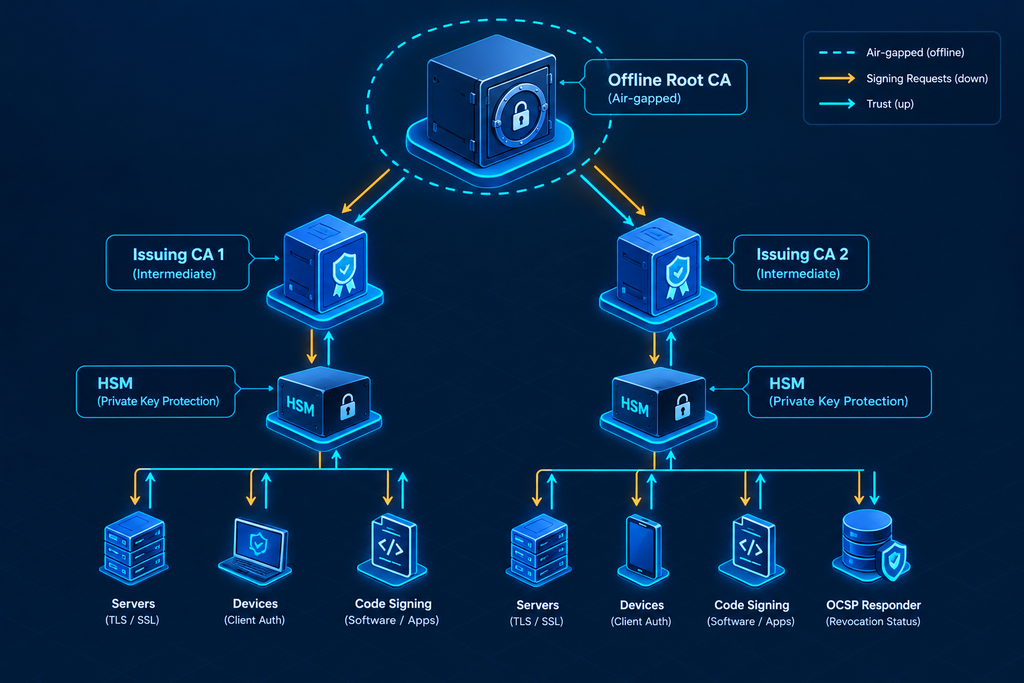
The root CA signs very little. Typically it signs only subordinate CA certificates and certificate revocation lists. Therefore, keep it offline, store its key in an HSM, and activate it only during a documented key ceremony.
A ceremony should involve split custody. Use an M-of-N quorum, so no single person can activate the key. Record every step, and store the evidence with your audit file.
Issuing CAs: Online but Never Exposed
Issuing CAs handle daily volume, so they must stay online. Even so, their private keys should never leave HSM hardware. The CA software sends signing requests, and the HSM returns signatures.
For high availability, cluster HSMs across sites and replicate keys using secure, approved backup mechanisms. Consider partitioning too. One partition per CA keeps blast radius small and makes audit scoping easier.
Supporting Components Worth Protecting
Do not stop at the CA. OCSP responders and timestamping services also sign data, so their keys deserve hardware protection. The same logic applies to code signing keys and document signing keys.
Additionally, plan your interfaces early. Most HSM integrations use PKCS#11, KMIP, or vendor APIs. Pick the interface your CA software supports well, and test failover before go-live.
Questions to Settle Before You Build
- Which CAs sign certificates for people, devices, servers, and code?
- How many tiers do you need, and which are offline?
- Which compliance standards apply, such as FIPS 140-3, Common Criteria, or eIDAS?
- Will you run on-premises, in the cloud, or in a hybrid model?
Answering these early prevents expensive redesign later. Once the architecture is settled, the next step is to map the lifecycle itself.
Mapping the Certificate Lifecycle HSM Integration, Stage by Stage
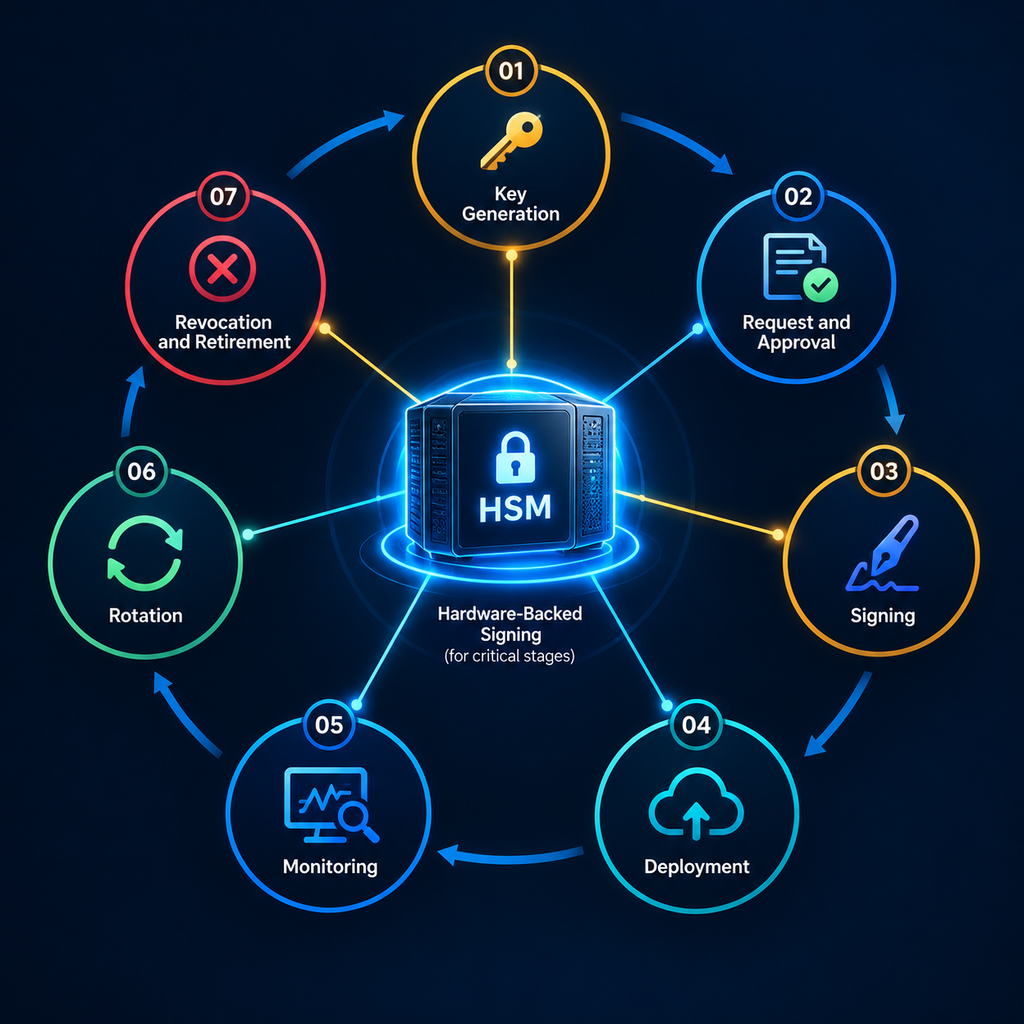
A certificate does not just exist. It moves through stages, and each stage needs a different control. Seeing the full picture helps you place the HSM correctly.
| Lifecycle stage | Main risk | HSM and policy control |
|---|---|---|
| Key generation | Weak entropy, exportable keys | Generate inside the HSM, mark keys non-exportable |
| Request and approval | Unauthorized issuance | Policy checks, role-based approval |
| Issuance | Misissued or wrong-profile certificates | HSM-backed signing, profile enforcement |
| Deployment | Keys copied during install | Direct provisioning, secure channels |
| Monitoring | Surprise expiry | Central inventory and alerting |
| Rotation and renewal | Outages, stale keys | Automated renewal, key rollover |
| Revocation | Slow response to compromise | Fast CRL and OCSP updates |
| Retirement | Orphaned keys | Documented destruction, archival of evidence |
Stage 1: Generate Keys Where They Will Live
Always create CA keys inside the HSM. Never generate them elsewhere and import them later. A key born in software has already had a chance to leak.
For end-entity keys, the answer depends on the use case. Server keys often stay on the server. Device identity keys, by contrast, may be better generated in secure hardware at manufacture.
Stage 2: Control Who Can Ask and Who Can Approve
Issuance is the policy decision point. Therefore, enforce rules before signing, not after. Check the requester’s identity, the domain or device ownership, the key type, and the certificate profile.
Separate duties as well. The person who requests should not be the person who approves. That single rule resolves many audit findings.
Stage 3: Sign Inside Hardware, Log Outside It
Every signing operation should happen in the HSM. Meanwhile, every request, approval, and signature should produce a tamper-evident log entry. Logs held only on the CA server are weaker than logs shipped to a protected store.
Stage 4: Monitor Continuously
Discovery is where most programs fail. Scan networks, cloud accounts, containers, and code repositories. Then reconcile findings against your CA records to expose certificates you never knew existed.
Stage 5: Rotate Before It Hurts
Rotation is not just renewal. A renewal can reuse the same key pair, whereas true rotation creates a new one. Rotating keys limits the damage if a key is ever stolen without notice.
We will return to this in the next section, because automation changes how rotation works.
Stage 6: Revoke Quickly and Prove It
When a key is compromised, speed matters. Revocation must reach relying parties quickly through CRLs or OCSP. Moreover, your team should rehearse the process, because untested revocation often fails under pressure.
Stage 7: Retire With Evidence
Retirement closes the Certificate Lifecycle HSM loop. Destroy keys through approved HSM procedures, record the destruction, and archive evidence for the retention period. Orphaned keys are future incidents.
Certificate Automation and Rotation in a Certificate Lifecycle HSM Design
Here is the tension every PKI administrator feels. Automation wants speed, and key custody wants restraint. Fortunately, the two can coexist when you design them together.
Use Standard Protocols for Certificate Automation
Modern certificate automation rests on a few well-known protocols:
- ACME automates issuance and renewal for web servers and cloud services.
- EST enrolls devices over secure HTTP, which suits IoT fleets.
- SCEP supports older network gear and mobile device management.
- CMP handles enterprise-grade enrollment and management scenarios.
Each protocol suits a Certificate Lifecycle HSM workflow because it lets a machine request a certificate without a human typing anything. However, none of them should bypass your policy layer. The request still needs to be validated against rules before the HSM signs.
Shorter Lifetimes Change the Math
Imagine a company with 20,000 public certificates. At 398 days, that is roughly 20,000 renewals per year. At 47 days, it is closer to 155,000. Manual handling collapses at that scale.
Notably, automation also improves security. Short-lived certificates reduce the window in which a stolen key is useful. Revocation becomes less critical when a certificate expires on its own within weeks.
A Practical Rotation Pattern
Follow this pattern for dependable certificate rotation:
- Set the window. Begin renewal at roughly one third of the remaining lifetime.
- Generate a fresh key pair. Do not reuse keys for end-entity certificates unless pinning forces it.
- Validate against policy. Confirm profile, identity, and algorithm.
- Sign with HSM-protected CA keys. Log the event.
- Deploy and verify. Confirm the new certificate is live before the old one expires.
- Retire the old key. Remove it from stores and record the action.
For CA keys, rotation is rarer but more delicate. Plan cross-signing or overlapping validity, so trust anchors in the field keep working during the changeover. Surprises here are the ones that make headlines.
Do Not Forget Certificates That Resist Automation
Not everything speaks ACME. Legacy appliances, embedded devices, and third-party platforms often need manual or semi-automated handling. Track them in the same inventory, assign owners, and set earlier alert thresholds.
Preparing Your PKI for Post-Quantum Change
This is where the topic gets interesting. Your Certificate Lifecycle HSM decisions today will either ease or block post-quantum migration tomorrow. So how do you stay ready?
Crypto-Agility Is a Design Property
Cryptographic agility means you can swap algorithms without rebuilding everything. It sounds simple. In practice, algorithm choices are buried in code, firmware, certificate profiles, and hardware drivers.
An agile PKI keeps algorithms in configuration and policy, not in hard-coded logic. Likewise, an agile HSM strategy confirms that your hardware can be updated to support new mechanisms. Ask vendors directly what their upgrade path looks like.
Why Hybrid Crypto Is the Practical Bridge
Few enterprises can flip from classical to quantum-resistant overnight. Hybrid crypto offers a safer path. It combines a classical algorithm with a post-quantum one, so security holds if either remains strong.
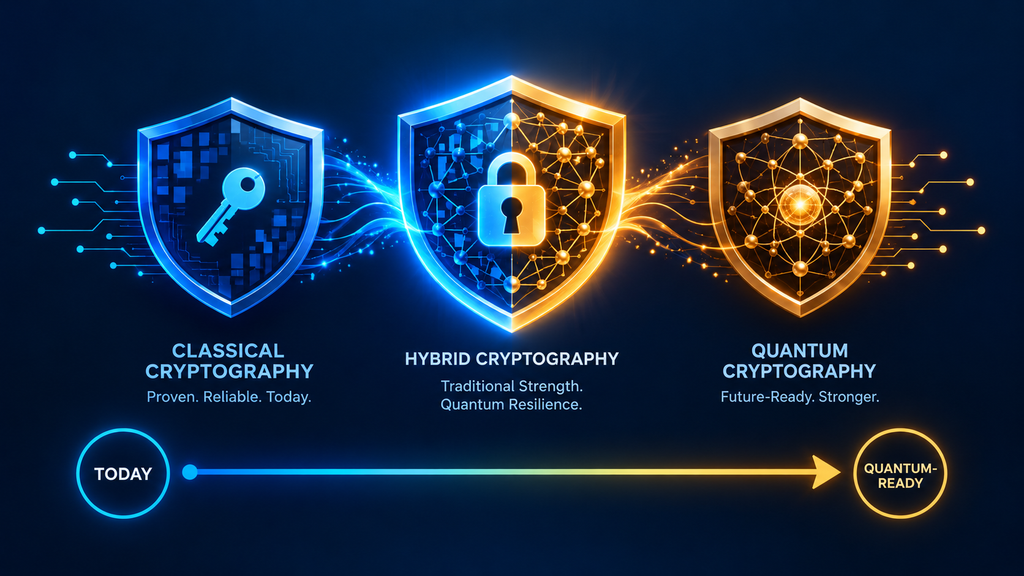
For certificates, hybrid approaches include dual-certificate deployments or composite structures that carry both signatures. Standards in this space are still maturing. Consequently, your platform should support several approaches and let you adjust as guidance settles.
The Hidden Cost: Size and Performance
Post-quantum keys and signatures are larger than their classical counterparts. ML-DSA signatures, for example, run into several kilobytes. That affects TLS handshakes, certificate chains, constrained devices, and storage.
Test early. Measure handshake latency, packet fragmentation, and memory use on your weakest devices. Surprises in the lab are cheap, whereas surprises in production are not.
Build a Cryptographic Inventory First
You cannot migrate what you cannot see. Start by cataloguing every certificate, algorithm, key length, and dependency. Then rank systems by data sensitivity and required confidentiality lifetime.
Systems protecting long-lived secrets, such as health records, financial contracts, and government data, should move first. Short-lived session traffic can follow.
How QuantumVault Brings Governance to Certificate Lifecycle HSM Workflows
By now the gap should be clear. HSMs protect keys, and CAs issue certificates, yet few teams have a unified layer that governs how cryptography is chosen, approved, rolled out, and audited. That is the gap QuantumVault is built to close.
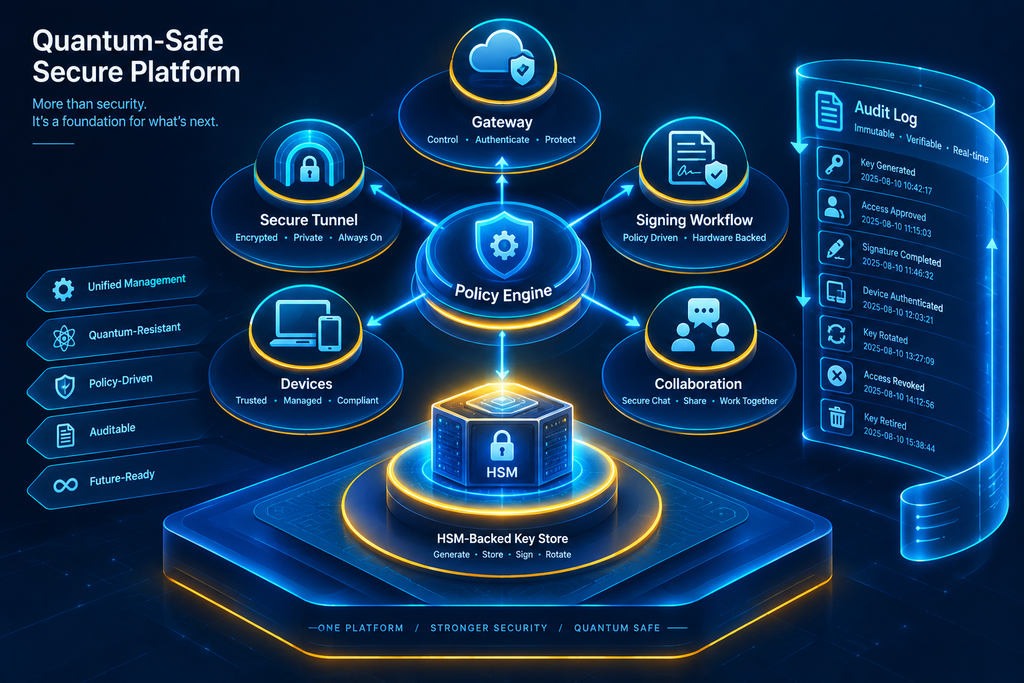
QuantumVault is a quantum-safe security platform with cryptographic agility at its core. It helps enterprises plan, enforce, and prove their migration to post-quantum cryptography, while keeping classical systems running in the meantime.
A PQC Policy Engine and Governance Layer
A PQC policy engine lets security architects define which algorithms, key sizes, and certificate profiles are allowed for each system class. When a team requests a certificate, the request is checked against that policy before any signing takes place.
This is where PQC governance becomes practical. Instead of relying on tribal knowledge, your rules live in one place and apply everywhere. Changing an approved algorithm becomes a policy update, not a project.
PQC Key Management Aligned With Hardware Custody
PQC key management in QuantumVault follows the same principle used for classical keys: protect the material, limit exposure, and track every use. It supports hardware-backed custody models, so CA and signing keys remain under strong control.
Combined with certificate rotation workflows, this reduces the risk of stale or orphaned keys during migration.
PQC Audit Logs and Compliance Evidence
Regulated enterprises need proof, not promises. PQC audit logs record who requested, approved, issued, rotated, and revoked each certificate, along with the policy that applied. As a result, PQC compliance reviews draw from a single trusted source.
For industries such as banking, insurance, healthcare, and telecom, this evidence shortens audit cycles and supports post-quantum cryptography for regulated enterprises.
Protecting the Places Certificates Actually Work
Certificates are only valuable where they secure real traffic. Therefore, QuantumVault extends beyond issuance into the surfaces that depend on trust:
- PQC gateway: A quantum-safe gateway enforces cryptographic policy at the network edge for web, mobile, and server traffic.
- PQC tunnel: Quantum-safe remote access and tunnel security protect distributed teams and branch connections with hybrid encryption.
- PQC signing workflow: Secure signing and approval workflows keep documents, code, and releases trustworthy.
- PQC device security: Device identities and firmware trust stay verifiable across long hardware lifecycles.
- PQC collaboration security: Messaging and file exchange stay protected as teams share sensitive data.
Together, these form a PQC security platform that treats certificate lifecycle as one thread in a larger quantum-ready fabric.
Where the Platform Is Different
Many tools focus on only one slice: discovery, issuance, or key storage. Others address post-quantum algorithms without lifecycle governance. QuantumVault connects policy, key custody, enforcement, and evidence, so migration becomes a managed program instead of a scramble.
To see how teams can automate certificate lifecycle tasks with policy-backed controls, review the certificate automation capabilities in the platform.
Certificate Lifecycle HSM Implementation Roadmap and Best Practices
A good plan beats a clever tool, and a Certificate Lifecycle HSM rollout is no exception. Here is a phased approach that works for most enterprises.
An Illustrative Scenario
Picture a mid-size bank with 40,000 internal and external certificates. Its root CA key sits in an HSM, but issuing CAs use mixed protection. Discovery finds 6,000 certificates nobody owned. Several use RSA 2048, and a few protect long-retention customer records.
The security architect starts with inventory and policy. Within one quarter, unmanaged certificates get owners. Within two, issuing CA keys move into HSM partitions, and renewal is automated through ACME and EST. By the third, pilot systems test hybrid certificates in a staging gateway.
Nothing dramatic happened. The program simply ran in order. That is what good PKI management looks like.
Phase 1: Discover and Baseline (Weeks 1 to 8)
- Scan networks, clouds, and repositories for certificates.
- Record algorithms, key sizes, owners, and expiry dates.
- Classify systems by data sensitivity and retention need.
Phase 2: Harden the Foundation (Months 2 to 5)
- Move all CA and signing keys into HSM-backed custody.
- Define roles, quorum rules, and key ceremony procedures.
- Centralize logging and ship logs to protected storage.
Phase 3: Automate and Enforce (Months 4 to 8)
- Introduce ACME, EST, or SCEP according to asset type.
- Apply policy checks before every signing event.
- Set alerts for approaching expiry and failed renewals.
Phase 4: Pilot Post-Quantum and Hybrid (Months 6 to 12)
- Test hybrid certificates and PQC tunnels in non-production.
- Measure performance, compatibility, and operational load.
- Update runbooks and train PKI administrators.
Phase 5: Roll Out and Govern (Ongoing)
- Expand PQC rollout by risk tier.
- Review policy and audit logs on a fixed schedule.
- Track standards changes and adjust algorithm policy.
Common Mistakes to Avoid
- Treating the HSM as the whole strategy. Hardware protects keys, but it does not govern process.
- Skipping discovery. Unknown certificates cause the outages you cannot predict.
- Reusing keys at renewal. This weakens the benefit of rotation.
- Ignoring failover. An HSM outage without a tested backup stops issuance entirely.
- Delaying PQC planning. Migration takes years in large estates, so waiting is a decision with consequences.
Frequently Asked Questions
1. What is certificate lifecycle management?
Certificate lifecycle management covers every stage of a certificate’s life: key generation, request, issuance, deployment, monitoring, renewal, revocation, and retirement. Its goal is to prevent outages and security gaps.
2. Why integrate an HSM with PKI?
An HSM keeps private keys inside tamper-resistant hardware, so they cannot be copied or exported. This protects CA trust and supports compliance requirements such as FIPS 140-3.
3. Which PKI keys must be stored in an HSM?
At minimum, root and issuing CA keys. Strong programs also protect OCSP responder, timestamping, code signing, and document signing keys.
4. How does an HSM help with certificate rotation?
The HSM signs new certificates and protects CA keys during rollover. Combined with automation and policy, it lets you rotate often without exposing key material.
5. What is the difference between an HSM and a KMS?
An HSM provides hardware-based key protection and secure cryptographic operations. A key management system orchestrates policy, lifecycle, and access around keys. Many enterprises use both together.
6. How will shorter TLS certificate lifetimes affect PKI administrators?
Renewal volume will rise sharply, so manual workflows will fail. Automation through protocols like ACME, plus strong inventory, becomes essential.
7. Can existing HSMs support post-quantum algorithms?
It depends on model, firmware, and vendor roadmap. Ask whether your hardware can add ML-KEM, ML-DSA, and SLH-DSA, and what performance to expect.
8. What is crypto-agility, and why does it matter?
Crypto-agility is the ability to change algorithms, keys, and protocols without major rebuilds. It matters because standards, threats, and regulations keep shifting.
9. What is hybrid encryption in a PKI context?
Hybrid encryption combines a classical algorithm with a post-quantum one. Security holds if either algorithm stays secure, which makes it a practical migration bridge.
10. How should we start a PQC migration?
Begin with a cryptographic inventory. Then rank systems by data sensitivity, set policy, pilot hybrid approaches, and expand in phases.
11. How do PQC audit logs support compliance?
They record who requested, approved, and issued each certificate under which policy. That gives auditors clear, consistent evidence for reviews.
12. How does QuantumVault support certificate lifecycle HSM programs?
QuantumVault adds a policy engine, key management, audit logs, and enforcement points such as a PQC gateway and tunnels. It works alongside hardware-backed custody to govern the full migration.
Conclusion: Make Certificate Lifecycle HSM a Managed Program
Certificates will keep multiplying, and their lifetimes will keep shrinking. At the same time, quantum timelines are pushing every enterprise toward new algorithms.
The core lessons are straightforward. Keep CA keys in HSMs from the first day. Automate issuance and rotation, but route every request through policy. Log everything. Build crypto-agility into profiles and processes, and use hybrid approaches to bridge the transition.
Above all, remember that a Certificate Lifecycle HSM strategy is a program, not a purchase. The hardware protects trust, while governance keeps it alive.
QuantumVault helps security architects and PKI administrators turn that program into daily practice, with PQC governance, policy enforcement, and audit-ready evidence across web, mobile, server, and device environments.
Ready to connect your HSM, PKI, and post-quantum plan? Get Integration Guide