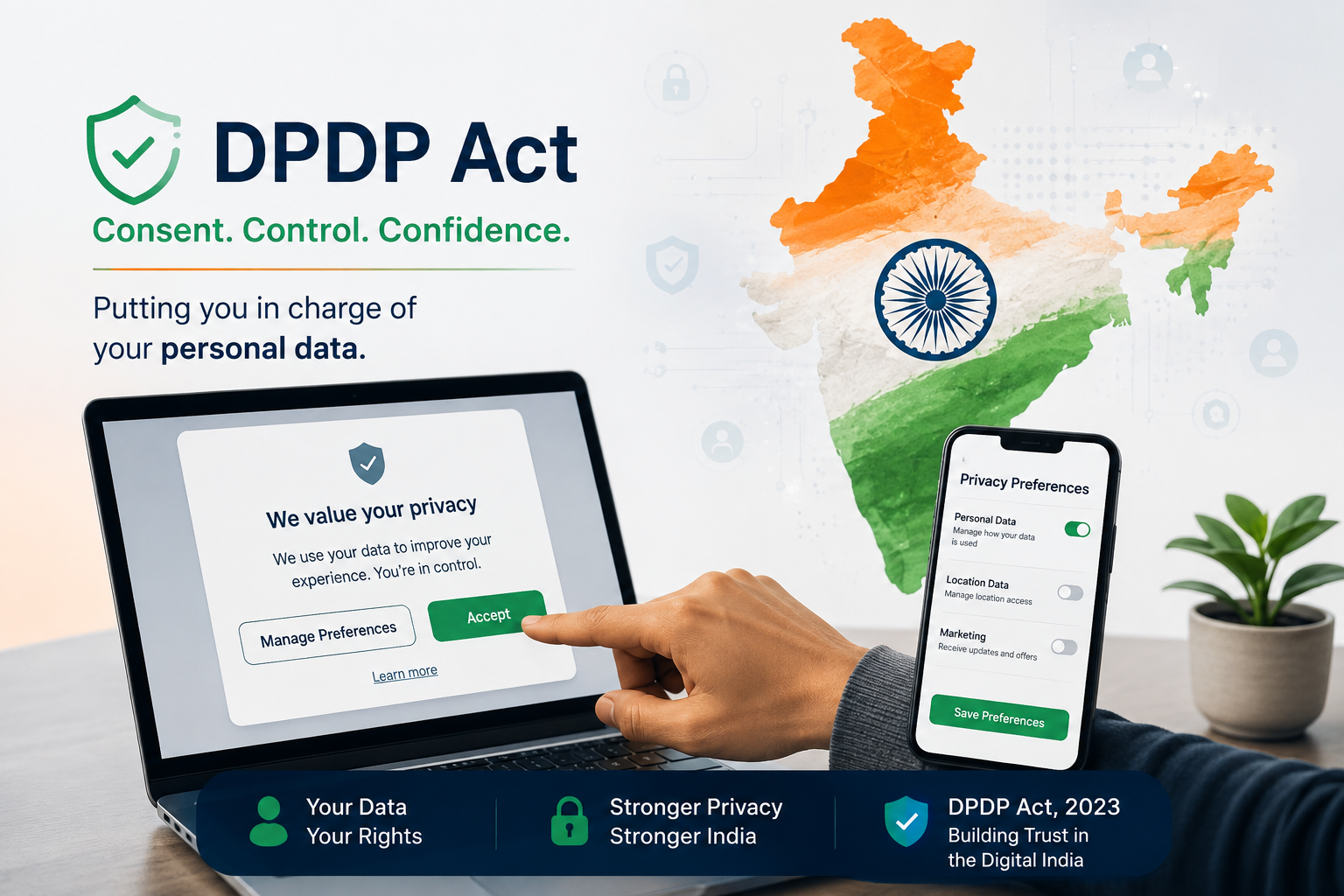

Most businesses do not fail at collecting consent. Instead, they fail at carrying that consent everywhere it needs to go. A user ticks a box on your website, and the signal stops right there. Meanwhile, your CRM keeps emailing them, your mobile app keeps tracking them, and your data warehouse keeps feeding a dashboard nobody has questioned in months.
That gap is exactly why consent management platform integration has become a serious engineering and compliance topic for Indian businesses. The Digital Personal Data Protection Act, 2023 expects consent to be specific, informed, and easy to withdraw. However, the law does not care which system captured the consent. It only cares whether every system respected it.
In this guide, we will walk through how this integration works across four layers: websites, mobile apps, CRMs, and backend business systems. Along the way, we will look at where integrations usually break, how to design for withdrawal, and what a defensible audit trail looks like. By the end, you will have a practical roadmap your product, legal, and security teams can follow together.
Why Consent Management Platform Integration Decides Whether DPDP Compliance Works
A consent platform that sits alone is just a fancy banner. Consequently, the real value appears only when the platform connects to every place personal data is collected, stored, or used. In other words, integration is what turns a recorded choice into an enforced choice.
Consider a simple example. A customer agrees to marketing emails for one specific purpose. Later, the same customer withdraws that consent from your mobile app. If your CRM never hears about it, the next campaign still goes out. As a result, you have a withdrawal on paper and a violation in practice.
Furthermore, DPDP enforcement is phased, with full substantive obligations expected from May 2027. That timeline sounds comfortable, but integration projects rarely are. Mapping systems, cleaning data flows, and testing withdrawal across vendors can take many months. Therefore, teams that start consent management platform integration now will have room to test, fix, and retest before scrutiny increases.
The Core Architecture: One Consent Ledger, Many Consumers
Before connecting anything, it helps to settle on a mental model. The cleanest approach treats the consent platform as a central ledger and every other system as a consumer of that ledger. In this model, the platform records the truth, and your websites, apps, CRMs, and databases ask it before acting.
First, the ledger stores each consent event with its purpose, timestamp, notice version, and channel. Next, it exposes that state through APIs and webhooks so that other systems can read it or receive updates. Finally, it logs every change in a way that nobody can quietly edit later.
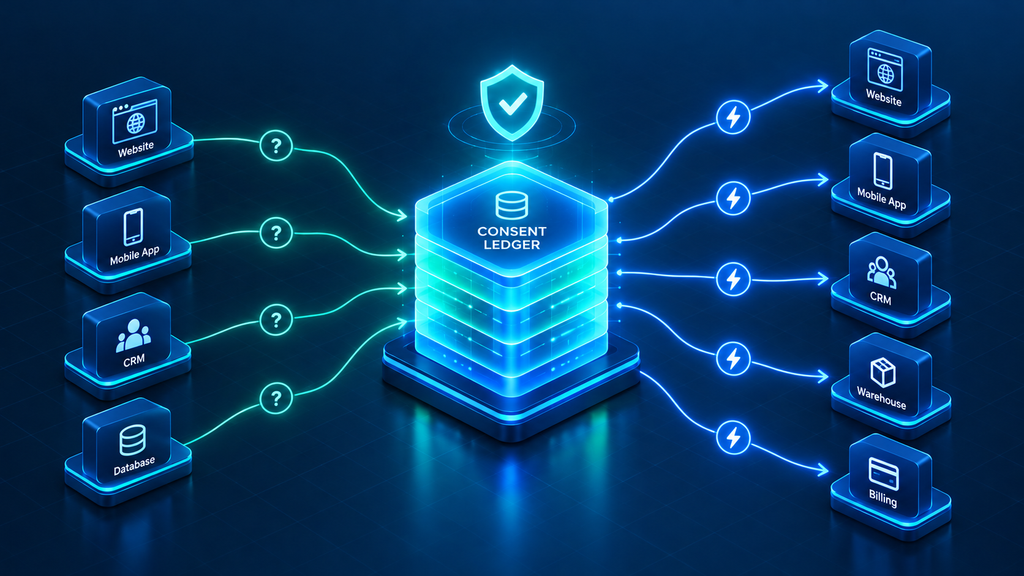
This design matters because the alternative is painful. Without a central ledger, each system keeps its own consent flag. Consequently, a website cookie says yes, a CRM field says no, and a billing system has no opinion at all.
Additionally, a central ledger supports two integration patterns that work well together. The first is a pull pattern, where a system checks consent in real time before processing data. The second is a push pattern, where the platform sends a webhook the moment consent changes. Ideally, you use both: pull for high-risk actions like sending a message, and push for keeping downstream copies fresh.
SecureCMS follows this ledger-first thinking. It was built around the DPDP consent lifecycle, with purpose-wise consent capture and API-first architecture. Consequently, connecting your systems to it starts from a clear model rather than a patchwork of banners and spreadsheets.
Website Integration: Capturing Consent Where Data Enters
Websites are usually the first integration point, so they deserve careful attention. Visitors arrive, forms collect details, and scripts quietly fire in the background. Therefore, consent management platform integration on the web has two jobs: collect valid consent and gate what runs afterwards.
To begin with, place the consent notice before any non-essential script loads. Analytics tags, ad pixels, and chat widgets should wait until the visitor makes a choice. Otherwise, you have already processed data before asking, which defeats the purpose.
Next, connect your forms. A signup form, a contact form, and a newsletter box each collect data for different reasons. Accordingly, each one should carry its own purpose, tied to a specific notice. Bundling them into a single “I agree” checkbox is the exact pattern regulators are likely to challenge first.
In addition, give your tag manager a role. Most teams already use one to control marketing and analytics scripts. When the consent platform feeds consent state into the tag manager, tags fire only for purposes the visitor approved. As a result, your marketing team keeps its flexibility while your compliance team keeps its control.
Finally, do not forget the return path. Visitors need an obvious place to review and change their choices, ideally one click away from any page. Since DPDP expects withdrawal to be as easy as giving consent, a preference link buried in a footer maze will not hold up. Consequently, a solid web setup always includes a visible, working preference center that updates the central ledger instantly.
Mobile App Integration: Where Consent Gets Complicated
Mobile apps are harder, and honestly, they deserve more respect in any consent integration plan. Apps request camera, location, contacts, and microphone access. Moreover, they run background services long after the user has forgotten the app exists.
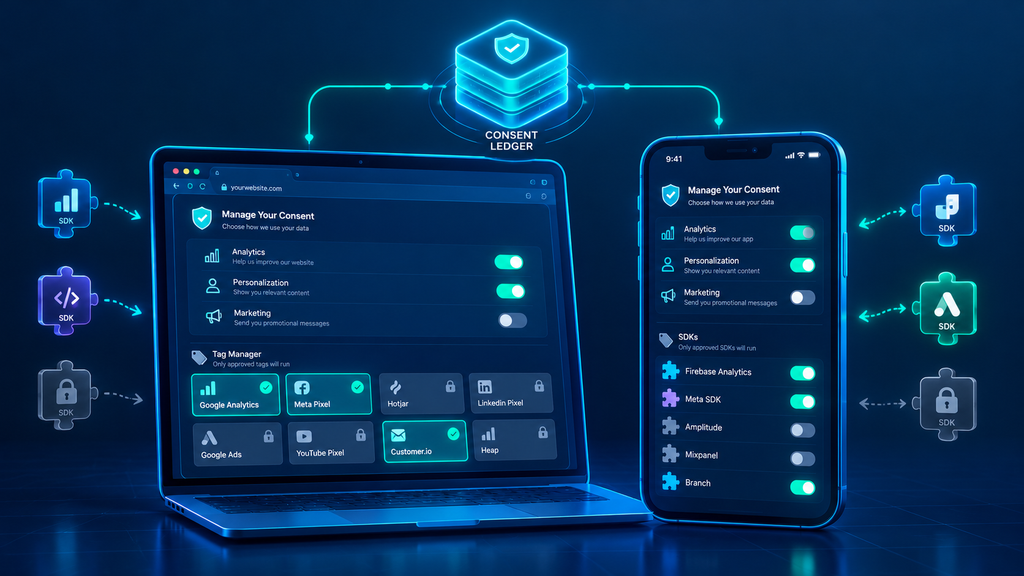
The first challenge is that operating system permission prompts are not DPDP consent. They tell the system whether an app may access a sensor, but they do not explain purpose, retention, or withdrawal. Therefore, apps need their own in-app consent screens that explain each purpose in plain language before the system prompt appears.
Taming Third-Party SDKs
The second challenge is the number of third-party SDKs. Crash reporting, attribution, push notifications, and analytics libraries all touch user data. Consequently, your integration should wrap or gate every one of them. In practice, that means the app checks the consent state at launch and again whenever it changes, then starts or stops each SDK accordingly.
Meanwhile, consider platform drift. An Android build, an iOS build, and a backend service often evolve on separate release cycles. Over time, the consent logic in each one can quietly diverge. A user withdraws consent on a phone, yet the backend still shows an active opt-in because the sync never handled that case. To avoid this, all three should read from the same central ledger rather than keeping local copies.
Additionally, plan for offline behavior. Apps often collect events without a network connection. When connectivity returns, queued data should pass through a consent check before it uploads. Otherwise, data collected after a withdrawal might still reach your servers.
Language also matters. India’s users read in many languages, so consent screens should appear in the language the person actually understands. Ultimately, a strong mobile setup treats the app as one more consumer of the ledger, with fast checks, clear screens, and no private consent flags.
CRM Integration: Stopping the Next Email Before It Goes Out
CRMs are where consent turns into action. Sales teams call, marketing teams email, and support teams message customers every single day. Therefore, a CRM without consent awareness is a compliance risk waiting for a busy Monday morning.
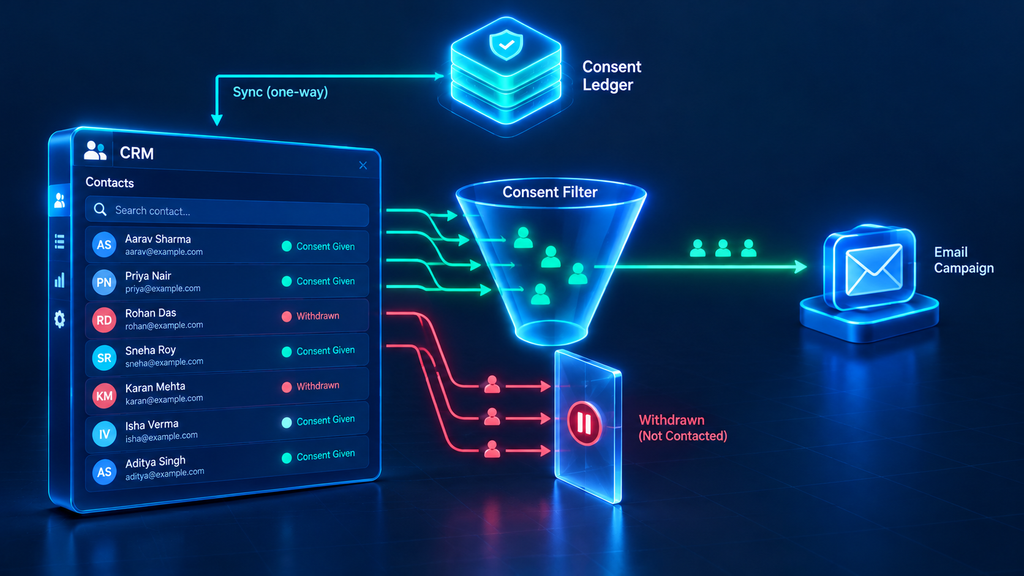
To start, decide which consent fields your CRM needs. At a minimum, each contact should carry purpose-level consent status, the date of the last change, and a reference back to the ledger record. Importantly, that reference lets you prove the source of truth without copying the full audit trail into the CRM.
Then, choose a sync direction. Consent should flow from the platform into the CRM, not the other way around. In other words, the CRM reads consent and never overrides it. Otherwise, an enthusiastic import from a sales spreadsheet could silently flip a withdrawn consent back to active.
Furthermore, build guardrails into the workflows themselves. Campaign tools should filter audiences by purpose-level consent before sending. Likewise, sales sequences should pause automatically when a contact withdraws.
Another common trap is lead imports. Trade shows, partner lists, and purchased contacts all arrive without clean consent records. Consequently, your setup needs an intake rule: no consent record, no marketing use.
Finally, remember duplicates. The same person often appears several times in a CRM under different emails. When someone withdraws consent, the platform should reach every matching record, not just the first one it finds. As a result, matching logic deserves real testing during integration rather than an assumption that it will work.
Backend Systems, Data Warehouses, and Processors
After websites, apps, and CRMs, the deeper layer is your backend. Databases, data warehouses, analytics stacks, billing systems, and customer support tools all hold personal data. Moreover, many of them sit with processors outside your direct control. Consequently, consent management platform integration at this layer is the difference between surface compliance and real compliance.
Start with a data map. List every system that holds personal data, the purpose it serves, and the processors that touch it. Although this exercise feels tedious, it exposes forgotten copies, like an old export folder or a test database filled with real records. Without the map, you cannot connect what you cannot see.
Choosing How Each System Learns About Consent
Next, decide how each system learns about consent. Some systems can query the platform in real time. Others work better with webhooks that update a local flag. Batch systems, such as a nightly warehouse load, may need a filter step that removes withdrawn records before processing. In each case, the principle stays the same: consent state comes from the ledger, and downstream systems only follow it.
In addition, processors need clear contracts and clear signals. Under DPDP, a data fiduciary stays responsible for processing done on its behalf. Therefore, when consent changes, your integration should notify processors and confirm that they acted. A quiet assumption that a vendor “probably handled it” is not evidence.
Similarly, treat analytics carefully. Event streams, session recordings, and behavioral profiles can reveal a great deal. Your integration should tag events with the consent purpose they relied on. Later, if a user withdraws, you can find and handle the related data instead of guessing.
Lastly, think about backups and archives. Deletion requests must eventually reach them, even if the process differs from live systems. Therefore, document how backups handle erasure and how long that takes.
Making Withdrawal and Data Principal Rights Work End to End
Collecting consent is the easy part. Honoring withdrawal across ten systems is where projects succeed or stall. For that reason, the whole integration should be designed backward, starting from withdrawal and working toward capture.
Here is the sequence that works. First, the user withdraws consent through any channel: website, app, email link, or support request. Second, the platform records the event in the ledger with a timestamp and purpose. Third, it fires webhooks to every integrated system. Fourth, each system stops processing for that purpose and sends back a confirmation. Finally, the platform stores those confirmations as part of the record.
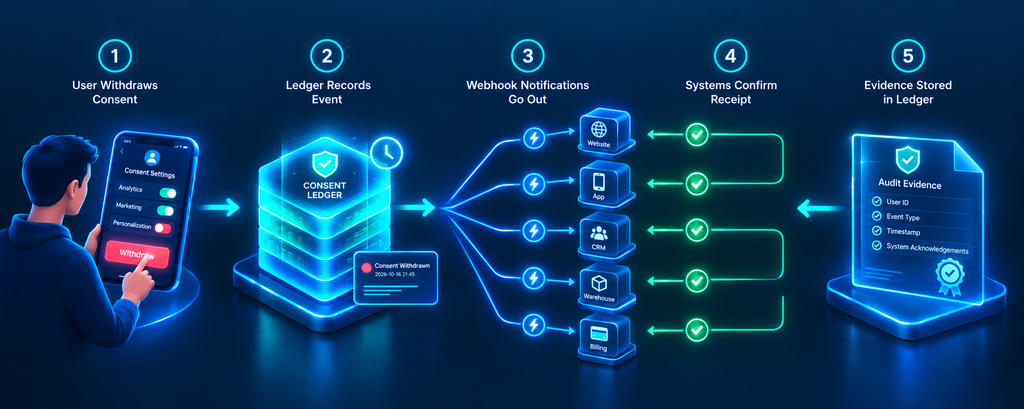
That final step often gets skipped, yet it is the one that matters most during an audit. A confirmation proves that withdrawal reached the system and took effect. In contrast, a sent webhook only proves that the platform tried.
Data principal rights follow a similar path. DPDP gives individuals rights to access, correct, and erase their personal data, and to nominate someone to act on their behalf. Consequently, a request should not land in a shared inbox. Instead, it should open a tracked workflow that routes to every system holding that person’s data, with owners, deadlines, and status.
Moreover, identity verification belongs in this workflow. Before releasing or deleting data, you must be confident that the requester is the right person. Otherwise, a rights process could become an attack path. A good integration builds verification in from the start.
SecureCMS automates these rights workflows and links them to the consent ledger. As a result, compliance teams can see a request, track its progress across systems, and close it with evidence rather than memory.
Audit Trail Integrity: The Layer Regulators Will Actually Examine
Integration creates a lot of events. Every grant, change, withdrawal, sync, and confirmation becomes a record. Therefore, the integrity of that record is just as important as the integration itself.
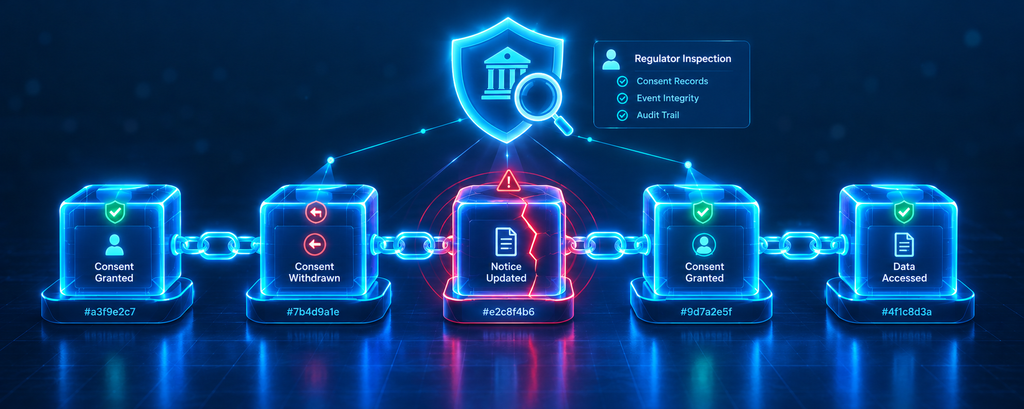
Think about how a Data Protection Board inquiry might unfold. An authority asks what a specific user consented to on a specific date, and whether you honored their withdrawal. You answer with logs. However, if those logs live in an ordinary database table, anyone with admin access could, in theory, change them. Consequently, your answer rests on trust rather than proof.
A tamper-evident audit trail changes that conversation. When each consent event is cryptographically linked to the previous one, any alteration becomes detectable. In other words, you can show that the record has not changed since capture. SecureCMS builds on this idea, drawing on SecureDApp’s blockchain security heritage to anchor consent records in a verifiable way.
Furthermore, integration events deserve the same treatment as consent events. Logging that a webhook fired, that a system confirmed, and that a CRM suppression ran gives you end-to-end evidence. Without that chain, you can prove consent was captured but not that it was respected.
It also helps to keep notice versions linked to every consent. If your privacy notice changes, you need to know which version each user saw. Accordingly, a good integration stores the notice version, language, and channel with each event.
A Practical Roadmap for Consent Management Platform Integration
Large integrations fail when teams try everything at once. Instead, a phased plan keeps risk low and momentum high. Here is a sequence that works for most organizations.
Phase one: discover and map. Inventory every system that collects or processes personal data. Identify purposes, processors, and owners. Meanwhile, rank systems by risk, giving priority to those that contact customers or handle sensitive data.
Phase two: define purposes and notices. Agree on a clear, plain-language list of processing purposes. Then link each purpose to a notice and a consent text. Because everything downstream depends on this list, legal, product, and engineering should sign off together.
Phase three: connect the front doors. Integrate websites and mobile apps first, since they capture most consent. Test grant, change, and withdrawal flows on every platform. In addition, verify that scripts and SDKs stop when consent is withdrawn.
Phase four: connect action systems. Next, link CRMs, email tools, and support platforms. Add audience filters and workflow pauses. Then run a withdrawal test and confirm that a campaign actually excludes the user.
Phase five: connect the backend. After that, integrate databases, warehouses, and processors. Build confirmations into each connection. Document how backups and archives handle erasure.
Phase six: rehearse and monitor. Finally, run tabletop exercises for rights requests and breach notifications. Set up monitoring that flags sync failures, since a silent failure is the most dangerous kind. Moreover, revisit the setup at least twice a year as DPDP rules and the Consent Manager framework evolve.
Common Mistakes in Consent Management Platform Integration
Even careful teams repeat the same errors.
One frequent mistake is integrating only the website. Teams feel finished because the banner works, yet mobile apps, CRMs, and warehouses keep processing freely. Consequently, the visible layer looks compliant while the invisible layers are not.
Another is keeping local copies of consent. Each team adds a “consent” column to its own system, and soon five columns disagree. Instead, every system should read from one ledger and store only a reference.
Additionally, many teams forget one-way sync. Without a rule that consent flows from the platform outward, imports and manual edits can overwrite legitimate withdrawals. Therefore, lock the direction early.
Some teams also skip failure handling. Webhooks fail, APIs time out, and queues back up. Without retries, alerts, and reconciliation jobs, a failed sync can leave a user opted in for weeks. Finally, teams often test only the happy path. A real test includes withdrawal, deletion, duplicate records, offline data, and processor confirmation.
Conclusion: Integration Is Where Consent Becomes Real
Consent does not protect anyone while it sits in a single system. It protects people only when every website, app, CRM, and backend honors it. For that reason, consent management platform integration is not a side project for the engineering backlog. It is the core of a working DPDP consent strategy.
To recap, start with a central ledger, connect the front doors first, and then extend consent into your action systems and backend. In addition, design backward from withdrawal, collect confirmations, and protect your audit trail so that it proves, rather than claims, compliance. With full substantive DPDP obligations expected from May 2027, the time to plan is now.
If you want a platform built around the DPDP consent lifecycle, with purpose-wise capture, rights automation, and a tamper-evident audit trail, SecureCMS is designed for exactly this challenge. Reach out to the SecureCMS team to map your websites, apps, and CRMs to one consent ledger before enforcement pressure arrives.
Frequently Asked Questions
1. What is consent management platform integration?
Consent management platform integration is the process of connecting your consent platform to every system that collects or uses personal data, including websites, mobile apps, CRMs, and backend databases. As a result, a consent or withdrawal recorded in one place is respected everywhere else.
2. Why is integration so important for DPDP compliance?
DPDP expects consent to be specific and just as easy to withdraw as to give. However, a withdrawal that never reaches your CRM or analytics stack protects nobody. Therefore, integration is what makes withdrawal real across your whole business.
3. Which systems should I connect first?
Begin with websites and mobile apps, since they capture most consent. Next, connect CRMs and marketing tools, because they contact people directly. Finally, extend the integration to data warehouses, billing systems, and processors.
4. How do I keep consent consistent across several systems?
Use one central consent ledger and treat every other system as a consumer. In addition, push changes through webhooks, check consent in real time before sensitive actions, and store confirmations from each system as proof.
5. How does SecureCMS support integration across systems?
SecureCMS is built around the DPDP consent lifecycle, with purpose-wise consent capture, automated data principal rights workflows, and an API-first design. Moreover, it records consent events in a tamper-evident audit trail, so teams can show what each user agreed to and when.