
The most dangerous person in your key infrastructure already has a badge. They passed the background check, they know the change windows, and nobody questions their access. That is exactly why HSM insider threat prevention has moved from a compliance checkbox to a boardroom concern.
External attackers must find a path to your keys. An insider simply asks for them. In this guide, you will see how hardware security modules, dual control, and separation of duties close that gap, and why the move to post-quantum cryptography raises the stakes for every Security Officer.
Why Insiders Are the Hardest Key Threat to Stop
Most security programs are built to keep strangers out. However, cryptographic keys sit behind the same doors that employees, contractors, and administrators walk through every day. Consequently, the people closest to your keys are also the people your perimeter controls trust the most.
Insider risk takes three forms. First, a malicious insider acts deliberately, perhaps for money or revenge. Second, a negligent insider makes an honest mistake, such as pasting a private key into a ticket. Third, a compromised insider is a legitimate account taken over by an outsider.
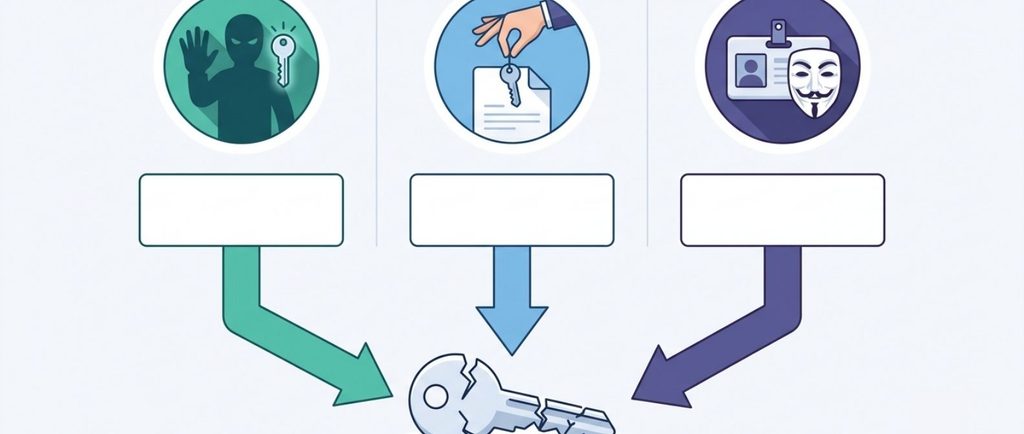
Each form ends in the same place: a key that is no longer under your control.
Why keys are the crown jewels
A stolen password opens one door. A stolen signing key lets an attacker sign software updates, approve transactions, and impersonate your organization to every customer who trusts you. Similarly, a stolen encryption key unlocks years of archived data in one move.
That asymmetry explains why key compromise prevention deserves its own budget line, separate from general access management.
A lesson from a well-known case
In 2013, a contractor working as a system administrator copied vast amounts of classified material from NSA systems. The case is famous for its politics, yet the security lesson is simple. One person held broad, standing privileges, and the surrounding controls could not separate trusted access from excessive access.
Replace the files with encryption keys and the lesson becomes uncomfortably familiar. Industry breach reports, including the annual Verizon DBIR, continue to list privilege misuse as a recurring pattern. Therefore, assuming that your best administrators will never become your biggest risk is not a strategy.
The regulatory squeeze
Meanwhile, expectations are rising. Regulators in India and worldwide want proof of who can touch cryptographic material, under what approval, and with what record. Organizations governed by RBI directions, the Digital Personal Data Protection Act of 2023, or global standards such as PCI DSS face the same question in audits: can you show control, not just claim it?
Software-only key storage struggles to answer that question. This is where hardware enters the picture.
HSM Insider Threat Prevention: What the Hardware Actually Protects
Imagine a vault where the key is born inside a locked room and never walks out. Anyone who wants a signature must send the document in and receive the result. That is the core promise behind effective HSM insider threat prevention.
A hardware security module is a tamper-resistant device that generates, stores, and uses keys inside a hardened boundary. Validated models typically carry FIPS 140-3 certification, which means independent labs have tested their physical and logical defenses.
What the hardware stops
Hardware changes the insider’s options in four important ways:
- No export: Keys are generated inside the module and marked non-exportable, so there is no file to copy.
- No memory scraping: Cryptographic operations run inside the device, away from the host’s memory.
- Tamper response: Physical attacks trigger zeroization, which erases the keys.
- No silent cloning: Backups travel only in wrapped form, protected by separate custodian credentials.
Together, these properties remove the easiest insider attacks. A rogue administrator can no longer dump a process, grab a PEM file, and leave.
What the hardware does not stop
Now comes the insight that many buyers miss. An HSM prevents key theft, but it does not automatically prevent key misuse. If an insider holds valid credentials, the module will happily sign whatever they submit.
In other words, the attacker never needs the key. They only need the key’s permission.
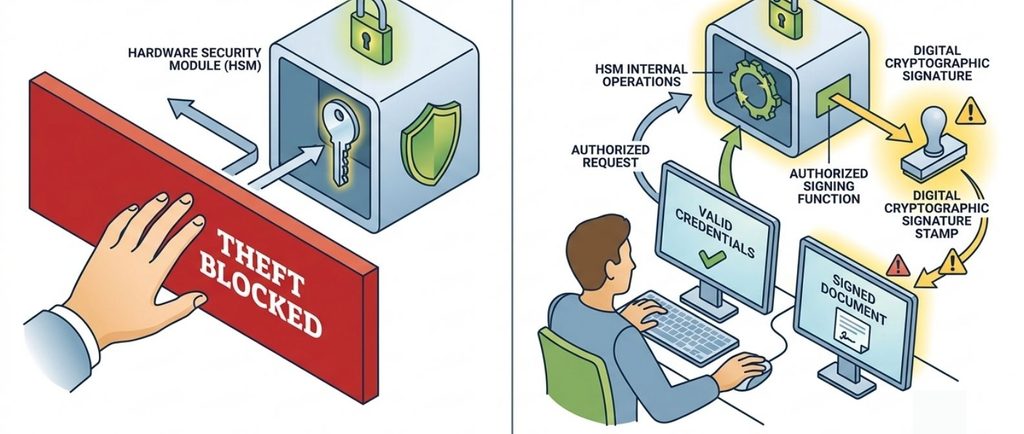
This distinction reshapes the whole conversation. Protecting the key is half the job. Governing every request that uses the key is the other half.
| Insider action | Without an HSM | With a well-configured HSM |
|---|---|---|
| Copy a private key file | Easy | Blocked by non-exportable keys |
| Dump memory to find keys | Possible | Blocked, operations stay inside the device |
| Sign a malicious file with valid access | Easy | Possible unless quorum approval is enforced |
| Change algorithm settings quietly | Easy | Possible unless policy and logging are enforced |
| Delete logs after misuse | Easy | Difficult if logs stream off-device |
The table shows why hardware alone is a foundation, not a finished building. The next controls turn it into one.
Dual Control and Separation of Duties: The Human Layer of Protection
Technology can enforce rules, but people write the rules. For that reason, the strongest HSM deployments pair tamper-resistant hardware with deliberate human design. Two principles carry most of the weight.
How dual control works in practice
Dual control means no single person can complete a sensitive operation alone. In HSM terms, this usually appears as an M-of-N quorum. For example, a module may require any three of five custodians to present smart cards before it activates a master key.
Because each custodian holds a separate credential, one compromised or dishonest person achieves nothing. Likewise, a rushed administrator cannot bypass the process at 2 a.m. without waking two colleagues.
Related to this is split knowledge, where no individual ever knows the complete key or passphrase. Dual control and split knowledge work best together. One limits who can act, and the other limits what any one person can know.
Designing separation of duties that holds
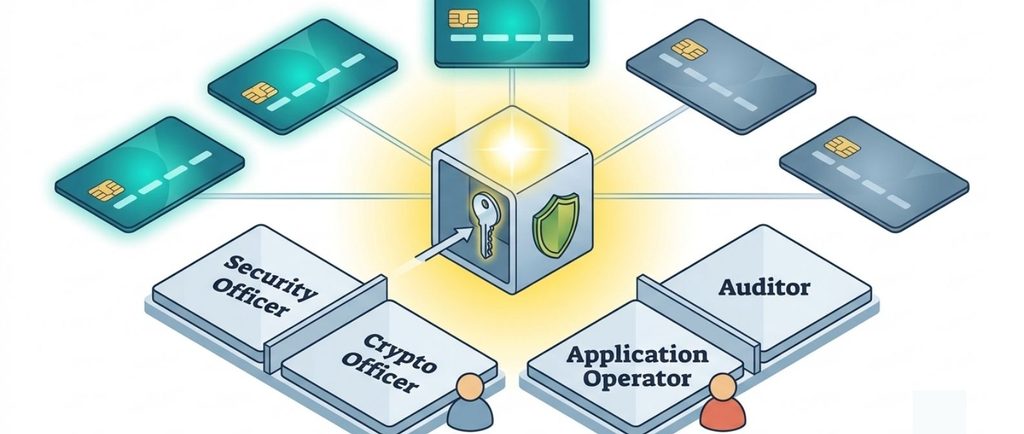
Separation of duties means the person who requests an action cannot also approve it, and the person who administers a system cannot also audit it. Importantly, this applies to roles, not just job titles.
A workable HSM role model usually includes:
- Security Officer: Defines policy and manages custodians.
- Crypto Officer: Creates and manages keys within approved policy.
- Application operator: Uses keys through approved interfaces only.
- Independent auditor: Reviews logs and has no administrative rights.
When one person holds two of these roles, the control collapses quietly. Therefore, review role assignments every quarter, not just at deployment.
The collusion problem
Admittedly, dual control has a weakness. Two insiders who cooperate can defeat it. So how do mature teams respond?
They make collusion harder and riskier. Custodians come from different reporting lines. Quorum cards are stored in separate physical locations. Approvals are recorded on a system that neither custodian controls. Furthermore, custodians rotate on a schedule, which shortens the window for any long-running scheme.
Notably, none of this slows legitimate work much. It simply makes illegitimate work expensive.
Access Control and Audit Trails That Survive Scrutiny
Strong custody means little if anyone can reach the module. Consequently, access control around the HSM deserves the same rigor as the hardware itself.
Least privilege and time-bound access
Start with the principle that no one holds standing administrative access. Instead, grant elevated rights only when a task requires them, then remove them automatically. Pair this with multi-factor authentication for every administrative session.
Next, isolate the network path. Applications should not reach the module directly. Rather, they should call a secure gateway that authenticates the caller, checks policy, and forwards only approved requests. As a result, a compromised application server cannot issue arbitrary commands to your most sensitive device.
Logs that cannot be quietly edited
Audit trails turn suspicion into evidence. However, a log is only trustworthy if the person it describes cannot alter it. If an administrator can delete the record of their own actions, you do not have an audit trail. You have a suggestion.
Strong designs stream logs to a separate, write-once location in near real time. Each entry should capture who acted, which key was used, which policy applied, and which approvals were attached. Moreover, timestamps should come from a synchronized, trusted source.
From logging to detection
Here is a second insight worth pausing on. Most teams collect logs but rarely read them until after an incident. Instead, treat key usage as a behavioral signal.
Consider what a baseline might reveal:
- A signing key used at 3 a.m. when it normally signs during business hours.
- A sudden tenfold rise in decryption requests from one service account.
- A failed quorum attempt followed immediately by a single-user workaround.
Any one of these may be harmless. Together with context, they are often the first visible sign of misuse.
The Post-Quantum Twist: Why Insider Risk Grows During Migration
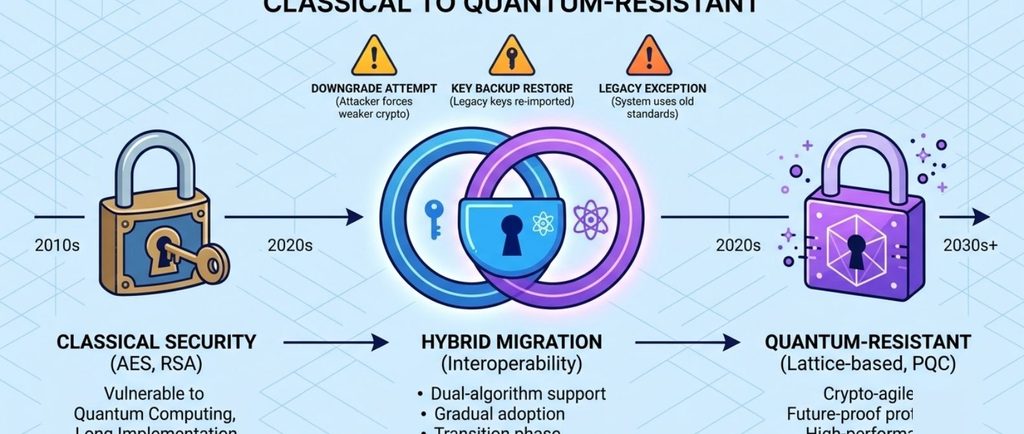
Every major cryptographic transition creates a messy middle. Old and new algorithms run side by side, teams rush, and documentation lags behind. Attackers know this, and so do malicious insiders.
The shift to post-quantum algorithms is the largest transition most organizations will ever run.
Why the clock matters now
NIST finalized its first three post-quantum standards in August 2024: FIPS 203 (ML-KEM), FIPS 204 (ML-DSA), and FIPS 205 (SLH-DSA). In 2025, it also selected HQC as an additional key-establishment algorithm. Furthermore, NIST’s draft transition guidance proposes retiring quantum-vulnerable algorithms by 2035, with deprecation beginning around 2030.
Meanwhile, the threat has already started. Adversaries can copy encrypted data today and decrypt it once a capable quantum computer exists. This “harvest now, decrypt later” approach is particularly attractive to insiders, because bulk exfiltration of encrypted archives is hard to notice and easy to store.
How migration expands the insider attack surface
Consider what a PQC migration adds to your environment:
- More keys: Hybrid crypto means each connection may use both a classical and a quantum-resistant key.
- More ceremonies: New key hierarchies require new generation, backup, and custody events.
- More exceptions: Legacy systems need temporary allowances, and temporary allowances become permanent.
- More spreadsheets: Inventories tracked by hand drift out of date quickly.
Each of these creates a place where an insider can hide a weakness.
Two risks specific to PQC
First, consider stateful hash-based signatures such as LMS and XMSS, which suit firmware and code signing. These schemes use each one-time key exactly once. If an insider restores an old backup or clones a module, a one-time key can be used twice, and security breaks. NIST guidance therefore expects these keys to be generated and managed inside hardware with strict state handling.
Second, consider downgrade attacks. A malicious insider with configuration access can quietly weaken an algorithm policy, moving traffic from a hybrid mode back to classical-only. Without a policy engine that demands approval for such changes, no alarm sounds.
This is where cryptographic agility becomes a security control, not just an engineering convenience. When algorithms are set by governed policy rather than hardcoded in applications, you can change them centrally, and you can also prove who changed them.
Check the hardware roadmap too
Not every module in the field supports PQC algorithms today. Before you commit, confirm your vendor’s firmware roadmap, the way firmware updates are signed, and whether PQC keys receive the same non-exportable protection as classical ones. Otherwise, you may secure the old world while leaving the new one exposed.
How QuantumVault Strengthens HSM Insider Threat Prevention
Hardware protects the key. Governance decides who may use it, with which algorithm, under whose approval, and with what record. QuantumVault is built to supply that second half as a quantum-safe security platform with cryptographic agility.
It works as a PQC governance platform for secure cryptographic migration, placing policy and evidence around the hardware-rooted custody you already trust. Importantly, this closes the gap identified earlier: stolen keys are not the only danger, because misused permissions are just as damaging.
Policy enforcement at the gateway
QuantumVault’s quantum-safe gateway for cryptographic policy enforcement sits between applications and key custody. Every request passes through a PQC policy engine that checks identity, purpose, and algorithm before anything reaches the key.
Consequently, an insider cannot simply call the module with borrowed credentials. They must also satisfy policy. Attempts to weaken a setting, such as a hybrid-to-classical downgrade, require approval and leave a record.
Approval workflows for signing
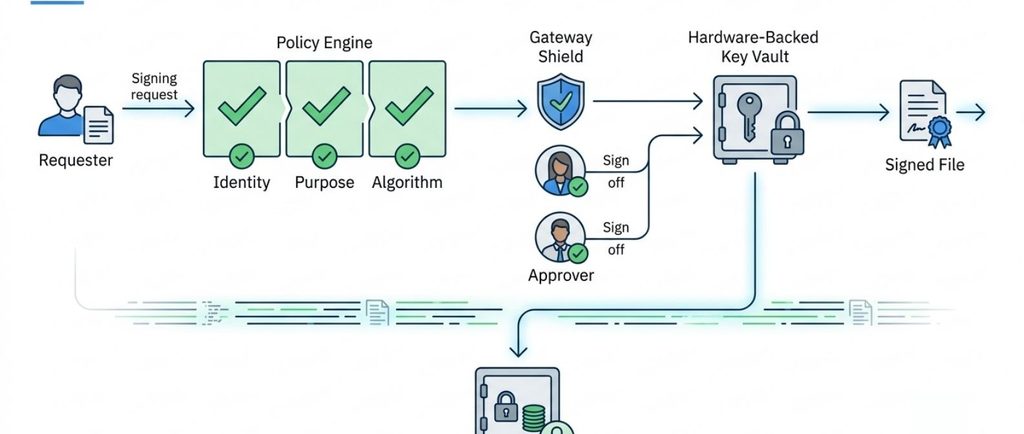
Signing is where insider damage is most visible, since one malicious signature can reach every customer. A PQC solution for secure signing and approval workflows lets organizations require multiple approvers before a release, firmware image, or high-value instruction is signed.
In practice, this applies dual control and separation of duties to the signing path itself. The requester, the approver, and the auditor remain different people, and each action lands in the PQC audit logs.
Evidence for audits and regulators
Regulated teams need more than good intentions. PQC compliance requires showing which keys exist, which algorithms protect which systems, and who changed what. QuantumVault centralizes PQC key management visibility and audit evidence, so a Security Officer can answer an examiner without assembling spreadsheets.
This is especially valuable for post-quantum cryptography for regulated enterprises, where banks, insurers, and healthcare providers must demonstrate control continuously rather than once a year.
Securing every path an insider might use
Keys are used well beyond the data center. Therefore, QuantumVault extends protection across the places employees actually work. This includes quantum-resistant security for web, mobile, server, and devices, quantum-safe remote access and tunnel security through a PQC tunnel, and PQC collaboration security for shared documents and messaging. Because the platform supports hybrid PQC and classical encryption, teams can roll out protection gradually without breaking legacy systems.
A scenario to make it concrete
Picture a mid-sized private lender running payment approvals and mobile banking. A senior infrastructure engineer, frustrated after a missed promotion, plans to sign a forged configuration update before leaving.
Under a hardware-only model, the engineer holds valid access, so the module signs. Under a governed model, the request enters a signing workflow. It needs two independent approvals, the policy engine flags an unusual time and an unfamiliar target, and an alert reaches the Security Officer within minutes. The forged update never ships.
Notice what changed. The key was never stolen. The permission to use it simply stopped belonging to one person.
Where this approach differs
Many HSM explainers and hardware-centric offerings focus on tamper resistance and key storage. That foundation is essential, yet it stops at the device boundary. The harder problems begin outside it: approval logic, algorithm policy, audit evidence, and the long road to quantum-ready operations.
QuantumVault is designed for that wider territory. Its PQC suite for enterprise quantum-safe security treats insider control, migration, and governance as one connected problem. If you want to prevent insider key compromise across both classical and post-quantum environments, that connected view is what makes the difference.
A Practical Roadmap for Security Officers
Knowing the theory is useful. Acting on it is better. The following sequence keeps effort proportional to risk and avoids a risky big-bang rollout.
- Inventory every key and who touches it. List keys, owners, locations, algorithms, and administrators. Include forgotten ones in CI/CD pipelines and old backups.
- Map privileged access. Identify accounts with standing rights over keys or modules. Remove anything that cannot be justified.
- Enforce quorum on sensitive operations. Start with root keys, code-signing keys, and anything tied to payments.
- Separate roles and test them. Confirm that no person holds conflicting roles, then verify it by attempting a bypass.
- Centralize and protect logs. Stream audit data to an independent, write-once location and assign a reviewer who is not an administrator.
- Pilot hybrid crypto on one critical path. Choose a contained service, then measure performance and operational impact.
- Phase the PQC rollout. Expand by risk tier, keeping policy approvals and evidence at every step.
- Run insider simulations. Ask a trusted team to act as a malicious administrator, and fix every gap they find.
A short caution applies here. Do not wait for a perfect inventory before starting. Instead, begin with the keys that would hurt most if misused, and improve coverage as you learn.
What to Ask Before You Choose a Solution
Vendor conversations go better with sharp questions. Consider bringing these to your next evaluation:
- Can any single administrator export, clone, or use a root key alone?
- Can algorithm policy be weakened without multi-person approval?
- Are audit logs stored where administrators cannot edit or delete them?
- Does the platform support hybrid encryption so classical and PQC can coexist during transition?
- How are stateful signature keys protected against backup restoration?
- What does the PQC rollout look like, and can policy be applied by risk tier?
- Which evidence can the platform produce for auditors without manual work?
- How does it enforce quantum-safe access for remote staff and third parties?
Clear answers to these questions reveal whether a vendor treats insider risk as a feature or an afterthought.
Frequently Asked Questions
1. What is HSM insider threat prevention?
It is the use of hardware security modules, combined with dual control, separation of duties, and monitoring, to stop trusted people from stealing or misusing cryptographic keys. The hardware blocks extraction, while governance controls limit how keys are used.
2. Can an HSM stop a malicious administrator?
Partly. It prevents key export and tampering, but a valid administrator can still request operations. Quorum approval, role separation, and monitored logs are needed to stop misuse.
3. What is the difference between dual control and separation of duties?
Dual control requires two people to complete one sensitive action. Separation of duties keeps conflicting roles, such as requesting and approving, with different individuals. Mature programs use both.
4. What does key compromise prevention include?
It covers secure generation, non-exportable storage, quorum-based access, least-privilege administration, tamper-evident logging, and tested recovery procedures. Prevention also includes detecting abnormal key usage early.
5. How does M-of-N authentication reduce insider risk?
It requires a minimum number of authorized custodians, such as three of five, before sensitive actions run. As a result, one compromised or dishonest person cannot act alone.
6. Why do audit logs matter for insider threats?
Logs provide evidence of who used which key and why. They deter misuse and speed up investigations, provided administrators cannot edit or delete them.
7. Does post-quantum cryptography change insider risk?
Yes. Migration adds keys, ceremonies, and temporary exceptions. It also introduces risks such as algorithm downgrades and stateful signature key reuse that governance controls must address.
8. What is hybrid crypto, and why use it?
Hybrid crypto combines a classical algorithm with a quantum-resistant one in the same protocol. It protects data even if one algorithm later proves weak, and it eases the transition.
9. What is harvest now, decrypt later?
It describes attackers collecting encrypted data today to decrypt once quantum computers mature. Insiders can accelerate this by exfiltrating archives, so long-lived sensitive data should move to quantum-resistant protection early.
10. Why is cryptographic agility important for security?
Agility lets you change algorithms through central policy instead of rewriting applications. It also lets you prove who changed a setting, which supports both safety and audits.
11. How do I protect code-signing keys from insiders?
Keep them in hardware, require multi-person approval for each signing request, log every operation, and restrict signing to approved build systems. Review approvers regularly.
12. Is a PQC governance platform still needed if I already use HSMs?
Generally yes. HSMs protect the key, while a governance platform controls policy, approvals, migration, and audit evidence around it. Together they address both theft and misuse.
13. How should regulated enterprises start with PQC migration?
Begin with a cryptographic inventory, rank systems by data sensitivity and lifespan, and pilot hybrid encryption on one contained service. Then expand in phases with documented approvals.
Conclusion: Close the Gap Between Trusted Access and Trusted Use
Insiders will always be part of your risk landscape, because trust is part of running a business. What you can change is how much damage one person can do with that trust.
Effective HSM insider threat prevention rests on three ideas. Hardware keeps keys from leaving. Dual control and separation of duties keep any one person from acting alone. Audit trails and policy turn every key operation into accountable evidence. Skip any one of them, and a determined insider will find the opening.
The post-quantum era adds urgency. New algorithms, hybrid modes, and migration projects multiply the places where governance can slip. Organizations that build cryptographic agility and approval discipline now will migrate faster and with fewer surprises.
QuantumVault gives security leaders a practical path through both challenges, combining PQC governance, policy enforcement, and quantum-safe protection across networks, devices, and workflows. To see how your organization can prevent insider key compromise and prepare for the quantum transition, take the next step.