
Your encrypted data is only as safe as the key that locks it. Most breach reports prove this point the hard way. Attackers rarely break the cipher. Instead, they steal, copy, or misuse the key.
That is why cloud data encryption has become a key management problem first and an algorithm problem second. Moreover, quantum computing is adding a second deadline to an already difficult job. Adversaries can collect encrypted traffic today and decrypt it later.
This guide gives cloud architects and CTOs a practical, HSM-based strategy for protecting encryption keys across multi-cloud environments. It also shows how to make that strategy quantum-ready, so you only build it once.
Why Cloud Data Encryption Fails at the Key, Not the Cipher
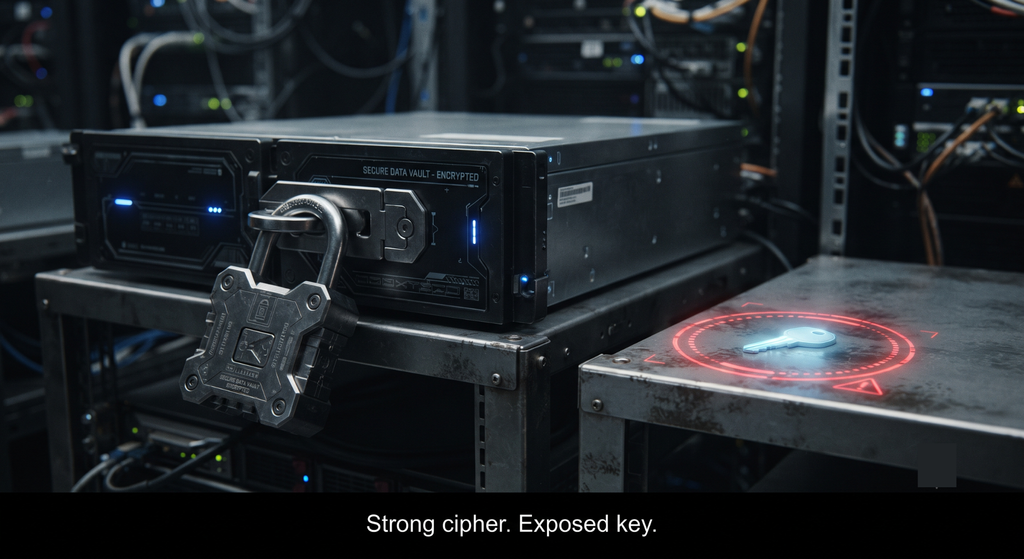
Ask any security team whether their cloud data encryption is in place, and the answer is almost always yes. Storage buckets, databases, and backups all carry default cloud data encryption. However, a second question tends to produce silence. Who controls the keys, and what happens if one leaks?
Encryption turns a data problem into a key problem. If an attacker holds the key, the cipher is irrelevant. As a result, mature cloud encryption programs spend most of their effort on where keys live, who can use them, and how every use is recorded.
The Hidden Gaps in Typical Cloud Data Encryption
Several gaps appear again and again in cloud environments.
- Keys stored beside the data. Application servers often hold secrets in environment variables or configuration files.
- Over-broad access. Developers and service accounts receive key permissions that far exceed their real needs.
- Fragmented tooling. Each cloud provider offers its own key service, so policy drifts between platforms.
- Weak evidence. Audit logs exist, but they sit in different formats and different accounts.
Notably, none of these gaps involve a broken algorithm. They are operational failures. Therefore, fixing cloud data encryption requires a key protection strategy rather than a stronger cipher.
A Real-World Reminder
In 2023, an attacker obtained a signing key at a major cloud provider and used it to forge authentication tokens. Those tokens reached enterprise email accounts. The lesson was clear. A single key, held outside a hardened boundary, can undermine an entire trust model.
Consequently, the question for every CTO is simple. If one of your keys leaked tonight, how far would the damage travel?
The Quantum Clock Changes the Key Protection Equation
Key protection used to be a compliance exercise with a comfortable timeline. That comfort is gone. Post-quantum cryptography (PQC) has moved from research papers to published standards, and migration deadlines are now part of planning conversations.
Harvest Now, Decrypt Later
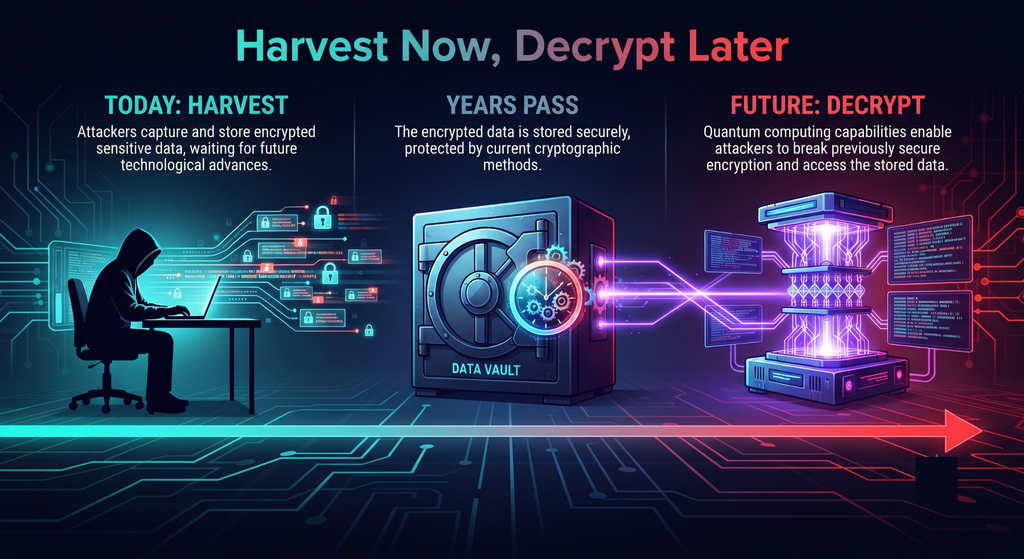
Here is the insight that changes the conversation. Attackers do not need a quantum computer today to benefit from one tomorrow. They can record encrypted traffic and stored ciphertext now, then decrypt it when the hardware arrives.
This tactic is often called “harvest now, decrypt later.” As a result, any data with a long confidentiality lifetime is already at risk. Health records, financial histories, intellectual property, and government data all qualify.
Importantly, the exposure sits in the key exchange and the public-key layer. Symmetric ciphers such as AES-256 remain comparatively resilient. The weak points are the classical key establishment and signature methods that wrap and authenticate those symmetric keys.
What the Standards Now Say
In 2024, NIST finalized its first post-quantum standards. These include ML-KEM for key encapsulation, ML-DSA for digital signatures, and SLH-DSA as a hash-based signature option. Furthermore, NIST guidance proposes retiring widely used public-key algorithms such as RSA and elliptic curve cryptography on a defined timeline.
Meanwhile, regulators are tightening expectations on data protection and cloud data encryption worldwide. In India, the Digital Personal Data Protection Act places clear duties on organizations to safeguard personal data. Financial regulators also expect strong cryptographic controls and audit evidence.
Taken together, these forces point to one conclusion for cloud data encryption. Quantum-safe security is no longer a research topic. It is a design requirement for every new key architecture.
What HSM-Based Key Protection Gives Your Cloud Data Encryption
A Hardware Security Module (HSM) is a tamper-resistant device built to generate, store, and use cryptographic keys. In simple terms, it lets you use a key without ever being able to read it. That single property explains why HSMs sit at the center of serious cloud data encryption programs.
A Hardened Boundary for Encryption Keys
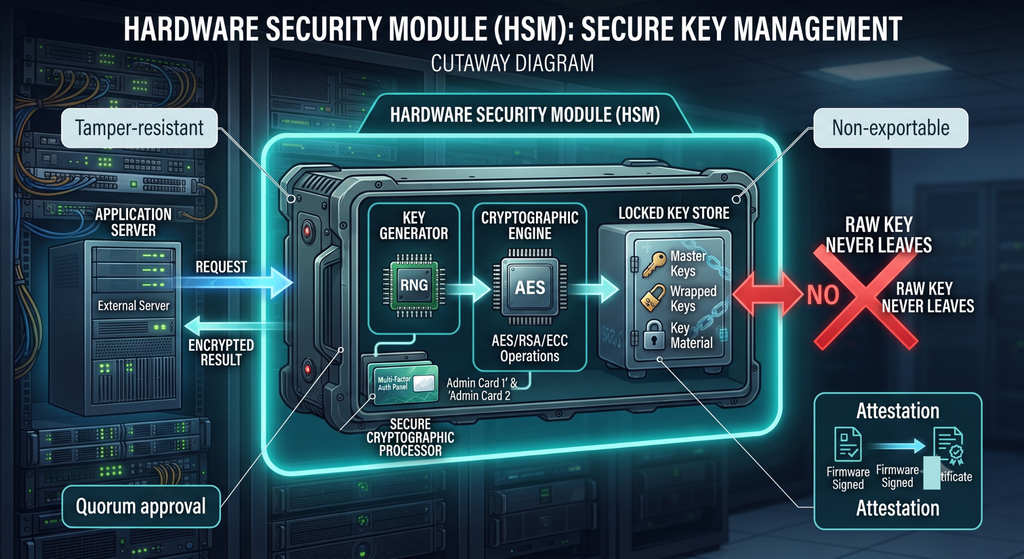
First, an HSM creates a physical and logical boundary around key material. Keys are generated inside the device. Cryptographic operations happen inside the device. The raw key never appears in application memory, in logs, or in a crash dump.
Therefore, even a fully compromised application server cannot walk away with the root key. An attacker might misuse access temporarily, but they cannot copy the key and use it offline.
Non-Exportability and Separation of Duties
Next, consider control over cloud data encryption keys. HSMs can enforce that a key is non-exportable. They also support role separation, so the person who administers the device is not the person who authorizes key use.
Quorum approval adds another layer. Sensitive actions, such as key deletion or policy changes, can require multiple authorized people. Consequently, no single insider can quietly change the rules.
Attestation and Assurance
Finally, HSMs provide assurance that auditors recognize. Devices validated against FIPS 140 standards give regulators and customers a shared language for trust. Attestation records can show that a key was generated and held inside a certified boundary.
For regulated enterprises, this evidence is often the difference between a smooth audit and a painful one.
Cloud-Native HSM Services vs a Multi-Cloud Key Strategy
Every major cloud provider now offers an HSM-backed key service for cloud data encryption. These services are good, and they are a sensible starting point. Google Cloud’s HSM offering, for example, hosts keys in FIPS 140-2 Level 3 certified HSM clusters and manages scaling and patching for you.
However, a service built for one cloud solves a one-cloud problem. Most enterprises no longer live in one cloud, so cloud data encryption has to span several.
Where Single-Cloud HSM Services Fall Short
Consider what a cloud architect must weigh when relying on a single provider’s HSM service.
- Location coupling. Customer-managed key integrations typically require the key location to match the location of the resource it protects.
- Operational limits. Provider documentation lists constraints such as smaller message sizes for HSM-backed operations and higher latency for some asymmetric operations.
- Policy fragmentation. Each provider defines its own roles, logs, and key lifecycle model.
- Provider dependency. Your key custody story is tied to one vendor’s roadmap and one vendor’s terms.
It is fair to note that providers are moving quickly. Google’s key service, for instance, now lists post-quantum algorithms alongside classical ones. Even so, algorithm support is only one piece. The harder question is who governs keys consistently across every environment you run.
The Multi-Cloud Gap
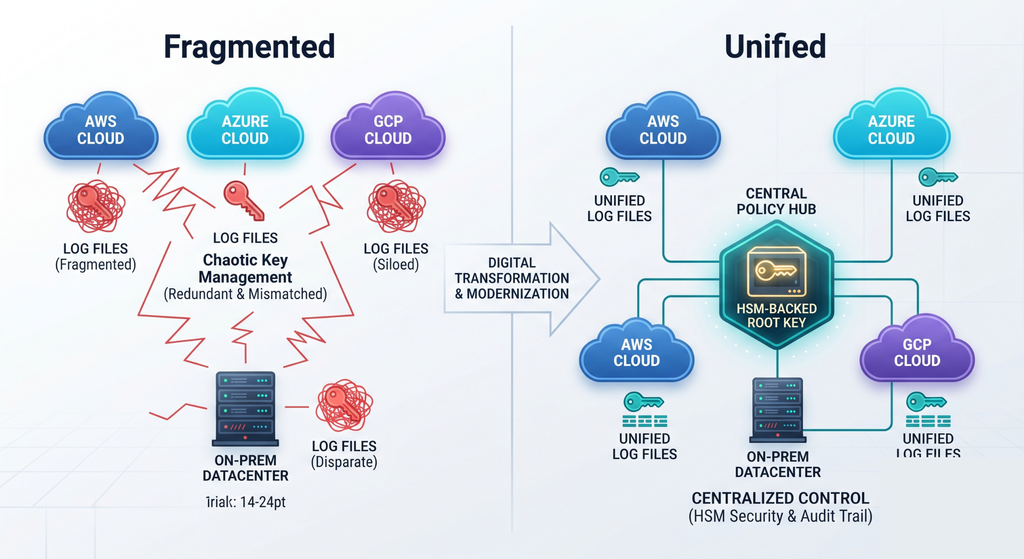
Imagine a platform team running workloads on two public clouds and an on-premises data center. Each environment has its own key service, its own IAM model, and its own audit format. Rotating a key means three procedures. Proving compliance means three evidence packages.
Here is the shift in thinking that matters for multi-cloud data encryption. The goal is not to find the best HSM inside each cloud. The goal is to build one control plane for encryption keys that works across all of them. That is the philosophy behind key management as a service done properly: one policy layer, many places to enforce it.
| Capability | Single-Cloud HSM Service | Unified Multi-Cloud Strategy |
|---|---|---|
| Key custody | Per provider | Consistent across providers |
| Policy model | Provider-specific | One policy engine |
| Audit evidence | Separate logs per cloud | Unified audit trail |
| Algorithm change | Depends on provider roadmap | Centrally governed |
| Exit flexibility | Limited | High |
A Reference Architecture for HSM-Based Cloud Data Encryption
Strategy becomes real only when it turns into architecture, and cloud data encryption is no exception. The following model works for most multi-cloud estates, and it scales from a single product team to a global enterprise.
Layer One: The Root of Trust
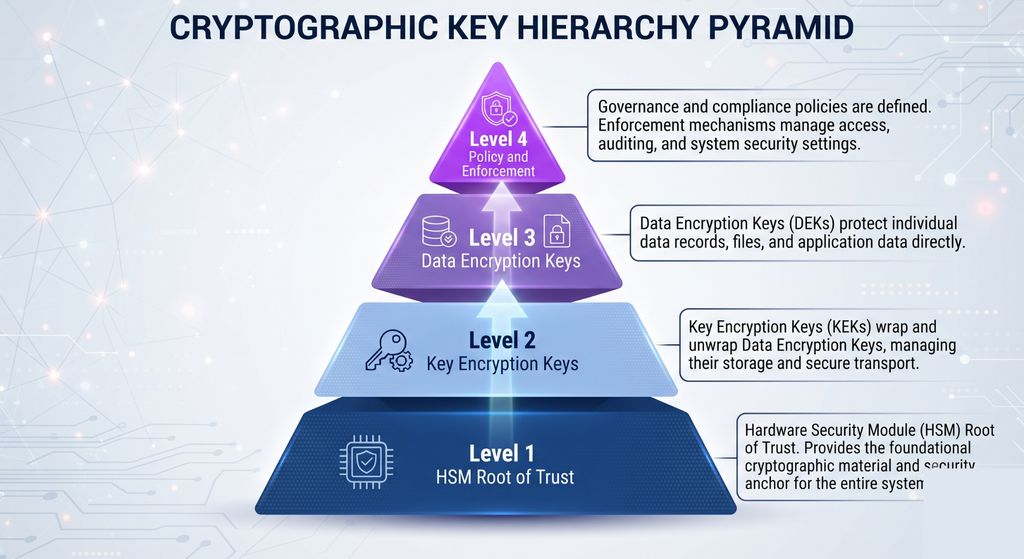
At the base sits an HSM-protected root key. This key never leaves the hardware boundary. It exists to wrap and protect everything above it. Because it is rarely used, it can be tightly controlled, heavily audited, and backed up under strict ceremony.
Layer Two: Key Encryption Keys
Above the root, key encryption keys (KEKs) protect data encryption keys. KEKs can be scoped by environment, region, or business unit. As a result, a compromise in one scope does not spread to others.
Layer Three: Data Encryption Keys and Envelope Encryption
Data encryption keys (DEKs) do the heavy lifting. Applications use DEKs for cloud data encryption of files, database fields, and objects. Each DEK is itself encrypted by a KEK, a pattern known as envelope encryption.
This design has a practical benefit. Rotating a KEK only requires re-wrapping DEKs, not re-encrypting terabytes of data. Therefore, rotation becomes routine instead of risky.
Layer Four: Policy and Enforcement
Finally, a policy layer for cloud data encryption decides who and what may use which keys. It evaluates identity, workload, location, and purpose before any key operation is approved. Every decision is written to an immutable log.
Without this layer, the HSM is a vault with no door rules. With it, every key use becomes explainable.
Key Lifecycle Controls That Matter
A sound strategy covers the full key lifecycle, not just storage.
- Generation inside the HSM with approved entropy.
- Rotation on a defined schedule and after any suspected exposure.
- Backup and recovery under dual control.
- Retirement and destruction with verifiable evidence.
Each stage should produce a record. After all, a key you cannot account for is a key you cannot defend.
Building Crypto-Agility Into Your Key Protection Strategy
Here is a hard truth for architects. Any architecture built around a single algorithm has an expiry date. Quantum computing simply made that date visible.
Crypto-agility, also called cryptographic agility, is the ability to change algorithms, key sizes, and protocols without redesigning applications. In practice, it means cryptography becomes a policy decision rather than a hard-coded choice.
Why Hard-Coded Cryptography Becomes Technical Debt
Many organizations discover thousands of places where cryptography is embedded in code, configuration, and device firmware. Swapping an algorithm in each place is slow and error-prone. Consequently, migrations stall.
An agile design avoids this trap. Applications call a central service. That service decides which algorithm to apply, based on policy. When standards change, the policy changes once.
Hybrid Crypto as the Practical Bridge
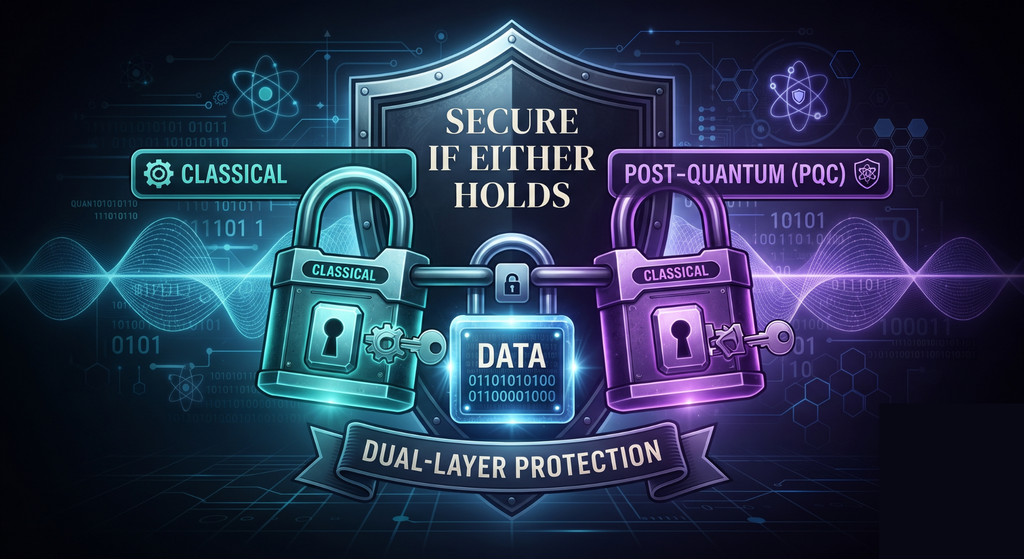
Switching cloud data encryption overnight from classical to post-quantum algorithms is neither safe nor realistic. Hybrid crypto offers a bridge. In a hybrid approach, a classical algorithm and a post-quantum algorithm are combined, so the connection stays secure if either one holds.
Hybrid encryption protects against two risks at once. If a flaw is found in a new PQC algorithm, the classical layer still stands. If quantum capability arrives early, the post-quantum layer protects the data. For regulated enterprises, a hybrid PQC and classical encryption platform is the most defensible transition path.
What a Quantum-Ready Key Strategy Includes
A quantum-ready design adds a few specific elements to the reference architecture.
- Post-quantum key encapsulation for key exchange and key wrapping.
- Post-quantum signatures for software, documents, and approvals.
- A central inventory of where cryptography is used.
- Policy controls that can enforce algorithm choices per workload.
None of these require abandoning HSMs. In fact, HSM-based custody becomes more important, because new algorithms bring new key types that also need protection.
How QuantumVault Brings HSM-Based Protection and Quantum-Safe Security Together
So far, we have described the pieces. The practical question is how to assemble them without stitching together five separate tools. This is where QuantumVault fits.
QuantumVault is a quantum-safe security platform built for enterprises that need cryptographic agility across web, mobile, server, and device environments. It treats HSM-backed key custody as the foundation and layers governance, policy, and post-quantum protection on top.
The PQC Suite, Explained Simply
The QuantumVault PQC suite for enterprise quantum-safe security covers the main places where cloud data encryption and other cryptography live.
- PQC key management keeps keys under HSM-backed custody with consistent lifecycle controls across clouds.
- PQC policy engine lets teams define which algorithms apply where, and enforce those rules centrally.
- PQC gateway acts as a secure gateway for cryptographic policy enforcement on traffic and API calls.
- PQC tunnel provides quantum-safe remote access and tunnel security for users and services.
- PQC audit logs record every key and policy event for review.
- PQC governance gives leaders visibility into migration progress and risk.
Because these components share one policy layer, a change made once applies everywhere. That is the practical meaning of a cryptographic agility platform.
Use Case: A Multi-Cloud Fintech
Consider a hypothetical payments company in India that depends on cloud data encryption. It runs customer-facing workloads on two public clouds and keeps settlement systems in a private data center. Regulators expect strong controls, and customers expect their financial histories to stay private for many years.
The team’s challenge is familiar. Three key services, three audit formats, and a growing list of encryption keys with no single owner. Meanwhile, the board is asking whether the company is prepared for post-quantum requirements.
With a unified approach, the company places root keys under HSM custody. It routes encryption policy through one engine. It deploys a PQC gateway at its API edge and a PQC tunnel for administrator access. Hybrid encryption protects long-lived data first, since that data carries the highest harvest risk.
Within one planning cycle, the team can show regulators a single evidence trail. More importantly, it can change algorithms through policy when standards evolve.
Use Case: Secure Signing and Approval Workflows
Encryption is not the only cryptographic exposure. Many organizations rely on digital signatures for software releases, contracts, and financial approvals. Those signatures also rely on algorithms that quantum computers could eventually break.
A PQC signing workflow protects these processes with post-quantum signatures, backed by HSM-protected signing keys. Approvals remain verifiable for as long as the record matters. Likewise, PQC collaboration security and PQC device security extend the same protections to shared documents and connected endpoints.
A Phased Rollout, Migration, and Governance Roadmap for Cloud Data Encryption
A strategy that cannot be executed is just a document. The following roadmap keeps scope manageable and delivers value early. It reflects how a PQC migration is best run: as a governed program, not a one-time project.
Phase One: Discover and Inventory

Begin by finding where cryptography is used. Catalog algorithms, key sizes, certificate authorities, libraries, and protocols across applications and infrastructure. You cannot migrate what you cannot see.
Next, classify data by confidentiality lifetime. Information that must stay secret for ten years or more moves to the front of the queue.
Phase Two: Secure the Foundation
Move root and master keys into HSM custody. Establish role separation and quorum controls. Define key hierarchies and rotation schedules. This step improves your security posture immediately, even before any post-quantum change.
Phase Three: Centralize Policy
Introduce a policy engine that governs algorithm choice, key use, and access for all cloud data encryption. Connect cloud key services into one governed model. Consequently, every environment follows the same rules, and exceptions become visible.
Phase Four: Pilot Hybrid Protection
Select a contained, high-value path for your first PQC rollout. Common candidates include an API gateway, an administrator tunnel, or a data store with long-lived records. Run hybrid encryption in parallel with existing controls and measure latency, compatibility, and operational impact.
Phase Five: Scale and Govern
Expand coverage in waves. Track progress against a PQC compliance plan, and review audit logs regularly. Governance should answer three questions at any time. What is protected, by which algorithm, and under whose authority?
Metrics That Prove Progress
- Percentage of keys under HSM custody.
- Percentage of workloads governed by central policy.
- Share of long-lived data protected with hybrid or post-quantum methods.
- Time required to rotate a key or change an algorithm.
Notably, the last metric reveals true agility. If a policy change takes weeks, your architecture is still brittle.
Frequently Asked Questions
1. What is cloud data encryption?
Cloud data encryption is the practice of encrypting data stored in, or moving through, cloud services. Its strength depends heavily on how the encryption keys are generated, stored, and controlled.
2. Why use an HSM for cloud encryption keys?
An HSM generates and uses keys inside tamper-resistant hardware, so the key material is never exposed. This sharply reduces the risk of theft and supports audit requirements.
3. What is the difference between a KMS and an HSM?
A key management system handles policy, access, and lifecycle. An HSM is the hardware that protects the keys. Strong programs use both, with the HSM as the root of trust.
4. What is key management as a service?
Key management as a service delivers key creation, rotation, access control, and auditing through a managed platform. Done well, it gives teams one control plane across several clouds.
5. Is AES-256 safe against quantum computers?
AES-256 is considered comparatively resilient to known quantum attacks. The larger risk lies in classical public-key methods used for key exchange and signatures, which quantum computers could break.
6. What does harvest now, decrypt later mean?
It describes attackers collecting encrypted data today to decrypt once quantum capability exists. Long-lived sensitive data is the most exposed.
7. What is crypto-agility?
Crypto-agility is the ability to switch algorithms and key sizes quickly through policy, without rewriting applications. It reduces migration cost and risk.
8. What is hybrid encryption in a PQC context?
Hybrid encryption combines a classical algorithm with a post-quantum algorithm. The data stays protected if either algorithm is later weakened.
9. Do I need to replace my HSMs to become quantum-safe?
Not necessarily. Many organizations keep HSM-based custody and add post-quantum algorithms, policy control, and governance. Hardware and firmware support should be reviewed as part of planning.
10. Which standards define post-quantum algorithms?
NIST published ML-KEM for key encapsulation, ML-DSA for signatures, and SLH-DSA as a hash-based signature standard. These form the core of most PQC roadmaps.
11. How do I secure keys across multiple clouds?
For multi-cloud data encryption, place root keys under HSM custody, define one policy model, and centralize audit logs. A unified platform prevents policy drift between providers.
12. How often should encryption keys be rotated?
Rotation depends on risk, data sensitivity, and compliance rules. Envelope encryption makes frequent rotation practical, since only key-wrapping layers need to change.
13. What should be migrated first in a PQC program?
Start with data that needs long-term confidentiality and with high-exposure paths such as gateways and remote access. These deliver the greatest risk reduction early.
14. How does a PQC gateway help?
A PQC gateway enforces cryptographic policy at the network or API edge. It lets enterprises add quantum-resistant protection without changing every application.
Conclusion: Protect the Key, Protect the Data
Cloud data encryption succeeds or fails at the key. Algorithms matter, but custody, control, and evidence matter more. An HSM-based strategy gives cloud data encryption a hardened root of trust, and a unified policy layer keeps that trust consistent across every cloud you use.
The quantum era raises the stakes without changing the logic. Harvest-now, decrypt-later attacks reward organizations that wait. Meanwhile, crypto-agility and hybrid encryption reward those who prepare. If your keys are protected by hardware and governed by policy, algorithm changes become a configuration task instead of a crisis.
QuantumVault was built for exactly this transition. It combines HSM-backed key custody with a PQC suite, governance, and cryptographic agility, so enterprises can move to quantum-safe security at a measured pace.
If your team is planning its next step, start with a clear strategy. Protect cloud data with HSM and give your encryption keys the foundation they need.