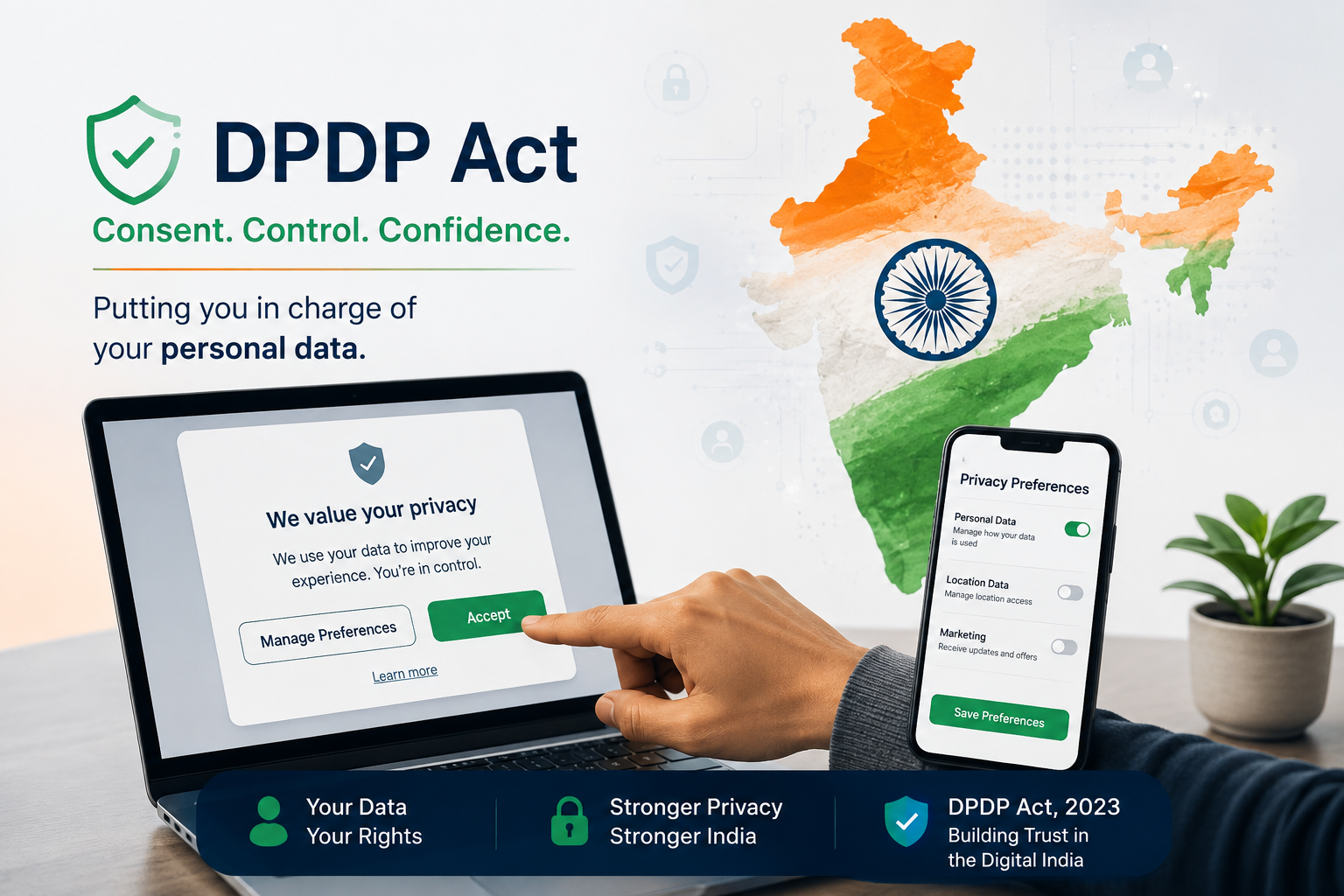

You ship a mobile payment app from Mumbai. Your customers span India, the EU, and California. Then the realization hits: these three jurisdictions have radically different data protection laws, each with teeth, each with penalties that could sink your business. The Digital Personal Data Protection Act (DPDP), the General Data Protection Regulation (GDPR), and the California Consumer Privacy Act (CCPA) do not coordinate with each other. Worse, they actively conflict in ways that force technical and operational compromises.
A consent management platform has become non-negotiable infrastructure for cross-border fintech and e-commerce businesses. Yet most teams discover too late that a single consent management platform cannot simply bridge these frameworks. Each law demands its own consent architecture, its own withdrawal mechanism, and its own audit trail. The compliance layering problem is not theoretical; it is a crisis unfolding across the entire sector right now.
This guide walks through what each framework demands, where they collide, and how forward-thinking businesses are building consent infrastructure that actually survives scrutiny across all three jurisdictions simultaneously.
Understanding the Three Frameworks: Core Principles and Differences
DPDP: India’s Purpose-Centric Consent Model
The Digital Personal Data Protection Act (DPDP) treats consent as a binding, revocable commitment tied to specific processing purposes. The law requires consent to be free, specific, informed, unconditional, and unambiguous. Furthermore, withdrawal must be as simple as the original grant.
Here is where DPDP diverges most sharply from global precedent. The Act introduces the concept of a registered Consent Manager, a third-party intermediary that will eventually allow individuals to view and manage consents across multiple businesses from a single dashboard. This architectural detail fundamentally changes how consent must be structured inside your application. Additionally, the full substantive obligations of the DPDP Act take effect in May 2027, meaning enforcement will intensify significantly over the next eighteen months.
In practice, DPDP demands that each data use get its own explicit, plain-language ask. Location for delivery tracking is a separate consent from location for personalized recommendations, even though both use GPS data. Bundling them under a single toggle directly violates the “specific consent” requirement that regulators increasingly scrutinize first.
GDPR: Europe’s Rights-First Framework
The General Data Protection Regulation (GDPR) flipped the consent model on its head compared to older privacy frameworks. Instead of asking permission for every use, businesses needed affirmative, documented consent before collecting data. Yet GDPR also introduced a broader set of individual rights: access, correction, erasure, and portability.
GDPR consent must be freely given, specific, informed, and unambiguous. Critically, consent must be distinguishable from other matters. That means burying consent language inside a terms-of-service document does not count. Users need a separate, clear affirmation.
However, GDPR also permits businesses to rely on legitimate interest as a legal basis for processing, not just consent. That flexibility does not exist under DPDP. Consequently, a processing activity that could slide through under GDPR’s legitimate-interest doctrine becomes a mandatory-consent event under DPDP.
CCPA: California’s Consumer Choice Model
The California Consumer Privacy Act (CCPA), expanded by the California Privacy Rights Act (CPRA), centers on consumer transparency and choice. Unlike GDPR and DPDP, CCPA does not always require explicit consent. Instead, it demands that businesses disclose what data they collect and allow users to opt out of certain uses, particularly the sale or sharing of personal information.
CCPA defines “sale” and “sharing” narrowly, which creates a compliance gap that many fintech and e-commerce businesses miss. Sharing personal information with advertising partners for behavioral targeting counts as “sharing” under CCPA, triggering opt-out obligations that look nothing like GDPR or DPDP consent.
Moreover, CCPA enforcement has accelerated dramatically. The California Attorney General and private attorneys general are filing actions regularly, making California compliance an immediate priority, not a deferred concern.
The Compliance Layering Problem: Where These Frameworks Collide
The Consent Architecture Mismatch
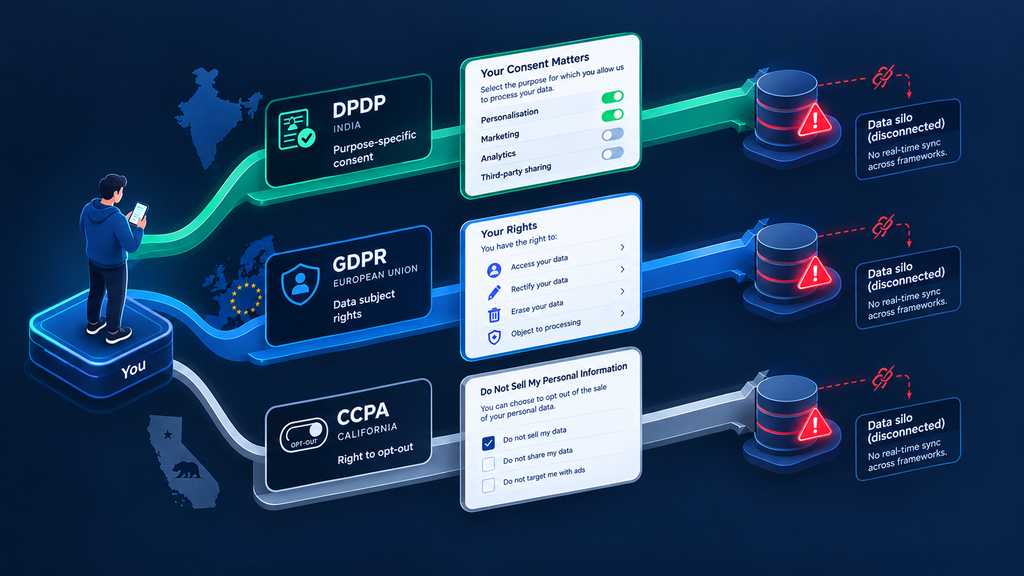
Here is the uncomfortable reality: there is no single consent architecture that satisfies all three frameworks simultaneously. Consequently, businesses end up building parallel consent systems, each with its own UI, its own backend logic, and its own audit trail.
Imagine your user flow. A customer in India grants consent for SMS marketing. Under DPDP, that consent is tied to a specific purpose, “marketing communications via SMS,” and must be revocable with equal ease. The same user, accessing your platform from London, sees a different consent request built for GDPR compliance. Then, if they have a California address on file, a third consent interface appears, this one built for CCPA opt-out logic.
Moreover, these three implementations often do not talk to each other. A user withdraws SMS consent in their DPDP-compliant interface, but your SMS marketing platform continues to receive the old consent status from your legacy system. The withdrawal never propagates. That gap is not a technical oversight; it is a regulatory violation waiting to be discovered.
Conflicting Consent Withdrawal Standards
Withdrawal timelines diverge sharply across these three regimes. Under DPDP, withdrawal must be honored immediately or as soon as technically feasible. GDPR similarly demands swift action, typically interpreted as within thirty days. CCPA opt-outs must be honored within forty-five days, though businesses can argue for reasonable delays based on technical feasibility.
More critically, the scope of withdrawal differs. Under GDPR, once a user withdraws consent, you must stop processing their data for that purpose and delete it within a defined timeline. DPDP similarly demands deletion or de-identification once the legal basis for retention expires. Yet CCPA does not always require deletion; it requires that you stop selling or sharing the data, which is a narrower obligation.
A fintech app handling payment data faces a genuine operational puzzle. GDPR might require that transaction history be deleted or anonymized six months after account closure. Yet financial regulations in India and California may require that records be retained for seven years. How do you comply with GDPR deletion rights while satisfying financial audit requirements? The answer is de-identification, but de-identification is only as good as your implementation. Inadequate anonymization, and you are violating both frameworks simultaneously.
Data Localization and Residency Tensions
DPDP imposes strict data residency requirements. Personal data of Indian data principals must be processed in India, with limited exceptions for government requests. This does not necessarily require that data live permanently within Indian borders, but processing must happen in India initially.
GDPR prohibits transfers of European personal data to jurisdictions deemed to lack adequate protection, which used to mean the United States until recent adequacy frameworks emerged. Yet India, from the EU’s perspective, has historically not met GDPR adequacy standards. Consequently, transferring European customer data to process it in India for DPDP compliance creates a GDPR violation simultaneously.
Meanwhile, CCPA creates no strict localization mandate, but California enforcement increasingly scrutinizes where personal data is stored and processed, particularly for sensitive categories like financial data.
The practical upshot: cross-border businesses end up maintaining separate data processing pipelines for each jurisdiction. An Indian fintech handling users from all three regions needs infrastructure that routes Indian users’ data through Indian infrastructure, European users’ data through EU infrastructure, and California users’ data through a separate instance. That complexity drives up operational cost and multiplies the number of compliance failure points.
Audit Trail and Proof Requirements
Each framework has different audit-trail expectations. GDPR expects businesses to demonstrate accountability. That typically means logs, audit trails, and documentation proving compliance. DPDP, increasingly, expects tamper-evident proof. Regulators are moving toward the position that a standard database log is insufficient because administrators could, in theory, alter it. Cryptographically verifiable logs offer mathematical assurance that records have not been modified.
CCPA audit trails are less prescriptive, but the California Attorney General is beginning to scrutinize whether consent and opt-out records are stored reliably. A business that cannot produce a clear record of what consent state a user had on a specific date faces a difficult defense.
The layering problem intensifies here. A single log format cannot satisfy all three frameworks. Consequently, many businesses maintain three separate audit systems, each with different retention policies, different verification methods, and different interfaces. That multiplication of infrastructure is where the real compliance risk accumulates.
Cross-Border Fintech and E-Commerce: The Real-World Squeeze
The Payment Processing Dilemma
A cross-border fintech platform processes transactions for users globally. Each transaction involves personal data: name, payment method, billing address, transaction history. DPDP requires that purpose-specific consent exist for transaction processing. GDPR requires the same. Yet CCPA does not require consent for transaction processing; it requires transparency and an opt-out mechanism for “sharing” the data with third parties.
Moreover, fintech businesses use payment data for fraud detection, anti-money laundering (AML), and regulatory reporting. Under DPDP, each of these uses requires its own explicit consent. Under GDPR, they may fall under legitimate interest if the business articulates why the user would reasonably expect it. Under CCPA, fraud detection typically does not trigger sale or sharing obligations, so opt-out requirements do not apply.
A fintech app that implements overly broad consent mechanisms risks violating DPDP’s specificity requirement. A fintech that relies too heavily on legitimate interest risks GDPR violations. The compliance sweet spot is narrow, and getting there requires purpose-mapped consent that translates across all three frameworks simultaneously.
E-Commerce and Third-Party Sharing
E-commerce businesses share customer data constantly: with payment processors, shipping partners, marketing analytics platforms, ad networks, and customer service tools. Each third party is a potential processor or joint controller, adding another layer of consent complexity.
Under GDPR, businesses need explicit consent before sharing data with many third parties, or they need a lawful basis. Under DPDP, each third-party share requires its own purpose-specific consent, and the business remains liable for how processors use the data downstream. Under CCPA, sharing with ad networks for behavioral targeting triggers explicit opt-out obligations.
The compliance requirement is this: an e-commerce business needs a centralized record of which third parties can access which categories of customer data, and it needs that access to be revocable consistently across all three jurisdictions. A user who opts out of targeted advertising should not have their data flowing to ad networks the next day because the revocation failed to propagate to one system.
Marketing and Behavioral Personalization
Modern e-commerce relies on marketing data: browsing history, purchase patterns, inferred preferences. The consent frameworks treat these entirely differently.
GDPR allows businesses to collect this data under legitimate interest for marketing optimization, though users must be able to opt out. DPDP requires explicit consent for each marketing purpose, purpose-limited to that specific activity, and the consent must be revocable. CCPA treats behavioral data collection as relatively permissible, but selling or sharing it with third parties for behavioral advertising requires opt-out rights.
Here is where many businesses stumble. They implement a single “marketing preferences” toggle expecting it to satisfy all three frameworks. It does not. DPDP users need granular options for different marketing purposes. GDPR users need clear, rights-based opt-out messaging. CCPA users need specific disclosures about sharing and opt-out mechanisms.
Building Compliant Consent Infrastructure: The Layered Approach
The Foundation: A Jurisdiction-Aware Consent Management Platform
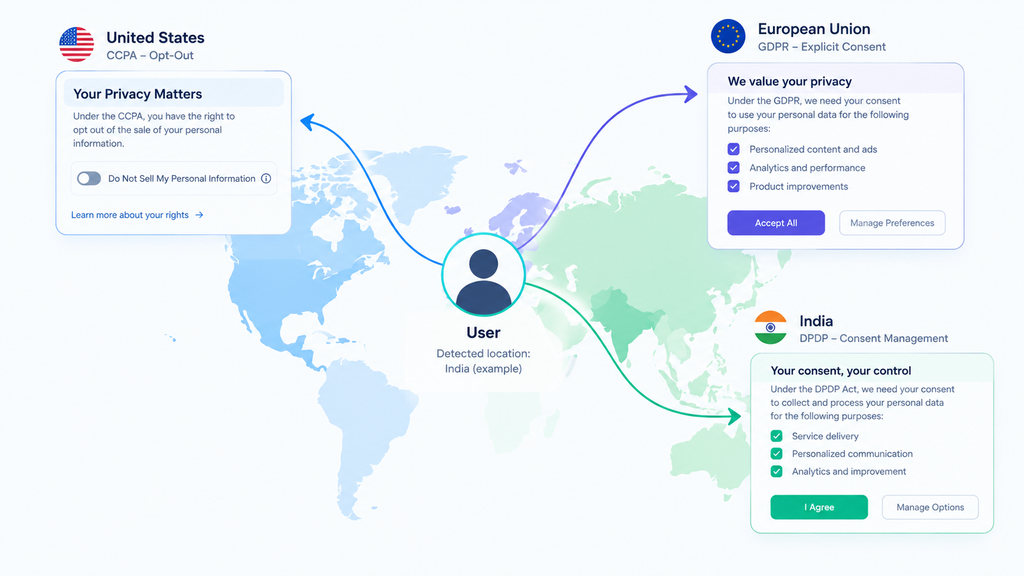
The starting point is infrastructure that understands which jurisdiction a user belongs to and routes their consent request through the appropriate framework. This is more complex than it sounds. A user may travel across jurisdictions. They may have a registered address in one country and a payment method in another. The system needs to determine the applicable framework without creating friction or confusion.
A robust consent management platform detects user location, resolves jurisdiction, and presents the appropriate consent interface. This is not a one-size-fits-all banner; it is a modular system that loads different consent workflows based on regulatory context.
Purpose Mapping Across Frameworks
Each processing activity needs to be mapped to the three frameworks’ requirements. “Send promotional emails” becomes three separate consent purposes: one for DPDP’s “marketing communications” category, one for GDPR’s “marketing” legal basis, and one for CCPA’s “marketing communication” share disclosure.
That mapping is not trivial. It requires working across product, legal, and compliance teams to document every data use, classify it against each framework’s categories, and define withdrawal scenarios for each. Businesses that skip this step end up with consent implementations that look compliant on paper but fail under real scrutiny.
Withdrawal Propagation Across Systems
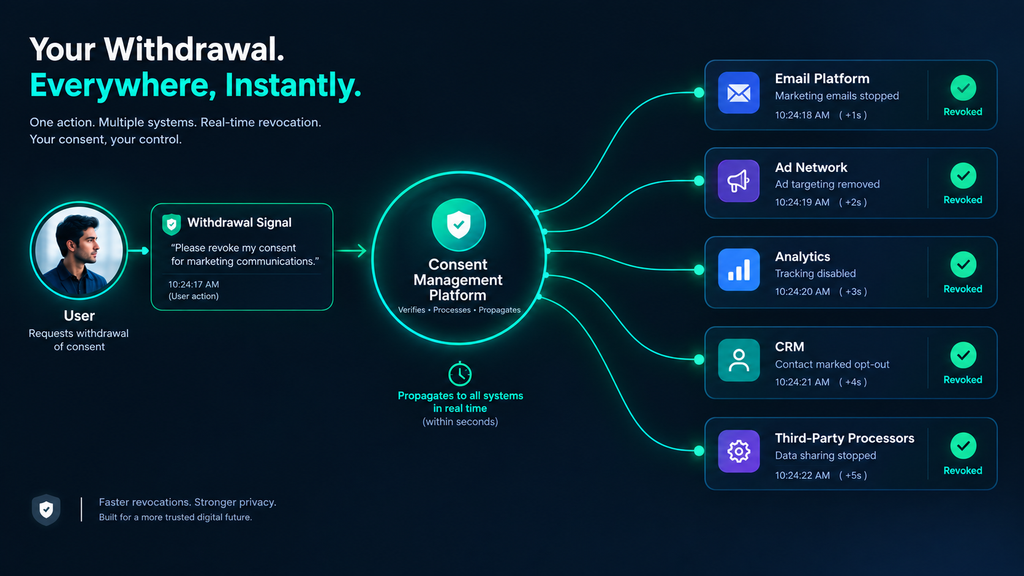
Consent withdrawal must flow through every system touching customer data. When a user withdraws marketing consent, that revocation must reach the email marketing platform, the ad network integrations, the analytics system, the CRM, and any downstream processors within hours, not days.
This requires real-time consent-state synchronization. The consent management platform becomes a source of truth that every data consumer in your stack checks before processing data. Email systems query it before sending a campaign. Ad networks respect it before loading a pixel. This architecture is achievable, but it demands planning during implementation, not as an afterthought.
Immutable Audit Trails
Each consent event must be logged in a way that cannot be quietly modified. Standard database logs are vulnerable to admin access and internal error. Cryptographically verifiable logs, often built on blockchain or similar technologies, provide tamper-evident proof that a consent record has not been altered since creation.
For cross-border businesses facing potential scrutiny from multiple regulators simultaneously, this distinction matters enormously. A tamper-evident log that proves when a user consented and when they withdrew that consent is defensible evidence. A standard log that an employee could theoretically modify is not.
Rights Fulfillment at Scale
GDPR’s right to access means users can demand a copy of their data. DPDP’s same right requires the same. CCPA also permits access requests. Automating these requests is critical because manual processing does not scale once volume increases.
A consent management platform that integrates with your data systems can automatically compile access requests, pulling data across databases, third-party processors, and cloud storage. Similarly, erasure requests can be automated, reaching every system where data is stored and triggering deletion or de-identification consistently.
Real-World Compliance Layering: Strategic Decisions
Choosing Data Residency Strategy
Cross-border businesses must decide: do we maintain separate data instances per jurisdiction, or do we centralize with sophisticated governance controls?
Separate instances offer regulatory clarity. Indian data stays in India. European data stays in the EU. California data stays in California. Each instance operates under its native legal framework with minimal complexity. However, this approach multiplies infrastructure cost and complicates business logic that spans jurisdictions.
Centralization with governance controls costs less operationally but requires substantially more compliance overhead. The business must prove to regulators in each jurisdiction that centralized data is processed according to their standards, that withdrawal requests propagate everywhere, and that deletion happens consistently.
Most cross-border fintech and e-commerce businesses opt for hybrid models: shared infrastructure for processing, but separated storage, with sophisticated consent and revocation logic managing which data flows where.
DPDP Consent Manager Readiness
The DPDP Act envisions registered Consent Managers that will allow individuals to withdraw consents across multiple businesses from a unified interface. As this framework matures through 2027, cross-border businesses need to decide: do we build for interoperability with external Consent Managers now, or do we integrate after launch?
Early adoption of interoperable architecture is tactically smart. A consent management platform built with API-first design, capable of receiving revocation signals from external Consent Managers, positions your business as forward-thinking and reduces rework as the regulatory landscape solidifies.
Vendor Selection and Lock-In
Selecting a consent management platform is not a purchase decision; it is an architectural commitment that shapes compliance posture for years. Businesses must evaluate vendors not just on current feature sets but on flexibility for future regulatory changes.
A platform that is architecturally rigid, designed around cookie consent, and difficult to integrate with backend systems becomes a liability as frameworks evolve. A platform built with modularity, API-first design, and jurisdiction-aware logic scales with regulatory changes.
The Cost of Not Getting This Right
Regulatory Penalties
GDPR fines reach 4% of global revenue. DPDP penalties, once full enforcement arrives in May 2027, are expected to reach 2% of annual turnover. CCPA fines currently reach $7,500 per violation, but the CPRA increased civil penalties to $10,000, and the scope of enforcement continues to expand.
For a fintech app with millions of users across three jurisdictions, a compliance failure in any framework becomes a nine-figure liability quickly.
Customer Trust Erosion
Data breaches and consent violations destroy customer trust. Once users learn that a business violated their withdrawal rights or mishandled their data, churn accelerates. Rebuilding trust takes years and requires demonstrable, transparent compliance improvements.
Operational Chaos During Incidents
When a breach occurs or regulators open an inquiry, the business must produce consent records, withdrawal timestamps, and audit trails across all three frameworks. A business without integrated, tamper-evident consent logging will struggle to produce evidence quickly. Investigations that take months instead of weeks create ongoing business disruption and legal uncertainty.
Practical Steps Forward: Implementation Roadmap
Audit Your Current State
Begin by documenting every data processing activity. Which purposes require consent? Which fall under legitimate interest or necessity? How does each activity map to DPDP, GDPR, and CCPA requirements?
Most businesses discover significant gaps during this audit. Consent implementations built for one framework often miss obligations in the others.
Map Consent Purposes Across Frameworks
Take your processing activities and create a mapping table. “Email marketing” becomes three rows: one for DPDP’s purpose category, one for GDPR’s legal basis, one for CCPA’s disclosure obligation. This exercise forces clarity around what each framework actually requires and where you need to adjust current implementations.
Evaluate and Implement a Consent Management Platform
A robust consent management platform designed for cross-border complexity eliminates the need to build this infrastructure from scratch. The platform should support jurisdiction detection, purpose-based consent capture, real-time withdrawal propagation, and tamper-evident audit logging.
Look for platforms that have DPDP expertise built in from the ground up, rather than retrofitted cookie-consent tools. The difference determines whether you pass audits or spend months defending inadequate consent records.
Integrate With Your Data Processors
Every system that handles personal data needs to check consent status before processing. Email systems, ad platforms, analytics tools, and third-party services must all respect the consent management platform as the authoritative source of truth.
Test Withdrawal Scenarios End-to-End
Before going live, run tabletop exercises. A user withdraws marketing consent. Trace that revocation through your entire data stack. Does it reach the email platform? The ad network? Does data collection stop within hours? Does the audit log record the withdrawal immutably?
Only after withdrawal works end-to-end across all systems should the implementation be considered production-ready.
Conclusion: Building for Three Frameworks Simultaneously
Compliance layering for DPDP, GDPR, and CCPA is not a solved problem. Yet successful cross-border fintech and e-commerce businesses are building consent management infrastructure that satisfies all three simultaneously. The key is recognizing that these frameworks are not compatible without intentional design. Each requires its own consent architecture, its own withdrawal mechanism, and its own proof of compliance.
A consent management platform purpose-built for cross-border complexity, with DPDP-native design and tamper-evident audit trails, becomes the operational backbone that makes this possible. Without it, businesses face the impossible task of managing three separate compliance regimes with manual processes and disconnected systems.
The regulatory landscape is tightening across all three jurisdictions. Businesses that build compliant consent infrastructure now position themselves to scale globally without regulatory risk. Those that treat consent as an afterthought will face escalating penalties, customer churn, and operational chaos as enforcement accelerates through 2026 and 2027.
Frequently Asked Questions
1. What is a Consent Management Platform and why do cross-border businesses need one?
A Consent Management Platform is software that captures, records, stores, and manages user consent for data collection and processing. For cross-border businesses operating under DPDP, GDPR, and CCPA simultaneously, a Consent Management Platform becomes non-negotiable because these three frameworks have conflicting consent requirements. The platform ensures that each jurisdiction’s specific consent architecture is implemented correctly, withdrawal signals propagate to all systems, and audit trails prove compliance. Without a Consent Management Platform, managing three separate regulatory regimes with manual processes becomes operationally impossible and increases regulatory risk exponentially.
2. How does a Consent Management Platform handle jurisdiction detection for compliance?
A modern Consent Management Platform detects user jurisdiction through multiple signals: IP geolocation, registered address, payment method location, and explicit user input. Once jurisdiction is determined, the platform routes the user through the appropriate consent workflow. A user in India sees DPDP-compliant consent requests focused on purpose-specific, easily revocable consent. A European user sees GDPR-compliant interfaces emphasizing rights and data processing transparency. A California user sees CCPA-focused opt-out mechanisms for data sharing. This jurisdiction-aware routing ensures that each user receives consent requests built specifically for their regulatory context, not a one-size-fits-all banner that satisfies none of the frameworks adequately.
3. Can a single Consent Management Platform truly satisfy DPDP, GDPR, and CCPA simultaneously?
A purpose-built Consent Management Platform can satisfy all three frameworks, but only if it was architected for cross-border complexity from inception. The platform must support DPDP’s purpose-specific consent model, GDPR’s rights-based approach, and CCPA’s opt-out and disclosure requirements as distinct, parallel workflows rather than attempting to force one framework’s logic onto the others. Critical capabilities include real-time consent-state propagation to all data consumers, tamper-evident audit logging that meets each framework’s evidentiary standards, and withdrawal mechanisms that operate instantaneously across all systems. A Consent Management Platform built primarily for cookie consent or GDPR alone will require extensive customization, likely will not scale reliably under cross-border conditions, and will create ongoing compliance gaps.
4. What happens to consent withdrawal requests if a Consent Management Platform is not integrated with all data systems?
Without full system integration, withdrawal requests become theater. A user revokes marketing consent through the platform, but the email marketing service continues to receive an outdated consent status from a legacy system. The user’s data continues flowing to ad networks because the revocation never reached the ad-tech integrations. From the user’s perspective, their withdrawal was honored. From the regulator’s perspective, the business violated withdrawal obligations. A robust Consent Management Platform must act as a real-time source of truth that every data consumer in your stack queries before processing data. Integration is not optional; it is the difference between compliant infrastructure and a compliance liability.
5. How does a Consent Management Platform create tamper-evident audit trails for regulatory defense?
A Consent Management Platform with cryptographically verifiable audit logging uses techniques like blockchain anchoring or cryptographic hashing to create records that cannot be altered after creation. Each consent event (grant, modification, withdrawal) is timestamped and cryptographically signed. If an administrator later tried to modify that record, the cryptographic hash would change, making the tampering obvious. When regulators ask “prove that this user consented to this processing on this date,” the business can produce a mathematically verifiable record that the platform created and locked. Standard database logs lack this protection; an employee with admin access could theoretically modify them. Tamper-evident audit trails eliminate that vulnerability entirely and provide mathematical proof of compliance that regulators accept at face value.