
Most Indian businesses still think they have time before the Digital Personal Data Protection Act becomes real. That assumption could turn out to be an expensive mistake. With the DPDP Rules notified and the compliance clock now ticking, 2026 and 2027 are shaping up to be the two most critical years for data privacy readiness in India. Consequently, organizations that delay preparation risk penalties, reputational damage, and operational disruption once enforcement begins in earnest.
This blog breaks down the entire DPDP Act compliance timeline, explains what each phase demands, and helps you map out a realistic action plan. Whether you run a startup, a mid-sized enterprise, or a large data-driven organization, understanding these deadlines is no longer optional. It is a business necessity.
Understanding the DPDP Act and Why the Timeline Matters
The Digital Personal Data Protection Act, 2023, is India’s first comprehensive data privacy law. It governs how businesses collect, store, process, and share personal data of Indian citizens. Unlike earlier frameworks that were fragmented and loosely enforced, the DPDP Act introduces clear obligations, defined timelines, and real financial consequences for non-compliance.
The Ministry of Electronics and Information Technology notified the DPDP Rules in 2025, which finally gave businesses clarity on implementation timelines. As a result, companies now have a structured runway to prepare, rather than facing sudden enforcement. However, this runway is shorter than many assume, which is exactly why mapping out 2026 and 2027 deadlines is so important right now.

Furthermore, the law applies broadly. It covers not just large enterprises but also startups, e-commerce platforms, fintech companies, healthcare providers, and any entity that processes personal data of individuals in India. In other words, almost no digital business is exempt.
Why 2026 and 2027 Are the Defining Years
Many compliance frameworks unfold gradually, but the DPDP Act has built-in staggered deadlines. This phased approach gives businesses time to adjust, yet it also means missing an early milestone can create a compounding compliance gap later.
Notably, the Data Protection Board of India is being operationalized during this window, which means grievance redressal and enforcement mechanisms will be active well before 2027 ends. Therefore, businesses that treat 2026 as a “wait and watch” year may find themselves scrambling when audits, notices, or complaints begin arriving.
On the other hand, businesses that proactively align their data practices now will have a smoother transition. They will avoid last-minute rushes, reduce legal exposure, and build long-term trust with customers who are increasingly aware of their data rights.
Key DPDP Compliance Deadlines to Track in 2026
Consent Manager Registration and Framework Setup
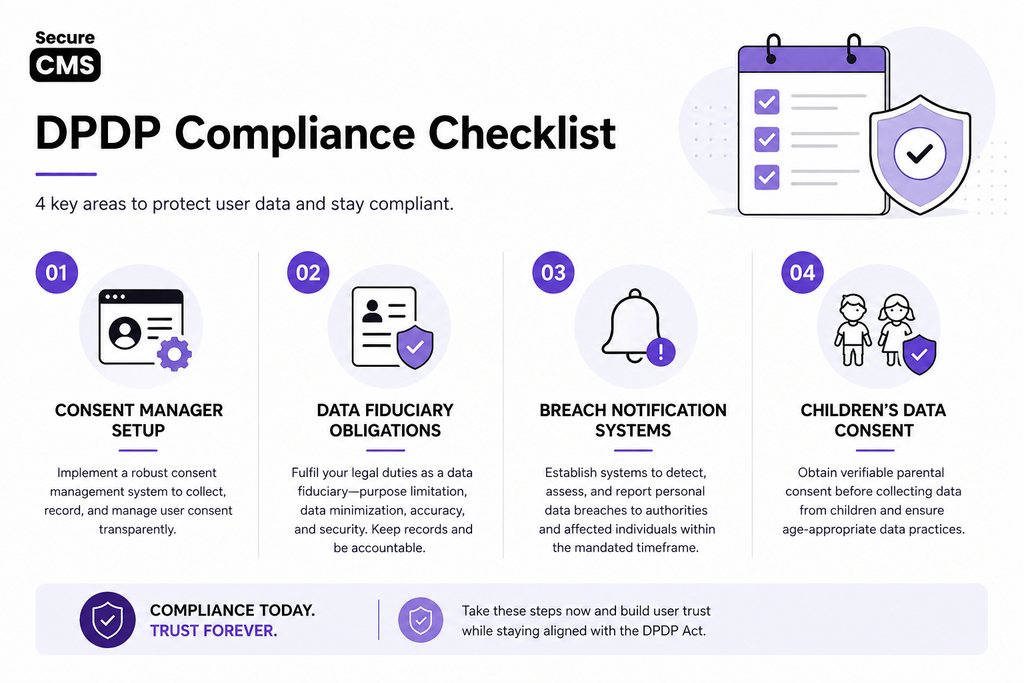
One of the earliest priorities in 2026 involves the Consent Manager ecosystem. Under the DPDP Rules, Consent Managers act as intermediaries who help individuals manage, review, and withdraw consent for data processing. Businesses that rely on third-party consent management platforms must ensure these platforms are registered and compliant with the Data Protection Board’s requirements.
As a result, organizations should begin auditing their existing consent collection mechanisms early in 2026. This includes reviewing consent forms, checkout flows, app permissions, and any point where personal data is collected.
Data Fiduciary Obligations Take Shape
By mid-2026, most data fiduciaries, meaning any entity determining the purpose and means of processing personal data, are expected to have foundational compliance measures in place. This includes appointing a Data Protection Officer where applicable, setting up grievance redressal mechanisms, and maintaining records of processing activities.
Additionally, businesses classified as Significant Data Fiduciaries, based on volume and sensitivity of data processed, face stricter obligations. These include periodic data protection impact assessments and independent data audits. Consequently, larger organizations should not wait until the deadline approaches. Early preparation gives room to correct gaps before scrutiny begins.
Breach Notification Systems Must Be Operational
Another crucial 2026 milestone involves breach notification readiness. The DPDP Act requires businesses to notify the Data Protection Board and affected individuals promptly in the event of a personal data breach. Therefore, having an internal incident response plan is not just good practice; it becomes a legal requirement.
Businesses should test their breach detection and notification workflows well before this deadline solidifies. Otherwise, a real breach event without a tested process could result in delayed reporting and heavier penalties.
Children’s Data and Verifiable Parental Consent
The DPDP Act places strict emphasis on protecting children’s personal data. By late 2026, platforms that process data of individuals under 18 must have verifiable parental consent mechanisms fully functional. This is particularly relevant for edtech platforms, gaming apps, and social media services with significant youth user bases.
Given the sensitivity of this requirement, businesses in these sectors should prioritize this compliance area early rather than treating it as a secondary concern.
Key DPDP Compliance Deadlines to Track in 2027
Full Enforcement of Significant Data Fiduciary Obligations
By 2027, Significant Data Fiduciaries are expected to be fully compliant with enhanced obligations, including mandatory data protection impact assessments, algorithmic transparency reviews where applicable, and stricter cross-border data transfer documentation. This phase marks the shift from preparation to active enforcement.
Moreover, the government is expected to notify additional countries where data transfer restrictions apply. Businesses relying on international cloud infrastructure or third-party vendors should closely monitor this list, since it directly impacts data storage and processing decisions.
Penalty Enforcement Becomes Fully Active
Perhaps the most significant shift in 2027 involves penalty enforcement. The DPDP Act allows penalties of up to two hundred fifty crore rupees for serious violations, including failure to implement reasonable security safeguards or failure to notify data breaches. While the Data Protection Board may begin issuing notices earlier, full-scale enforcement action is expected to intensify through 2027.
As a result, businesses cannot afford to treat 2027 as another year of grace. Instead, this is the year when compliance gaps translate directly into financial and reputational consequences.
Cross-Border Data Transfer Rules Solidify
Throughout 2027, businesses operating internationally or storing data on foreign servers must align fully with cross-border transfer conditions specified under the Rules. This includes ensuring that data localization requirements, where applicable, are met without exception.
Given the complexity of global data flows, companies with international operations should not wait for 2027 to begin this exercise. Instead, mapping data flows now can prevent costly restructuring later.

Continuous Audit and Reporting Cycles Begin
By the end of 2027, periodic audits, impact assessments, and compliance reporting are expected to become a routine part of business operations for larger data fiduciaries. In other words, compliance shifts from a one-time project to an ongoing operational function.
Therefore, businesses should start building internal compliance calendars now, rather than treating each audit as a fresh emergency.
Building a Practical Compliance Roadmap for Your Business
Given the scale of these deadlines, businesses need a structured, phased approach rather than a last-minute scramble. Here is a practical way to think about it.
First, conduct a full data audit. Understand what personal data you collect, why you collect it, where it is stored, and who has access to it. Without this foundational clarity, no other compliance step will be effective.
Next, review and redesign consent mechanisms. Ensure that consent requests are clear, specific, and easily withdrawable, exactly as the DPDP Act requires. Vague or bundled consent practices will not hold up under scrutiny.
Subsequently, establish internal accountability. Appoint responsible personnel, even if a formal Data Protection Officer is not mandatory for your organization’s size. Someone within the business must own compliance end to end.
In addition, invest in technical safeguards. Encryption, access controls, and breach detection systems are not optional extras. They form the backbone of “reasonable security safeguards” that the law explicitly requires.
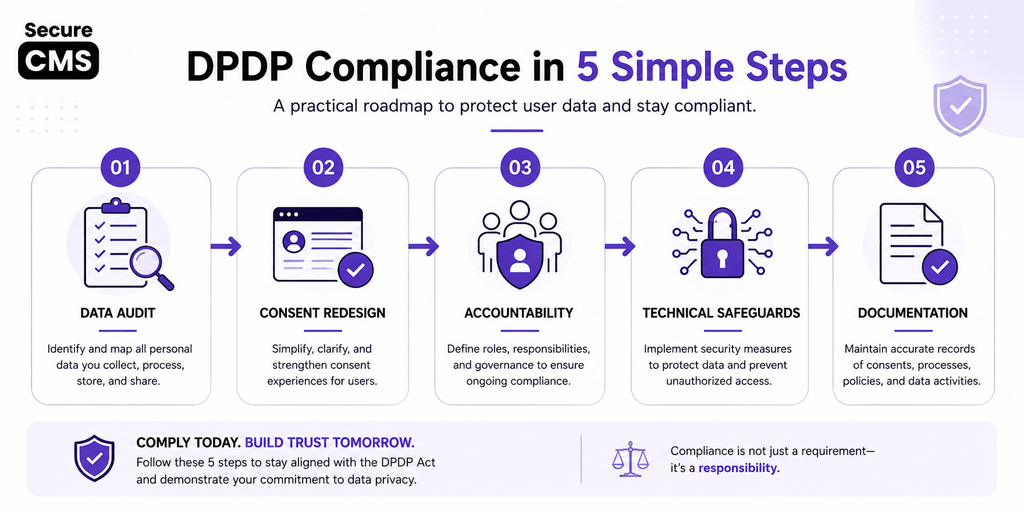
Finally, document everything. Maintain records of processing activities, consent logs, breach response drills, and audit trails. When enforcement begins, documentation often becomes the difference between demonstrating good faith compliance and facing heavier penalties.
Platforms like SecureDApp can play a meaningful role here, particularly for businesses looking to strengthen data security infrastructure and audit readiness as these deadlines approach. Having the right technical and advisory support can simplify what otherwise feels like an overwhelming compliance journey.
Common Mistakes Businesses Should Avoid
Despite growing awareness, many organizations still make avoidable mistakes while preparing for DPDP compliance. Understanding these pitfalls can save significant time and resources.
One frequent mistake is assuming that smaller businesses are exempt. In reality, the DPDP Act applies based on data processing activity, not company size alone. Even small businesses handling sensitive personal data must comply.
Another common error involves treating compliance as a one-time IT project rather than an ongoing governance responsibility. As outlined earlier, audits and reporting cycles are meant to be continuous, not occasional.
Additionally, some businesses focus only on consent forms while neglecting backend data security. However, consent alone does not satisfy the law’s requirement for reasonable security safeguards. Both aspects must work together.
Lastly, many organizations underestimate how long genuine compliance takes. Building proper systems, training staff, and testing processes requires months, not weeks. Therefore, starting early in 2026 rather than waiting until deadlines approach is the safest strategy.
Final Thoughts on Staying Ahead of the DPDP Timeline
The DPDP Act compliance timeline for 2026 and 2027 represents a defining shift in how Indian businesses must handle personal data. Rather than viewing these deadlines as distant regulatory milestones, businesses should treat them as an immediate operational priority.
In summary, 2026 is the year of foundational readiness, covering consent systems, breach protocols, and Data Protection Officer appointments. Meanwhile, 2027 marks the shift toward full enforcement, higher penalties, and continuous compliance obligations.
Ultimately, businesses that act early will not only avoid penalties but also build stronger trust with their users. In a digital economy increasingly shaped by data privacy expectations, that trust could become a genuine competitive advantage. With the right planning, tools, and support, from internal audits to platforms like SecureDApp, Indian businesses can navigate this transition confidently rather than reactively.
Frequently Asked Questions
1. What is the deadline for DPDP Act full compliance in India?
While specific obligations are being phased in through 2026 and 2027, businesses should aim for full readiness, including consent systems, breach protocols, and audit mechanisms, by the end of 2027, when enforcement is expected to intensify significantly.
2. Does the DPDP Act apply to small businesses and startups?
Yes. The DPDP Act applies based on the nature and volume of personal data processed, not company size. Even small businesses handling customer data must implement basic compliance measures.
3. What happens if a business fails to comply with DPDP deadlines?
Non-compliance can lead to significant financial penalties, potentially running into hundreds of crores for serious violations, along with reputational damage and increased regulatory scrutiny.
4. What is a Significant Data Fiduciary under the DPDP Act?
A Significant Data Fiduciary is an entity that processes large volumes of sensitive or high-risk personal data. Such entities face stricter obligations, including mandatory audits and impact assessments.
5. How can businesses start preparing for DPDP compliance right now?
Businesses should begin with a comprehensive data audit, followed by consent mechanism reviews, security safeguard implementation, and internal accountability structures, ideally well before the 2026 deadlines take effect.