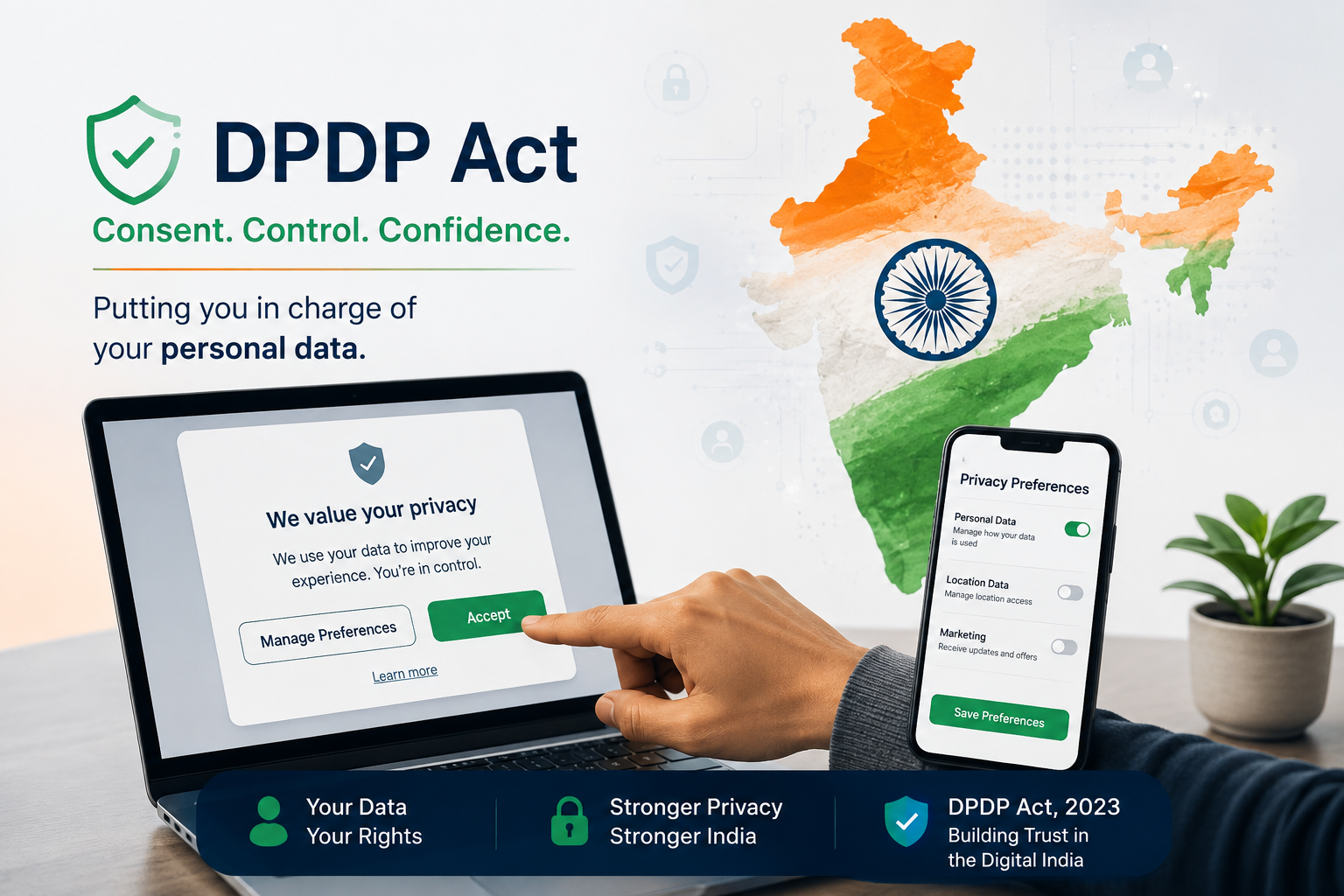

A single unauthorized data pull can now cost an Indian bank or NBFC up to 250 crore rupees. That is not a hypothetical figure. It is the financial reality written into the Digital Personal Data Protection Rules 2025, and it has changed how banking, financial services, and insurance companies must think about customer data forever.
For decades, BFSI institutions in India treated consent as a formality. A checkbox during onboarding, a clause buried in a forty-page terms document, a one-time tick that quietly authorized years of data usage. That approach no longer survives regulatory scrutiny. Under the DPDP Rules 2025, Consent Management has moved from a legal afterthought to an operational necessity that touches every customer-facing and back-end process a financial institution runs.
This shift matters more for BFSI than almost any other sector. Banks, insurers, NBFCs, and fintech platforms sit on the most sensitive personal data category that exists: financial identity. Income records, transaction histories, credit scores, insurance claims, investment patterns, and biometric identifiers all pass through these systems daily. When the law tightens around how that data can be collected, stored, and used, the institutions handling it face the sharpest compliance curve of any industry.
So the real question for compliance heads, CISOs, and product leaders across Indian BFSI is not whether to act. It is how to build a Consent Management approach that satisfies regulators, survives audits, and still lets the business function at speed. This guide walks through exactly that.
Understanding What DPDP Rules 2025 Actually Demand From BFSI
The Digital Personal Data Protection Act was passed in 2023, but the Rules notified in 2025 are what gave it operational teeth. For BFSI companies, these rules translate abstract privacy principles into specific technical and procedural obligations.
At the core sits one requirement: every instance of personal data processing must be backed by clear, informed, and verifiable consent, unless a narrow legitimate use exception applies. Financial institutions cannot rely on implied consent buried in onboarding forms anymore. Consequently, the entire architecture of how consent is captured, stored, and honored needs a rebuild in most legacy systems.

Notably, the rules introduce the concept of a Consent Manager, a registered intermediary that allows individuals to give, manage, review, and withdraw consent across multiple data fiduciaries through a single interface. For BFSI, this is significant because customers often interact with several financial entities simultaneously, a bank, an insurer, a mutual fund platform, and a lending app. A unified consent layer means customers can control their data footprint across all of them without repeating the process everywhere.
Additionally, the rules mandate that consent requests be presented in clear and plain language, independent of any other information the fiduciary wants to share. This directly targets the old practice of hiding consent clauses inside dense legal text. Banks and NBFCs must now separate the consent ask from marketing content, product pitches, or unrelated disclosures.
Why BFSI Faces Higher Stakes Than Other Sectors
Financial data qualifies as sensitive by nature, even though the DPDP framework does not use the same sensitive-data classification as GDPR. However, the practical risk profile is comparable. A breach involving health records causes reputational damage. A breach involving bank account access, credit history, or investment portfolios causes direct financial harm.
As a result, regulators including the Reserve Bank of India have historically applied stricter data governance expectations on BFSI entities, and the DPDP Rules layer on top of existing RBI guidelines on data localization, digital lending, and customer data sharing. Therefore, Consent Management in this sector cannot be treated as a standalone legal checkbox. It has to align with RBI’s Master Directions, KYC norms, and the Account Aggregator framework simultaneously.
This overlapping regulatory environment is precisely why BFSI companies need a Consent Management strategy that is more sophisticated than a simple pop-up banner.
The Real Cost of Getting Consent Management Wrong
Before exploring solutions, it helps to understand what is actually at stake. The Rules empower the Data Protection Board of India to levy penalties up to 250 crore rupees for significant violations, and repeated or severe breaches can scale even higher depending on the nature of the failure.
But the monetary penalty is only part of the exposure. Consider a mid-sized NBFC that continues using a customer’s transaction data for cross-selling insurance products after the customer has withdrawn consent. If that withdrawal was not propagated across the NBFC’s CRM, its analytics engine, and its third-party marketing vendor, the institution is now in violation even though no one intended to break the rules.

This scenario is not rare. It is the default outcome in most BFSI organizations today, where consent status lives in one system while data usage happens in five others. Without a centralized Consent Management layer, there is no reliable way to guarantee that a withdrawal actually stops downstream processing.
Beyond regulatory penalties, there is a trust dimension that matters just as much. Indian consumers are becoming increasingly aware of data rights, partly because of the DPDP Act’s public rollout and partly because of high-profile data breach incidents in recent years. A financial institution that mishandles consent risks losing customers to competitors who can demonstrably show better data stewardship. In an industry where switching costs are already low for savings accounts, insurance renewals, and lending products, trust has become a genuine differentiator.
Building a Consent Management Framework That Actually Works
Here is where the conversation needs to move from compliance theory to practical architecture. What does a functioning Consent Management system look like inside a bank, NBFC, or insurance company?

Step One: Map Every Data Touchpoint Before Designing Consent Flows
Most BFSI institutions underestimate how many places personal data actually enters and exits their systems. Onboarding forms, mobile apps, call center scripts, third-party KYC vendors, credit bureau integrations, marketing platforms, and partner APIs all touch customer data independently.
Therefore, the first real step is not writing consent language. It is conducting a complete data flow audit. This means identifying every system that collects, stores, processes, or shares personal data, and documenting the legal basis for each instance. Without this map, any Consent Management solution built on top will have blind spots that surface during an audit or a customer complaint.
Many institutions find this step uncomfortable because it exposes just how fragmented their data ecosystem has become over years of vendor additions and system upgrades. However, skipping it guarantees that the eventual consent framework will miss critical processing activities.
Step Two: Design Purpose-Specific Consent, Not Blanket Consent
One of the most important shifts required under DPDP Rules 2025 is granularity. Blanket consent, where a single checkbox authorizes data usage for account opening, marketing, analytics, and third-party sharing simultaneously, does not meet the standard of informed consent anymore.
Instead, BFSI companies need to break consent requests into distinct, purpose-linked categories. For example, a bank should separately ask for consent to process data for account servicing, for sending promotional offers, for sharing data with credit bureaus, and for using transaction history in personalized recommendations. Each purpose needs its own clear explanation and its own toggle.
This might feel like friction at first glance, particularly for growth and marketing teams accustomed to broad data access. Yet, in practice, purpose-specific consent often improves customer trust because people can see exactly what they are agreeing to. Furthermore, it protects the institution because withdrawing consent for one purpose does not have to disrupt essential services like account operation.
Step Three: Build a Centralized Consent Registry
Once consent categories are defined, the institution needs a single source of truth that records what consent was given, when, for what purpose, and through which channel. This registry becomes the backbone of the entire Consent Management system.
Every downstream system, the CRM, the marketing automation platform, the analytics warehouse, and any third-party integration, must query this registry before processing personal data for a given purpose. If consent has been withdrawn or was never granted for that specific use, processing must stop automatically.

This is where many BFSI institutions realize their legacy infrastructure was never designed for real-time consent checks. Retrofitting this capability often requires either a dedicated consent management platform or significant custom engineering. Either way, the investment is unavoidable because manual consent tracking simply cannot scale to millions of customers across multiple products.
Step Four: Make Withdrawal As Easy As Consent
The DPDP Act explicitly states that withdrawing consent must be as easy as giving it. This single line has significant implications for BFSI user experience design.
If a customer can grant consent for marketing communications with one tap in a mobile app, they must be able to withdraw it with equally minimal friction. Hiding withdrawal options behind multiple settings screens, requiring a phone call, or forcing customers to submit written requests all violate the spirit and likely the letter of the rules.
Practically, this means product teams need to build a visible, accessible consent dashboard within customer-facing apps and portals. Customers should be able to see every purpose they have consented to and toggle each one independently, including full withdrawal, without needing to contact support.
Step Five: Prepare for the Consent Manager Ecosystem
As mentioned earlier, the Rules establish registered Consent Managers as intermediaries. Over time, it is likely that customers will increasingly manage their data permissions across banks, insurers, and lenders through these third-party consent platforms rather than dealing with each institution separately.
BFSI companies should begin evaluating how their systems will integrate with Consent Manager APIs once these entities become operational at scale. This is particularly relevant given the existing Account Aggregator framework in India, which already demonstrates how a consent-based data sharing layer can work across financial institutions. Many industry observers expect the DPDP Consent Manager model to build on lessons learned from the Account Aggregator rollout.

Institutions that start integration planning early will have a smoother transition than those who wait until the ecosystem matures and then scramble to connect.
Aligning Consent Management With Existing RBI Frameworks
BFSI compliance teams cannot treat DPDP Rules in isolation. The Reserve Bank of India has its own set of expectations around data handling, and these frameworks need to work together rather than in conflict.
For instance, RBI’s digital lending guidelines already require lenders to obtain explicit borrower consent before accessing device data such as contacts, call logs, or location. The DPDP Rules reinforce this by adding a broader legal obligation around purpose limitation and data minimization. Similarly, RBI’s data localization requirements for payment data intersect with DPDP’s cross-border data transfer provisions, which permit transfers to most countries except those specifically restricted by the central government.
Consequently, a well-designed Consent Management strategy for BFSI should map every consent category against both DPDP requirements and relevant RBI circulars. This dual-layer compliance approach reduces the risk of satisfying one regulator while inadvertently falling short with another.
Insurance companies face a parallel challenge with IRDAI regulations, particularly around health data used in underwriting and claims processing. Mutual fund and wealth management platforms must align with SEBI’s data handling norms as well. In every case, the underlying principle remains consistent: consent must be specific, informed, and revocable, but the exact documentation and audit trail requirements vary by regulator.
Technology Choices That Support Scalable Consent Management
Given the volume of customers most BFSI institutions serve, manual or semi-automated consent tracking is not a realistic long-term solution. Technology has to carry the operational weight.
Consent Management Platforms
Dedicated consent management platforms, whether built in-house or licensed from vendors, provide the infrastructure to capture consent at every touchpoint, store it in a structured registry, and expose APIs that other systems can query before processing data. These platforms typically include audit logging, which becomes critical when the Data Protection Board requests evidence of compliance during an investigation.
When evaluating such platforms, BFSI institutions should prioritize systems that support granular purpose tagging, real-time consent status checks, multi-channel capture including app, web, and call center, and integration flexibility with existing core banking or policy administration systems.
API-Driven Architecture
Modern Consent Management cannot function as a siloed module. It needs to be woven into the API layer that connects every internal system and third-party vendor. When a marketing platform wants to send a promotional email, it should be required to call the consent registry API first. When a data analytics team wants to build a customer segmentation model, the underlying data pull should be filtered by consent status automatically rather than relying on manual checks.
This API-first approach also future-proofs the institution against upcoming integration requirements with Consent Managers and Account Aggregators, since both ecosystems operate through standardized API protocols.
Encryption and Access Controls
Consent Management does not exist in isolation from broader data security practices. The consent registry itself contains sensitive metadata about customer preferences and personal information usage, so it needs the same encryption, access control, and audit logging protections applied to core financial data.
This is an area where blockchain-based verification and cryptographic audit trails have gained attention, since they can provide tamper-proof records of when consent was given, modified, or withdrawn. For institutions handling high transaction volumes and facing frequent regulatory audits, an immutable consent trail significantly simplifies compliance reporting and reduces disputes over what a customer actually agreed to.
Training Teams to Operate Within the New Consent Framework
Technology alone will not solve this challenge. BFSI institutions employ thousands of people across branches, call centers, relationship management teams, and digital product units, and every one of them interacts with customer data in some capacity.
Frontline staff need clear training on what they can and cannot do with customer information based on current consent status. A relationship manager who casually shares a customer’s investment portfolio details with a partner insurance agent, assuming implied consent, creates real regulatory exposure even if the intent was purely to offer better service.
Similarly, product and engineering teams need embedded awareness of privacy-by-design principles. Every new feature that touches personal data, from a new loan product to a chatbot integration, should go through a consent impact assessment before launch. This prevents the common pattern where compliance gets looped in only after a product has already shipped, forcing expensive retrofits.
Compliance and legal teams, meanwhile, need ongoing visibility into how consent data flows through the organization. Quarterly internal audits of the consent registry against actual data processing activities can catch gaps before they become regulatory violations.
Handling Third-Party Vendors and Data Processors
BFSI institutions rarely process data entirely in-house. Credit bureaus, KYC verification vendors, cloud hosting providers, marketing automation tools, and fraud detection services all receive customer data as part of normal operations.
Under DPDP Rules, the data fiduciary, meaning the bank, NBFC, or insurer, remains accountable for how third parties handle that data, even when a data processor is technically responsible for the breach. Therefore, vendor contracts need explicit clauses requiring processors to honor consent status, delete data upon withdrawal instructions, and support audit requests from the fiduciary.
This is an area many institutions overlook. A bank might have excellent internal Consent Management practices, but if its analytics vendor continues processing data for a customer who withdrew consent three months ago, the bank still bears regulatory responsibility. Consequently, vendor onboarding processes need a consent compliance checklist as a standard requirement, not an optional add-on.
Children’s Data and Special Consent Categories
The DPDP Rules include heightened requirements for processing children’s personal data, requiring verifiable parental consent. While BFSI products are typically designed for adults, certain scenarios do involve minors, such as education loan applications, minor savings accounts, or insurance policies where a minor is a beneficiary.
Institutions offering any product touching minors’ data need a distinct consent workflow that verifies parental or guardian identity before processing begins. This adds operational complexity, but treating it as an afterthought creates significant regulatory risk given the specific protections the law extends to children.
Measuring Whether Your Consent Management Approach Is Actually Working
Building the framework is one thing. Knowing whether it functions correctly under real operational pressure is another. BFSI compliance teams should track a specific set of metrics to validate their Consent Management maturity.
First, consent capture rates across different channels reveal whether the consent request design is clear enough for customers to understand and act on. A very low opt-in rate might indicate confusing language rather than genuine customer reluctance.
Second, withdrawal fulfillment time measures how quickly a consent withdrawal actually propagates across all connected systems. If this takes days rather than being near-instantaneous, there is a structural gap in the consent registry integration.
Third, audit trail completeness checks whether every processing activity can be traced back to a specific, documented consent instance. Gaps here are exactly what regulators look for during investigations.
Fourth, vendor compliance rates track how consistently third-party processors honor consent instructions passed to them. This requires periodic vendor audits rather than one-time contractual assurances.
Regularly reviewing these metrics turns Consent Management from a static compliance project into a continuously improving operational discipline, which is ultimately what regulators expect to see.
Common Mistakes BFSI Companies Make With Consent Management
Even institutions that genuinely intend to comply often stumble in predictable ways. Recognizing these patterns early can save significant rework later.
One frequent mistake is treating Consent Management as a one-time project rather than an ongoing operational function. Institutions build a compliant consent flow at launch, pass an initial audit, and then stop revisiting it as new products, vendors, and data uses get added over time. Within a year, the original framework no longer reflects actual data processing activity, and the gap only surfaces during a customer complaint or regulatory inquiry.
Another common error is designing consent language that is legally accurate but practically incomprehensible. Simply translating dense legal text into shorter sentences does not satisfy the plain-language requirement if customers still cannot understand what they are agreeing to. Effective consent design requires genuine user testing, not just legal review.
A third mistake involves underestimating the engineering effort required to make withdrawal instantaneous across distributed systems. Many institutions build a consent dashboard that updates a central database correctly, but downstream systems like marketing automation platforms or data warehouses sync on a delayed batch schedule. During that lag window, the institution is technically out of compliance even though the customer-facing interface shows the withdrawal as successful.
Finally, some institutions assume that because a customer signed a physical form years ago, that consent remains valid indefinitely. The DPDP framework expects consent to be tied to a specific purpose and time context, and processing practices that have expanded well beyond what was originally disclosed require fresh consent, not reliance on outdated paperwork.
The Business Case Beyond Compliance
It would be incomplete to frame Consent Management purely as a regulatory burden. There is a genuine business upside that forward-thinking BFSI leaders are beginning to recognize.
Customers who explicitly and knowingly consent to specific data uses tend to engage more meaningfully with personalized offers, because they understand why they are receiving them. This contrasts sharply with the current experience many Indian consumers have, where financial institutions send irrelevant marketing based on data usage they never clearly agreed to, resulting in complaints and app uninstalls.
Moreover, a transparent Consent Management system can become a marketing differentiator in its own right. As data privacy awareness grows among Indian consumers, particularly younger, digitally native customers, institutions that visibly respect data choices build stronger long-term loyalty than those that treat privacy as a minimum legal requirement to work around.
There is also an operational efficiency angle. A well-structured consent registry reduces the manual effort compliance teams currently spend investigating data usage complaints, responding to regulatory queries, and reconciling inconsistent records across departments. The upfront investment in proper Consent Management infrastructure pays back through reduced friction in day-to-day compliance operations.
Practical Next Steps for BFSI Compliance and Technology Leaders
Given everything outlined above, where should an institution actually begin? The path forward does not need to happen all at once, but it does need to start with the right sequence.
Begin with the data flow audit described earlier, since every subsequent decision depends on understanding the current state accurately. Following that, prioritize the highest-risk processing activities, typically anything involving third-party data sharing, marketing usage, or sensitive financial categories like credit history and investment data.
Next, invest in the technical infrastructure needed to support real-time consent checks, whether through a dedicated platform or custom-built registry integrated with core systems. Parallel to this technical work, update customer-facing consent language and interfaces to meet the plain-language and granularity requirements the Rules demand.
Finally, build the organizational muscle through training, vendor contract updates, and ongoing audit processes that keep the entire framework aligned as the business evolves and new products launch.
Institutions that treat this as a genuine transformation project, rather than a checkbox exercise handled solely by the legal department, will be far better positioned when the Data Protection Board begins active enforcement. Working with security and compliance specialists like SecureDApp can help BFSI organizations translate these regulatory requirements into technical architecture, particularly where cryptographic audit trails and secure API integrations are involved in building trustworthy consent infrastructure.
Conclusion
The DPDP Rules 2025 have fundamentally changed what it means to handle customer data responsibly in Indian BFSI. Consent Management is no longer a passive legal disclaimer sitting at the bottom of an onboarding form. It has become an active, technical, and organizational discipline that touches product design, vendor relationships, customer experience, and regulatory reporting all at once.
For banks, NBFCs, insurers, and fintech platforms, the institutions that succeed will be those that stop viewing consent as a barrier to data usage and start viewing it as the foundation of customer trust. Building purpose-specific consent flows, centralized consent registries, accessible withdrawal mechanisms, and vendor accountability frameworks is not simply about avoiding penalties that can reach 250 crore rupees. It is about building a financial ecosystem where customers feel genuinely in control of their most sensitive information.
The regulatory deadline has already arrived. The institutions that act decisively now, mapping their data flows, upgrading their technology, and training their teams, will be the ones that turn this compliance requirement into a lasting competitive advantage.
Frequently Asked Questions
1. What is Consent Management under DPDP Rules 2025 for BFSI companies?
Consent Management refers to the structured process of capturing, storing, honoring, and updating customer permissions for personal data processing. For BFSI companies, this means building systems that record purpose-specific consent, allow easy withdrawal, and ensure every downstream system respects the customer’s current consent status at all times.
2. Can BFSI institutions use a single blanket consent for all data processing activities?
No. The DPDP Rules require purpose-specific consent, meaning institutions must separately request permission for distinct activities like account servicing, marketing, credit bureau sharing, and analytics. Blanket consent covering multiple unrelated purposes does not meet the informed consent standard the Rules establish.
3. What happens if a customer withdraws consent but a third-party vendor keeps using their data?
The data fiduciary, meaning the bank or financial institution, remains legally accountable even when a third-party processor fails to honor a withdrawal. This makes vendor contracts and integration with the consent registry essential, since regulators hold the primary institution responsible regardless of where the failure occurred.
4. How does the Consent Manager framework affect banks and NBFCs?
Registered Consent Managers will allow customers to control data permissions across multiple financial institutions through one interface, similar to the existing Account Aggregator model. BFSI companies should prepare their systems for API integration with these intermediaries to stay compatible as the ecosystem develops.
5. Do DPDP Rules 2025 replace RBI’s existing data protection guidelines?
No. DPDP Rules operate alongside RBI’s Master Directions, digital lending guidelines, and data localization requirements rather than replacing them. BFSI institutions need Consent Management frameworks that satisfy both DPDP obligations and sector-specific RBI, IRDAI, or SEBI regulations simultaneously.