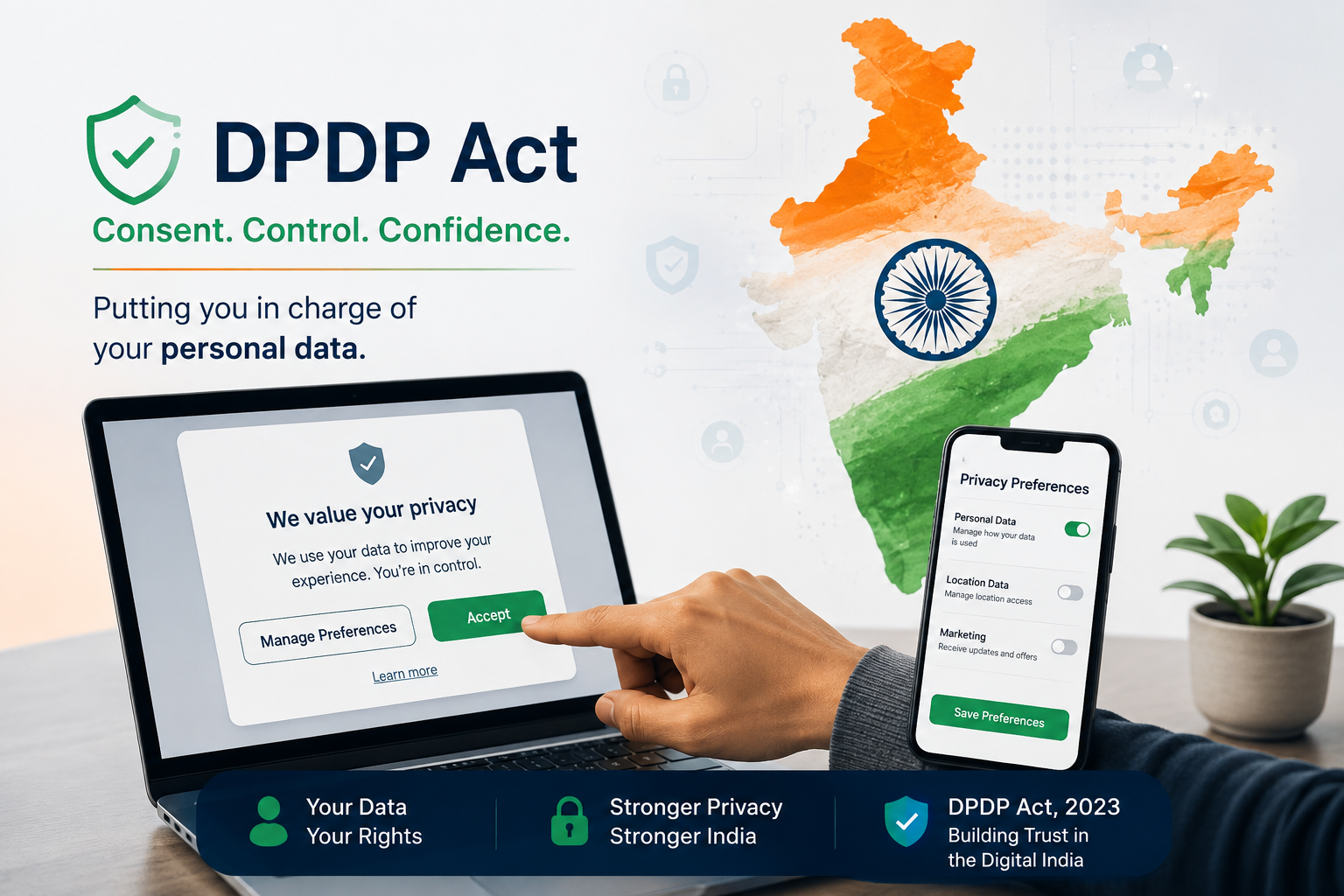

Every digital platform today, whether it is a fintech app, a healthcare portal, an e-commerce marketplace, or a SaaS product, faces the same three interconnected challenges: who gets access to what, how sensitive data is protected, and how user consent is captured, tracked, and honored. For years, organizations have treated these as separate problems, bolting on an identity and access management tool here, an encryption library there, and a cookie banner plugin somewhere else. The result is fragmented systems, inconsistent audit trails, and constant firefighting whenever a regulator, auditor, or customer asks a simple question: “Can you prove you handled my data correctly?”
This is where SecureCMS changes the equation. Instead of stitching together disconnected tools, SecureCMS brings access control, data protection, and consent management into a single, unified platform. For organizations operating in India and grappling with the Digital Personal Data Protection Act (DPDP Act), as well as businesses operating globally under GDPR, CCPA, and other privacy regimes, this consolidation is not just a convenience. It is quickly becoming a competitive necessity.
In this article, we will walk through why unified platforms matter, how SecureCMS approaches access control, data protection, and consent workflows, and why a centralized Consent Management Platform is now a foundational requirement for any serious data-driven business.
The Problem With Fragmented Compliance Tools
Before diving into what SecureCMS does well, it is worth understanding why the fragmented approach fails so many organizations.
When access control lives in one system, encryption and data protection policies live in another, and consent capture lives in a third-party cookie banner tool, you end up with silos that do not talk to each other. A user might withdraw consent through the cookie banner, but that signal never reaches the backend systems that continue processing their data. An employee might be granted elevated access to a customer database for a one-time task, but nobody remembers to revoke it. A security team might encrypt data at rest, but have no visibility into who actually queried that data and why.

These gaps are not just theoretical. They are exactly the kind of gaps that regulators, auditors, and increasingly, customers themselves, are trained to look for. Under the DPDP Act, for instance, organizations classified as Significant Data Fiduciaries must demonstrate not only that consent was collected, but that it maps cleanly to specific processing activities, that data principals can withdraw consent as easily as they gave it, and that access to personal data is restricted to those with a legitimate, auditable need.
Trying to prove this across three or four disconnected systems is painful, error-prone, and expensive. It also creates real business risk. A single misconfigured access control rule or an unlogged consent withdrawal can turn into a compliance violation, a data breach, or a reputational crisis.
SecureCMS was built specifically to close these gaps by treating access control, data protection, and consent as three faces of the same underlying problem: giving organizations complete, provable control over how personal data flows through their systems.
What Makes SecureCMS a Unified Platform
The core idea behind SecureCMS is simple to state but hard to execute well: every piece of personal data in your system should carry with it the context of who can access it, how it is protected, and what consent governs its use. Rather than managing these as separate configurations in separate tools, SecureCMS ties them together at the data and workflow level.
This means that when a new user signs up on a platform built on SecureCMS, their consent choices are recorded in a structured, auditable consent ledger. Those consent records are immediately linked to access control policies, so that if a user declines marketing communications, the marketing module is automatically restricted from querying that user’s contact details. If a user withdraws consent for analytics processing, the analytics pipeline is automatically excluded from including that user’s data in future computations.

At the same time, the underlying personal data, wherever it lives, whether in a primary database, a data warehouse, or a third-party integration, is protected using strong encryption and cryptographic controls, with certificate-based authentication ensuring that only verified systems and services can decrypt and process it.
This tri-fold integration of access control, data protection, and consent is what allows SecureCMS to function as a genuine Consent Management Platform rather than just a cookie banner or a basic preference center.
Access Control: Granular, Auditable, and Built for Scale
Access control is often treated as an IT afterthought, a simple matter of usernames, passwords, and role assignments. But in a modern data protection context, access control needs to be far more sophisticated, and this is one of the areas where SecureCMS invests heavily.

Role-Based and Attribute-Based Access
SecureCMS supports both role-based access control (RBAC) and attribute-based access control (ABAC), allowing organizations to define not just broad roles like “admin” or “support agent,” but fine-grained rules based on attributes such as department, data sensitivity classification, geographic jurisdiction, and even the specific consent status of the data subject in question.
For example, a customer support agent might be permitted to view a customer’s order history but explicitly blocked from viewing payment card details unless a supervisor grants temporary, time-boxed access. This level of granularity matters enormously in industries like healthcare, finance, and e-commerce, where different categories of data carry different sensitivity levels and different regulatory obligations.
Certificate-Based Authentication and PKI Integration
SecureCMS extends beyond simple username and password authentication by integrating enterprise-grade Public Key Infrastructure (PKI). Through X.509 certificate management and certificate lifecycle automation, SecureCMS ensures that machine-to-machine access, such as when one microservice requests data from another, is authenticated using cryptographic certificates rather than static credentials that can be leaked or reused.
This certificate-based authentication model is particularly valuable for platforms with complex, distributed architectures where dozens or hundreds of services need to interact securely. Certificate lifecycle automation means that certificates are issued, rotated, and revoked automatically according to policy, removing the operational burden of manual certificate management and reducing the risk of expired or compromised certificates creating security gaps.
Audit-Ready Access Logs
Every access event within SecureCMS, whether a human user viewing a record or a system process querying a database, is logged in a tamper-evident audit trail. These access logs are structured specifically to support compliance audits and regulatory inquiries. If a regulator asks “who accessed this individual’s data in the last twelve months, and under what authorization,” SecureCMS can answer that question in minutes rather than weeks.
This audit-ready design is a defining feature of what makes SecureCMS function well as an Audit-Ready Consent Management Platform. Consent and access are logged together, so auditors can trace a single, coherent story from the moment a user gave consent through every subsequent access to their data.
Data Protection: Cryptographic Rigor at Every Layer
The second pillar of SecureCMS is data protection, and here the platform draws on deep cryptographic expertise to secure information at rest, in transit, and during processing.

Cryptographic Message Syntax and Digital Signing
SecureCMS incorporates Cryptographic Message Syntax (CMS) capabilities, including PKCS#7 digital signing and CMS SignedData processing, to ensure that documents, records, and data exchanges can be cryptographically signed and verified. This is particularly important for organizations that need to demonstrate non-repudiation, in other words, proving conclusively that a specific document or consent record was created or approved by a specific party and has not been altered since.
Alongside signing, SecureCMS supports CMS EnvelopedData encryption, allowing sensitive documents and messages to be encrypted such that only authorized recipients holding the correct private key can decrypt them. This is foundational to secure document signing and secure data exchange between organizations, particularly in regulated industries like banking, insurance, and government services.
Secure Document Signing and Electronic Signature Validation
As more business processes move to digital-first workflows, secure document signing platforms have become essential infrastructure. SecureCMS offers digital signature management capabilities that support electronic signature validation, ensuring that signed contracts, consent forms, and compliance documents carry cryptographic proof of authenticity.
This matters directly for consent management. When a user provides explicit consent for data processing, particularly for sensitive categories of data under the DPDP Act or GDPR, having that consent captured in a digitally signed, verifiable record strengthens an organization’s compliance posture considerably. It transforms a simple checkbox click into a legally defensible, cryptographically verifiable event.
Enterprise PKI and Trusted Certificate Issuance
SecureCMS’s enterprise PKI integration extends to secure certificate issuance and end-to-end digital trust infrastructure. Organizations can issue and manage their own internal certificates, integrate with external trusted Certificate Authorities, and incorporate timestamping authority integration to prove exactly when a document was signed or a consent record was created.
Timestamping is a small but crucial detail often overlooked in consent management discussions. Under the DPDP Act and similar frameworks, the timing of consent matters. If a user withdraws consent, everything that happens after that timestamp needs to reflect the new consent status. SecureCMS’s cryptographic timestamping ensures these timelines are provable and cannot be disputed or falsified after the fact.
Secure Email and End-to-End Message Protection
Beyond documents and databases, SecureCMS extends its cryptographic document security capabilities to secure email encryption and end-to-end message protection. This ensures that when personal data or consent-related communications travel between systems, partners, or individuals via email, they remain protected from interception, satisfying both security best practices and regulatory expectations around data-in-transit protection.
Secure File Encryption and Key Protection
At the storage layer, SecureCMS provides secure file encryption platform capabilities alongside robust cryptographic key protection. Encryption keys are managed according to enterprise cryptography management best practices, ensuring that even if underlying storage is compromised, the encrypted personal data remains unreadable without proper key access, which is itself gated by the platform’s access control layer.
This layered approach, where encryption, key management, and access control reinforce each other, is what allows SecureCMS to function as a genuinely secure, defense-in-depth data protection platform rather than a single-point security tool.
Consent Workflows: The Heart of Modern Privacy Compliance
While access control and data protection form the security backbone of SecureCMS, consent management is where the platform most directly touches the end user experience and regulatory compliance obligations. This is where SecureCMS operates as a full-featured Consent Management Platform.

Centralized, Unified Consent Records
Rather than scattering consent signals across a cookie banner, a mobile app SDK, a customer relationship management system, and a marketing automation tool, SecureCMS acts as a Centralized Consent Management Platform. Every consent event, whether it originates from a website cookie banner, an in-app permission prompt, a signed paper form that has been digitized, or a call center interaction, flows into a single, unified consent record for each data subject.
This unification is what enables SecureCMS to function as both a Unified Consent Management System and a Global Consent Management Platform with DPDP support, allowing multinational organizations to manage consent consistently across jurisdictions while still respecting the specific requirements of each regional law.
Real-Time Consent Orchestration
One of the most technically demanding aspects of consent management is ensuring that consent changes propagate instantly across all connected systems. SecureCMS addresses this through real-time consent orchestration, meaning that the moment a user updates their consent preferences, whether granting new permissions or withdrawing existing ones, that change is broadcast across every integrated system, from marketing platforms to analytics pipelines to third-party data processors.
This real-time orchestration is critical for DPDP compliance automation, since the DPDP Act requires that withdrawal of consent be honored promptly and that downstream processing stop accordingly. A consent platform that only updates preferences in one system while leaving others unaware creates exactly the kind of compliance gap that regulators are increasingly focused on identifying.
Granular Consent Management
Not all data processing is equal, and SecureCMS reflects this through granular consent management. Users are not forced into a binary all-or-nothing consent choice. Instead, they can grant or deny consent for specific processing purposes such as marketing communications, analytics, third-party data sharing, profiling, or specific categories of sensitive personal data.
This granularity directly supports DPDP compliance, since the Act emphasizes purpose limitation, meaning that personal data collected for one purpose should not be repurposed for another without fresh, specific consent. A Granular Consent Management Platform like SecureCMS allows organizations to map each data processing activity to the exact consent purpose that authorizes it, closing the gap between what was promised to users and what actually happens with their data.
Consent Lifecycle Management
Consent is not a one-time event. It has a lifecycle, from initial capture, through active use, to eventual expiry, renewal, or withdrawal. SecureCMS supports full consent lifecycle management, tracking when consent was given, under what version of the privacy notice, for what specific purposes, and for how long that consent remains valid before requiring renewal.
This lifecycle approach is particularly relevant for India DPDP consent form compliance, where organizations need to demonstrate not just that consent was captured at signup, but that it continues to reflect an accurate, current, and freely given choice by the data principal throughout the relationship.
Multi-Jurisdiction and Cookie Consent Support
Global platforms rarely operate under a single regulatory framework. SecureCMS functions as a Multi-Jurisdiction Consent Management Platform, allowing a single implementation to serve compliance requirements across the DPDP Act in India, GDPR in Europe, CCPA in California, and other emerging privacy laws worldwide. This includes robust Cookie Consent Platform functionality and Privacy Consent Platform capabilities, ensuring that website visitors see consent banners and preference centers tailored to their specific jurisdiction’s legal requirements, rather than a generic one-size-fits-all approach that may under-comply in stricter jurisdictions or over-complicate the experience in more lenient ones.
Developer-Friendly and API-Based Architecture
Recognizing that consent management cannot be a bolt-on afterthought, SecureCMS is designed as a Developer-Friendly Consent Management Platform with a comprehensive API-Based Consent Management Platform architecture. Development teams can embed consent checks directly into application logic, query consent status before triggering any data processing activity, and integrate consent capture into custom user interfaces rather than being locked into a rigid, generic widget.
This Embedded Consent Management Platform approach means that consent becomes a first-class citizen within the application architecture itself, not a separate compliance layer bolted on at the edge. For engineering teams, this reduces the friction of compliance work considerably, since consent checks become just another API call within existing application logic.
Intelligent Consent Insights and Dashboards
Beyond simple capture and enforcement, SecureCMS provides an Intelligent Consent Management Platform layer that surfaces analytics and insights. Organizations can view consent dashboards showing opt-in and opt-out rates by purpose, geography, and time period, helping privacy teams and marketing teams alike understand how users are engaging with consent choices.
These dashboards also support DPDP awareness among users, since organizations can identify segments of their user base who may not fully understand their consent options and target them with clearer, simplified consent education, an increasingly important consideration as regulators emphasize meaningful, informed consent rather than mere technical compliance.
Consent Evidence and Consent Logs for Audit Readiness
When regulators or auditors come calling, vague assurances are not enough. SecureCMS maintains detailed consent evidence and consent logs for every consent event, capturing the exact consent policy version presented to the user, the specific choices they made, the timestamp of the action, and the IP address or device context in which it occurred.
This consent evidence trail is what elevates SecureCMS from being merely a consent capture widget to being a genuine Audit-Ready Consent Management Platform capable of withstanding regulatory scrutiny under DPDP compliance automation requirements.
Why This Matters Specifically for DPDP Compliance in India
India’s Digital Personal Data Protection Act represents a significant shift in how organizations operating in India must handle personal data. Unlike some earlier voluntary frameworks, the DPDP Act carries real enforcement teeth, including substantial penalties for non-compliance.
For startups and growing platforms, building DPDP compliance from scratch can feel overwhelming. A practical Consent Management checklist for startups typically includes items such as: implementing clear, specific consent notices in accessible language, ensuring consent can be withdrawn as easily as it was given, maintaining verifiable records of consent, restricting data access to those with legitimate business need, encrypting sensitive personal data, and establishing breach notification procedures.

SecureCMS addresses each of these checklist items directly. As a DPDP Consent Management Platform India, it provides pre-built consent notice templates aligned with DPDP requirements, one-click withdrawal mechanisms, tamper-evident consent records, role-based access restrictions, and enterprise-grade encryption, all within a single platform rather than requiring separate point solutions for each requirement.
For organizations already operating and looking to formalize their approach, SecureCMS functions as a comprehensive DPDP management system that brings structure and automation to what would otherwise be a manual, error-prone compliance process. Rather than relying on spreadsheets to track consent status or email threads to approve data access requests, teams gain a single source of truth that scales with the organization.
Enterprise-Grade Trust and Security Infrastructure
For larger organizations, SecureCMS functions as an Enterprise Consent Management System backed by genuinely enterprise-grade cryptographic infrastructure. This includes Advanced Cryptographic Services covering everything from document integrity verification to Non-Repudiation Solutions that ensure disputes over what was agreed to, signed, or consented to can be resolved definitively through cryptographic proof rather than conflicting recollections.

As a Secure Consent Management Platform, SecureCMS treats every consent record with the same rigor typically reserved for financial transactions or legal contracts, applying Trusted Document Authentication standards to ensure that consent evidence holds up not just to internal audits but to external regulatory review and, if necessary, legal proceedings.
This is particularly important for organizations in regulated industries such as banking, insurance, healthcare, and government services, where a Secure CMS Platform approach to both data protection and consent is often a baseline expectation rather than a differentiator.
Bringing It All Together: One Platform, One Source of Truth
The real power of SecureCMS lies not in any single feature but in how access control, data protection, and consent management reinforce each other within a single platform. When a user withdraws consent, that action automatically triggers access control restrictions, preventing further processing of their data by systems that no longer have a valid legal basis to use it. When sensitive data is accessed, that access is logged alongside the consent status that authorized it, creating a complete, provable chain of custody. When documents or consent forms need to be verified, cryptographic signing and certificate-based authentication provide unshakeable proof of authenticity and timing.
This is fundamentally different from managing three separate tools that each address one piece of the puzzle. Fragmented tools create fragmented compliance, fragmented audit trails, and fragmented risk. A unified Consent Management Platform like SecureCMS, one that treats consent, access, and protection as deeply interconnected rather than separate concerns, gives organizations something far more valuable: a single, coherent, defensible story about how they handle personal data from the moment it is collected to the moment it is deleted.
For platforms operating in India navigating DPDP compliance automation, for global businesses managing consent across multiple jurisdictions, and for any organization that takes data protection seriously, this unified approach is no longer a nice-to-have. It is rapidly becoming the standard against which serious platforms are measured, by regulators, by enterprise customers conducting vendor due diligence, and increasingly, by everyday users who are more aware than ever of how their personal data is being used.
SecureCMS was built for this moment: a platform that does not force organizations to choose between security, compliance, and usability, but delivers all three, together, in one place.
Frequently Asked Questions
1. What is a Consent Management Platform, and why do I need one instead of a simple cookie banner?
A Consent Management Platform goes far beyond a cookie banner by capturing, storing, and enforcing user consent choices across every system that processes personal data, not just the website. While a basic cookie banner might record a single opt-in or opt-out for cookies, a full platform like SecureCMS tracks granular consent by purpose, propagates consent changes in real time to connected systems, maintains audit-ready consent logs, and ties consent status directly to access control and data protection enforcement. This comprehensive approach is what regulators expect under frameworks like the DPDP Act and GDPR.
2. How does SecureCMS help specifically with DPDP compliance in India?
SecureCMS functions as a DPDP Consent Management Platform India by providing consent notices aligned with DPDP requirements, straightforward consent withdrawal mechanisms, verifiable and timestamped consent records, purpose-based granular consent, and role-based access restrictions on personal data. It also maintains detailed consent evidence and audit logs, which are essential for demonstrating compliance if the Data Protection Board or an auditor requests proof of how consent was obtained and honored.
3. Can SecureCMS handle consent management for organizations operating in multiple countries with different privacy laws?
Yes. SecureCMS operates as a Multi-Jurisdiction Consent Management Platform and Global Consent Management Platform with DPDP support, allowing a single implementation to serve compliance needs under India’s DPDP Act, the EU’s GDPR, California’s CCPA, and other regional privacy laws simultaneously. Consent banners, preference centers, and enforcement logic can be tailored to the specific legal requirements of each jurisdiction a user is located in.
4. Is SecureCMS difficult to integrate into an existing application or platform?
No. SecureCMS is built as a Developer-Friendly and API-Based Consent Management Platform, meaning development teams can embed consent checks, access control rules, and encryption directly into existing application logic through well-documented APIs. This Embedded Consent Management Platform approach avoids the need to rip out existing systems, instead layering consent, access, and protection capabilities on top of what already exists.
5. How does SecureCMS ensure that data access and consent records cannot be tampered with or disputed later?
SecureCMS relies on enterprise-grade cryptography, including PKCS#7 digital signing, CMS SignedData and EnvelopedData processing, certificate-based authentication, and timestamping authority integration, to create tamper-evident, non-repudiable records of both consent events and data access events. This means that every consent record and access log carries cryptographic proof of authenticity and timing, making SecureCMS a genuinely Audit-Ready Consent Management Platform capable of withstanding scrutiny from regulators, auditors, or legal proceedings.