
India’s Digital Personal Data Protection Act, 2023 (DPDP Act) has fundamentally changed how businesses collect, store, and use personal data. For the first time, Indian companies, from early-stage startups to global enterprises operating in India, must demonstrate, not just claim, that they have obtained valid, informed, and revocable consent from every individual whose data they process. This is where a Consent Management Platform becomes indispensable.
A Consent Management Platform (CMP) is no longer a “nice-to-have” compliance add-on. It is the operational backbone that turns the DPDP Act’s legal requirements into everyday, auditable business processes. Without one, most organizations simply cannot prove compliance at scale, especially when data flows across websites, mobile apps, call centers, physical forms, and third-party vendors simultaneously.
This article explains, in detail, what a Consent Management Platform does, why Indian businesses need one under the DPDP Act, how it works technically and operationally, what to look for when choosing one, and how to build a practical rollout plan. Along the way, we’ll cover the consent lifecycle, DPDP consent form compliance, audit-readiness, and the growing need for DPDP awareness among users.
Understanding the DPDP Act: A Quick Recap
The DPDP Act, 2023 is India’s comprehensive data protection law, built around the concept of “Data Principals” (individuals) and “Data Fiduciaries” (organizations that determine the purpose and means of processing personal data). Its core philosophy is simple: personal data can only be processed with the free, specific, informed, unconditional, and unambiguous consent of the Data Principal, or under a small set of “legitimate uses” defined by law.
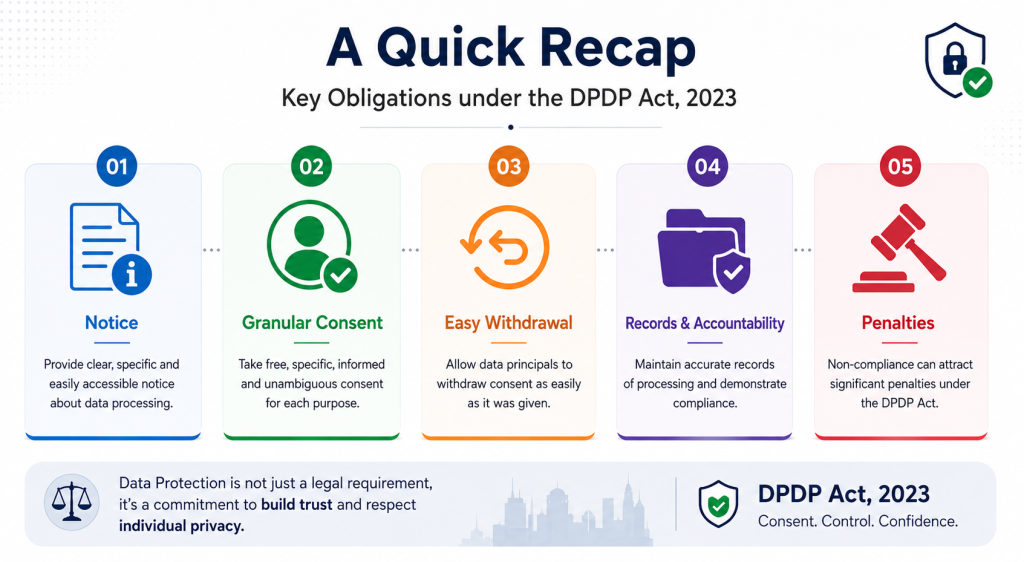
Key obligations under the Act include:
Data Fiduciaries must provide a clear notice, in plain language, describing what data is collected and why, before or at the time of seeking consent. Consent must be granular, meaning a user should be able to consent to specific purposes rather than a single blanket “I agree” checkbox covering everything. Consent must be as easy to withdraw as it was to give. Organizations must maintain records that prove consent was validly obtained, including timestamps, the exact notice text shown, and the scope of permissions granted. Significant Data Fiduciaries (SDFs), a category of large-scale data processors notified by the government, face additional obligations such as data protection impact assessments and independent audits. Non-compliance can attract penalties running into hundreds of crores of rupees, calculated per instance of the breach.
The Act also introduces the concept of a “Consent Manager“, a registered, interoperable platform through which Data Principals can give, manage, review, and withdraw consent across multiple Data Fiduciaries. While the Consent Manager framework under the Act is a distinct regulatory registration, the broader category of consent management platforms (technology used by businesses internally to manage their own consent workflows) is what most companies need immediately to operationalize compliance.
Why “Consent” Is Harder Than It Sounds
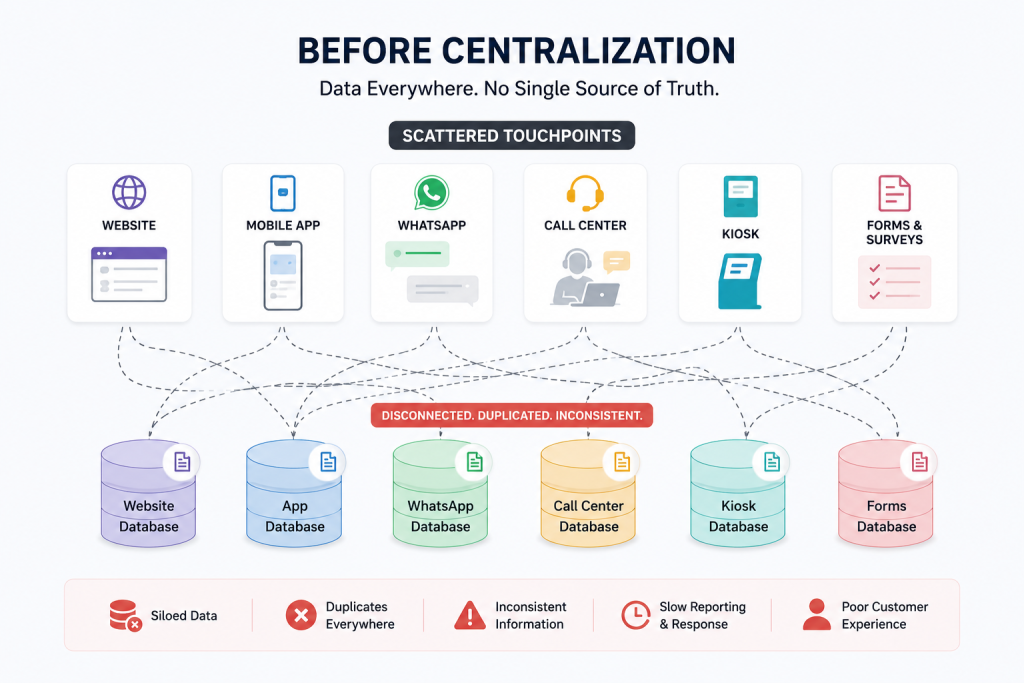
On paper, consent sounds like a single checkbox. In practice, for a mid-sized Indian business, consent touches dozens of systems: the corporate website, mobile apps, WhatsApp and SMS marketing tools, call center scripts, in-store kiosks, HR onboarding forms, vendor and partner data-sharing agreements, and cookie trackers embedded by analytics or advertising tools.
Each of these touchpoints can capture consent differently, store it in a different database, and expire or update it on a different schedule. Without a centralized system, businesses end up with fragmented, inconsistent, and unverifiable consent records, exactly the gap regulators will look for during an audit or after a complaint. This fragmentation is precisely the problem a Consent Management Platform is designed to solve.
What Is a Consent Management Platform?
A Consent Management Platform is a software system that centralizes the entire consent lifecycle: capturing consent at the point of collection, storing it as verifiable evidence, enforcing it across downstream systems, allowing users to modify or withdraw it, and generating records for audits and regulatory reporting.
Think of it as the single source of truth for “who consented to what, when, and under what notice text.” Instead of every department or product building its own ad hoc consent checkbox, a CMP provides standardized APIs, widgets, and dashboards that plug into websites, apps, CRMs, and backend systems.
Modern platforms are increasingly described using terms like Unified Consent Management System, Centralized Consent Management Platform, or Real-time Consent Orchestration Platform, all pointing to the same underlying idea: consent should be managed once, consistently, and be instantly enforceable everywhere data flows.
Core Capabilities a Consent Management Platform Must Offer
1. Granular, Purpose-Based Consent Capture
The DPDP Act requires that consent be specific to a purpose, not bundled into a vague, all-encompassing agreement. A well-designed CMP allows businesses to define individual purposes, for example, “order processing,” “marketing communications,” “analytics,” or “third-party sharing”, and lets users accept or decline each independently. This granular structure is the foundation of genuine DPDP consent form compliance, as opposed to a single “Accept All” button that regulators increasingly view with suspicion.
2. Clear, Localized Notices
Notices must be understandable, not buried in legal jargon. A capable platform supports multilingual notice delivery (an important consideration in India’s linguistically diverse market), plain-language summaries, and version control so that businesses can prove which exact notice text a user saw when they consented.
3. Consent Logs and Immutable Evidence
Every consent action, grant, modification, or withdrawal, needs to be logged with a timestamp, IP or device reference, notice version, and purpose scope. These consent logs form the backbone of audit-readiness. If a regulator or a user disputes whether consent was obtained, the business must be able to produce this record instantly. This is why the concept of an Audit-Ready Consent Management Platform has become a distinct selling point among vendors, it’s not enough to collect consent; you must be able to prove it years later.
4. Easy Withdrawal Mechanisms
Just as important as capturing consent is making withdrawal frictionless. The DPDP Act explicitly requires that withdrawing consent be as simple as giving it. A CMP should provide self-service preference centers where users can review and revoke permissions without contacting support.
5. Real-Time Enforcement Across Systems
Capturing consent is only half the job, a Consent Management Platform must also propagate consent status to every downstream system in near real time. If a user withdraws marketing consent, that signal needs to reach the email platform, SMS gateway, CRM, and any third-party processor before the next campaign goes out. This is where API-Based Consent Management Platform and Developer-Friendly Consent Management Platform architectures matter: businesses need SDKs and webhooks that let engineering teams wire consent status into existing systems without rebuilding them from scratch.
6. Cookie and Tracking Consent
Websites that use cookies, pixels, or third-party trackers need a Cookie Consent Platform layer that blocks non-essential scripts until the user has made a choice. This is a specific and highly visible subset of consent management, since it’s the first interaction most users have with a company’s privacy posture. A combined Cookie & Preference Consent Management Platform approach ensures that website-level consent and account-level consent stay synchronized rather than existing as two disconnected systems.
7. Data Principal Rights Management
Beyond consent itself, the DPDP Act grants Data Principals rights to access, correct, and erase their data, and to nominate someone to exercise these rights on their behalf in case of death or incapacity. Many enterprise-grade platforms extend beyond pure consent capture into broader Privacy Consent Platform functionality, handling these rights requests through the same dashboard.
8. Multi-Jurisdiction and Global Readiness
Indian businesses that also serve customers in the EU, UK, US, or elsewhere need consent frameworks that satisfy GDPR, CCPA, and DPDP simultaneously. A Global Consent Management Platform with DPDP support allows a single implementation to apply the strictest applicable rule set based on the user’s location, rather than maintaining separate systems per region, a major efficiency gain for companies expanding beyond India.
The Consent Lifecycle: From Capture to Deletion
Effective consent lifecycle management in India follows a repeatable structure:
Notice and disclosure. The user is shown a clear notice explaining what data is collected, for what purpose, and for how long it will be retained, before any data is captured.
Capture. The user actively opts in, silence, pre-ticked boxes, or continued use of a service cannot be treated as valid consent under the Act.
Storage as evidence. The consent event is recorded immutably, tied to the specific notice version and purpose.
Enforcement. Systems downstream honor the recorded consent status whenever they access or process the individual’s data.
Review and modification. Users can log into a preference center at any time to see exactly what they’ve consented to and change it.
Withdrawal. When consent is withdrawn, the platform triggers a cascade that stops further processing for that purpose and, where applicable, initiates deletion workflows.
Expiry and renewal. Some consents may have a defined validity period after which they must be refreshed.
Audit and reporting. At any point, the business must be able to generate a report showing consent status across its entire user base, segmented by purpose, date, or channel.
Treating consent as this end-to-end lifecycle, rather than a one-time checkbox click, is the single biggest shift the DPDP Act demands, and it’s precisely the workflow a Consent Management Platform is built to automate.
DPDP Compliance Automation: Why Manual Processes Fail
Many Indian businesses, particularly startups and mid-market companies, initially try to handle consent manually, a spreadsheet of opted-in users here, a custom checkbox there, an email unsubscribe list somewhere else. This approach breaks down quickly for several reasons.
First, it doesn’t scale. A company with a few thousand users might manage manually, but growth to hundreds of thousands or millions of records makes manual tracking practically impossible to keep accurate. Second, it’s not verifiable. Spreadsheets can be edited, and there’s no cryptographic or systemic proof that a consent record wasn’t altered after the fact, a serious weakness during a regulatory audit. Third, it doesn’t propagate. Even if you correctly record a withdrawal in one system, there’s no guarantee every other system that touches that user’s data gets updated, leading to violations that happen unintentionally, simply because a marketing team wasn’t aware a customer had opted out.
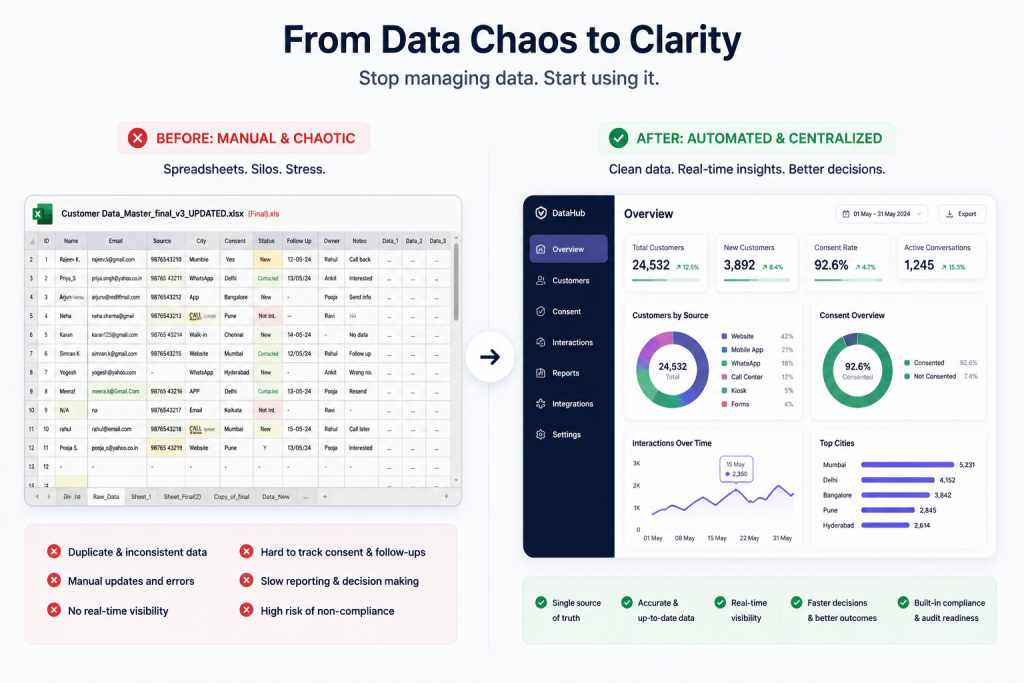
DPDP compliance automation solves this by making consent status a live, queryable, and enforced attribute of every user record, automatically synced across the organization’s tech stack. This shifts compliance from a periodic, manual clean-up exercise to a continuous, built-in property of how systems operate.
Building a Consent Management Checklist for Startups
Startups often assume DPDP compliance is a “later” problem, something to address once they scale. This is a costly assumption, since the Act applies regardless of company size, and retrofitting consent infrastructure into a live product with an existing user base is far harder than building it in from day one. Here is a practical consent management checklist for startups:
Map every place your product or business collects personal data, signup forms, cookies, app permissions, customer support chats, payment flows, and third-party integrations. Classify the purposes for which each piece of data is used, and avoid combining unrelated purposes into a single consent request. Draft plain-language notices for each purpose, avoiding legal jargon, and have them reviewed for DPDP consent form compliance. Implement a consent capture mechanism, even a lightweight CMP, before launch, rather than bolting one on after a data breach or complaint forces the issue. Set up consent logs from day one, since retroactively reconstructing historical consent evidence is often impossible. Build a simple self-service preference center so users can review and withdraw consent without emailing support. Establish a data retention policy and, ideally, automate deletion of data when it’s no longer needed or when consent is withdrawn. Identify whether any data processing involves children or persons with disabilities, since the DPDP Act imposes stricter parental consent and processing restrictions in these cases. Vet third-party vendors and data processors to ensure they also honor consent signals passed to them. Assign clear internal ownership, even a fractional or outsourced Data Protection Officer role, for consent and privacy compliance.
Following this checklist early means a startup can grow without a painful, expensive compliance retrofit later, and it builds a foundation of user trust that compounds as the company scales.
Why a DPDP Management System Matters for Enterprises
For larger organizations, consent isn’t confined to a single product, it spans multiple business units, brands, customer touchpoints, and legacy systems, often accumulated through years of organic growth or acquisitions. An enterprise-grade DPDP management system in India needs to handle scale, complexity, and governance simultaneously.
An Enterprise Consent Management System typically provides centralized policy administration, so legal and compliance teams can define consent rules once and have them enforced consistently across every business unit rather than negotiated separately by each team. It also needs to integrate with a wide range of existing systems, CRMs, marketing automation tools, data warehouses, and customer support platforms, through APIs, making an Embedded Consent Management Platform approach valuable, since it lets consent checks happen inside existing workflows without disrupting them.
Role-based access controls matter as well, ensuring that only authorized personnel can view or export consent records, since consent data is itself sensitive personal information. Enterprises operating in regulated sectors like banking, insurance, or healthcare also typically require a Secure Consent Management Platform with encryption at rest and in transit, detailed access logs, and compliance with sector-specific regulatory frameworks in addition to the DPDP Act. Finally, because Significant Data Fiduciaries face mandatory audits and impact assessments under the Act, an Audit-Ready Consent Management Platform with pre-built compliance reports significantly reduces the manual burden during these reviews.
For enterprises with global operations, a Multi-Jurisdiction Consent Management Platform ensures that consent rules automatically adjust based on where the Data Principal resides, applying DPDP rules for Indian users and GDPR or CCPA rules for others, all from a single administrative console.
Intelligent Consent Management: Where the Technology Is Heading
As data ecosystems get more complex, providers are increasingly building what’s marketed as an Intelligent Consent Management Platform, one that uses automation and analytics to flag consent gaps, predict where compliance risk is highest, and recommend notice or purpose changes based on regulatory updates. While the core legal requirement remains the same (valid, informed, revocable consent), these intelligent layers help compliance teams stay ahead of gaps rather than discovering them during an audit or after a complaint.
This is closely tied to DPDP awareness among users, a broader trend where Indian consumers are becoming increasingly conscious of their data rights, partly due to media coverage of the Act, partly due to high-profile data breaches, and partly due to more transparent consent interfaces becoming the norm across major platforms. Businesses that get ahead of this awareness curve, by making consent clear, respectful, and easy to manage, tend to see better customer trust and lower complaint volumes than those that treat consent as a legal formality to be minimized.
A Note on Cryptographic Consent Evidence and Document Security
Some advanced Consent Management Platforms extend into the realm of cryptographic evidence to strengthen the legal defensibility of consent records. Concepts borrowed from secure document and messaging standards, such as digital signature validation, certificate-based authentication, and structures similar to Cryptographic Message Syntax (CMS) or PKCS#7 signing, can be applied to consent logs, effectively creating tamper-evident, non-repudiable proof that a specific individual gave consent at a specific time, under a specific notice.
This matters because consent evidence sometimes needs to be produced years after the fact, during litigation, regulatory inquiry, or a data subject access request. A platform that applies document integrity verification techniques, timestamping authority integration, and certificate lifecycle automation to its consent logs offers a materially stronger evidentiary trail than one relying on plain, editable database entries. While not every business will require this level of cryptographic rigor, organizations handling highly sensitive data, financial services, healthcare, or large-scale consumer platforms, increasingly look for this as part of a broader enterprise PKI integration and digital trust infrastructure strategy, ensuring their consent records hold up to the same scrutiny as a digitally signed legal document.
How to Choose the Right Consent Management Platform
When evaluating vendors, Indian businesses should look past marketing claims and test for a few concrete capabilities.
Ask whether the platform supports granular, purpose-level consent rather than a single blanket toggle, since this is a direct DPDP requirement, not an optional feature. Check whether consent logs are exportable in a format usable for audits, and whether they include notice version history, not just a yes/no flag. Confirm the platform offers real APIs and SDKs so your engineering team can enforce consent status across existing systems, a good sign of a genuinely Developer-Friendly Consent Management Platform rather than a marketing widget bolted onto a website. Evaluate how quickly consent changes propagate across integrated systems; delays of even a day can result in unwanted communications reaching users who withdrew consent. Look for multilingual notice support, given India’s linguistic diversity and the goal of genuinely informed consent. Ask about data residency, where consent records are physically stored, since this can matter both for DPDP compliance and for enterprise security policies. Finally, request a live audit report demonstration, since the ability to generate a clean, regulator-ready report on demand is often the true test of whether a platform is audit-ready in practice, not just in a sales deck.
Common Mistakes Businesses Make Without a Proper CMP
Several patterns show up repeatedly among businesses that delay investing in consent infrastructure. Many use a single “Accept Terms and Conditions” checkbox to cover marketing, analytics, and data sharing all at once, a practice the DPDP Act’s emphasis on specific, purpose-bound consent makes increasingly risky. Others fail to keep any record of which notice version a user saw, making it impossible to prove what a customer actually agreed to if that notice is later updated. It’s also common to see marketing or sales teams continuing outreach after a user has withdrawn consent through a different channel, simply because the systems weren’t connected. Cookie banners are sometimes decorative, tracking scripts load before the user makes any choice, defeating the purpose of asking at all. And many organizations only start thinking about consent architecture after receiving a user complaint or a legal notice, at which point the fix is far more expensive and reputationally damaging than if it had been built proactively.
A properly implemented Consent Management Platform for DPDP directly prevents each of these failure modes by design, rather than relying on individual teams to remember every rule manually.
Conclusion
The DPDP Act has moved data protection in India from a set of best practices to a hard legal requirement with real financial and reputational consequences. Consent sits at the very center of this law, and managing it well requires more than good intentions, it requires infrastructure. A Consent Management Platform gives Indian businesses, from early-stage startups to global enterprises, the tools to capture, enforce, evidence, and continuously manage consent across every channel where personal data is collected.
Whether you’re building your first consent management checklist for startups or evaluating an enterprise-grade DPDP management system in India, the underlying goal is the same: make consent genuine, granular, easy to withdraw, and provable. Businesses that treat this as a foundational investment, not a compliance afterthought, will be better positioned not just to avoid penalties, but to earn the kind of user trust that has become a competitive advantage in its own right as DPDP awareness among users continues to grow.
Frequently Asked Questions
1. What is a Consent Management Platform, and why do Indian businesses need one under the DPDP Act?
A Consent Management Platform is a system that captures, stores, enforces, and manages user consent across every touchpoint where personal data is collected. Under the DPDP Act, businesses must prove that consent was informed, specific, and freely given, something manual processes like spreadsheets or scattered checkboxes cannot reliably demonstrate at scale.
2. How is a Consent Management Platform different from a simple cookie banner?
A Cookie Consent Platform handles a specific slice of the problem, tracking scripts on a website, while a full Consent Management Platform covers the entire consent lifecycle across websites, apps, CRMs, call centers, and third-party vendors, including consent logs, withdrawal handling, and audit reporting.
3. Do startups really need a Consent Management Platform, or is this only for large enterprises?
Startups need it just as much, if not more, since the DPDP Act applies regardless of company size, and retrofitting consent infrastructure after launch is far costlier than building it in from the start. A basic consent management checklist for startups should be part of the initial product build, not a later addition.
4. What records does a business need to keep to prove DPDP consent form compliance?
Businesses should retain the exact notice text shown to the user, the specific purposes consented to, a timestamp of the consent action, and any subsequent modifications or withdrawals. These consent logs form the primary evidence during a regulatory audit or user dispute.
5. Can a Consent Management Platform help with compliance beyond India, such as GDPR or CCPA?
Yes. Many platforms are built as a Global Consent Management Platform with DPDP support, allowing businesses to apply the correct regional rule set, DPDP for Indian users, GDPR for EU users, and so on, from a single system rather than maintaining separate compliance infrastructure for each market.