
The potential of Self-Sovereign Identity (SSI) to transform identity management and credential verification is substantial, yet this potential remains constrained by a critical challenge: fragmentation. In a world where credentials issued by one organization cannot easily be verified by another, where digital wallets from different providers cannot communicate, and where enterprises operate within isolated SSI ecosystems, the technology fails to achieve its revolutionary promise.
True transformation emerges only when SSI achieves interoperability the ability for credentials issued on one system to be verified on another, for wallets from different providers to communicate seamlessly, and for enterprises operating across different platforms to exchange verified credentials without friction. Interoperable SSI creates network effects where each enterprise adopting SSI increases the system’s value for all other participants.
This comprehensive exploration examines the critical challenge of SSI interoperability, explores technical standards enabling cross-platform credential verification, analyzes enterprise network architectures supporting interoperability, addresses governance and trust frameworks necessary for multi-enterprise SSI ecosystems, and outlines the pathway toward truly interoperable identity systems spanning diverse organizational boundaries.
The Interoperability Challenge in SSI Ecosystems
Why Interoperability Matters
Without interoperability, SSI remains a collection of isolated systems rather than a unified identity infrastructure. An employee with credentials issued by one provider cannot present them through a different provider’s wallet. A credential issued on one blockchain cannot be verified on another. Universities adopting SSI cannot easily recognize credentials from institutions using different SSI platforms.
This fragmentation undermines SSI’s fundamental value proposition. Much of SSI’s value comes from the assumption that verified credentials will be recognized across organizational boundaries. An employee receiving a credential from an employer should be able to present it to future employers. A student earning credentials from a university should present them to employers globally. A patient receiving healthcare credentials should present them to any healthcare provider.
Without interoperability, these use cases fail. Employees cannot easily present credentials across companies. Students cannot have globally recognized qualifications. Patients must re-prove information to each new provider. The friction and inefficiency that SSI promised to eliminate remains.
Technical Fragmentation
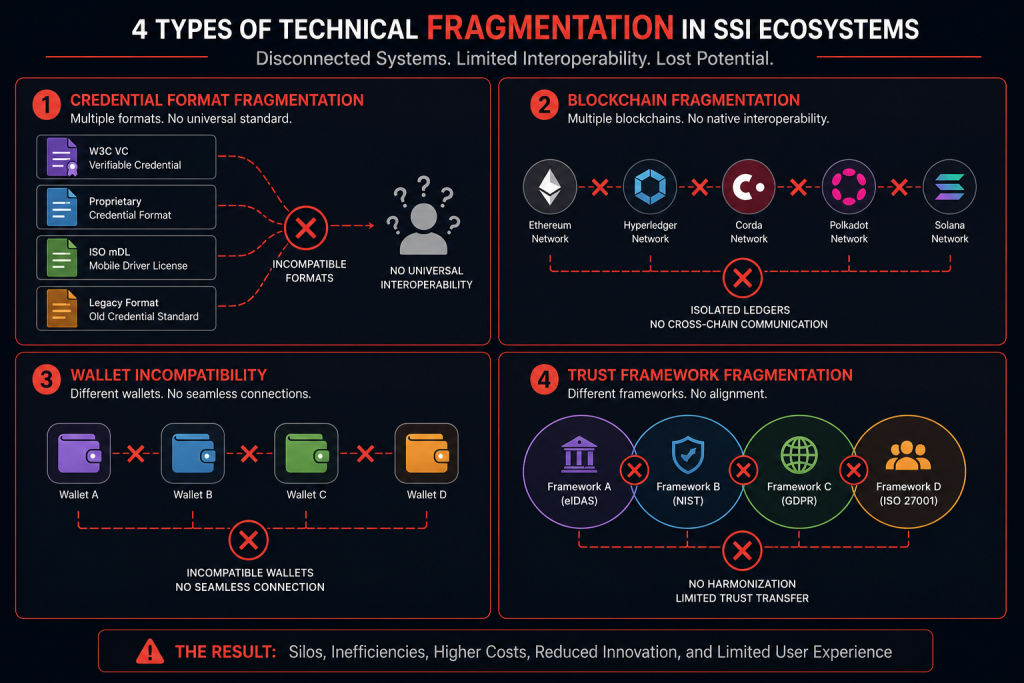
SSI implementations across the ecosystem exhibit substantial technical fragmentation:
Credential Format Fragmentation: Different SSI platforms use different credential formats. W3C Verifiable Credentials represent one approach, but implementations vary significantly in how credentials are structured, what data they contain, and how they are signed. Systems using different credential formats cannot easily exchange credentials.
Blockchain Fragmentation: SSI implementations operate on different blockchains and distributed ledgers. Some use Ethereum, others Hyperledger Fabric, still others Corda or specialized SSI-specific blockchains. Credentials registered on one blockchain cannot be verified on another without complex bridge mechanisms.
Wallet Incompatibility: Digital wallet providers implementing SSI use different protocols, cryptographic approaches, and storage mechanisms. A wallet from Provider A cannot directly communicate with infrastructure from Provider B, limiting credential portability.
Trust Framework Fragmentation: Without standardized approaches to trust, individual enterprises or consortiums establish their own trust frameworks specifying which parties are authorized issuers and what credentials they can issue. These fragmented trust frameworks don’t recognize each other.
Consequences of Fragmentation
This fragmentation creates several serious problems:
Reduced Value: Network effects that would emerge with interoperability are lost. The value of SSI credentials increases when they can be used across more contexts, but fragmentation limits contexts where credentials are recognized.
Implementation Challenges: Enterprises face difficult technology choices. Should they implement SSI on Ethereum, Hyperledger, or another platform? Should they use W3C Verifiable Credentials or proprietary formats? Uncertainty about which choice is “correct” delays adoption.
Lock-in Risk: Once organizations invest in particular SSI platforms or implementations, switching costs become substantial. Fragmentation may lock organizations into specific vendor platforms, creating dependencies and limiting future flexibility.
Limited Adoption: Enterprises are hesitant to invest in technologies that may become obsolete or incompatible. Fragmentation slows adoption by creating uncertainty about long-term viability.
Standards Enabling SSI Interoperability
W3C Verifiable Credentials
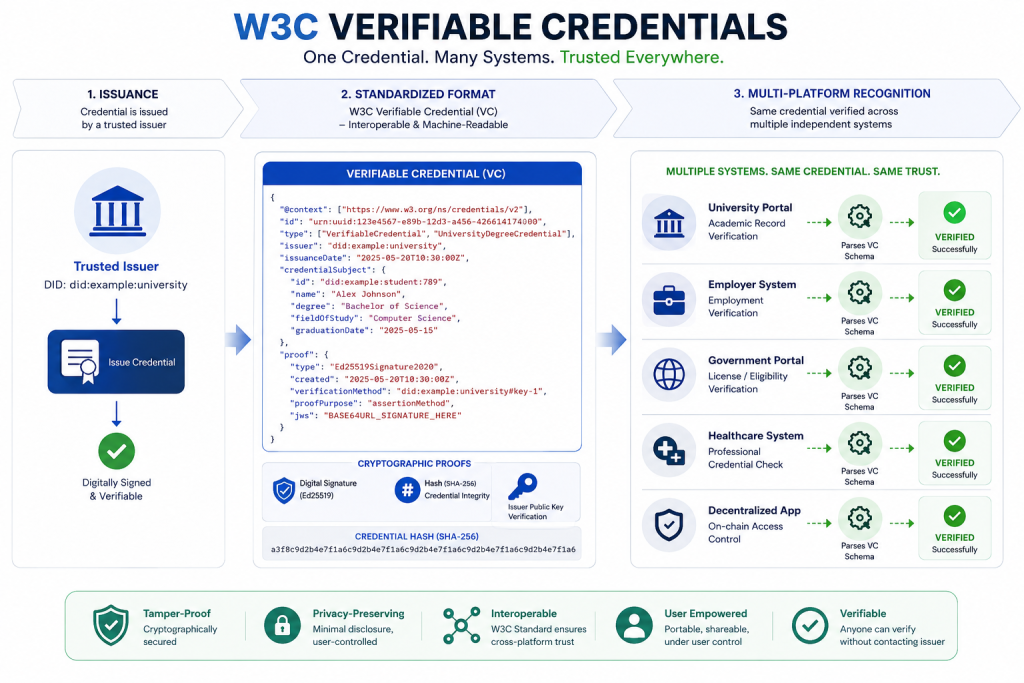
The W3C Verifiable Credentials Data Model has emerged as the leading standard for structuring credentials in interoperable ways. This standard defines how credentials are represented, what information they must contain, and how they are cryptographically signed. By following W3C standards, credentials issued on different platforms can be recognized and verified by systems using the same standard.
W3C Verifiable Credentials enable:
Standardized Structure: Credentials follow predictable structures, allowing different systems to parse and understand credentials regardless of their origin.
Platform Independence: Credentials issued on Ethereum can be verified on Hyperledger Fabric or private systems, provided both use W3C standards.
Cryptographic Interoperability: W3C standards specify how credentials are cryptographically signed, enabling different systems to verify signatures regardless of which platform issued them.
Extensibility: The standard provides mechanisms for adding domain-specific information while maintaining core interoperability.
Decentralized Identifiers (DIDs)
Decentralized Identifiers are crucial for interoperability because they decouple identity from platform dependence. Rather than identifiers being meaningful only within specific systems (Social Security numbers, employee IDs, corporate account identifiers), DIDs are self-generated, portable, and meaningful across systems.
DIDs enable:
Cross-Platform Identity: Individuals and organizations maintain consistent identity across multiple platforms through their DID, rather than maintaining separate identities for each platform.
Portable Credentials: Since credentials are associated with DIDs rather than platform-specific identifiers, they move with individuals between platforms and systems.
Reduced Lock-in: DIDs are platform-agnostic, allowing holders to migrate between implementations without losing identity continuity.
Interoperable Verification: Systems verifying credentials need only resolve the DID to verify the credential’s authenticity, regardless of which platform the DID operates on.
DID Method Specifications
Different DID methods implement DIDs on different underlying systems. DID:SOL uses Solana blockchain, DID:ETH uses Ethereum, DID:KEY generates DIDs without requiring blockchain, and others use Hyperledger, Corda, or proprietary systems. Multiple competing DID methods create potential fragmentation, but the DID specification framework enables these different methods to coexist and interoperate.
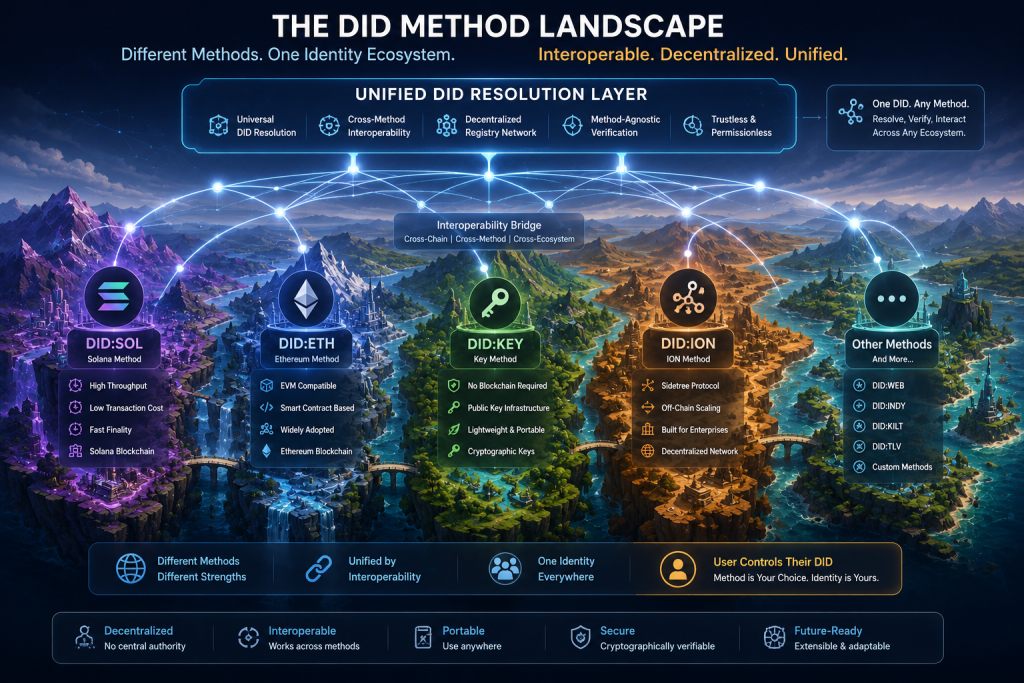
Well-designed DID method specifications ensure that systems supporting DIDs can verify credentials from any DID method without requiring platform-specific infrastructure. This standard framework creates interoperability despite underlying platform diversity.
DID Resolution and Discovery
DID resolution mechanisms enable parties to look up information about any DID, regardless of its method. A system receiving a credential signed by a particular DID can resolve that DID to discover the corresponding public key, then use that key to verify the credential’s signature. This capability enables verification across platforms and DID methods.
Standard DID resolution protocols mean systems don’t need to know about every possible DID method in advance they can dynamically resolve any DID they encounter using standardized resolution mechanisms.
Enterprise Network Architectures for Interoperable SSI
Decentralized Identity Consortium Approaches
Some enterprises address interoperability by forming consortiums establishing shared SSI infrastructure. Consortium participants agree to use common standards (W3C Verifiable Credentials, specific DID methods), operate shared trust registries, and interconnect their systems using standard protocols.
Examples include:
Sovrin Network: An open-source network providing infrastructure for decentralized identity, with governance structures enabling multiple organizations to participate while maintaining standards-based interoperability.
Trust Over IP Foundation: An industry consortium developing standards and governance frameworks enabling interoperable identity ecosystems. Members include enterprises, technology providers, and institutions from across industries.
GLEIF: The Global Legal Entity Identifier Foundation operates a system for issuing identifiers to legal entities, increasingly integrating with SSI technologies to enable interoperable credential exchange.
These consortium approaches work when industry participants share sufficient interest in establishing unified standards. However, consortiums require governance overhead and may exclude participants preferring different technological approaches.
Blockchain Bridges and Cross-Chain Solutions
For enterprises operating across multiple blockchains, cross-chain solutions enable credential verification spanning different underlying systems. Blockchain bridges enable atomic credential transfer and verification across chains. Inter-blockchain communication protocols allow credentials registered on one chain to be verified on another.
While cross-chain solutions add complexity, they enable enterprises already committed to different blockchains to establish interoperability without forcing migration to common platforms.
Hub-and-Spoke Models
Some large enterprises or infrastructure providers operate as interoperability hubs, connecting different SSI ecosystems. The hub maintains adapters and translators enabling credential exchange between different standards and platforms. Smaller participants connect to the hub rather than directly to every other participant.
Hub-and-spoke models reduce the number of connections each participant must maintain, simplifying implementation for smaller organizations. However, they introduce centralized dependencies, potentially creating single points of failure.
API Standards and Translation Layers
Enterprises can establish interoperability through standardized APIs that abstract underlying platform differences. A translation layer converts between different credential formats, DID methods, and verification approaches. Applications interact with these standard APIs without needing platform-specific knowledge.
This approach defers interoperability problems to infrastructure layers, enabling application developers to focus on business logic rather than platform incompatibilities. However, translation layers add complexity and potential performance overhead.
Governance and Trust Frameworks for Interoperable SSI
Trust Registry Standards
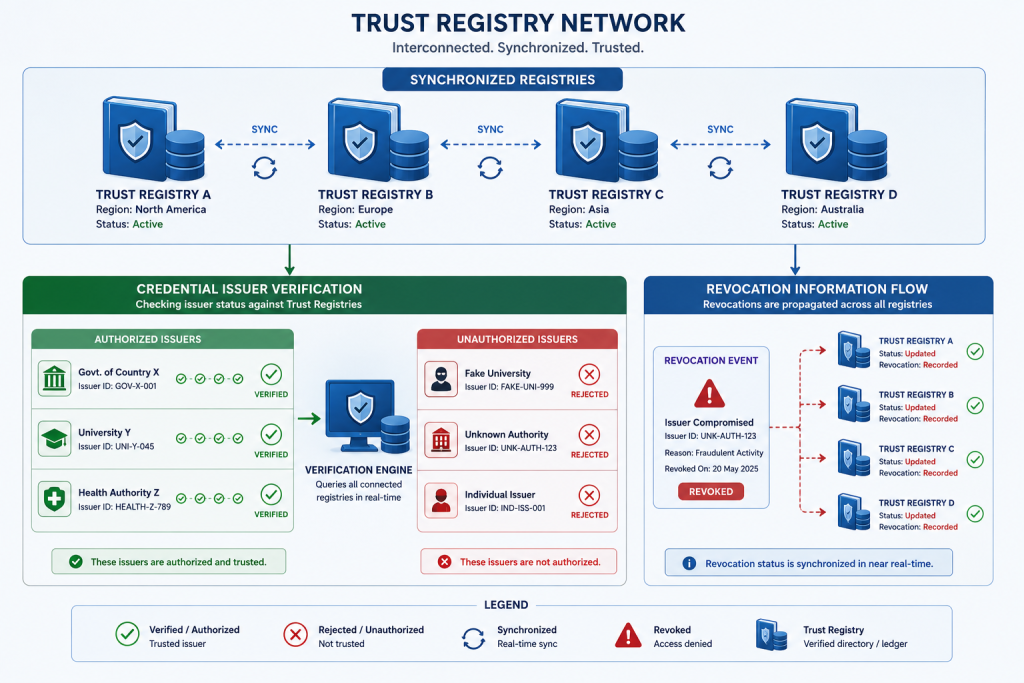
For SSI to function at scale, participants must know which entities are authorized credential issuers and what credentials they are authorized to issue. Trust registries maintain this information, enabling verification systems to validate that credentials are issued by legitimate authorities.
Interoperable trust registries require:
Standard Schemas: Trust registries must use consistent formats for recording trust information, enabling different systems to understand trust decisions.
Cross-Registry Recognition: Multiple trust registries may operate, and they must recognize each other’s trust decisions or provide mechanisms for coordinating trust determination.
Revocation Coordination: When an issuer’s credentials are revoked or an issuer is removed from trust registries, this information must propagate across registries to prevent reliance on invalid credentials.
Leading trust registry approaches include Sovrin’s public ledger of trusted issuers and GLEIF’s registry of authorized legal entity identifiers.
Governance Frameworks
Interoperable SSI ecosystems require governance frameworks specifying:
Credential Governance: Which entities can issue which types of credentials, what information credentials must contain, credential retention policies, and revocation mechanisms.
Identity Governance: Requirements for establishing identity, binding credentials to identities, privacy protections, and dispute resolution procedures.
Technical Governance: Standards for credential formats, DID methods, blockchain use, and verification protocols.
Legal Governance: How credentials are recognized in legal contexts, liability for credential issuance, and dispute resolution between participants.
Organizations like the Trust Over IP Foundation develop governance frameworks that can be adopted or adapted by consortiums establishing specific SSI ecosystems. Standard governance frameworks accelerate ecosystem maturity and enable interoperability by providing proven models.
Legal and Regulatory Alignment
For interoperable SSI to achieve mainstream adoption, governance frameworks must align with legal and regulatory requirements across jurisdictions. A credential recognized in one jurisdiction may not be recognized elsewhere if different legal standards apply.
Addressing this challenge requires:
Regulatory Recognition: Governments and regulators must explicitly recognize SSI credentials as meeting regulatory requirements, rather than requiring traditional documentation.
Mutual Recognition Agreements: Countries and jurisdictions establish agreements recognizing credentials issued under specific governance frameworks, enabling cross-border credential recognition.
Flexible Governance: Governance frameworks must accommodate jurisdiction-specific variations while maintaining core interoperability standards.
Practical Interoperability: Real-World Implementations
Educational Credential Recognition
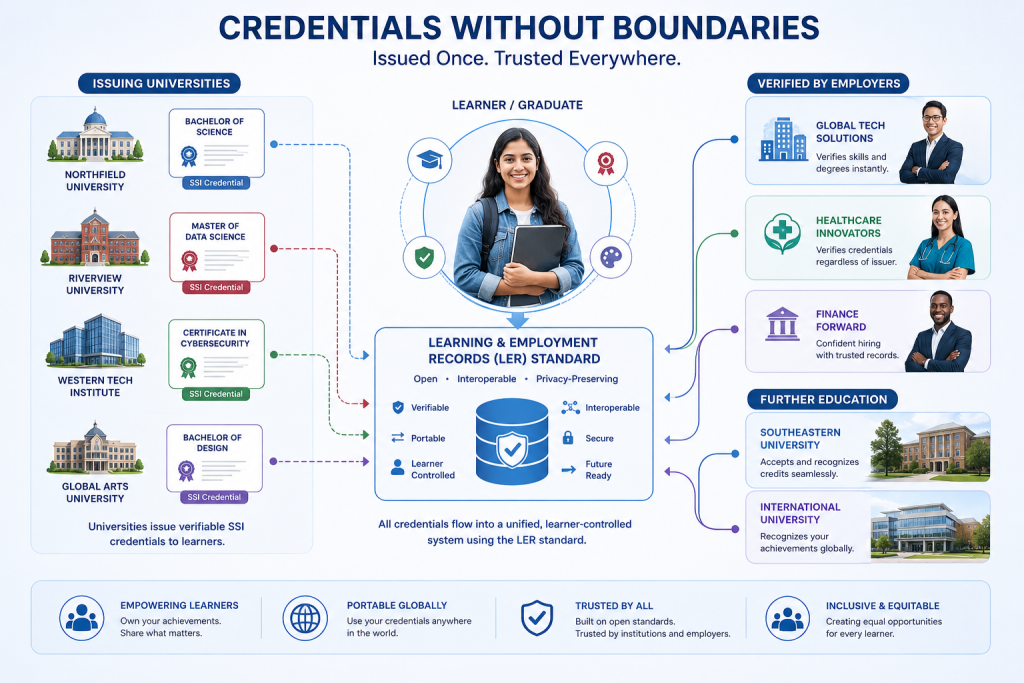
Universities adopting SSI credentials face challenges when students apply to other universities or employers that don’t recognize SSI. Interoperability solutions address this by establishing shared credential standards and trust frameworks.
The Learning and Employment Records (LER) initiative develops standards for educational credentials enabling institutions to issue and institutions to verify credentials regardless of underlying SSI platform. Multiple universities can participate in this ecosystem, issuing credentials recognized across participating institutions.
Healthcare Credential Portability
Healthcare providers increasingly issue SSI credentials verifying patient information. Interoperability enables patients to present credentials across healthcare providers, insurance companies, and public health authorities. Standards like FHIR (Fast Healthcare Interoperability Resources) adapted for SSI enable healthcare credential exchange.
Patients receiving a vaccination credential from one provider can present it to different providers, insurance companies, or public health authorities, with each recipient verifying the credential’s authenticity through standardized mechanisms.
Financial Services Credential Networks
Financial institutions increasingly use SSI for KYC/AML compliance. Interoperability enables financial institutions to recognize KYC credentials issued by other institutions, reducing duplicate KYC processes and accelerating account opening.
A customer verified by Bank A receives a credential. When opening an account at Bank B, they present this credential. Bank B verifies its authenticity and accepts it as proof of KYC compliance. This interoperability dramatically simplifies customer experience while reducing compliance burden on banks.
Supply Chain Credential Verification
Supply chain participants using interoperable SSI can verify supplier credentials regardless of which platforms suppliers and buyers use. A manufacturer receives certifications from an ISO authority on one SSI platform. A buyer using a different platform can still verify these certifications through standardized verification mechanisms.
This interoperability enables supply chains to function across platform boundaries, preventing supplier diversity requirements from becoming technical barriers.
Barriers to SSI Interoperability
Technical Complexity
Achieving true interoperability requires solving complex technical problems spanning cryptography, distributed systems, and security. Different approaches to credential storage, verification, and privacy protection may not easily interoperate. Implementing cross-platform verification adds engineering complexity and potential security risks.
Standards Maturity
While W3C Verifiable Credentials and DID specifications exist, implementations remain actively evolving. Standards gaps remain, and vendors sometimes implement standards in incompatible ways. Waiting for perfect standards before building delays adoption, while building before standards stabilize risks incompatibility.
Governance Challenges
Establishing interoperable SSI requires coordinating among diverse organizations with different interests and priorities. Financial institutions may want different governance than educational institutions. Tech-forward enterprises may prefer different approaches than conservative organizations. Achieving consensus on governance remains challenging.
Regulatory Uncertainty
As different jurisdictions regulate SSI differently, interoperable systems must accommodate diverse regulatory requirements. This complexity increases implementation burden and may make certain interoperability approaches impossible in certain jurisdictions.
Competitive Dynamics
Some technology providers benefit from vendor lock-in and may resist genuine interoperability. Establishing interoperability sometimes requires vendors to cede competitive advantages they currently enjoy. Overcoming these competitive incentives to enable genuine interoperability remains an ongoing challenge.
Achieving Interoperability: Strategic Pathways
Phased Standards Adoption
Rather than waiting for perfect comprehensive standards, organizations can adopt existing standards incrementally. Begin with W3C Verifiable Credentials and a single DID method. Expand to multiple DID methods and trust frameworks as ecosystem matures. This pragmatic approach enables early adoption while leaving room for standards evolution.
Industry-Specific Consortiums
Instead of attempting universal interoperability across all industries immediately, establish industry-specific consortiums addressing interoperability within specific domains. Education, healthcare, and finance may each establish separate SSI ecosystems with tailored governance. These specialized ecosystems can later be connected through cross-industry bridges.
Open-Source Implementations
Open-source SSI implementations enable diverse organizations to adopt proven, community-reviewed code rather than proprietary implementations. Open-source creates pressure for interoperability because community participants across different organizations contribute to unified codebases. Examples include Hyperledger Indy and Aries projects providing open-source SSI infrastructure.
Regulatory Leadership
Governments and regulators can accelerate interoperability by establishing regulatory frameworks requiring or strongly encouraging standards compliance. When regulators require SSI implementations to meet specific technical standards or governance frameworks, compliance incentives align with interoperability.
Market Incentives and Network Effects
Market competition provides powerful incentives for interoperability. Organizations preferring interoperable systems create demand for standards-based approaches. Technology providers delivering interoperable solutions gain competitive advantages. Over time, market forces drive consolidation toward interoperable approaches, even without central mandates.
Future of Interoperable SSI
Multi-Chain SSI Ecosystems
As blockchain technology matures, SSI ecosystems will increasingly span multiple blockchains. Rather than choosing a single blockchain, organizations will operate on multiple chains simultaneously, with SSI standards enabling credential verification across chains. This multi-chain approach maximizes flexibility and reduces lock-in risk.
AI-Enhanced Interoperability Management
Machine learning systems will manage interoperability complexity, automatically translating between different credential formats, discovering appropriate trust frameworks, and optimizing verification paths across ecosystem boundaries. AI will make interoperability transparent to end users by automating technical complexity.
Global Identity Infrastructure
As interoperable SSI adoption expands, a global identity infrastructure will emerge enabling credential exchange across industries, organizations, and geographic boundaries. This infrastructure won’t be centralized but rather distributed and federated, with local governance but global interoperability standards.
Regulatory Harmonization
As jurisdictions recognize SSI benefits and observe successful implementations, regulatory requirements will gradually harmonize around common standards. This harmonization will enable SSI implementations that satisfy regulatory requirements across multiple jurisdictions simultaneously, accelerating global adoption.
Conclusion
The promise of Self-Sovereign Identity to transform identity management, enable credential verification without centralized intermediaries, and restore individual agency over identity data depends critically on achieving interoperability. SSI systems operating in isolation generate limited value. Only when credentials issued by one organization can be verified by any other organization, when wallets from different providers can exchange credentials seamlessly, and when enterprises operate within unified identity ecosystems does SSI achieve its transformative potential.
The technical standards enabling interoperability W3C Verifiable Credentials and Decentralized Identifiers exist and increasingly mature. However, implementing these standards at scale across enterprises, industries, and geographic boundaries requires overcoming governance challenges, regulatory uncertainty, competitive dynamics, and technical complexity.
Success requires coordinated effort from multiple stakeholders: technology providers building interoperable implementations, industry consortiums establishing standards and governance frameworks, regulators recognizing SSI and creating compliance incentives, and individual organizations adopting proven interoperability approaches.
The pathway forward is clear: incremental adoption of existing standards, industry-specific consortiums establishing tailored ecosystems, market incentives driving consolidation toward interoperable approaches, and regulatory frameworks encouraging standardization. Organizations and technology providers investing in interoperable SSI position themselves to lead the transition to distributed identity infrastructure while avoiding costly investments in fragmented systems.
The future of identity management will be determined not by isolated SSI implementations but by genuinely interoperable ecosystems enabling trustworthy credential exchange across organizational, industry, and geographic boundaries. Building this future requires focused attention on interoperability as a core objective rather than an afterthought.
FAQ: Interoperable Self-Sovereign Identity Across Enterprise Networks
What does interoperability mean in the context of SSI?
Interoperability means credentials issued by one organization can be verified by any other organization, regardless of which underlying SSI platform they use. A credential issued through Hyperledger Fabric can be verified by systems using Ethereum. A credential structured in one format can be understood and verified by systems using different formats. Wallets from different providers can exchange credentials seamlessly. Digital identifiers (DIDs) generated on one system are recognized and resolvable by other systems. True interoperability eliminates situations where organizations must implement specific platforms or use specific wallet providers to recognize credentials. Instead, standardized formats and protocols enable frictionless credential exchange across platform and organizational boundaries.
How do W3C Verifiable Credentials enable interoperability?
W3C Verifiable Credentials define a standard way to structure credentials, what fields they must contain, how they are signed cryptographically, how they represent claims about credential holders. By following these standards, credentials issued by any organization using the standard can be understood and verified by any system also implementing the standard. Imagine credentials as standardized documents with consistent formatting, signatures, and information structure. Just as a physical government ID is recognized across the country despite being issued by different agencies, W3C standardized credentials are recognized across diverse systems despite being issued by different organizations. The standard also defines verification procedures enabling systems to check credential authenticity without contacting the issuing organization. This standardization is critical for interoperability; without it, each system would need custom knowledge of every possible credential format and verification approach.
What role do Decentralized Identifiers (DIDs) play in interoperability?
DIDs enable identities to be portable across platforms and recognized uniformly across systems. Traditional identifiers like Social Security numbers are meaningful only within specific systems. Someone’s employee ID at Company A means nothing at Company B. DIDs solve this problem by creating identifiers that are self-generated, platform-independent, and meaningful everywhere. A person’s DID remains the same whether they interact with a hospital, bank, or employer. Credentials issued to that DID are recognized regardless of which system issues them or which system attempts to verify them. This universality eliminates the need to maintain separate identities on different platforms and enables credentials to travel with individuals across all contexts. DIDs also enable systems to verify credentials without platform-specific knowledge; they simply need to resolve the DID to find the public cryptographic key used to sign the credential.
How can enterprises ensure their SSI implementation is interoperable?
Answer: Enterprises should prioritize standardization in their SSI implementations. First, use W3C Verifiable Credentials for credential structure this is the most widely adopted standard and maximizes compatibility with other systems. Second, choose DID methods with broad ecosystem support, such as DID:KEY or methods based on major blockchains. Third, avoid proprietary extensions or modifications to standards that would make credentials incompatible with other systems. Fourth, participate in industry consortiums establishing governance frameworks and standards for your industry. Fifth, test interoperability regularly by attempting to verify credentials issued by other implementations. Sixth, build APIs and protocols enabling credential exchange with diverse partners rather than requiring specific technical stacks. Finally, monitor standards evolution and plan for migration as standards mature. Interoperability requires conscious effort and deliberate standards choices, but these choices enable enterprise flexibility and avoid costly lock-in to specific platforms.
What happens during the transition period when some organizations use interoperable SSI and others use legacy systems?
Answer: During transition periods, hybrid approaches enable interoperability between new SSI systems and legacy infrastructure. Bridge implementations can translate between SSI credentials and legacy documentation formats. For example, a healthcare provider issuing SSI credentials can also export credentials in PDF or other formats for patients interacting with legacy systems. Enterprises can accept both SSI credentials and traditional documentation during transitions. API adapters enable legacy systems to query SSI credential verification infrastructure without fundamentally changing their internal operations. This gradual migration approach acknowledges that enterprises cannot transition everything simultaneously. Organizations first implement interoperable SSI in new systems and processes, gradually expanding as maturity increases and ecosystem participation broadens. Eventually, as SSI becomes sufficiently prevalent, legacy approaches phase out. The key is enabling both approaches during transitions so that lack of full ecosystem adoption doesn’t prevent early adopters from gaining SSI benefits.