
The digital landscape is undergoing a profound transformation. As blockchain technology matures and non-fungible tokens (NFTs) become increasingly mainstream, a new paradigm is emerging that promises to fundamentally reshape how we think about digital identity, wallet security, and ownership in the Web3 ecosystem. At the heart of this revolution lies a concept that seems almost paradoxical: soulbound tokens are non-transferable digital assets that are permanently bound to a wallet address.
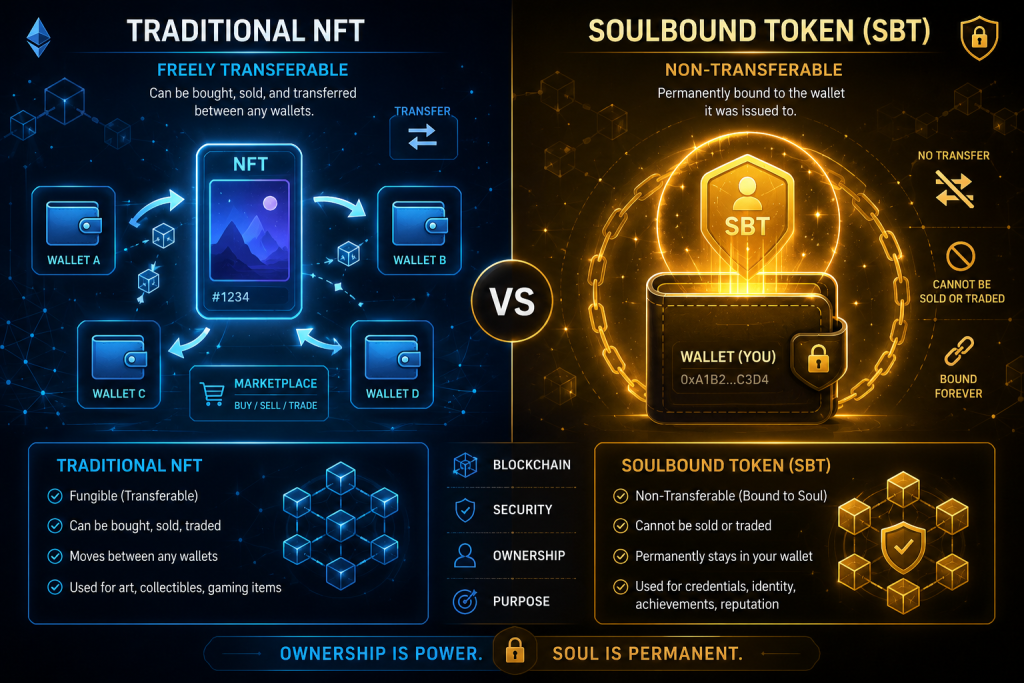
Introduced by Vitalik Buterin and Glen Weyl in their groundbreaking 2022 research paper, soulbound tokens (SBTs) represent a seismic shift in blockchain philosophy. Unlike traditional NFTs, which are designed to be freely traded and transferred across wallets, soulbound tokens are immutable, permanent fixtures of a specific wallet address. They cannot be sold, traded, or stolen in traditional ways. This fundamental difference opens up entirely new possibilities for creating verifiable digital identities, securing wallets against theft, and building trustworthy ecosystems where reputation and credentials matter.
As cybersecurity threats loom larger in the digital age and identity fraud becomes increasingly sophisticated, soulbound tokens offer a compelling solution. They enable users to build verifiable, tamper-proof digital identities while simultaneously providing enhanced security mechanisms that protect valuable NFT collections and crypto assets. This article explores how soulbound tokens are revolutionizing wallet security and digital identity, examining their technical foundations, real-world applications, challenges, and the transformative potential they hold for the future of Web3.
Understanding Soulbound Tokens: The Basics
What Are Soulbound Tokens?
Soulbound tokens are digital credentials that are permanently attached to a blockchain wallet conceptualized as a “soul” in the Web3 ecosystem. Unlike traditional NFTs, which follow the ERC-721 or ERC-1155 standards and emphasize transferability and market value, soulbound tokens are non-transferable and non-tradeable by design. Once issued to a wallet, they remain there indefinitely, creating an immutable record of a user’s achievements, credentials, or identity markers.
The term “soulbound” draws inspiration from massively multiplayer online (MMO) games like World of Warcraft, where certain items become permanently bound to a character once obtained and cannot be transferred to other players. In the blockchain context, this metaphor creates a powerful framework for understanding reputation and identity in digital spaces.
Technical Architecture
Soulbound tokens typically operate on Ethereum or other smart contract-enabled blockchains using modified token standards. While traditional ERC-721 tokens include transfer functions that allow tokens to move freely between addresses, soulbound tokens restrict or eliminate these transfer capabilities entirely. Instead, they function more like verified badges or certificates stored permanently within a wallet’s transaction history.
The technical implementation involves smart contracts that:
- Mint tokens directly to a specific wallet address
- Include ownership restrictions that prevent transfers
- Store metadata about the credential or achievement
- Create an immutable audit trail of issuance and verification
This architectural approach ensures that soulbound tokens cannot be stolen, sold, or fraudulently transferred, a critical security feature that distinguishes them from traditional NFTs.
The Security Revolution: How SBTs Protect Digital Assets
Wallet Hijacking Prevention
One of the most pressing challenges in the crypto space is wallet hijacking. When attackers gain access to a user’s private keys through phishing, malware, or social engineering, they can transfer entire collections of valuable NFTs and cryptocurrencies in seconds. The damage is often irreversible, and victims have limited recourse.
Soulbound tokens introduce a novel solution to this problem. By incorporating SBT-based identity verification, wallets can implement additional security layers that distinguish between legitimate owners and unauthorized actors. For instance, a wallet might require proof of ownership of specific soulbound identity tokens before executing high-value transactions. This creates a multi-factor authentication mechanism rooted in verifiable identity rather than mere password strength.
Consider a practical scenario: A collector owns valuable NFTs worth millions. Their wallet is protected not just by a private key but by a soulbound token that represents their verified identity through a decentralized identity provider. When someone attempts to transfer these NFTs, even if they have compromised the private key, the network can verify that the transaction is being initiated by the authenticated holder of the soulbound identity token. If the soulbound token is not present or does not match, the transaction fails, preventing theft.
Recovery Mechanisms and Social Guardianship
Soulbound tokens enable innovative account recovery mechanisms that go beyond traditional centralized solutions. Vitalik Buterin’s research proposes a “social recovery wallet” concept where users designate “guardians”, trusted individuals or institutions represented by soulbound tokens. If a user loses access to their wallet, they can recover it by presenting proof of identity verified through their designated guardians’ soulbound tokens.
This decentralized recovery approach eliminates the need for centralized customer support teams while maintaining robust security. Unlike password recovery systems that rely on knowledge-based questions or email verification, social recovery leverages cryptographic verification of trusted relationships embedded in soulbound tokens. The system becomes harder to compromise because it requires multiple independent actors to collude, dramatically reducing the attack surface.
Preventing Wash Trading and Fraud
In NFT markets, wash trading the practice of repeatedly buying and selling the same asset to artificially inflate its value and trading volume remains a persistent problem. Soulbound tokens can help combat this fraud by creating verifiable provenance records that cannot be obscured or manipulated.
By issuing soulbound tokens that represent transaction history, market participation verification, or asset ownership authenticity, platforms can create transparent ledgers that track legitimate versus fraudulent trading patterns. This immutable record becomes invaluable for compliance, auditing, and market integrity enforcement.
Digital Identity: Building Trust in Web3
Decentralized Identity Credentials
The foundation of any functional digital ecosystem is trust, and trust begins with verified identity. Soulbound tokens enable a revolutionary approach to decentralized identity (DID) by providing cryptographically verifiable, non-repudiable credentials that prove achievements, qualifications, or affiliations without requiring centralized intermediaries.
Imagine a developer who earns soulbound tokens from completing security audits for smart contracts. These tokens serve as verifiable evidence of their expertise, stored permanently in their wallet. Employers can instantly verify these credentials on-chain without contacting third-party institutions. The developer maintains control over their identity data while employers gain immediate, trustworthy access to relevant qualifications.
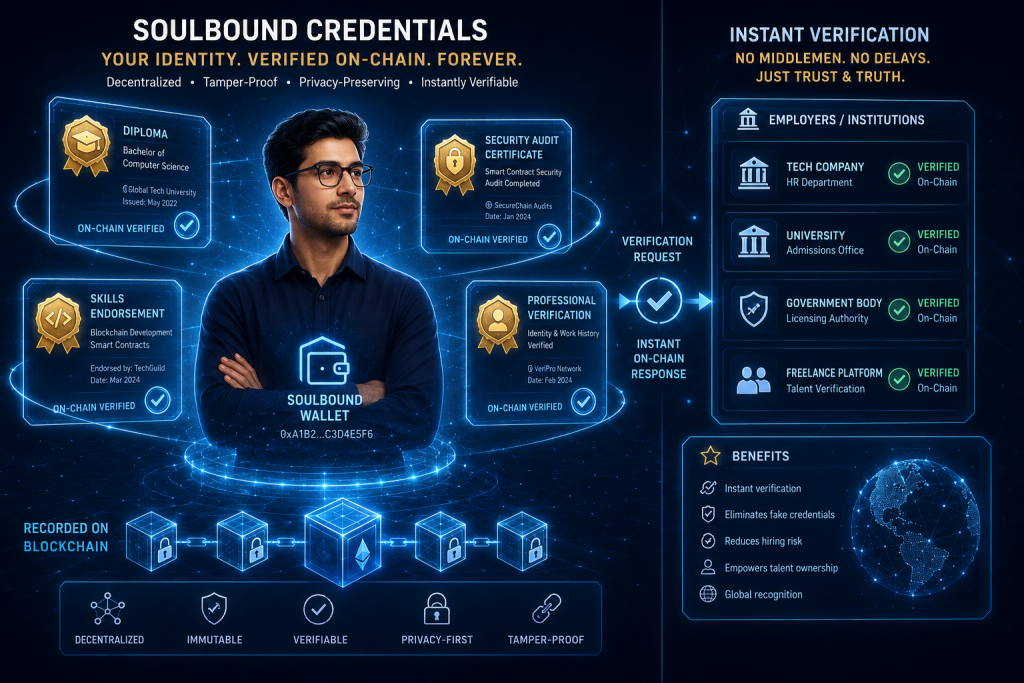
This model extends to countless professional and educational contexts: medical licenses, academic degrees, certifications, employment history, and professional endorsements can all be represented as soulbound tokens. Each token represents a verified claim about the holder’s identity or qualifications, creating a comprehensive digital resume that is immune to forgery or credential inflation.
Privacy-Preserving Identity Verification
While soulbound tokens are transparent and verifiable, they can also be designed to preserve privacy through zero-knowledge proofs and selective disclosure mechanisms. A user might prove they hold certain soulbound credentials without revealing their wallet address or the complete details of those credentials.
For example, a financial institution might require proof that a user has undergone KYC (Know Your Customer) verification without needing to see the user’s personal identification documents or wallet address. The user can prove they possess a soulbound KYC verification token without revealing which specific verification provider issued it or any other metadata. This strikes an elegant balance between verification and privacy, a critical requirement for Web3 adoption in regulated industries.
Reputation and Trust Networks
Soulbound tokens create tangible, on-chain reputation systems. Instead of relying on centralized platforms like LinkedIn or Yelp that can be manipulated or deplatformed, users can build verifiable reputation through accumulated soulbound tokens from trusted issuers.
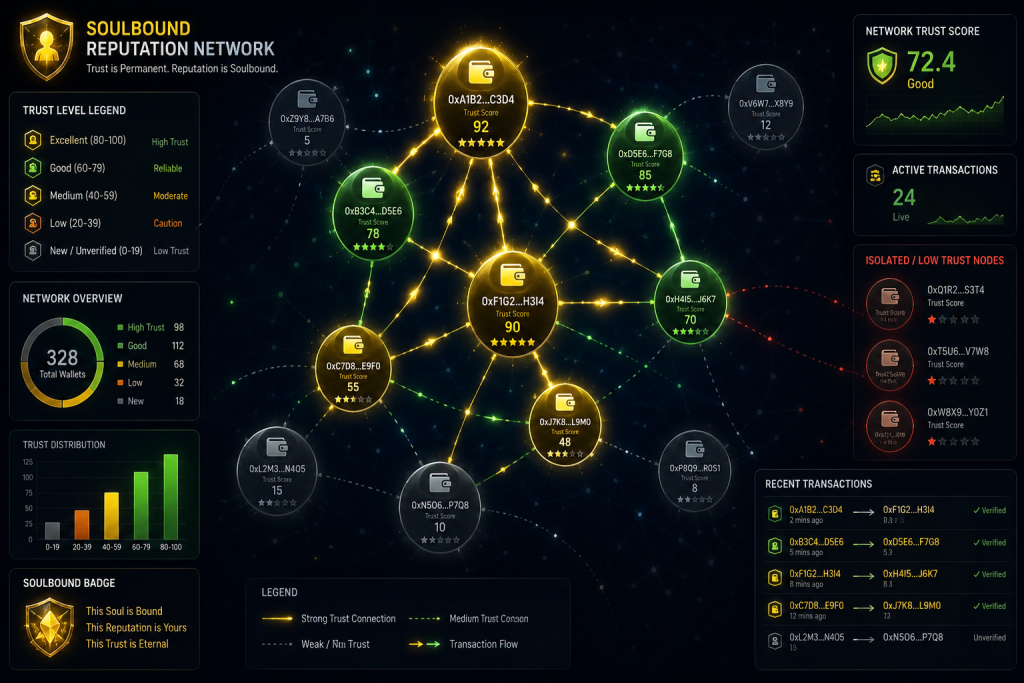
A marketplace facilitator might issue soulbound tokens to buyers and sellers with positive transaction histories. These tokens become visible on-chain, allowing new users to assess counterparties’ trustworthiness. The non-transferable nature of these tokens prevents bad actors from purchasing fraudulent reputation, fundamentally different from current systems where reputation can be artificially manipulated through coordinated review campaigns.
Real-World Applications and Current Implementations
Educational Credentials and Skill Certification
Several universities and educational platforms are experimenting with soulbound tokens to issue digital diplomas and skill certifications. Graduates receive soulbound tokens representing their degrees, which they can display in their wallet profiles. Employers can verify educational credentials instantly without contacting registrars or relying on potentially fraudulent diploma mills.
This implementation provides benefits beyond simple verification: graduates maintain ownership of their credentials indefinitely, and if a university’s legitimacy is later questioned, the immutable record on the blockchain preserves the historical evidence of when and under what conditions the credential was issued.
Healthcare and Medical Records
The healthcare industry presents compelling use cases for soulbound tokens. Vaccination records, medical certifications, and health insurance verification can be issued as soulbound tokens, creating portable, verifiable health credentials that travel with patients across geographical boundaries and healthcare systems.
During public health emergencies, such credentials enable rapid, trustworthy verification of vaccination status without requiring centralized databases that are vulnerable to hacking or manipulation. Patients maintain control over their health records while healthcare providers can instantly verify relevant credentials.
Decentralized Finance (DeFi) and Credit Scoring
DeFi protocols struggle with the lack of verifiable identity and credit history information. Soulbound tokens can serve as on-chain credit scores, created through analysis of a user’s transaction history, collateralization practices, and lending behavior. Protocols can issue soulbound tokens representing different risk tiers, automatically adjusted based on real-time on-chain behavior.
This approach enables DeFi platforms to offer variable interest rates, loan amounts, and risk parameters based on verified on-chain history rather than centralized credit bureaus. It democratizes access to financial services while maintaining robust risk management.
Government and Legal Documentation
Forward-thinking governments are exploring soulbound tokens for issuing digital identity documents, driver’s licenses, and property titles. These applications provide citizens with cryptographic proof of legal status and ownership that cannot be forged or falsified. In countries with weak institutional frameworks, soulbound tokens could provide unprecedented security and permanence for critical legal documents.
Challenges and Limitations
Irreversibility and Mistakes
The permanent, non-transferable nature of soulbound tokens creates a double-edged sword. While this irreversibility provides security, it also means mistakes are difficult to correct. If a soulbound token is issued incorrectly or revoked due to credential fraud, users cannot simply transfer the problematic token away; remediation becomes complex and requires sophisticated revocation mechanisms.
Revocation and Updates
Soulbound tokens need mechanisms for revocation when credentials become invalid or when fraud is discovered. However, standard blockchain immutability makes revocation non-trivial. Solutions like revocation registries or issuer-controlled revocation functions add complexity and centralization, potentially undermining the decentralization benefits that make soulbound tokens attractive.
Privacy Concerns and Surveillance
While soulbound tokens can be designed with privacy protections, their permanent storage on public blockchains creates surveillance opportunities. A comprehensive collection of soulbound tokens in a wallet reveals substantial information about an individual’s identity, credentials, relationships, and history. This transparency, while beneficial for trust and verification, poses serious privacy risks if not carefully managed.
Limited Mainstream Adoption
Currently, soulbound token adoption remains limited to early-stage blockchain projects and experimental implementations. Broader adoption requires standardization, user education, and ecosystem infrastructure development. Regulatory clarity also remains elusive in many jurisdictions, slowing mainstream institutional adoption.
Technical Complexity
For typical users, managing soulbound tokens and understanding their security implications requires substantially more technical sophistication than traditional account management. User experience improvements and simplified interfaces are necessary before soulbound tokens can achieve meaningful mainstream adoption.
The Future of Soulbound Tokens and Digital Identity
Integration with Self-Sovereign Identity
The convergence of soulbound tokens with self-sovereign identity (SSI) frameworks represents the future trajectory. SSI principles emphasize individual ownership and control over identity data, while soulbound tokens provide the technical infrastructure for permanent, verifiable credentials. Together, they create a comprehensive identity system where individuals control all aspects of their digital identity while institutions can instantly verify relevant credentials.
Cross-Chain Identity Portability
As blockchain technology becomes increasingly multi-chain and fragmented, soulbound token standards must enable portable identity across different blockchain networks. Emerging solutions using atomic swaps, sidechains, and inter-blockchain communication protocols are working toward this goal, enabling users to maintain coherent identity regardless of which blockchain they primarily operate on.
Regulatory Evolution
As regulatory frameworks mature, soulbound tokens will likely receive formal recognition in compliance and legal contexts. Jurisdictions that issue government-backed soulbound tokens will establish new standards that other institutions follow, accelerating broader adoption and standardization.
Integration with Traditional Systems
The real transformational potential emerges when soulbound tokens bridge blockchain and traditional systems. A user might receive a soulbound token from their bank representing credit history, use that token to access DeFi services, and present it to employers as financial stability verification. This interoperability creates a unified identity layer spanning blockchain and traditional digital infrastructure.
Conclusion
Soulbound tokens represent a fundamental paradigm shift in how digital identity and security function in decentralized systems. By introducing non-transferable, permanent credentials bound to specific wallet addresses, they enable entirely new security models that protect against wallet hijacking and theft while simultaneously facilitating verifiable, decentralized identity systems that eliminate the need for centralized intermediaries.
The implications extend far beyond technical security improvements. Soulbound tokens could fundamentally reshape professional credentials, educational systems, healthcare records, and financial services. They promise to democratize access to verified identity while restoring individual agency over personal data two objectives that have long seemed contradictory in digital systems.
However, significant challenges remain. Issues around irreversibility, revocation, privacy, and user experience must be addressed before soulbound tokens achieve mainstream adoption. The technology also requires clear regulatory frameworks and substantial ecosystem development.
Despite these challenges, the trajectory is clear. As Web3 matures and the blockchain community recognizes the limitations of purely transferable token models, soulbound tokens will become increasingly central to building trustworthy, secure digital ecosystems. The future of digital identity in blockchain may well be defined not by what can be transferred, but by what remains permanently bound to the individuals and institutions it represents.
The revolution in NFT wallet security and digital identity is not just coming it’s already beginning. Soulbound tokens are the foundation upon which Web3’s more mature, trustworthy future will be built.
Frequently Asked Questions (FAQ)
How are soulbound tokens different from regular NFTs?
The fundamental difference lies in transferability. Regular NFTs are designed to be freely bought, sold, and transferred between wallets; they function like digital assets in a marketplace. Soulbound tokens, by contrast, are permanently bound to a specific wallet and cannot be transferred under any circumstances. This non-transferable nature makes them ideal for representing identity, credentials, and reputation rather than ownership of scarce collectibles. While regular NFTs emphasize market value and liquidity, soulbound tokens emphasize permanence, verification, and trust.
Can soulbound tokens be stolen through wallet hacks?
No, and this is one of their key security advantages. Since soulbound tokens cannot be transferred, a hacker who compromises your private key cannot steal or transfer your soulbound tokens. However, a compromised account could still be used to perform transactions or interact with dApps if the hacker has access to the private key. The solution is implementing security mechanisms like social recovery wallets or requiring soulbound token verification before executing sensitive transactions, essentially using soulbound identity verification as an additional security layer that a hacker would need to bypass to cause damage.
What happens if I want to sell or transfer a soulbound token I no longer want?
You cannot. This is by design. Soulbound tokens are permanent fixtures of a wallet and cannot be transferred, sold, or disposed of through traditional blockchain transactions. However, some sophisticated solutions are being developed, such as creating new revocation mechanisms or allowing token holders to formally renounce credentials in ways that are recorded on-chain. If a credential is invalid or fraudulently issued, the issuing institution can revoke it through their systems, though this differs from a standard transfer and typically involves registering the revocation on-chain separately.
Are soulbound tokens private, or can everyone see them?
By default, soulbound tokens are visible on public blockchains just like any other blockchain transaction, meaning anyone can see your wallet address and the tokens associated with it. However, privacy is not lost entirely. Developers are implementing privacy-preserving mechanisms such as zero-knowledge proofs, which allow you to prove you hold certain credentials without revealing your wallet address or the full details of those credentials. Additionally, users could employ privacy wallets or interact with privacy-preserving protocols. The balance between transparency (for verification) and privacy remains an active area of development in the soulbound token ecosystem.
What prevents someone from creating fake or fraudulent soulbound tokens?
Soulbound tokens derive their value from the reputation and trustworthiness of the issuer. While technically anyone can create soulbound tokens on a blockchain, fraudulent tokens issued by unknown or untrustworthy entities have no credibility. The security comes from cryptographic verification of who issued the token. If a credential is issued by a recognized university, government, or institution, its authenticity is verifiable on-chain by checking the issuer’s digital signature. Users and platforms will only accept soulbound tokens from recognized, trusted issuers. Additionally, blockchain explorers and verification services help users identify legitimate issuers and distinguish them from fraudsters. The immutable record of who issued each token provides transparency that makes fraud difficult to maintain at scale.