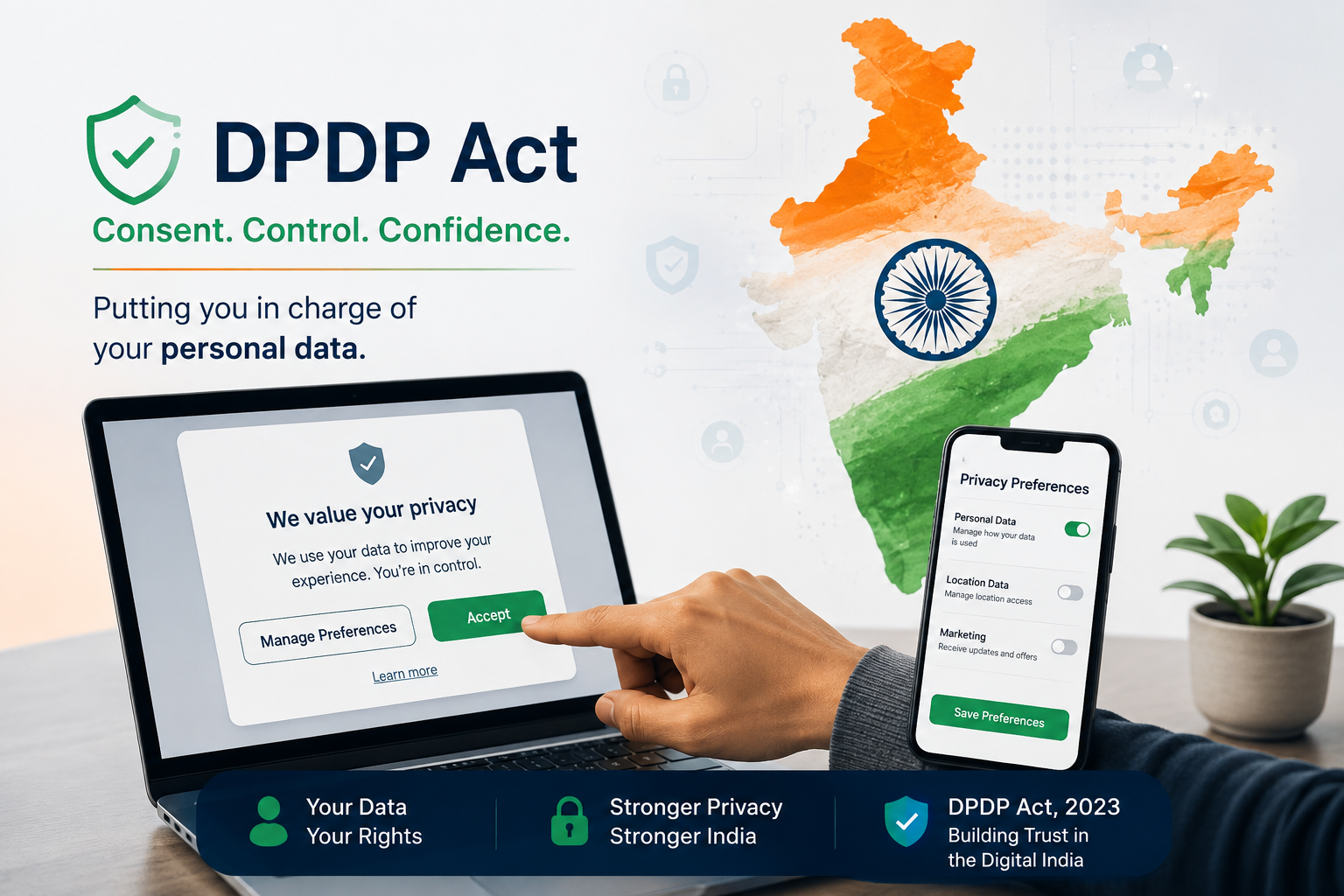

Most web platforms collecting user data today are operating on borrowed time. India’s Digital Personal Data Protection Act (DPDP Act, 2023) has fundamentally changed the rules, and content-heavy platforms, news portals, e-commerce ecosystems, SaaS products, and data-driven applications face disproportionately higher exposure than simpler websites. The more data touchpoints your platform has, the greater the compliance surface area. And right now, that surface area is largely unprotected for most organizations.
The challenge is not simply checking a legal box. It is building a consent infrastructure that can handle thousands of data interactions daily, maintain a verifiable audit trail, respond to user requests in real time, and scale without breaking. That is precisely the gap SecureCMS is designed to close.
This blog explores exactly how SecureCMS functions as a DPDP Consent Management Platform for India, what specific risks it mitigates, and why content-heavy platforms cannot afford to manage consent manually in 2024 and beyond.
Why Content-Heavy Platforms Face Amplified DPDP Compliance Risk
A straightforward brochure website may collect a name and an email address. A content-heavy platform, however, collects behavioral data, tracks scroll depth, runs A/B tests, serves personalized content, integrates third-party analytics, displays cookie banners, manages newsletter subscriptions, and runs retargeting campaigns simultaneously.
Each of these activities represents a personal data processing event. Under the DPDP Act, each one requires a valid legal basis, and consent is the most commonly relied upon basis for digital platforms. That means every data touchpoint needs a corresponding consent record, a timestamp, the specific purpose disclosed, the version of the privacy notice shown, and evidence that the user genuinely opted in.
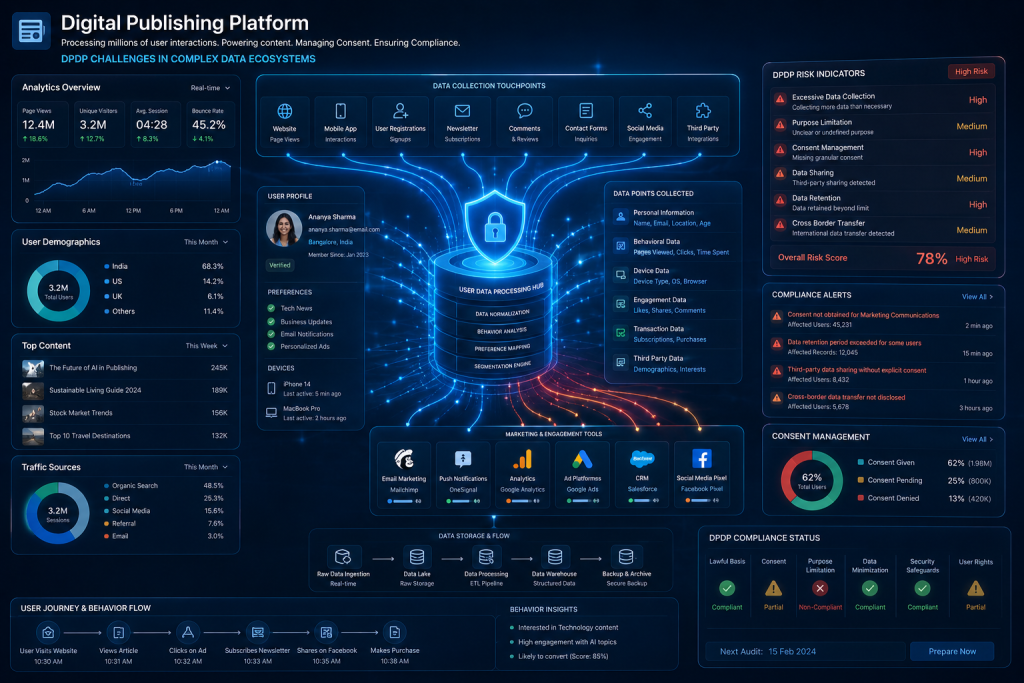
Multiply that across thousands or millions of users and dozens of data flows, and the compliance picture becomes staggering. Without a dedicated DPDP compliance automation system, organizations are left manually stitching together spreadsheets, generic cookie banners, and custom-built forms that lack the structural integrity to survive regulatory scrutiny.
Moreover, the DPDP Act introduces strict obligations around consent withdrawal. Users must be able to revoke consent as easily as they gave it. For platforms running complex data architectures, this is operationally challenging without the right consent management infrastructure underneath.
What the DPDP Act Actually Requires from Data Fiduciaries
Before evaluating any DPDP management system in India, it is worth being precise about what the regulation demands. The DPDP Act places obligations on Data Fiduciaries, the entities that determine the purpose and means of processing personal data.
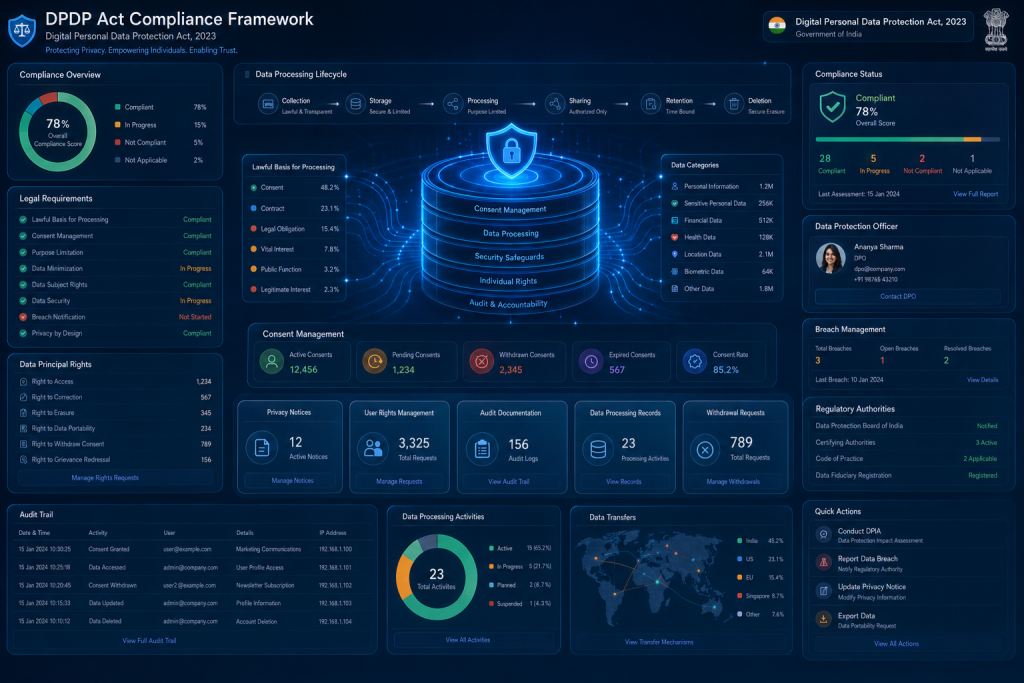
These obligations include:
Free, specific, informed, and unambiguous consent. The DPDP Act does not permit consent bundled into terms and conditions. It requires a clear, standalone consent request tied to a specific purpose. Pre-ticked checkboxes and inferred consent are not valid under this framework.
Granular purpose disclosure. Each processing activity must be disclosed separately. A user consenting to marketing emails is not automatically consenting to behavioral profiling. Consent must be collected and recorded at the purpose level.
Consent withdrawal infrastructure. Users have the right to withdraw consent at any time. Platforms must honor that withdrawal promptly and ensure downstream systems are updated accordingly. This is not a one-time technical task. It is an ongoing operational requirement.
Data Principal rights management. Beyond consent, the Act grants users the right to access, correction, erasure, and grievance redressal. Platforms must have workflows to handle these requests within defined timelines.
Audit readiness. The Data Protection Board of India can initiate inquiries. Organizations must maintain records proving that consent was obtained properly. Without an audit-ready consent management platform, demonstrating compliance becomes nearly impossible.
These requirements, taken together, demand a system purpose-built for consent lifecycle management in India, not a generic cookie banner solution retrofitted for DPDP.
The Problem with Manual Consent Management
Many organizations are still managing consent through a combination of website pop-ups, static privacy policies, and internally maintained spreadsheets. This approach creates several critical failure points.
First, there is the problem of consent proof. If a regulator asks you to demonstrate that a specific user consented to a specific processing activity on a specific date under a specific version of your privacy notice, can you produce that evidence within hours? For most organizations using manual systems, the honest answer is no.
Second, there is the consent drift problem. Privacy notices change. Purposes evolve. New data flows are added. Without a versioned consent system, organizations cannot track whether existing consent records map to the current version of their privacy notice, or to an outdated one that no longer reflects actual processing.

Third, manual systems cannot scale. A platform with 100,000 registered users and a contact form, a newsletter, a personalization engine, and a retargeting pixel is managing potentially millions of individual consent states. No spreadsheet survives that volume.
Fourth, consent withdrawal breaks down entirely in manual systems. When a user requests withdrawal, the information needs to propagate across analytics platforms, CRM systems, email marketing tools, and advertising platforms. Without an integrated consent solution, that propagation simply does not happen reliably.
These are not edge-case problems. They are systematic gaps that the DPDP Act now makes legally significant.
How SecureCMS Functions as an Enterprise Consent Management System
SecureCMS is built specifically to address the consent management requirements of the DPDP Act within the Indian regulatory context. It operates as a centralized consent management platform that integrates with your existing web infrastructure and provides a structured, auditable, and user-friendly layer of consent governance.
Here is how SecureCMS addresses each layer of DPDP compliance risk.
Granular Consent Collection at Every Touchpoint
SecureCMS enables platforms to collect consent at the purpose level, not just at the site level. This means when a user visits your platform, they can see exactly what data is being collected, for which specific purpose, and by which entity. They can consent to analytics while declining marketing. They can accept functional cookies while opting out of third-party trackers.
This granular consent management approach directly satisfies the DPDP Act’s requirement for specific, purpose-linked consent. It also respects DPDP awareness among users by giving them genuine visibility into how their data is used, rather than burying purposes inside a generic privacy notice.
Each consent interaction is captured with a timestamp, the user’s identifier, the version of the consent notice presented, and the specific purposes accepted or declined. This is the consent evidence layer that makes regulatory defense possible.
Consent Lifecycle Management Across the User Journey
Consent is not a single event. It is a lifecycle. Users sign up, change their preferences, upgrade their accounts, withdraw consent for one purpose, and later re-consent for another. SecureCMS tracks the full consent lifecycle for every user across the entire duration of their relationship with your platform.
This consent lifecycle management in India context matters because the DPDP Act requires organizations to honor consent states dynamically. A user who withdrew marketing consent six months ago should not be receiving promotional emails today. SecureCMS maintains the current consent state for each user and makes that state available to integrated systems in real time.
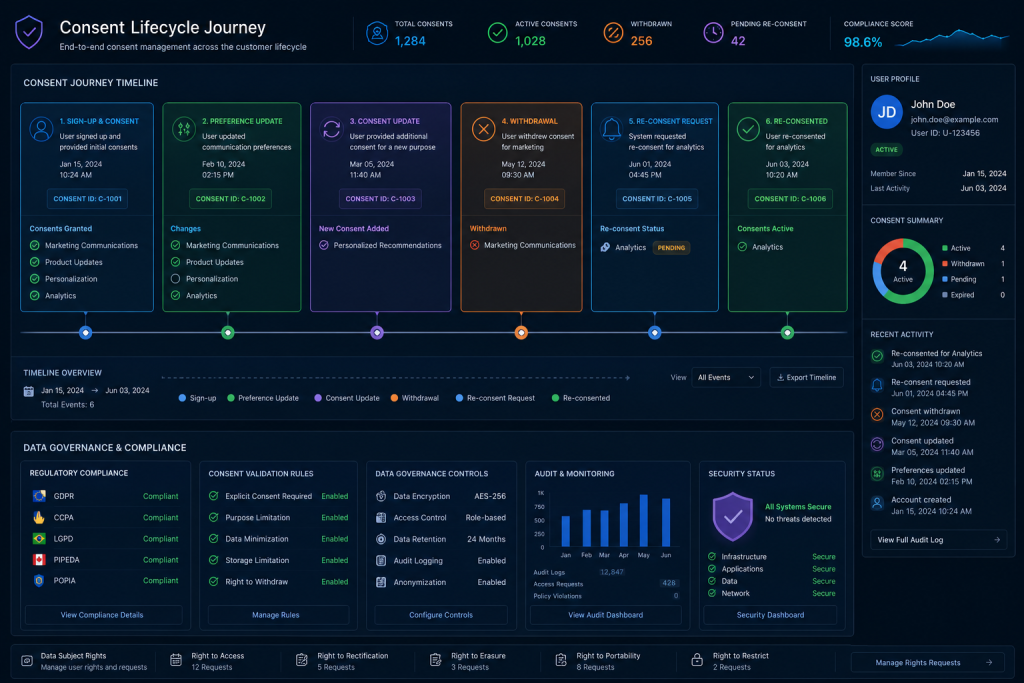
Furthermore, when privacy notices are updated, SecureCMS can trigger re-consent flows for users whose existing consent was collected under a previous version of the notice. This versioning capability is critical for platforms that regularly update their data practices.
Audit-Ready Consent Logs and Consent Dashboard
One of the strongest operational features of SecureCMS is its audit-ready consent management infrastructure. Every consent event, whether it is an initial opt-in, a preference update, or a withdrawal request, is logged with full metadata and stored in a tamper-evident format.
Compliance teams can access a unified consent dashboard that provides a real-time view of consent coverage across the user base. They can filter by consent type, date range, user segment, or processing purpose. They can generate consent reports for regulatory submissions or internal audits. They can identify gaps where users have not yet provided consent for newly added processing activities.
This level of visibility transforms compliance from a reactive scramble into a proactive, manageable function. Organizations no longer need to piece together consent evidence from multiple systems when they face regulatory inquiries.
DPDP Consent Form Compliance and Customization
SecureCMS provides flexible DPDP consent form compliance capabilities that allow organizations to design consent experiences aligned with their brand while remaining fully compliant with the Act’s disclosure requirements. This includes support for multilingual consent notices, which is particularly relevant for platforms serving users across India’s linguistic diversity.
The consent forms capture all mandatory elements: the identity of the Data Fiduciary, the specific purposes of processing, the user’s right to withdraw consent, and the mechanism through which withdrawal can be exercised. These forms are not static HTML pages. They are dynamically generated based on the user’s context, device, and prior consent history, ensuring that each interaction is both relevant and legally defensible.
Real-Time Consent Withdrawal and Preference Management
The right to withdraw consent is one of the most operationally demanding requirements in the DPDP Act. SecureCMS handles this through a self-service privacy preference center that allows users to manage their consent at any time, from any device.
When a user withdraws consent, the change is recorded immediately in the consent system and propagated to integrated downstream platforms through SecureCMS’s API layer. This real-time consent orchestration platform capability ensures that withdrawal is not merely acknowledged but actually executed across the data ecosystem.
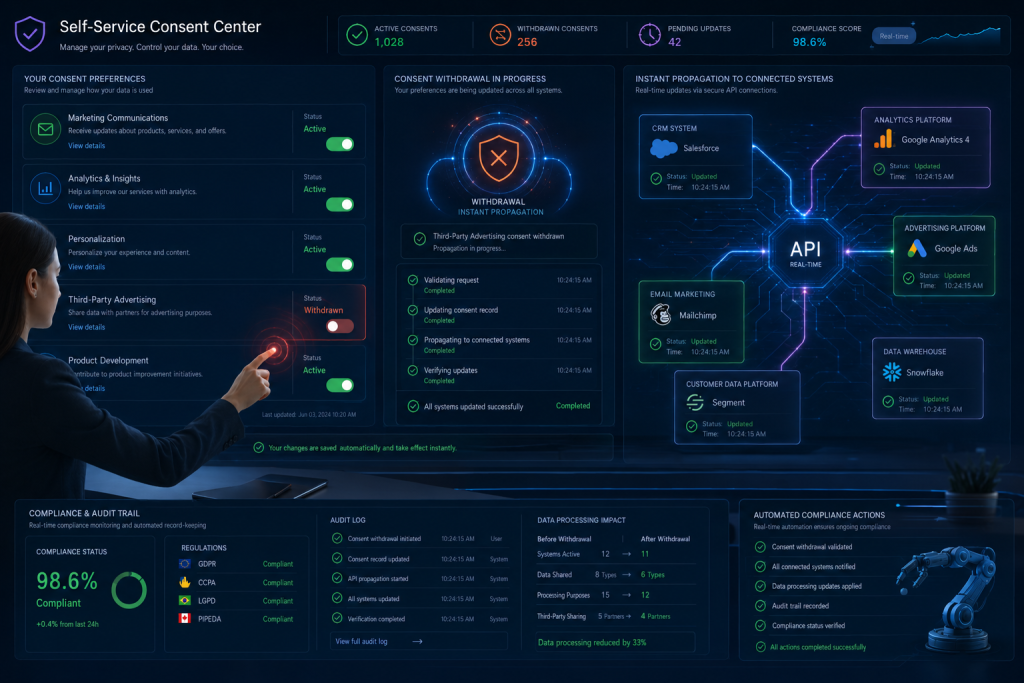
For platforms integrated with email service providers, CRM systems, analytics tools, and advertising platforms, this automated propagation eliminates the operational gap where withdrawal is captured on the website but never actually enforced in connected systems.
The Compliance Risk Reduction SecureCMS Delivers
Understanding how SecureCMS works mechanically is useful. Understanding what compliance risk it actually eliminates is more valuable for decision-makers evaluating their DPDP exposure.
Eliminating Consent Validity Risk
The highest single risk most platforms face is that their existing consent records are legally invalid. Consent collected through pre-ticked boxes, bundled into terms of service, or obtained without clear purpose disclosure does not meet DPDP standards. SecureCMS eliminates this risk by ensuring that all new consent is collected through a compliant mechanism from day one.
For existing consent records that may not meet the new standard, SecureCMS supports re-consent campaigns that allow organizations to migrate their user base to compliant consent records in a structured, trackable way.
Eliminating Audit Exposure Risk
Without a dedicated consent management platform for DPDP, organizations cannot respond to regulatory inquiries with confidence. They lack the records. They lack the timestamps. They lack the ability to reconstruct the consent journey for any specific user.
SecureCMS eliminates this risk by maintaining a complete, immutable consent log for every user interaction. Compliance teams can respond to Data Protection Board inquiries with precise evidence rather than approximations and assumptions.
Eliminating Consent Lifecycle Management Gaps
Many platforms today have consent data scattered across multiple systems, with no single source of truth. A user may have consented in the CRM but not in the analytics platform. They may have withdrawn consent in the email system but remain active in the advertising platform.
SecureCMS creates a unified consent management system that serves as the definitive record of each user’s consent state. Integrated systems query this record rather than maintaining independent, inconsistent consent databases.
Reducing Operational Overhead for Compliance Teams
DPDP compliance in a manual environment is extraordinarily labor-intensive. Compliance teams spend significant time responding to individual user requests, auditing consent records, coordinating with IT teams to enforce withdrawal requests, and preparing documentation for internal reviews.
SecureCMS automates the consent workflow layer, dramatically reducing the operational overhead associated with DPDP compliance. Consent collection, recording, withdrawal processing, and audit reporting happen within the platform without requiring manual intervention for each transaction.
SecureCMS as a Consent Management Platform for Startups and Growing Platforms
The DPDP Act applies to all Data Fiduciaries regardless of company size. This means startups and early-stage platforms face the same consent management obligations as large enterprises, often with far fewer compliance resources.
For startups, the DPDP consent management checklist can appear overwhelming. Consent forms, audit logs, withdrawal workflows, purpose disclosures, multilingual notices, and API integrations represent a significant technical and operational investment if built from scratch.
SecureCMS reduces this burden by providing a ready-built consent infrastructure that can be integrated quickly and scaled as the platform grows. Startups get enterprise-grade consent management capabilities without the enterprise-grade build timeline and cost. Moreover, building on a compliant foundation from the outset is significantly less expensive than retrofitting compliance onto an existing data architecture after the fact.
As regulatory enforcement tightens and data principal awareness increases among Indian users, platforms that have invested in proper consent management infrastructure will have a meaningful competitive advantage in user trust and regulatory standing.
Integrating SecureCMS into Your Web Platform Architecture
SecureCMS is designed as an API-based consent management platform, meaning it integrates with existing web architectures without requiring a complete rebuild. Whether your platform runs on a headless CMS, a traditional WordPress infrastructure, a custom-built application, or a microservices architecture, SecureCMS can be embedded at the consent collection layer.
The integration approach typically involves deploying the SecureCMS consent banner and preference center on the front end, connecting the SecureCMS API to your backend user management system, and configuring integrations with downstream platforms such as analytics tools, email marketing systems, and CRM platforms.
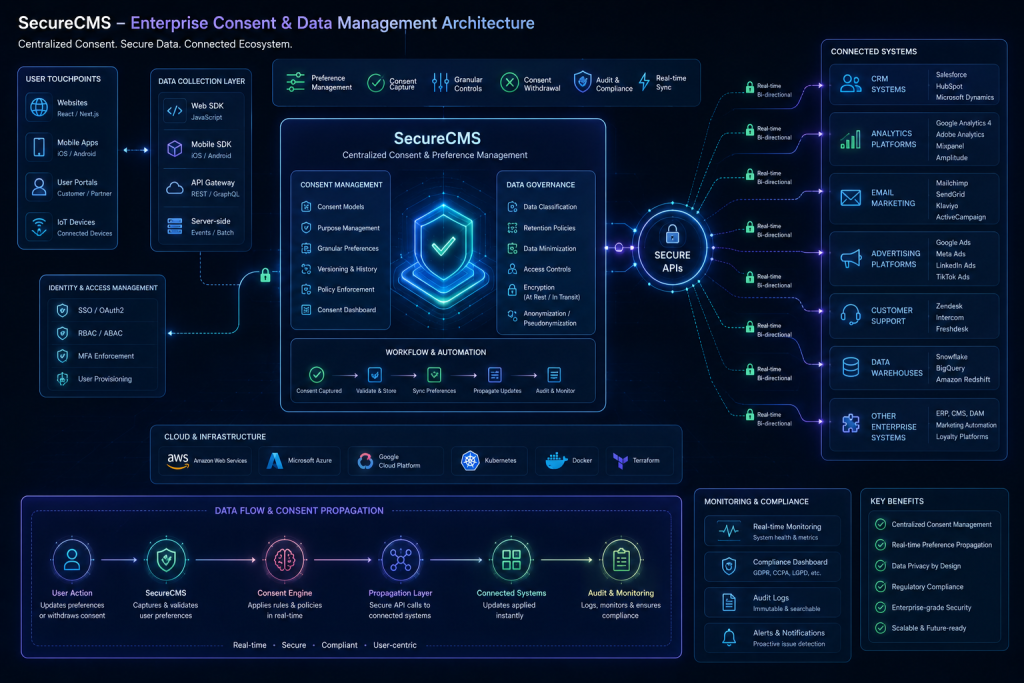
Once integrated, every consent interaction flows through SecureCMS, is recorded in the centralized consent log, and is available for real-time querying by connected systems. The result is a single consent management backbone that governs data flows across the entire platform ecosystem.
For platforms operating across multiple jurisdictions, SecureCMS also supports multi-jurisdiction consent management, allowing organizations to apply different consent rules and disclosures based on the user’s location, with DPDP logic applied for Indian users and other regulatory frameworks applied where relevant.
Conclusion
The DPDP Act has made consent management a first-order operational and legal priority for every data-driven web platform in India. Content-heavy platforms, with their multiple data touchpoints, third-party integrations, and large user bases, face the most complex compliance surface area and therefore the highest exposure.
Managing that exposure manually is not a viable strategy. The volume of consent interactions, the need for granular purpose-level records, the operational demands of real-time withdrawal, and the evidence requirements for regulatory defense all demand a purpose-built solution.
SecureCMS addresses each of these requirements as a unified consent management system, providing granular consent collection, complete lifecycle management, audit-ready logging, real-time withdrawal propagation, and an intuitive compliance dashboard. It transforms DPDP compliance from a legal burden into a manageable operational process.
For platforms serious about building lasting user trust and maintaining a defensible compliance posture under the DPDP Act, SecureCMS represents the logical foundation. The question is not whether your platform needs a DPDP consent management platform. The question is whether you build that foundation now or after your first regulatory inquiry.
FAQ
1. What makes SecureCMS different from a standard cookie consent banner?
A standard cookie consent banner captures a single yes-or-no consent event at the session level and typically stores that record only in the user’s browser. SecureCMS operates as a full consent management platform, capturing granular, purpose-specific consent for every user, storing it server-side with complete metadata, maintaining a versioned audit log, supporting real-time withdrawal, and providing an admin dashboard for compliance oversight. The difference is between a checkbox and a complete compliance infrastructure.
2. How does SecureCMS handle consent withdrawal under the DPDP Act?
When a user withdraws consent through the SecureCMS preference center, the withdrawal is logged immediately with a timestamp and the specific purposes affected. SecureCMS then propagates that withdrawal to connected downstream systems through its API layer, ensuring that the withdrawal is enforced across the data ecosystem, not merely recorded. This real-time propagation is essential for meeting the DPDP Act’s requirement that withdrawal be honored promptly and without friction.
3. Can SecureCMS support multilingual consent notices for Indian users?
Yes. SecureCMS supports multilingual consent notice delivery, which is particularly important for platforms serving users across India’s diverse linguistic landscape. Consent notices can be configured in multiple Indian languages, ensuring that users receive disclosures in a language they genuinely understand. This directly supports the DPDP Act’s requirement for informed consent and strengthens the legal validity of consent records collected from users who may not be fluent in English.
4. How does SecureCMS help organizations prepare for a Data Protection Board audit?
SecureCMS maintains a comprehensive, tamper-evident consent log for every user interaction on the platform. When a regulatory inquiry or audit is initiated, compliance teams can access the SecureCMS dashboard to retrieve consent records filtered by user, date range, purpose, or consent version. They can generate structured audit reports demonstrating that consent was collected compliantly, that withdrawals were processed appropriately, and that the platform’s consent practices align with the DPDP Act’s requirements. This audit-ready infrastructure eliminates the scramble that organizations without dedicated consent management systems typically experience during regulatory inquiries.
5. Is SecureCMS suitable for startups that are early in their compliance journey?
SecureCMS is well-suited for startups precisely because it provides enterprise-grade consent management capabilities through a scalable, API-based platform. Rather than building consent infrastructure from scratch, a startup can integrate SecureCMS quickly and establish a compliant consent foundation from the outset. This approach is significantly more cost-effective than retrofitting compliance later and gives startups a credible compliance posture from their earliest user interactions. The platform scales as the user base grows, ensuring that consent management infrastructure does not become a bottleneck at any stage of growth.