


Cryptography is the silent backbone of enterprise security. It secures your data in transit, protects identities, validates digital signatures, and enforces access controls. For decades, that backbone has held firm. Now, it is starting to crack, not because of a breach or a zero-day, but because of a fundamental shift in computing power that most enterprises are only beginning to understand.
Quantum computing is no longer a distant theoretical concern. In 2024, IBM unveiled its 1,000-plus qubit processor. Google’s quantum research teams continue to push boundaries around error correction. Cryptographically relevant quantum computers, systems powerful enough to break RSA-2048 and ECC-256, are expected within the next 5 to 10 years. That timeline may sound comfortable, but for enterprises with sensitive data, long-lived contracts, regulatory obligations, and critical infrastructure dependencies, the preparation window is already closing.
Enterprise HSM key management sits at the center of this challenge. If your key management architecture is not quantum-ready today, everything it protects is already at risk from harvest-now-decrypt-later attacks. Sophisticated adversaries are collecting encrypted data today, fully intending to decrypt it once quantum capability arrives. The question is not whether to act, but how quickly you can build a quantum-safe foundation.
This guide walks you through exactly how to do that.
Why Enterprise HSM Key Management Must Evolve Now

Hardware Security Modules have long been the gold standard for protecting cryptographic keys. They offer tamper-resistant hardware, strict access controls, and certified key lifecycle management. However, the algorithms those HSMs currently rely on, RSA, ECC, and Diffie-Hellman, are mathematically vulnerable to Shor’s algorithm running on a sufficiently powerful quantum computer.
This is not a minor upgrade problem. It is a foundational renegotiation of trust.
Consider what enterprise HSM key management protects today: TLS certificates, code signing keys, database encryption keys, PKI root and intermediate certificates, API authentication tokens, and document signing workflows. Every one of these is at risk if the underlying cryptographic primitives can be broken. Moving to quantum-safe security means replacing or augmenting those primitives across every layer of your cryptographic infrastructure.
Furthermore, compliance timelines are tightening. The National Institute of Standards and Technology (NIST) finalized its first set of post-quantum cryptography standards in 2024, including CRYSTALS-Kyber for key encapsulation and CRYSTALS-Dilithium for digital signatures. Regulatory bodies in the financial, defense, and healthcare sectors are expected to begin mandating PQC adoption within enterprise systems over the coming years. Building your quantum-ready architecture now puts you ahead of those mandates rather than scrambling to catch up.
The Core Challenge: Cryptographic Fragility at Scale
Most enterprises do not have a clear picture of where cryptography lives in their environment. It is embedded in network protocols, application code, hardware firmware, cloud APIs, SaaS integrations, partner connections, and legacy systems built decades ago. This invisible sprawl is what makes PQC migration so complex.
Security teams commonly discover three critical gaps when they begin quantum readiness assessments.
First, there is no centralized cryptographic inventory. Keys are generated, stored, and rotated across dozens of systems without any unified visibility. Expired certificates go unnoticed. Weak algorithms persist in legacy applications. Rotation policies exist on paper but not in practice.
Second, algorithm agility is almost entirely absent. Systems are hardcoded to specific cryptographic suites. Swapping RSA-2048 for a NIST-approved PQC algorithm requires application code changes, infrastructure reconfiguration, and retesting, multiplied across every affected system.
Third, there is no governance layer for cryptographic decisions. Who approves a new algorithm for production use? How are key rotation schedules enforced? Where are PQC migration activities tracked and audited? Without answers to these questions, even well-intentioned quantum-readiness efforts become fragmented and incomplete.
These three gaps sit at the heart of the enterprise quantum security problem. Solving them requires an architecture built around cryptographic agility, centralized key governance, and standards-aligned PQC implementation.
Understanding the Key Pillars of a Quantum-Ready Architecture
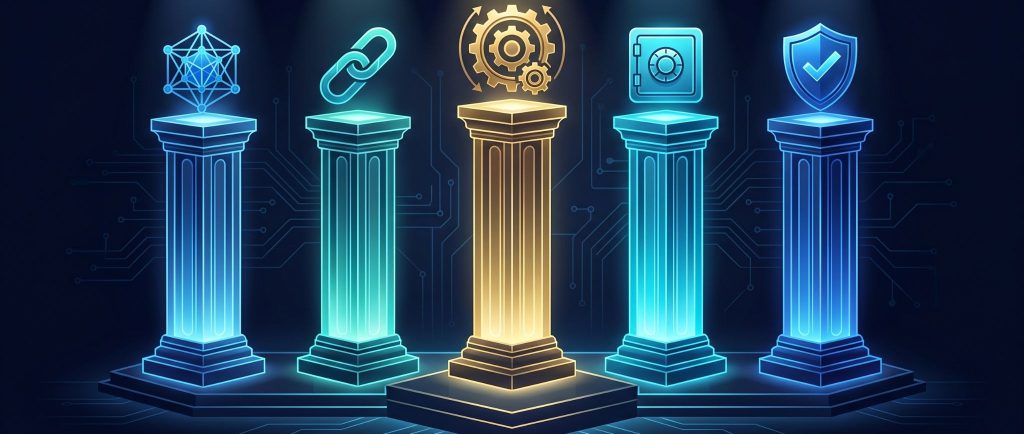
Before moving to implementation steps, it is worth establishing what a quantum-ready enterprise key management architecture actually consists of. There are five foundational pillars.
1. PQC Algorithm Integration
A quantum-ready architecture incorporates NIST-approved post-quantum algorithms alongside or in replacement of classical cryptographic primitives. This means adopting CRYSTALS-Kyber for asymmetric key encapsulation, CRYSTALS-Dilithium or FALCON for digital signatures, and SPHINCS+ for hash-based signing where appropriate.
These algorithms are mathematically designed to resist attacks from both classical and quantum computers. However, integrating them is not simply a matter of swapping libraries. Key sizes, signature lengths, and performance characteristics differ significantly from RSA and ECC, requiring careful evaluation across performance-sensitive use cases.
2. Hybrid Encryption Architecture

A purely quantum-resistant deployment is not always practical or risk-free during the transition period. Standards bodies and security researchers broadly recommend hybrid encryption models, where both a classical algorithm and a PQC algorithm are used simultaneously for key encapsulation. Only if both are broken simultaneously does security fail.
Hybrid crypto protects against two risks at once. It maintains backward compatibility with systems that cannot yet support pure PQC, and it ensures that unknown weaknesses in newly standardized PQC algorithms do not leave you exposed. Most enterprises will operate in this hybrid mode for several years before completing a full PQC migration.
3. Cryptographic Agility
Cryptographic agility is the architectural capability to swap cryptographic algorithms with minimal disruption to systems and applications. This requires abstracting algorithm selection away from application code, centralizing it in a policy engine or key management layer that can be updated independently.
Without cryptographic agility, every algorithm change becomes a complex engineering project. With it, updates propagate from a central governance layer outward to all dependent systems automatically, dramatically reducing migration time and risk.
4. Centralized Key Lifecycle Management
A quantum-ready key management architecture centralizes the complete lifecycle of every cryptographic key in the environment. Generation, storage, distribution, rotation, suspension, and revocation are all managed from a unified platform with full audit trails. This visibility is the prerequisite for any migration effort.
5. PQC Governance and Compliance
Governance defines the policies, controls, and accountability structures for cryptographic decisions. In a quantum-ready architecture, governance includes algorithm approval workflows, rotation policy enforcement, PQC audit logs for compliance reporting, and executive visibility into migration progress.
Step-by-Step: Building Your Quantum-Ready Key Management Architecture
With the pillars understood, here is how to build the architecture in practice.
Step 1: Conduct a Cryptographic Inventory and Risk Assessment
The first step is visibility. You cannot migrate what you cannot see. Conduct a comprehensive cryptographic discovery across your environment to identify every system, application, and integration that uses cryptographic keys or certificates.
For each asset, document the algorithm in use, the key length, the certificate validity period, the use case, and the system owner. Classify each asset by quantum vulnerability risk. RSA and ECC keys used for long-lived data or identity assertions carry the highest risk. Short-lived session keys carry lower immediate risk but still require a migration path.
This inventory forms the foundation of your PQC migration roadmap. It tells you where to prioritize, where your compliance gaps are, and what dependencies exist between systems.
Step 2: Establish a Central PQC Key Management Platform
Once you have visibility, you need a centralized platform to manage keys across the enterprise. This platform must support HSM integration for hardware-backed key storage, PQC algorithm support for NIST-standardized post-quantum primitives, hybrid key generation combining classical and post-quantum algorithms, policy-driven key lifecycle management, and comprehensive PQC audit logs for compliance and forensic purposes.
This is where a purpose-built solution like QuantumVault becomes essential. QuantumVault provides a unified PQC key management platform designed specifically for enterprise environments navigating the quantum transition. It integrates with existing HSM infrastructure while extending it with post-quantum cryptographic capabilities, giving security teams centralized control over both classical and quantum-safe key material.
Importantly, QuantumVault supports cryptographic agility through a PQC policy engine that allows security teams to define, update, and enforce algorithm policies without touching application code. When NIST releases updated standards or when an enterprise’s compliance requirements evolve, algorithm transitions happen at the policy layer rather than the code layer.
Step 3: Deploy Hybrid Encryption Across Critical Communication Channels
For enterprise communication channels, including inter-service APIs, partner gateways, and remote access tunnels, begin deploying hybrid encryption immediately. Configure your PQC gateway to negotiate hybrid key exchanges, combining classical ECDH with CRYSTALS-Kyber so that connections are protected against both current adversaries and future quantum-capable attackers.
A PQC tunnel deployed at the network perimeter extends quantum-safe protection to all traffic traversing that boundary, without requiring individual applications to be refactored. This network-layer approach is often the fastest path to meaningful quantum-safe coverage for existing infrastructure.
Quantum-safe remote access, protecting VPN connections and zero-trust access pathways, should be an early priority. Remote workforce connections are high-value targets, and hybrid encryption at the access layer delivers immediate risk reduction with relatively low deployment complexity.
Step 4: Migrate Signing Workflows to PQC Algorithms
Code signing, document signing, firmware signing, and approval workflows represent some of the highest-risk use cases in the enterprise. A compromised signing key undermines trust in software supply chains, document authenticity, and regulatory submissions. These workflows need PQC migration prioritized.
Implement CRYSTALS-Dilithium or FALCON for new digital signing operations while maintaining compatibility with existing signature verification processes during the transition period. A PQC signing workflow solution manages key generation in HSM-backed secure enclaves, enforces signature algorithm policy, and logs every signing event with full attribution for audit trail completeness.
Enterprises in regulated industries, including financial services, healthcare, and critical infrastructure, will find that PQC audit logs for signing operations become a compliance differentiator as regulators begin examining quantum readiness posture.
Step 5: Implement a PQC Policy Engine for Cryptographic Governance

Governance without tooling is just documentation. Build or deploy a PQC policy engine that translates your cryptographic governance policies into enforceable controls across the enterprise.
The policy engine should define which algorithms are approved for which use cases, enforce minimum key lengths, trigger automated rotation workflows when keys approach expiry, flag policy violations for security team review, and generate compliance reports mapping cryptographic posture to regulatory requirements.
This PQC governance layer is what transforms a fragmented collection of cryptographic assets into a managed, auditable, and demonstrably compliant cryptographic environment. It also provides the visibility that executive stakeholders and auditors require as quantum-readiness assessments become part of standard enterprise security reviews.
Step 6: Extend PQC Protection to Devices and Endpoints

Enterprise cryptographic exposure does not stop at the server layer. Endpoint devices, IoT sensors, mobile applications, and embedded systems all participate in cryptographic operations. Many of these devices have long operational lifespans that extend well into the quantum era.
PQC device security requires lightweight PQC implementation suitable for resource-constrained hardware, secure provisioning of quantum-safe keys to devices at scale, and lifecycle management for device certificates using post-quantum PKI.
Extending your central PQC key management platform to cover device cryptography closes a critical gap that is often overlooked in quantum readiness planning. An enterprise can have perfect server-side quantum-safe security and still be fully exposed if device communications remain protected only by classical algorithms.
Step 7: Enable Quantum-Safe Collaboration Security
Enterprise collaboration platforms, including email, document sharing, video conferencing, and project management tools, transmit sensitive information continuously. As these platforms integrate deeper into business operations, ensuring that the cryptography protecting collaboration data is quantum-safe becomes a meaningful security requirement.
Quantum-safe collaboration security applies PQC encryption to data at rest and in transit within collaboration workflows, and ensures that authentication mechanisms use quantum-resistant credentials. Combined with quantum-safe access controls enforcing zero-trust principles, this layer protects the human communication layer of the enterprise just as rigorously as the infrastructure layer.
Common Migration Mistakes to Avoid
Enterprises beginning their PQC migration frequently encounter several avoidable pitfalls.
Attempting a big-bang migration, replacing all cryptography simultaneously, almost always fails. The complexity is too high, the dependencies too intricate, and the risk of disruption too significant. A phased, risk-prioritized migration is consistently more successful.
Neglecting legacy systems is another common error. Old applications and infrastructure components often cannot support PQC algorithms without significant refactoring. These systems need dedicated migration tracks with realistic timelines, not assumptions that they will somehow be covered by enterprise-wide tooling.
Treating PQC migration as purely a technical project is also a mistake. It requires executive sponsorship, cross-functional coordination between security, engineering, compliance, and operations teams, and budget commitment that reflects the scale of what is being replaced. Without organizational alignment, technical progress stalls.
Finally, skipping the governance layer and jumping straight to algorithm deployment leaves enterprises with quantum-safe cryptography but no visibility or control over it. The PQC policy engine and audit log capability are not optional features. They are the management infrastructure without which the technical deployment cannot be maintained, demonstrated to auditors, or confidently scaled.
Measuring Quantum Readiness Progress
Quantum readiness is not a binary state. It is a continuous improvement trajectory. Measure progress against clear metrics at regular intervals.
Track the percentage of cryptographic assets that have completed PQC migration. Monitor the time-to-rotate across all key types to verify that automated rotation policies are functioning as intended. Report on PQC audit log completeness to confirm that no cryptographic events are going unrecorded. Measure algorithm compliance rate against your approved PQC suite to identify any drift or policy violations.
These metrics give security leadership, compliance teams, and executive stakeholders a clear, factual view of where the enterprise stands. They also create accountability for migration progress, ensuring that the effort maintains momentum over what will typically be a multi-year journey.
The Role of PQC Compliance in Regulatory Readiness
Regulatory expectations around quantum-safe security are solidifying. NIST’s formal publication of PQC standards in 2024 establishes the technical baseline. The US National Security Memorandum on quantum computing has already directed federal agencies toward PQC migration. Financial regulators, data protection authorities, and sector-specific bodies are expected to follow with their own mandates targeting critical infrastructure operators and regulated enterprises.
Enterprises that build quantum-ready architectures now are not just reducing security risk. They are positioning themselves ahead of compliance requirements that will carry enforcement weight within the next regulatory cycle. For organizations in financial services, healthcare, defense contracting, and critical infrastructure, early PQC compliance is increasingly a competitive and reputational differentiator, not just a technical checkbox.
PQC compliance documentation, including algorithm inventories, migration plans, audit logs, and policy evidence, will be the artifacts that regulators examine. Building those artifacts into your architecture from the start, rather than trying to reconstruct them after the fact, dramatically reduces compliance cost and risk.
How QuantumVault Accelerates Enterprise Quantum Readiness
QuantumVault is built specifically to address the complexity enterprises face when transitioning to quantum-safe security. As an enterprise PQC platform, it combines HSM-integrated key management with native support for NIST-approved post-quantum algorithms, a configurable PQC policy engine, hybrid encryption capabilities, and comprehensive PQC audit logs.
Its architecture is designed for cryptographic agility. Security teams can update algorithm policies centrally and propagate changes across dependent systems without application-layer code changes. This means that as post-quantum cryptography standards evolve, and they will continue to evolve as the field matures, QuantumVault-managed environments can adapt quickly.
QuantumVault also addresses the full breadth of enterprise quantum security requirements, including PQC key management for server and cloud infrastructure, PQC gateway and tunnel capabilities for network security, PQC signing workflows for code and document integrity, PQC device security for endpoint and IoT environments, quantum-safe access controls for remote workforce security, and PQC governance with audit-ready reporting for compliance teams.
For enterprises beginning their quantum readiness journey, QuantumVault provides both the immediate capability to start protecting high-priority assets today and the architectural foundation to execute a complete, governed PQC migration over time.
Frequently Asked Questions
1. What is enterprise HSM key management and why does it matter for quantum readiness? Enterprise HSM key management refers to the centralized control of cryptographic keys using hardware security modules, tamper-resistant devices that store and process key material securely. It matters for quantum readiness because current HSMs rely on classically secure algorithms like RSA and ECC, which are vulnerable to quantum computers. Upgrading HSM key management to support PQC algorithms is the foundational step in building a quantum-safe cryptographic infrastructure.
2. How soon do enterprises need to act on PQC migration? Security experts recommend beginning PQC migration immediately, primarily because of harvest-now-decrypt-later attacks. Adversaries are collecting encrypted data today with the intention of decrypting it once quantum computers reach sufficient capability. Data encrypted now with classical algorithms that must remain confidential for 5 or more years is already at risk.
3. What are NIST-approved PQC algorithms and which should enterprises prioritize? NIST finalized its first set of PQC standards in 2024. CRYSTALS-Kyber is the standard for key encapsulation and public key encryption. CRYSTALS-Dilithium and FALCON are the primary standards for digital signatures. SPHINCS+ is a hash-based alternative for signing. Enterprises should prioritize Kyber for securing communication channels and Dilithium for code and document signing workflows.
4. What is hybrid encryption and why is it recommended during PQC transition? Hybrid encryption combines a classical algorithm, such as ECDH, with a post-quantum algorithm, such as CRYSTALS-Kyber, so that communications remain secure even if one of the two algorithms is later found to be vulnerable. Standards bodies including NIST and ETSI recommend the hybrid approach during the transition period, as it provides both quantum resistance and backward compatibility with systems not yet capable of pure PQC.
5. What is cryptographic agility and how does it reduce PQC migration risk? Cryptographic agility is the ability to change cryptographic algorithms quickly and with minimal disruption to dependent systems. It reduces PQC migration risk by centralizing algorithm selection in a policy layer that can be updated independently of application code. Without cryptographic agility, each algorithm change requires engineering effort across every affected system, dramatically increasing migration complexity and timeline.
6. What are PQC audit logs and why are they important for compliance? PQC audit logs record every cryptographic event, including key generation, key use, algorithm selections, rotation events, and policy changes, in a tamper-evident, timestamped format. They are essential for compliance because regulators examining quantum-readiness posture will require evidence that PQC controls are functioning as intended and that cryptographic operations are fully traceable.
7. How does a PQC policy engine work in practice? A PQC policy engine translates cryptographic governance policies into automated, enforceable controls. It defines which algorithms are approved for which use cases, sets minimum key lengths, enforces rotation schedules, and generates alerts when violations occur. Security teams manage policies centrally, and the engine enforces them consistently across all cryptographic operations in the environment.
8. What is the difference between a PQC gateway and a PQC tunnel? A PQC gateway is a network boundary component that enforces quantum-safe cryptographic policies for traffic entering or leaving the enterprise, including enforcing PQC algorithm negotiation for TLS connections. A PQC tunnel provides an encrypted communication channel between two endpoints using post-quantum key exchange, protecting traffic in transit even if intercepted. Both are typically deployed together to secure enterprise network boundaries and remote access.
9. How does PQC device security differ from server-side PQC? Server-side PQC operates on high-performance hardware with ample resources for computationally intensive post-quantum algorithms. PQC device security must work within the constraints of embedded systems, IoT sensors, and mobile devices, which have limited processing power and memory. Lightweight PQC implementations are required, and device certificate lifecycle management must scale to potentially millions of endpoints.
10. What is quantum-safe remote access and how does it protect remote workers? Quantum-safe remote access applies post-quantum key exchange to VPN connections and zero-trust network access pathways, ensuring that traffic from remote workers is protected against both classical and quantum-capable interception. It is typically implemented at the access gateway layer using hybrid PQC and classical key encapsulation, allowing immediate quantum risk reduction without requiring endpoint application changes.
11. How long does a complete enterprise PQC migration typically take? For most large enterprises, a complete PQC migration takes 3 to 7 years. This reflects the complexity of cryptographic inventory across hundreds or thousands of systems, the need to coordinate migrations across multiple teams, the dependency on third-party vendors updating their platforms to support PQC, and the phased timeline of regulatory mandates. Starting today significantly reduces risk throughout that timeline.
12. What is the harvest-now-decrypt-later threat and how serious is it? Harvest-now-decrypt-later is a threat model in which adversaries collect encrypted data today, storing it until quantum computers become capable of breaking the encryption used to protect it. The seriousness of this threat depends on the sensitivity and longevity of the data being protected. For national security information, financial records, healthcare data, and intellectual property, the threat is already actively exploited by sophisticated state-sponsored actors.
13. How does QuantumVault integrate with existing HSM infrastructure? QuantumVault is designed to integrate with existing enterprise HSM deployments rather than replacing them. It extends HSM infrastructure with PQC algorithm support, centralized key governance, hybrid encryption capabilities, and PQC audit logging, allowing enterprises to leverage their existing hardware investment while building quantum-safe capability on top of it.
14. What is a PQC compliance posture assessment? A PQC compliance posture assessment evaluates an enterprise’s current cryptographic environment against emerging quantum-readiness standards and regulatory expectations. It typically covers cryptographic inventory completeness, algorithm vulnerability mapping, key lifecycle management maturity, governance and policy documentation, and migration roadmap alignment with compliance timelines.
15. What should enterprises prioritize first when starting their PQC journey? Enterprises should prioritize the combination of cryptographic inventory and highest-risk asset migration. Begin by building visibility into where cryptography lives in the environment. Then, prioritize migration for assets that protect long-lived sensitive data, code signing workflows, PKI infrastructure, and external-facing communication channels, as these carry the greatest exposure from harvest-now-decrypt-later attacks and the highest regulatory scrutiny.
Conclusion
The quantum era is approaching faster than most enterprise security roadmaps have accounted for. The cryptographic foundations that protect your data, communications, identities, and operations today were not designed to withstand quantum computing. Rebuilding those foundations requires planning, architecture, and investment that cannot be deferred to the year quantum computers arrive.
Enterprise HSM key management is the natural starting point for this transformation. It sits at the center of your cryptographic infrastructure and provides the leverage point from which a quantum-ready architecture can be built outward. By integrating PQC algorithms, deploying hybrid encryption, implementing cryptographic agility, establishing a PQC governance layer, and extending quantum-safe protection to every layer of the enterprise, security leaders can execute a migration that is both technically sound and demonstrably compliant.
The organizations that act now will not only reduce their exposure to quantum-enabled attacks. They will also build the institutional knowledge, technical infrastructure, and compliance documentation that positions them ahead of regulatory mandates and client expectations as quantum readiness becomes a standard due diligence requirement.
QuantumVault provides the enterprise PQC platform to make that transition tractable, with centralized key governance, native post-quantum cryptography support, cryptographic agility, and audit-ready compliance tooling built into a single, integrated solution. The quantum threat is real, the timelines are shortening, and the architecture decisions made today will define your organization’s security posture for the decade ahead.