
If your organisation is still relying on a cookie consent banner to demonstrate compliance with India’s Digital Personal Data Protection Act, you are operating on a foundation that is already cracking. Cookie banners were designed for a simpler regulatory era. They were built around a narrow concept: asking users whether they agree to be tracked while browsing a website. That was it. No structure, no proof, no accountability.
India’s DPDP Act 2023 and its implementing rules signal a fundamentally different expectation. The law does not ask whether you displayed a notice. It asks whether you obtained free, informed, specific, and unambiguous consent. It asks whether you can prove it. It asks whether the individual can withdraw that consent at any time, easily and without consequence. And it asks whether you have an auditable record of every consent decision, updated in real time.
A cookie banner cannot answer any of those questions. That is precisely why enterprises across India are rethinking their consent infrastructure from the ground up, and turning to purpose-built DPDP Consent Management Platforms to close the gap.
This blog breaks down exactly what the DPDP rules demand, where cookie banners fall short, and what a modern, enterprise-grade consent management system must do to keep your organisation genuinely compliant.
Understanding What the DPDP Act Actually Requires from Consent
Before diagnosing the problem with cookie banners, it is worth being precise about what the Digital Personal Data Protection Act 2023 mandates. The DPDP Act is not simply a notice-and-opt-in law. It establishes a rights-based framework in which the Data Principal holds meaningful control over their personal data.
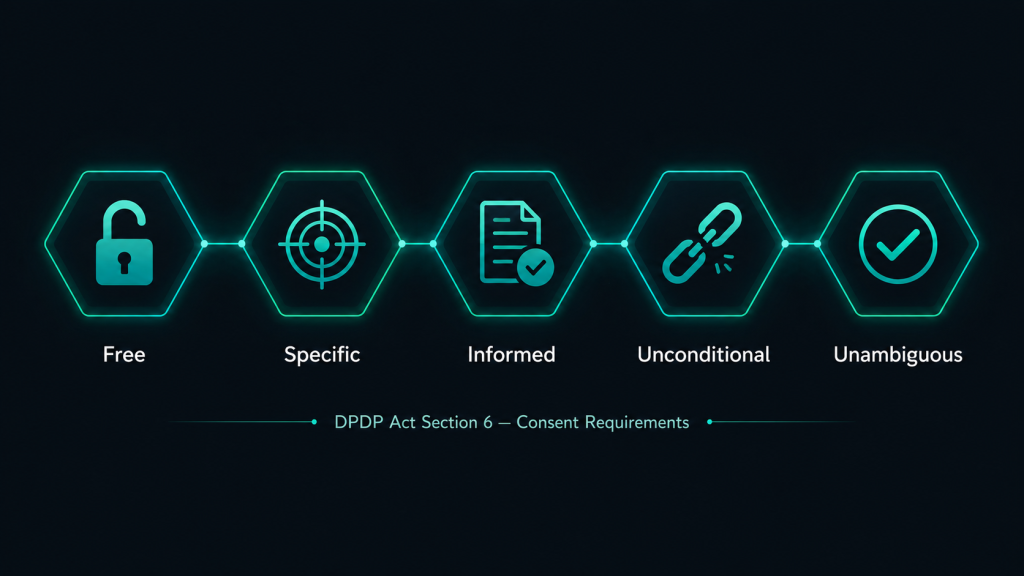
Section 6 of the Act is the critical provision. It requires that consent be:
- Free: Not coerced or bundled with access to a service as a hard condition where no legitimate necessity exists
- Specific: Granted for a defined purpose, not a vague all-encompassing statement
- Informed: Based on a clear, plain-language notice that explains what data is collected, for what purpose, and for how long
- Unconditional: Not tied to irrelevant conditions
- Unambiguous: Expressed through an affirmative action, not silence or pre-ticked boxes
Furthermore, Section 11 gives every Data Principal the right to withdraw consent at any time. The withdrawal must be as easy as giving consent. And Section 12 makes it clear that processing must stop once consent is withdrawn, unless another legal basis applies.
The rules also introduce the concept of the Consent Manager, an entity that helps individuals manage their consent across multiple Data Fiduciaries. This is a significant development. It presupposes an infrastructure that can communicate consent signals across systems, record them reliably, and update them dynamically.
Read these provisions carefully and one thing becomes obvious. This is not a banner problem. It is a data governance problem. And it requires a consent governance solution.
The Cookie Banner Illusion: Why It Was Never Enough
Cookie consent banners became widespread following the European Union’s ePrivacy Directive and the early rollout of GDPR. They were a quick, front-end fix for a back-end problem. And for a while, they worked well enough in a low-enforcement environment.
But here is what a cookie banner actually does. It displays a message. It asks a user to click “Accept” or “Decline.” It sets or withholds a few tracking cookies. And it stores a record, often poorly structured, that a user clicked something on a particular day.
Here is what it does not do.
It does not capture consent at the purpose level. Most banners present consent as a binary all-or-nothing toggle or, at best, a few category-level switches like “analytics” and “marketing.” The DPDP Act requires purpose-specific consent. A user should be able to agree to receiving transactional communications while declining to have their data used for profiling. A generic banner cannot support this level of granularity.
It does not maintain a real-time, auditable consent record. Most banner implementations store a simple boolean flag in a browser cookie or a loosely formatted database entry. This is not an audit trail. It does not capture the specific version of the consent notice shown to the user, the timestamp with timezone, the mechanism by which consent was expressed, or the IP and device context. An audit-ready consent management platform must preserve all of this, structured and searchable.
It does not manage consent withdrawal effectively. When a user withdraws consent through a banner, does that signal propagate to your CRM? Does it stop the marketing automation platform from sending the next campaign? Does it halt the data analytics pipeline from processing that user’s behavioural data? Almost certainly not. The banner sits at the edge of your stack. It has no integration with the systems that actually use data. Withdrawal becomes a checkbox exercise rather than an operational reality.
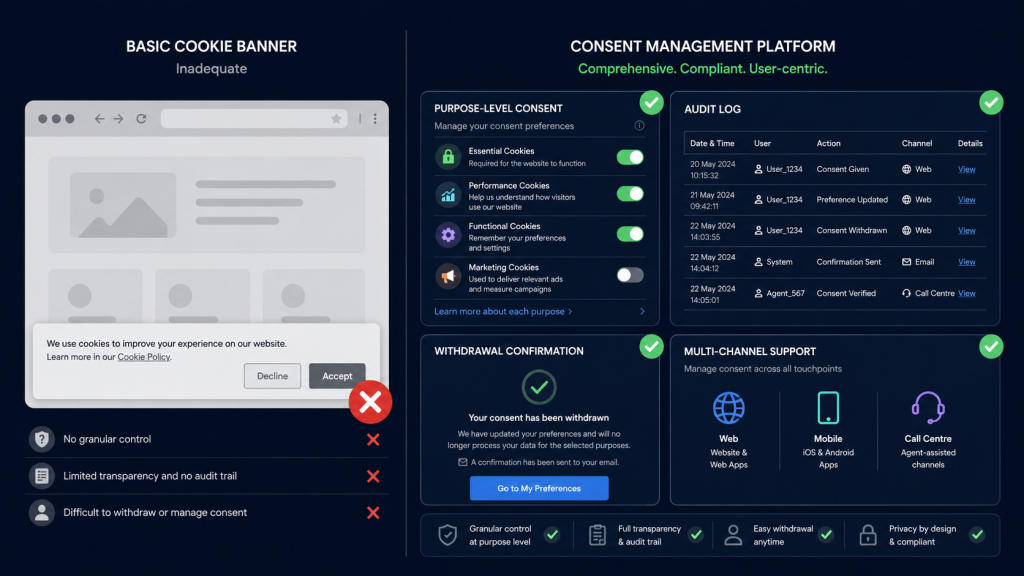
It does not handle consent across channels. Your customers interact with your organisation through websites, mobile apps, call centres, in-store touchpoints, and partner platforms. A cookie banner is a web-only tool. Consent captured or withdrawn through one channel must be reflected across all others. This requires a centralised consent management system with API connectivity, not a front-end script.
It cannot support minor protections. The DPDP Act introduces specific protections for children’s data. Processing personal data of a child requires verifiable consent from a parent or guardian. A cookie banner has no mechanism for age verification or guardian-consent workflows.
These are not minor technical gaps. They are structural failures that will expose organisations to regulatory scrutiny and, as enforcement frameworks mature, significant penalties.
What Has Changed with the DPDP Rules 2025
The Ministry of Electronics and Information Technology released the draft Digital Personal Data Protection Rules in early 2025. These rules operationalise the Act and introduce several specific requirements that further underline why cookie banners are insufficient.
The rules elaborate on the format and content of consent notices. Notices must be available in multiple Indian languages, ensuring comprehension across linguistic communities. They must be presented in a clear, plain manner. This is not a one-size-fits-all template exercise. An enterprise operating across India’s diverse linguistic landscape needs a consent management platform capable of delivering dynamically localised notices.
The rules clarify the obligations of Consent Managers, entities that will be registered with the Data Protection Board and act as intermediaries between Data Principals and Data Fiduciaries. Consent Managers must maintain accurate, real-time records of consent decisions. They must ensure that Data Principals can review and modify their consent preferences through accessible interfaces. They must be interoperable with multiple Data Fiduciaries simultaneously.
This is a significant technical requirement. It means that a consent management system must not be a siloed tool sitting on a single website. It must be a consent hub capable of managing data flows across services, platforms, and third-party processors.
The rules also reinforce purpose limitation. Data collected for one purpose cannot be repurposed without fresh consent. If your organisation collected a customer’s phone number for order delivery notifications and now wants to use it for cross-sell messaging, that requires a new, specific consent event with its own notice, its own record, and its own withdrawal mechanism.
Moreover, the rules address data retention. Consent must specify the period for which data will be processed. A consent platform must therefore capture not just the “yes” or “no” but also the associated retention parameters and trigger automated deletion or re-consent workflows when those periods expire.
Taken together, these rules paint a picture of consent management as a dynamic, multi-dimensional operational process. A static cookie banner is not even close to meeting this standard.
The Enterprise Consent Infrastructure Gap
Indian enterprises, particularly in BFSI, e-commerce, healthtech, and edtech, are sitting on massive consent infrastructure gaps right now. Most have some form of cookie consent tool, often a third-party script bolted onto their website. Many have privacy policy pages. Some have opt-out forms buried in their account settings. Very few have a unified, centralised consent management platform that connects all of these touchpoints to a single, authoritative consent record.
This gap matters for several reasons.
First, consent fragmentation creates compliance blind spots. When consent records are scattered across a website’s cookie database, a mobile app’s local storage, a CRM field, and a marketing platform preference centre, there is no single source of truth. When a regulator or a Data Principal asks for a record of consent, your team cannot produce a clear, comprehensive answer quickly.
Second, fragmented consent creates legal exposure across the data lifecycle. Consent may have been captured correctly at the point of collection, but if downstream processing systems are not receiving and respecting real-time consent signals, the organisation is technically in breach regardless of what happened at the front end.
Third, the cost of retroactive compliance is significantly higher than proactive architecture. Organisations that wait for enforcement actions or data principal complaints to force infrastructure upgrades will face emergency remediation costs, potential penalties, and reputational damage. Building consent infrastructure correctly from the outset is a strategic investment.
The gap between current cookie consent implementations and DPDP-compliant consent management is not a small one. Bridging it requires rethinking consent as an enterprise data governance function, not a UI element.
What a DPDP Consent Management Platform Must Actually Do
A genuine DPDP Consent Management Platform India enterprises need is not a cosmetically improved cookie banner. It is an enterprise-grade system built on several core functional requirements.
Granular, Purpose-Level Consent Capture
The platform must support consent collection at the level of individual processing purposes. Not categories. Not blanket toggles. Each specific use of data, whether for personalisation, marketing, analytics, third-party sharing, or profiling, must have its own consent event, its own notice, and its own record. A granular consent management platform gives users precise control and gives organisations precise proof.
Multilingual, Accessible Consent Notices
Notices must be rendered in the user’s preferred language from among Indian official languages, with clear, plain-language descriptions of purpose, data type, retention period, and withdrawal mechanism. The platform must manage notice versioning, ensuring that when a notice is updated, re-consent workflows are triggered for affected users.
Real-Time Consent Orchestration
When a user grants or withdraws consent, that signal must propagate instantly to every downstream system that uses the relevant data. This requires deep integration capabilities. A real-time consent orchestration platform connects to CRM systems, marketing automation platforms, data warehouses, analytics pipelines, and third-party processors via APIs, ensuring that consent decisions are operationalised, not just recorded.
Immutable, Audit-Ready Consent Logs
Every consent event must be recorded with full context: the exact notice version shown, the timestamp with timezone, the channel through which consent was expressed, the specific purposes consented to or declined, and the mechanism of consent expression. Consent logs must be immutable, meaning they cannot be altered retroactively, and must be searchable and exportable for audit purposes. An audit-ready consent management platform turns regulatory inquiries from stressful scrambles into structured responses.
Easy, Immediate Consent Withdrawal
The DPDP Act mandates that withdrawal must be as easy as giving consent. The platform must provide accessible withdrawal mechanisms across all channels, web, mobile, and call centre, with immediate downstream propagation. Consent withdrawal must trigger automated process halts in connected systems and generate records confirming that processing stopped.
Minor Protection and Guardian Consent Workflows
Where data processing involves children, the platform must support age verification mechanisms and guardian consent collection workflows, with dedicated records maintaining the linkage between the minor’s data and the guardian’s consent decision.
Centralised Consent Dashboard
A unified consent dashboard gives data governance teams a real-time view of consent status across the entire user base. Teams can monitor consent rates, identify gaps, run compliance reports, and respond to Data Principal requests quickly. This transforms consent from a passive compliance checkbox into an active governance instrument.
Multi-Channel Consent Management
Whether consent is collected through a website, a mobile app, a partner integration, or a verbal confirmation in a call centre, the platform must provide a consistent, centralised record. A unified consent management system ensures that no channel operates outside the consent governance framework.
The Consent Manager Role and Platform Interoperability
One of the more forward-looking aspects of the DPDP framework is the Consent Manager construct. This is an entity, likely a regulated intermediary, that helps Data Principals manage their consent preferences across multiple Data Fiduciaries through a single interface.
For this model to function, consent management platforms deployed by individual Data Fiduciaries must be interoperable. They must be capable of receiving consent signals from a Consent Manager and reflecting them in their own systems. They must be capable of reporting consent status back to the Consent Manager in a standardised format.
This is not a future consideration. Enterprises should be building consent platforms that are API-first and integration-ready, capable of participating in the broader consent ecosystem that the DPDP framework envisions.
A developer-friendly consent management platform with well-documented APIs and webhook support positions organisations to adapt as the Consent Manager ecosystem develops, without requiring a complete infrastructure overhaul. An embedded consent management platform that integrates naturally into existing tech stacks rather than sitting as a separate, disconnected layer is the architecture direction that future-proofs DPDP compliance.
How SecureCMS Addresses the DPDP Consent Management Challenge
SecureCMS is built precisely for organisations navigating this transition. It is not a cookie banner. It is a secure, enterprise-grade consent management system designed to meet the structural demands of the DPDP Act and the 2025 rules.
SecureCMS delivers granular consent capture, allowing organisations to collect purpose-specific consent decisions with full audit trails attached to each event. Every interaction is logged with complete contextual metadata, creating the kind of evidence-grade consent records that regulatory scrutiny requires.
The platform supports multilingual consent notice delivery, ensuring that users across India’s linguistic landscape receive notices they can genuinely understand, not legal boilerplate translated mechanically. Notice versioning is managed automatically, with re-consent workflows triggered whenever material changes are made to the purpose or data handling terms.
SecureCMS provides real-time consent orchestration through API integrations with downstream systems. When a user withdraws consent, that signal does not stop at the front end. It flows through to the CRM, the marketing platform, and the analytics pipeline, ensuring that withdrawal is operationally meaningful. The consent dashboard gives compliance and data governance teams a single, authoritative view of consent status across the user base, with reporting tools designed for audit readiness.
For enterprises managing data across multiple products, regions, or partner ecosystems, SecureCMS functions as a centralised consent hub, providing consistency and control regardless of where or how data is collected. Its architecture is API-based and developer-friendly, positioning it as an embedded consent management platform that integrates with existing infrastructure rather than requiring parallel systems.
The platform also supports the minor protection workflows demanded by the DPDP Act, with guardian consent mechanisms that create clear, auditable linkages between children’s data and authorised parental approval.
For organisations that need a DPDP Compliance Consent Management Platform they can trust to scale with regulatory evolution, SecureCMS provides a foundation built on security, transparency, and operational accountability.
Building a DPDP Consent Strategy: A Practical Roadmap
Moving from a cookie banner to a DPDP-compliant consent management infrastructure is not a weekend project. It requires a structured approach. Here is a practical framework for enterprises beginning this journey.
Step 1: Consent Audit. Map every point in your customer journey where personal data is collected or processed. Identify what consent, if any, was captured, in what form, through what mechanism, and where it is stored. This audit will reveal the full extent of your current consent gaps.
Step 2: Purpose Mapping. For every data processing activity, document the specific purpose, the legal basis (consent or legitimate interest or legal obligation), the data types involved, the retention period, and the third parties involved in processing. This becomes your consent architecture blueprint.
Step 3: Notice Redesign. Rewrite your consent notices to be purpose-specific, plain-language, multilingual, and DPDP-compliant. Work with legal counsel to ensure that notices accurately reflect your processing activities and that the consent they solicit is genuinely free, informed, and specific.
Step 4: Platform Selection and Integration. Choose a consent management platform that can manage granular consent, maintain audit-ready logs, support multilingual notices, and integrate with your downstream systems. Integration depth is critical. A platform that cannot reach your CRM, marketing tools, and data infrastructure cannot deliver operational compliance.
Step 5: Withdrawal and Rights Management Infrastructure. Build or configure workflows that make consent withdrawal as easy as giving consent, that propagate withdrawal signals in real time, and that handle Data Principal rights requests including access, correction, and erasure in alignment with the DPDP Act’s provisions.
Step 6: Continuous Monitoring and Re-Consent. Consent is not a one-time event. Build processes for monitoring consent validity, triggering re-consent when retention periods expire or processing purposes change, and maintaining consent health as part of ongoing data governance operations.
The Business Case Beyond Compliance
DPDP compliance is not only about avoiding penalties. There is a genuine business case for investing in a secure, enterprise-grade consent management platform.
Trust is increasingly a competitive differentiator. Customers who understand how their data is used, who have meaningful control over it, and who can withdraw consent easily without negative consequences are more likely to grant broader, sustained consent. Transparency builds the kind of trust that cookie banners, with their manipulative dark patterns and confusing toggle interfaces, systematically erode.
Data quality improves when consent is genuine. Marketing databases populated with coerced or confused consent contain noisy, low-quality data. Campaigns built on genuinely consented, purpose-specific data perform better because they reach audiences who have affirmatively indicated interest.
Regulatory readiness reduces operational risk. As the Data Protection Board of India operationalises and enforcement begins, organisations with robust consent infrastructure will be able to demonstrate compliance quickly and confidently. Those relying on cookie banners will face a much harder conversation.
Finally, consent infrastructure built to DPDP standards is increasingly compatible with global frameworks. India’s DPDP Act has strong conceptual alignment with GDPR and similar frameworks in Singapore, Brazil, and Thailand. A global consent management platform with DPDP capability allows multinational enterprises to manage consent governance consistently across jurisdictions, reducing duplication and compliance overhead.
Conclusion
The era of the cookie consent banner as a compliance strategy is over. India’s Digital Personal Data Protection Act 2023 and the 2025 rules implementing it have drawn a clear line between superficial notice-and-click mechanisms and genuine, operationally grounded consent governance.
The requirements are not ambiguous. Consent must be free, specific, informed, and unambiguous. It must be as easy to withdraw as to give. Every decision must be documented in a form that can withstand regulatory scrutiny. Processing must halt when consent is withdrawn. Children’s data requires guardian authorisation. And as the Consent Manager ecosystem develops, consent infrastructure must be interoperable and API-ready.
Cookie banners were never designed to meet these standards. They were built for a different moment, and that moment has passed.
What Indian enterprises need now is a DPDP Consent Management Platform that treats consent as a data governance function rather than a user interface element. One that provides granular control, real-time orchestration, audit-ready logging, and the multilingual, accessible notice capabilities that the DPDP Act demands.
SecureCMS is built for exactly this requirement. It gives organisations the infrastructure to move from compliance anxiety to compliance confidence, from cookie banners to genuine consent governance, and from regulatory risk to regulatory readiness.
The 2025 rules are not a distant deadline. They are the operating environment your organisation is already navigating. The question is not whether to upgrade your consent infrastructure. The question is whether you are going to do it proactively, or under pressure.
Frequently Asked Questions
1. Is a cookie consent banner legally sufficient under India’s DPDP Act 2023?
No. A cookie banner addresses only web-based tracking consent and cannot provide purpose-specific consent, audit-ready logs, real-time withdrawal propagation, or multi-channel consent management as required by the DPDP Act.
2. What is a DPDP Consent Management Platform?
It is a dedicated software system that enables organisations to collect, record, manage, and withdraw personal data consent in full compliance with the Digital Personal Data Protection Act, including granular purpose-level consent, multilingual notices, and real-time audit trails.
3. What does “granular consent” mean under the DPDP Act?
Granular consent means obtaining separate, specific consent for each distinct purpose for which personal data is processed, rather than a single blanket agreement covering all uses.
4. How does consent withdrawal work under the DPDP Act?
The Act requires that withdrawal be as easy as giving consent. Once withdrawn, the Data Fiduciary must cease processing for that purpose, and a compliant consent management system must propagate this signal to all connected downstream systems in real time.
5. What records must a Data Fiduciary maintain for consent?
Organisations must maintain records of what consent was given, for which purposes, in response to which notice version, through which channel, at what time, and by what mechanism. These records must be accessible for audit purposes.