
Why Enterprise HSM-Based Key Management Has Become a Boardroom Priority
Cryptographic keys are the quiet foundation of every modern digital business. Every encrypted database, payment rail, customer identity, cloud workload, signed API call, and tokenised record ultimately depends on a small set of keys, and on the discipline with which those keys are generated, stored, rotated, and retired.
When that discipline breaks, encryption breaks with it. Industry breach reports consistently show that compromised credentials and cryptographic exposure are involved in a significant share of enterprise incidents, often dwarfing the rate at which attackers attempt to break encryption algorithms directly. The global HSM market, projected to exceed $3.28 billion by 2030, has grown precisely because security leaders have realised that software-only key storage cannot deliver the hardware isolation, tamper resistance, and auditability that modern compliance regimes demand.
At the same time, a second pressure has emerged: the quantum horizon. Adversaries are already executing Harvest Now, Decrypt Later campaigns, collecting encrypted enterprise data today on the assumption that future quantum computers will eventually break RSA and ECC. For banks, healthcare systems, government bodies, and any organisation protecting long-lived data, the right time to move toward PQC, post-quantum cryptography, and quantum-safe security infrastructure is now, not after standards are finalised in production.
This is the backdrop against which HSM-Based Key Management Solutions and Enterprise HSM Key Management platforms are being re-evaluated. Below we profile seven vendors operating across India and globally, covering FIPS-certified HSM infrastructure, centralised key lifecycle governance, tokenisation, data-centric security, and PQC-enabled cryptographic agility
How We Selected the Top 7
For this 2026 roundup, vendors were assessed against ten criteria that matter to security architects evaluating an Enterprise HSM Key Management platform:
- Whether keys are generated and stored inside tamper-resistant hardware (FIPS 140-2 or FIPS 140-3 certified modules).
- Depth of centralised key lifecycle management, creation, rotation, revocation, expiration, archival, and audit.
- Role-based access control, multi-factor authentication, and segregation of duties.
- Multi-cloud and hybrid reach across AWS, Azure, GCP, and on-prem.
- PQC readiness, support for quantum-resistant algorithms such as ML-KEM, ML-DSA, and CRYSTALS-Kyber, plus a credible hybrid crypto path.
- Crypto-agility, the ability to swap algorithms without rewriting applications.
- Compliance alignment with PCI-DSS, ISO 27001, GDPR, NIST SP 800-57, and India’s DPDP Act and RBI cybersecurity directives.
- Bring Your Own Key (BYOK) support and cryptographic sovereignty options.
- Blockchain, Web3, and digital-asset key custody capabilities.
- India readiness, data residency, DPDP alignment, and local deployment options.
No single vendor wins every category. The list below reflects the best fit for different enterprise profiles, ordered by how comprehensively each platform addresses these criteria today, and how well-positioned each is for the post-quantum, quantum-ready decade ahead.
1. Quantum Vault: The PQC-Enabled, India-Ready Enterprise HSM Key Management Platform
Best for: Enterprises needing a single platform that combines FIPS 140-2 certified HSM infrastructure, PQC readiness, multi-cloud governance, and blockchain key security, with India DPDP-aligned data sovereignty.
Quantum Vault sits at the top of this list because it is one of the few platforms purpose-built for the convergence of three pressures security teams are facing simultaneously: hardware-grade protection for cryptographic keys, multi-cloud governance, and credible post-quantum cryptography readiness from day one. Keys are generated, stored, and used entirely inside FIPS 140-2 certified HSM hardware, never appearing in application memory or operating-system address space, which directly addresses the most common exfiltration patterns seen in modern breach reports.
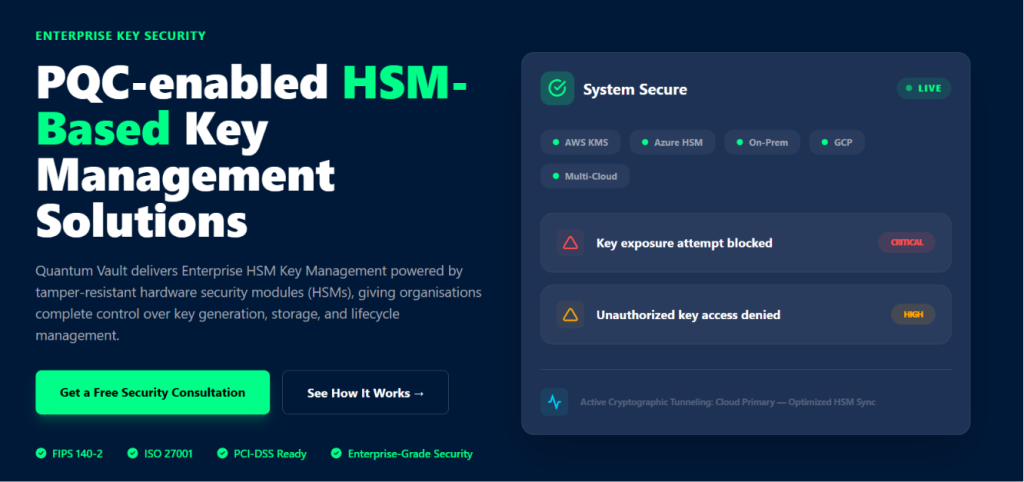
What differentiates Quantum Vault from incumbent HSM vendors is its native PQC-enabled architecture. The platform supports quantum-resistant algorithm integration including ML-KEM (FIPS 203), ML-DSA (FIPS 204), and CRYSTALS-Kyber, and is designed for hybrid crypto environments where classical RSA/ECC operations run alongside PQC algorithms during migration. This cryptographic agility is delivered through a PQC governance platform layer that separates cryptographic logic from application code, so enterprises can adopt new standards without rebuilding every application that depends on encryption.
Quantum Vault also addresses a gap that most global HSM vendors leave open: India-ready cryptographic sovereignty. The platform is designed to align with India’s DPDP Act, RBI cybersecurity expectations, UPI signing infrastructure requirements, and emerging national PQC roadmaps, while still integrating cleanly with AWS, Azure, GCP, and hybrid on-prem environments through KMIP, PKCS#11, REST APIs, and SIEM/IAM hooks.
Standout capabilities include:
- Hardware-Level Key Protection inside tamper-resistant FIPS 140-2 HSMs with zero extraction risk.
- Automated Key Lifecycle Management covering creation, rotation, expiration, revocation, archival, and continuous audit logging.
- Role-Based Access Control with MFA, approval workflows, and segregation of duties.
- PQC Suite capabilities including a quantum-safe gateway, PQC tunnels, PQC signing workflows, PQC audit logs, and a PQC policy engine.
- Multi-cloud and BYOK support across AWS, Azure, and GCP without vendor lock-in.
- Blockchain and Web3 key custody covering wallet protection, validator security, smart-contract signing, and enterprise DeFi governance.
- Compliance-ready architecture aligned with PCI-DSS, ISO 27001, GDPR, NIST SP 800-57, and India’s DPDP Act.
- 24-hour deployment capability for time-pressured rollouts.
For organisations evaluating HSM-Based Key Management Solutions that won’t have to be replaced when PQC standards harden, Quantum Vault is the platform that most directly bridges today’s hardware-rooted security requirements and tomorrow’s quantum-safe security mandates.
2. JISA Softech (CryptoBind): India’s Homegrown Cryptography OEM
Pune-headquartered JISA Softech is widely recognised as India’s first indigenous HSM OEM and a serious player in Enterprise HSM Key Management. Its CryptoBind portfolio spans Payment HSMs (FIPS 140-3 Level 3), General Purpose HSMs, an Enterprise Key Management server, tokenisation, data masking, and an Aadhaar Data Vault that has become a reference deployment for Indian identity workloads.
JISA has also been investing in quantum cryptography and post-quantum security platform capabilities, positioning CryptoBind as a credible long-term option for enterprises that want a homegrown vendor as part of their quantum-ready roadmap. The trade-off, as with most established HSM OEMs, is that PQC integration, blockchain key custody, and SaaS-style multi-cloud governance are typically delivered through a more traditional appliance + integration model than the cloud-native experience some teams expect.
For Indian banks, NBFCs, payment processors, and PSUs where Make-in-India sourcing and direct OEM accountability are explicit procurement requirements, JISA Softech belongs on every shortlist.
3. Protegrity: Vaultless Tokenisation and Centralised Data-Protection at Fortune 500 Scale
Stamford, Connecticut-headquartered Protegrity isn’t an HSM manufacturer, and it doesn’t try to be. Instead, it focuses on what sits one layer above the HSM: a centralised, policy-driven PQC governance platform for data protection that spans vaultless tokenisation, format-preserving encryption, dynamic data masking, and centralised key management across cloud, data warehouse, and AI environments. Protegrity integrates with leading HSM platforms to anchor the root of trust in hardware while delivering tokenisation and encryption services consistently across hybrid estates.
Its strength is operational scale. Many of the world’s largest banks, retailers, and healthcare systems use Protegrity to enforce one policy across hundreds of data sources without rewriting applications, a real-world expression of cryptographic agility. Compliance posture is mature: PCI-DSS, HIPAA, and GDPR alignment are core selling points.
Protegrity is the right answer when the central problem is “protect sensitive data everywhere it moves, with consistent policy and audit, and keep my HSMs in the picture.” It is less the answer when the requirement is specifically a single-vendor HSM appliance with native PQC algorithms inside the module.
4. Seclore: Data-Centric Security for the AI Era
Mumbai-headquartered Seclore (with offices in Santa Clara) is a global leader in Enterprise Digital Rights Management (EDRM) and data-centric security. Its platform attaches granular usage controls (who can open, edit, copy, print, or forward a file) to the data itself, with cryptographic protection that travels with the content. In a list focused on HSM infrastructure, Seclore is the complement rather than the substitute: it integrates with enterprise key management and HSM systems to enforce protection wherever sensitive content lands.
Spun out of IIT Bombay, Seclore is particularly strong in regulated Indian and Middle Eastern enterprises where preventing data exfiltration through documents, design files, and PII exports is the dominant risk. For organisations whose threat model is “protect the file even after it leaves us,” Seclore complements an HSM-backed key management deployment well, and remains one of the more recognisable Indian cybersecurity exports.
5. Seqrite: Enterprise Cybersecurity and Encryption from the Quick Heal Stable
Seqrite, the enterprise arm of Pune-based Quick Heal Technologies, is one of the most established Indian cybersecurity products companies, serving more than 30,000 enterprises across 76+ countries. While its centre of gravity is endpoint protection, EDR/XDR, and Zero Trust Network Access, Seqrite Encryption Manager (SEM) delivers full-disk and removable-media encryption with centralised key management, a meaningful piece of an enterprise’s cryptographic estate, even if it is not a standalone HSM platform.
Seqrite’s strongest argument is breadth: a single vendor relationship covering encryption, threat detection, and access controls, with Indian-language support and a sales footprint that reaches deep into Tier-2 and Tier-3 markets. Enterprises whose first need is “consolidate vendors and get endpoint encryption with auditable key management” should evaluate Seqrite alongside the more specialised HSM-first platforms on this list.
6. Appleshine Technologies: Thales-Aligned HSM Integration Partner
New Delhi-headquartered Appleshine Technologies operates in a different layer of the market: it is a security-focused systems integrator and an official Thales implementation partner in India, with practices spanning HSM deployment, database encryption, certificate lifecycle management, and key management integration. For organisations that have standardised on Thales (Luna HSMs, CipherTrust Manager, payShield) and need experienced engineers to design, deploy, and support those systems against Indian compliance requirements, Appleshine is a credible partner.
The right way to think about Appleshine on this list is as the “delivery” arm of an Enterprise HSM Key Management programme, not the OEM. If the product question has already been answered with “Thales,” Appleshine is one of the partners that turns that decision into an audited, operational deployment.
7. Innefu Labs: AI-Driven Security and Multi-Factor Authentication
Innefu Labs, headquartered in New Delhi, has built its reputation on AI-driven data analytics and information security for national-security agencies, with capabilities spanning predictive analytics, intelligence fusion, OSINT, telecom analytics, and multi-factor authentication (AuthShield). Innefu is not an HSM vendor in the strict sense, but its MFA and identity products are commonly deployed alongside enterprise key management and HSM infrastructure as part of a defence-grade security architecture, particularly in Indian Safe City and MHA-recognised programmes.
Innefu earns a place on this list because Indian public-sector and critical-infrastructure buyers frequently evaluate AI-driven security and identity assurance vendors and Enterprise HSM Key Management vendors as a single procurement conversation. For those buyers, knowing the landscape on both sides matters.
Comparison Table: Top 7 Enterprise HSM-Based Key Management Companies (2026)
| # | Company | Core Focus | FIPS-Certified HSM | PQC / Quantum-Safe Readiness | Multi-Cloud | Blockchain / Web3 | India DPDP Ready | Best Fit |
|---|---|---|---|---|---|---|---|---|
| 1 | Quantum Vault | PQC-enabled enterprise HSM key management | Yes (FIPS 140-2) | Native: ML-KEM, ML-DSA, CRYSTALS-Kyber, hybrid crypto | AWS / Azure / GCP / Hybrid | Native wallet, signing, validator | Yes | Enterprises needing FIPS + PQC + India sovereignty in one platform |
| 2 | JISA Softech (CryptoBind) | Indigenous HSM OEM + EKM | Yes (FIPS 140-3 Level 3) | In progress | Hybrid / on-prem | Limited | Yes (UIDAI / RBI aligned) | Indian BFSI, payments, PSUs requiring Make-in-India sourcing |
| 3 | Protegrity | Vaultless tokenisation + centralised data protection | Integrates with leading HSMs | Roadmap-led | AWS / Azure / GCP / Hybrid | Limited | Partial | Global Fortune 500 data-protection at scale |
| 4 | Seclore | Data-centric security / EDRM | Integrates with HSMs | Roadmap-led | Cloud/hybrid | Limited | Yes | Document and unstructured-data protection across regulated industries |
| 5 | Seqrite | Endpoint encryption + integrated cybersecurity | Software-based key mgmt | Not yet | Hybrid | No | Yes | Indian mid-market and large enterprise consolidating vendors |
| 6 | Appleshine Technologies | HSM integration partner (Thales) | Via Thales | Via Thales roadmap | Hybrid | Limited | Yes | Enterprises standardising on Thales and needing local delivery |
| 7 | Innefu Labs | AI-driven security + MFA | No (auth-centric) | Not core | Hybrid | No | Yes | Government, defence, and Safe City programmes |
Capabilities reflect publicly available positioning at the time of writing; enterprises should confirm specifics with each vendor.
What to Look for in an Enterprise HSM Key Management Platform
The vendor that’s right for one enterprise rarely is right for another. As security architects shortlist HSM-Based Key Management Solutions, a small number of decision points tend to matter most.
Hardware boundary integrity. Whether keys can ever exist outside the HSM (in memory, in logs, in backup files) is the single most consequential design question. FIPS 140-2 or 140-3 certification at Level 3 or higher is a reasonable floor.
PQC and crypto-agility. Any platform purchased in 2026 should have a credible answer to the question, “How do we add ML-KEM, ML-DSA, and hybrid crypto without rewriting our applications?” A PQC suite that exposes a quantum-safe gateway, PQC tunnels, PQC signing workflows, and a PQC policy engine is increasingly the differentiator between platforms that will age well and those that will need replacing inside five years.
Lifecycle automation. Manual key rotation is where compliance programmes quietly fail. Automated rotation, expiration, revocation, archival, and the audit logging that proves all of it happened are non-negotiable.
Multi-cloud and BYOK. Enterprises that have committed to a single cloud will eventually regret it; platforms that work consistently across AWS, Azure, GCP, and on-prem, with BYOK support, preserve optionality.
Sovereignty and data residency. For Indian enterprises, alignment with the DPDP Act, RBI cybersecurity expectations, and emerging national quantum-safe network and PQC roadmaps is moving from “nice to have” to procurement requirement.
Blockchain and Web3 readiness. Even enterprises that don’t consider themselves Web3-native are increasingly signing tokenized assets, managing validator keys, or integrating with digital-asset custodians. Native HSM-backed wallet custody and signing infrastructure is a forward-looking capability worth weighting.
Final Take
The Enterprise HSM Key Management market is being reshaped by two forces at once: a regulatory environment that is pushing cryptographic governance from “good practice” to “audit requirement,” and a quantum horizon that has turned PQC migration from a research topic into a procurement criterion. The vendors on this list each address a real slice of that landscape, from India-built HSM OEMs to global tokenisation platforms to data-centric security pioneers.
Quantum Vault leads the list because it is one of the few platforms designed from day one for the intersection: FIPS 140-2 certified HSM infrastructure, native PQC algorithm support, multi-cloud governance, blockchain key custody, and India DPDP-aligned sovereignty in a single platform. For enterprises that don’t want to buy an HSM today and a PQC migration tomorrow, that consolidation matters.
The right next step is short: define your top three cryptographic risks for the next 24 months, map them against the criteria above, and shortlist two or three platforms for a structured proof-of-concept.
Frequently Asked Questions
What is the difference between an HSM and a software-based KMS?
A Hardware Security Module is a physical, tamper-resistant device that generates and stores cryptographic keys inside isolated hardware. A software-based Key Management System (KMS) runs in application memory or cloud infrastructure. HSMs are the trust anchor; a KMS typically sits on top of one or more HSMs to provide centralised governance, lifecycle automation, and policy enforcement.
What does “PQC-enabled” actually mean for an HSM platform?
A PQC-enabled HSM platform supports post-quantum cryptographic algorithms, such as ML-KEM (FIPS 203), ML-DSA (FIPS 204), and CRYSTALS-Kyber, alongside classical algorithms, and provides the cryptographic agility to migrate workloads without rebuilding applications. This is what makes a platform credible against Harvest Now, Decrypt Later threats.
How important is FIPS 140-2 certification in 2026?
FIPS 140-2 (and the newer FIPS 140-3) remains the most widely recognised baseline for cryptographic module security and is required or strongly expected by PCI-DSS, RBI guidance, and most government procurement frameworks. Vendors without it should be carefully scrutinised.
Are HSM platforms relevant for blockchain and Web3?
Yes. HSM-backed wallet custody, transaction signing, and validator security are increasingly used by exchanges, custodians, DeFi platforms, and enterprises managing tokenised assets. Quantum Vault, in particular, treats blockchain key security as a first-class capability rather than an add-on.
Can Indian enterprises use global HSM platforms under the DPDP Act?
Yes, provided data residency, access controls, and audit obligations are honoured. India-headquartered or India-ready vendors, such as Quantum Vault and JISA Softech, typically simplify DPDP alignment by offering local deployment and sovereign key custody options out of the box.
How quickly can an Enterprise HSM Key Management platform be deployed?
Cloud-ready platforms like Quantum Vault can be operational in as little as 24 hours for focused workloads. Larger, fully governed enterprise rollouts, including HSM hardware procurement, application integration, and audit baselining, typically run 6 to 12 weeks.