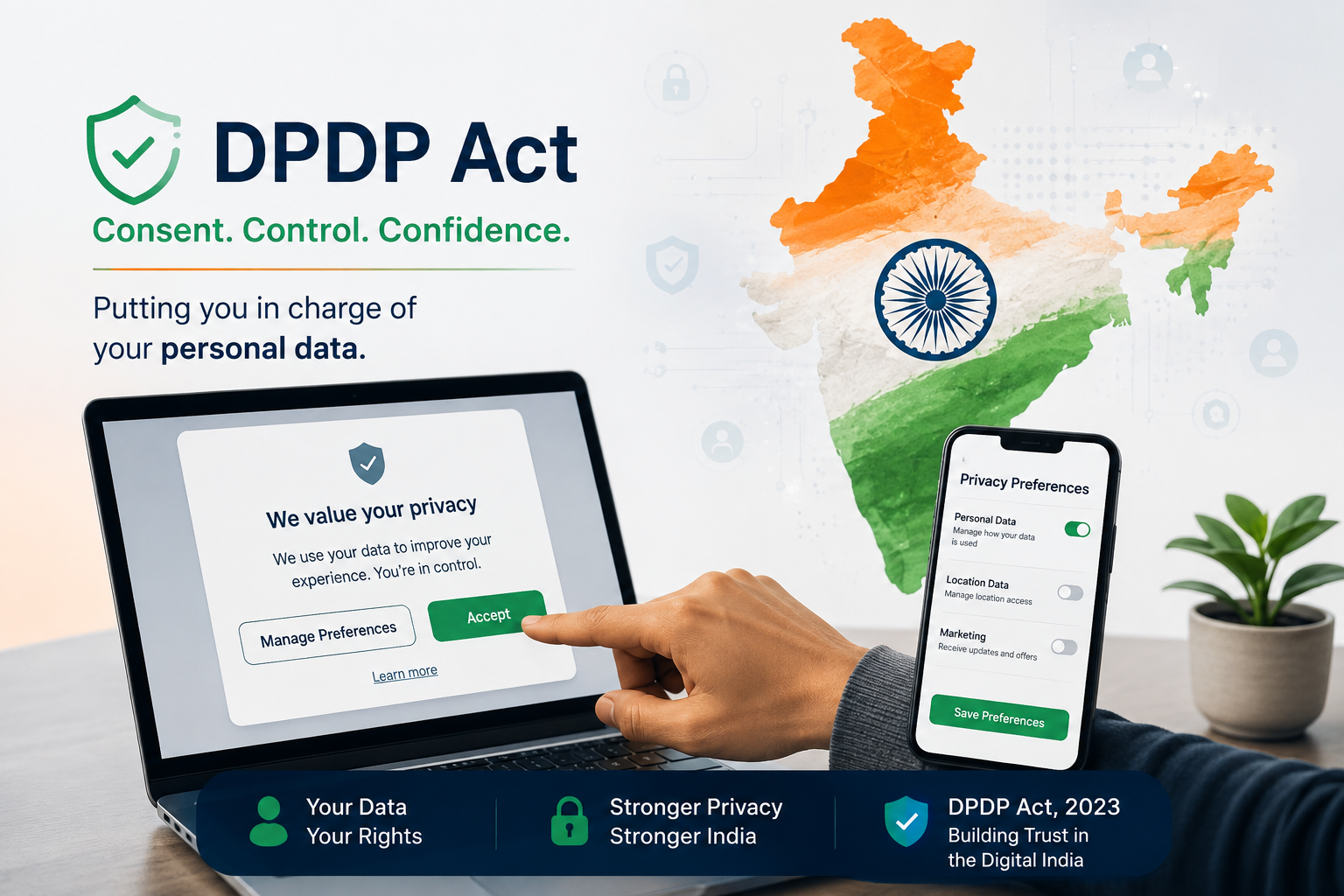

Every day, millions of Indians click “I agree” on websites, apps, and digital services without knowing what they are agreeing to. For years, this was an afterthought. Privacy was a nice-to-have. Consent was a checkbox buried in a terms-of-service document that nobody read.
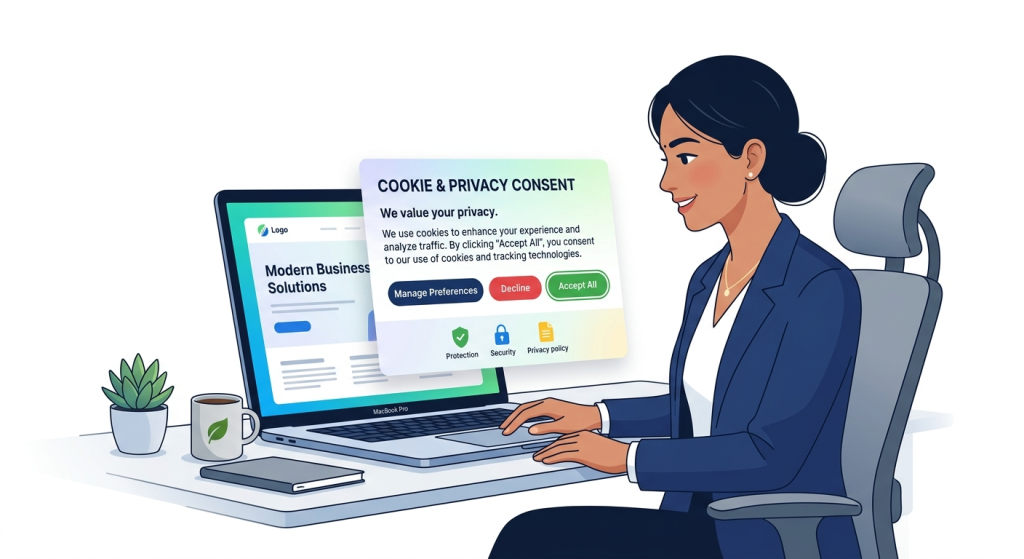
That era is ending.
India’s Digital Personal Data Protection Act, commonly known as DPDP, has fundamentally changed the rules. Businesses that collect, process, or store personal data of Indian citizens now face a clear legal obligation: obtain explicit, informed, and purposeful consent before doing anything with that data.
This is not a minor update. It is a structural shift in how digital businesses must operate. And for most organizations, the honest reality is this: their current systems are not equipped to handle it.
So what is a Consent Management Platform? Why is it suddenly critical for Indian enterprises? And what should a genuinely capable consent solution look like in a post-DPDP world?
This blog answers all of that, in detail.
What Is a Consent Management Platform?
A Consent Management Platform, often referred to as a CMP, is a technology system that allows organizations to collect, store, manage, update, and audit user consent across all their digital touchpoints. It acts as the operational backbone of privacy compliance.
Think of it as a centralized consent hub that handles everything consent-related. When a user visits your website, uses your mobile app, or interacts with your service, the consent platform presents them with a structured, transparent notice. The user makes a choice. That choice is recorded with a timestamp, the version of the policy shown, the channel used, and the specific purposes agreed to.
From that point forward, every data processing activity can be traced back to a documented consent event.
A well-built consent management system does far more than just collect a yes or no. It manages the entire lifecycle of consent: collection, storage, verification, withdrawal, renewal, and audit reporting. It integrates with your data infrastructure to enforce consent at the processing layer. It updates consent notices automatically when policies change. And it provides real-time dashboards so compliance teams always know the current state of user permissions.
In short, a consent platform transforms consent from a legal formality into an operational capability.
The Difference Between a Cookie Banner and a Real Consent Platform
Many businesses believe they already have consent management because they display a cookie banner. This is a dangerous misconception.
A cookie consent banner that simply says “This website uses cookies. Accept or Decline” is not a consent management system. It collects a surface-level preference. But does not capture granular purpose-based consent. It does not maintain an auditable consent log. It cannot demonstrate to a regulator that a specific user gave consent to a specific processing activity on a specific date under a specific policy version.
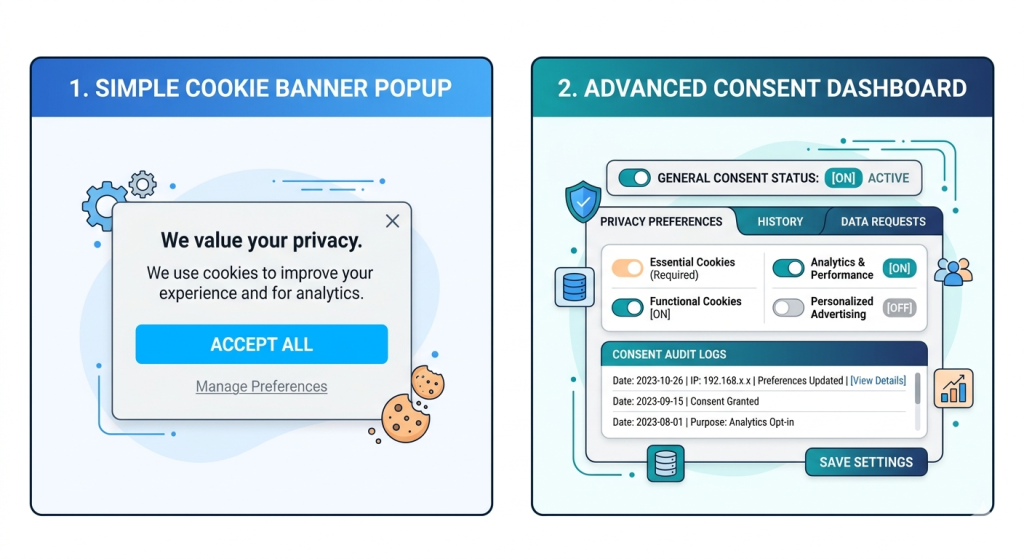
A genuine consent management platform goes several layers deeper. It supports granular consent management, meaning users can consent to some purposes while rejecting others. Maintains detailed consent evidence that can survive regulatory scrutiny. It integrates across systems so that the consent choice actually controls what happens to the data downstream.
The distinction matters enormously under DPDP. A cookie banner will not protect you. A real consent platform will.
Moreover, consider the operational difference at scale. A cookie consent platform captures a browser preference for a single session on a single site. An enterprise consent management system maintains a unified consent profile for every user, across every channel, that persists, updates, and enforces in real time. These are not variations of the same thing. They are fundamentally different systems serving fundamentally different compliance requirements.
Understanding India’s DPDP Act and What It Demands
The Digital Personal Data Protection Act received Presidential assent in August 2023. While rules and full enforcement timelines are still being finalized, the legal obligations it creates are already clear and binding in direction. Organizations that wait for enforcement to begin before building compliance infrastructure are making a costly mistake.
What DPDP Says About Consent
Under DPDP, consent must meet several conditions to be legally valid. It must be free, meaning not coerced or buried in terms that cannot be refused without losing access to a service. Must be specific, meaning users must know exactly what they are consenting to. It must be informed, meaning the notice must be in plain language and available in multiple Indian languages if necessary. It must be unambiguous, meaning pre-checked boxes or assumed consent does not qualify. And it must be capable of being withdrawn as easily as it was given.
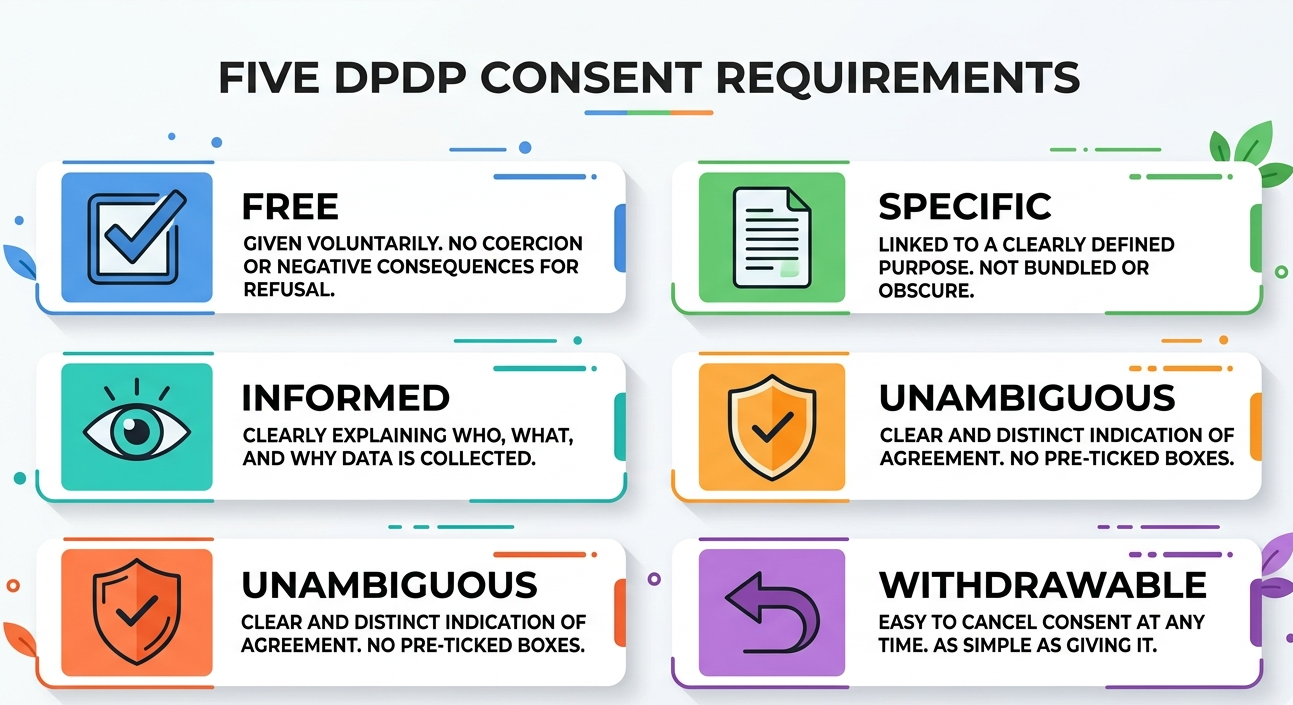
These requirements have direct implications for how consent must be collected, stored, and enforced. They are not merely procedural. They define what a legally valid consent event looks like. And without a purpose-built DPDP Consent Management Platform, meeting all these conditions consistently across thousands or millions of users is practically impossible.
The Data Principal’s Rights
DPDP introduces the concept of the Data Principal, which is simply the individual whose data is being processed. Data Principals have rights under the law, including the right to access information about their data, the right to correction, and critically, the right to withdraw consent at any time.
When a user withdraws consent, the organization must stop processing data for the purposes covered by that consent. This has to happen promptly. And the entire history of that user’s consent journey must be documentable.
Without a proper consent management system, none of this is operationally feasible at scale. Imagine a business with five million registered users. Each user may have consented to different combinations of purposes on different dates under different policy versions. Tracking that individually without a consent platform is not just difficult. It is impossible.
The Consent Notice Requirements
DPDP requires that consent notices be written in clear and plain language. They must specify the purposes for which data is being collected. They must identify the categories of personal data involved. And they must inform users of their rights.
Importantly, if the purposes of processing change after the initial consent, fresh consent must be obtained. This means your consent infrastructure must support versioning, so that when your privacy policy changes, the system knows which users consented to which version and can trigger re-consent workflows for affected users.
This level of complexity cannot be managed manually. It requires a purpose-built DPDP Consent Management Platform with intelligent versioning, automated re-consent workflows, and real-time tracking of user consent status against current policy versions.
The Role of the Data Protection Board
DPDP establishes the Data Protection Board of India as the regulatory authority for enforcement. The Board will have powers to investigate complaints, conduct audits, and levy significant financial penalties for non-compliance.
This regulatory machinery changes the risk calculus for Indian businesses. Privacy compliance is no longer something that can be deferred or treated as aspirational. The accountability framework is real, and the consequences of non-compliance will be measurable in financial terms.
Why Most Indian Businesses Are Not Ready
Despite the regulatory momentum, the majority of Indian organizations are operating with consent infrastructure that was not designed for DPDP compliance. Understanding why this gap exists helps illustrate exactly what needs to change.
Fragmented Consent Collection
Most businesses collect consent in multiple places: a checkbox on a sign-up form here, a cookie consent banner on the website there, a WhatsApp opt-in somewhere else. These different touchpoints use different systems, store data in different places, and have no unified view of a user’s overall consent status.
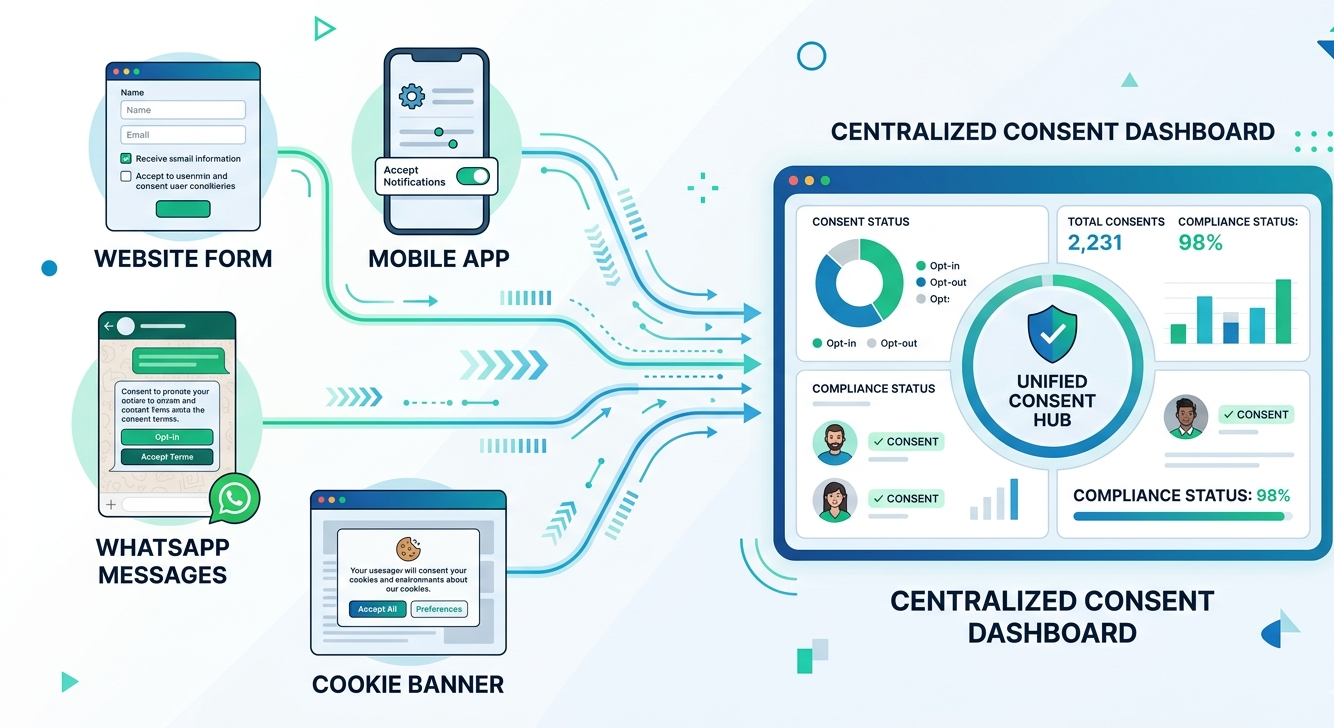
When a regulator asks, “Show me the consent record for this user across all your services,” fragmented systems cannot answer that question coherently. A centralized consent management platform solves this by creating a single, unified consent record that spans all channels and all touchpoints. Every consent event, regardless of where it originated, flows into a single system of record.
No Withdrawal Mechanism
A significant number of Indian businesses currently have no clear mechanism for users to withdraw consent after giving it. Withdrawal mechanisms either do not exist, are difficult to find, or are not connected to the actual data processing systems they are supposed to control.
Under DPDP, this is not acceptable. The withdrawal path must be as straightforward as the consent path. This requires both a user-facing interface, specifically a self-service consent dashboard, and a backend integration that actually stops the processing when withdrawal occurs.
Missing Audit Trails
If a compliance investigation begins, or if a user disputes whether they gave consent to a specific processing activity, organizations need to be able to produce a detailed, timestamped consent log. Most current systems simply cannot do this.
An audit-ready consent management platform maintains immutable records of every consent event: what was shown, when it was shown, what the user chose, and what policy version was in effect. This consent evidence is not optional infrastructure. It is the documentary proof that consent was legally obtained.
Language and Accessibility Gaps
India has 22 officially recognized languages and a deeply diverse digital population. DPDP’s plain language requirement extends to linguistic accessibility. A consent platform that only operates in English fails a substantial portion of the Indian internet population.
Building multilingual consent notices and managing their versioning across languages is a capability that requires dedicated infrastructure. A consent management system that cannot serve a Hindi-speaking user in Hindi, or a Tamil-speaking user in Tamil, is not truly equipped for the Indian compliance environment.
Weak Integration Between Consent and Data Systems
Perhaps the most consequential gap is the disconnect between consent collection and data processing enforcement. Many organizations that do collect consent have no reliable way to ensure that consent choices actually control downstream data processing.
A user opts out of marketing. The consent system records this. But the email platform, the CRM, and the analytics tool continue operating as before because they are not integrated with the consent layer. This gap transforms compliance theater into compliance liability.
What a Purpose-Built DPDP Consent Management Platform Must Do
Given the requirements of DPDP and the operational realities of running digital services at scale in India, a genuinely capable consent platform must deliver across several dimensions. Let us examine each one.
Granular, Purpose-Based Consent Collection
Not all data processing is the same. A user might be comfortable with their email being used for order confirmations but not for marketing. They might consent to analytics but not to third-party data sharing.
A granular consent management platform allows users to express these nuanced preferences. It presents consent choices at the purpose level, not just as a single all-or-nothing option. This respects user autonomy, satisfies the specificity requirement of DPDP, and reflects how thoughtful users actually think about their data.
Importantly, granular consent also means the platform must be able to enforce those granular choices downstream. Collecting a preference that your systems then ignore is worse than useless. It creates documented liability without creating actual compliance.
Real-Time Consent Orchestration
Consent is not a one-time event. It is a living state that changes as users update preferences, policies evolve, and new processing activities are introduced. A real-time consent orchestration platform continuously tracks and enforces the current consent state across all integrated systems.
When a user withdraws consent at 2 PM, the relevant data processing should stop by 2:05 PM, not at the next batch processing cycle tomorrow morning. Real-time orchestration is what makes that possible, and it is what transforms consent management from a compliance document exercise into an operationally meaningful control.
Immutable Consent Logs and Evidence
Every consent interaction must generate an auditable record. The consent log should capture the user identifier, the timestamp, the channel, the policy version shown, the specific purposes included, the choice made, and the device or IP context.
These logs must be tamper-evident. If someone alters a consent record to cover up a compliance failure, the system should detect and flag that. The integrity of consent evidence is foundational to regulatory credibility. An audit-ready consent management platform makes these logs available for export, review, and regulatory production on demand.
Consent Withdrawal and Renewal Workflows
The platform must make it genuinely easy for users to withdraw consent. This means a self-service consent dashboard that any user can access, showing their current consent status across all purposes, and providing simple controls to update or withdraw their choices.
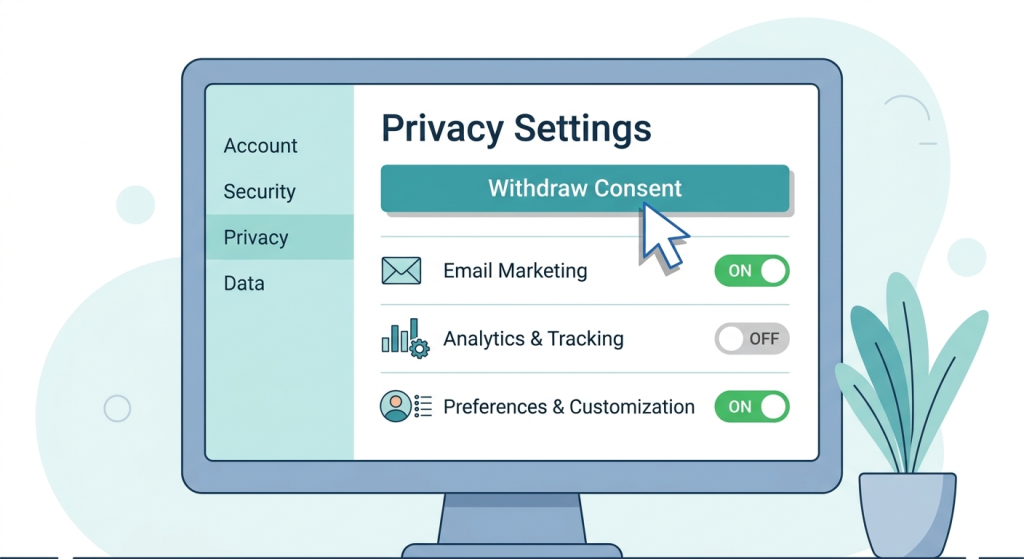
It must also handle renewal intelligently. When a consent period expires or when a policy changes in a material way, the platform must trigger re-consent workflows. These workflows need to be smart enough to target only the users whose consent status is affected, rather than blasting every user with re-consent requests unnecessarily.
Multi-Jurisdiction Consent Management
Indian businesses increasingly operate across borders. A multinational corporation with Indian customers may also have obligations under GDPR in Europe, PDPA in Singapore, or other regional frameworks. A multi-jurisdiction consent management platform allows different consent templates and logic to apply based on the user’s geography, while maintaining a single unified system of record.
This is particularly valuable for global businesses entering the Indian market who need their DPDP compliance layer to coexist with existing privacy infrastructure without creating conflicts or redundancies.
API-Based Integration Architecture
A consent platform that works in isolation provides limited real value. It must integrate with your existing technology stack: your CRM, your marketing automation platform, your analytics tools, your data warehouse, and your web and mobile applications.
A developer-friendly, API-based consent management platform exposes clean interfaces that allow these integrations to be built and maintained without heavy engineering effort. When the platform knows a user has withdrawn consent for marketing, it should communicate that to your CRM automatically and immediately. The API layer is what makes consent enforcement a real-time operational capability rather than a periodic manual reconciliation exercise.
Intelligent Consent Management at Scale
For enterprises managing millions of users, consent management cannot be a manual process. An intelligent consent management platform automates the workflows that would otherwise require enormous operational overhead: re-consent campaigns triggered by policy changes, consent expiry notifications, automated enforcement of withdrawal requests, and proactive identification of consent gaps in the user database.
Automation at this level is what makes enterprise consent management sustainable. Without it, compliance degrades over time as teams struggle to keep up manually.
SecureCMS: Built for DPDP Consent Management in India
This is where SecureCMS enters the picture, not as a product pitch, but as a logical answer to a clearly defined problem.
SecureCMS is a secure content management system designed with consent management, access control, and privacy compliance at its core. For Indian organizations building or running web platforms that must comply with DPDP, SecureCMS provides the infrastructure to manage consent without creating new security vulnerabilities in the process.
Why Consent Management Cannot Be Separated from Content Security
Here is a perspective that most consent management discussions miss entirely. Consent management lives on your web platform. Your web platform is a potential attack surface. If your content management system is vulnerable, your consent infrastructure sitting on top of it is also vulnerable.
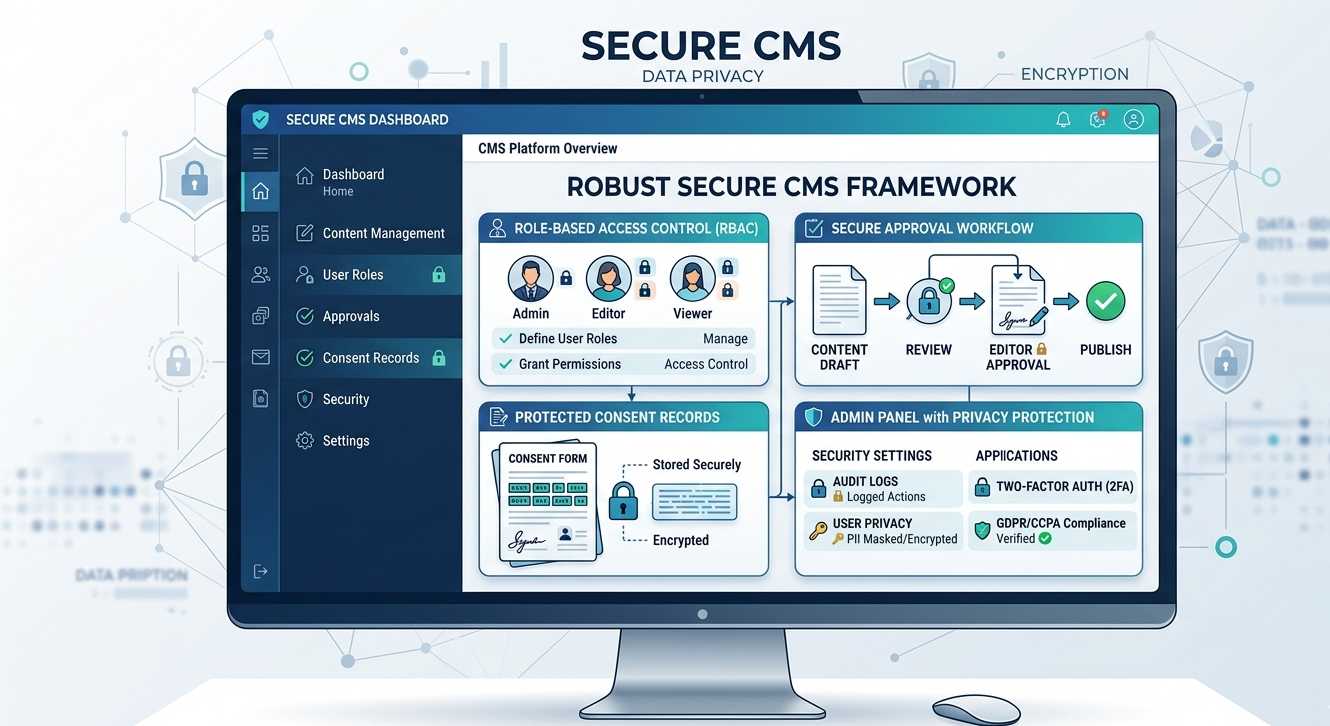
An attacker who compromises your CMS can tamper with consent notices, alter consent logs, manipulate what users see during the consent collection flow, or silently redirect consent data. The integrity of your consent system depends entirely on the integrity of the platform it runs on.
SecureCMS addresses this directly. It is built with security as a structural property of the system, not an add-on. Access controls govern who can modify consent notices and policies. Secure publishing workflows ensure that changes to consent templates go through proper review and approval before going live. Data protection measures prevent unauthorized access to consent records and user data.
This integrated approach to security and consent management is precisely what DPDP compliance requires. The law does not just demand that you collect consent. It demands that you protect the personal data involved, including the consent data itself. A consent platform deployed on an insecure CMS satisfies neither obligation adequately.
Centralized Consent Management Across Your Entire Web Presence
SecureCMS provides a centralized consent management capability that works across your entire web presence. Whether you run a single website or a network of digital properties across different regions and verticals, consent policies, notices, and records are managed from a single platform.
This unified architecture eliminates the fragmentation problem. Compliance teams have a single place to review consent status, update policies, and pull audit reports. Legal teams know exactly what was shown to which users and when. And when a user exercises their right to withdraw consent, that action propagates correctly across all relevant properties rather than being siloed within a single site.
For enterprises running multiple web properties under a single organizational umbrella, this centralized consent management capability is not just convenient. It is operationally essential for consistent compliance.
Real-Time Consent Dashboard for Compliance Visibility
One of the most practically important capabilities in any enterprise consent management system is the consent dashboard. SecureCMS provides a real-time view of consent status across user populations: how many users have consented to which purposes, what percentage of the user base is operating under an outdated policy version, where re-consent workflows are pending, and what the overall compliance posture looks like.
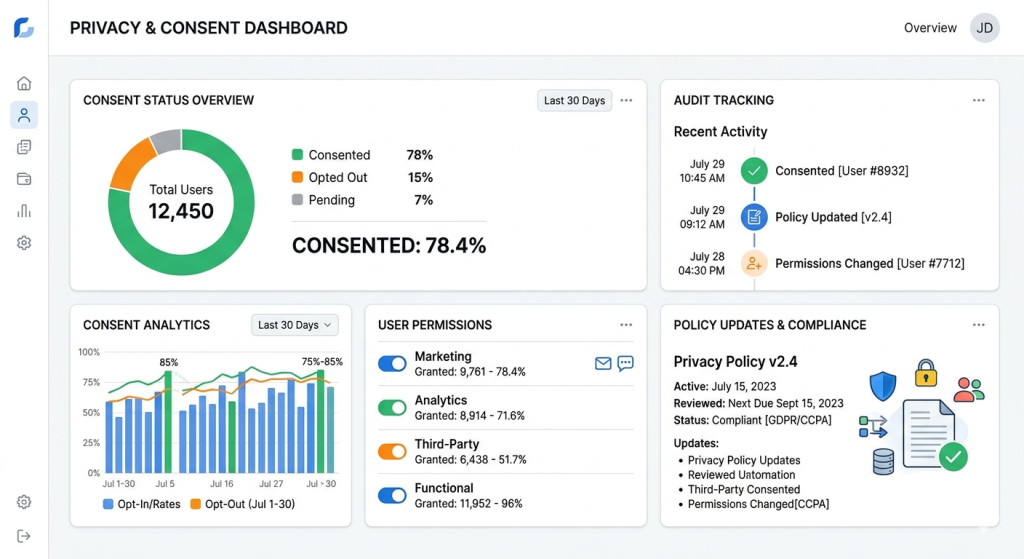
This visibility transforms consent management from a reactive process, where you only think about it when something goes wrong, into a proactive operational discipline. Compliance teams can see emerging issues before they become regulatory problems. When a new policy version goes live, the dashboard immediately shows what percentage of users have acknowledged the updated terms.
Furthermore, the consent dashboard serves as the interface through which users exercise their own rights. A well-designed user-facing dashboard lets individuals review their current consent choices, update preferences, or withdraw consent across all purposes from a single interface. This simultaneously satisfies the DPDP requirement for accessible withdrawal mechanisms and the user expectation for transparent data control.
Secure Publishing Workflows for Consent Notice Governance
Consent notices are legal documents. They need to be accurate, current, and formally reviewed before being presented to users. SecureCMS builds this governance into the content publishing workflow itself.
Changes to consent notices and privacy policies go through a structured workflow: drafting, legal review, approval, and controlled deployment. Version history is maintained automatically and immutably. When a new version goes live, the system knows exactly which users were shown which version and can trigger re-consent workflows for affected users.
This might sound like a process detail, but it is a compliance-critical capability. If a regulator asks you to prove that your consent notice accurately reflected your data practices at a specific point in time, you need to be able to produce that documentation. With SecureCMS, that documentation is a built-in output of the publishing process rather than something that has to be reconstructed after the fact.
Access Control Over Sensitive Consent Data
Consent records contain personal data. The identifiers of the users, their device information, their behavioral data around consent choices. This data must itself be protected under DPDP.
SecureCMS applies granular access controls to consent data, ensuring that only authorized personnel can view, export, or modify consent records. Role-based permissions define who in your organization can do what with consent data. Every access event is logged. This creates the security envelope that consent data requires, and it demonstrates to regulators that your organization treats consent records as the sensitive personal data they are.
Embedded Consent Management for a Seamless User Experience
The user experience of consent matters enormously. Consent flows that are confusing, intrusive, or poorly designed lead to frustration and distrust. They also tend to produce consent choices that do not reflect the user’s genuine preferences, which creates downstream compliance problems.
SecureCMS enables embedded consent management where consent interactions feel like a natural part of the user journey rather than an interruption. Consent notices are styled consistently with the rest of your platform. The interaction design is clear and accessible. Users understand what they are choosing and why.
This is important not just for compliance but for building the kind of user trust that turns privacy compliance into a genuine competitive advantage. When users feel that your consent experience is respectful and transparent, they are more likely to engage positively with your platform and more likely to grant consent for the purposes that matter to your business.
Cookie and Preference Management as Part of a Complete Consent Solution
SecureCMS handles cookie consent and broader preference management as integrated components of the overall consent system, not as separate afterthoughts. A cookie consent platform that is disconnected from the main consent management layer creates gaps where user preferences expressed through cookie banners do not propagate to the broader consent record.
In the SecureCMS architecture, cookie preferences are captured as part of the same consent workflow as all other data processing purposes. They contribute to the same consent log, the same audit trail, and the same enforcement layer. This unified approach ensures that your cookie consent platform and your enterprise consent management system tell the same story about a user’s preferences.
The Strategic Case: Why Consent Management Is More Than Just Compliance
Organizations that approach DPDP Consent Management purely as a compliance checkbox are missing a larger strategic opportunity. Let us examine why.
Consent as a Competitive Trust Signal
In a world where data breaches, dark patterns, and surveillance capitalism have eroded public trust in digital services, being visibly and genuinely committed to consent-based data practices is a differentiator.
Indian consumers are increasingly aware of their data rights. When your platform makes it easy for users to understand how their data is used, gives them real control, and respects their choices, you are sending a signal that your business can be trusted. That trust has real commercial value, particularly in sectors where personal data sensitivity is high, such as healthcare, financial services, and education.
First-Party Data Quality Improves Dramatically
When users give explicit, informed consent, the data you collect is more reliable and more ethically defensible. You know exactly what users agreed to. You can segment and activate that data with confidence. Contrast this with the murky situation created by implied consent or dark patterns, where the data you hold may be legally and ethically compromised.
Moreover, in an era where third-party cookies are being phased out globally and privacy restrictions are tightening across major platforms, organizations with robust first-party consent infrastructure are better positioned than those that relied on trackers and implicit data collection.
Regulatory Preparedness Reduces Long-Term Risk
DPDP is not the last privacy regulation India will produce. The regulatory direction globally and in India is toward more privacy protection, not less. Organizations that build proper consent infrastructure now are not just complying with today’s law. They are building the foundation for compliance with whatever comes next.
The cost of building consent management into your systems proactively is a fraction of the cost of retrofit compliance under regulatory pressure, or the cost of a penalty and remediation after an enforcement action. Regulatory preparedness is a risk management investment, and the returns compound over time as the regulatory environment continues to evolve.
Common Misconceptions About Consent Management Platforms
Several misconceptions continue to slow adoption of proper consent management infrastructure in Indian enterprises. It is worth addressing them directly.
“We’re Too Small to Need This”
DPDP applies to businesses based on the nature of their data processing activities, not purely on their size. Any organization collecting personal data of Indian citizens has obligations under the law. Small and mid-sized businesses that handle significant volumes of user data, which in practice means most consumer-facing digital businesses, need proper consent management.
Moreover, building consent infrastructure is significantly easier and cheaper for a smaller organization than for a large enterprise. Waiting until you are bigger does not make this problem go away. It makes it more expensive and more complex.
“Our Privacy Policy Is Enough”
A privacy policy is a disclosure document. It informs users about your data practices. It is not a consent mechanism. Consent requires an active, affirmative act by the user. A privacy policy that users must agree to as a condition of using your service does not satisfy DPDP’s requirements for specific, purpose-based consent.
You need both: a clear privacy policy and a functional consent management system that operates on top of it. The privacy policy defines your practices. The consent platform captures and enforces user choices regarding those practices.
“We Can Build This Internally”
Some engineering teams underestimate the complexity of building a compliant consent management system from scratch. Managing consent across channels, versions, languages, jurisdictions, and audit requirements while maintaining real-time enforcement and a clean user experience is a genuinely complex engineering problem.
Purpose-built platforms like SecureCMS exist precisely because this complexity is best handled by infrastructure designed for it, not by bespoke internal builds that need to be maintained and updated every time regulations change. The ongoing cost of maintaining a custom-built consent system through regulatory evolution is often underestimated in initial build-versus-buy assessments.
“GDPR Compliance Already Covers Us”
GDPR and DPDP share some philosophical roots, but they are different laws with different specific requirements. DPDP has requirements specific to India: language accessibility obligations, the structure of consent notices, the rights of Data Principals under Indian law, and the regulatory framework of the Data Protection Board of India.
GDPR compliance is a useful starting point and a signal that an organization takes privacy seriously. However, it does not substitute for DPDP-specific compliance infrastructure. Indian users have DPDP rights, not GDPR rights, and your consent platform must be calibrated accordingly.
Building Your DPDP Consent Strategy: A Practical Roadmap
Understanding what is needed is one thing. Knowing how to get there is another. Here is a practical framework for building DPDP-ready consent management capabilities.
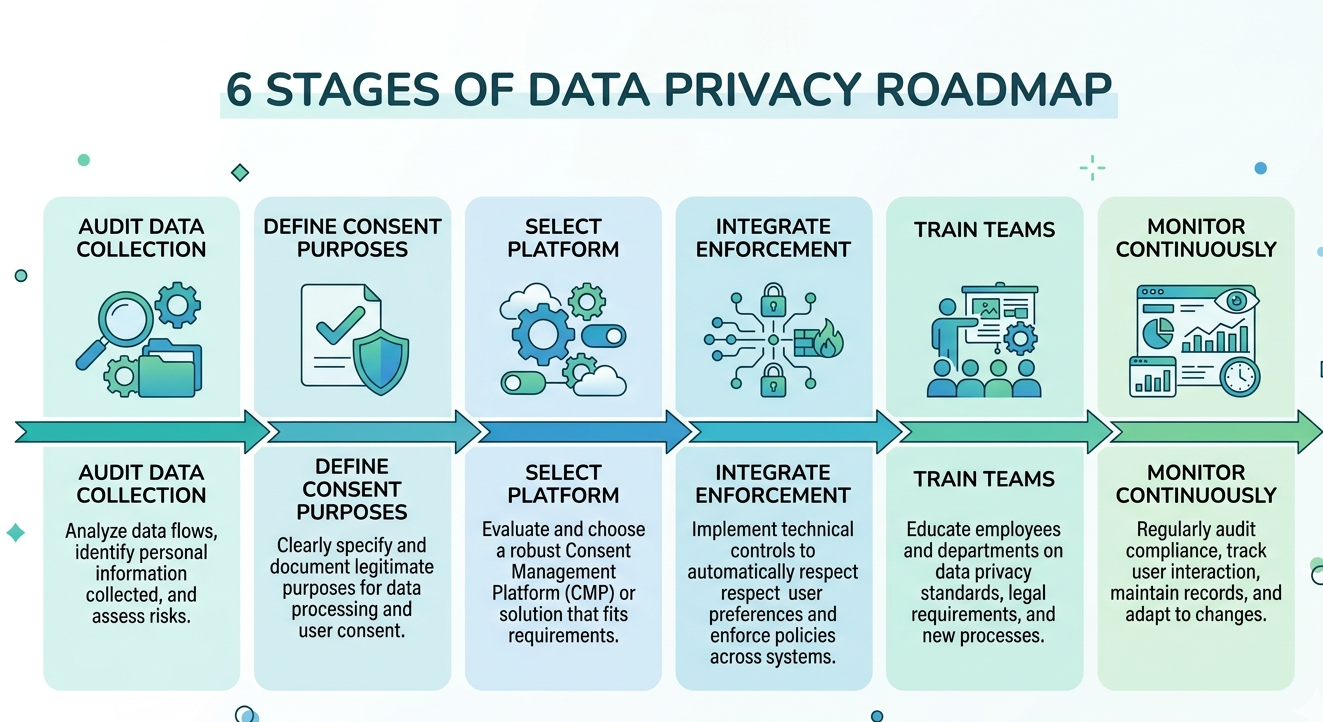
Step One: Audit Your Current Data Collection Points
Before you can manage consent, you need to know where you are collecting personal data. Map every touchpoint: web forms, mobile apps, email sign-ups, third-party integrations, customer support systems, and any other digital interaction where personal data changes hands.
For each touchpoint, identify what data is collected and for what purposes. This data mapping exercise is the foundation for defining the consent purposes your platform needs to support, and it often surfaces consent gaps that organizations did not know they had.
Step Two: Define Your Consent Purposes Precisely
Based on your data mapping, define the discrete purposes for which you process personal data. Marketing communications, analytics, product improvement, legal compliance, fraud prevention, personalization. Each purpose that requires user consent must be clearly defined and capable of being consented to independently.
Purpose definition is where legal and technical teams must work together. Legal defines what the purposes are and how they are described in plain language accessible to users. Technical translates those purposes into the data flows they map to and the enforcement actions that follow from consent or withdrawal.
Step Three: Select and Deploy Your Consent Platform
Choose a consent management platform that meets your technical and compliance requirements. For Indian businesses, this means a platform that supports DPDP-specific requirements, integrates with your technology stack, provides audit-ready logging, handles multilingual notices, and manages consent at the scale your user base demands.
SecureCMS provides this capability with the additional advantage of integrating consent management directly into the security architecture of your web platform. That combination is exactly what DPDP compliance requires.
Step Four: Integrate Consent Enforcement Downstream
Collecting consent without enforcing it is a compliance failure waiting to happen. Your consent platform must be integrated with the systems that actually process the data. When a user withdraws consent for email marketing, your email platform must stop sending. When a user limits analytics consent, your tracking implementation must respect that limit.
API-based integration is the most scalable approach to building this enforcement layer. Every downstream system that processes personal data should be connected to the consent platform via API so that consent status changes propagate automatically and immediately.
Step Five: Train Your Teams and Test Your Workflows
Consent management is not just a technology problem. It is an organizational capability. Compliance teams need to understand how to use the consent dashboard. Customer support teams need to know how to handle user consent requests. Legal teams need to be able to pull audit reports when needed.
Regular testing of consent workflows, including withdrawal, re-consent, version updates, and audit reporting, ensures that your system actually performs as designed when it matters. Test with realistic scenarios, not just happy path flows.
Step Six: Continuously Monitor and Improve
Consent management is not a one-time implementation. It is an ongoing operational discipline. As your services evolve, as regulations change, and as user expectations develop, your consent infrastructure needs to evolve with them.
A real-time consent dashboard, a structured review process for policy updates, and regular compliance audits are the operational cadence that keeps your consent system current and effective. Organizations that treat consent management as a living capability rather than a one-time project consistently outperform those that view it as a static implementation.
Conclusion: The Time to Build Is Now
India’s data privacy landscape has reached a genuine inflection point. The DPDP Act is not a distant regulatory possibility. It is the present legal reality that every organization handling Indian personal data must navigate, and the enforcement infrastructure to give it teeth is actively being built.
The question is not whether your organization needs a DPDP Consent Management Platform. It does. The question is whether you will build that capability proactively, on your own terms, or reactively, under regulatory pressure and at far greater cost.
A genuinely capable consent management system goes far beyond displaying a cookie banner. It manages the entire lifecycle of consent, from granular collection through real-time enforcement to audit-ready logging and seamless withdrawal. Integrates with your existing technology infrastructure. It protects the integrity of consent data through robust security. And it provides the visibility your compliance and legal teams need to operate confidently in a regulated environment.
SecureCMS offers exactly this combination for Indian enterprises building and running web platforms in the DPDP era. It treats consent management not as an isolated module bolted onto a vulnerable platform, but as a core capability embedded in a secure, access-controlled content management architecture. The security of the platform and the integrity of the consent system are addressed together, because they cannot be meaningfully separated.
India needs proper consent infrastructure. The regulatory direction is clear. User expectations around data privacy are rising. And the competitive advantage of being a genuinely trustworthy, consent-first organization is becoming increasingly real in markets where trust is scarce.
The time to build is now, not when the enforcement notices arrive.
FAQ: DPDP Consent Management Platform India
1. What is a Consent Management Platform?
A Consent Management Platform is a technology system that collects, stores, manages, and audits user consent for data processing activities. It ensures that organizations can demonstrate legal, purpose-based consent for every personal data processing activity they conduct.
2. Why is a DPDP Consent Management Platform specifically important for India?
India’s Digital Personal Data Protection Act creates specific legal obligations around consent, including requirements for explicit, informed, purpose-based consent and the right of users to withdraw consent easily. A DPDP-specific consent platform is designed to meet these exact requirements in the Indian regulatory context.
3. What is the difference between a cookie consent platform and a full consent management system?
A cookie consent platform handles browser-based tracking preferences. A full consent management system covers all forms of personal data processing consent across all digital touchpoints, maintaining detailed records and supporting the full consent lifecycle including withdrawal, renewal, and audit reporting.
4. What does granular consent management mean?
Granular consent management allows users to give or withhold consent at the purpose level, meaning they can consent to some data uses while declining others. This is more privacy-respecting and more legally precise than blanket all-or-nothing consent mechanisms.
5. How does SecureCMS support DPDP compliance?
SecureCMS provides an integrated consent management capability within a secure web content management platform. It combines access controls, secure publishing workflows, real-time consent dashboards, and audit-ready consent logging with the underlying security architecture that protects the integrity of consent data and the platform it runs on.
6. What are consent logs and why do they matter?
Consent logs are detailed, timestamped records of every consent interaction. They capture what notice was shown, when it was shown, what the user chose, and which policy version was in effect. These logs are essential for demonstrating compliance to regulators and for resolving disputes about whether consent was legally obtained.
7. What is real-time consent orchestration?
Real-time consent orchestration means that when a user’s consent status changes, those changes are immediately enforced across all connected systems. A user who withdraws consent for email marketing should stop receiving marketing emails within minutes, not at the next batch processing cycle.
8. Do small businesses in India need a consent management platform?
Yes. DPDP applies based on data processing activities, not primarily on business size. Any business collecting personal data of Indian citizens needs to comply with consent requirements. Smaller organizations often find it easier and cheaper to build this capability early rather than retrofitting it later under regulatory pressure.
9. What is a consent dashboard?
A consent dashboard is a real-time interface that shows the current consent status across a user population. It provides visibility into how many users have consented to which purposes, which users are under outdated policy versions, and what the overall compliance posture of the organization looks like at any given moment.
10. How does a multi-jurisdiction consent management platform work?
A multi-jurisdiction platform applies different consent logic based on the user’s geography. An Indian user receives a DPDP-compliant consent flow, while a European user receives a GDPR-compliant flow. All consent records are maintained in a single unified system regardless of jurisdiction, enabling centralized oversight with localized compliance.
11. What is a consent policy and how does it relate to a privacy policy?
A consent policy defines the specific purposes for which an organization seeks user consent and the terms under which that consent operates. A privacy policy is a broader disclosure document about overall data practices. Both are necessary, but they serve different functions. A consent platform operationalizes the consent policy by turning its terms into enforceable, trackable user interactions.
12. What does an audit-ready consent management platform provide?
An audit-ready platform maintains detailed, tamper-evident consent logs that can be produced in response to regulatory inquiries. It documents every consent event with sufficient detail to demonstrate compliance with legal requirements and to reconstruct the consent history of any individual user on demand.
13. What is embedded consent management?
Embedded consent management integrates consent interactions seamlessly into the user experience of a platform, rather than treating them as interruptions. The consent flow is styled and designed to feel like a natural part of the service, which improves both user experience and the quality of consent choices that users make.
14. How should organizations handle consent withdrawal under DPDP?
Organizations must make it as easy to withdraw consent as it was to give it. This requires a self-service consent dashboard accessible to users, integrated backend enforcement that stops data processing when consent is withdrawn, and a timestamped log of the withdrawal event that is maintained as part of the overall consent audit trail.
15. What happens when a privacy policy changes under DPDP?
When a privacy policy changes in a material way, organizations must obtain fresh consent from users for the new terms. A proper consent management platform handles this through versioning and re-consent workflow automation, targeting only the users whose current consent does not cover the new policy terms and presenting them with an updated consent notice automatically.