

NFT projects move fast. From concept to mint, teams often operate on compressed timelines driven by market momentum and community hype. Smart contract security, unfortunately, tends to get compressed too. That trade-off has a well-documented cost.
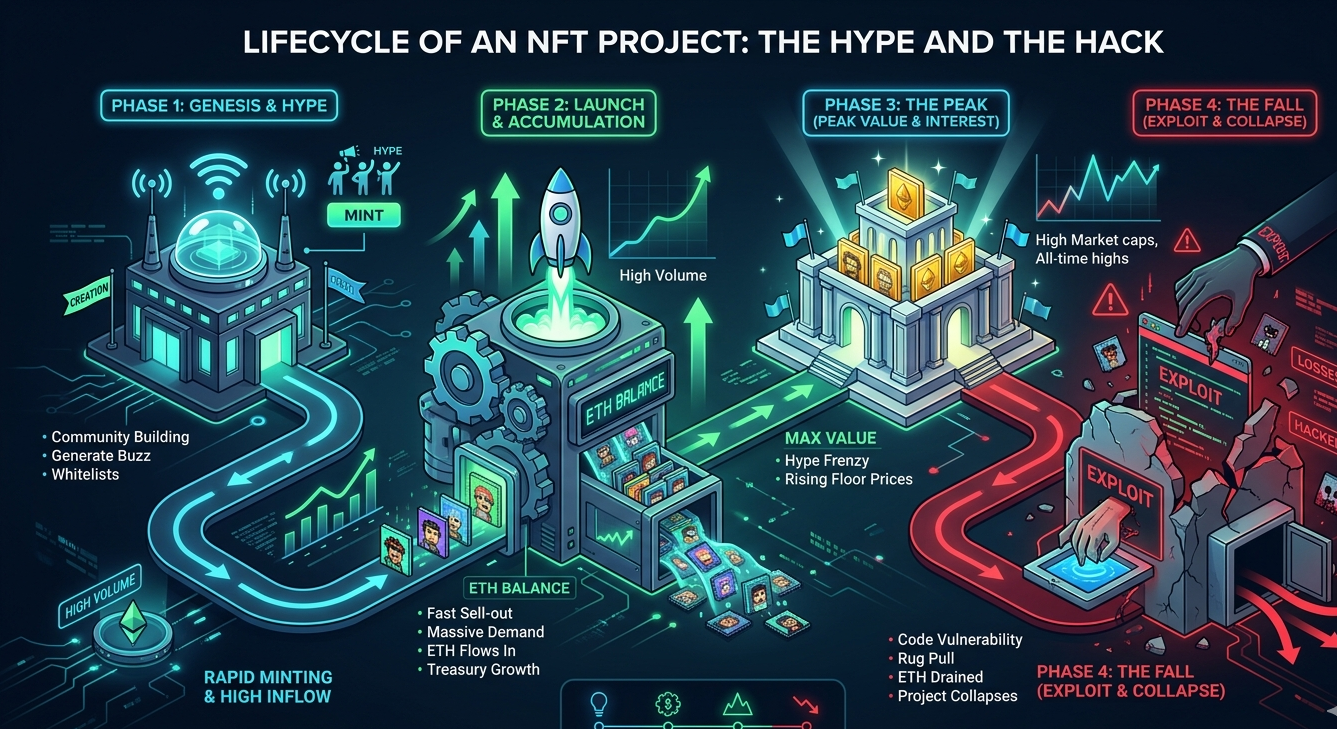
In recent years, NFT-related smart contract exploits have resulted in losses ranging from a few thousand dollars to tens of millions. Royalty bypasses, unlimited minting exploits, and access control failures have damaged projects that had strong art, engaged communities, and genuine potential. In every case, the technical foundation was the failure point.
Smart contract security for NFT projects is not simply about preventing theft. It is about building a project that functions correctly, treats holders fairly, and operates as promised. This guide covers what every NFT team needs to understand about smart contract security before, during, and after deployment.
The Unique Security Challenges of NFT Smart Contracts
NFT contracts are structurally different from simple token contracts. They manage not just fungible value but unique digital assets, metadata, ownership records, and increasingly complex utility mechanics. This complexity creates a correspondingly larger attack surface.
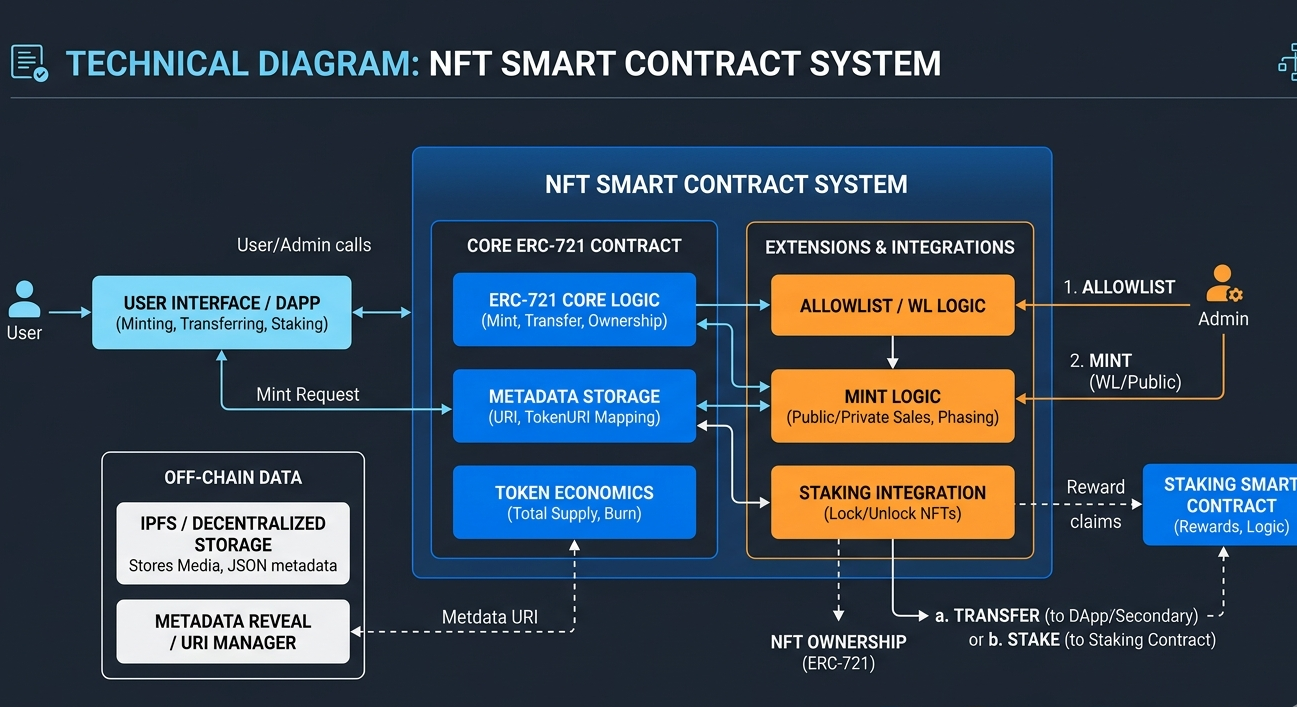
Most NFT projects implement the ERC-721 or ERC-1155 standards, but the vulnerabilities that matter most are rarely in the standard itself. They emerge from the custom logic that teams build on top of the standard, including mint mechanics, allowlists, royalty enforcement, reveal systems, and staking integrations.
Furthermore, NFT projects often involve significant financial concentration. A large mint can bring thousands of ETH into a contract in a matter of minutes. This makes NFT contracts extremely attractive targets during their most vulnerable period, which is right at launch.
Critical Smart Contract Security Vulnerabilities in NFT Projects
Unrestricted Minting
One of the most damaging vulnerabilities an NFT contract can have is unrestricted minting access. If the mint function lacks proper access controls or supply limits, an attacker can mint tokens far beyond the intended collection size. This directly dilutes holder value and destroys collection scarcity.
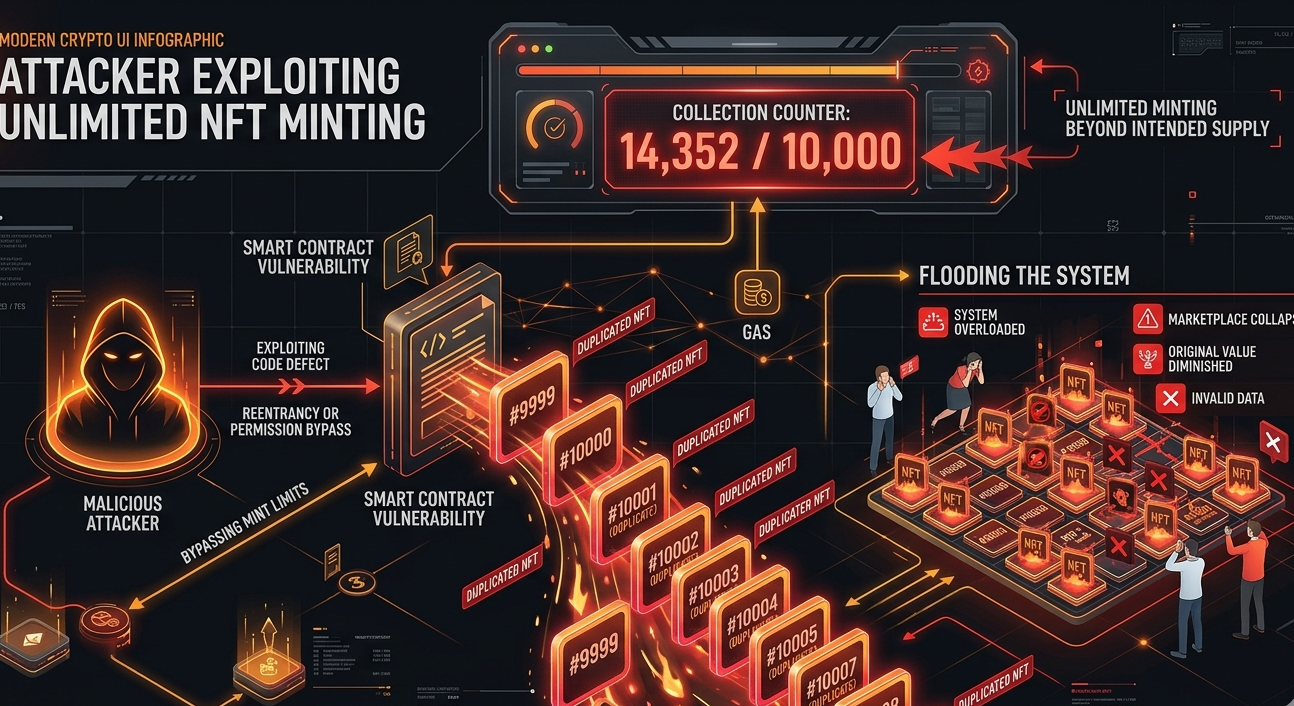
This vulnerability often appears when developers use public mint functions without checking total supply, when allowlist logic has bypasses, or when signature verification is implemented incorrectly. Notably, some projects have seen their entire collection minted in a single transaction by an attacker who identified an unprotected function.
Reentrancy in Mint and Withdraw Functions
Reentrancy is especially dangerous in NFT contracts that handle ETH directly. The mint function typically accepts payment, and the withdrawal function transfers funds to the project wallet. Both are high-value targets for reentrancy attacks.
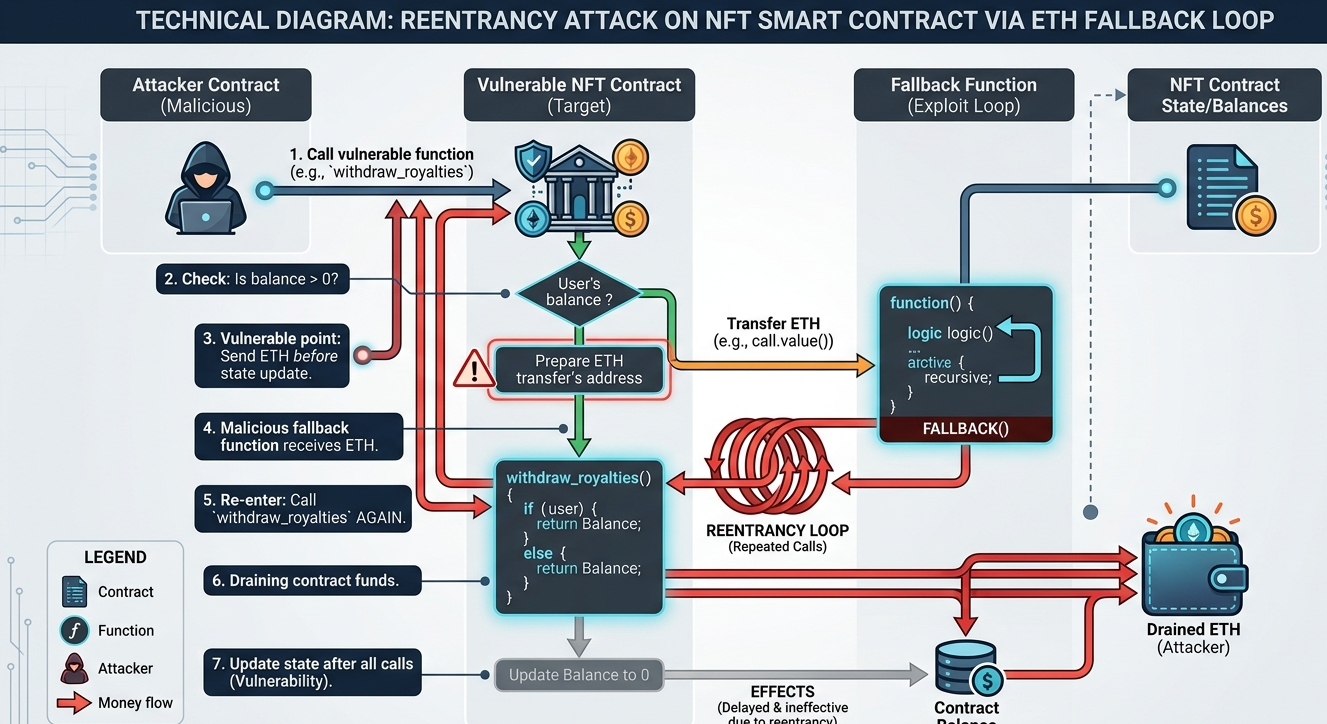
An attacker deploying a malicious contract with a fallback function can re-enter the target contract during a transfer operation, executing the function multiple times before the state is updated. This can drain the contract’s ETH balance entirely.
Metadata Manipulation and Reveal Exploits
Many NFT projects use a delayed reveal mechanic to build anticipation around trait distribution. However, if the randomness used to assign traits is predictable or manipulable, sophisticated actors can calculate which tokens will receive rare traits before the reveal and target those tokens specifically.
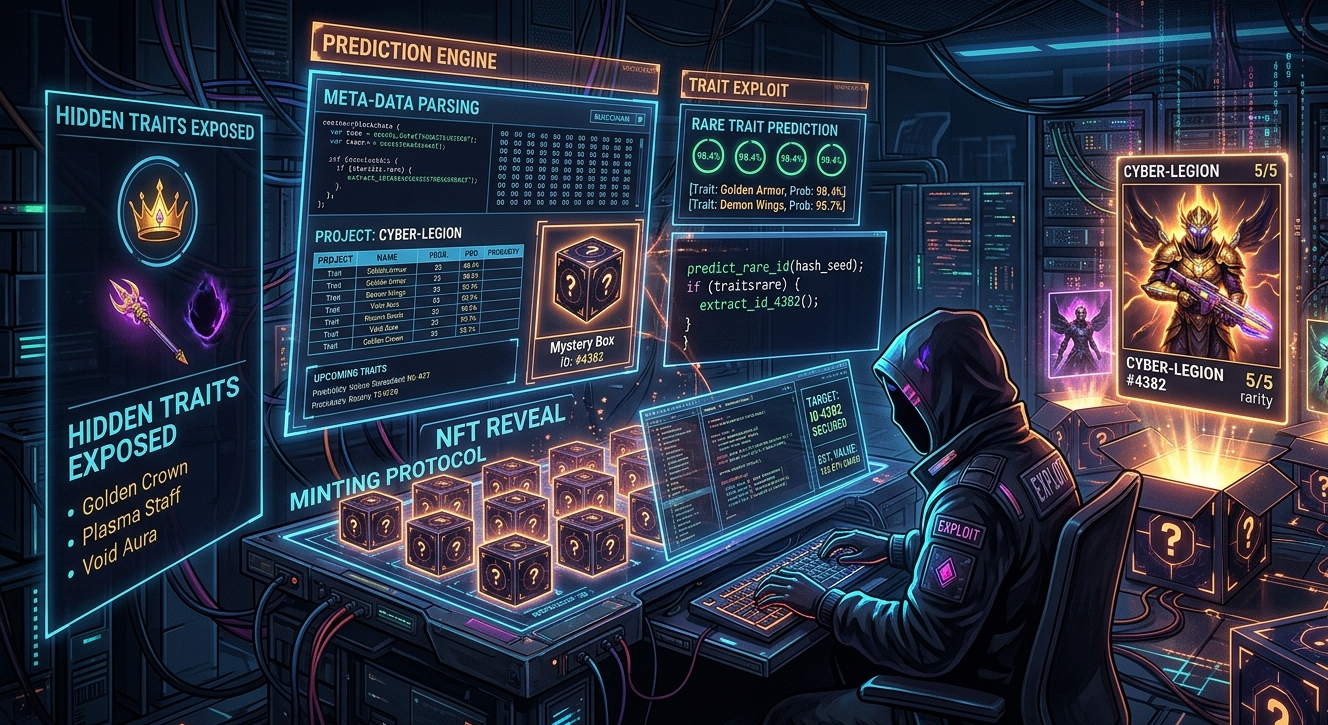
On-chain randomness using block data such as block.timestamp or block.difficulty is notoriously weak because miners and validators can influence these values. This is not a theoretical risk. It has been exploited in multiple notable projects.
Royalty Bypass Vulnerabilities
Creator royalties represent a significant part of the economic model for many NFT projects. However, royalty enforcement on Ethereum is not enforced at the protocol level for ERC-721 or ERC-1155. It depends on marketplace cooperation. Smart contract-level royalty enforcement mechanisms, when implemented poorly, can often be bypassed by routing transfers through non-compliant contracts.
Access Control Failures in Administrative Functions
NFT contracts frequently include administrative functions such as setting base URI, pausing minting, withdrawing funds, and updating royalty settings. When these functions are not properly protected, they become vectors for external exploitation or insider attacks.
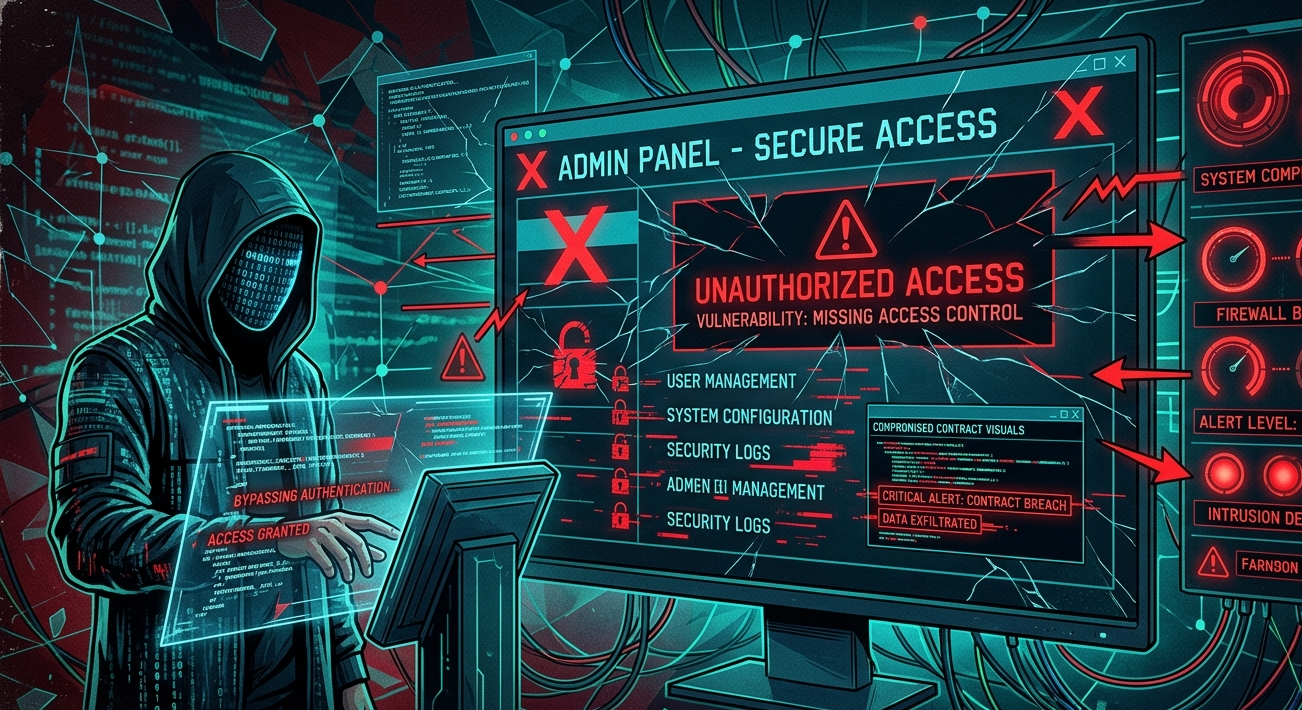
In several documented incidents, projects were compromised because the owner key was exposed or because the admin function was accessible to any address due to a missing access modifier.
Smart Contract Security During the Mint Phase
The mint phase is the highest-risk period in an NFT project’s lifecycle. Thousands of transactions hit the contract simultaneously, often under conditions the team never tested. Gas wars, bot activity, and high-volume concurrent minting can trigger edge cases that were invisible in testing.
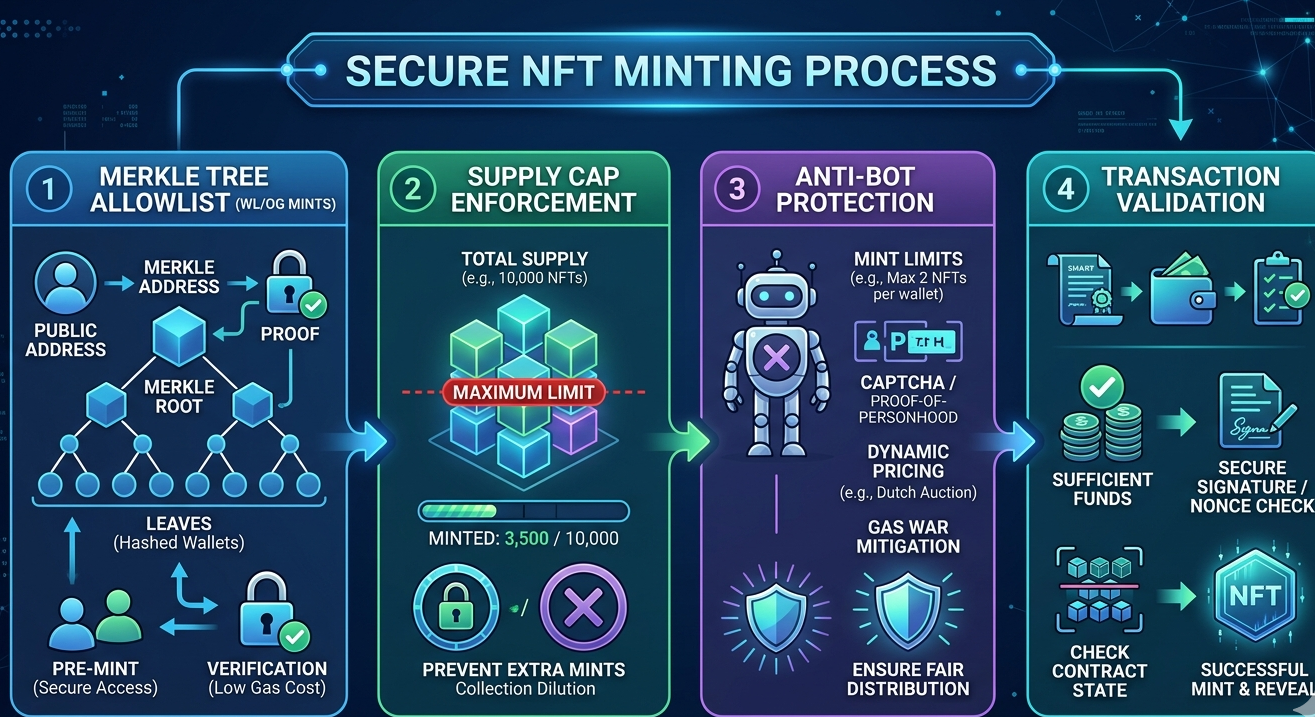
Allowlist implementations are a common source of mint-phase exploits. Merkle tree-based allowlists are more secure than centralized signature schemes, but both can be compromised if the underlying logic has flaws. Teams should ensure that allowlist checks cannot be bypassed by manipulating the call data or exploiting signature reuse.
Moreover, supply tracking must be reliable under concurrent minting pressure. Contracts that use off-chain counters or optimistic supply checks have been exploited by attackers who submitted multiple transactions in the same block to exceed intended supply limits.
Post-Mint Security Considerations
Many NFT teams believe that once the mint is complete, the primary security risk has passed. This is a dangerous misconception. Post-mint security threats are numerous and often underappreciated.
Staking contracts that lock NFTs introduce new attack surfaces. If the staking contract has a vulnerability, it can be exploited to steal locked NFTs or drain accumulated rewards. Similarly, games, utilities, and secondary mechanics built on top of NFT ownership all extend the attack surface beyond the original collection contract.
Additionally, metadata management remains a security concern post-mint. If the base URI points to a mutable endpoint, the project operator or an attacker who compromises the admin key can change what every NFT displays. This is a systemic trust risk that many holders do not fully understand.
How Solidity Shield Addresses NFT Contract Risks
Solidity Shield provides structured smart contract security auditing built for the full complexity of NFT projects. It goes beyond the base ERC-721 or ERC-1155 implementation to examine the custom logic that most projects introduce and most exploits target.
The audit methodology used by Solidity Shield covers mint mechanics, randomness sources, access control implementation, withdrawal patterns, royalty logic, and all integration points between the NFT contract and connected protocols. This comprehensive approach means that vulnerabilities in the peripheral logic are caught as reliably as vulnerabilities in the core contract.
For NFT projects preparing for a high-volume mint, Solidity Shield’s audit process includes stress-testing the contract logic against scenarios that simulate real-world mint conditions. This provides confidence that the contract will behave correctly not just in normal operation but under the adversarial conditions of a live launch.
Furthermore, Solidity Shield delivers audit reports with actionable remediation guidance. Finding a vulnerability is valuable. Knowing exactly how to fix it is what actually protects your project.
Building a Security-First NFT Project
Security should be designed into an NFT project from the beginning, not bolted on at the end. This starts with choosing the right standards and libraries. OpenZeppelin’s audited implementations of ERC-721 and ERC-1155 provide a solid foundation, but they are only as secure as the custom logic built on top of them.
Teams should write comprehensive tests before any audit begins. A project that arrives at an audit with low test coverage is not just unprepared. It is sending a signal that the code has not been challenged. Comprehensive tests document the intended behavior of every function and make it far easier to verify that remediations are correct.
In addition, conducting an internal security review before the formal audit is an effective way to catch obvious issues early. This reduces the audit cost and allows the professional auditor to focus on complex logic rather than basic code quality issues.
Real-World Scenario: The Allowlist Bypass
A mid-sized NFT project launched with an allowlist mint designed to give early supporters first access. The allowlist was implemented using a signature verification scheme where the backend signed eligible addresses. However, the signature verification did not include the mint quantity in the signed data.
An attacker discovered that they could use their valid allowlist signature to mint multiple tokens in a loop, far exceeding their intended allocation. By the time the team identified the issue, the attacker had minted over two hundred tokens, undermining the fairness of the allowlist and creating significant community backlash.
This is a precise example of a business logic vulnerability that automated scanners would not catch. Only a manual review with awareness of how allowlist systems can be abused would have identified the missing quantity check. That is the kind of analysis Solidity Shield is designed to deliver.
Conclusion
NFT projects live and die by community trust. Smart contract security is one of the most direct investments in that trust that any team can make. A contract that behaves exactly as promised, that cannot be exploited, and that protects holder assets is the foundation of every successful NFT project.
The vulnerabilities are real, the exploits are well-documented, and the cost of a compromise extends far beyond the immediate financial loss. It affects reputation, community confidence, and the long-term viability of the project.
Solidity Shield provides the depth of analysis that NFT smart contracts require. If you are building an NFT project, make security a first-class concern from the start. The mint will be safer, the post-launch period will be more stable, and your holders will have genuine reason to trust what you have built.
Frequently Asked Questions
1. What is the most common smart contract vulnerability in NFT projects?
Access control failures and reentrancy in payment-handling functions are among the most common vulnerabilities. Allowlist bypass exploits are also frequently seen in projects that implement custom signature verification without proper parameter binding.
2. How do I make my NFT mint secure against bots and front-running?
Commit-reveal schemes, Merkle tree-based allowlists, and rate limiting at the contract level are effective techniques. However, each implementation must be audited carefully to ensure the protections cannot themselves be exploited.
3. Is the ERC-721 standard itself secure?
The ERC-721 standard interface is well-established and not inherently insecure, but the vulnerabilities that matter most arise in the custom implementation logic built on top of it. The standard does not protect against poorly written mint functions, weak randomness, or access control mistakes.
4. Should an NFT project be audited before or after the reveal?
The audit should be completed before the mint. Any randomness or reveal mechanism should be reviewed as part of the audit to ensure it cannot be manipulated. Post-mint audits of utility contracts and staking modules are also valuable.
5. Can royalty enforcement be made secure at the contract level?
Full royalty enforcement at the contract level is technically difficult on Ethereum without restricting transfers to approved marketplaces. Newer standards and operator filter registries offer partial solutions, but any royalty implementation should be reviewed for bypass vectors as part of the audit process.