

The promise of cross-chain interoperability is compelling. Move assets seamlessly between Ethereum, BNB Chain, Solana, and a dozen other networks. Access liquidity wherever it lives. Build applications that are not constrained by the boundaries of any single blockchain. The vision is driving enormous developer investment and user adoption.

The security reality is considerably more complicated. Cross-chain protocols introduce a class of smart contract security challenges that do not exist in single-chain deployments. The attack surface expands dramatically. Trust assumptions multiply. And when something goes wrong, the consequences can be catastrophic at a scale that purely single-chain exploits rarely reach. Some of the largest crypto losses in history have come from cross-chain bridge hacks.
Why Cross-Chain Architecture Creates Unique Security Risks
In a single-chain protocol, the security model is relatively contained. You write contracts, deploy them on one blockchain, and reason about their security within that single execution environment. The rules are well-understood. The attack surface is bounded.
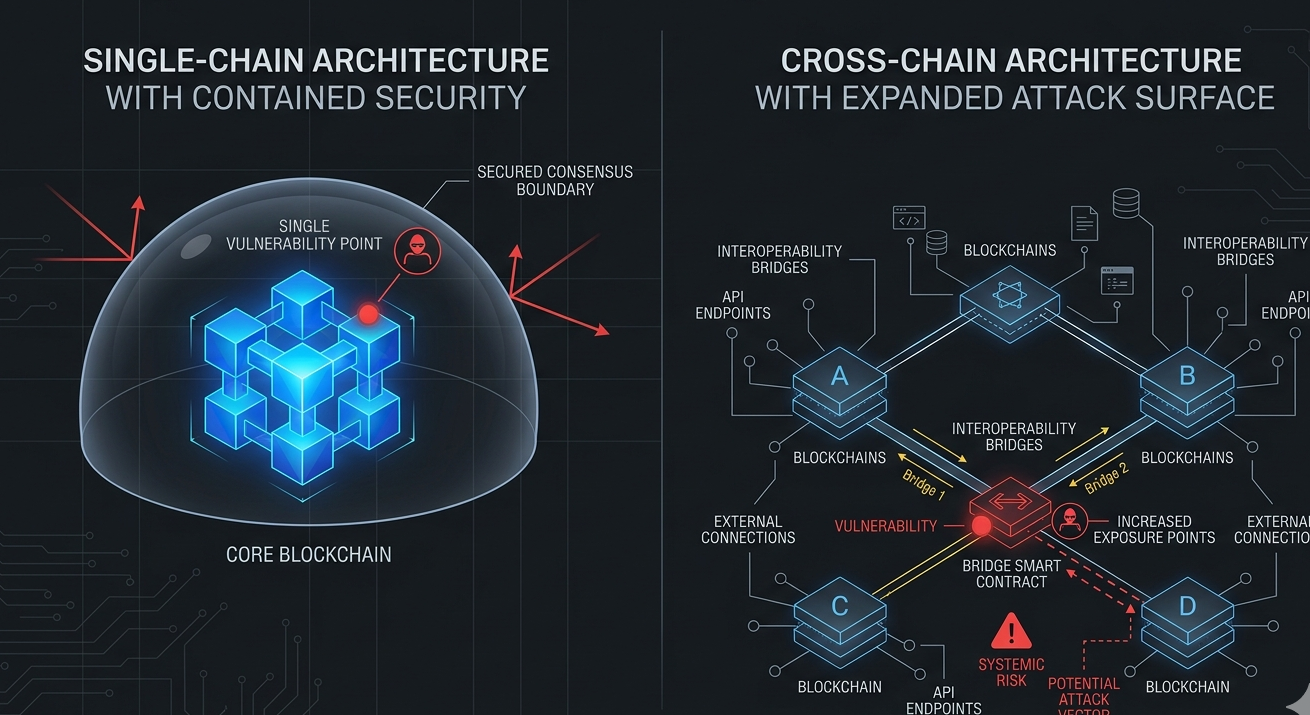
Cross-chain protocols break this containment. At their core, they involve a message or asset leaving the security context of one blockchain and entering the security context of another. The bridge or interoperability protocol in between must maintain security guarantees that neither blockchain enforces natively. That gap is where most cross-chain exploits originate.
The fundamental challenge is trust. On a single chain, the blockchain itself provides trust through consensus. In a cross-chain context, you are introducing external systems, validators, relayers, or multisig committees to attest that something happened on one chain so it can be acted upon on another. Each of these intermediaries is an attack surface that does not exist in a purely single-chain architecture.
Bridge Vulnerabilities: The Most Dangerous Category
Cross-chain bridges have been the site of the largest smart contract exploits in Web3 history. The Ronin bridge hack, the Wormhole exploit, the Nomad bridge attack, each involved hundreds of millions of dollars in losses and each revealed a different failure mode in cross-chain smart contract security.

The Ronin hack exposed the risk of validator centralization. A small number of validators controlled the bridge’s security, and an attacker who compromised the requisite number of validator keys could forge withdrawal approvals. The bridge contract was not buggy in the traditional sense. The vulnerability was in the trust architecture that the contracts depended on.
The Wormhole exploit was more classic: a signature verification flaw allowed an attacker to mint wrapped tokens on Solana without actually locking assets on Ethereum first. This was a code vulnerability, the kind that rigorous pre-deployment audit processes are designed to catch.
The Nomad attack exploited a contract upgrade that introduced a logic flaw allowing anyone to spoof messages. The interesting feature of this exploit was that it was copycat in nature: once one attacker found the flaw, dozens of others replicated the attack, draining the bridge in a chaotic free-for-all.
These three different failure modes illustrate that cross-chain smart contract security requires thinking systematically about code correctness, trust architecture, and upgrade safety simultaneously.
The Complexity of Auditing Cross-Chain Contracts
For teams building cross-chain protocols, the audit challenge is meaningfully more complex than for single-chain deployments. This complexity has direct implications for how to approach pre-deployment security.
First, the codebase spans multiple chains. The Solidity contracts on Ethereum, the Move or Rust programs on other chains, and the off-chain relayer or validator software all need to be understood as a unified system. Vulnerabilities can emerge from incorrect assumptions about how behavior on one chain is interpreted on another.
Second, the trust model must be explicitly analyzed. Who or what is trusted to attest to cross-chain events? What happens if that trust is compromised? What is the minimum number of validators, signers, or proofs required for a malicious actor to forge a message? These are not code-level questions. They are architecture-level questions that must be answered before the code review begins.
Third, edge cases in cross-chain protocols are more numerous and harder to enumerate. Message replay attacks, message ordering attacks, and chain reorganization scenarios all create edge cases that do not exist in single-chain protocols. A thorough pre-deployment analysis must account for these systematically.
Solidity Shield supports this kind of comprehensive pre-deployment analysis for the Solidity components of cross-chain systems. Identifying vulnerabilities in bridge contracts, message verification logic, and token locking and unlocking mechanisms before deployment is the minimum necessary foundation for a secure cross-chain protocol.
Relayer and Validator Risk: Off-Chain Components in On-Chain Security
One of the most underappreciated risks in cross-chain protocols is that the security model typically depends on off-chain components. Relayers carry messages between chains. Validators attest to cross-chain events. Oracle networks provide price data that bridge calculations depend on.
These off-chain components are outside the scope of smart contract audits in the traditional sense. Yet their compromise can make the on-chain contracts completely insecure regardless of how well the code was written.
Security-conscious cross-chain protocol teams address this by analyzing the trust assumptions their contracts make about off-chain components explicitly. They design for minimum trust: how can the protocol remain secure even if a minority of validators or relayers misbehave? They implement economic security through slashing conditions and bonding requirements. They design fraud proof mechanisms that allow honest actors to challenge malicious attestations.
None of this replaces smart contract code review. Rather, it adds a layer of analysis that is uniquely required in cross-chain contexts. Teams that use Solidity Shield for their bridge contract analysis get rigorous code-level coverage. They then need to layer in explicit trust model analysis as a complement.
Message Verification: Where Many Exploits Begin
A recurring theme in cross-chain exploits is failures in message verification logic. The bridge contract on the destination chain needs to verify that the message it received actually originated on the source chain and has not been tampered with. Getting this wrong is catastrophic.
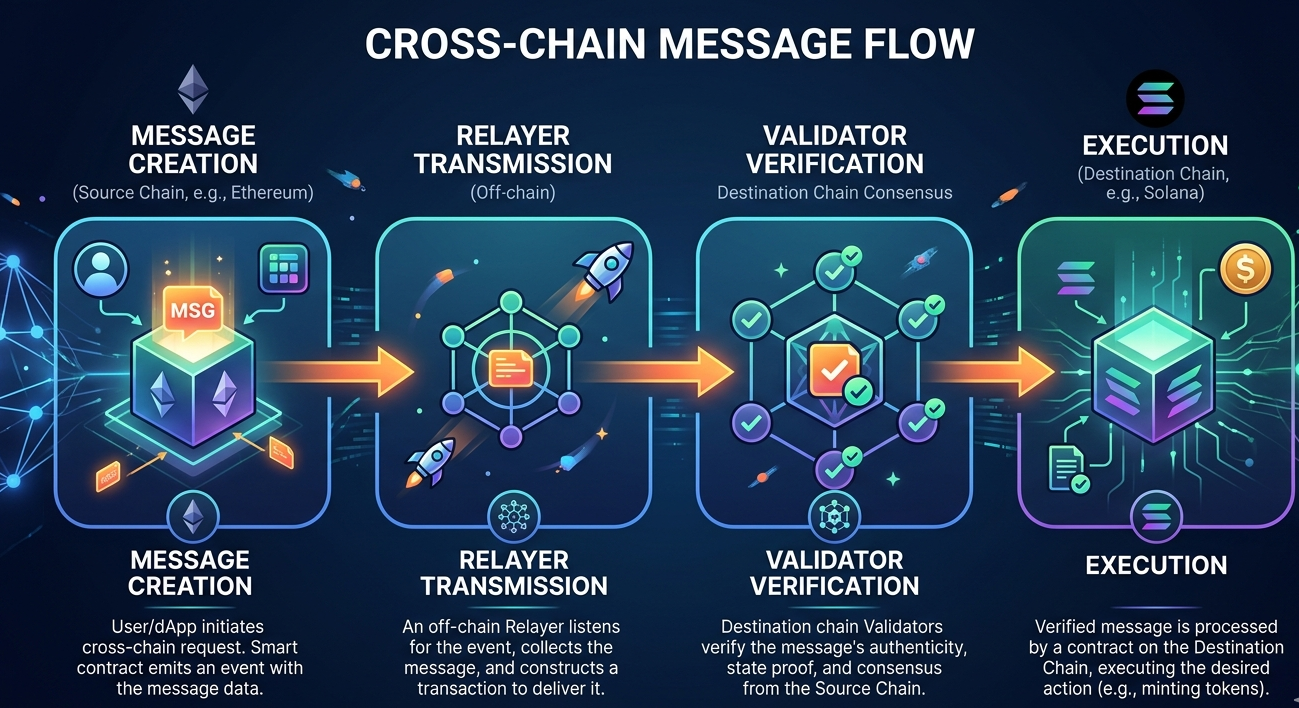
Verification failures can take several forms. Signature verification bugs allow forged messages that the contract accepts as legitimate. Replay protection failures allow a valid message to be processed multiple times. Missing nonce checks allow message ordering attacks. Incorrect chain ID validation allows a message from one chain to be replayed on a different chain.
These are exactly the kinds of vulnerabilities that rigorous pre-deployment analysis is designed to catch. Solidity Shield’s vulnerability detection covers signature verification, access control, and logical correctness issues that directly apply to message handling in bridge contracts. The specificity of the analysis matters: a generic scanner may flag common patterns, but a comprehensive audit of bridge message verification requires understanding the full flow of how messages are created, relayed, and processed.
Upgrade Safety in Cross-Chain Protocols
Upgrade mechanisms in cross-chain protocols deserve particular attention. Many bridge contracts use upgradeable proxy patterns to allow bug fixes and feature additions. These patterns introduce their own security risks, and in a cross-chain context, those risks are amplified.

An upgrade to a bridge contract can change the assumptions that the corresponding contracts on other chains rely on. If the Ethereum-side contract is upgraded in a way that changes how it interprets messages from the BNB Chain side, the bridge may behave incorrectly or exploitably without any individual contract containing a bug. The vulnerability is in the interaction between the upgraded contract and its unchanged counterparts.
This means upgrade management for cross-chain protocols must be coordinated across all chains simultaneously. Upgrade authorization must be carefully access-controlled, with governance mechanisms that are themselves resistant to attack. The Nomad exploit, mentioned earlier, was triggered by an upgrade that inadvertently introduced a vulnerability. It is a cautionary example of how upgrade safety must be treated as a first-class concern.
Solidity Shield’s pre-deployment analysis includes evaluation of upgrade patterns and proxy safety. For cross-chain protocols specifically, this analysis should be applied to every upgrade in addition to the initial deployment, given the cascade risks of uncoordinated changes.
Liquidity Risk and Economic Security in Bridges
Cross-chain bridges that hold significant liquidity are targets not just for code exploits but for economic attacks. An attacker who finds a way to mint wrapped tokens without locking collateral effectively creates money from nothing, up to the total liquidity held in the bridge.

This concentration of value in bridge contracts creates a risk profile that is unlike most other smart contract types. The potential reward for finding a bridge vulnerability scales with the total value locked. Bridges holding hundreds of millions of dollars attract attacker attention commensurate with that prize.
The economic security response to this reality is a combination of technical rigorous, particularly in the areas most directly related to the lock-and-mint mechanism, and architectural choices that limit the maximum damage from a single exploit. Caps on bridge liquidity, time delays on large withdrawals, and circuit breakers that halt operations when anomalous patterns are detected all reduce the potential impact of a successful attack.
These architectural choices must be built into the contracts from the start and validated in pre-deployment analysis. Retrofitting them into deployed contracts is possible in some cases but difficult and introduces new risks. Getting the design right before deployment, with Solidity Shield’s comprehensive analysis as a quality gate, is the right approach.
Building Cross-Chain Security Practices
Given the complexity of cross-chain smart contract security, teams building in this space need a more systematic approach than single-chain teams can get away with.
The foundational step is comprehensive pre-deployment analysis of every contract component across all chains involved. Solidity Shield provides this for the Solidity components. Equivalent rigor needs to be applied to any other chain-specific code. This is not the place to cut corners.
Trust model documentation should be explicit and reviewed independently of the code. What is assumed about validator behavior? What is the attack cost to compromise the bridge’s security guarantees? What monitoring is in place for validator misbehavior? These questions deserve explicit answers before deployment.
Staged deployment with limited liquidity allows teams to test real on-chain behavior before concentrating significant value in a new bridge. Security under real conditions sometimes reveals edge cases that testing environments miss.
Conclusion
Cross-chain protocols represent some of the most complex smart contract security challenges in Web3. The combination of multi-chain codebases, off-chain trust dependencies, and concentrated liquidity creates an attack surface that demands more rigorous security practices, not less.
Solidity Shield addresses the code-level foundation of this challenge. Comprehensive pre-deployment analysis of bridge contracts, message verification logic, and upgrade mechanisms is the starting point from which everything else in a cross-chain security strategy builds.
In cross-chain security, thorough pre-deployment analysis is not optional. It is the minimum viable foundation.
FAQs
Q1. Why are cross-chain bridges such frequent targets for exploits?
Bridges concentrate large amounts of liquidity in contracts that depend on off-chain trust assumptions, such as validator attestations or relayer messages. This combination creates a high-value target with an expanded attack surface. Flaws in message verification, validator coordination, or upgrade management can allow attackers to drain bridge liquidity entirely.
Q2. What are the most common smart contract vulnerabilities specific to cross-chain protocols?
Cross-chain vulnerabilities frequently involve signature verification failures, replay attack vectors, incorrect chain ID validation, and unsafe upgrade patterns. Additionally, trust model failures where a minority of validators can forge messages have been responsible for several of the largest bridge exploits in Web3 history.
Q3. How does Solidity Shield help with cross-chain smart contract security?
Solidity Shield provides comprehensive pre-deployment analysis for the Solidity components of cross-chain systems, covering vulnerability detection in bridge contracts, message handling logic, access controls, and upgrade safety. This establishes the code-level security foundation that all other cross-chain security measures build upon.
Q4. Why are upgrade mechanisms particularly risky in cross-chain protocols?
Upgrades to contracts on one chain can change assumptions that corresponding contracts on other chains rely on. If upgrades are not coordinated across all chain components simultaneously, the interaction between updated and unupdated contracts can introduce vulnerabilities. Upgrade authorization must also be carefully protected against governance attacks.
Q5. What architectural measures help reduce the impact of a successful bridge exploit?
Liquidity caps limit the maximum value at risk. Time delays on large withdrawals create windows for detecting and responding to anomalous activity. Circuit breakers that pause operations when unusual patterns are detected can contain ongoing attacks. These architectural choices must be designed into contracts from the start and validated in pre-deployment analysis.