

Most teams treat smart contract security as a problem to solve before deployment. Audit the code, fix the findings, deploy, and move on. It is a reasonable approach on the surface. The problem is that it assumes the threat landscape ends at the moment your contract goes live. It does not.

The reality of on-chain security is considerably more uncomfortable. Smart contracts exist in a shared, adversarial environment where every transaction is public, every interaction can be observed, and well-resourced attackers actively monitor deployed protocols for exploitable conditions. The audit is necessary. However, it is not sufficient. And the growing body of evidence from post-deployment exploits makes this point difficult to dispute.
The Audit Gap: What Happens After Deployment
An audit captures the security posture of your code at a specific moment in time. It reflects the threat knowledge available when it was conducted, the state of your contracts as they existed at audit time, and the assumptions your auditors made about how the protocol would be used.
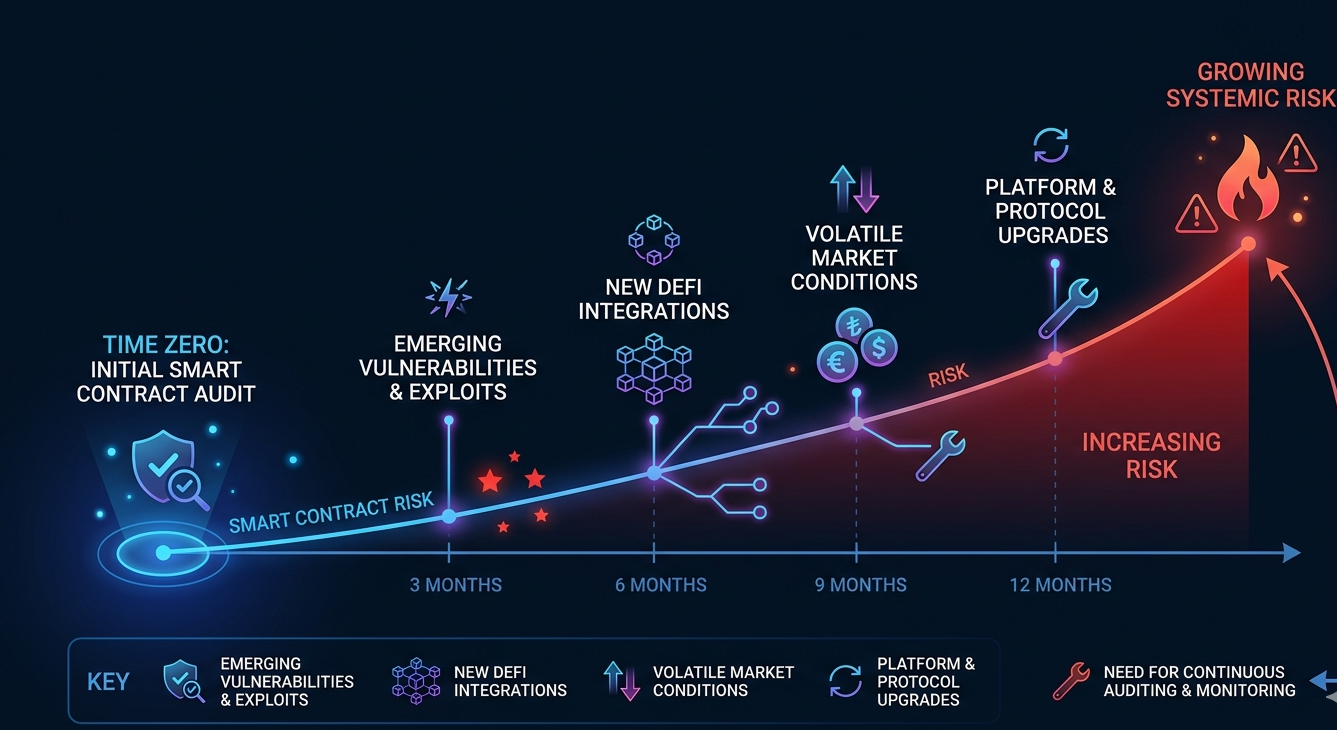
After deployment, all three of those anchors begin to drift. New attack techniques emerge. Integrations with other protocols introduce dependencies that were not in scope. User behavior evolves in ways that stress test edge cases the auditor did not anticipate. Economic conditions shift in ways that make previously theoretical attack vectors economically viable.
This drift is not hypothetical. Some of the most significant DeFi exploits have targeted contracts that passed rigorous audits. The vulnerability was not in the code as it existed at audit time. It emerged from the interaction between the deployed contract, the broader on-chain environment, and specific market conditions that only materialized months after launch.
Real-time monitoring addresses this by treating security as an ongoing operational function rather than a pre-launch checklist item.
What Real-Time Smart Contract Monitoring Actually Involves
The term is used loosely, so it is worth being precise about what meaningful real-time monitoring requires.
At its core, smart contract monitoring means continuously observing on-chain activity related to your contracts and evaluating that activity against a model of what normal and potentially anomalous behavior looks like. This involves tracking transaction patterns, function call sequences, state variable changes, fund flows, and interaction patterns with external contracts.

Meaningful monitoring goes beyond simple alerting on unusual transaction volumes. It requires understanding the protocol well enough to distinguish routine activity from genuine threats. A large withdrawal might be a whale user exercising their rights or it might be the first step in a multi-transaction exploit. The monitoring system needs context to tell the difference.
This is why effective monitoring is not simply a matter of deploying a generic alerting tool. It requires purpose-built analysis tailored to the behavior of the specific protocol being protected.
How Solidity Shield Supports a Proactive Security Posture
Solidity Shield’s role in smart contract security centers on the pre-deployment phase, where comprehensive vulnerability detection during the audit process establishes a strong security foundation. This foundation directly enables better monitoring outcomes.
When a contract has been thoroughly analyzed before deployment, the team understands its attack surface precisely. They know which functions handle value transfers, where access controls are implemented, what the expected behavior patterns are, and which edge cases the design intentionally handles. That understanding is invaluable when configuring monitoring and responding to anomalies.
Contracts that enter production with known vulnerabilities create monitoring blind spots. The monitoring team does not know what they are looking for because the audit did not give them a complete picture of where the risks lie. Solidity Shield’s structured audit output provides exactly the kind of detailed risk intelligence that makes post-deployment monitoring effective.
Think of it this way: Solidity Shield ensures you know your code before it goes live. That knowledge directly improves your ability to protect it after launch.
The Economic Logic of Continuous Security
There is a straightforward economic case for continuous smart contract security that often gets overlooked in discussions about cost.
Smart contract exploits are not random events. They are targeted attacks by financially motivated actors who invest significant time in finding and validating vulnerabilities. The expected return on a successful exploit can be enormous. Attackers rationally allocate their effort toward protocols where the probability of success times the potential reward justifies the investment.
A protocol with strong pre-deployment security and active post-deployment monitoring is a significantly harder target. The attacker’s probability of success decreases. The time required to find an exploitable condition increases. The risk of detection before extraction completes rises. From the attacker’s perspective, there are easier targets.
This is not purely theoretical. Security-hardened protocols in DeFi do get attacked. But they get attacked less frequently and the attacks that do succeed often exploit circumstances that no technical control could prevent. Systemic improvements in the security baseline genuinely change the risk calculus for the protocol.
Early Detection and Its Outsized Impact
In incident response, the single most important variable is time from threat emergence to detection. The faster a team identifies that something anomalous is happening, the more options they have.

In smart contract attacks, this window is often measured in seconds or minutes. Flash loan attacks execute within a single transaction. Multi-step exploits can drain significant value before any human could realistically respond. However, not all attacks are instantaneous. Many sophisticated exploits involve preparation phases, test transactions, and incremental probing that occurs well before the final extraction.
Early detection during preparation phases creates response opportunities that do not exist once the attack is fully underway. A team that notices unusual probing of specific contract functions can investigate, consult, and potentially intervene. A team that only knows about the attack after funds have moved has no such options.
Building this capability requires both the technical infrastructure for real-time observation and the operational preparedness to act on what monitoring surfaces.
Integrating Security Into Protocol Operations
The shift toward ongoing smart contract security requires treating security as a function of protocol operations, not just a development activity. This has practical implications for how teams are structured and how they operate.
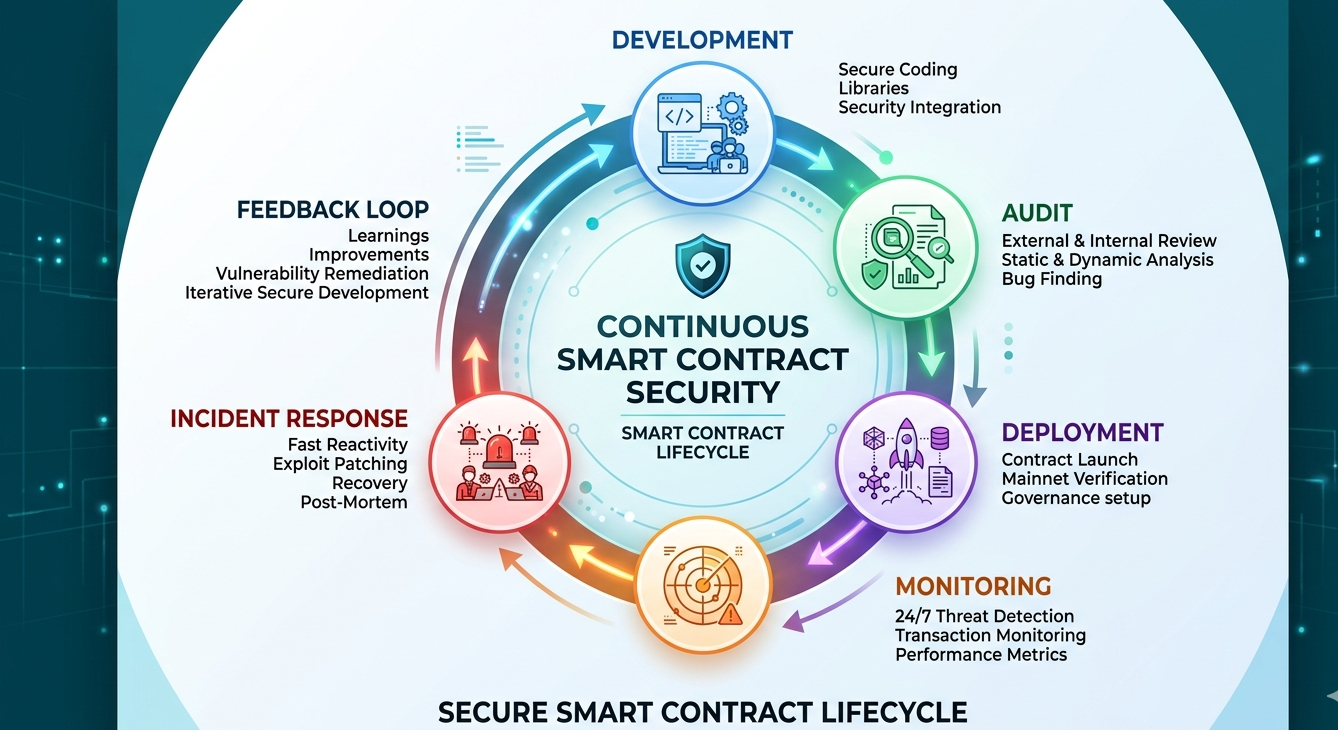
Development teams that build with Solidity Shield throughout the coding process carry security knowledge into deployment. They understand their code’s risk profile because they have engaged with security analysis continuously rather than as a final gate. That knowledge does not disappear at launch. It becomes operational intelligence.
The most security-mature Web3 teams have effectively merged their security and operations functions. Security findings from the development phase inform operational protocols. Monitoring alerts trigger responses from people who understand the technical context of what they are seeing. Post-incident analysis feeds back into the next development cycle.
This virtuous cycle starts with a strong pre-deployment foundation. Solidity Shield provides that foundation.
Threat Intelligence in an Open Environment
One underappreciated aspect of smart contract security is the radical transparency of the on-chain environment. Every transaction, every state change, and every contract interaction is publicly visible. This creates a counterintuitive situation where attackers have more visibility into your protocol than you might expect.

A sophisticated attacker can study your deployed contracts in detail, simulate attack scenarios against a local fork of the blockchain, and validate their approach before ever touching the live protocol. They operate in information-rich conditions.
Defenders have access to the same information. Every on-chain interaction with your contracts is visible to you as well. The question is whether you have the systems and the processes to derive security intelligence from that data.
This is where the combination of strong pre-deployment analysis through Solidity Shield and effective monitoring creates a meaningful defensive advantage. You know your code deeply, you understand its expected behavior, and you are watching its actual behavior continuously. That combination closes the information gap that attackers count on exploiting.
Smart Contract Security as a Competitive Differentiator
In an increasingly crowded Web3 landscape, security posture is emerging as a genuine competitive factor. Sophisticated users, institutional participants, and serious investors evaluate protocols not just on yield or features but on the quality of their security practices.

A protocol that has undergone rigorous pre-deployment auditing, maintains transparent security documentation, and operates with active monitoring is communicating something important to its users. It is signaling that the team takes their responsibility to protect user funds seriously.
This matters more than it did a few years ago. The Web3 community has a long memory for exploits. A protocol that loses user funds to a preventable vulnerability faces not just the direct financial cost but lasting reputational damage that affects user acquisition and retention for years.
Investing in comprehensive security with tools like Solidity Shield is, in this light, not just a risk management decision. It is a positioning decision.
The Path Forward for Smart Contract Security
The trajectory of smart contract security is toward continuous, intelligent, and integrated protection rather than point-in-time assessment. This is driven by the evolution of the threat landscape, the increasing complexity of on-chain protocols, and the growing financial stakes involved.
Teams that are building with this trajectory in mind are already differentiating themselves. They treat security as a development practice, not a pre-launch gate. They build with tools that support continuous analysis. They plan for post-deployment monitoring from the beginning of the development cycle. And they treat security intelligence as an ongoing operational input rather than a one-time report.
Solidity Shield supports this approach at the pre-deployment phase, where establishing a clean, well-understood security baseline is the most foundational step in the process.
Conclusion
Smart contract security cannot be reduced to a single audit before deployment. The on-chain environment is dynamic, adversarial, and transparent to all parties. Sustainable security requires building a strong foundation through rigorous pre-deployment analysis and maintaining active vigilance after launch.
Solidity Shield addresses the foundational layer. It gives development teams the depth of analysis they need to understand their code’s security profile before it ever faces a real adversary. That understanding is the starting point for everything that comes next in a mature security program.
Build securely from the start. The rest of your security program depends on it.
FAQs
Q1. Why is a one-time pre-deployment audit not enough for smart contract security?
Audits capture security at a specific point in time. After deployment, the threat landscape evolves, new integrations introduce dependencies, and economic conditions change in ways that create new attack vectors. Continuous monitoring complements the audit to address risks that emerge post-launch.
Q2. What role does Solidity Shield play in a continuous security program?
Solidity Shield handles the pre-deployment phase with comprehensive vulnerability detection and audit support. The detailed understanding of a contract’s risk profile that this process generates directly improves the effectiveness of post-deployment monitoring by ensuring teams know exactly what to watch for.
Q3. How does early detection of a smart contract attack change outcomes?
Earlier detection creates response options that disappear once an attack is fully underway. Many sophisticated exploits involve preparation phases with observable on-chain activity. Detecting anomalous behavior during preparation gives teams time to investigate and intervene before significant damage occurs.
Q4. What is the economic argument for continuous smart contract security investment?
Attackers rationally target protocols where the probability of success justifies their investment. Protocols with strong pre-deployment security and active monitoring are harder targets that require more attacker effort with higher detection risk. This changes the attacker’s cost-benefit analysis and genuinely reduces attack frequency.
Q5. How does on-chain transparency affect smart contract security strategy?
All on-chain activity is publicly visible, which means attackers can study deployed contracts in detail before attacking. However, defenders have the same visibility. Teams that actively monitor their on-chain activity can detect anomalous patterns that signal an attack in preparation, turning the transparency from a liability into a defensive asset.