

Most smart contract exploits are not clever breakthroughs. They are the same bugs appearing in new protocols, exploited by attackers who have studied what works. The honest reality is that the majority of funds lost to blockchain attacks over the past several years were lost to vulnerabilities that have been publicly documented for years. Reentrancy. Integer overflow. Broken access control. Unchecked external calls.
Understanding these vulnerabilities is not optional for Solidity developers. Every protocol launched on a public chain faces an adversarial environment from its first block. Attackers are patient, systematic, and financially motivated. The only effective response is building contracts that genuinely do not contain the bugs they look for.
This article covers the most common smart contract security bugs in detail. For each one, you will understand what it is, why it is dangerous, and precisely how to fix it.
Reentrancy: The Persistent Threat
Reentrancy has been responsible for some of the largest losses in blockchain history. The DAO hack in 2016 drained 60 million dollars through a reentrancy exploit. Despite this well-documented history, reentrancy vulnerabilities continue to appear in new protocols.
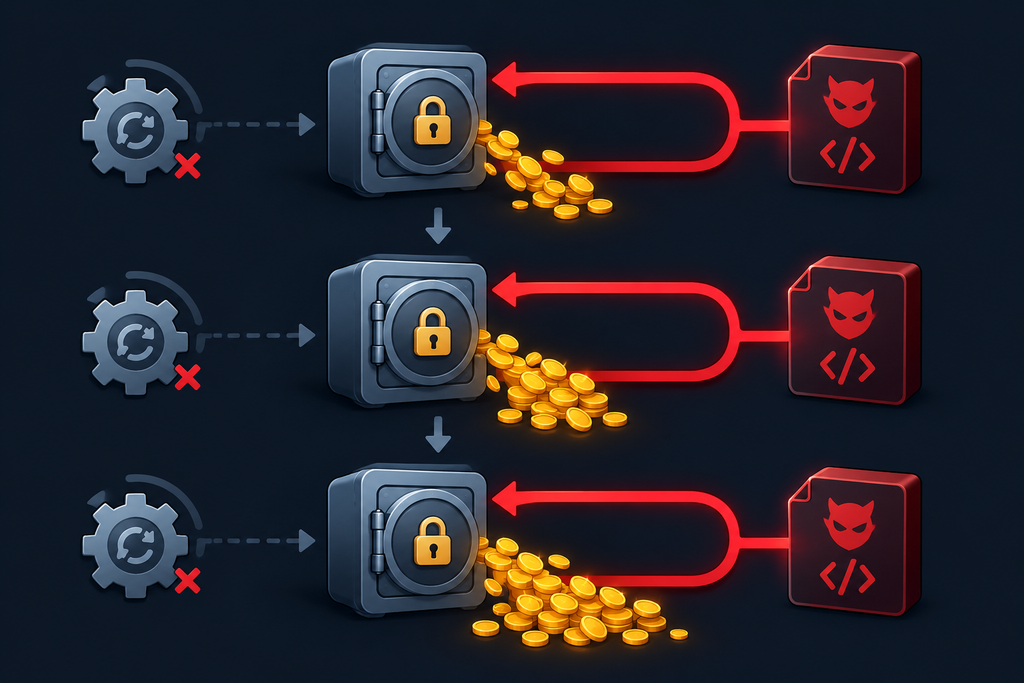
The mechanism is straightforward. A contract function sends ETH to an external address before updating its internal state. The receiving address is a malicious contract with a fallback function. That fallback function calls back into the original contract before the balance update has committed. The original contract still reflects the old balance, so it sends ETH again. The cycle repeats until the contract is drained.
The fix has two components. First, always follow the checks-effects-interactions pattern. Update all state before making any external calls. Second, apply OpenZeppelin’s nonReentrant modifier to any function that makes external calls. Used together, these defenses eliminate reentrancy as a viable attack path. Applying only one of the two is better than neither, but the combination provides genuine protection.
Integer Overflow and Underflow: Silent Destroyers
Before Solidity 0.8.0, arithmetic in smart contracts was entirely silent about overflow. A uint256 value at its maximum could be incremented to zero. A uint256 at zero could be decremented to its maximum. These wrapping behaviors produced catastrophic logical errors that were completely invisible without explicit bounds checking.
Several significant protocol losses occurred because of overflow conditions in token balance tracking. An attacker who could engineer an overflow in a balance variable could suddenly appear to hold enormous amounts of tokens without having deposited them.
Solidity 0.8.0 and later reverting on overflow by default solved this for most developers. However, two scenarios remain dangerous. First, developers working with legacy code written before 0.8.0 may be maintaining contracts where SafeMath was not consistently applied. Second, any arithmetic inside an unchecked block in modern Solidity will silently wrap. If you are using unchecked for gas optimization, you are taking on the responsibility for reasoning about every arithmetic operation within that block.
Access Control Failures: Unauthorized Power
Access control vulnerabilities occur when functions that should be restricted to specific callers can be called by anyone. The consequences range from parameter manipulation to complete protocol takeover. In several documented attacks, attackers called administrative functions that should have been protected by owner-only restrictions but were either missing their modifier or had a modifier that contained a logic error.
The most basic fix is ensuring every sensitive function has an explicit access control check. Whether you use a simple onlyOwner modifier, OpenZeppelin’s AccessControl with role-based permissions, or a custom multi-signature governance system depends on the complexity of your protocol. For anything beyond a simple contract, role-based access control provides the flexibility to grant fine-grained permissions without concentrating all power in a single owner address.
A subtle variant of this bug is the unprotected initializer. Upgradeable contracts often use an initialize function instead of a constructor. If this function is not protected to prevent calling it more than once, an attacker can reinitialize the contract after deployment and set themselves as the owner. OpenZeppelin’s Initializable contract with the initializer modifier prevents this.
Unchecked Return Values: Silent Failures
When a Solidity contract calls an external function using the low-level call interface, the call returns a boolean indicating whether it succeeded or failed. A common bug is ignoring this return value and proceeding as if the call succeeded regardless of the actual outcome.
Consider a contract that calls an external token contract’s transfer function and then updates its internal accounting assuming the transfer succeeded. If the transfer failed silently and the return value was not checked, the internal state now reflects a transfer that never happened. This discrepancy can be exploited in various ways depending on the protocol logic.
The fix is always to check return values from external calls and to revert if the expected outcome was not achieved. For token transfers specifically, use OpenZeppelin’s SafeERC20 library, which wraps token calls with proper success checking and handles tokens that do not return a boolean correctly.
Front-Running: Transaction Ordering Manipulation
Front-running exploits the public nature of the blockchain mempool. Before a transaction is included in a block, it is visible to anyone monitoring the network. An attacker who sees a profitable pending transaction can submit their own transaction with a higher gas price, causing it to be included first and capturing the opportunity.
This is particularly relevant for DEX trades, NFT mints at a specific price, and any action where the outcome depends on being first. Commit-reveal schemes address some front-running risks by requiring users to first commit to an action cryptographically, then reveal it in a subsequent transaction. By the time the reveal happens, the attacker knows what the user intends but the commitment has already been made.
For many protocol designs, perfect front-running resistance is not achievable. The practical goal is to make front-running economically unattractive by limiting the profit available from any single transaction ordering exploit.
Denial of Service via Gas Limit Attacks
A denial of service vulnerability in a smart contract makes some function or the entire contract permanently or temporarily unusable. One class of DoS attack involves deliberately making a function consume enough gas to exceed the block gas limit, preventing it from ever executing successfully.
This commonly occurs in contracts that loop over user-supplied arrays. If an attacker can add thousands of entries to an array that your contract iterates over in a single transaction, they can make that transaction exceed the gas limit and fail every time it is called. If the function being blocked is essential to protocol operation, this is effectively a protocol freeze.
The fix is to avoid unbounded loops over data structures that external users can grow. Use pagination patterns for large data sets. Design withdrawal functions that allow users to pull their own funds rather than having the contract push funds to a list of recipients. The pull-over-push pattern is a fundamental design principle that eliminates entire classes of DoS vulnerabilities.
Oracle Manipulation: Corrupted Price Data
Many DeFi protocols depend on price data from on-chain oracles. If that price data can be manipulated, the protocol can be tricked into making decisions based on false information. Flash loan attacks have enabled some of the largest oracle manipulation exploits in DeFi history, where attackers borrow enormous sums, move a market within a single transaction, exploit the manipulated price, and repay the loan all in one block.

On-chain spot prices from decentralized exchanges are particularly vulnerable because they reflect the state of the pool at a single point in time. A large trade can dramatically move this price within a single transaction. Using time-weighted average prices across multiple blocks makes manipulation significantly more expensive because the attacker would need to maintain the manipulated price across multiple blocks rather than just one.
For high-value protocols, using reputable decentralized oracle networks with multiple data sources and deviation bounds provides substantially better manipulation resistance than on-chain price calculation.
Logic Errors: The Hardest Bugs to Catch
Not every smart contract vulnerability is a known vulnerability class. Some of the most damaging exploits have targeted logic errors specific to a particular protocol’s design. A calculation that produces the wrong result under specific conditions. A state machine that can reach an invalid state through an unexpected sequence of transactions. A fee calculation that can be gamed to extract value.
Logic errors are the hardest category to catch because automated tools cannot reliably identify them. They require understanding the intended behavior of the protocol, understanding all possible ways to deviate from that behavior, and reasoning about what an attacker could gain from each deviation.
This is precisely where tools like Solidity Shield provide their deepest value. The vulnerability detection in Solidity Shield is not limited to pattern matching against known bug classes. Expert reviewers analyze the protocol logic to identify unexpected behaviors specific to the architecture being audited. For logic errors in particular, this kind of contextual expert review is what separates a meaningful audit from a checklist exercise.
Timestamp Dependence: Time Cannot Be Trusted
Block timestamps in Solidity represent the time at which a block was mined, as reported by the miner. Miners have a small degree of control over this value, generally within about 15 seconds. While this window is narrow, for contracts where even a small timestamp adjustment creates a profitable opportunity, it is sufficient.
Contracts that rely on block.timestamp for critical decision points, such as determining when a vesting period has elapsed, when a time lock expires, or when a lottery resolves, should build in a tolerance window that makes the 15-second miner adjustment range economically insignificant. Additionally, using block numbers instead of timestamps provides a more predictable reference point, though it is not immune to manipulation in proof-of-stake environments.
How Solidity Shield Catches These Bugs Before Deployment
The bugs described in this article are not theoretical. Every single one has been exploited in production. The consistent thread running through most post-exploit analyses is that the vulnerability would have been caught by a thorough pre-deployment audit.
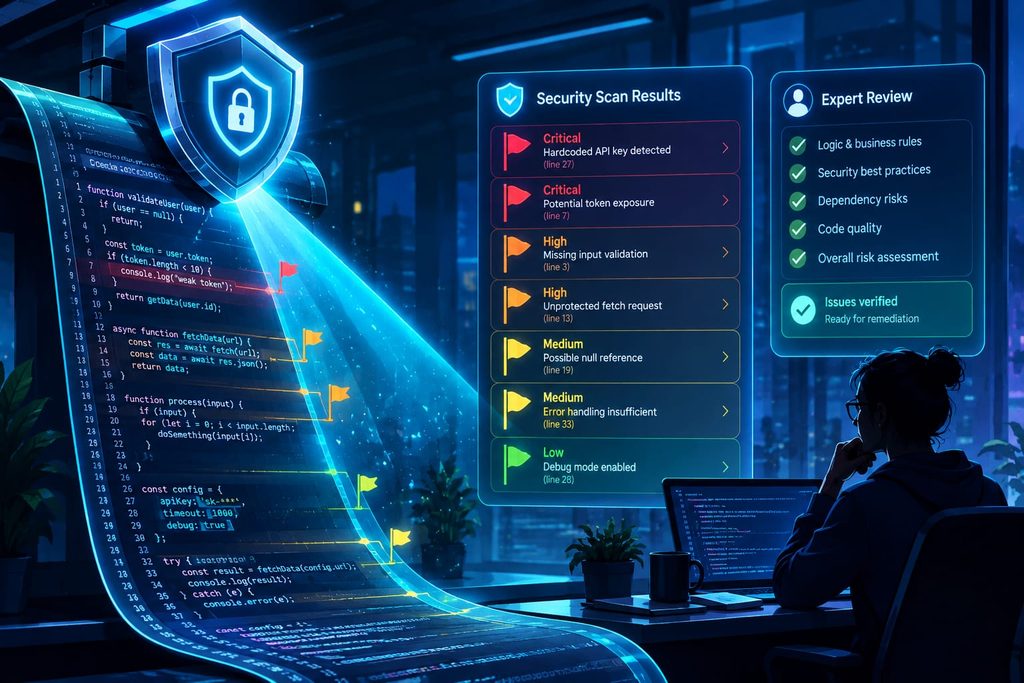
Solidity Shield by SecureDApp runs systematic analysis across all of these vulnerability categories. Reentrancy patterns, access control gaps, unchecked return values, integer arithmetic issues, logic flows that could produce unexpected outcomes. The tool combines static analysis with expert manual review to provide coverage that neither approach achieves alone.
Protocols that use Solidity Shield before deployment do not just check a compliance box. They gain a structured report of every identified risk, prioritized by severity, with actionable remediation guidance. That is the kind of pre-deployment intelligence that makes the difference between a secure launch and a post-mortem.
Conclusion
Smart contract security bugs are not random misfortune. They are predictable patterns that appear repeatedly across different protocols. Developers who understand reentrancy, integer overflow, access control failures, unchecked return values, front-running, denial of service attacks, oracle manipulation, logic errors, and timestamp dependence have the knowledge to avoid them.
Avoiding them in practice requires discipline, thorough testing, and pre-deployment review. The combination of careful development practices and tools like Solidity Shield gives protocols the best available chance of surviving contact with the adversarial environment of a public blockchain.
Frequently Asked Questions
1. What is the most financially damaging smart contract bug in history?
Reentrancy bugs have collectively caused the most financial damage, with the original DAO hack being the most historically significant single incident. However, oracle manipulation attacks in DeFi have produced comparable individual losses in more recent years, with some exploits exceeding 100 million dollars.
2. Does using OpenZeppelin guarantee my contract is secure?
OpenZeppelin provides battle-tested, audited implementations of common patterns, which significantly reduces risk compared to writing equivalent logic from scratch. However, using OpenZeppelin libraries does not guarantee security. Incorrect usage, missing modifiers, and logic errors in your own code remain your responsibility.
3. Can reentrancy happen in non-ETH transfers?
Yes. Reentrancy can occur through any external call, including token transfers, governance calls, and oracle queries. Any time your contract calls an external address before completing its state updates, the potential for reentrancy exists. The CEI pattern applies regardless of whether ETH is involved.
4. What is the pull-over-push pattern?
The pull-over-push pattern means designing your contract so users withdraw their own funds by calling a function, rather than having the contract loop through users and push funds to them. Pull patterns avoid the gas limit DoS attack and also reduce reentrancy risk by keeping fund movement under user initiation.
5. How long does a typical smart contract audit take?
Audit duration depends on contract complexity. Simple contracts may take a few days. Complex DeFi protocols with multiple interacting contracts can require several weeks of thorough review. Rushing an audit to meet a launch deadline is a common reason vulnerabilities get missed. Build audit time into your development timeline, not as an afterthought.